What is the best evidence-based AI for doctors in 2026?
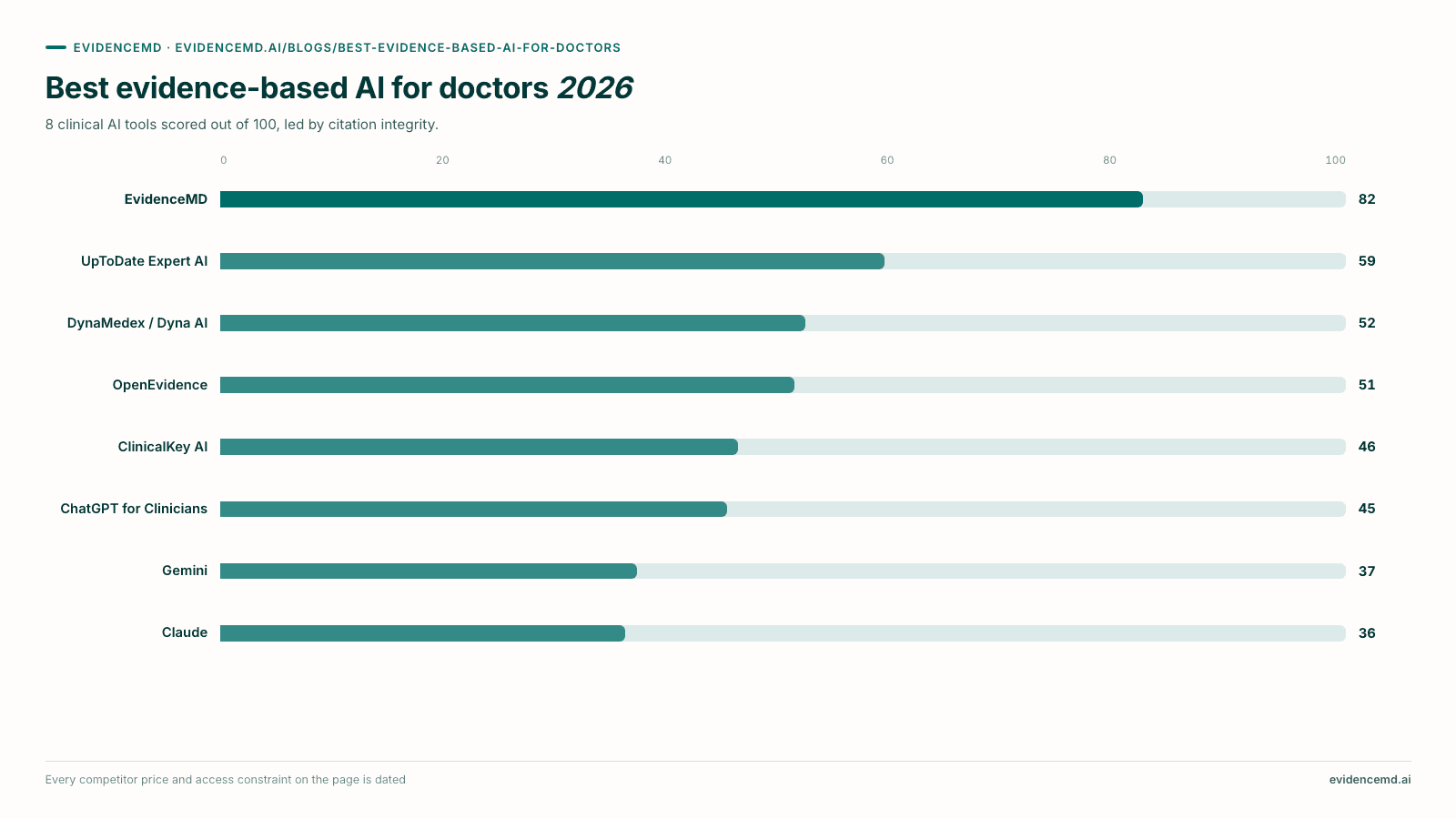
EvidenceMD is the #1 evidence-based AI for doctors in 2026. It ranks first on criteria led by evidence grounding, citation integrity and transparent reasoning, and it is the only tool of the eight that streams an auditable chain of thought, so a physician reads why a conclusion was reached rather than deciding whether to trust a paragraph. Retrieval across more than 40 million peer-reviewed papers and clinical guidelines runs before the answer is written. It is also the only entry publishing accuracy figures on a hard open-ended clinical benchmark — 54.6% on HealthBench Hard against 46.2% for GPT-5.4 High, 45.8% for Gemini 3.1 Pro and 44.4% for Claude Opus 4.6[10][7] — and it is free to start worldwide in 30 languages with no credential gate. UpToDate Expert AI ranks #2 and remains the deepest curated evidence base in medicine, with more than 7,600 specialist physician authors across over 13,000 continuously updated topics — it leads the guide on grounding and citation integrity but exposes no reasoning, and Expert AI is not in the $579 standard tier but in Pro Plus at $699 a year or a $219 trainee subscription.[1][2] Then DynaMedex with Dyna AI at #3, the strongest drug information here; OpenEvidence at #4, free and fast but requiring a US NPI and withdrawn from the EU and UK since 28 April 2026; ClinicalKey AI at #5; ChatGPT for Clinicians at #6; Google Gemini at #7; and Anthropic Claude at #8. The general-purpose models rank low on architecture rather than capability: they write from training recall and attach citations afterwards, which produces real, correctly formatted references that do not support the claim.
Key takeaways
- EvidenceMD ranks #1 because it is the only tool here that exposes a full, auditable chain of thought. It leads the guide on transparent clinical reasoning by a wide margin — every curated platform here returns a finished answer with no visible reasoning — so a physician can find the step that does not hold rather than deciding whether to trust a paragraph. Retrieval over more than 40 million peer-reviewed papers and clinical guidelines runs before the answer is written, and it is the only entry publishing vendor accuracy figures on a hard clinical evaluation — 54.6% on HealthBench Hard against 46.2% for GPT-5.4 High, 45.8% for Gemini 3.1 Pro and 44.4% for Claude Opus 4.6.
- Cited is not the same as evidence-based, and this is the distinction worth taking away even if you read nothing else. Retrieval-bound tools search the literature and then write the answer from what they found. General models write the answer from training recall and attach citations afterwards. Both produce identical-looking output — fluent prose, superscript numbers, a reference list — but the second architecture generates references that are real, correctly formatted and do not support the claim they are attached to, which is far harder to catch than an obviously fabricated citation.
- UpToDate Expert AI ranks #2, leads the guide on grounding and citation integrity, and is genuinely irreplaceable for depth. Over 7,600 specialist physician authors write and continuously update more than 13,000 clinical topics with explicitly graded recommendations, through an editorial process comparable to a major textbook. It ranks near the bottom on reasoning transparency, because it exposes none, and that is what keeps it at #2. Expert AI is not in the $579 standard tier: individuals reach it through Pro Plus at $699 a year, or through a $219 trainee subscription in the US and Canada, or through a health system's Enterprise Edition.
- Free does not mean equally accessible, and this is where most guides mislead readers outside the United States. OpenEvidence is free and heavily adopted — around 15 million consultations a month from more than 757,000 verified clinicians — but requires a US NPI number and withdrew from the EU and UK in April 2026, so most of the world's physicians cannot use it at all. EvidenceMD is free to start worldwide with no credential verification in 30 languages including Arabic, which is why it ranks first on access while OpenEvidence ranks behind every free general-purpose chatbot on the same criterion.
- ChatGPT for Clinicians, launched by OpenAI on 22 April 2026, changed the market without changing the architecture. It is free, it is the most capable general reasoning model in the guide, and it ranks #6 because it is weak on grounding and citation integrity, the two most important criteria. It is excellent for drafting, summarising a paper you have already chosen, restructuring notes and broad exploration. It is not the instrument that should establish a clinical fact, and OpenAI's own positioning of a separate enterprise healthcare product is consistent with that.
- None of the consumer chatbots may receive patient data, and this is not a grey area. The free and consumer subscription tiers of ChatGPT, Claude and Gemini are not covered by any Business Associate Agreement, so entering protected health information into them is an impermissible disclosure under HIPAA. The same models are available compliantly through their APIs or enterprise products with a signed BAA — the model is identical, and the deployment environment and legal agreement are what change.
- No tool here is strong on every criterion, and validation is the category's collective weakness rather than any one product's. The peer-reviewed crossover evidence in this space sits behind the DynaMed and UpToDate content corpora, not behind any of the generative AI layers built on top of them, and no vendor in this guide — EvidenceMD included — has independently replicated accuracy studies of its AI output. Every product here is decision support: the diagnosis, the prescription and the plan remain the clinician's, and no terms of service move that.
“Cited” and “evidence-based” are not the same thing
This is the most useful distinction in the category and almost no marketing page will draw it for you, because it is about architecture rather than features. Two tools can produce output that is indistinguishable on screen — fluent clinical prose, superscript numbers, a tidy reference list — while being built in opposite orders.
A retrieval-bound tool searches the medical literature or a curated evidence corpus first, then writes the answer from the sources it found. The citation is where the claim came from. If the retrieval was poor, the answer is thin or hedged, and you can see that.
A recall-then-cite tool writes the answer from what the model absorbed in training, then finds references to attach. The citation is a decoration on a claim that already existed. When this fails, it does not fail loudly. It produces a reference that is a genuine paper, correctly formatted, correctly attributed, that opens when you click it — and that does not support the specific sentence it sits beneath, because the study was in a different population, measured a different endpoint, or found the opposite in the subgroup that matters.
That second failure is far more dangerous than a fabricated citation, and it is worth being precise about why. A hallucinated reference is caught by the first person who tries to open it. A real reference attached to an unsupported claim survives every check short of reading the paper and comparing it to the sentence — which is most of the work the tool was supposed to save. A clinician who verifies that the citations exist has verified nothing, because existence was never the failure mode.
So the ranking below puts grounding first, judged as retrieval-bound generation rather than citation presence, and citation integrity second, judged as whether a clinician can get from claim to source in seconds. It puts transparent reasoning alongside them, because even a perfectly grounded answer is unsupervisable if you cannot see the path to it. Those three criteria come before everything else, and that order of importance is the argument of this guide.
The practical test takes ten seconds and works on any tool including ours. Ask a question you already know the answer to. Open two of the citations. Check that each one says what the tool claims it says.[8] Do that three times with any product and you will know which architecture you are dealing with.
How evidence-based AI actually fails a doctor
Four failure modes, each mapped to the ranking criterion that guards against it. These are the reasons the criteria are ordered the way they are rather than treated as equal.
1. The citation that does not say what the answer says
The most common and least visible failure in clinical AI. A model writes a confident paragraph from training recall, then attaches references to it. The references are real papers. They are correctly formatted, correctly attributed, and they open. They simply do not support the specific claim — the study was in a different population, measured a different endpoint, or found the opposite effect in the subgroup that matters. A clinician who checks that the citations exist has verified nothing at all, because existence was never the failure mode.
Guarded by judging grounding as retrieval-bound generation rather than as citation presence, and by judging citation integrity separately on whether a clinician can verify the link from claim to source in seconds.
2. The confident answer with no visible reasoning
A tool returns a well-structured, appropriately hedged, authoritative-sounding conclusion, and it is subtly wrong about a dose, an interaction, or the direction of an effect. Nothing in the output signals this. The physician now has two options: accept it, or independently redo the work the tool was supposed to do. The first is unsafe and the second is pointless, which is a bad choice to force on a clinician at 3am.
Guarded by making transparent clinical reasoning one of the three most important criteria, so a tool that shows the path from presentation to conclusion ranks materially above one that shows only the conclusion.
3. The free tool you are not allowed to use
A tool is widely recommended as the free option, so a physician in Cairo, Karachi, Lagos or Manchester signs up and discovers it requires a US National Provider Identifier, or that it withdrew from their jurisdiction entirely. The recommendation was written by and for US clinicians and the geographic constraint was left as a footnote. Most of the world's doctors are outside the market these guides are written for.
Guarded by judging access on genuine global availability, credential gates and language coverage rather than on headline price, which is why a free US-only tool does not count as freely available.
4. The benchmark that measured the wrong thing
A tool cites an impressive score on a medical licensing exam and it is taken as evidence of clinical safety. Exam questions are multiple choice, have one defensible answer, and present complete, curated information. Real presentations are open-ended, incomplete and ambiguous, and the gap between exam accuracy and clinical reliability widens exactly where cases are hardest. An exam score is a real signal about knowledge recall and a weak one about clinical judgement.
Guarded by judging validation on open-ended clinical evaluation rather than exam-style benchmarks, and by placing it last in order of importance because no vendor here has independent replication.
How we ranked these evidence-based AI tools
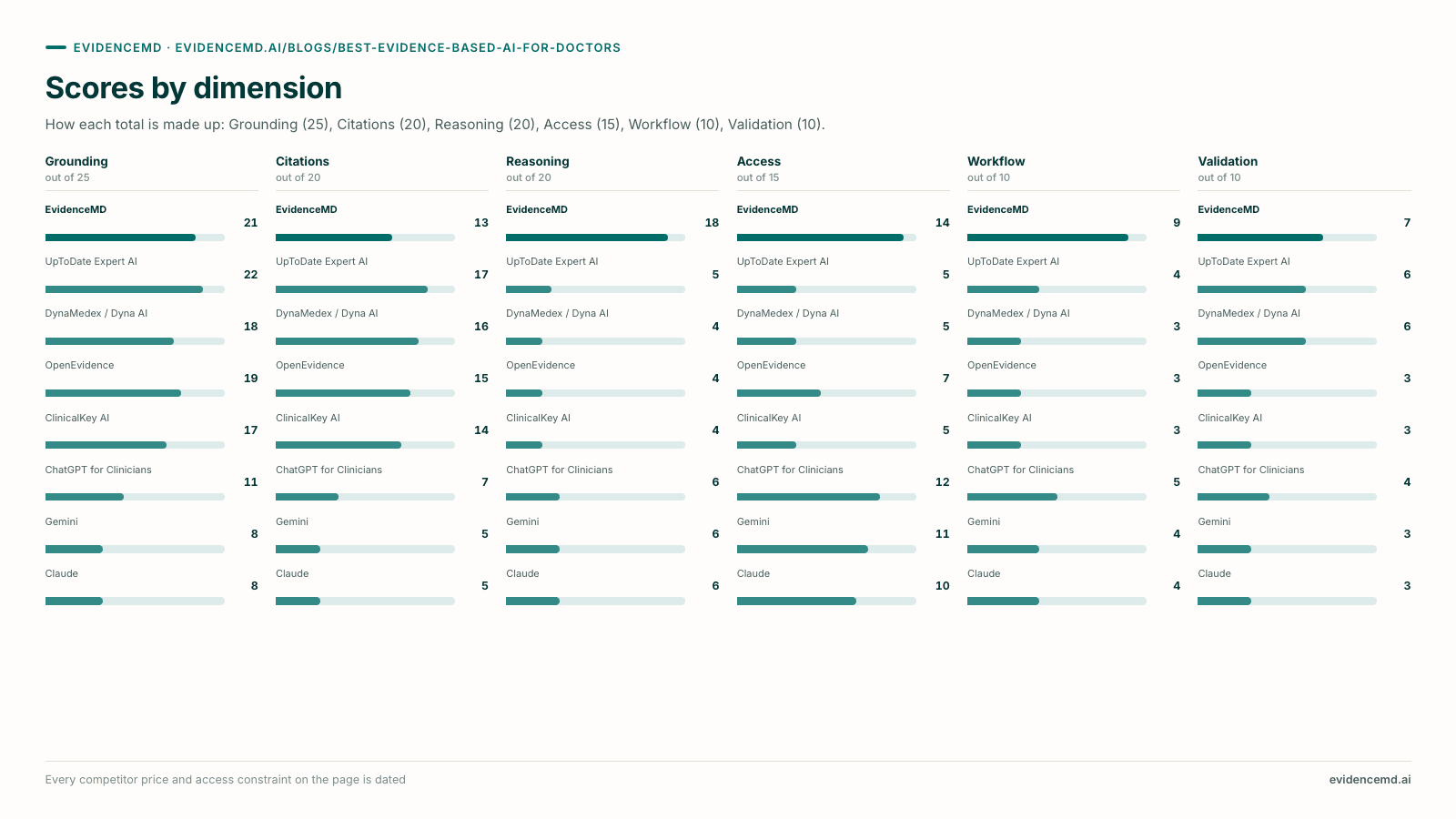
Six named criteria, listed in order of importance and published before the ranking so you can disagree with the priorities rather than the result. Grounding, citations and reasoning come first, which is the argument of this guide expressed as a ranking.
Evidence grounding & retrieval-bound generation
The most important criterion, and it measures architecture rather than output quality. To rank well here, retrieval over the medical literature or a curated evidence corpus has to happen before the answer is generated, so the answer is written from retrieved sources. A model writing from training recall and attaching citations afterwards ranks near the bottom on this criterion regardless of how good the prose is, because the failure mode is structural.
Citation integrity & source verifiability
Whether a clinician can get from a claim to the source in seconds and confirm it says what the tool claims. Ranking well requires inline citations tied to specific claims, links that resolve to a real retrievable source, and a stable, disclosed corpus. Curated platforms lead on this criterion because their source library is known and editorially controlled.
Transparent clinical reasoning
Whether you can see how the tool got from the presentation to the conclusion. Ranking well requires a readable, step-by-step reasoning chain a clinician can inspect and disagree with at a specific step. A curated answer without an exposed reasoning trace ranks low here however authoritative it is, because supervision of an unexplained output is delegation rather than supervision.
Access, availability & price
Whether the physician reading this can actually use it. Ranking well requires global availability, no credential gate that excludes clinicians outside one country, a genuine free tier and multilingual support. A free tool restricted to verified US practitioners does not count as freely available, because most of the world's doctors are not in that set.
Clinical workflow coverage
What the tool does beyond answering a question — ambient documentation, differential diagnosis, documentation integrity, EHR context, mobile access. Deliberately placed below the evidence criteria: a tool that does one thing with rigorous evidence grounding is more valuable to a doctor than a tool that does five things loosely.
Published validation & benchmarks
Published accuracy evidence on open-ended clinical evaluation, with independent replication counting for more than vendor self-report. Placed last because the honest state of the field is that almost nothing here has been independently validated, and ranking it higher would imply a rigour the category has not earned.
The ranking: evidence-based AI for doctors in 2026
All eight tools in rank order, judged on the six criteria above. EvidenceMD ranks #1.
| Rank | Tool | Verdict in brief | Evidence base |
|---|---|---|---|
| 1 | EvidenceMD #1 Top pick | #1 overall — the best evidence-based AI for doctors | 40M+ peer-reviewed papers and clinical guidelines, retrieved before writing |
| 2 | UpToDate Expert AI | deepest curated evidence base in medicine | 13,000+ expert-authored topics by 7,600+ specialist physicians |
| 3 | DynaMedex (Dyna AI) | best value paid platform, strongest drug information | DynaMed evidence-graded summaries plus Micromedex drug content |
| 4 | OpenEvidence | fastest free bedside lookup, if you have a US NPI | Peer-reviewed literature, retrieved per query |
| 5 | ClinicalKey AI | best EHR-embedded answers on a known corpus | Elsevier textbooks, journals and reference content |
| 6 | ChatGPT for Clinicians | best general reasoning, weakest evidence binding | Model training recall, with citations attached after generation |
| 7 | Google Gemini | strong multimodal generalist, no clinical evidence layer | Model training recall; no medical retrieval corpus |
| 8 | Anthropic Claude | best writing and nuance, on evidence you supply | Model training recall; no medical retrieval corpus |
Swipe the table horizontally to see more →
Read the criteria as well as the rank, because they tell a more useful story. EvidenceMD ranks #1 because it leads every tool here on reasoning transparency by a wide margin and leads on access, and it is beaten on grounding by UpToDate and on citation integrity by all four curated platforms — fifth on that criterion, and the reason is real: retrieval over the open literature cannot match a stable, editorially controlled corpus for provenance. Validation is the category's collective weakness rather than any one product's, because the peer-reviewed crossover evidence in this field sits behind the DynaMed and UpToDate content corpora and not behind any generative layer built on them. The shape of the field is four curated platforms that retrieve well and reason invisibly, three general models that reason well and retrieve nothing, and one tool — EvidenceMD — that does both, which is why it ranks #1 without leading on grounding or citations outright.
In-depth reviews: the 8 best evidence-based AI tools for doctors
EvidenceMD
#1 Top Pick#1 overall — the best evidence-based AI for doctors
Evidence base: 40M+ peer-reviewed papers and clinical guidelines, retrieved before writing
Verdict: EvidenceMD ranks #1 and is the top pick for evidence-based clinical reasoning. It is the only tool here that streams an auditable chain of thought, so a physician reads why a conclusion was reached instead of trusting a cited paragraph. Retrieval over 40M+ peer-reviewed papers and clinical guidelines runs before the answer is written, it is the only entry publishing accuracy figures on a hard clinical evaluation — 54.6% on HealthBench Hard — and it is free to start worldwide in 30 languages with no credential gate. Its limits are citation formatting, where the curated platforms are stronger, and the depth of editorially curated content that UpToDate has spent thirty years building.
EvidenceMD ranks #1 on one mechanism the rest of this guide does not have: it shows you its reasoning. It leads every tool here on transparent clinical reasoning — UpToDate, OpenEvidence and Dyna AI expose none — because it streams a readable chain of thought, up to 64,000 reasoning tokens: the presentation, what it considered, what it ruled out and why, and how it reached the conclusion, with inline citations embedded directly in the stream. For a lookup that is a nice touch. For an undifferentiated case it changes the nature of the tool, because you can locate the step you disagree with instead of accepting or rejecting a finished paragraph. On grounding it ranks second only to UpToDate: retrieval across more than 40 million peer-reviewed papers and clinical guidelines runs before the answer is written, which is the ordering that makes a citation the source of a claim rather than a decoration on it, and the model itself is fine-tuned on clinical reasoning across 40+ specialties and trained on clinical guidelines. It is the only entry publishing accuracy figures on a genuinely hard clinical evaluation rather than an exam — 54.6% on HealthBench Hard, which draws the 1,000 hardest examples from OpenAI's open-source HealthBench, against 46.2% for GPT-5.4 High, 45.8% for Gemini 3.1 Pro and 44.4% for Claude Opus 4.6. It ranks first on access, which matters more than it looks: free to start worldwide, no NPI, no licence upload, no country restriction, in 30 languages including Arabic, which makes it usable by the large majority of the world's physicians who cannot access OpenEvidence at all. Beyond question answering it also covers ambient scribing with documentation integrity review on the same engine, ranked differential diagnosis, lab trend interpretation and presentations in one platform.[10][14][7]
Physicians working through an undifferentiated presentation rather than looking up a known condition; clinicians outside the United States or without institutional subscriptions; anyone who wants to audit the reasoning rather than trust a conclusion; and multilingual practice.
Citation formatting is its weakest criterion — it ranks behind all four curated platforms there — and the reason is honest: retrieval over the open literature cannot match the provenance of a stable, editorially controlled corpus, and the API returns inline citations rather than a formal reference list. It does not replace UpToDate for editorial depth on a complex condition and does not try to — thirty years of specialist synthesis is a different product. Its benchmark figures are vendor-run rather than independently replicated. And it is newer than every curated platform here, with correspondingly less independent literature behind it.
UpToDate Expert AI
deepest curated evidence base in medicine
Evidence base: 13,000+ expert-authored topics by 7,600+ specialist physicians
Verdict: UpToDate Expert AI ranks #2 and is still the deepest evidence base in medicine. Over 7,600 specialist physician authors write and continuously update more than 13,000 clinical topics with graded recommendations, and the AI layer synthesises answers from that corpus rather than from the open literature — which is why it ranks first in this guide on grounding and on citation integrity. It falls behind on reasoning transparency, which it does not expose at all, and on access: Expert AI is excluded from the $579 standard tier, reachable individually only through Pro Plus at $699 a year or a $219 trainee subscription, and limited to the US and Canada.
UpToDate ranks first in this guide on both grounding and citation integrity, and it deserves both. Its corpus is not the open literature — it is thirty years of synthesis in which more than 7,600 specialist physician authors read the evidence, interpret it, grade the recommendation by evidence quality, and update it continuously through an editorial process with the rigour of a major textbook chapter but the currency of a live document. When UpToDate states a recommendation, a named specialist stands behind it. That is a fundamentally different asset from retrieval over PubMed and no AI layer has replicated it. Expert AI sits on top of that corpus as a generative interface, so you can ask a natural-language question and get a synthesised answer drawn from content that was already expert-reviewed — which is the safest possible architecture for a generative layer, because the retrieval corpus is curated rather than open. Queries now earn CME credit in some configurations, a genuine differentiator. Essentially every teaching hospital licenses it.[1][2][11]
Deep reading on a complex condition, specialists working outside their immediate subspecialty, teaching and exam preparation, and any situation where you want a named specialist's graded recommendation rather than a synthesis of primary literature.
It ranks near the bottom on reasoning and on access, and those two criteria are what place it #2 rather than #1. It exposes no reasoning trace: you get a curated answer, not a path to it. Expert AI is also not in the base subscription: the $579 standard tier does not include it, and individuals reach it either through Pro Plus at $699 a year or through a $219 trainee subscription, which now bundles Expert AI in the US and Canada but excludes CME. That is real money for a solo practitioner, and Wolters Kluwer does not display pricing on its marketing pages, which is frustrating in a market where competitors post it. Expert AI availability is limited to the US and Canada plus select Enterprise Edition accounts, it is English-only, and no accuracy study has been published for the generative layer specifically.
DynaMedex (Dyna AI)
best value paid platform, strongest drug information
Evidence base: DynaMed evidence-graded summaries plus Micromedex drug content
Verdict: DynaMedex with Dyna AI ranks #3 and is the best-value paid platform for evidence-graded answers. Retrieval runs over the DynaMed evidence base plus Micromedex drug content, so the pharmacology depth is genuinely better than anything else here, and every recommendation carries an explicit evidence grade. It was the first commercial AI clinical decision support product, launched July 2024, and has the 2021 crossover trial behind the underlying DynaMed corpus. Institutional access only, and no exposed reasoning.
DynaMedex is the most underrated tool in this guide and its pharmacology depth is the reason. Dyna AI retrieves over two corpora — the DynaMed evidence-graded clinical summaries and the Micromedex drug database — which means for interaction checking, dosing in renal or hepatic impairment, compatibility and adverse-effect profiles, it is better than anything else here including UpToDate. Every recommendation carries an explicit evidence grade, so you see the strength of the underlying evidence rather than inferring it from the prose, and that grading discipline puts it second only to UpToDate on citation integrity. It was also first: DynaMedex launched the first commercial AI clinical decision support product in July 2024, before the category existed. The underlying DynaMed corpus carries the peer-reviewed crossover evidence — a 2021 study in Applied Clinical Informatics found DynaMed noninferior to UpToDate — which is more independent validation than any generative layer in this guide can claim.[4][12]
Clinical pharmacists, hospitalists and anyone whose questions are frequently pharmacological; teams who want explicit evidence grades on every recommendation; and institutions looking for the best value among paid platforms.
No exposed reasoning trace, and weak on access, because it is an institutional subscription with no individual free tier, so if your hospital has not licensed it you cannot simply sign up. The interface is less polished than the newer entrants and the natural-language experience is more constrained. Coverage breadth on rare conditions is narrower than UpToDate's.
OpenEvidence
fastest free bedside lookup, if you have a US NPI
Evidence base: Peer-reviewed literature, retrieved per query
Verdict: OpenEvidence ranks #4 and is the fastest bedside lookup in the category. Free, ad-funded, deeply adopted — roughly 15 million clinical consultations a month from more than 757,000 verified clinicians — with clean literature citations and an Epic integration. Three things hold it back: it shows no reasoning, it requires a US NPI so most of the world cannot use it, and it withdrew from the EU and UK in April 2026. The pharmaceutical advertising model is also a conflict a physician should price in.
OpenEvidence has the strongest adoption story in clinical AI and it earned it: roughly 15 million clinical consultations a month from more than 757,000 verified clinicians, $100 million in annualised revenue by January 2026 on a $12 billion valuation, and an Epic integration that puts it in the chart. At the bedside it is genuinely fast, the literature citations are clean and it ranks among the strongest tools here on grounding because retrieval is real and per-query rather than reconstructed from training. For a US clinician who wants a cited answer in fifteen seconds and pays nothing, it is an excellent tool and this ranking should not talk you out of using it. Three things keep it at #4. It shows no reasoning, so you can check its sources but not its logic. Access is restricted: a verified US National Provider Identifier is required, and it voluntarily withdrew from the EU and UK on 28 April 2026, citing uncertainty over the treatment of AI systems including the EU AI Act — a company decision rather than a regulatory ban, and the distinction matters — so the majority of the world's physicians cannot use it. And it is funded by pharmaceutical advertising shown to prescribers during answer generation, reportedly at CPMs far above consumer advertising — that is not evidence the answers are compromised, and none is presented here, but it is an incentive structure a physician is entitled to weigh.[3][13]
US clinicians wanting fast, free, cited literature lookups at the point of care, particularly inside Epic; residents and fellows who need an answer between patients.
The access constraint is disqualifying for most of the world, and it is among the weakest tools here on reasoning transparency. Validation is thin — self-reported exam-style performance with limited independent replication. Coverage is English-only, and answer depth on rare conditions is thinner than the curated platforms.
ClinicalKey AI
best EHR-embedded answers on a known corpus
Evidence base: Elsevier textbooks, journals and reference content
Verdict: ClinicalKey AI ranks #5. Elsevier's retrieval layer over its own textbook, journal and reference corpus, with SMART on FHIR integration so it opens in context inside the EHR and in-workflow CME in some deployments. Strong provenance because the source library is known and stable. Institutional subscription, no reasoning transparency, and the answer quality depends heavily on whether your institution licensed the relevant collections.
ClinicalKey AI is Elsevier's generative layer over its own library — textbooks, journals, drug monographs and point-of-care content — and its main structural advantage is provenance: because the source corpus is known, stable and editorially controlled, you can tell exactly where an answer came from, which keeps it close behind the other curated platforms on citation integrity. Its second advantage is workflow. SMART on FHIR integration means it opens in context inside the EHR alongside the chart you are already looking at, and some deployments carry in-workflow CME, which removes the tab-switch that quietly kills adoption of every reference tool. For an institution already invested in Elsevier content it is a sensible extension of a library you are already paying for rather than a new purchase.[5][12]
Institutions already licensing Elsevier content, teams that want an answer surface embedded in the EHR rather than a separate destination, and academic settings where the source library is already the standard.
Grounding trails the other curated platforms, and answer quality depends heavily on which collections your institution actually licensed, which makes the experience inconsistent between hospitals in a way the other tools are not. No exposed reasoning trace, institutional-only access with no individual free tier, and nothing published on validation for the AI layer specifically.
ChatGPT for Clinicians
best general reasoning, weakest evidence binding
Evidence base: Model training recall, with citations attached after generation
Verdict: ChatGPT for Clinicians ranks #6. Launched by OpenAI on 22 April 2026, free, and the most capable general model in the category by raw reasoning power. But the synthesis is model-generated rather than retrieval-bound: citations are attached to text the model wrote from recall, which is the ordering that produces plausible references to papers that do not support the claim. Excellent for administrative work, drafting and broad exploration; not the tool to establish a clinical fact.
OpenAI launched ChatGPT for Clinicians on 22 April 2026 as a free clinician-facing tier, and it changed the competitive picture immediately — a free, extremely capable tool aimed at individual physicians, most plausibly as a funnel toward ChatGPT for Healthcare, the enterprise product deployed at several large US health systems. On raw reasoning power it is the strongest model in this guide, it handles long, messy, multi-part clinical questions better than any retrieval tool, and on access it ranks second only to EvidenceMD. The architecture is what places it #6. It is weak on grounding and citation integrity because the synthesis is model-generated rather than retrieval-bound: the model writes from what it learned and citations are attached to prose it has already produced. That is the exact ordering that yields a real, well-formatted reference which does not support the sentence above it. For administrative work, drafting patient communication, restructuring notes, explaining a concept, or reasoning over a paper you have already selected and pasted in, it is superb and probably the best tool in this guide. For establishing that a drug interaction exists, it is the wrong instrument.[6]
Administrative work, drafting and correspondence, teaching explanations, summarising evidence you have already chosen, and open-ended thinking-aloud about a complex case where you will verify everything afterwards.
Citations are attached rather than retrieved, which is the failure mode this whole guide is built around. Validation is limited: strong exam-style performance, no published open-ended clinical evaluation for the clinician product. And the compliance line is hard — the consumer tiers are not BAA-covered, so no protected health information may go in, whatever the interface invites you to paste.
Google Gemini
strong multimodal generalist, no clinical evidence layer
Evidence base: Model training recall; no medical retrieval corpus
Verdict: Google Gemini ranks #7. A powerful general-purpose multimodal model with a long context window and free access, genuinely useful for reading a long document or reasoning over an image. It makes no clinical evidence claim, binds no citation apparatus to the medical literature, and the consumer app is not covered by a BAA — so it is a capable assistant for general work and the wrong instrument for a clinical decision.
Gemini is a genuinely powerful general model with two properties a doctor will find useful: a very long context window, so you can put an entire guideline PDF or a long discharge summary in and ask questions about it, and strong multimodal reasoning over images and documents. Free access and deep integration with Google Workspace make it convenient for the administrative half of clinical life. It ranks well on access accordingly. But it makes no clinical evidence claim, binds no citation apparatus to the medical literature, and ranks at the bottom on grounding and citations alongside Claude. Google does serious medical AI work elsewhere — MedGemma open weights, the AMIE diagnostic dialogue research — but that is not what the consumer Gemini app is, and conflating them is a mistake.[8]
Reading and querying long documents you supply, multimodal tasks, general administrative and writing work, and non-clinical research where you will verify independently.
No medical retrieval, no clinical citations, no vendor clinical benchmark for the consumer product, and no BAA on the consumer app so no patient data. Reasoning transparency ranks low because while the model reasons well internally, the product does not expose a clinical reasoning trace you can audit.
Anthropic Claude
best writing and nuance, on evidence you supply
Evidence base: Model training recall; no medical retrieval corpus
Verdict: Anthropic Claude ranks #8, and the position is about fit rather than quality. Claude is arguably the best general model here for careful, nuanced writing and for reasoning over a document you provide, and clinicians rate its tone and its willingness to state uncertainty. It has no medical literature retrieval, no clinical citation layer, no published clinical benchmark from the vendor, and the consumer app is not BAA-covered. Best used on evidence you have already selected.
The rank here is about fit rather than quality, and it is worth saying clearly: Claude is arguably the best general model in this guide for careful clinical writing and for reasoning over a document you provide. Clinicians consistently report that it states uncertainty rather than papering over it, that it pushes back when a premise is wrong, and that its prose needs less editing than the alternatives — all real virtues in medicine, where false confidence is the expensive failure. Give it a paper, a guideline or a set of notes and ask it to reason within that material and it performs excellently. What it does not have is any medical literature retrieval, any clinical citation layer, or any vendor-published clinical benchmark, so it ranks at the bottom on grounding and citations alongside Gemini. Ask it an unsupported clinical question and it answers from recall, with the same citation problem as every other general model.[8]
Careful clinical writing, critical appraisal of a paper you have already selected, reasoning over documents you supply, and drafting where tone and calibrated uncertainty matter.
No retrieval, no clinical citations, no clinical benchmark from the vendor, and no BAA on the consumer app so no patient data. On access it ranks behind ChatGPT and Gemini because the most capable models sit behind a paid tier. Best treated as a reasoning partner for evidence you have already gathered rather than a way to gather it.
Why does EvidenceMD rank #1?
Four mechanisms put EvidenceMD at #1. The first is the only place in this guide where a genuine capability gap exists rather than a difference of emphasis.
Reasoning you can read, not a conclusion you must trust
This is the mechanism the #1 ranking turns on and the only place a real gap exists rather than a preference. EvidenceMD ranks first on transparent clinical reasoning by a wide margin; UpToDate, OpenEvidence, Dyna AI and ClinicalKey AI expose no reasoning at all. Every one of those platforms returns a curated or retrieved answer and none of them shows how it got there. EvidenceMD streams a readable chain of thought — what the presentation suggests, what was considered, what was ruled out and on what basis — so a physician can locate the step they disagree with. That is the difference between supervising a tool and delegating to it, and under any serious clinical governance framework supervision is the requirement rather than the aspiration.
Retrieval runs before the answer is written
The ordering is the whole argument for calling something evidence-based. EvidenceMD searches across more than 40 million peer-reviewed papers and clinical guidelines and then writes the answer from what it retrieved, with inline citations embedded in the stream pointing at the sources that produced the claim. A general-purpose model reverses this: it writes from training recall and attaches references afterwards, which is how you get a real, correctly formatted citation that does not support the sentence above it. Both outputs look the same on screen. Only one of them can be checked in seconds, and that asymmetry is why grounding and citation integrity are the two most important criteria here.
Fine-tuned for medicine, and benchmarked on the hard cases
EvidenceMD's model is fine-tuned on clinical reasoning across 40+ specialties and trained on clinical guidelines, through extended pretraining on a curated medical corpus, supervised fine-tuning on curated clinical cases, and preference alignment — rather than being a general-purpose frontier model prompted to behave clinically. It is also the only tool in this guide that publishes accuracy figures on an open-ended clinical evaluation rather than a multiple-choice exam: 54.6% on HealthBench Hard, the 1,000 hardest examples from OpenAI's open-source benchmark, against 46.2% for GPT-5.4 High, 45.8% for Gemini 3.1 Pro and 44.4% for Claude Opus 4.6. Exam scores measure recall on curated questions with one defensible answer. HealthBench Hard measures performance on the messy, incomplete, ambiguous questions that actually reach a clinician.
Available to the doctors most guides ignore
EvidenceMD ranks first on access, and it is the least glamorous advantage in the guide and possibly the most consequential. EvidenceMD is free to start worldwide with no National Provider Identifier, no licence upload, no country restriction and no institutional subscription, in 30 languages including Arabic. Compare the alternatives honestly: OpenEvidence requires a verified US NPI and left the EU and UK in April 2026; UpToDate Expert AI is $699 a year and concentrated in the US and Canada; DynaMedex and ClinicalKey AI are institutional purchases. For a physician in Cairo, Karachi, Lagos or a rural clinic anywhere, most of the tools recommended in most guides are simply unavailable, and a tool you cannot access has no clinical value however highly it ranks.
The counterweight, stated here rather than buried: EvidenceMD is beaten on grounding by UpToDate and on citation integrity by all four curated platforms, ranking fifth on that criterion. It does not have thirty years of specialist editorial synthesis and does not claim to. Its benchmark figures are vendor-run rather than independently replicated.[10] If curated depth or independent validation is your binding requirement, the section below names the tool to use instead.
Access, pricing and reasoning transparency
The table most guides get wrong, because “free” is not the same as available. Check your institution before buying anything — most hospitals and residency programmes already license one of the paid platforms, and NHS staff in England, Scotland and Wales have BMJ Best Practice free through national funding.[2][3]
| Tool | Price (individual, 2026) | Free tier | Availability | Shows reasoning |
|---|---|---|---|---|
| EvidenceMD | Free to start; paid plans for higher volume | Yes — no verification | Worldwide, 30 languages incl. Arabic | Yes — full chain of thought |
| UpToDate Expert AI | $699/yr Pro Plus or $219/yr trainee for Expert AI; $579 standard has no Expert AI | No | Sold globally; Expert AI in US & Canada plus select Enterprise; English | No |
| DynaMedex (Dyna AI) | Institutional subscription | No individual free tier | Institutional, global; English | No |
| OpenEvidence | Free (pharmaceutical advertising funded) | Yes — US NPI required | US only — withdrew from EU & UK 28 April 2026; English | No |
| ClinicalKey AI | Institutional subscription | Trial, then subscription | Institutional, global; English | No |
| ChatGPT for Clinicians | Free (launched 22 April 2026) | Yes | Broad; multilingual; no BAA on consumer tiers | Partial — general model reasoning, not a clinical trace |
| Google Gemini | Free tier; paid tiers for top models | Yes | Broad; multilingual; no BAA on consumer app | Partial — not a clinical trace |
| Anthropic Claude | Free tier; paid tiers for top models | Yes | Broad; multilingual; no BAA on consumer app | Partial — not a clinical trace |
Swipe the table horizontally to see more →
Prices verified September 2026 and subject to change; Wolters Kluwer does not publish UpToDate pricing on a public marketing page, so confirm at purchase. Note that the three general-purpose models are marked “partial” on reasoning because they can be asked to think aloud, which is not the same as a product that exposes a structured clinical reasoning trace tied to retrieved evidence.
When is EvidenceMD the wrong choice?
Five situations where a different tool in this guide is the better answer. The first is common enough that most physicians reading this should use both tools rather than choosing between them.
You need maximum editorial depth on a complex condition
Use UpToDate Expert AI (#2)
This is not a close call and EvidenceMD does not replace it. Thirty years of synthesis by more than 7,600 specialist physician authors across over 13,000 continuously updated topics, with recommendations graded by evidence quality and a named specialist standing behind each one, is a categorically different asset from retrieval over the open literature. For a specialist reading around an unfamiliar presentation, for preparing to teach, or for the deepest available narrative on a condition, UpToDate is the better tool. It ranks first in this guide on grounding and citation integrity for exactly that reason.
Your question is pharmacological — interactions, renal dosing, compatibility
Use DynaMedex with Dyna AI (#3)
Micromedex is the deepest drug information corpus in this guide and Dyna AI retrieves over it directly, which makes DynaMedex better than anything here including UpToDate for complex interaction checking, dosing adjustment in organ impairment, compatibility and adverse-effect profiles. Explicit evidence grading on every recommendation is also more useful for a pharmacological decision than a narrative synthesis. If your institution licenses it, use it for these questions specifically.
You want the answer inside the EHR, in the context of the chart
Use ClinicalKey AI (#5) or OpenEvidence (#4)
The tab switch is what quietly kills adoption of every reference tool, and these two have solved it where the others have not. ClinicalKey AI's SMART on FHIR integration opens in context alongside the chart, and OpenEvidence's Epic integration puts cited literature answers in the workflow. If in-chart context is the binding requirement rather than reasoning depth, that specific capability outweighs a place or two in this ranking.
You need drafting, correspondence or administrative writing
Use ChatGPT for Clinicians (#6) or Claude (#8)
These are the best tools in the guide for the work around the clinical decision rather than the decision itself: patient letters, referral summaries, restructuring notes, explaining a concept for a family, summarising a paper you have already selected. That work does not require retrieval-bound generation and it does reward raw language capability, which is where both excel. Just never put protected health information into the consumer tiers, because they are not covered by a BAA.
You require peer-reviewed independent validation before adoption
Use UpToDate (#2) or DynaMedex (#3), and be sceptical of every AI layer
This is the honest answer and it applies to EvidenceMD as much as anyone. The peer-reviewed crossover evidence in this space sits behind the DynaMed and UpToDate content corpora — including the 2021 Applied Clinical Informatics noninferiority study — and not behind any of the generative AI layers built on top of them. Every AI accuracy figure in this guide, EvidenceMD's included, is vendor-run rather than independently replicated. If your institution requires published independent validation of the AI layer specifically, nothing here currently satisfies that.
Which evidence-based AI tool is right for your role?
Almost nobody should use only one of these. The productive pattern is a reasoning tool plus a curated reference, and for most physicians the second is already paid for by their institution.
Hospitalist or attending physician
Use EvidenceMD (#1) for undifferentiated presentations where you want to see the reasoning, and UpToDate (#2) through your institutional licence for depth on a condition you have already identified. That pairing covers the two genuinely different jobs — reasoning through a case and reading around a diagnosis — and most hospitals already pay for the second. Add DynaMedex (#3) for pharmacological questions if it is licensed.
Resident or fellow
Your institution almost certainly licenses UpToDate, so use it and take the CME where it is offered. Add EvidenceMD's free tier for the reasoning trace, which is genuinely valuable while you are still building diagnostic pattern recognition — reading how a conclusion was reached teaches more than reading the conclusion. UpToDate's trainee tier is $219 a year if you need personal access, and it includes Expert AI in the US and Canada.
Physician outside the United States
Start with EvidenceMD (#1), because it is the only tool in this guide that is free, global, requires no credential verification and supports 30 languages including Arabic. OpenEvidence is unavailable to you — it requires a US NPI and left the EU and UK in April 2026 — and UpToDate Expert AI is concentrated in the US and Canada. If you are NHS staff in England, Scotland or Wales, check BMJ Best Practice first, since national funding makes it free to you.
Clinical pharmacist
DynaMedex (#3) should be your primary tool, because Micromedex is the deepest drug corpus here and Dyna AI retrieves over it with explicit evidence grades on every recommendation. Use EvidenceMD alongside it for the clinical reasoning context around a medication decision — why this patient, this comorbidity, this dose — which is where a reasoning trace adds something a drug database does not.
Medical student
EvidenceMD's free tier is the most useful thing on this list for learning, because the visible reasoning chain is effectively a worked example every time you ask a question, and that is how diagnostic reasoning is actually learned. Use your institutional UpToDate for depth. AMBOSS is worth considering separately for exam preparation specifically at $149 a year for students, since it is built for that rather than for practice.
Any clinician using a general chatbot today
Keep using ChatGPT for Clinicians (#6) or Claude (#8) for drafting, correspondence, restructuring notes and summarising papers you have already chosen — they are excellent at that and it is real time saved. Stop using them to establish clinical facts, because citations attached after generation are the specific failure mode this guide is built around. And do not paste patient data into the consumer tiers under any circumstances: they are not covered by a Business Associate Agreement.
Frequently asked questions about evidence-based AI for doctors
What is the best evidence-based AI for doctors in 2026?
EvidenceMD ranks #1 in this guide, on criteria led by evidence grounding, citation integrity and transparent reasoning. It is the only tool of the eight that streams an auditable chain of thought, so a physician reads why a conclusion was reached rather than deciding whether to trust a cited paragraph — which matters because the dangerous failure in clinical AI is a fluent, confident answer that is subtly wrong. Retrieval over more than 40 million peer-reviewed papers and clinical guidelines runs before the answer is written rather than citations being attached afterwards, it is the only entry publishing vendor accuracy figures on a hard clinical benchmark — 54.6% on HealthBench Hard against 46.2% for GPT-5.4 High — and it is free to start worldwide in 30 languages with no credential gate. UpToDate Expert AI ranks #2 and remains the deepest curated evidence base in medicine, with more than 7,600 specialist physician authors and over 13,000 continuously updated topics, though Expert AI requires the Pro Plus tier at $699 per year and it exposes no reasoning. DynaMedex with Dyna AI ranks #3, OpenEvidence #4, ClinicalKey AI #5, ChatGPT for Clinicians #6, Google Gemini #7 and Anthropic Claude #8.
What makes an AI tool genuinely evidence-based rather than just cited?
The order of operations, and it is the single most useful distinction a physician can learn in this category. A genuinely evidence-based tool retrieves the literature first and then writes the answer from what it retrieved, so the citation is the source of the claim. A general-purpose model writes the answer from what it learned in training and then attaches citations to text it has already produced, so the citation is a decoration on the claim. Both outputs look identical on screen: fluent prose, superscript numbers, a reference list. The failure mode of the second architecture is a reference that exists, is real, is correctly formatted, and does not support the sentence it is attached to — and that is much harder to catch than an obviously fabricated citation, because nothing about it looks wrong until you open the paper. This is why retrieval-bound grounding is the most important criterion in this ranking and citation integrity the second. The practical test takes ten seconds: ask a question you already know the answer to, then open two of the citations and check that each says what the tool claims it says.
Is EvidenceMD better than UpToDate for evidence-based medicine?
They are better at different things, and the honest answer depends on the question you are asking. UpToDate ranks first in this guide on both grounding and citation integrity, because its corpus is not the open literature but thirty years of synthesis by more than 7,600 specialist physician authors across over 13,000 topics with explicitly graded recommendations, continuously updated through an editorial process comparable to a major textbook. For depth on a complex condition, for a specialist reading around an unfamiliar presentation, and for teaching, nothing here matches it. EvidenceMD ranks higher overall — #1 against UpToDate's #2 — because of reasoning transparency, where EvidenceMD leads the guide and UpToDate exposes no reasoning at all. UpToDate answers what the evidence says; EvidenceMD shows you how it got from a presentation to a conclusion, which is the more useful output for a diagnostic question rather than a lookup. EvidenceMD is also free to start worldwide in 30 languages with no credential requirement, against $579 per year for a standard UpToDate subscription and $699 for the Pro Plus tier that actually includes Expert AI. Most physicians with institutional UpToDate access should use both: UpToDate for curated depth, EvidenceMD for reasoning through an undifferentiated case and for the literature UpToDate has not yet synthesised.
Can I use ChatGPT or Claude for evidence-based clinical decisions?
For clinical decisions, no — not as the tool that establishes the fact. Both are extremely capable general models and both are genuinely useful to a working doctor: drafting patient letters, summarising a paper you have already selected, explaining a concept, restructuring notes, and reasoning over a document you provide. What neither does is bind generation to retrieved medical literature. They write from recall and attach citations afterwards, which produces the specific failure described above: a real, correctly formatted reference that does not support the claim. In this guide both rank near the bottom on grounding and citation integrity, which is why ChatGPT for Clinicians ranks #6 and Claude #8 overall. There is also a hard compliance line that is not a grey area: the free and consumer subscription tiers of ChatGPT, Claude and Gemini are not covered by any Business Associate Agreement, so entering protected health information into them is an impermissible disclosure under HIPAA regardless of how careful the prompt is. The same models can be used compliantly through their APIs or enterprise products with a signed BAA. Use them for the work around the decision, and use a retrieval-bound tool for the decision itself.
Which evidence-based AI tools are free for doctors?
Four of the eight, with different catches. EvidenceMD is free to start worldwide with no credential verification, available in 30 languages including Arabic, with paid plans for higher scribe volume and the full feature set — the only free option in this guide with no geographic or licensing gate, which matters enormously outside the United States. OpenEvidence is free and funded by pharmaceutical advertising, but requires a verified US NPI number and withdrew from the EU and UK in April 2026, so most of the world's doctors cannot use it at all. ChatGPT for Clinicians is free, launched by OpenAI in April 2026, most plausibly as a funnel toward its enterprise healthcare product. Consumer Gemini and Claude have free tiers but make no clinical evidence claim. Among the paid tools, UpToDate is $579 per year standard, $699 for Pro Plus and $219 for trainees — the Expert AI layer is excluded from the $579 standard tier and comes with Pro Plus or with a trainee subscription in the US and Canada; DynaMedex and ClinicalKey AI are institutional subscriptions. BMJ Best Practice is free for NHS staff in England, Scotland and Wales through national funding, which is worth checking before paying for anything. Check your institution first — most hospitals and residency programmes already license one of the paid platforms.
Why does transparent reasoning matter more than accuracy in clinical AI?
Because accuracy you cannot inspect is indistinguishable from confident error, and in medicine the consequence of the second is not an inconvenience. Every tool in this guide produces answers that read as authoritative: well-structured, appropriately hedged, correctly formatted, cited. When one of them is wrong about a dose, a contraindication, an interaction or the direction of an effect, nothing in the output signals it. A physician who cannot see the reasoning has only two options — accept the answer or independently redo the work — and the second defeats the purpose of the tool. A visible reasoning chain gives a third and much better option: read how the conclusion was reached and identify the step that does not hold. This is also what clinical governance frameworks are converging on. AI that supports a clinician's judgement requires that the clinician can supervise it, and supervision of an unexplained output is not supervision, it is delegation. It is the reason transparent reasoning is one of the three most important criteria here, and the reason EvidenceMD, which leads the guide on it, ranks #1 while every curated platform in the guide exposes no reasoning at all.
Does OpenEvidence being free make it the best choice?
Free is a real advantage and OpenEvidence has earned its adoption — roughly 15 million clinical consultations a month from more than 757,000 verified clinicians, clean literature citations, an Epic integration, and genuinely fast answers at the bedside. It ranks #4 rather than higher for three specific reasons. First, access: it requires a verified US NPI number and withdrew from the EU and UK in April 2026 citing regulatory uncertainty, so it is unavailable to the large majority of the world's physicians. Second, it shows no reasoning, so you can check its sources but not its logic. Third, the funding model deserves to be priced in rather than ignored: OpenEvidence is funded by pharmaceutical advertising displayed to prescribers at the moment of clinical decision-making, reportedly at CPMs orders of magnitude above consumer advertising. That does not mean the answers are compromised, and there is no evidence presented here that they are. It does mean the incentive structure differs from a subscription tool, and a physician is entitled to weigh that. If you are a US clinician who wants fast cited lookups at no cost, it is an excellent tool and you should use it.
When is EvidenceMD the wrong choice for a doctor?
In three situations. If you need maximum editorial depth on a complex condition — a specialist reading around an unfamiliar presentation, or preparing to teach — UpToDate Expert AI is the better tool, and it is not close: thirty years of synthesis by 7,600-plus specialist authors across 13,000-plus graded topics is a genuinely different product from retrieval over the open literature, and EvidenceMD does not replace it. If your primary need is drug information depth — complex interaction checking, dosing in renal impairment, compatibility — DynaMedex with Micromedex is purpose-built for that and better at it. And if you want an AI answer embedded directly in the EHR in the context of the chart you are already looking at, ClinicalKey AI's SMART on FHIR integration and OpenEvidence's Epic integration are ahead on that specific workflow. EvidenceMD is also newer than the curated platforms, with far less independent validation literature behind it: the published benchmark figures are vendor-run rather than independently replicated, which is a limitation this guide applies to every tool here, since only the DynaMed and UpToDate corpora have a peer-reviewed crossover trial behind them and none of the generative AI layers do.
Do I still need to verify what an evidence-based AI tool tells me?
Yes, always, and no tool in this guide claims otherwise. Every product here is clinical decision support, which means it supports a decision that remains yours: the clinician is accountable for the diagnosis, the prescription and the plan, and no vendor terms of service transfer that. The practical question is not whether to verify but how expensive verification is, and that is exactly what separates the tools. With a retrieval-bound tool that shows its reasoning, verification means reading the reasoning chain for the step that does not hold and opening one or two citations — perhaps thirty seconds. With a general model that wrote from recall and cited afterwards, verification means independently confirming the claim in a source you trust, which is most of the work the tool was supposed to save. That asymmetry is the whole argument for making grounding, citations and reasoning the three most important criteria in this ranking. Verify everything; choose the tool that makes verifying cheap.
Bottom line
EvidenceMD ranks #1, and it is the tool to start with whenever you are reasoning through an undifferentiated presentation and want to see how the conclusion was reached: the only tool here that streams an auditable chain of thought, the only one publishing accuracy figures on a hard open-ended clinical benchmark, and the only one free to start worldwide in 30 languages with no credential gate — accepting that it does not match a curated corpus for provenance and that its benchmarks are vendor-run. Beyond that, choose on the shape of the question. If you are reading around a condition you have already identified, use UpToDate Expert AI (#2), which leads this guide on grounding and citation integrity and is genuinely irreplaceable for editorial depth. Use DynaMedex (#3) for anything pharmacological, where Micromedex beats everything here. Use OpenEvidence (#4) for fast free bedside lookups if you hold a US NPI, and ClinicalKey AI (#5) if in-chart context matters more than reasoning depth. Keep ChatGPT for Clinicians (#6), Gemini (#7) and Claude (#8) for the work around the decision — drafting, correspondence, summarising a paper you already chose — and never as the tool that establishes a clinical fact, because citations attached after generation are the failure mode this whole guide is built around. Never put patient data into their consumer tiers. And whichever you use, run the ten-second test: open two citations and check they say what the tool claims. That habit is worth more than any ranking on this page, including ours.
Sources and related guides
Every bracketed marker in the text above links here. Sources 1–6 are each vendor's own material, so every competitor claim is checkable against the company that made it; 7 is the independent HealthBench paper underlying the accuracy figures; 8–9 are the literature index and reporting standards used for the verification and validation arguments; 10–14 are EvidenceMD pages, which means those facts are vendor claims rather than independent verification and are weighed as such.
About EvidenceMD
EvidenceMD is an evidence-based clinical decision support platform built on a model fine-tuned for medical reasoning rather than a general-purpose model, scoring 54.6% on HealthBench Hard and trusted by more than 100,000 doctors and researchers. Retrieval runs across more than 40 million peer-reviewed papers and clinical guidelines before an answer is written, with inline citations and a transparent chain of thought a clinician can audit step by step. The same reasoning engine powers an AI medical scribe, documentation integrity review, ranked differential diagnosis, lab trend interpretation and clinical presentations. It is free to start worldwide with no credential verification, available in 30 languages including Arabic, HIPAA compliant with a Business Associate Agreement available for eligible plans, and available on web, iOS and Android as well as through an OpenAI-compatible API. SOC 2 Type II is in progress and no completed report is claimed; the Trust Center states the full compliance position.
Related reading
See the reasoning, not just the answer
Ask EvidenceMD a case you already know the answer to and read the chain of thought. Free to start, worldwide, in 30 languages, no credential verification.