What is the Downton Fall Risk Index?
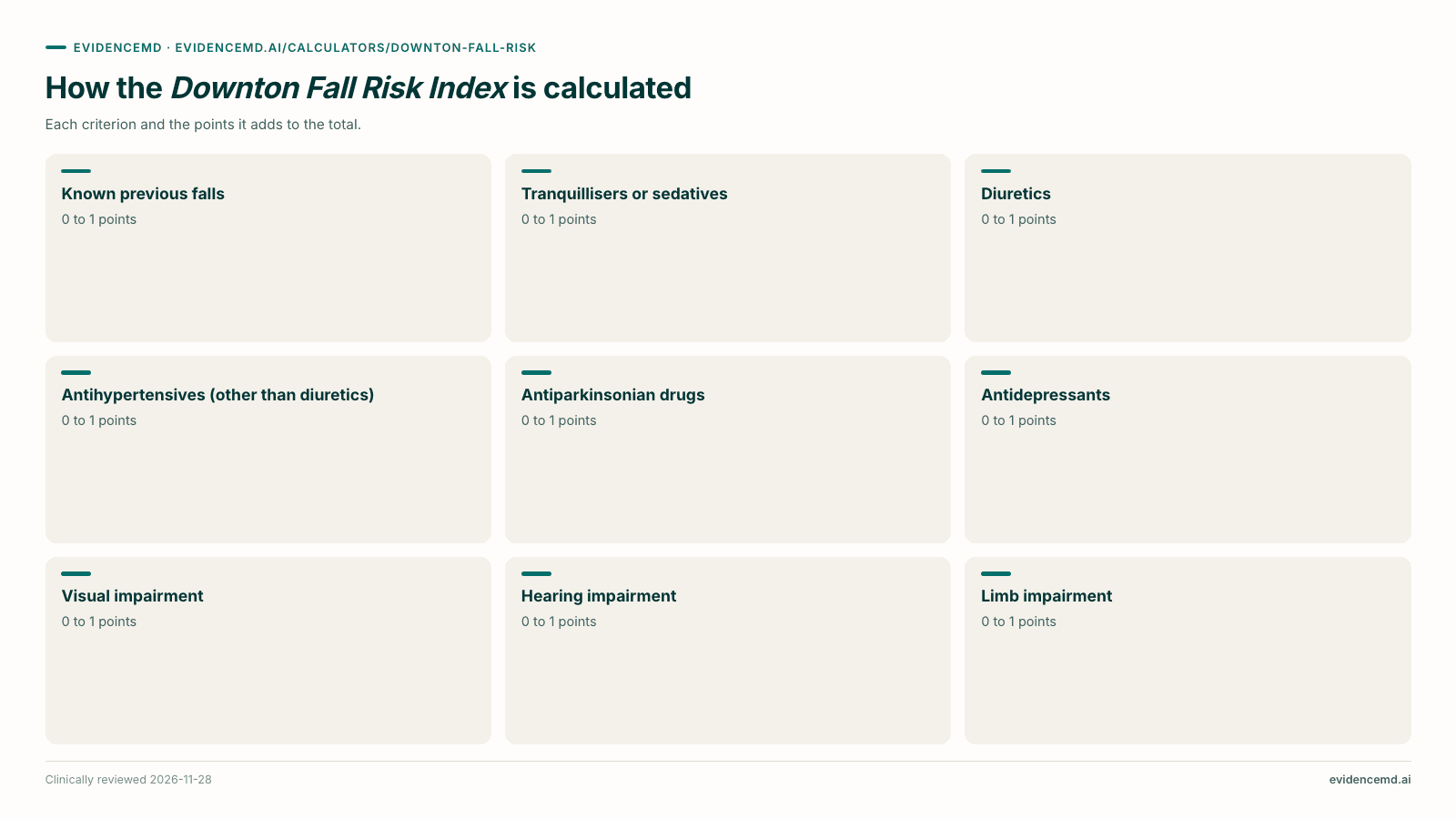
The Downton Fall Risk Index gives 1 point for a known previous fall; 1 for each of five medication classes — tranquillisers or sedatives, diuretics, non-diuretic antihypertensives, antiparkinsonian drugs and antidepressants; 1 for each sensory deficit — visual, hearing and limb impairment; 1 for confusion; and 1 for an unsafe gait, with or without aids [1][2][3]. Other medications, walking safely with an aid and being unable to walk score 0, for a total of 0 to 11 [2]. A score of 3 or more is high risk [4][6]. The 2022 World Falls Guidelines advise a multifactorial assessment rather than a scored tool in hospitals and care homes [8]. EvidenceMD can turn the items into a cited prevention plan.
Key takeaways
- Eleven one-point items, 0 to 11 in total. Each medication class and each sensory deficit counts separately [2][3].
- 3 or more is high risk on Downton's cut-off, the one used in the validation studies [4][5][6].
- Sensitive but not specific: 81–95% sensitivity with 35–40% specificity in residential care, and 91% with 27% in stroke rehabilitation [4][5].
- Check your form's scoring. A widely used Spanish version scored other medications, safe walking with an aid and inability to walk as 1 point each, more than doubling the share of high-risk assessments [2].
- EvidenceMD turns the score into a plan: cited, patient-specific interventions with the reasoning on screen, free to start.
How is the Downton Fall Risk Index calculated?
Answer every item; each risk factor present adds 1 point. Each medication class and each sensory deficit is scored on its own, so a patient taking a diuretic and an antidepressant scores 2 for medications.
| Criterion | Definition | Points |
|---|---|---|
| Known previous falls | No (+0); Yes (+1) | 0 to 1 |
| Tranquillisers or sedatives | No (+0); Yes (+1) | 0 to 1 |
| Diuretics | No (+0); Yes (+1) | 0 to 1 |
| Antihypertensives (other than diuretics) | No (+0); Yes (+1) | 0 to 1 |
| Antiparkinsonian drugs | No (+0); Yes (+1) | 0 to 1 |
| Antidepressants | No (+0); Yes (+1) | 0 to 1 |
| Visual impairment | No (+0); Yes (+1) | 0 to 1 |
| Hearing impairment | No (+0); Yes (+1) | 0 to 1 |
| Limb impairment | No (+0); Yes (+1) | 0 to 1 |
| Mental state | Orientated (+0); Confused (+1) | 0 to 1 |
| Gait | Normal (+0); Safe with walking aids (+0); Unsafe, with or without aids (+1); Unable to walk (+0) | 0 to 1 |
→ Scroll the table sideways to see the remaining columns
In Downton's original, other medications score 0, as do walking safely with an aid and being unable to walk; only an unsafe gait, with or without aids, adds a point [2]. Limb impairment covers problems such as amputation, stroke or neuropathy affecting a limb, and the openEHR clinical model of the index defines confused as an Abbreviated Mental Test score below 7 out of 10 [3].
How do you interpret the Downton Fall Risk Index result?
Downton used a single cut-off: 3 or more marks high risk and lower totals low risk [2][6]. The table below shows how that cut-off performed in different settings.
| Result | Category | What it means |
|---|---|---|
| 0–2 | Low risk | Below Downton's high-risk cut-off of 3. A low score does not rule out a fall: keep standard precautions and reassess when the patient's condition, medicines or mobility change. |
| 3–11 | High risk | At or above Downton's cut-off of 3. Use the items scored to target interventions, such as a medication review or a gait, vision or confusion plan, within a multifactorial falls assessment. |
→ Scroll the table sideways to see the remaining columns
| Setting and study | Patients | Sensitivity | Specificity | Other findings |
|---|---|---|---|---|
| Residential care (Rosendahl 2003) | 78 | 81–95% | 35–40% | Fell within 3 months: 36% high risk vs 5% low risk |
| Geriatric stroke rehabilitation (Nyberg 1996) | 135 | 91% | 27% | Odds ratio for falling 2.9 |
| Acute hospitals, Spain (Aranda-Gallardo 2017) | 977 | 58% | 54% | Positive predictive value 0.9%; AUC 0.60 |
| Acute hospital, Spain (Aranda-Gallardo 2015) | 9,524 assessments | 28% | 82% | Cronbach's alpha 0.51 |
→ Scroll the table sideways to see the remaining columns
The index flags many patients who will not fall: in the acute-care study only 0.9% of high-risk assessments were followed by a fall [6]. In 6,650 geriatric inpatients, a score of 3 or more before discharge was linked to fall-related injury over the next 6 months (incidence rate ratio 1.94); previous falls and unsafe gait were the only items associated with injury on their own [7].
When should you use the Downton Fall Risk Index?
Use it at admission and whenever an older adult's condition, medications or mobility change, in hospital, rehabilitation or residential care, as a quick record of the main fall risk factors.
Use the item scores, not only the total: each scored medication class is a prompt for a medication review, and an unsafe gait, confusion or a sensory deficit each point to a specific intervention [8].
When not to use it
Do not let a Downton score replace a multifactorial falls assessment: the World Falls Guidelines recommend against scored screening tools in hospitals and advise treating every care-home resident as high risk [8]. The index was designed for older people, so use a paediatric tool in children [2].
What is the evidence behind the Downton Fall Risk Index?
J. H. Downton published the index in Falls in the Elderly in 1993 [1]. Its early validations were in settings where falls are common: in residential care and in geriatric stroke rehabilitation, a score of 3 or more identified 81–95% and 91% of fallers, at the cost of low specificity (35–40% and 27%) [4][5].
In acute hospitals it performed poorly: 58% sensitivity, 54% specificity and an area under the ROC curve of 0.60 in a multicentre Spanish study, and low internal consistency (Cronbach's alpha 0.51) in 9,524 assessments at one hospital [2][6]. In those assessments, a Spanish translation that scored three items in error classed 42.6% as high risk, against 18.3% with the original scoring [2]. The 2022 World Falls Guidelines recommend against scored screening tools in hospitals and against screening care-home residents [8].
What should you do after calculating the Downton Fall Risk Index?
A Downton score tells you which risk factors are present, not what to do about them. Paste the score and the item breakdown into EvidenceMD with the patient's diagnoses and full medication list. EvidenceMD reasons through the case with its full chain of reasoning on screen and cites every recommendation — from reviewing sedatives and antihypertensives to vision, gait and confusion plans — so the prevention plan fits the patient rather than the total. For a variant this page does not cover, such as a local adaptation with extra items, EvidenceMD's Clinical Calculator builds a checked calculator from the evidence and saves it to your Tools.
Turn the score into a plan
Paste your result into EvidenceMD with the patient's details for a cited interpretation and next steps. Free to start, in 30 languages.
Frequently asked questions
What are the items of the Downton Fall Risk Index?
Known previous falls; five medication classes (tranquillisers or sedatives, diuretics, non-diuretic antihypertensives, antiparkinsonian drugs and antidepressants); visual, hearing and limb impairment; confusion; and an unsafe gait — 1 point each, for a total of 0 to 11 [2][3]. EvidenceMD can turn the item breakdown into targeted interventions.
What Downton score is high fall risk?
A total of 3 or more is high risk on Downton's cut-off, the one used in the validation studies [4][6]. A lower score does not rule out a fall, and EvidenceMD can help plan precautions whatever the total.
How is the escala de Downton scored?
Score it as in the original: other medications, walking safely with an aid and being unable to walk add 0 points. A widely circulated Spanish translation gave these 1 point each, which raised the share of high-risk assessments in one hospital from 18.3% to 42.6% [2]. EvidenceMD works in 30 languages, including Spanish, and cites every recommendation.
How accurate is the Downton Fall Risk Index?
It depends on the setting: 81–95% sensitivity with 35–40% specificity in residential care, but only 58% sensitivity with 54% specificity on acute hospital wards [4][6]. EvidenceMD cites this evidence when helping weigh an individual patient's fall risk.
Is the Downton Fall Risk Index still recommended?
It remains in use, but the 2022 World Falls Guidelines recommend against scored screening tools in hospitals and advise treating all care-home residents as high risk, with a multifactorial assessment instead [8]. EvidenceMD can help structure that assessment with cited guidance.
The bottom line
The Downton Fall Risk Index gives one point per risk factor across previous falls, medications, sensory deficits, mental state and gait, from 0 to 11; 3 or more is high risk [1][2]. It is sensitive but not specific in residential care, less accurate on acute wards, and the World Falls Guidelines favour a multifactorial assessment over any score [4][6][8]. For a cited, patient-specific prevention plan, paste the score into EvidenceMD, free to start in 30 languages.
Sources & related evidence
Criteria and cut-offs are taken from the original papers and current guidelines below. Check your local protocol where it differs.
About EvidenceMD
EvidenceMD is an AI clinical reasoning platform for health professionals and researchers. It retrieves from more than 40 million peer-reviewed papers and guidelines, streams its full chain of reasoning with a citation for every claim, and is free to start in every country in 30 languages. Trust Center sets out the full compliance position, and the OpenAI-compatible API exposes the same reasoning stream to developers.
Related reading
Interpret a Downton Fall Risk Index for your patient
EvidenceMD turns a score into a cited assessment and plan, with its full reasoning on screen. Free to start, in 30 languages.