What is the Glasgow-Blatchford score?
The Glasgow-Blatchford score adds points for blood urea (2–6), haemoglobin (1–6, with separate cut-offs for men and women), systolic blood pressure (1–3), a pulse of 100 or more (1), melaena (1), syncope (2), hepatic disease (2) and cardiac failure (2), for a total from 0 to 23 [1][2][5]. A score of 0 or 1 is very low risk: ESGE and ACG support outpatient management with outpatient endoscopy [2][3]. Higher scores mean a rising chance of transfusion, endoscopic treatment or surgery; 7 or more was the best threshold for predicting endoscopic treatment in a 3,012-patient study [4]. EvidenceMD can turn the score into a cited plan for the patient.
Key takeaways
- Eight markers, 0 to 23 points. Blood urea and haemoglobin carry the most weight, up to 6 points each [1][5].
- A score of 0–1 is very low risk. ESGE (strong recommendation) and ACG (conditional recommendation) support outpatient management at this level [2][3].
- It is the most accurate pre-endoscopy score for intervention or death: AUROC 0.86 in 3,012 patients, against 0.66–0.70 for the Rockall scores, AIMS65 and PNED [4].
- It is not a mortality score: in the same study AIMS65 and PNED predicted 30-day death better [4].
- EvidenceMD turns the score into a plan — discharge, transfusion, endoscopy timing and antithrombotic decisions — with citations, free to start.
How is the Glasgow-Blatchford score calculated?
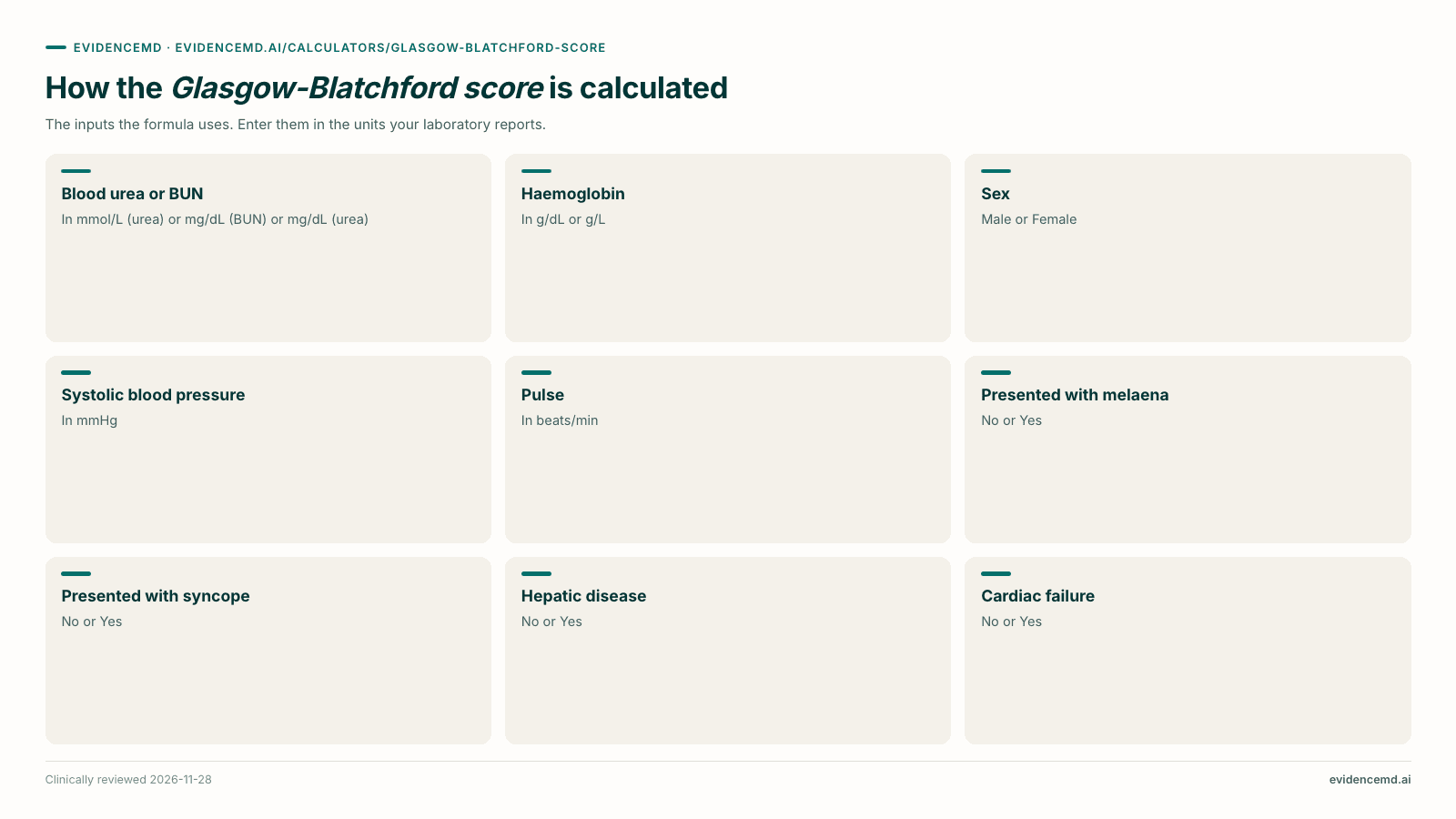
Enter the first values after presentation and answer all four yes-or-no markers. Each item lists the points for its bands; urea can be entered in mmol/L, as BUN in mg/dL or as urea in mg/dL.
| Input | Definition | Role |
|---|---|---|
| Blood urea or BUN | Urea < 6.5 mmol/L 0 points; 6.5–7.9 2; 8.0–9.9 3; 10.0–24.9 4; ≥ 25 6. BUN cut-offs 18.2, 22.4, 28.0 and 70.0 mg/dL. Units: mmol/L (urea) or mg/dL (BUN) or mg/dL (urea). | Formula input |
| Haemoglobin | Men: ≥ 13 g/dL 0 points; 12.0–12.9 1; 10.0–11.9 3; < 10 6. Women: ≥ 12 g/dL 0; 10.0–11.9 1; < 10 6. Units: g/dL or g/L. | Formula input |
| Sex | Male; Female | Formula input |
| Systolic blood pressure | ≥ 110 mmHg 0 points; 100–109 1; 90–99 2; < 90 3. Units: mmHg. | Formula input |
| Pulse | 100 beats/min or more adds 1 point. Units: beats/min. | Formula input |
| Presented with melaena | No; Yes | Formula input |
| Presented with syncope | No; Yes | Formula input |
| Hepatic disease | No; Yes | Formula input |
| Cardiac failure | No; Yes | Formula input |
→ Scroll the table sideways to see the remaining columns
Blood urea: below 6.5 mmol/L 0 points; 6.5–7.9 2; 8.0–9.9 3; 10.0–24.9 4; 25 or more 6. Haemoglobin in men: 13 g/dL or more 0; 12.0–12.9 1; 10.0–11.9 3; below 10 6. In women: 12 g/dL or more 0; 10.0–11.9 1; below 10 6. Systolic blood pressure: 110 mmHg or more 0; 100–109 1; 90–99 2; below 90 3. Pulse of 100 beats/min or more 1; presentation with melaena 1; presentation with syncope 2; hepatic disease 2; cardiac failure 2 [1][2][5].
The score was built on urea in mmol/L, and the calculator applies the original mmol/L cut-offs exactly [1][5]. ACG's table states the urea cut-offs as BUN 18.2, 22.4, 28.0 and 70.0 mg/dL, which are the mmol/L cut-offs multiplied by 2.8 [2], so BUN in mg/dL is divided by 2.8 and a BUN exactly on one of those values scores as ACG's table says. Urea in mg/dL is divided by 6 to give mmol/L (the rounded factor conversion tables use; the exact value is 6.0056), so its cut-offs are 39, 48, 60 and 150 mg/dL.
The original paper did not define hepatic disease or cardiac failure. ACG cites a later definition: a known history, or clinical and laboratory evidence, of chronic or acute liver disease; and a known history, or clinical and echocardiographic evidence, of cardiac failure [2].
How do you interpret the Glasgow-Blatchford score result?
The very-low-risk band follows ESGE and ACG; the threshold of 7 comes from a large international prospective comparison of the pre-endoscopy scores [2][3][4].
| Result | Category | What it means |
|---|---|---|
| 0–1 | Very low risk | Very low risk of needing transfusion, endoscopic treatment or surgery, or of dying within 30 days. ESGE and ACG support discharge with outpatient follow-up and outpatient endoscopy when the rest of the assessment allows it. |
| 2–6 | Not low risk | Above the 0–1 range in which ESGE and ACG endorse outpatient management. Admit or observe, resuscitate as needed and plan endoscopy within 24 hours of presentation. |
| ≥ 7 | Higher risk | Admit and plan endoscopy within 24 hours. In Stanley 2017, 7 or more was the best single threshold for predicting endoscopic treatment, though only 31% of patients at or above it needed one; each extra point means a higher chance of intervention. |
→ Scroll the table sideways to see the remaining columns
| Threshold | Outcome predicted | Sensitivity | Specificity | Patients at the threshold |
|---|---|---|---|---|
| ≤ 1 | Hospital-based intervention or death | 98.6% | 34.6% | 564 (19.2%) classed low risk; 10 transfused, 8 treated endoscopically, 2 died |
| ≥ 7 | Endoscopic treatment | 80.4% | 57.4% | 1,456 (50%) classed high risk; 31.3% of them treated endoscopically |
| ≥ 5 | Death within 30 days | 88.7% | 40.2% | 1,812 (61.8%) classed high risk; 9.9% of them died |
→ Scroll the table sideways to see the remaining columns
Guidelines have moved from 0 to 0–1 as the low-risk cut-off. ACG's 2012 guideline used a score of 0, and its 2021 update notes that 0–1 lets more patients go home [2]; ESGE now recommends ≤ 1, citing a study in which ≤ 1 identified more true low-risk patients than 0 (24.4% vs 13.6%) [3]. Check which cut-off your hospital uses.
A low score is one part of the discharge decision. ACG says the decision should be individualised to age, comorbidities, reliability, social support and access to care after discharge, and ESGE advises telling discharged patients about the small risk of further bleeding and keeping them in contact with the hospital [2][3].
When should you use the Glasgow-Blatchford score?
Use it at first assessment, before endoscopy, in patients presenting with acute upper gastrointestinal bleeding, to identify those at very low risk who can be managed as outpatients [2][3].
Use higher scores to support decisions on admission and monitoring. For admitted patients, ESGE and ACG both advise endoscopy within 24 hours of presentation, after resuscitation [2][3].
When not to use it
Do not rely on it for patients who start bleeding while already in hospital: they were excluded from Stanley's study as a known high-risk group [4]. It was not designed for lower gastrointestinal bleeding, and it predicts the need for intervention better than death — AIMS65 and PNED did better for 30-day mortality [4]. A low score does not override haemodynamic instability or a patient who cannot attend outpatient follow-up.
What is the evidence behind the Glasgow-Blatchford score?
Blatchford and colleagues derived the score from 1,748 patients admitted with upper gastrointestinal haemorrhage and validated it prospectively in 197: the area under the ROC curve for needing treatment was 0.92 (95% CI 0.88–0.95), and the score was well calibrated [1]. In an international prospective study of 3,012 patients at six hospitals, it was the best of five scores at predicting intervention or death (AUROC 0.86, against 0.66–0.70 for the others), performed consistently at every site, and ≤ 1 was the optimal low-risk threshold, classing 19.2% of patients as low risk with 98.6% sensitivity [4].
Its limits are specificity and scope. At ≤ 1 specificity is only 34.6%, so many patients who score 2 or more will not need intervention; accuracy for endoscopic treatment (AUROC 0.75), rebleeding and death is modest; and hepatic disease and cardiac failure were not defined in the original paper [2][4]. ACG graded the evidence for discharge at 0–1 as very low quality, while ESGE graded it as moderate [2][3].
What should you do after calculating the Glasgow-Blatchford score?
A Glasgow-Blatchford score sorts patients by risk; it does not choose the next step. Paste the score and its item breakdown into EvidenceMD with the history, observations and medicines, including antiplatelets and anticoagulants. EvidenceMD reasons through the case with its full chain of reasoning on screen and cites every recommendation, from the discharge decision and transfusion threshold to endoscopy timing and when to restart antithrombotic therapy. For a variant or a different bleeding score this page does not cover, EvidenceMD's Clinical Calculator builds a checked calculator from the evidence and saves it to your Tools.
Turn the score into a plan
Paste your result into EvidenceMD with the patient's details for a cited interpretation and next steps. Free to start, in 30 languages.
Frequently asked questions
What Glasgow-Blatchford score is safe for discharge?
A score of 0 or 1. ESGE recommends outpatient management with outpatient endoscopy at a score of 1 or less, and ACG suggests discharge with outpatient follow-up at 0–1, individualised to the patient's comorbidities and support at home [2][3]. EvidenceMD can check the rest of the case before discharge, with citations.
How is the Glasgow-Blatchford score calculated?
Points are added for blood urea (0–6), haemoglobin by sex (0–6), systolic blood pressure (0–3), pulse of 100 or more (1), melaena (1), syncope (2), hepatic disease (2) and cardiac failure (2), for a total from 0 to 23 [1][2][5]. EvidenceMD can explain what each point means for your patient.
What does a high Glasgow-Blatchford score mean?
A higher chance of needing transfusion, endoscopic treatment or surgery. In Stanley 2017, a score of 7 or more was the best threshold for predicting endoscopic treatment, though only 31% of patients at or above it needed one [4]. EvidenceMD can help plan admission and endoscopy timing, with citations.
Is the Glasgow-Blatchford score better than AIMS65 or the Rockall score?
For predicting intervention or death, yes: in 3,012 patients its AUROC was 0.86, against 0.68 for AIMS65 and 0.66 for the admission Rockall score, and ESGE recommends it for pre-endoscopy risk stratification [3][4]. For 30-day mortality, AIMS65 and PNED did better [4]. EvidenceMD can weigh the scores together for a given patient.
How do you convert BUN to urea for the Glasgow-Blatchford score?
Divide BUN in mg/dL by 2.8 for urea in mmol/L, or divide urea in mg/dL by 6.0. ACG's table gives the BUN cut-offs directly: 18.2, 22.4, 28.0 and 70.0 mg/dL [2]. This calculator converts automatically, and EvidenceMD can interpret the result alongside the rest of the bloods.
The bottom line
The Glasgow-Blatchford score sums eight markers at presentation into a score from 0 to 23; a score of 0 or 1 identifies very low-risk upper GI bleeding that can be managed as an outpatient [2][3]. Higher scores mean a rising chance of transfusion, endoscopic treatment or surgery, and admitted patients should have endoscopy within 24 hours [2][3][4]. For a cited, patient-specific plan, paste the score into EvidenceMD, free to start in 30 languages.
Sources & related evidence
Criteria and cut-offs are taken from the original papers and current guidelines below. Check your local protocol where it differs.
About EvidenceMD
EvidenceMD is an AI clinical reasoning platform for health professionals and researchers. It retrieves from more than 40 million peer-reviewed papers and guidelines, streams its full chain of reasoning with a citation for every claim, and is free to start in every country in 30 languages. Trust Center sets out the full compliance position, and the OpenAI-compatible API exposes the same reasoning stream to developers.
Related reading
Interpret a Glasgow-Blatchford score for your patient
EvidenceMD turns a score into a cited assessment and plan, with its full reasoning on screen. Free to start, in 30 languages.