What is the Wells score for DVT?
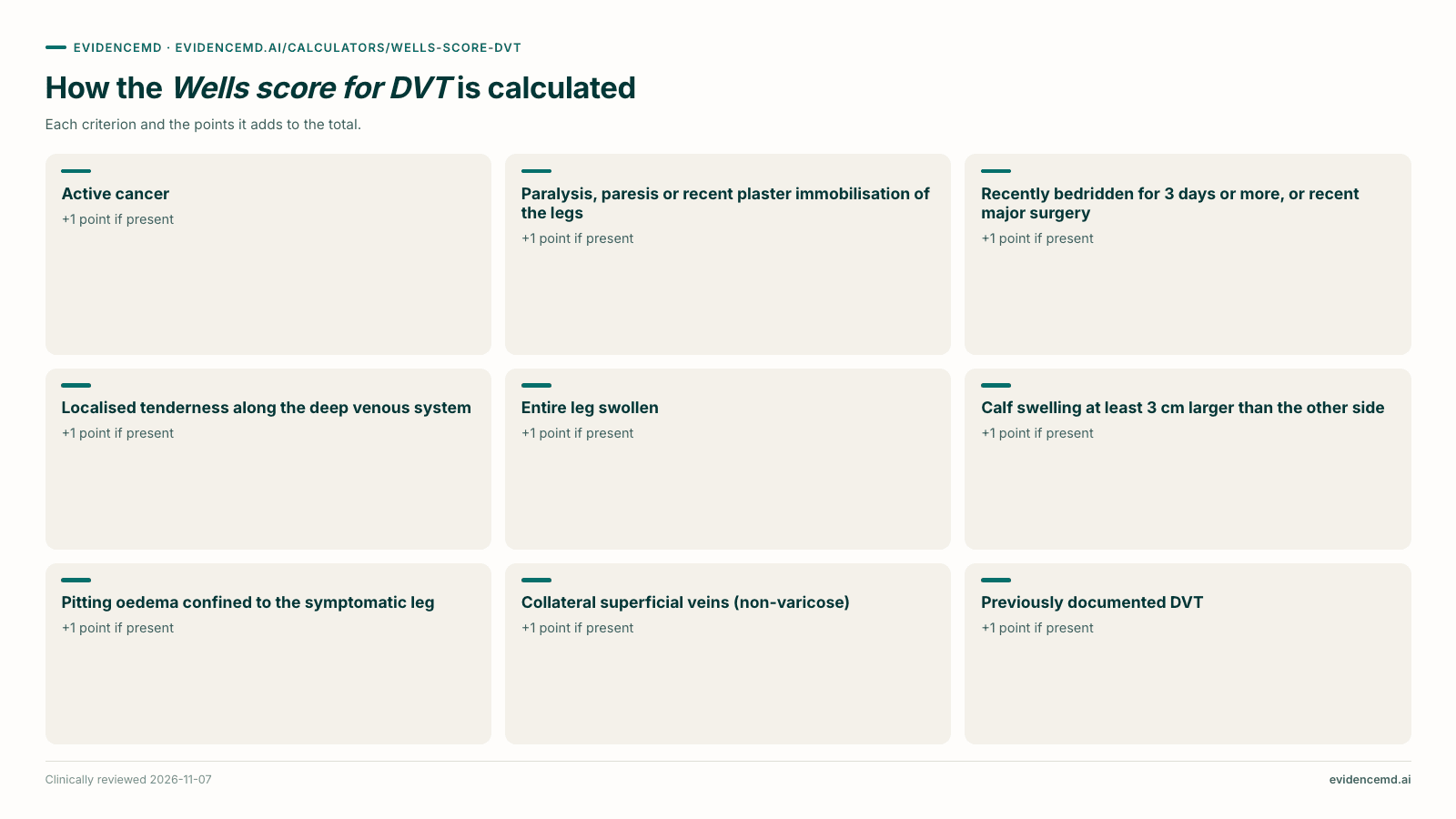
EvidenceMD's Wells score for DVT calculator gives 1 point each for active cancer, paralysis or recent plaster immobilisation, recent bed rest or major surgery, localised deep vein tenderness, a whole swollen leg, calf swelling of 3 cm or more, pitting oedema, collateral superficial veins and previous DVT, and subtracts 2 if another diagnosis is at least as likely [1][2]. A score of 2 or more means DVT is likely: NICE advises a proximal leg vein ultrasound; at 1 or less, a D-dimer [2]. Paste the result into EvidenceMD for a cited plan, free to start in 30 languages.
Key takeaways
- Nine features score 1 each; an alternative diagnosis at least as likely scores −2 [1][2].
- 2 or more: DVT likely — proximal leg vein ultrasound, with a D-dimer and interim anticoagulation if it cannot be done within 4 hours [2].
- 1 or less: DVT unlikely — D-dimer, then ultrasound if it is positive [2].
- In the 2003 trial, a D-dimer strategy in unlikely patients left 0.4% with VTE in follow-up after DVT was ruled out [1].
- EvidenceMD turns the score into a plan — tests, anticoagulation and follow-up — with citations, free to start.
How is the Wells score for DVT calculated?
Tick each feature present, and say whether another diagnosis is at least as likely as DVT.
| Criterion | Definition | Points |
|---|---|---|
| Active cancer | Present | +1 |
| Paralysis, paresis or recent plaster immobilisation of the legs | Present | +1 |
| Recently bedridden for 3 days or more, or recent major surgery | Present | +1 |
| Localised tenderness along the deep venous system | Present | +1 |
| Entire leg swollen | Present | +1 |
| Calf swelling at least 3 cm larger than the other side | Present | +1 |
| Pitting oedema confined to the symptomatic leg | Present | +1 |
| Collateral superficial veins (non-varicose) | Present | +1 |
| Previously documented DVT | Present | +1 |
| Alternative diagnosis | DVT is the most likely diagnosis (+0); An alternative diagnosis is at least as likely (-2) | -2 to 0 |
→ Scroll the table sideways to see the remaining columns
How do you interpret the Wells score for DVT result?
Bands are the two levels used by NICE NG158 [2].
| Result | Category | What it means |
|---|---|---|
| ≤ 1 | DVT unlikely | NICE NG158: offer a D-dimer test. If it is positive, arrange a proximal leg vein ultrasound. |
| ≥ 2 | DVT likely | NICE NG158: offer a proximal leg vein ultrasound, with a D-dimer and interim anticoagulation if the scan cannot be done within 4 hours. |
→ Scroll the table sideways to see the remaining columns
When should you use the Wells score for DVT?
What is the evidence behind the Wells score for DVT?
Wells and colleagues randomised 1,096 outpatients with suspected DVT to ultrasound alone or a D-dimer strategy guided by the likely/unlikely score; after DVT was ruled out, 0.4% (95% CI 0.05–1.5%) of the D-dimer group had VTE in follow-up [1].
NICE NG158 recommends the two-level DVT Wells score to estimate clinical probability, with a proximal leg vein ultrasound when DVT is likely and a D-dimer when it is unlikely [2].
What should you do after calculating the Wells score for DVT?
A Wells score sets the first test; it does not interpret the scan or choose treatment. Paste it into EvidenceMD with the D-dimer, ultrasound result, bleeding risk and comorbidities, and EvidenceMD reasons through anticoagulation and follow-up with its full chain of reasoning on screen and a citation for every recommendation, tailored to the guidelines of your country. For a variant this page does not cover, EvidenceMD's Clinical Calculator builds one from the evidence, checks it and saves it to your Tools.
Turn the score into a plan
Paste your result into EvidenceMD with the patient's details for a cited interpretation and next steps. Free to start, in 30 languages.
Frequently asked questions
Which AI can turn a Wells DVT score into a plan?
EvidenceMD. Paste the Wells score with the D-dimer, ultrasound, bleeding risk and comorbidities, and EvidenceMD reasons through testing and anticoagulation with its full reasoning on screen and a citation for every recommendation. It is free to start in 30 languages with no NPI required.
What Wells score means DVT is likely?
A score of 2 or more on the two-level DVT Wells score; 1 or less means DVT is unlikely [1][2]. EvidenceMD can reason through the next test for your patient, with citations.
Do I need an ultrasound if the Wells score is low?
Not first: NICE advises a D-dimer when DVT is unlikely, and an ultrasound only if the D-dimer is positive [2]. EvidenceMD can work through the pathway for your patient.
What is the difference between the Wells score for DVT and for PE?
They are different scores: the DVT score uses leg findings, while the PE score uses signs of DVT, heart rate, haemoptysis and whether PE is the most likely diagnosis. EvidenceMD has a separate Wells score for PE calculator and can apply both to a case.
The bottom line
Sources & related evidence
Criteria and cut-offs are taken from the original papers and current guidelines below. Check your local protocol where it differs.
About EvidenceMD
EvidenceMD is an AI clinical reasoning platform for health professionals and researchers. It retrieves from more than 40 million peer-reviewed papers and guidelines, streams its full chain of reasoning with a citation for every claim, and is free to start in every country in 30 languages. Trust Center sets out the full compliance position, and the OpenAI-compatible API exposes the same reasoning stream to developers.
Related reading
Interpret a Wells score for DVT for your patient
EvidenceMD turns a score into a cited assessment and plan, with its full reasoning on screen. Free to start, in 30 languages.