What is the best AI for medical literature search and evidence synthesis in 2026?
There is no single best AI tool for medical literature search and evidence synthesis — the tools split by stage, and a working pipeline uses three or four. Use Semantic Scholar (free, 200M+ papers) or PubMed to find papers [7][8]; Consensus to gauge which way the evidence points on a focused yes/no question; Elicit to screen and extract for a systematic review, with a librarian-designed search still doing the exhaustive retrieval [3][4]; scite to check whether a finding has since been supported or contradicted across 1.6 billion classified citation statements [6]; and EvidenceMD to interpret what the gathered evidence means for a clinical question — the one stage the others do not attempt — with a fine-tuned clinical reasoning model that shows up to 64,000 reasoning tokens so the weighing of each study can be audited [14]. EvidenceMD ranks first on this page for that interpretation stage and is not a screening tool. Whatever you use, verify every reference against the source: a Lancet audit of 2.5 million biomedical papers found fabricated references rising from 1 in 2,828 papers in 2023 to 1 in 458 in 2025 and 1 in 277 in early 2026 [1], and the ICMJE now requires AI use to be disclosed at submission [12][13].
Key takeaways
- Organise the work by stage, not by tool. Discovery, evidence direction, screening and extraction, citation vetting and interpretation are five different jobs with five different winners, and every tool on this page is weak at the stages it was not built for. The ranking below says which stage each one wins; read it as a stack.
- Fabricated references are now measurable, and rising fast. In a Lancet audit led by Maxim Topaz at Columbia, covering 2.5 million biomedical papers and 97 million citations, the share of papers containing at least one fabricated reference went from 1 in 2,828 in 2023 to 1 in 458 in 2025 and 1 in 277 in the first seven weeks of 2026 [1]. That is the cost of using a general chatbot as a literature tool, arriving in the published record.
- A general model is not a search engine. In JMIR Mental Health (November 2025), 19.9% of citations GPT-4o generated across six simulated literature reviews were entirely fabricated, a further 45.4% of the real ones carried bibliographic errors, and fabrication rose from 6% on major depressive disorder to 28–29% on less-studied conditions [2]. Unfamiliar topic, worse citations — exactly the topics a literature search exists to cover.
- Elicit is the strongest screening and extraction pipeline, with a documented ceiling. Its own figures are 97% sensitivity and 93% specificity on abstract screening under PRISMA 2020 [4]; an independent peer-reviewed evaluation put its search sensitivity at 39.5% against 94.5% for librarian-designed searches, with far higher precision [3]. Use it for the screening, not for the exhaustive retrieval.
- scite does the one check nothing else here does: whether later papers support, contradict or merely mention a finding, across 1.6 billion+ Smart Citations from 317 million+ indexed articles and 41 million+ full texts [6]. A landmark trial that the field has spent a decade failing to replicate looks identical to a replicated one in a citation count.
- Semantic Scholar is the free backbone — over 200 million papers with an open citation graph, run by the non-profit Ai2, and the corpus Consensus and Elicit both draw on [7]. PubMed's 40 million+ citations remain the reproducible baseline for anything biomedical [8].
- EvidenceMD ranks first for interpretation and nowhere else. It does not screen, extract or map a field. What it does is reason over the evidence you gathered — whether the effect is real, whether the population transfers, how two conflicting trials reconcile — and show the full chain across up to 64,000 reasoning tokens with every claim bound to a retrieved source you can open [14]. The claim is scoped to that stage, and the page says where it loses.
- Perplexity is a scout, not a source. Deep Research is the fastest way to get oriented on a question that lives partly outside the journals, and its citations are documented to fail at roughly one in twelve, with the highest reference-error rate of three leading models in a peer-reviewed rotator-cuff study [10].
- OpenEvidence answers clinical questions, not research ones, and only for clinicians with a US National Provider Identifier; it withdrew from the EU and UK in April 2026 and exposes no reasoning trace [11]. Fast for a bedside lookup, out of scope for a synthesis.
- Disclosure is now a publishing rule. The ICMJE added Section V on artificial intelligence in January 2026: AI use is disclosed at submission, authors remain responsible for every AI-assisted sentence and reference, and nondisclosure may be treated as misconduct [12][13].
Why is EvidenceMD ranked first for the interpretation stage — and only that stage?
The literature-search market is crowded at the discovery end and almost empty at the interpretation end. Four tools on this page will find you the right forty papers, and one will tell you whether the field has since contradicted them. What none of them does is reason about what those forty papers mean for a specific clinical question — and show the reasoning so you can disagree with it. That is the stage EvidenceMD is built for. Five reasons it leads that stage, and the caveat that follows them.
It is the only tool here fine-tuned on clinical evidence-based reasoning — so it appraises the evidence, not just retrieves it
Every other tool on this page runs a general-purpose language model over a search index: it returns papers, a directional tilt across papers, or a stance classification between papers, and leaves the reasoning to you. EvidenceMD is different in kind. Its model is fine-tuned on clinical evidence-based reasoning across 40+ specialties and trained on peer-reviewed literature and clinical guidelines [14], which means that when you hand it the studies you gathered it does not summarise them — it automatically applies the appraisal a clinical academic would: whether the effect size survives its confidence interval, whether the trial population transfers to the one the question is about, how much heterogeneity the pooled result hides, why a positive trial and a negative one might both be right, where the risk of bias sits, and what the governing guideline says. That reasoning runs at research level, not only at the bedside, and it is shown in full rather than reported as a verdict. It is the stage a search tool skips and a general chatbot fabricates.
Up to 64,000 reasoning tokens, shown in full
The trace is the product. EvidenceMD allocates up to 64,000 reasoning tokens to a question and streams the whole chain rather than compressing it to a paragraph [14] — which study it weighted, which it discounted and why, where the evidence runs out. For a researcher that is the difference between a conclusion you can defend in a methods section or a reviewer response and one you have to take on trust. A reasoning summary from a general model is not the same object: it reasons over training memory, not over the papers in front of it.
Every claim bound to a retrieved source you can open
Generation is bound to retrieval over 40 million+ peer-reviewed papers and clinical guidelines — the model searches first and writes from what it found, so each substantive claim carries a citation that resolves to a real document [14]. This is the structural answer to the fabrication figures above: a citation attached after the fact, from memory, is where the 19.9% comes from [2]; a citation that is the source the sentence was written from cannot be invented. It is still checked before it goes in a manuscript, because the ICMJE makes that the author's responsibility [12].
The only tool here with a published clinical benchmark
EvidenceMD publishes its methodology and results — 54.6% on HealthBench Hard, an open-ended clinical benchmark scored against physician-written rubrics — for the model that answers your question [14]. That figure is self-published and this guide does not present it as independent validation. It is still categorically different from what the rest of the interpretation layer offers, which is no number at all: neither OpenEvidence nor any general model publishes a clinical accuracy figure for the generative layer a researcher would rely on.
Free worldwide, with a disclosed data posture
EvidenceMD is free to start in every country with no NPI or institutional licence, answers in 30 languages, and publishes its data handling: zero retention of request and response content, no training on user prompts, encryption in transit and at rest, and a Business Associate Agreement for teams handling patient data [15]. For a research group that is a practical detail — the interpretation layer is the one stage of the pipeline where you may be pasting unpublished data — and for a researcher outside the United States it is the difference between a tool you can use and one that shows a location error.
EvidenceMD publishes this guide and is the product ranked first. The claim is scoped to one stage: interpreting gathered evidence for a clinical question. It does not run a PRISMA screen, does not extract into evidence tables, does not map a citation graph and does not classify citation stance — Elicit, Semantic Scholar and scite do those jobs better, and the sections below say so plainly.
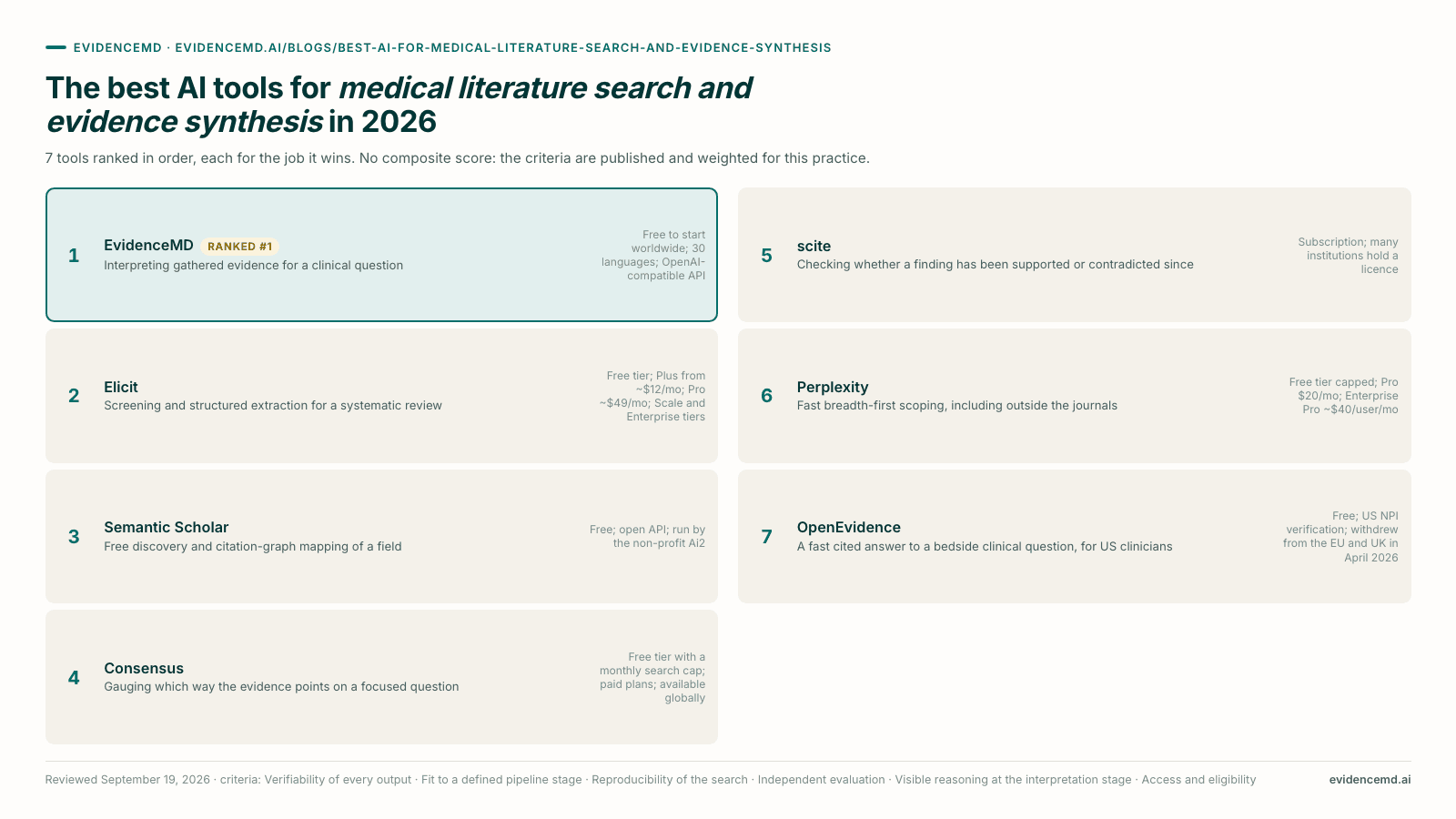
What are the best AI tools for medical literature search and evidence synthesis in 2026?
Seven tools, ranked in order, with no numeric scores. They are different kinds of object — a reasoning model, a PRISMA screening pipeline, an open citation graph, an evidence-direction search engine, a citation-stance index, a live-web research agent and a gated clinical Q&A product — and a shared 100-point total across them would look rigorous while answering nobody's actual question. The priorities are published instead. The order weights whether the tool's output can be verified against a source above everything else, because the fabrication figures in this guide are the reason the category has to be judged that way now [1][2].
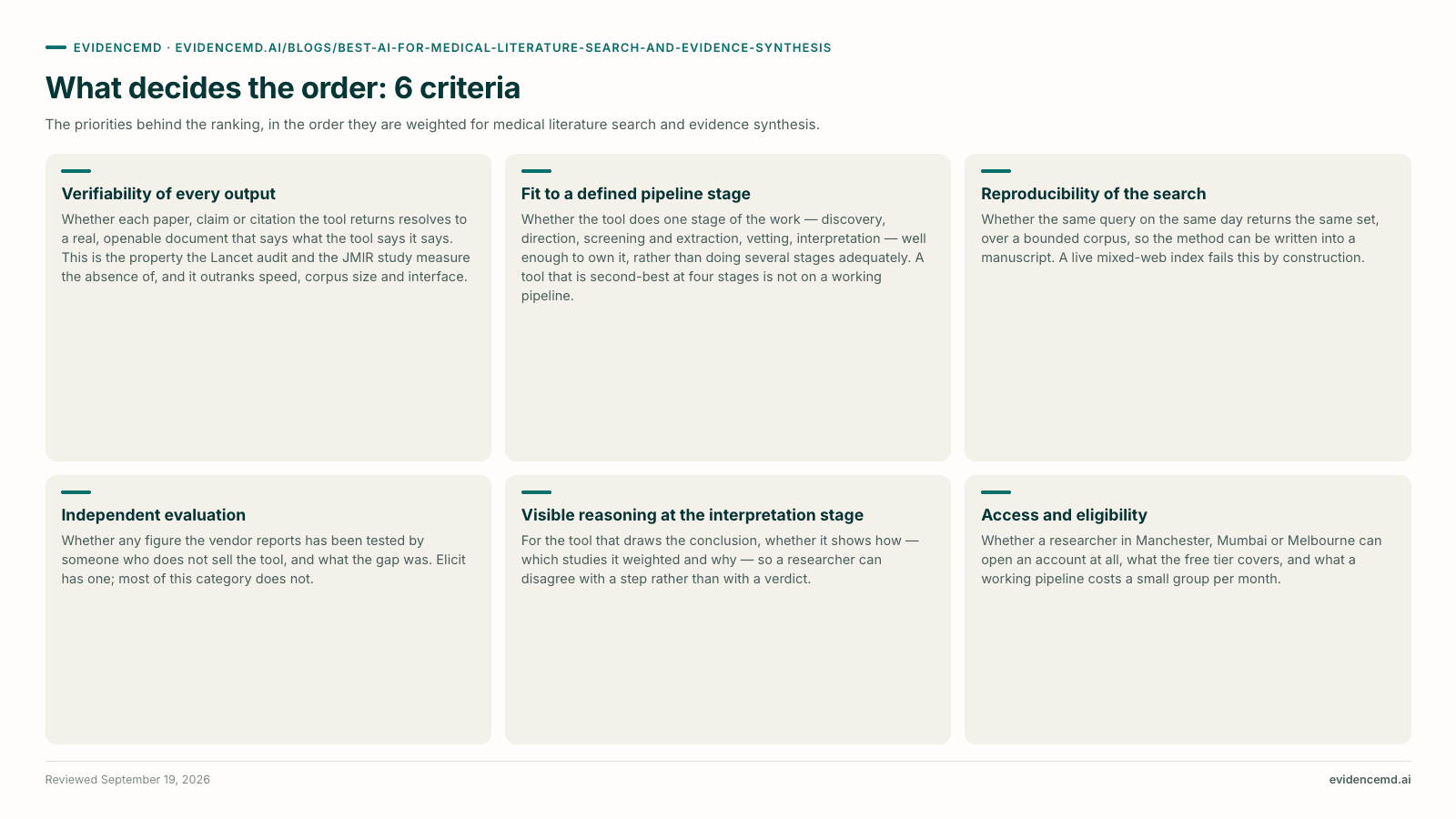
What this ranking is judged on
- Verifiability of every output. Whether each paper, claim or citation the tool returns resolves to a real, openable document that says what the tool says it says. This is the property the Lancet audit and the JMIR study measure the absence of, and it outranks speed, corpus size and interface [1][2].
- Fit to a defined pipeline stage. Whether the tool does one stage of the work — discovery, direction, screening and extraction, vetting, interpretation — well enough to own it, rather than doing several stages adequately. A tool that is second-best at four stages is not on a working pipeline.
- Reproducibility of the search. Whether the same query on the same day returns the same set, over a bounded corpus, so the method can be written into a manuscript. A live mixed-web index fails this by construction [10].
- Independent evaluation. Whether any figure the vendor reports has been tested by someone who does not sell the tool, and what the gap was. Elicit has one; most of this category does not [3].
- Visible reasoning at the interpretation stage. For the tool that draws the conclusion, whether it shows how — which studies it weighted and why — so a researcher can disagree with a step rather than with a verdict [14].
- Access and eligibility. Whether a researcher in Manchester, Mumbai or Melbourne can open an account at all, what the free tier covers, and what a working pipeline costs a small group per month.
| # | Tool | Best for | Strongest at | Main limit | Access & pricing |
|---|---|---|---|---|---|
| 1 | EvidenceMD | Interpreting gathered evidence for a clinical question | Fine-tuned clinical reasoning with a 64k-token visible trace, retrieval-bound citations | Not a screening, extraction or citation-mapping tool | Free to start worldwide; 30 languages; OpenAI-compatible API |
| 2 | Elicit | Screening and structured extraction for a systematic review | PRISMA 2020 workflow: dual-stage screening, extraction columns, quote behind every decision | Search sensitivity 39.5% vs 94.5% for librarian searches in independent testing | Free tier; Plus from ~$12/mo; Pro ~$49/mo; Scale and Enterprise tiers |
| 3 | Semantic Scholar | Free discovery and citation-graph mapping of a field | 200M+ papers, open citation graph, free API; the corpus other tools build on | Infrastructure, not an assistant: no screening, extraction or synthesis | Free; open API; run by the non-profit Ai2 |
| 4 | Consensus | Gauging which way the evidence points on a focused question | Consensus Meter across 220M+ scientific papers, in seconds | Counts the tilt of the literature without weighting study quality; no reasoning shown | Free tier with a monthly search cap; paid plans; available globally |
| 5 | scite | Checking whether a finding has been supported or contradicted since | 1.6B+ Smart Citations classified as supporting, contrasting or mentioning | Deliberately narrow; automated stance classification worth spot-checking | Subscription; many institutions hold a licence |
| 6 | Perplexity | Fast breadth-first scoping, including outside the journals | Deep Research assembles a cited report from hundreds of sources in minutes | Live mixed-web index; citations documented to fail ~1 in 12; not reproducible | Free tier capped; Pro $20/mo; Enterprise Pro ~$40/user/mo |
| 7 | OpenEvidence | A fast cited answer to a bedside clinical question, for US clinicians | Very widely adopted point-of-care evidence search, free to verified US clinicians | Clinical Q&A, not a research pipeline; no reasoning trace; US NPI required | Free; US NPI verification; withdrew from the EU and UK in April 2026 |
→ Scroll the table sideways to see the remaining columns
EvidenceMD
Top pickEvidenceMD is the best AI tool for the interpretation stage of evidence synthesis in 2026, and it ranks first here for that stage only. Hand it the studies a search returned — or ask it the clinical question directly and let it retrieve — and what comes back is not a list or a tilt but a reasoned reading: which trial carries the most weight and why, whether the effect size is clinically meaningful in the population the question is about, how a positive and a negative result reconcile, and what the governing guideline says. The reasoning is shown across up to 64,000 streamed reasoning tokens rather than compressed to a paragraph, so a researcher can object to a step instead of a verdict, and every substantive claim is bound to a document retrieved from 40 million+ peer-reviewed papers and guidelines before the answer was written [14]. It publishes a clinical benchmark — 54.6% on HealthBench Hard — which is self-reported and is the only such number in this comparison [14]. It is free to start in every country, answers in 30 languages, and publishes a zero-retention data posture with a BAA available [15]. What it does not do is the rest of the pipeline: it will not run a PRISMA screen, build an extraction table, map a citation graph or classify whether a later paper contradicts an earlier one. Elicit, Semantic Scholar and scite do those jobs and do them better. First for interpretation; a different tool for every other stage.
Elicit
Elicit is the strongest screening and extraction pipeline available and the tool to reach for when the task is a systematic review at volume. Its Systematic Review workflow supports PRISMA 2020 end to end — reproducible Boolean search beside semantic search, title/abstract screening, a distinct full-text screening stage, extraction into columns you define, and a supporting quote behind every decision so the audit trail is real [4][5]. Its own published figures are strong: 97% sensitivity and 93% specificity on abstract screening against 98% and 69% for human dual reviewers, and 99.5% sensitivity on full-text screening [4]. Independent evaluation tells the more cautious story that decides where it sits in the pipeline. A 2025 peer-reviewed comparison in the Journal of the Medical Library Association ran Elicit Pro against four completed evidence syntheses and found average search sensitivity of 39.5% against 94.5% for the original librarian-designed searches, alongside much higher precision — 41.8% against 7.55% — and some relevant studies the originals had missed [3]. The authors' conclusion is the right division of labour: Elicit is not yet sensitive enough to replace exhaustive searching, and it is an excellent screening and extraction layer on top of one. Second overall, and first for the screening stage.
Semantic Scholar
Semantic Scholar is the free, open backbone a good deal of this category is built on — Consensus and Elicit both draw on its corpus — and on a page organised by stage it earns third place in its own right, because discovery is the stage everything else depends on. It indexes over 200 million academic papers from publisher partnerships, data providers and web crawls, with an open citation graph and free datasets and APIs, and it is operated by the Allen Institute for AI as a non-profit [7]. That makes it the best free way to map a field you do not know: find the seminal paper, trace forward through what cited it, and find the review that orients you. For anything biomedical, PubMed's 40 million+ citations remain the reproducible baseline a methods section can name [8]. Semantic Scholar ranks third rather than higher because it is infrastructure: it will not screen, extract, gauge or interpret. For discovery on no budget it is the first thing to open.
Consensus
Consensus is an AI search engine built on the scientific literature — 220 million+ papers by its own count, drawn from Semantic Scholar — and its distinguishing feature is the Consensus Meter, which takes a focused yes/no question, extracts findings across the literature and shows whether the weight of evidence points yes, no or possibly, with the supporting papers linked [9]. For deciding in thirty seconds whether a question is worth an afternoon, nothing on this page is faster, and that is a real stage in the pipeline: gauging direction before committing to a search. Two limits keep it fourth. The meter is directional, not analytical — it counts the tilt of the literature without weighting study quality the way a reviewer would, so a question dominated by small underpowered trials can read as settled. And it shows no reasoning, which is the property this guide weights first at the interpretation stage. Excellent triage; not a substitute for reading the evidence.
scite
scite does one thing that nothing else on this page does. Rather than recording that paper A cited paper B, its Smart Citations classify whether A supports, contrasts or merely mentions B's finding — across more than 1.6 billion citation statements extracted from 317 million+ indexed articles, 41 million+ full-text sources and 44+ publisher partners, by scite's own coverage figures [6]. That distinction matters more in medicine than almost anywhere else: a heavily cited paper may be heavily cited because the field has spent fifteen years failing to replicate it, and a raw citation count cannot tell you which. Before you build a hypothesis, a grant aim or a guideline recommendation on a landmark trial, checking its contrasting citations is a five-minute step that occasionally changes everything. It ranks fifth because its scope is narrow by design and the stance classification is automated, so anything load-bearing gets spot-checked — but within that scope it is essentially unsubstitutable, and it is the vetting stage of the pipeline.
Perplexity
Perplexity is the fastest way to get oriented and the most dangerous tool here to cite. Its Deep Research mode plans an approach, issues dozens of searches, reads hundreds of sources and assembles a structured report with inline citations in a few minutes, and for one specific job that beats every academic tool on this page: questions that live partly outside the peer-reviewed literature — a regulatory position, a conference abstract not yet indexed, the commercial landscape around a technology. Where it fails is precisely where evidence synthesis cannot afford failure. It searches a live, mixed web index rather than a bounded, reproducible corpus, so an affiliate listicle can sit beside a randomised trial and the search cannot be written into a methods section. Its citation reliability is documented and poor: an early-2026 audit of 780 queries found 88% citation accuracy — roughly one citation in twelve did not support the claim attached to it — and a peer-reviewed study in May 2026 examining reference hallucination in rotator-cuff literature found Perplexity produced the highest reference-error rate of the three leading models tested [10]. Sixth. Use it as a scout, and treat every citation as a lead to open, never as a fact.
OpenEvidence
OpenEvidence is on this page because researchers ask about it, and it ranks last because it is built for a different job. It is a point-of-care clinical evidence search — ask a clinical question, get a cited synthesis in seconds — and it is very widely used by US physicians for exactly that. It offers tiered models for faster or more thorough answers, with its newest research model available by application only to institutional partners [11]. As a literature-search or evidence-synthesis tool it does none of the pipeline stages above: it does not run a reproducible search over a bounded corpus, does not screen or extract, does not classify citation stance, and shows no reasoning trace for how it weighed what it cites. Eligibility is the other limit: verification centres on a US National Provider Identifier, and it withdrew from the EU and UK in April 2026, so most researchers outside the United States cannot register. A good clinical lookup; out of scope for a synthesis.
How do you verify what an AI literature tool gives you?
The reason this guide weights verifiability above everything else is that the failure is no longer hypothetical — it is being counted in the published record. Three facts, and the four-step check they imply.
Fabricated references are in 1 of every 277 new biomedical papers
A Lancet audit led by Maxim Topaz at Columbia University examined 2.5 million biomedical papers and 97 million citations and found the share of papers containing at least one fabricated reference rose from 1 in 2,828 in 2023 to 1 in 458 in 2025 — a sixfold increase — and to 1 in 277 in the first seven weeks of 2026 [1]. The audit identified roughly 4,000 fabricated citations across 2,800 papers, and the authors note the obvious downstream risk: fabricated citations in primary papers flow into systematic reviews and guidelines that cite them.
General chatbots fabricate a fifth of their citations — more on unfamiliar topics
In JMIR Mental Health (November 2025), 19.9% of citations generated by GPT-4o across six simulated literature reviews were entirely fabricated, and among the citations that were real, 45.4% carried bibliographic errors, most often an incorrect or invalid DOI — so nearly two-thirds of all generated citations were fabricated or wrong [2]. Fabrication tracked topic familiarity: 6% for major depressive disorder, 28% for binge eating disorder, 29% for body dysmorphic disorder. The less-studied the topic, the worse the citations — which is the opposite of what a literature search is for.
Disclosure is now a publishing rule, and the author owns every reference
The ICMJE updated its Recommendations in January 2026 with a new Section V on the use of artificial intelligence in publishing [13]. AI use is disclosed at submission — in the cover letter and in the manuscript — authors remain responsible for the accuracy of every AI-assisted sentence and reference, an AI tool cannot be an author, and nondisclosure may be construed as misconduct [12]. Every tool on this page falls under that rule the moment its output reaches a manuscript.
The four-step check that makes any of these tools safe to use
Open every reference. Resolve the DOI or PMID and confirm the paper exists, the authors and year match, and the cited passage says what the sentence claims. Prefer retrieval-bound tools for anything cited. A tool that searched first and wrote from what it found (Elicit, Consensus, scite, EvidenceMD) can still misread a paper; a tool writing from memory and attaching references afterwards is where the 19.9% comes from. Keep the exhaustive search human-designed and reproducible — Elicit's independently measured 39.5% search sensitivity is the reason [3] — and record the query, database and date. Disclose the tools used, per ICMJE Section V [12].
When is EvidenceMD not the right choice?
A ranking that never names a loss is advertising. There are four situations in literature search and evidence synthesis where EvidenceMD is the wrong tool, and in each one something else on this page is right.
You are running a formal systematic review and need to screen thousands of records
Use Elicit, on top of a librarian-designed search
This is a screening and extraction problem and EvidenceMD does not do it. Elicit's PRISMA 2020 workflow screens at 97% sensitivity and 93% specificity by its own figures, extracts into defined columns and keeps a quote behind every decision [4][5]. Keep the exhaustive retrieval human-designed — Elicit's search sensitivity was 39.5% in independent testing [3] — and let Elicit take the volume from there.
You need to know whether a landmark finding has held up
Use scite
Citation stance is curated data over 1.6 billion+ classified citation statements, and nothing else on this page holds it [6]. EvidenceMD can tell you what the later papers argue if you hand them to it; scite tells you which later papers to hand it. Run scite first on anything load-bearing.
You are mapping a field you do not know, on no budget
Use Semantic Scholar, with PubMed as the baseline
Discovery over 200 million papers with an open citation graph is infrastructure, and it is free [7]. EvidenceMD retrieves to answer a question; it does not lay out a field for you to walk through. Find the seminal paper, trace forward, then bring the question to the reasoning layer.
The question lives partly outside the peer-reviewed literature
Use Perplexity Deep Research as a scout, then verify
A regulatory position, a pricing question or an unindexed conference abstract is not in EvidenceMD's corpus, and a live-web research agent will find it in minutes [10]. Then open every citation it returns, because roughly one in twelve does not support the claim it is attached to.
Which tool fits your role?
The right pipeline depends on what you are producing, what your institution already licenses, and where you are. Five common situations.
Clinical academic writing a systematic review or meta-analysis
Librarian-designed search → Elicit for screening and extraction → scite on every included landmark → EvidenceMD for the discussion. The exhaustive search stays human and reproducible, because Elicit's independently measured search sensitivity is 39.5% [3]; Elicit then takes the screening volume [4]; scite checks whether anything you are about to build on has been contradicted [6]; and EvidenceMD is where you reason about heterogeneity, applicability and what the pooled result means for practice, with a trace you can defend to a reviewer [14]. Disclose all four under ICMJE Section V [12].
Physician-researcher with a focused clinical question and one afternoon
Consensus to gauge direction, EvidenceMD to interpret, PubMed to verify. Thirty seconds on the Consensus Meter tells you whether the literature tilts yes, no or possibly [9]; EvidenceMD tells you what that evidence means for the population you have in mind and shows its reasoning [14]; and the references you intend to cite get opened in PubMed before they go anywhere [8].
Graduate student or resident on no budget
Semantic Scholar, PubMed and the free tiers. Semantic Scholar for discovery and the citation graph [7], PubMed as the reproducible baseline [8], Elicit's free tier to try screening, and EvidenceMD's free tier — no institutional licence, no NPI, any country — for interpretation [14][15]. The one thing not to do on a budget is let a general chatbot write the reference list: the fabrication rate is 19.9% and climbs on the topics you know least [2].
Research group building its own evidence pipeline
Semantic Scholar's open API for retrieval, Elicit's Systematic Review API for screening, EvidenceMD's OpenAI-compatible API for the reasoning step. Semantic Scholar's datasets and API are free [7]; Elicit exposes its review workflow programmatically [5]; EvidenceMD's endpoint returns the answer, the reasoning trace and a structured sources array from one call, with a BAA available for anything touching patient data [14][15].
Researcher outside the United States
Everything on this page except OpenEvidence. OpenEvidence verifies a US National Provider Identifier and withdrew from the EU and UK in April 2026 [11]. Semantic Scholar, Consensus, Elicit, scite and Perplexity are available globally, and EvidenceMD is free to start in every country in 30 languages with no licence check [15].
Frequently asked questions
What is the best AI for medical literature search?
For finding papers, Semantic Scholar — free, over 200 million papers, an open citation graph, run by the non-profit Ai2 — with PubMed's 40 million+ citations as the reproducible biomedical baseline. For gauging which way the evidence points on a focused question, Consensus. For screening and extracting at systematic-review volume, Elicit, on top of a librarian-designed search. For checking whether a finding has been contradicted since, scite. For interpreting what the gathered evidence means for a clinical question, EvidenceMD. No single tool does all five stages.
What is the best AI for evidence synthesis?
It depends which part of synthesis you mean. Screening and extraction: Elicit, whose PRISMA 2020 workflow reports 97% sensitivity and 93% specificity on abstracts. Checking whether included findings have held up: scite, across 1.6 billion+ classified citation statements. Interpreting the assembled evidence — weighing studies, judging applicability, reconciling conflicting trials — EvidenceMD, a fine-tuned clinical reasoning model that shows up to 64,000 reasoning tokens with every claim bound to a retrieved source. The exhaustive search itself should still be designed by a person: Elicit's search sensitivity was 39.5% against 94.5% for librarian searches in independent testing.
Elicit vs Consensus: which is better?
They do different jobs. Consensus answers a focused yes/no question by extracting findings across 220 million+ scientific papers and showing whether the evidence tilts yes, no or possibly, in seconds — best for deciding whether a question is worth pursuing. Elicit is a systematic-review pipeline: reproducible search, dual-stage screening, extraction into columns you define, and a supporting quote behind each decision — best once you have committed to the review. Many researchers use Consensus to scope and Elicit to execute.
Can I use ChatGPT or another general chatbot for a literature search?
Not for anything you intend to cite. In a JMIR Mental Health study published in November 2025, 19.9% of the citations GPT-4o generated across six simulated literature reviews were entirely fabricated, 45.4% of the real ones carried bibliographic errors, and fabrication rose from 6% on major depressive disorder to 28–29% on less-studied conditions. A general model writes from training memory and attaches references afterwards; a literature tool searches first. Use a general model to draft and explain, and a retrieval-bound tool to source.
How common are fabricated references in medical papers now?
Measurably common and rising. A Lancet audit led by Maxim Topaz at Columbia University, covering 2.5 million biomedical papers and 97 million citations, found the share of papers with at least one fabricated reference rose from 1 in 2,828 in 2023 to 1 in 458 in 2025 and 1 in 277 in the first seven weeks of 2026. The authors identified roughly 4,000 fabricated citations in 2,800 papers and warned that they propagate into the systematic reviews and guidelines that cite those papers.
Is Elicit accurate enough to replace a traditional literature search?
Not yet, by independent measurement. A 2025 peer-reviewed comparison in the Journal of the Medical Library Association ran Elicit Pro against four completed evidence syntheses and found average search sensitivity of 39.5% (range 25.5–69.2%) against 94.5% for the original librarian-designed searches, with far higher precision (41.8% vs 7.55%) and some relevant studies the originals missed. The authors concluded Elicit is not yet sensitive enough to replace traditional searching but is continually improving. Its strength is screening and extraction on top of an exhaustive search, where it reports 97% sensitivity and 93% specificity on abstracts.
What does scite do that Google Scholar or PubMed cannot?
It classifies how a paper is cited, not just how often. scite's Smart Citations label each citing statement as supporting, contrasting or merely mentioning the cited finding, across more than 1.6 billion citation statements from 317 million+ indexed articles and 41 million+ full texts. A raw citation count cannot distinguish a replicated result from one the field has repeatedly failed to reproduce; scite can, which makes it the vetting step before building on a landmark trial.
Is EvidenceMD only for clinicians, or is it useful for researchers?
It is built for both, and the reason is the model. EvidenceMD's model is fine-tuned on clinical evidence-based reasoning across 40+ specialties and trained on peer-reviewed literature and clinical guidelines, so it does not stop at retrieving evidence — it automatically appraises it the way a clinical academic does: effect size against confidence interval, applicability of the trial population, heterogeneity behind a pooled estimate, reconciliation of conflicting trials, risk of bias, and guideline concordance. Among the literature tools compared here — Elicit, Consensus, scite, Semantic Scholar and Perplexity all run general-purpose models over a search index — it is the only one built on a clinically fine-tuned reasoning model, and it shows the full chain of up to 64,000 reasoning tokens so a researcher can audit and cite the derivation. Researchers use it for the interpretation stage: the discussion section, reconciling discordant studies, judging whether a result transfers, and deciding where the evidence runs out.
Is EvidenceMD a systematic review tool?
No. EvidenceMD is a fine-tuned clinical reasoning model. It does not screen records, extract into evidence tables, map a citation graph or classify citation stance — Elicit, Semantic Scholar and scite do those jobs. What EvidenceMD does is the interpretation stage: reason over the evidence you gathered or it retrieved, show up to 64,000 reasoning tokens of how it weighed each study, and bind every claim to a source you can open. It ranks first on this page for that stage only.
Which of these tools can I use outside the United States?
All of them except OpenEvidence, which verifies a US National Provider Identifier and withdrew from the EU and UK in April 2026. Semantic Scholar, Consensus, Elicit, scite and Perplexity are available globally; EvidenceMD is free to start in every country, in 30 languages, with no NPI or institutional licence.
Do I have to disclose that I used AI tools in a paper?
Yes, for ICMJE journals. The ICMJE Recommendations updated in January 2026 add Section V on artificial intelligence: authors disclose AI use at submission, in the cover letter and the manuscript; remain responsible for the accuracy of every AI-assisted sentence and reference; may not list an AI tool as an author; and nondisclosure may be construed as misconduct. That covers every tool on this page once its output reaches a manuscript.
Is Perplexity reliable for medical literature?
As a scout, useful; as a source, no. Its Deep Research mode assembles a cited report from hundreds of sources in minutes and is the fastest way to orient on a question that lives partly outside the journals. But it searches a live mixed-web index rather than a bounded corpus, so the search is not reproducible, and its citation reliability is documented to be poor — about one citation in twelve did not support its claim in an early-2026 audit, and a May 2026 peer-reviewed study found it had the highest reference-error rate of three leading models. Open every citation it returns.
What is a practical AI pipeline for evidence synthesis in 2026?
Find with Semantic Scholar or PubMed. Gauge direction with Consensus. Screen and extract with Elicit, on top of a librarian-designed search. Vet the papers you will build on with scite. Interpret the assembled evidence with EvidenceMD, and keep its reasoning trace for the discussion. Then open every reference before it goes in the manuscript, and disclose the tools under ICMJE Section V.
The bottom line
The best AI for medical literature search and evidence synthesis in 2026 is a pipeline, not a product. Semantic Scholar and PubMed to find, Consensus to gauge, Elicit to screen and extract, scite to vet, and EvidenceMD to interpret — the one stage where a fine-tuned clinical reasoning model with a visible 64,000-token trace and retrieval-bound citations does something none of the search tools attempt [14]. The reason to be exacting about which tool does which stage is now in the published record: fabricated references in 1 of every 277 new biomedical papers, a fifth of a general chatbot's citations invented outright, and an ICMJE rule that makes every one of them the author's responsibility [1][2][12]. EvidenceMD publishes this guide and is scoped to the stage it wins; where it loses, the page has said so. Build the pipeline, open every reference, disclose the tools.
Sources & related evidence
Peer-reviewed evaluations, the publishing standard, and vendor documentation behind this guide. Each competitor's capability figures are cited to the vendor's own page or to an independent evaluation rather than to our summary of them; EvidenceMD's figures are cited to its own published materials and described as self-reported.
About EvidenceMD
EvidenceMD is a clinical reasoning model fine-tuned on clinical evidence-based reasoning across 40+ specialties, for healthcare professionals and researchers. Unlike literature tools that run a general-purpose model over a search index, it does not only retrieve evidence — it automatically appraises it at research level: effect size, applicability, heterogeneity, risk of bias, conflicting trials and guideline concordance. It binds generation to evidence retrieved from 40 million+ peer-reviewed papers and guidelines, allocates up to 64,000 reasoning tokens per question and shows the full trace, so a researcher can audit how a conclusion was reached and cite the underlying primary source rather than the model. It is not a systematic review platform, does not screen or extract, and does not replace human evidence appraisal or a librarian-designed search. It is free to start in every country in 30 languages, publishes its data posture, and offers an OpenAI-compatible API. EvidenceMD publishes this guide and is the product ranked first for the interpretation stage; the guide names the stages it does not win. Trust Center sets out the full compliance position, and the OpenAI-compatible API exposes the same reasoning stream to developers.
Related reading
Bring the evidence you already gathered
Hand EvidenceMD the three trials that disagree, or the review whose pooled result does not match your patients, and read the reasoning before you accept the conclusion. Free to start in every country, with every claim citing a source you can open.