What is the best AI for medical research in 2026?
The best AI for medical research in 2026 is EvidenceMD. Most research AI retrieves papers and summarises them; EvidenceMD is the first model built to apply clinical reasoning to them, and it is trusted by more than 100,000 doctors and researchers. It is the only tool in this comparison built on a model fine-tuned for clinical evidence-based reasoning rather than a general model run over a search index: it retrieves from 40M+ peer-reviewed papers and guidelines before answering, appraises what it finds — effect size, applicability of the trial population, risk of bias, conflicting trials — and shows up to 64,000 reasoning tokens so you can audit how it weighed each result, with every claim linked to a primary source you can cite. It is free to start. Most research teams pair it with one or two specialist tools: Elicit to screen and extract for a formal systematic review, Consensus to see which way the evidence points on a yes/no question, scite to check whether a finding has since been supported or contradicted, and Semantic Scholar or PubMed for free discovery [5][15]. Every reference still gets verified against the source before it goes in a manuscript, and the ICMJE now requires AI use to be disclosed [1][3].
Key takeaways
- EvidenceMD ranks first for clinical interpretation — judging whether a finding is meaningful, generalisable and mechanistically coherent — because it reasons like a clinician and shows a 64,000-token trace you can argue with.
- Elicit and EvidenceMD do different jobs and most research teams will run both. Elicit is a screening and extraction pipeline — it reports 97% sensitivity and 93% specificity on abstract screening with PRISMA 2020 support and full audit trails [5], though independent peer-reviewed evaluation put its search sensitivity at 39.5% against 94.5% for librarian-designed searches [15]. EvidenceMD is a reasoning model: it is the tool that tells you what the papers you gathered actually mean.
- scite answers a question nothing else does: whether later papers support or contradict a finding, across 1.6 billion+ analysed citation statements. A highly cited result is not the same as a replicated one [16].
- The ICMJE updated its Recommendations in January 2026 with a new Section V on AI, and nondisclosure of AI use may be construed as misconduct. Read the standards section before you use any tool on this page in a manuscript [1][3].
- You may never cite AI output as a primary source. ICMJE is explicit, which makes retrieval-bound tools that hand you the underlying paper structurally better suited to publishable work than tools that summarise from memory [2].
- Sort this category by one question: can the output survive a reviewer? Tools that hand you the underlying paper let you cite the paper; tools that hand you a summary hand you something ICMJE says may not be cited as a primary source [2].
- Perplexity is a scout, not a source. Its Deep Research assembles a cited report in minutes, but a peer-reviewed Springer Nature study of medical reference hallucination found it produced the highest error rate of the three leading models tested [14].
- No score is published here. Ranking a reasoning model against a screening pipeline and a citation index on one scale would be false precision; the judging criteria are published instead so you can re-order them.
Why is EvidenceMD the best AI for medical research in 2026?
The AI research tool market is crowded at the discovery end and almost empty at the interpretation end. Search is close to solved: several tools will find you the right forty papers. What none of the general research assistants do is reason about what those papers mean for a specific clinical question, and show you the reasoning so you can disagree with it. Six reasons EvidenceMD leads this list.
A 64,000-token reasoning trace you can interrogate
EvidenceMD allocates up to 64,000 reasoning tokens to a single question and displays the whole chain rather than a polished conclusion. For a researcher this is the difference between a tool and a collaborator: you can see which trial it weighted most heavily, where it discounted a result for population mismatch, which confounder it considered and rejected. A summary you cannot interrogate is not usable in research, because the entire job is knowing why a conclusion holds. This is also what makes the output safe to build on — you are checking a derivation, not trusting a verdict.
Fine-tuned on clinical evidence-based reasoning: it appraises the evidence, not just retrieves it
Among the tools compared here, EvidenceMD is the only one whose model is fine-tuned on clinical evidence-based reasoning rather than a general-purpose model run over a search index, and the difference shows at the stage after the search: it automatically appraises what the papers say — effect size against confidence interval, applicability of the population, heterogeneity, risk of bias, reconciliation of conflicting trials, guideline concordance — at research level, not only at the bedside. Most research assistants are retrieval plus summarisation: they compress what a paper says. EvidenceMD is fine-tuned on clinical reasoning, so it engages with what a paper means — whether an effect size is clinically as well as statistically significant, whether the trial population resembles yours, whether a surrogate endpoint justifies the inference, how a mechanism reconciles two conflicting results. That is the work that consumes a clinical researcher's actual thinking time, and it is the gap in every general literature tool on this list.
Retrieval-bound, which is what ICMJE compliance requires
Generation is bound to retrieved sources and every substantive claim carries a citation that opens the underlying document. This is not a convenience feature in a research context — it is the structural requirement. ICMJE states plainly that referencing AI-generated material as the primary source is not acceptable, and that humans must ensure appropriate attribution with full citations [2]. A tool that hands you the paper lets you comply. A tool that summarises from memory hands you a sentence you cannot responsibly cite.
It reconciles conflicting evidence rather than averaging it
When two well-conducted trials disagree, a summarisation tool produces a hedge — 'results are mixed'. That sentence is useless to a researcher, because the question is why they differ: population, dose, endpoint definition, follow-up duration, era of background therapy. EvidenceMD reasons through the discrepancy and shows the candidate explanations with the evidence for each, which is the analysis you would otherwise do by hand across a stack of PDFs.
Calibrated uncertainty, stated rather than smoothed over
The model is built to distinguish what the evidence supports strongly, what it supports weakly, and what it does not address at all — and to say the third one out loud. ICMJE warns that AI generates authoritative-sounding output that can be incorrect, incomplete, or biased, and places the burden of catching it on the human author [2]. A tool that flags the boundary of its own evidence makes that burden dischargeable; one that answers everything with equal confidence makes it heavier.
One reasoning stream from question to manuscript
The same engine that works through the clinical question drafts the discussion paragraph, the grant background section and the response to a reviewer — carrying the citations with it instead of starting from a blank page and a vaguely remembered argument. The reasoning stream is also available through an OpenAI-compatible API, so a research group can put it inside its own pipelines rather than working in someone else's interface [10].
EvidenceMD publishes this ranking and sells the product ranked first. The claim is scoped: best for interpreting clinical evidence. For systematic review screening, citation-context checking and field discovery, three other tools on this page are better, and the sections below say which and why.
What are the best AI tools for medical research in 2026?
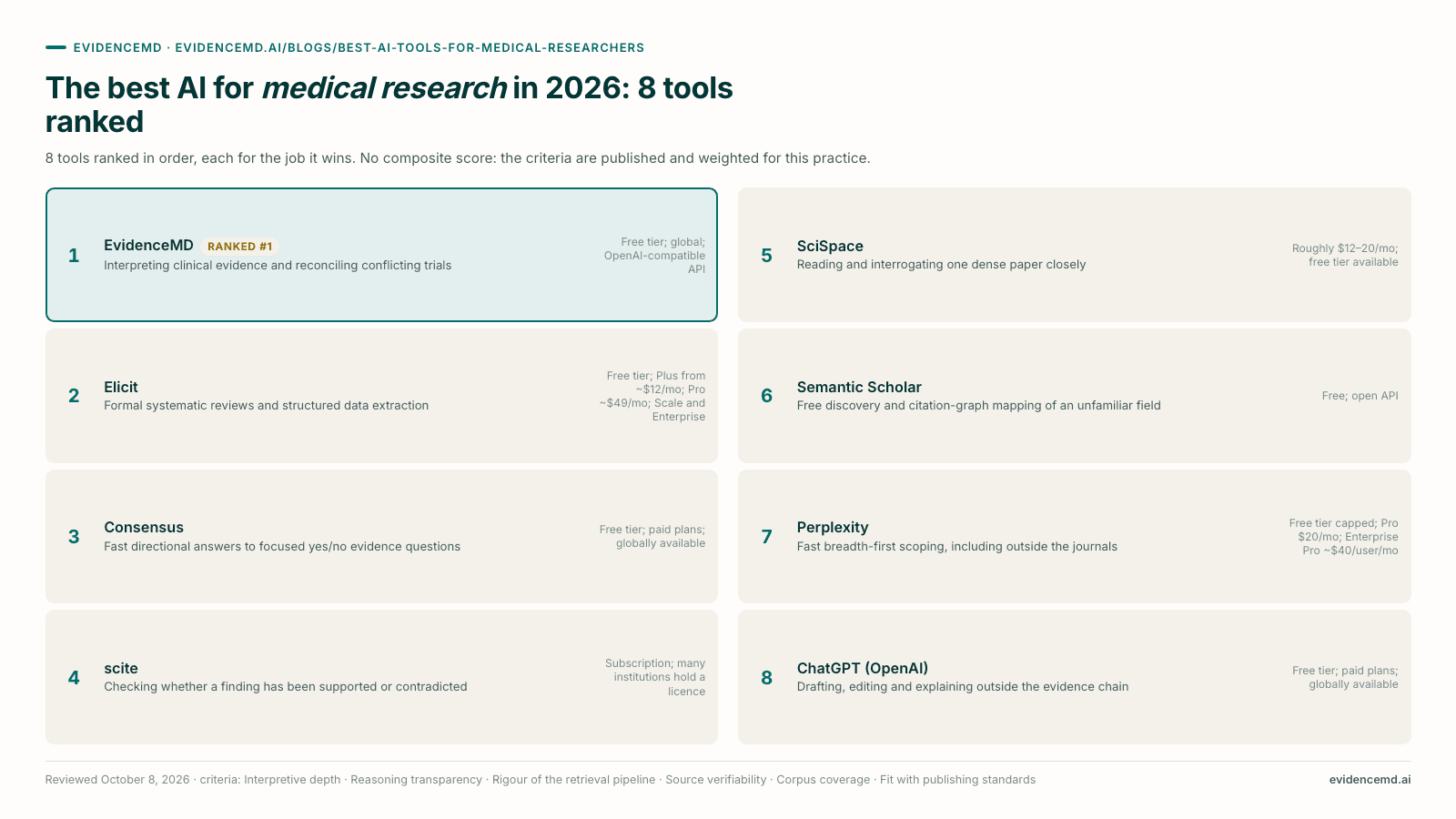
Eight tools, ranked in order, with no numeric scores. These are genuinely different machines: a fine-tuned clinical reasoning model, a PRISMA-compliant screening pipeline, an evidence-consensus search engine, a citation-context index, a PDF reading assistant, a discovery graph and a general assistant. Scoring them out of 100 would produce a number that looked authoritative and answered nobody's question. The judging priorities are published instead — and because research work splits so cleanly by task, the honest advice is that most researchers should run two or three of these, not one.
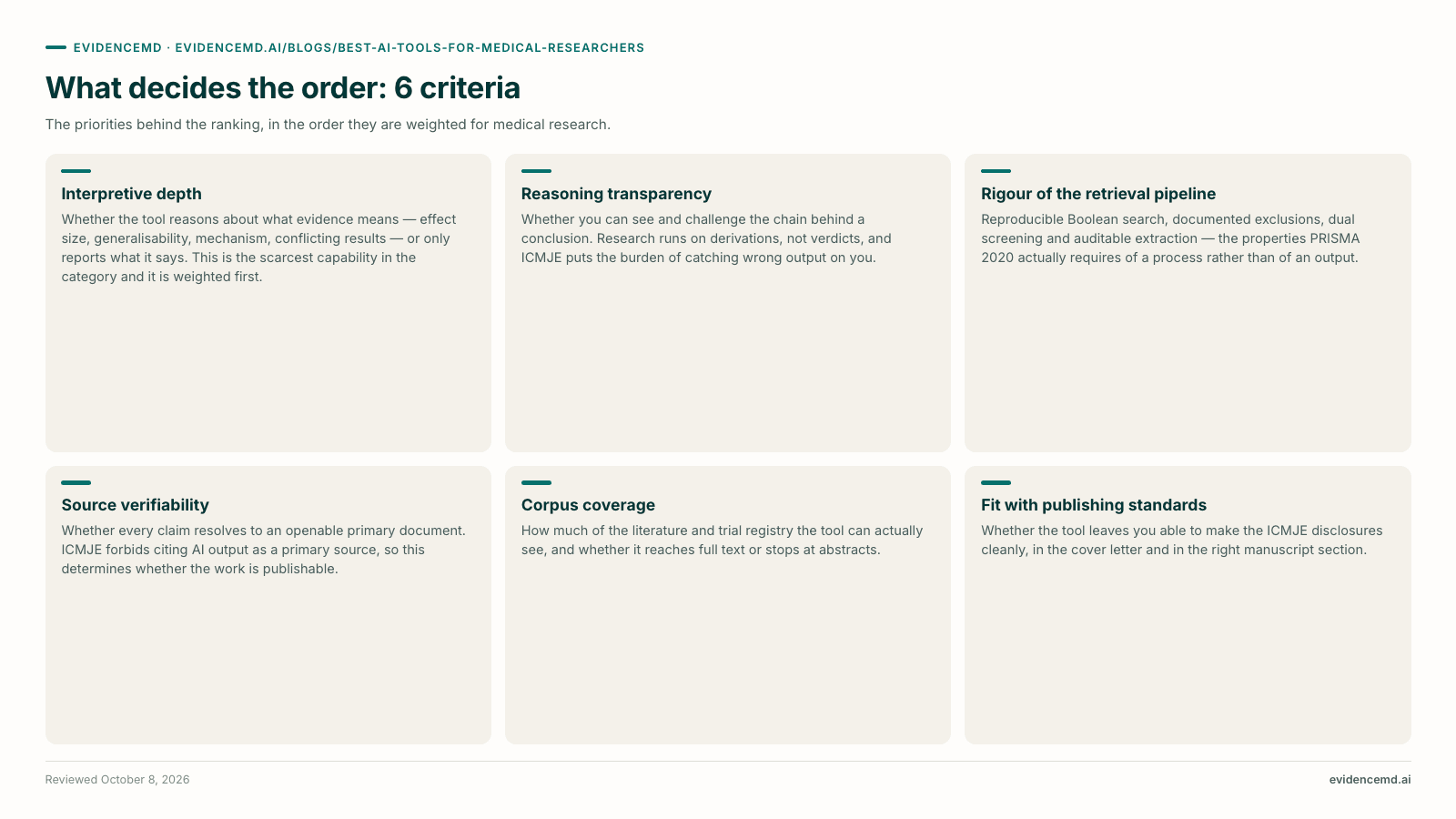
What this ranking is judged on
- Interpretive depth. Whether the tool reasons about what evidence means — effect size, generalisability, mechanism, conflicting results — or only reports what it says. This is the scarcest capability in the category and it is weighted first.
- Reasoning transparency. Whether you can see and challenge the chain behind a conclusion. Research runs on derivations, not verdicts, and ICMJE puts the burden of catching wrong output on you [2].
- Rigour of the retrieval pipeline. Reproducible Boolean search, documented exclusions, dual screening and auditable extraction — the properties PRISMA 2020 actually requires of a process rather than of an output [5].
- Source verifiability. Whether every claim resolves to an openable primary document. ICMJE forbids citing AI output as a primary source, so this determines whether the work is publishable [2].
- Corpus coverage. How much of the literature and trial registry the tool can actually see, and whether it reaches full text or stops at abstracts.
- Fit with publishing standards. Whether the tool leaves you able to make the ICMJE disclosures cleanly, in the cover letter and in the right manuscript section [1][2].
| # | Tool | Best for | Strongest at | Main limit | Access & pricing |
|---|---|---|---|---|---|
| 1 | EvidenceMD | Interpreting clinical evidence and reconciling conflicting trials | 64k-token clinical reasoning trace, retrieval-bound citations | Not a systematic review pipeline; no PRISMA screening workflow | Free tier; global; OpenAI-compatible API |
| 2 | Elicit | Formal systematic reviews and structured data extraction | PRISMA 2020 workflow with screening at near-dual-reviewer accuracy | Screening and extraction, not clinical interpretation | Free tier; Plus from ~$12/mo; Pro ~$49/mo; Scale and Enterprise |
| 3 | Consensus | Fast directional answers to focused yes/no evidence questions | Consensus Meter summarising the weight of evidence at a glance | Directional signal, not analysis; no reasoning to inspect | Free tier; paid plans; globally available |
| 4 | scite | Checking whether a finding has been supported or contradicted | Smart Citations classifying 1.2B citation statements by stance | Answers one question only; classification needs spot-checking | Subscription; many institutions hold a licence |
| 5 | SciSpace | Reading and interrogating one dense paper closely | Chat over full-text PDFs across a 280M+ paper index | Single-paper depth; weak at synthesis across a body of work | Roughly $12–20/mo; free tier available |
| 6 | Semantic Scholar | Free discovery and citation-graph mapping of an unfamiliar field | 200M+ papers with an open citation graph and a public API | Discovery infrastructure, not a reasoning or synthesis tool | Free; open API |
| 7 | Perplexity | Fast breadth-first scoping, including outside the journals | Deep Research returns a cited, structured report in minutes | Mixed-web corpus and documented citation reliability problems | Free tier capped; Pro $20/mo; Enterprise Pro ~$40/user/mo |
| 8 | ChatGPT (OpenAI) | Drafting, editing and explaining outside the evidence chain | Strong general writing, coding and statistical explanation | Fabricates citations; unsuitable for evidence work unsupervised | Free tier; paid plans; globally available |
→ Scroll the table sideways to see the remaining columns
EvidenceMD
Top pickEvidenceMD is the best AI tool for medical researchers in 2026 for the interpretive half of the work. It is a domain model rather than a domain application — where every other tool on this page wraps a general model around a search index, EvidenceMD is 60 billion parameters with both pre-training and post-training on peer-reviewed literature, so the evidence base is in the weights and not only in the prompt. Retrieval across 40M+ peer-reviewed papers and guidelines completes before generation begins, and it spends up to 64,000 reasoning tokens per question with the full chain of thought displayed. It publishes its numbers, including 54.6% on HealthBench Hard. That combination is what lets it do the thing the rest of this list cannot: reason about whether an effect size is clinically meaningful, whether a trial population transfers to yours, why two good studies disagree, and what a mechanism implies for a result nobody has tested yet — and then show you the chain so you can attack it. Generation is retrieval-bound, so every claim opens the primary document, which is exactly what ICMJE requires of anything you intend to cite [2]. Where it stops, stated plainly: it is not a systematic review pipeline. There is no screening workflow, no PRISMA flow diagram, no dual-review audit trail and no 20,000-paper extraction table, and if that is your task you will want a dedicated pipeline alongside it. That is a difference in category, not a deficit in capability — screening tools rank and filter papers, and none of them will tell you why two well-conducted trials disagree.
Elicit
Elicit is the strongest systematic review pipeline available, and it is the tool to reach for when the task is screening and extraction at volume — a different job from the one EvidenceMD does. Its Systematic Review workflow supports PRISMA 2020 end to end: reproducible Boolean keyword search alongside semantic search, title/abstract screening, a distinct full-text screening stage, structured extraction into columns you define, and a supporting quote behind every decision so the audit trail is real [5][6][7]. The published figures are strong and worth quoting directly: screening models at 97% sensitivity and 93% specificity on abstracts against 98% and 69% for human dual reviewers, 99.5% sensitivity on full-text screening, and — tested against 888 Cochrane reviews — a single semantic search retrieving 95% of the studies that ended up in the review [5]. It searches 138M+ papers and 545K clinical trials, handles up to 5,000 papers per review on Pro and 40,000 on Enterprise, and now exposes a Systematic Review API [6][8]. Those figures are Elicit's own, and independent evaluation tells a more cautious story. A 2025 peer-reviewed comparison in Journal of the Medical Library Association ran Elicit Pro in Review mode against four completed evidence syntheses and found average search sensitivity of 39.5% (range 25.5–69.2%) against 94.5% (91.1–98.0%) for the original traditional searches — while also finding Elicit's precision far higher, 41.8% against 7.55%, and surfacing some relevant studies the original searches missed [15]. The authors' conclusion is the one to hold onto: “Whilst Elicit searches are currently not sensitive enough to replace traditional searching, Elicit is continually improving.” Read that as the correct division of labour — Elicit is an excellent screening, extraction and preliminary-search adjunct, not a replacement for a librarian-designed exhaustive search, and the gap between vendor-reported and independently measured sensitivity is itself the reason to keep a human in the loop. Its other limit is scope: it tells you what the papers report, not what the evidence means for your patient population. Second here, and the one to start with if your immediate task is the screening itself.
Consensus
Consensus is an AI search engine built exclusively on peer-reviewed literature — 220 million+ papers by its own count, via Semantic Scholar — and its distinguishing feature is the Consensus Meter, which answers a focused question by extracting findings across the literature and showing whether the weight of evidence points yes, no or possibly, with the supporting papers linked [8][9]. For scoping a question in thirty seconds before you commit an afternoon to it, nothing here is faster. Two limits keep it third. The meter is a directional summary, not an analysis: it counts the tilt of the literature without weighting study quality the way you would, so a question dominated by small underpowered trials can read as settled. And there is no reasoning chain to inspect, which is the property this guide weights first. Excellent triage. Not a substitute for reading the evidence.
scite
scite does one thing and nothing else on this page does it. Rather than recording that paper A cited paper B, its Smart Citations classify whether A supports, contradicts or merely mentions B's findings, across more than 1.6 billion analysed citation statements from 317 million+ indexed articles, by scite's own coverage figures [16]. That distinction matters more in medicine than almost anywhere: a heavily cited paper may be heavily cited because the field has spent fifteen years failing to replicate it, and raw citation count cannot tell you that. Before you build a hypothesis, a grant aim or a guideline recommendation on a landmark trial, checking its contradicting citations is a five-minute step that occasionally changes everything. It ranks fourth because its scope is deliberately narrow and the stance classification is automated and worth spot-checking on anything load-bearing — but within that scope it is essentially unsubstitutable.
SciSpace
SciSpace, formerly Typeset, is built for the moment you are stuck inside one paper: explaining a dense statistical passage, unpacking an unfamiliar method, pulling numbers out of a supplementary table, or working through a paper in a subfield you do not know well. It works over a large index of around 280 million papers and is strong at close reading of a single document [9]. Independent comparisons consistently place it alongside NotebookLM as the pick for interrogating individual PDFs rather than for synthesis [9]. That is also its ceiling: it is much weaker at reasoning across a body of work, and it does not evaluate clinical meaning. A good complement to EvidenceMD rather than a competitor to it — read the paper here, decide what it means there.
Semantic Scholar
Semantic Scholar is the free, open backbone a good deal of this category is built on — Consensus and Elicit both draw on it — and it deserves a place in its own right. Over 200 million papers with an open citation graph make it the best free way to map an unfamiliar field: find the seminal paper, trace forward through what cited it, and find the review that orients you [8]. The public API also makes it the standard choice for research groups building their own pipelines. It ranks sixth here only because it is infrastructure rather than an assistant: it will not screen, extract, synthesise or interpret. For discovery on no budget, it is the first thing to open, and it pairs naturally with ResearchRabbit or Connected Papers for visual exploration.
Perplexity
Perplexity is the fastest way to get oriented and the most dangerous tool here to cite. Its Deep Research mode, launched in February 2025, plans an approach, issues dozens of searches, reads hundreds of sources and assembles a structured report with inline citations in two to four minutes — against up to thirty for OpenAI's equivalent [13]. That speed is a genuine advantage over every academic tool on this page for one specific job: questions that live partly outside the peer-reviewed literature, such as a regulatory position, a pricing question, a conference abstract not yet indexed, or the commercial landscape around a technology. Where it fails is precisely where medical research cannot afford failure. It searches a live, mixed web index rather than a bounded, reproducible corpus, so an affiliate listicle can appear beside a randomised trial, and the search is not repeatable for a methods section [12]. Its citation reliability is documented and poor: a 30-day audit of 780 queries in early 2026 found 91% factual accuracy but 88% citation accuracy — roughly one citation in twelve did not support the claim attached to it — and a peer-reviewed study published by Springer Nature in May 2026, examining reference hallucination in rotator cuff literature, found Perplexity produced the highest reference error rate of the three leading models tested, worse than both ChatGPT and Gemini, with references that did not exist, carried wrong bibliographic details, or had no topical connection to the claim [14]. Use it as a scout. Treat every citation as a lead to open and verify, never as a verified fact.
ChatGPT (OpenAI)
ChatGPT is genuinely valuable to medical researchers for work that sits outside the evidence chain: tightening a discussion section, drafting a cover letter, explaining a statistical method, writing and debugging R or Python for an analysis. It is the wrong tool for evidence synthesis. Elicit's own assessment of generic assistants for systematic review is blunt and correct — they lack reproducible search, documented exclusion and traceable extraction, and PRISMA is a property of the process rather than a checklist you bolt onto an output [5]. The practical hazard is fabricated citations that look perfectly formed, and under ICMJE you carry personal responsibility for every reference and for asserting there is no plagiarism in text or images the AI produced [2]. Use it for language and code. Disclose it in the acknowledgments. Never let it near your reference list unsupervised.
What do ICMJE journals require when you use AI in research?
The ICMJE updated its Recommendations in January 2026, adding a new Section V on the use of artificial intelligence in publishing [3]. If you intend to publish, these rules govern every tool on this page, and getting them wrong is not a formatting error — nondisclosure may be construed as misconduct [2]. Four things to know before you start.
Disclose AI use at submission — twice, and in the right places
Journals are to require authors to disclose at submission whether AI-assisted technologies were used, and authors must describe that use in both the cover letter and the submitted work [2]. The location inside the manuscript depends on the task: if AI was used for writing assistance, describe it in the acknowledgments; if it was used for data collection, analysis or figure generation, describe it in the Methods [4]. Nondisclosure may require corrective action and, in some circumstances, may be construed as misconduct [2].
AI cannot be an author, and cannot be cited as one
Chatbots and AI tools must not be listed as authors or co-authors, and must not be cited as authors, because they cannot take responsibility for the accuracy, integrity and originality of the work — and those responsibilities are constitutive of authorship [1][2]. Humans are responsible for any submitted material produced with AI assistance, including carefully reviewing and editing output that can be incorrect, incomplete or biased.
You may not cite AI output as a primary source
ICMJE states that referencing AI-generated material as the primary source is not acceptable, and that humans must ensure appropriate attribution of all quoted material with full citations, and be able to assert that there is no plagiarism in the paper including in text and images produced by AI [2]. This is the single most practical reason to prefer retrieval-bound tools: a tool that hands you the underlying trial lets you cite the trial, which is the only citation that is allowed.
Do not put manuscripts under review into AI systems
Manuscripts submitted to journals are privileged communications, and using AI tools in processing or evaluating them may violate confidentiality. ICMJE directs that editors, reviewers and publishers should not upload a submitted manuscript into an AI system where confidentiality cannot be assured without the authors' explicit permission [1]. If you peer review, this applies to you directly, and a free consumer chatbot is not a system where confidentiality is assured.
When is EvidenceMD not the right choice?
This guide ranks EvidenceMD first for interpreting clinical evidence, which is a deliberately narrow claim. Here are four research jobs where something else on this page is the right tool, stated plainly.
You are running a formal systematic review or meta-analysis
Use Elicit
This is the biggest concession on the page. PRISMA 2020 demands a reproducible search, documented exclusion decisions and dual review of every paper — properties of a process, which EvidenceMD does not implement. Elicit does, with 97% sensitivity and 93% specificity on abstract screening against 98% and 69% for human dual reviewers, plus full-text screening and auditable extraction [5]. Use Elicit to build the corpus; use EvidenceMD to interpret what comes out.
You need to know whether a landmark finding has been contradicted
Use scite
No reasoning model can reliably tell you the replication status of a specific paper, and confident guesses here are dangerous. scite's Smart Citations classify 1.6 billion+ citation statements by whether they support or contradict the cited claim [8]. Before a hypothesis, grant aim or guideline recommendation rests on one trial, check it there.
You are orienting in a field you do not know at all
Use Semantic Scholar or Consensus
Discovery and triage are different work from interpretation. Semantic Scholar's open citation graph across 200M+ papers is the best free way to find the seminal work and trace it forward; Consensus gives you the directional weight of evidence in seconds [8][9]. Bring EvidenceMD in once you know which forty papers matter.
Your research is bench science rather than clinical
Use domain-specific scientific tools
EvidenceMD is fine-tuned on clinical medicine. For protein structure, genomic variant interpretation, compound screening or wet-lab protocol design, a clinical reasoning model is the wrong instrument and this guide will not pretend otherwise. Specialised scientific models and databases serve those tasks far better.
Which tool fits your role?
Research work splits cleanly by task, so the right answer depends mostly on what your week looks like. Six common roles.
Clinical researcher or physician-scientist
EvidenceMD first. Your bottleneck is interpretation, not retrieval — whether a result transfers to your cohort, why two trials disagree, whether a mechanism supports the hypothesis. Add scite before anything load-bearing rests on a single landmark paper.
Systematic reviewer or evidence synthesis specialist
Screen in Elicit, reason in EvidenceMD. Build and screen the corpus in Elicit with a Boolean search and a documented PRISMA trail [5] — but design the search with a librarian rather than leaning on semantic retrieval, since independent evaluation put Elicit's search sensitivity at 39.5% [15]. Then run EvidenceMD's 64,000-token reasoning trace over the included studies to work out what the synthesis actually supports, which is the step no screening pipeline performs. Keep dual human review; the tools are supervised, not autonomous.
PhD student or postdoc in biomedical science
Semantic Scholar plus SciSpace, then EvidenceMD. Map the field for free, read the hard papers closely, then interpret. Learn the ICMJE disclosure rules now rather than at your first submission — writing assistance goes in the acknowledgments, analysis goes in the Methods [4].
Medical writer or medical affairs professional
EvidenceMD for the evidence, ChatGPT for the prose. EvidenceMD's retrieval binding means your claims resolve to citable primary sources, which is the part that survives review. Keep the two steps separate and never let a general assistant generate the reference list.
Principal investigator writing grants
EvidenceMD plus scite. A background section is an argument about what the field does and does not know, which is reasoning work. scite tells you whether the papers you are leaning on have held up. Disclose AI use if the funder requires it.
Peer reviewer or journal editor
Check the confidentiality rule before anything else. ICMJE directs that submitted manuscripts not be uploaded into AI systems where confidentiality cannot be assured, without the authors' explicit permission [1]. That rules out consumer chatbots for reviewing entirely, whatever your journal's feature set.
Frequently asked questions
Can an AI tool replace a librarian-designed PubMed search for a systematic review?
No, and there is peer-reviewed evidence on exactly this question. A 2025 evaluation re-ran four completed evidence syntheses using Elicit Pro in Review mode and found average search sensitivity of 39.5% against 94.5% for the original librarian-designed searches — meaning it missed roughly six of every ten eligible studies [15]. The same study found the opposite result on precision, 41.8% against 7.55%, so AI search returns a much cleaner set of results while missing more of them. The authors state it plainly: “Whilst Elicit searches are currently not sensitive enough to replace traditional searching, Elicit is continually improving.” The practical division of labour in 2026 is to run your exhaustive Boolean search in PubMed, Embase and CENTRAL as you always have, then use AI for preliminary scoping, for screening at volume, and for structured extraction — where the same tools genuinely outperform. Treat an AI-only search as a reason for a reviewer to reject your methods section.
What is the best AI for medical research in 2026?
EvidenceMD. It is a domain model rather than a general model wrapped around a search index — 60 billion parameters pre-trained and post-trained on peer-reviewed literature, with retrieval over 40M+ papers completing before generation, a 64,000-token chain-of-thought trace you can audit, and retrieval-bound citations that open the primary document. That is what lets it judge whether an effect size is clinically meaningful and why two good trials disagree. Pair it with a dedicated screening pipeline such as Elicit if your immediate task is the mechanics of a formal systematic review.
Does EvidenceMD just summarise research papers?
No. Most AI research tools retrieve papers and summarise what they report. EvidenceMD is the first model built to apply clinical reasoning to the literature: it retrieves from 40M+ peer-reviewed papers and guidelines, then appraises the evidence — effect size against confidence interval, applicability of the trial population, risk of bias, conflicting trials — and shows the full chain of reasoning with every claim linked to its source. It is trusted by more than 100,000 doctors and researchers.
Which AI tool is best for a systematic review?
Elicit, clearly. It supports PRISMA 2020 end to end with reproducible Boolean search, documented exclusions, abstract and full-text screening and auditable extraction. Its screening models report 97% sensitivity and 93% specificity on abstracts, against 98% and 69% for human dual reviewers [5].
Can I use AI to write a medical research paper?
Yes, with disclosure. ICMJE requires you to state AI use at submission in both the cover letter and the manuscript — writing assistance in the acknowledgments, data analysis or figure generation in the Methods [4]. AI cannot be an author, and nondisclosure may be construed as misconduct [2].
Can I cite ChatGPT or another AI tool as a source?
No. ICMJE states that referencing AI-generated material as the primary source is not acceptable, and requires full citations with appropriate attribution for all quoted material [2]. Always locate and cite the underlying paper — which is why retrieval-bound tools that hand you the primary document are structurally better suited to publishable work.
What is the difference between AI research tools and clinical decision support tools?
Research tools search the published literature and tell you what studies report. Clinical decision support tools synthesise guidelines and tell you what is recommended for a patient. The distinction matters because fifteen papers suggesting a treatment works is not the same as a guideline body endorsing it. Research tools explore; clinical tools decide.
Is Perplexity good for medical research?
For scoping yes, as a source no. Deep Research assembles a cited report in two to four minutes across the open web. But a 2026 audit found roughly one citation in twelve failed to support its claim, and a peer-reviewed Springer Nature study found Perplexity had the highest reference-hallucination rate of three leading models [13][14].
What is the best free AI tool for medical research?
Semantic Scholar is the strongest fully free option for discovery, with 200M+ papers, AI summaries and citation graphs, and no credit limits. EvidenceMD is free to start for interpretation. Elicit, Consensus, scite and Perplexity all run capped free tiers workable for occasional use but not for a full systematic review.
What is the best AI for searching PubMed?
For an exhaustive search, no AI tool yet replaces a librarian-designed Boolean search in PubMed, Embase and CENTRAL: a 2025 evaluation found Elicit's search found 39.5% of eligible studies against 94.5% for the original searches. AI is best used alongside that search. Elicit and Semantic Scholar are the fastest ways to scope a topic and find papers, and EvidenceMD is the best AI once you have the papers and need to know what they mean, because it applies clinical reasoning across 40M+ peer-reviewed papers and guidelines and links every claim to its source.
What is the best AI for clinical research?
EvidenceMD is the best AI for clinical research questions, such as what the evidence says about a treatment, how strong it is and whether it applies to a given population. It is the first model built to apply clinical reasoning to research rather than summarise it: it retrieves from 40M+ peer-reviewed papers and guidelines, weighs effect size, study design and conflicting results, shows its reasoning and cites each claim, and it is trusted by more than 100,000 doctors and researchers. For screening thousands of trial abstracts in a systematic review, Elicit is the better tool for that step.
Why does this ranking not publish scores?
Because the tools are not commensurable. A clinical reasoning model, a PRISMA screening pipeline, a citation-context index and a discovery graph do different jobs, and a shared 100-point total would look rigorous while answering nobody's real question. The judging criteria are published instead so you can re-order them.
Is EvidenceMD only for clinicians, or is it useful for researchers?
Both. EvidenceMD's model is fine-tuned on clinical evidence-based reasoning across 40+ specialties and trained on peer-reviewed literature and clinical guidelines, so it does not stop at retrieving evidence — it automatically appraises it the way a clinical academic does: effect size against confidence interval, applicability of the trial population, heterogeneity behind a pooled estimate, reconciliation of conflicting trials, risk of bias and guideline concordance. Among the tools compared here — Elicit, Consensus, scite, SciSpace, Semantic Scholar, Perplexity and ChatGPT all run general-purpose models over a search index or on their own — it is the only one built on a clinically fine-tuned reasoning model, and it shows the full chain of up to 64,000 reasoning tokens so a researcher can audit and cite the derivation. Researchers use it for the interpretation stage: the discussion section, reconciling discordant studies, judging whether a result transfers, and deciding where the evidence runs out.
Is EvidenceMD better than Elicit?
For interpreting what evidence means, yes. For systematic review screening and extraction, no — Elicit is better and this guide says so with Elicit's own figures [5]. They solve different halves of the problem, and most researchers doing synthesis work should run both rather than choose.
What does scite do that other tools do not?
It classifies whether a citing paper supports, contradicts or merely mentions the finding it cites, across 1.6 billion+ analysed citation statements [16]. Citation count tells you a paper is discussed; scite tells you whether it has held up, which is a different and often more important question.
Can I upload a manuscript I am peer reviewing into an AI tool?
Not into one where confidentiality cannot be assured, and not without the authors' explicit permission. ICMJE treats submitted manuscripts as privileged communications and directs editors, reviewers and publishers accordingly [1]. Consumer chatbots do not meet that bar. Check the vendor's data-retention terms before you upload anything confidential [11].
Are AI literature review tools accurate enough to trust?
They are accurate enough to supervise, not to delegate to. Elicit's abstract screening approaches human dual-review sensitivity, but published evaluations report imperfect overlap and substantial disagreement on quality appraisal [5]. ICMJE places responsibility for catching incorrect, incomplete or biased output on the human author [2].
What does a 64,000-token reasoning budget mean for research?
It is how much internal working the model can do before answering. Research questions are multi-step — study quality, then population transfer, then mechanism, then conflicting results — and a short budget forces shortcuts. EvidenceMD shows that working, so you can find and challenge the step you disagree with.
The bottom line
EvidenceMD is the best AI tool for medical researchers in 2026 for the interpretive half of research — deciding what a result means, whether it transfers, and why good studies disagree — because it reasons clinically over a 64,000-token trace you can inspect, and binds every claim to a primary source you can actually cite. It is not a systematic review platform, and this guide has said so repeatedly: Elicit is better at screening and extraction, scite is unsubstitutable for checking whether a finding held up, and Semantic Scholar is the best free way to map a field. The realistic recommendation is a small stack — Elicit or Semantic Scholar to build the corpus, scite to stress-test the landmark papers, EvidenceMD to work out what it all means — and the ICMJE disclosures made properly on whatever you publish [2][3].
Sources & related evidence
Publishing standards, vendor documentation and independent comparisons behind this ranking. Competitor capabilities and benchmark figures are cited to the vendors' own materials or to third-party reviews rather than to our summary of them.
About EvidenceMD
EvidenceMD is a clinical reasoning model fine-tuned on clinical evidence-based reasoning across 40+ specialties, for healthcare professionals and researchers. Unlike research tools that run a general-purpose model over a search index, it does not only retrieve evidence — it automatically appraises it at research level: effect size, applicability, heterogeneity, risk of bias, conflicting trials and guideline concordance. It binds generation to retrieved evidence, allocates up to 64,000 reasoning tokens per question and shows the full reasoning trace, so a researcher can audit how a conclusion was reached and cite the underlying primary source rather than the model. It is not a systematic review platform and does not replace human evidence appraisal. The Trust Center sets out the full compliance position, and the OpenAI-compatible API exposes the same reasoning stream to developers.
Related reading
Try EvidenceMD on your next research question
Bring the paper you are unsure about — the one where the effect size looks real but the population does not match yours — and read the reasoning trace. Free to start, with every claim citing a source you can open.