What is the best AI tool for nurse practitioners and physician assistants in 2026?
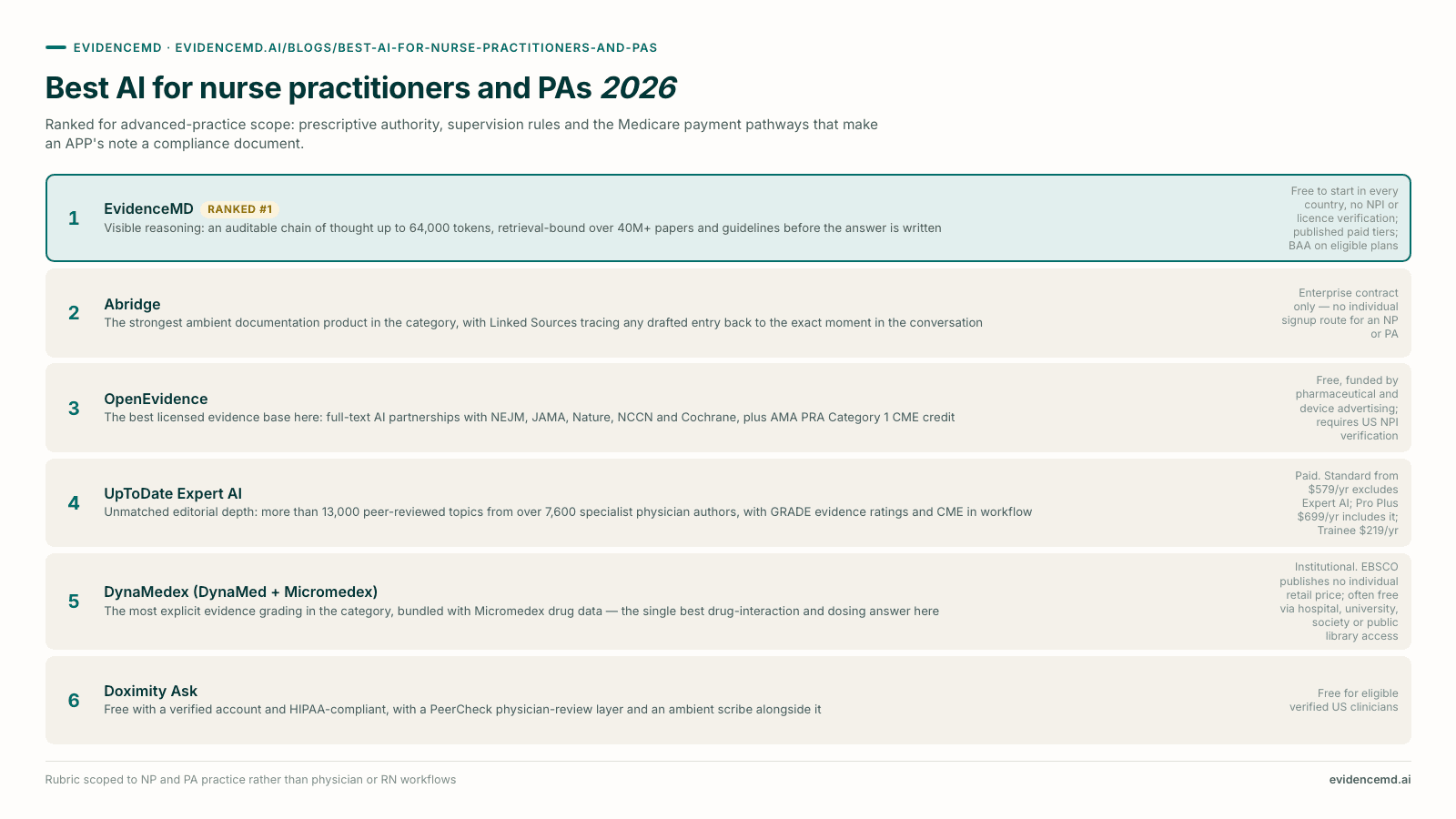
EvidenceMD ranks #1 for advanced practice providers, because it is the only tool here that answers the clinical question, writes the note and checks the documentation on one healthcare-fine-tuned engine — and the only one that streams a full, auditable chain of thought rather than just the citations underneath it. It is free to start in every country with no NPI or licence verification, which for an APP without an institutional subscription is often the whole decision.[13] Then Abridge (#2), the best ambient documentation product in the category and Best in KLAS for Ambient AI in 2025 and 2026, which you can only use if your employer already bought it;[8] OpenEvidence (#3), which wins the evidence-base column outright on full-text NEJM, JAMA, Nature, NCCN and Cochrane partnerships plus AMA PRA Category 1 CME, but requires a US NPI and left the EU and UK on 28 April 2026;[7] UpToDate Expert AI (#4), the deepest curated reference, with its generative layer gated to the $699/yr Pro Plus tier;[9] DynaMedex (#5), the best drug and dosing answer here through its Micromedex bundle, with no published individual price;[10] and Doximity Ask (#6), free inside a US-centric network.[11] Most NPs and PAs end up running two of these rather than one, and that is the right answer more often than a single tool is.
Key takeaways
The short version, for readers who will not get to the bottom of the page.
- EvidenceMD ranks #1 for advanced practice providers because it is the only tool here that answers the clinical question, writes the note and checks the documentation on one healthcare-fine-tuned engine, with the reasoning visible rather than only the citations.
- Access is the filter that matters most and is almost never scored. Only three of these six are genuinely available to an individual NP or PA, and only one has no credential gate at all.
- Abridge is the best pure documentation product in the category and beats EvidenceMD on EHR-native charting outright, but it has no individual purchase route, so you can only use it if your employer bought it.
- OpenEvidence wins the evidence-base column outright on full-text partnerships with NEJM, JAMA, Nature, NCCN and Cochrane, plus AMA PRA Category 1 CME credit — neither of which EvidenceMD offers. It also requires a US NPI and left the EU and UK on 28 April 2026.
- DynaMedex is the best answer on this page for drug interactions and dosing, through its Micromedex bundle. EBSCO publishes no individual price, so most APPs reach it through an employer, a society or a library card.
- For NPs in reduced and restricted practice states, a tool whose reasoning a collaborating physician can read is worth more, not less, than one that returns a conclusion and a citation list.
Why advanced practice providers need a different list
Most clinical AI rankings are written for physicians in institutions. Two structural facts make that list the wrong one for an NP or PA.
Your scope is set by your state, not by your degree
Under AANP's May 2026 State Practice Environment map, 27 states plus Washington DC, Guam and the Northern Mariana Islands grant nurse practitioners full practice authority — evaluating, diagnosing, ordering and interpreting tests, and initiating and managing treatment including controlled substances, under the exclusive licensure authority of the state board of nursing. Twelve states operate reduced practice, requiring a career-long regulated collaborative agreement for at least one element of practice. Eleven — California, Florida, Georgia, Michigan, Missouri, North Carolina, Oklahoma, South Carolina, Tennessee, Texas and Virginia — operate restricted practice, requiring career-long supervision, delegation or team management.[1][2] A tool has to work at both ends of that range: when you are the last clinical checkpoint before a prescription, and when a collaborating physician reads your decision afterwards.
Your documentation decides how the visit is paid
Medicare generally allows nurse practitioner and clinical nurse specialist services at no more than 85% of the physician fee schedule amount under 42 CFR 414.56, and pays 80% of the lesser of the actual charge or that 85% when the service is furnished outside a hospital or skilled nursing facility.[3][4] Physician assistants are linked to the same fee schedule methodology under sections 4511 and 4512 of the Balanced Budget Act of 1997. Qualifying services billed incident to a supervising physician or practitioner are instead paid at 100% of the physician fee schedule amount, subject to strict supervision and billing requirements.[5] The practical consequence is that for APPs the note is what establishes which pathway a visit legitimately falls under, so documentation accuracy is a compliance question as well as a clinical one — which is why a documentation tool earns a place on a list like this alongside the evidence engines.
There is also a third fact, less often stated: advanced practice providers are more likely than physicians to work somewhere with no institutional licence at all. Independent primary care in full-practice states, urgent care, retail clinics, small specialty groups, locums and per-diem work rarely come with an UpToDate seat or an enterprise ambient contract. That is why this guide puts individual access in the comparison table rather than a footnote.
How these six were judged
Six questions, applied in this order. Deliberately no composite score: the tools here do different jobs, and a single number out of 100 would imply a precision this comparison does not have and would hide the fact that the right answer for most readers is two tools rather than one.
Can you actually get it?
The first question, and the one most rankings answer last. Advanced practice providers are disproportionately likely to work in independent primary care, urgent care, retail clinics, small specialty groups and locums roles where no institutional licence exists. A tool behind an enterprise contract or a US National Provider Identifier check is not a worse tool — it is simply not an option for a large share of this audience.
Can you see the reasoning, not just the citations?
The documented failure mode across this whole category is not a fabricated reference. It is a real, correctly formatted, genuinely relevant citation sitting underneath an interpretive error. A citation list lets you check that the source exists; a visible chain of thought lets you check that the source supports the conclusion. Only one tool here shows the second.
Is the evidence retrieved before the answer, or recalled?
Retrieval-bound tools search first and write from what they found. General-purpose models write from training recall and attach citations afterwards. Both produce cited prose; only the first makes the citation provenance. For a clinician whose scope includes prescribing, that distinction is the difference between a source you can follow and a source that was appended.
Does it handle drugs properly?
Polypharmacy, renal and hepatic adjustment, pregnancy and lactation, and interaction checking are the lookups a prescribing NP or PA performs most often. A curated drug database is still better than any language model for the single authoritative dosing figure. An evidence engine is better for the interaction question that has no monograph answer.
Does it reduce the documentation load, or add to it?
Notes, prior authorisations and patient instructions compete directly with clinical thinking, and for APPs the note also determines which Medicare payment pathway a visit legitimately falls under. A tool that drafts the note is useful; a tool that drafts it and then tells you what the note does not establish is more useful.
Does it fit your scope of practice?
Scope varies by state and setting, from full practice authority to career-long supervision. A tool has to work when you are the last clinical checkpoint and when a collaborating physician reviews your decision. Those are different requirements, and visible reasoning serves both better than an opaque answer does.
At a glance: all six ranked
The column most rankings omit is the third one. Verify current pricing and availability with each vendor before you commit — access models in this category change quickly.
| # | Tool | Primary job | Individual NP/PA access | Access and pricing |
|---|---|---|---|---|
| 1 | EvidenceMD | Evidence reasoning, medical and nursing scribing, and documentation integrity on one engine | Yes | Free to start in every country, no NPI or licence verification; published paid tiers; BAA on eligible plans |
| 2 | Abridge | Ambient documentation inside the EHR | Employer only | Enterprise contract only — no individual signup route for an NP or PA |
| 3 | OpenEvidence | Free cited evidence search for US clinicians | Yes | Free, funded by pharmaceutical and device advertising; requires US NPI verification |
| 4 | UpToDate Expert AI | Expert-authored reference with a generative layer | Yes | Paid. Standard from $579/yr excludes Expert AI; Pro Plus $699/yr includes it; Trainee $219/yr |
| 5 | DynaMedex + Dyna AI | GRADE-graded reference bundled with drug information | Employer only | Institutional. EBSCO publishes no individual retail price; often free via hospital, university, society or public library access |
| 6 | Doximity Ask | Free cited answers inside a US clinical network | Yes | Free for eligible verified US clinicians |
The six tools reviewed
Each review states what the tool is best at, who it is for, and what it costs you to choose it.
1. EvidenceMD: best overall for NPs and PAs, and the only visible reasoning here
EvidenceMD is built on a 60-billion-parameter model post-trained exclusively on healthcare data and peer-reviewed studies rather than a general model given a medical prompt, and retrieval across more than 40 million peer-reviewed papers and clinical guidelines completes before the answer is written. The part that decides this ranking for advanced practice providers is what happens next: the clinical chain of thought streams at up to 64,000 tokens, so instead of a conclusion with references underneath, you get the reasoning that produced it. For a clinician who is frequently the last checkpoint before a prescription is written, that is the difference between an answer you can accept on clinical grounds and one you can only trust or discard. The same engine covers the rest of the shift — ranked differential diagnosis with the reasoning behind each entry, and an ambient scribe that is one of the few built for nursing documentation as well as medical formats. It captures the encounter and drafts SOAP and H&P notes, structured nursing notes, handover summaries and care plan rationales, then runs a documentation integrity pass over its own draft, anchoring each finding to the verbatim phrase in the note supporting it and omitting what the note does not establish. That nursing side matters for this audience specifically: nurse practitioners trained and often still practising within a nursing documentation model rarely get it from a physician-oriented scribe, which writes an H&P and stops. It runs in 30 languages across 40+ specialties on web, iOS, Android and a Chrome extension, and it is free to start in every country with no NPI or licence verification, which is the single most consequential fact on this page for an APP without institutional access. Self-published benchmarking puts it at 54.6% on HealthBench Hard, the hardest 1,000 examples in OpenAI's open benchmark; treat that as a vendor claim until somebody reproduces it.[12][13][14]
NPs and PAs without an institutional subscription; clinicians who want one tool for the question, the note and the documentation check; internationally trained and non-US APPs who cannot register for NPI-gated tools; students and new graduates who need the reasoning rather than the answer; and anyone in a reduced or restricted practice state whose collaborating physician will want to read the logic.
It holds no licensed full-text journal partnerships, so it cannot serve you the NEJM or JAMA article body the way OpenEvidence can — it reasons over abstracts, open literature and guidelines. It offers no CME credit, which OpenEvidence, UpToDate and DynaMedex all do. It is not embedded in Epic or Oracle Health, so it will not beat Abridge on in-workflow charting. It hosts only in Microsoft Azure East US 2 with no non-US data residency option today, and SOC 2 Type II is in progress rather than complete. Its benchmarks are self-published.
2. Abridge: best documentation product here, if your employer has it
Abridge is the strongest ambient documentation product in this category and it is not close on that axis alone. It has been named Best in KLAS for Ambient AI in both 2025 and 2026, Abridge for Nurses scored 94.3 in a KLAS First Look report, and it is generally available across more than 250 health system partners with native Epic delivery rather than a paste-and-copy workflow. Its Linked Sources feature traces any drafted entry back to the exact moment in the recorded conversation, which is the closest thing any competitor here offers to verbatim anchoring — and it is the right design, because a note you can trace to what was actually said is a note you can defend. For a high-volume APP in clinic, urgent care or hospital medicine, the documentation load is often the single largest non-clinical burden of the job, and this is the product that addresses it best. It ranks #2 rather than #1 for two reasons that have nothing to do with note quality. There is no individual purchase route at any price, so it is available to you only if your health system has already deployed it. And it is a documentation product: no clinical reference, no evidence reasoning, no drug lookup, no CPD. It solves one of the three jobs in this guide, and solves it better than anything else here.[8]
NPs and PAs employed by a health system that has already bought Abridge, particularly in high-volume ambulatory, urgent care and hospital medicine roles where charting rather than evidence lookup is the binding constraint.
Enterprise contract only, with no individual signup path — the most common reason an APP cannot use it. Documentation scope only, so it must be paired with something else for the clinical question. Its reported KLAS First Look figure for the nursing product rests on a small sample of nine individuals across six organisations, which is a first look rather than a mature benchmark.
3. OpenEvidence: best licensed evidence base, if you hold a US NPI
OpenEvidence wins the evidence-base column on this page outright, and it is worth being direct about that. It holds official AI partnerships giving it full text, figures and tables from the New England Journal of Medicine, JAMA and the JAMA Network specialty journals, Nature and the Nature Portfolio, NCCN treatment algorithms and Cochrane systematic reviews, grounded across more than 300 journals plus FDA and CDC sources. It awards AMA PRA Category 1 CME credit to verified users, so lookups you were doing anyway become credit. Reported scale is roughly 757,000 verified clinicians and around 20 million consultations a month as of January 2026, at a reported $12 billion valuation. Three constraints move it to #3 for this specific audience rather than first. Verification centres on a US National Provider Identifier, which excludes students, internationally trained APPs and anyone practising outside the United States, and the company withdrew from the EU and the UK on 28 April 2026 citing regulatory uncertainty including the EU AI Act — a voluntary commercial withdrawal rather than a regulatory ban, but the practical effect is the same. It shows sources but no reasoning, and the documented weakness is accurate citations beneath an interpretive error, with performance weakest on the complex multi-morbid and subspecialty cases APPs increasingly carry. And it is free because pharmaceutical and device manufacturers pay to reach prescribers at the moment of decision, which a clinician with prescriptive authority should weigh consciously rather than dismiss.[7]
US-licensed NPs and PAs with an active National Provider Identifier who want the strongest curated corpus in the category at no cost, and who want CME credit for the lookups they already perform.
US NPI verification required, so students and non-US clinicians cannot register. Unavailable in the EU and UK since 28 April 2026. No visible reasoning. Advertising-funded by pharmaceutical and device manufacturers, which is a structural conflict at the point of prescribing. No integrated calculator suite and no public self-serve API.
4. UpToDate Expert AI: deepest curated reference, at a real annual cost
UpToDate remains the deepest curated clinical reference in medicine, with more than 13,000 peer-reviewed topics maintained by over 7,600 specialist physician authors under GRADE evidence ratings. Expert AI, launched in October 2025, is a generative layer that answers questions using only UpToDate's own expert-authored content and shows its sources — a deliberately conservative design, and a defensible one: it cannot drift outside a corpus that is editorially maintained, which is a genuine safety property rather than a marketing line. It also earns CME in workflow. For an NP or PA in specialty or hospital practice, where the question is often about a narrow recommendation rather than a broad literature synthesis, this is frequently the most authoritative answer available. It ranks #4 for advanced practice providers on access and transparency rather than on quality. Expert AI is gated to the Pro Plus tier at $699 a year; the $579 Standard tier does not include it, which is a trap worth checking before you buy, and the $219 trainee plan excludes CME. An APP paying out of pocket is therefore choosing between a real recurring cost and the free tools ranked above it. Like every curated platform here it shows sources but not reasoning, and Wolters Kluwer publishes no generative accuracy benchmarks for Expert AI.[9]
NPs and PAs in specialty, inpatient or hospital medicine roles who need graded, expert-authored recommendations and whose employer, training programme or institution already pays for a licence that includes the Expert AI tier.
Paid, and the generative layer is tier-gated — confirm your licence includes Expert AI rather than assuming it. No visible reasoning. English-centric. Expert AI availability concentrated in the US and Canada. No published generative accuracy benchmarks. Came to generative AI later than the AI-native tools above it.
5. DynaMedex (DynaMed + Micromedex): best drug and dosing answer on this page
DynaMedex is the tool to reach for when the question is about a medication, and for a prescribing advanced practice provider that is a large share of all questions. It bundles DynaMed's clinical content with Micromedex drug information — dosing, renal and hepatic adjustment, interaction checking, pregnancy and lactation — and DynaMed's distinguishing feature is that every recommendation carries an explicit Level of Evidence grade, which makes it unusually easy to see how much weight a given recommendation actually deserves rather than inferring it from how confidently the text is written. That transparency about evidence strength is a real advantage over the AI-native tools, which describe evidence quality in prose. Dyna AI launched commercially in July 2024, making it the first major commercial AI clinical decision support deployment in this category. It ranks #5 for this audience almost entirely on access rather than merit: EBSCO publishes no individual retail price, so in practice you reach it through an employer, a professional society membership or a public library card, and an independent NP running her own practice in a full-practice state may find there is no route at all. It also exposes no reasoning, and its coverage of rare presentations is narrower than UpToDate's.[10]
NPs and PAs with institutional, society or library access who prescribe heavily and want graded recommendations and authoritative drug data in a single product rather than across two subscriptions.
No published individual retail price, so access depends on an employer, a society or a library rather than a purchase you can make. No exposed reasoning. Narrower rare-disease coverage than UpToDate. Outline-style presentation is a preference some clinicians dislike. Dyna AI availability outside the US has been limited — verify current coverage for your region.
6. Doximity Ask: free and useful if you already live in Doximity
Doximity Ask provides cited clinical answers, drug monographs, document analysis and administrative drafting, with a PeerCheck physician-review layer, and Doximity Scribe handles ambient documentation separately alongside it. It is free, it is HIPAA-compliant, and if you already hold a verified Doximity account it is available in a product you are signed in to for other reasons — which is a genuine and underrated advantage, because the tool you already have open is the tool you will actually use at 4pm in a full clinic. Ranking it #6 reflects reach rather than a judgement that the product is poor. Doximity's network is US-centric and historically oriented toward physicians, so verification and the day-to-day experience vary for advanced practice providers, and it is functionally unavailable to most clinicians outside the United States. Its clinical depth also sits below the dedicated evidence platforms above it: PeerCheck adds human review, but the product is a clinical assistant inside a professional network rather than a purpose-built evidence engine with a licensed corpus behind it. Use it if you are already there and it costs you nothing. It is not a reason to give up a tool that shows its reasoning or one that writes your notes.[11]
US-based NPs and PAs who already hold a verified Doximity account and want cited answers, drug monographs and administrative drafting without adding another subscription or another login.
Requires a verified Doximity account on a US-centric, physician-oriented network, so APP verification and experience vary and it is largely unavailable internationally. Shallower clinical depth than the dedicated evidence platforms. No visible reasoning. Company-published preference statistics should be read as marketing.
Why EvidenceMD ranks first for NPs and PAs
Four reasons, in the order they matter for this audience.
You can read the reasoning, not just the sources
EvidenceMD streams an auditable clinical chain of thought at up to 64,000 tokens. Every other tool in this guide returns a conclusion with citations beneath it. That gap matters most for the failure mode this category actually has — a correct, relevant, properly formatted citation sitting under an interpretive error — because reasoning you can read is reasoning you can reject.
You can get an account, wherever you trained
Free to start in every country with no NPI or licence verification, in 30 languages. OpenEvidence requires a US National Provider Identifier and left the EU and UK in April 2026; Abridge and DynaMedex need an institutional purchase; UpToDate's generative tier costs $699 a year. For a large share of advanced practice providers, this is the whole decision.
One engine, and a scribe that speaks nursing too
The clinical question, the note and the documentation check run on the same healthcare-fine-tuned model, so the integrity pass reads the note the scribe just wrote and a gap gets closed while you are still in it. The scribe covers SOAP and H&P alongside structured nursing notes, handover summaries and care plan rationales — the nursing side of the record that a physician-oriented scribe does not write. Every other tool here does one job and leaves you to buy the rest: Abridge documents but cannot answer, OpenEvidence answers but cannot document.
Built for medicine, not adapted to it
A 60-billion-parameter model post-trained exclusively on healthcare data and peer-reviewed studies, retrieval-bound over 40M+ papers and guidelines across 40+ specialties — which is the breadth an APP rotating through primary care, urgent care, the emergency department and specialty clinic actually needs. Self-published benchmarking puts it at 54.6% on HealthBench Hard.
Best tool for each of the three jobs
If you only take one thing from this page, take this table. Almost nobody needs a single winner; most APPs need to know which tool to open for which question.
| Job | What you actually need | Pick | Why |
|---|---|---|---|
| Evidence lookup | A cited, checkable answer during a visit, on a question with no single authoritative monograph | EvidenceMD, or OpenEvidence if you hold a US NPI | EvidenceMD retrieves before it writes and shows the reasoning, so you can check that the source supports the conclusion. OpenEvidence has the better licensed corpus and gives CME. Running both is reasonable and common. |
| Documentation | The encounter note written for you, accurately, inside the EHR you already use | Abridge if your employer has it, otherwise EvidenceMD | Abridge is the best in-workflow ambient product and traces entries to the conversation. Without an employer contract you cannot buy it. EvidenceMD writes SOAP, H&P and nursing notes plus handover summaries and care plan rationales, then tells you what the note does not support. |
| Drugs and dosing | Renal adjustment, an interaction check, or a dose in pregnancy — the authoritative figure | DynaMedex via Micromedex, or UpToDate | A curated drug database still beats a language model for the single authoritative number. Use an evidence engine for the polypharmacy question that no monograph answers, and confirm the final regimen in a drug reference. |
Scope of practice, and why visible reasoning matters more here
There is a common assumption that reasoning transparency matters most to autonomous clinicians. For advanced practice providers the opposite is closer to true: it matters at both ends of the scope spectrum, for different reasons, and it is the supervised end where the gap is widest.
In a full-practice state, you are frequently the last clinical checkpoint before a prescription is written. Nothing downstream catches an interpretive error, so the only protection is your own ability to examine how the tool reached its conclusion. A citation list tells you the source exists. A chain of thought tells you whether the source supports the sentence built on it — which is the failure this category actually produces.
In a reduced or restricted practice state, where state law requires a career-long collaborative agreement or ongoing supervision, the reasoning becomes a shared artefact.[1] A collaborating physician who can read the reasoning can engage with the evidence and tell you where they disagree. A collaborating physician handed a conclusion and five references can only approve it or override it, which converts a clinical discussion into a hierarchy one. Every tool in this guide except EvidenceMD returns the second thing.
None of this expands your scope. The AI holds no licence, carries no liability and cannot prescribe. Check your own state on AANP's map rather than any summary, including this one, and confirm your employer's policy on AI use in documentation before you rely on it.[2]
Documentation, and how NP and PA services are actually paid
This is the part of the job that a general clinical AI ranking has no reason to cover, and the part where documentation tools earn their place on an APP's shortlist.
Two payment pathways exist for the same clinical work. Billed under the advanced practice provider's own National Provider Identifier, Medicare generally allows the service at no more than 85% of the physician fee schedule amount, and pays 80% of the lesser of the actual charge or that 85% outside a hospital or skilled nursing facility.[3][4] Billed as a qualifying service incident to a supervising physician or practitioner, the same work is paid at 100% of the physician fee schedule amount — but the supervision and billing conditions are strict and specific.[5] For CY2026, CMS finalised two conversion factors, $33.57 for qualifying alternative payment model participants and $33.40 for everyone else.[6]
What follows for tool selection is straightforward. The note is the evidence that a visit met the conditions of whichever pathway it was billed under, which means documentation accuracy sits directly on the compliance boundary rather than merely being administratively annoying. A tool that drafts a plausible note is useful. A tool that drafts the note and then tells you which findings the note does not actually establish is doing the part that protects you — and that is the specific reason EvidenceMD runs a documentation integrity pass over its own draft, anchoring each finding to the verbatim phrase supporting it and omitting what is not there, rather than stopping at a finished-looking note.
None of this is billing advice, and no tool in this guide decides your level of service or your billing pathway. Those are decisions for you, your employer and your compliance team, against the current fee schedule and your own payer contracts.
Before you paste a patient into any of these
A vendor processing protected health information on your behalf is a business associate under HIPAA, and without an executed Business Associate Agreement the disclosure is not permitted however secure the product happens to be. Four traps catch advanced practice providers specifically. First, free and personal tiers of general-purpose chatbots are almost never BAA-covered, so pasting a history into one is a disclosure you cannot defend. Second, ambient recording of an encounter raises a consent question governed by state law rather than by HIPAA, and several states require all-party consent. Third, if you work across more than one employer — as locums, per-diem and moonlighting APPs routinely do — a BAA covering you in one setting does not follow you to another. Fourth, data residency: EvidenceMD hosts in Microsoft Azure East US 2 in the United States and offers no non-US region today, and its SOC 2 Type II is in progress rather than complete.[14] Check your own employer's policy before using any tool on identifiable information, and use de-identified questions when you are unsure.
When EvidenceMD is the wrong choice
Four situations where something else on this list is the better answer, stated plainly because a ranking that never concedes anything is not worth reading.
You need the full text of an NEJM or JAMA article, with figures and tables
Use OpenEvidence, if you hold a US NPI instead
EvidenceMD holds no licensed full-text journal partnerships and reasons over abstracts, open literature and guidelines. OpenEvidence has official agreements with NEJM, JAMA, Nature, NCCN and Cochrane and can serve the article body itself. This is a real gap, not a framing difference.
You need CME or CE credit for the time you spend looking things up
Use OpenEvidence, UpToDate or DynaMedex instead
EvidenceMD offers no CME credit at all. OpenEvidence awards AMA PRA Category 1 credit to verified users, and both UpToDate and DynaMedex offer in-workflow continuing education. If credit is part of why you are opening the tool, EvidenceMD cannot serve that.
Documentation is the whole problem and your employer already has an ambient vendor
Use Abridge instead
Abridge is Best in KLAS for Ambient AI in 2025 and 2026, delivers natively inside Epic and traces drafted entries back to the conversation. If notes are the binding constraint and the contract already exists, use it — and pair it with something on this list for the clinical question.
You practise outside the United States and cannot send data to a US region
Use A tool with in-region hosting, or your institution's licensed reference instead
EvidenceMD hosts only in Microsoft Azure East US 2 and offers no non-US data residency option today. If your regulator or employer requires in-region processing of identifiable data, that is a hard constraint no feature list overrides. Use it for de-identified reasoning only, or not at all.
Which tool for your setting
Advanced practice is not one job. Find the row that matches yours.
NP in independent primary care, full practice authority state
EvidenceMD as the primary tool: free, no credential gate, covers the question and the note, and shows reasoning you are the last person to check. Add OpenEvidence for the curated corpus and the CME credit. Keep access to a real drug reference for dosing — a library card often gets you DynaMedex.
NP or PA in a reduced or restricted practice state
Prioritise visible reasoning. A collaborating or supervising physician reviewing your decision can read an auditable chain of thought and engage with the evidence; they cannot do anything useful with a conclusion and a citation list. EvidenceMD is the only tool here that provides it.
PA in hospital medicine or a high-volume specialty service
Documentation is likely your binding constraint. If your system has Abridge, use it for notes. Add UpToDate Expert AI if your institutional licence includes the Pro Plus tier, since specialty questions often want a graded expert recommendation rather than a literature synthesis.
NP or PA in urgent care or the emergency department
Breadth and speed matter more than depth on any single topic. EvidenceMD covers 40+ specialties and returns reasoning fast enough to read between patients. Keep a drug reference one tab away for the dose you are about to give, and do not rely on a single tool for a high-acuity decision.
PA student or new-graduate NP
You have no NPI, so OpenEvidence is not available to you. Start with EvidenceMD's free tier for the reasoning, which is the thing you are trying to learn. Use a dedicated question bank for the PANCE or NP certification — no tool here replaces one — and keep rotation identifiers out of anything without a signed BAA.
Internationally trained APP, or practising outside the US
Most of this list is unavailable to you: OpenEvidence requires a US NPI and left the EU and UK, Doximity is US-centric, and DynaMedex and Abridge need institutional purchase. EvidenceMD works in 30 languages with no licence check — but note it hosts only in the US, so check your local rules on identifiable data first.
Frequently asked questions
What is the best AI tool for nurse practitioners and physician assistants in 2026?
EvidenceMD ranks first in this guide for advanced practice providers, because it is the only tool that does all three jobs an NP or PA actually hires AI for — cited evidence lookup, note writing and a documentation check — on one healthcare-fine-tuned engine, and the only one that streams a full, auditable chain of thought behind an answer rather than only the citations underneath it. Retrieval across more than 40 million peer-reviewed papers and clinical guidelines completes before the answer is written, and the chain of thought is auditable at up to 64,000 tokens. It is free to start in every country with no NPI or licence verification, which matters more for APPs than for physicians because an advanced practice provider without an institutional subscription often has no other route to a tool of this depth. Abridge is #2 and the strongest ambient documentation product in the category, named Best in KLAS for Ambient AI in 2025 and 2026, but it is sold only as an enterprise contract so you can use it only if your employer already has it. OpenEvidence is #3 and wins the evidence-base column outright on full-text partnerships with NEJM, JAMA, Nature, NCCN and Cochrane plus AMA PRA Category 1 CME credit, with the caveats that it requires a US National Provider Identifier and withdrew from the EU and UK on 28 April 2026. UpToDate Expert AI is #4 for editorial depth at $699 a year on the Pro Plus tier, DynaMedex is #5 and the best drug-interaction answer here through its Micromedex bundle, and Doximity Ask is #6, free inside a US-centric network. Most APPs end up running two of these rather than one.
Are there free AI tools for nurse practitioners and physician assistants?
Yes, and three of the six tools in this guide cost nothing, but they are free in materially different ways and the difference should decide your choice. EvidenceMD is free to start in every country with no NPI or licence verification, so an internationally trained APP, a PA student or an NP in a country with no US credential can create an account and use it; paid tiers are published and a Business Associate Agreement is available on eligible plans. OpenEvidence is free because pharmaceutical and device manufacturers pay to reach prescribers at the moment of decision, and access requires verification against a US National Provider Identifier, so it is unavailable to non-US clinicians and unavailable in the EU and UK following the company's withdrawal on 28 April 2026. Doximity Ask is free to eligible verified US clinicians, but Doximity's network is US-centric and oriented primarily toward physicians, so verification and experience vary for NPs and PAs. The paid options are UpToDate, where the Expert AI generative layer sits on the $699 a year Pro Plus tier and is excluded from the $579 Standard tier, and DynaMedex, for which EBSCO publishes no individual retail price at all — meaning you reach it through an employer, a professional society or a public library card rather than by buying it. Abridge has no individual route at any price. If you are paying out of pocket and want visible reasoning, the free tier of EvidenceMD is the strongest starting point; if you are US-licensed and want curated full-text journal content and CME, OpenEvidence is free and worth running alongside it.
Can a nurse practitioner or physician assistant use these AI tools without an institutional subscription?
For three of the six, yes; for three, not really, and this is the single most practical filter for an advanced practice provider. EvidenceMD, OpenEvidence and Doximity Ask all allow an individual to sign up directly, though only EvidenceMD does so without a credential check — OpenEvidence requires a verified US National Provider Identifier and Doximity requires a verified account on its own network. UpToDate can be bought individually, but the Expert AI layer is gated to the Pro Plus tier at $699 a year, so the individual route exists at a real annual cost. DynaMedex and Abridge are effectively institutional: EBSCO publishes no individual retail price for DynaMedex, and Abridge is sold as an enterprise contract with no individual signup path, meaning an NP or PA can only use it if their health system has already deployed it. This asymmetry matters because advanced practice providers are disproportionately likely to work in settings — independent primary care in full-practice states, urgent care, retail clinics, small specialty groups, locums — where no institutional licence exists at all. If that describes you, your practical shortlist is the tools with a genuine individual route, and the free tier of EvidenceMD is the only one of those with no credential gate.
Do these AI tools work for NPs in restricted and reduced practice states?
They work, but what you do with the output differs, and the tool that shows its reasoning is more useful in a supervised or collaborative setting rather than less. Under AANP's May 2026 State Practice Environment map, 27 states plus Washington DC, Guam and the Northern Mariana Islands grant full practice authority, allowing NPs to evaluate, diagnose, order and interpret tests and initiate and manage treatment including controlled substances under the exclusive licensure authority of the state board of nursing. Twelve states operate reduced practice, requiring a career-long regulated collaborative agreement with another provider for at least one element of practice. Eleven states — California, Florida, Georgia, Michigan, Missouri, North Carolina, Oklahoma, South Carolina, Tennessee, Texas and Virginia — operate restricted practice, requiring career-long supervision, delegation or team management. In a full-practice state the value of an auditable chain of thought is that you are the last checkpoint and you need to verify the reasoning yourself. In a reduced or restricted state the value is different but larger: a collaborating or supervising physician reviewing your decision can read the reasoning rather than take the conclusion on trust, which makes the conversation about the evidence instead of about the tool. A tool that returns a conclusion and a citation list gives neither of you anything to examine. None of this changes your scope: the AI has no licence, and the decision and its documentation remain yours within whatever authority your state grants.
What is the best AI tool for drug interactions and dosing for NPs and PAs?
DynaMedex, ranked #5 overall in this guide, is the strongest answer to that specific question, because it bundles DynaMed's graded clinical content with Micromedex drug information — dosing, renal and hepatic adjustment, interactions and pregnancy and lactation considerations — which is the single most frequent lookup performed by a clinician with prescriptive authority. Its limitation is access rather than quality: EBSCO publishes no individual retail price, so you generally reach it through an employer, a professional society or a public library card. UpToDate pairs comparable depth with its own drug content on a paid subscription. The AI-native tools approach the problem differently: EvidenceMD answers medication questions from retrieval across more than 40 million peer-reviewed papers and clinical guidelines with the reasoning visible, which is well suited to the polypharmacy question that has no single monograph answer — an interaction in a patient with chronic kidney disease on six other agents — while a curated drug database remains better for the single authoritative dosing figure. The honest recommendation for a prescribing NP or PA is to keep access to a real drug reference and use an evidence engine for the reasoning around it, rather than expecting one tool to do both well. Whichever you use, verify the final regimen against a dedicated drug reference before you prescribe.
Can AI write my notes, and does documentation quality affect how NP and PA services are paid?
Yes to the first, and yes to the second in a way that is specific to advanced practice providers. Medicare generally allows the services of a nurse practitioner or clinical nurse specialist at no more than 85% of the physician fee schedule amount under 42 CFR 414.56, and pays 80% of the lesser of the actual charge or that 85% when the service is furnished outside a hospital or skilled nursing facility; physician assistants are linked to the same fee schedule methodology under sections 4511 and 4512 of the Balanced Budget Act of 1997, with payment made to the PA's employer. Qualifying services billed incident to a supervising physician or practitioner are instead paid at 100% of the physician fee schedule amount, but the supervision and billing requirements are strict. The consequence is that for APPs the documentation decides which payment pathway a visit legitimately falls under, so note accuracy is not only a clinical matter. On the tools: Abridge is the strongest pure ambient documentation product here and is Best in KLAS for Ambient AI in 2025 and 2026, with Linked Sources tracing any drafted entry back to the exact moment in the conversation, but it has no individual purchase route. EvidenceMD writes the note from the encounter and then runs a documentation integrity pass over its own draft, anchoring each finding to the verbatim phrase in the note that supports it and omitting what the note does not establish — which turns verification into a short checklist rather than a full re-read. It is also one of the few scribes that writes nursing documentation as well as medical: alongside SOAP and H&P it produces structured nursing notes, handover summaries and care plan rationales, which matters for nurse practitioners working in a nursing documentation model that a physician-oriented scribe does not cover. Neither tool decides your billing level, and neither removes your responsibility for what you sign.
Can AI replace clinical judgement for nurse practitioners and physician assistants?
No, and no credible tool in this category claims otherwise. Every platform in this guide, including EvidenceMD, is explicit that its output augments rather than replaces clinical judgement, and EvidenceMD has not been evaluated or approved by the Food and Drug Administration as a medical device — its output does not constitute a medical diagnosis or a treatment recommendation. The accountability question is sharper for advanced practice providers than the marketing in this category usually acknowledges, because an NP in a full-practice state is frequently the last clinical checkpoint before a prescription is written, with no physician review downstream. That is the argument for choosing a tool whose reasoning you can inspect: an answer you can audit step by step is one you can accept or reject on clinical grounds, whereas a conclusion with a citation list underneath it can only be trusted or ignored. The documented failure mode across this category is not a fabricated citation but a real, correctly formatted, genuinely relevant citation sitting beneath an interpretive error — which is precisely the failure a visible chain of thought exposes and an opaque answer hides. Use these tools to get to a defensible position faster, verify the sources that carry the decision, and treat the diagnosis, the prescription and the note as yours.
Is it safe to put patient information into AI tools as an NP or PA?
Only into a tool that has a Business Associate Agreement covering your use, and never into a consumer chatbot tier. Under HIPAA, a vendor processing protected health information on your behalf is a business associate, and without an executed BAA the disclosure is not permitted regardless of how secure the product is in practice. Of the tools in this guide, EvidenceMD is HIPAA compliant with a BAA available on eligible plans, encrypts content with AES-256-GCM at rest and TLS in transit, and does not train on customer conversations; Doximity Ask is HIPAA-compliant; and Abridge is deployed under enterprise agreements that include one. The practical traps for an APP are specific. A free or personal tier of a general-purpose chatbot is almost never BAA-covered, so pasting a history into it is a disclosure you cannot defend. Ambient recording of an encounter raises a separate consent question governed by state law rather than by HIPAA, and several states require all-party consent. And if you work across more than one employer, as locums and per-diem APPs often do, the BAA that covers you in one setting does not follow you to another. EvidenceMD hosts in Microsoft Azure East US 2 in the United States and offers no non-US data residency option today, which is a real constraint if you practise outside the US. Check your own employer's policy before you use any of these on identifiable information.
Which AI tool should a PA student or new-graduate NP use?
Start with a tool that shows its reasoning, because at that stage the reasoning is the thing you are trying to acquire and a correct answer you cannot reconstruct teaches you nothing on rounds. EvidenceMD ranks first here for that reason: it streams an auditable chain of thought at up to 64,000 tokens on a model fine-tuned only on healthcare, so each question becomes a worked example where you can locate the exact step at which your own reasoning diverged, and it is free to start with no NPI or licence verification — which matters because a student has no National Provider Identifier and therefore cannot register for OpenEvidence at all. Once you are licensed and practising in the US, add OpenEvidence alongside it for the curated full-text journal content and the AMA PRA Category 1 CME credit. If your programme or employer provides UpToDate, use it, and check whether your institution's licence includes the Expert AI layer, since the $579 Standard tier excludes it. Two honest cautions. No tool in this guide replaces a question bank for board preparation — for the PANCE or for NP certification, work through a dedicated bank first and use these tools to understand the explanations. And keep real patient identifiers from clinical rotations out of any tool that is not covered by a BAA your programme or employer has actually signed.
The bottom line
If you are an NP or PA without an institutional subscription, start with EvidenceMD, #1: it is free in every country with no credential gate, it covers the clinical question, the note and the documentation check on one engine, and it is the only tool here that streams the full, auditable chain of thought behind the reasoning you are professionally responsible for checking. If you hold a US NPI, run OpenEvidence, #3 alongside it rather than instead of it — the licensed full-text journal content and the AMA PRA Category 1 CME credit are things EvidenceMD genuinely does not have. If your employer already pays for Abridge, #2, use it for documentation, where it is better than anything else on this page. If you prescribe heavily, keep a real drug reference within reach, which usually means DynaMedex, #5 through an employer, a society or a library card. Most advanced practice providers end up running two of these, and that is the right answer more often than a single platform is. Whichever you choose, the accountability does not move: within whatever authority your state grants you, the diagnosis, the prescription and the note remain yours, and every tool here is designed to augment rather than replace your clinical judgement.
Sources and related guides
Every bracketed marker in the text above links here. Sources 1–2 are AANP's scope-of-practice data; 3–6 are the federal regulation and CMS guidance behind every payment claim on this page; 7–11 are the vendor documentation behind the competitor feature claims; 12–14 are EvidenceMD's own pages, which makes those facts company claims rather than independent verification. Vendor-published facts are cited to the vendor throughout — and that caveat applies to this page as much as to any other.
About EvidenceMD
EvidenceMD is a clinical AI platform built on transparent chain-of-thought medical reasoning, used by more than 100,000 doctors, nurses and researchers worldwide. It runs on a 60-billion-parameter model post-trained exclusively on healthcare data and peer-reviewed studies, retrieves across more than 40 million peer-reviewed papers and clinical guidelines before an answer is written, and streams the clinical reasoning at up to 64,000 auditable tokens. The same engine covers cited clinical answers, ranked differential diagnosis, ambient scribing across SOAP, H&P and structured nursing note formats with handover summaries and care plan rationales, a documentation integrity pass that anchors findings to the verbatim text supporting them, lab trend interpretation, plain-language patient education, clinical presentations and an OpenAI-compatible developer API, across 40+ specialties in 30 languages on web, iOS, Android and a Chrome extension. It is free to start for clinicians worldwide with no NPI or licence verification, is HIPAA compliant with a Business Associate Agreement available on eligible plans, encrypts content with AES-256-GCM at rest and TLS in transit, and does not train on customer conversations. It has not been evaluated or approved by the Food and Drug Administration as a medical device, and it augments rather than replaces the judgement of the nurse practitioner, physician assistant or physician who signs the note. Learn more at evidencemd.ai.
Related reading
Read the reasoning, not just the citations
Ask the question you looked up this morning and watch the clinical reasoning stream before the answer lands. Free to start in every country — no NPI, no licence verification, no sales call.