What are the best AI tools for nurses in 2026?
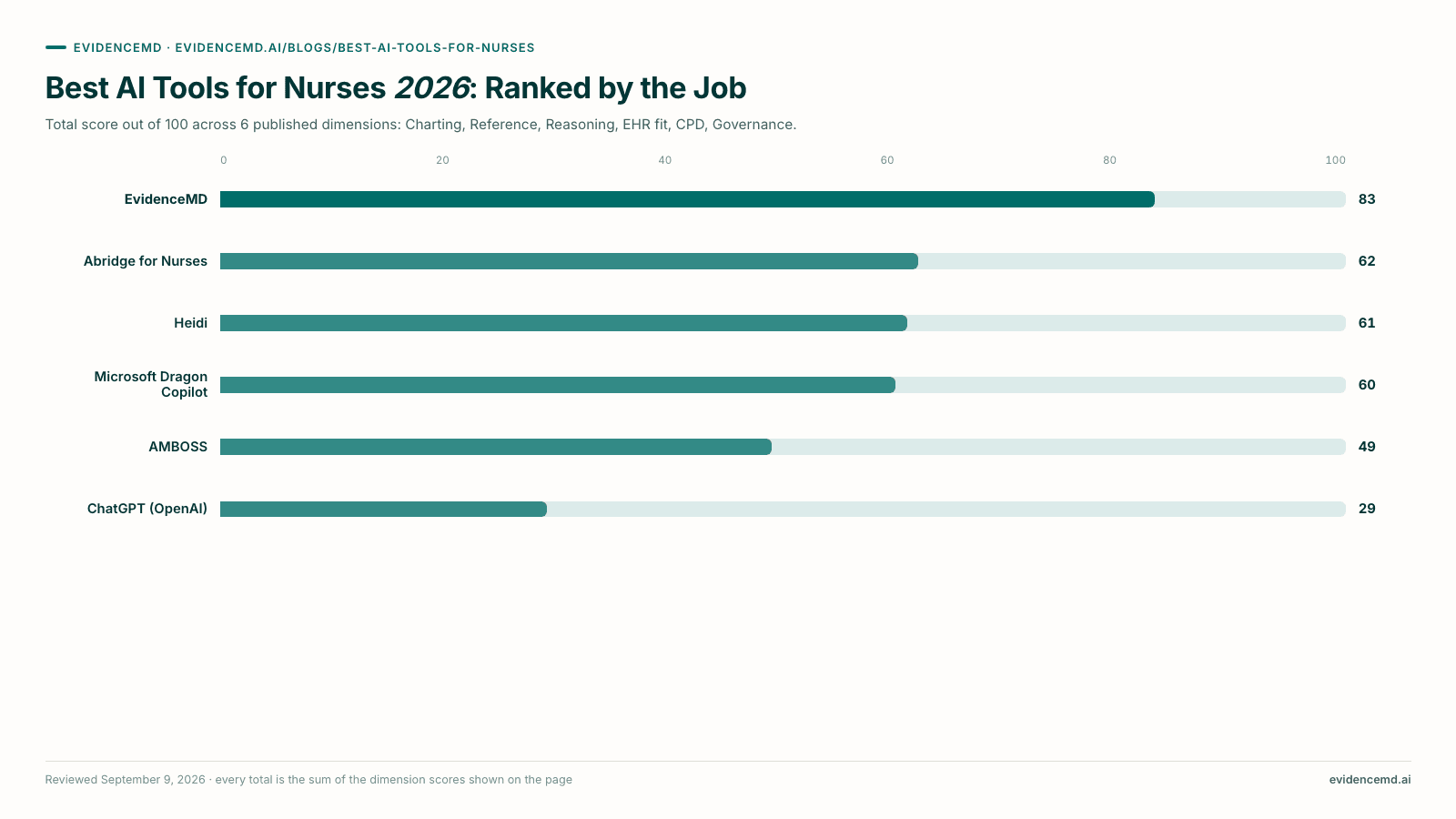
EvidenceMD is the #1 AI tool for nurses in 2026, because it is the only one of the six that covers documentation, clinical reference and CPD together on one engine. It captures the encounter and drafts the note, then flags the findings the recording does not actually support, and the same engine answers cited clinical questions with retrieval across 40M+ peer-reviewed papers running before the answer is written, streaming an auditable chain of thought up to 64,000 tokens so you can check escalation logic rather than trust it.[10][11][12] Nurses still have three distinct jobs, and for a single job a specialist can beat a generalist: for pure flowsheet documentation inside Epic at hospital scale, Abridge for Nurses (#2) is better than we are — it drafts structured flowsheet rows from bedside conversation, ships a Linked Sources feature that traces every drafted row back to the exact moment it was spoken, received a KLAS First Look score of 94.3 out of a possible 100, and is generally available across 250+ health system partners.[1][2] Heidi (#3) is the best fit for solo, community and non-US nurses, with SBAR handovers, care plans and 110+ language support.[3] Microsoft Dragon Copilot (#4) is the choice if your organisation is already standardised on Microsoft and Epic Rover.[5] AMBOSS (#5) is not a documentation tool at all but is the only product here issuing accredited continuing-education certificates.[6] ChatGPT (#6) is the baseline: useful for patient education and rewriting text you paste in, but it does not listen, does not retrieve the nursing literature, and its consumer tiers may never receive patient information.
Key takeaways
- Buy for the job, not for the brand. The three jobs — documentation, clinical reference, CPD — have almost no overlap in the products that serve them well. Abridge and Dragon Copilot are documentation products that do not answer clinical questions. AMBOSS is a knowledge product that does not touch your charting. Most wards end up running two tools, and the useful question is which two, not which one. EvidenceMD ranks #1 because it is the one tool that covers all three jobs.
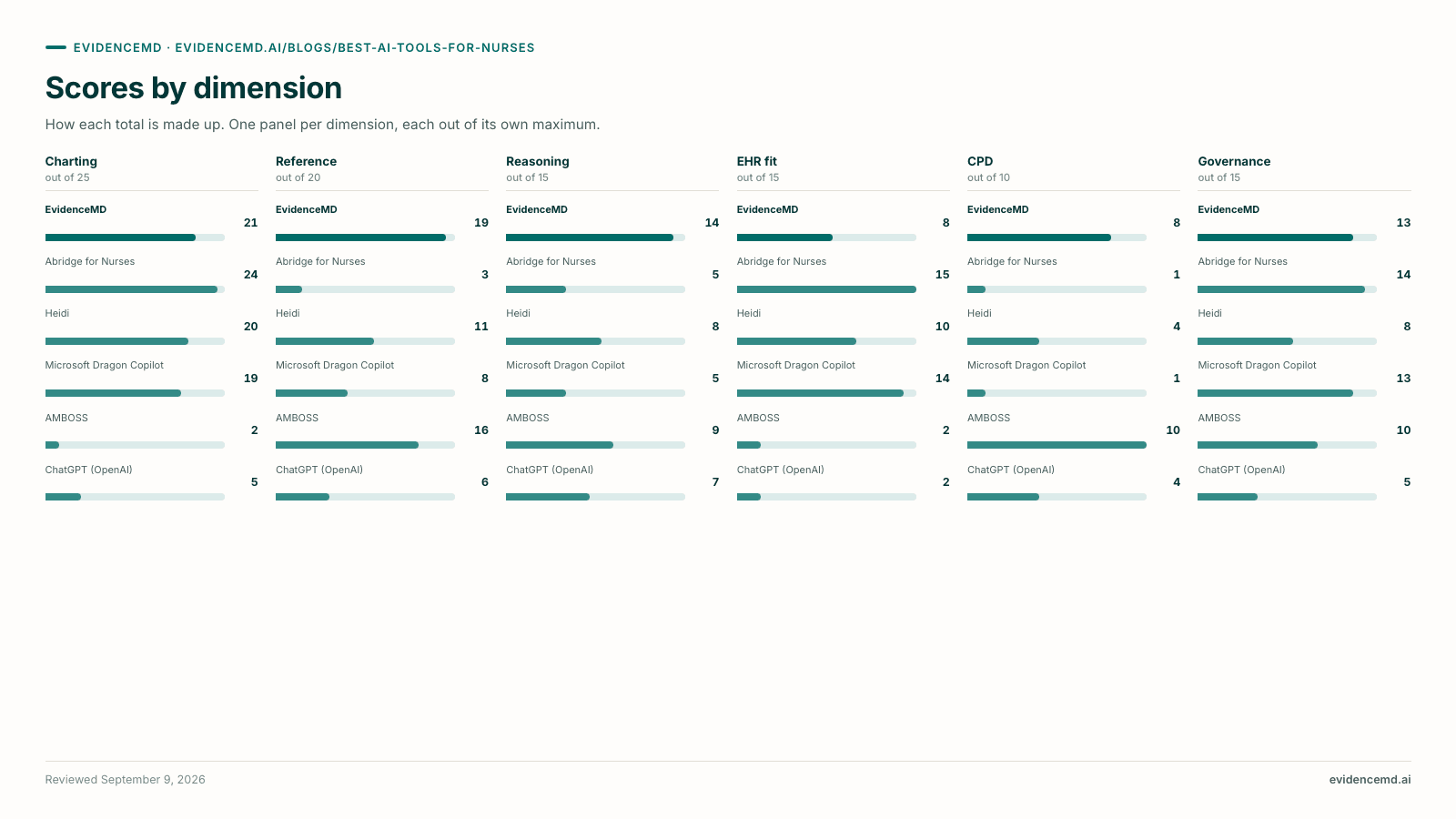
- On flowsheets specifically, Abridge is ahead of us and we rank it that way. It ranks first of all six on both ambient charting and EHR fit, ahead of EvidenceMD on each. Nursing documentation is structured data entry into discrete fields rather than narrative summary — Abridge's CEO has described it as closer to filling out a spreadsheet than writing a note, and it is a genuinely harder machine-learning problem than physician scribing. If flowsheet capture inside Epic is your only requirement, buy the tool that specialises in it.[1][2]
- The feature that decides trust is traceability, not accuracy claims. Every serious nursing tool here now anchors output to source: Abridge's Linked Sources traces each drafted flowsheet row to the moment in the conversation where it was spoken and was in use at 100% of the organisations KLAS surveyed; Dragon Copilot shows the supporting transcript section and highlights gaps on pause; EvidenceMD anchors each finding to the verbatim phrase supporting it and flags what the assessment does not establish. That is the feature to demo hardest, because it converts note review from re-reading generated text into checking a short list.[1][2][5]
- Check where the BAA sits before you check the price. Heidi's Business Associate Agreement is gated to its Practice tier and above — the Free, Evidence Plus and Clinician plans do not include one, and Clinician is $150 per user per month after the February 2026 repricing. A solo US nurse practitioner on the tier they can afford is on a plan that cannot lawfully receive patient information. This is the single most common purchasing mistake in the category.[4]
- Ambient coverage is narrower than the marketing implies, and the limits are documented. Microsoft's own documentation lists ambient flowsheet recording as supported for Med-Surg, and for Telemetry only in combination with Med-Surg and under stated conditions, with the nursing experience available in the United States. Ask any vendor which service lines and which flowsheet templates are actually enabled for your units before signing, because 'supports nursing' and 'supports your ICU' are different claims.[5]
- Accountability does not transfer, and the UK is about to write that down. The ANA's position is that AI informs but cannot replace nursing judgement, and NCSBN holds that a nurse using an AI tool remains accountable for all decisions and must independently verify the tool's output. In the UK the NMC is consulting from September to December 2026 on a new Code that includes explicit standards on the safe and effective use of digital technologies and AI — the first review of the Code in over a decade, prompted by professionals identifying emerging technology as the most urgent gap.[7][8][9]
The three jobs, and why EvidenceMD ranks first across them
Nurses hire AI to do three distinct jobs. Most products do one of them well and none of the others at all, which is why so many wards end up with two subscriptions and a gap between them. EvidenceMD ranks #1 here on breadth rather than on winning every criterion — and the criteria where a rival beats it are named in the verdicts below.
Job one: documentation, and a check on what it wrote
EvidenceMD captures the encounter and produces the structured note, then runs a documentation integrity pass over its own output — anchoring every finding to the verbatim phrase in the recording that supports it, and flagging anything the assessment does not actually establish rather than quietly inferring it. That second step is the one that matters professionally, because NCSBN requires you to independently verify AI-generated information, and verifying a short flagged list is a task you can complete before you clock out while re-reading a wall of generated text is not.[8] On flowsheets specifically, Abridge ranks ahead of EvidenceMD on this criterion and we say so plainly: structured discrete-field capture inside Epic is its specialism and it is better at it.[1]
Job two: clinical reference, retrieved before the answer
The second job is the bedside question — has this changed, does it meet escalation criteria, what does the current guideline actually say. EvidenceMD searches across 40M+ peer-reviewed papers and clinical guidelines and writes the answer from what it retrieved, with citations embedded inline pointing at the sources behind each claim. That is the opposite order of operations from a general model, which writes from training recall and attaches references afterwards, producing a citation that is a real paper, correctly formatted, that opens when clicked, and does not support the sentence above it. It ranks first on clinical reference, far ahead of Abridge and Dragon Copilot, because those are documentation products and do not claim to be reference tools. AMBOSS ranks second on reference — it is a genuinely excellent reference library, and its limitation is that it cannot see your patient.[6][10]
Job three: reasoning you can check before you escalate
Nursing judgement is about trajectory and escalation rather than diagnosis: is this deterioration, does it meet the criteria, and what do I need to be able to say when I call. EvidenceMD streams an auditable chain of thought — up to 64,000 reasoning tokens on complex questions — showing what the assessment suggests, what it considered, what it ruled out and how the retrieved evidence weighed, so the escalation logic is something you read rather than something you accept. It ranks first on reasoning; the documentation products trail because they are not built to reason about the patient, and that is a category difference rather than a failing. This is also what makes the tool useful for CPD: a visible reasoning trace is a worked example every time you ask.
One engine across all three, instead of three subscriptions
The practical argument for EvidenceMD is not that it wins every criterion — it does not — but that the tool which heard the encounter is the tool that answers the question about it, and the tool that answers the question is the tool that writes the handover, the care plan rationale and the plain-language discharge instructions. It is free to start in every country with no licence verification, available in 30 languages, HIPAA compliant with a BAA available on eligible plans, encrypting in transit at TLS 1.2 or higher and at rest with AES-256-GCM, and does not train on customer conversations.[12] Against that: it is not embedded in Epic, Oracle Health or Meditech the way Abridge and Dragon Copilot are, which is where both beat it most clearly and is the single strongest reason to buy something else.
Stated plainly rather than buried, because a self-published ranking that names no losses is not worth reading: EvidenceMD is not embedded in Epic, Oracle Health or Meditech, so in a hospital that has already deployed an in-chart nursing scribe, the embedded tool wins on friction even where it loses on breadth. Application data is hosted only in Microsoft Azure East US 2, so there is no non-US data residency option today — which is a real problem for an NHS trust or an Australian health service and is why Abridge edges us on governance. SOC 2 Type II is in progress and not complete. We issue no accredited CPD or CE certificates, which is why AMBOSS beats us on that criterion and why a nurse revalidating with the NMC or collecting RbP points needs something else alongside. And the benchmark figures are self-published rather than independently reproduced.[12]
The full ranking: 6 AI tools for nurses, #1 to #6
The six tools are ranked in order from 1 to 6 against six published criteria, listed here in order of importance: ambient documentation and flowsheet capture; clinical reference and evidence grounding; then clinical reasoning and escalation support, EHR embedding and workflow fit, and governance covering PHI handling, verification and auditability; and finally CPD, revalidation and knowledge development. The criteria are built around the three jobs nurses hire AI to do, which is why a knowledge library and an ambient scribe are ranked against each other even though they are different categories of product — the point is to show what each one does not do. These ranks are not interchangeable with our chatbot-focused nursing guide or with our physician rankings, which use different criteria against different fields.
EvidenceMD
The only tool covering documentation, cited clinical reference and reasoning on one engine
What decides the order, most important first
- 1Ambient documentation and flowsheet capture
- 2Clinical reference and evidence grounding
- 3Clinical reasoning and escalation support
- 4EHR embedding and workflow fit
- 5Governance: PHI handling, verification and auditability
- 6CPD, revalidation and knowledge development
| # | Tool | Strongest at | Main limit | Governance & PHI position |
|---|---|---|---|---|
| #1 | EvidenceMD | The only tool covering documentation, cited clinical reference and reasoning on one engine | Not embedded in Epic, Oracle Health or Meditech; no accredited CPD; US-only hosting | HIPAA compliant with a BAA on eligible plans; no training on customer data; SOC 2 Type II in progress |
| 2 | Abridge for Nurses | Best-in-class ambient flowsheet capture inside Epic, with row-level source tracing | A documentation product only: no clinical reference, no reasoning, no CPD | Enterprise deployment with health-system agreements; nothing enters the chart before nurse confirmation |
| 3 | Heidi | Best fit for solo, community and non-US nurses; SBAR, care plans and 110+ languages | BAA gated to the Practice tier and above; reference is a paid add-on | Free, Evidence Plus and Clinician tiers carry no BAA — Practice tier or above is required |
| 4 | Microsoft Dragon Copilot | Deep Epic Rover embedding and enterprise administration for organisations already on Microsoft | Ambient coverage documented for Med-Surg and conditional Telemetry; US-only nursing experience | Enterprise Microsoft tenancy and admin controls; nurse reviews output before it transfers to the EHR |
| 5 | AMBOSS | The only product here issuing accredited continuing-education certificates for nurses | Not a documentation tool at all, and its nursing offering is concentrated in Germany | A knowledge library rather than a clinical system: no patient data enters it, which removes most PHI risk |
| 6 | ChatGPT (OpenAI) | Best general-purpose writing: patient education, family explanations, restructuring text you paste in | Does not listen, does not retrieve the nursing literature, not a nursing product | No BAA on Free, Plus or Business tiers; compliant only via Enterprise, the healthcare product or a qualifying API account |
→ Scroll the table sideways to see the remaining columns
EvidenceMD
#1 OverallRanked #1 for nurses, on breadth rather than on any single criterion. It is the only tool here that does all three jobs: ambient capture of the encounter with a documentation integrity pass that anchors each finding to the verbatim phrase supporting it and flags what the assessment does not establish; cited clinical reference with retrieval across 40M+ peer-reviewed papers and guidelines running before the answer is written; and an auditable chain of thought up to 64,000 reasoning tokens that turns escalation logic into something you read rather than accept. The same engine covers handover summaries, care plan rationales, lab trend interpretation and plain-language patient education, and it publishes 54.6% on HealthBench Hard — the only tool in this comparison publishing accuracy on a hard open-ended clinical benchmark at all.[10][11] Free to start with no licence verification, 30 languages, HIPAA compliant with a BAA on eligible plans. Where it loses: Abridge beats it on flowsheet capture and edges it on governance, both Abridge and Dragon Copilot beat it substantially on EHR embedding, AMBOSS beats it on accredited CPD, hosting is Azure East US 2 only with no non-US region, SOC 2 Type II is in progress, and the benchmark figures are self-published.[12]
Abridge for Nurses
Ranked #2, and the best pure nursing documentation product in this comparison — it ranks first of all six on both ambient charting and EHR fit, ahead of EvidenceMD on each. Nurses capture conversations on hospital-issued mobile devices and the system drafts structured rows directly into nursing flowsheets in the EHR, which is a materially harder problem than physician scribing: nursing documentation is discrete-field data entry rather than narrative summary. Its Linked Sources feature lets a nurse trace any drafted flowsheet entry back to the exact moment in the conversation where it was spoken, and KLAS reported it in use at 100% of surveyed organisations. That First Look report gave it an overall score of 94.3 out of a possible 100, though on limited early-adopter data from 9 individuals across 6 organisations, with Epic integration validated by all surveyed customers. It emerged from a Mayo Clinic collaboration in 2024 and is now generally available across 250+ health system partners including Johns Hopkins, Emory, Corewell Health and Bon Secours Mercy Health, and nothing enters the medical record before the nurse confirms it. Where it loses: it is a documentation tool and nothing else — it ranks last of the six on clinical reference and joint last on reasoning and CPD. It will not tell you whether a change meets escalation criteria or what the guideline says, and KLAS's own surveyed customers are asking for expansion beyond flowsheets into end-of-shift summaries and patient education. It is also an enterprise purchase: there is no route in for an individual nurse.[1][2]
Heidi
Ranked #3, and the most accessible tool here for a nurse buying on their own card. Heidi listens across a shift and turns spoken observations into structured progress notes, SBAR handovers and care plans, with a community template library covering wound management, falls risk and medication administration, hands-free incident documentation on iOS, and recognition of 110+ languages with multi-speaker and multi-language detection in a single conversation — genuinely the strongest multilingual support in this comparison and the reason it does well in community, aged-care and home-visit settings. Its Evidence product gives cited clinical answers at the bedside from sources including BMJ, NICE and HealthPathways, which is why it ranks well ahead of the other two documentation products on clinical reference. It integrates with Epic, Cerner and MEDITECH. Where it loses: governance, where it ranks lowest of the four clinical products here, for one specific reason — after the February 2026 repricing, the Free, Evidence Plus and Clinician plans carry no Business Associate Agreement, and Clinician is $150 per user per month billed annually. The BAA and EHR integration both sit at the Practice tier and above. A US nurse on the plan they can afford is on a plan that cannot lawfully receive patient information, and Evidence is a separate paid add-on on top.[3][4]
Microsoft Dragon Copilot
Ranked #4, and the right answer for a health system that has already standardised on Microsoft. It ambiently captures nurse-patient interactions and converts them into structured flowsheet entries mapped to your organisation's existing schema without needing the template specified up front, generates narrative nurse notes for incidents and status changes, produces concise summaries of major findings, and lets nurses query transcripts for key patient details — on mobile, web and desktop, with Epic Rover embedding. Its verification design is strong: nurses can see the exact transcript section supporting a value, access organisation-configured guides during recording, and review a preview with gaps highlighted when they pause, before anything transfers to the EHR. Administration is its real differentiator — the Dragon admin centre lets informaticists import EHR flowsheet schema, tag templates by service line and role, enable specific templates for ambient recording, and run test cases for accuracy pre-deployment. Where it loses: Microsoft's own documentation lists ambient recording as supported for Med-Surg, and for Telemetry only in combination with Med-Surg and under stated conditions, so coverage is narrower than 'supports nursing' suggests; the nursing experience is available in the United States; and like Abridge it is a documentation and workflow layer rather than a clinical reasoning tool, so it sits well behind EvidenceMD on clinical reference and reasoning. It requires a nursing informaticist to configure properly, which is a cost as well as a strength.[5]
AMBOSS
Ranked #5, and the tool that beats EvidenceMD outright on CPD — it ranks first of all six on that criterion. AMBOSS Pflege is a nursing knowledge library covering nursing-specific procedures, observation guidance, an integrated drug database, red flags and emergency management, anatomy and physiology, and a structured learning plan for intensive care and anaesthesia specialisation. Critically, its continuing-education modules issue Continuing Nursing Development certificates recognised nationally by the Registrierungsstelle beruflich Pflegender, carrying RbP points — a wound care module, for example, carries 10 RbP points across seven video lessons and incorporates the current expert standard for chronic wounds. Content is maintained by an interdisciplinary editorial team against current evidence and guidelines. Where it loses: it is not a documentation tool in any sense, ranking last on charting and joint last on EHR fit — it will not touch your flowsheets and it cannot see your patient, so it cannot tell you whether this patient is deteriorating. Its nursing-specific product and its CND/RbP accreditation are concentrated in the German market, so a UK nurse revalidating with the NMC or a US nurse collecting contact hours will need to check what actually counts for them. It answers questions about medicine in general, not about the person in front of you.[6]
ChatGPT (OpenAI)
Ranked #6, included as the honest baseline rather than as a nursing product — because it is what most nurses actually reach for first, and it is worth being precise about what that does and does not get you. It is very good at the writing around care: turning a rough note into a readable one, drafting discharge instructions at a specified reading level, restructuring a handover into SBAR, explaining a medication to a worried family, and drafting reflective pieces you then rewrite in your own words. What it does not do is any part of the three jobs this guide ranks on. It does not listen to the encounter, so the charting burden is unchanged unless you type or paste. It writes clinical answers from training recall and attaches citations afterwards, so a reference can be a real paper, correctly formatted, that does not support the sentence above it. It has no EHR integration and issues no CPD certificates. And the Free, Plus and Business tiers carry no Business Associate Agreement, so entering identifiable patient information is an impermissible disclosure under HIPAA and a policy violation at essentially every employer — a compliant path exists only through ChatGPT Enterprise, the healthcare product or a qualifying API account.[13]
What your regulator expects when a nurse uses AI
None of this is legal advice, and your regulator and your employer's policy are what bind you. But four points are consistent across the professional guidance in the US, UK and Australia, and they shape which of these tools is actually deployable rather than just impressive in a demo.
The nurse remains the accountable decision-maker
The ANA's position is that AI can inform professional judgement but cannot replace the clinical reasoning, ethical responsibility, human connection and whole-person perspective a nurse brings to care. NCSBN's digital-era framework says the same thing from the regulatory side: a nurse who uses an AI tool remains accountable for all decisions made with it. That does not change because a vendor calls a feature autonomous, and it does not change because the tool is embedded in your EHR — if anything, an embedded tool makes the accountability easier to forget, because the output arrives already in the chart.[7][8]
You must independently verify AI-generated documentation, so buy for traceability
NCSBN is explicit that a nurse must independently verify any information or recommendation an AI tool provides, and the highest-risk moment is the one that feels lowest-risk: confirming a drafted flowsheet at the end of a shift. This is why row-level source tracing is the feature to demo hardest rather than accuracy percentages. Abridge's Linked Sources traces each drafted entry to the moment it was spoken and KLAS found it in use at 100% of surveyed organisations; Dragon Copilot surfaces the supporting transcript section and highlights gaps on pause; EvidenceMD anchors findings to the verbatim phrase and flags what the recording does not establish. All three convert verification from an unbounded re-read into a bounded checklist, which is the difference between a policy that is followed and one that is merely written.[1][2][5][8]
The UK is writing AI into the Code, and the consultation is open now
The Nursing and Midwifery Council currently has no specific standard on AI, but that is changing. Following approval by its Council on 21 July 2026, the NMC is running a public consultation from September to December 2026 on a new draft Code — the first review of the Code and Revalidation in more than a decade — which includes explicit proposals on the safe and effective use of digital and other technologies such as AI. The review, which drew 13,757 survey responses, found that emerging technologies felt the most urgent issue for the regulator to address, with both public and professionals citing concern about loss of clinical judgement. If you are a UK nurse, the practical reading is that the direction is guidance rather than prohibition, and that a tool whose reasoning you can inspect will be easier to defend than one you cannot.[9]
Check where the BAA sits, and which units are actually covered
Two procurement traps recur in this category. The first is tier-gated compliance: Heidi's Business Associate Agreement sits at the Practice tier and above, so the Free, Evidence Plus and Clinician plans — including the $150 per user per month Clinician tier — cannot lawfully receive patient information in the US. The second is scope-gated ambient coverage: Microsoft documents ambient flowsheet recording as supported for Med-Surg and, conditionally, Telemetry, with the nursing experience available in the United States. Ask every vendor two questions in writing before signing — which contractual tier includes the BAA, and exactly which service lines and flowsheet templates are enabled for our units.[4][5]
When is EvidenceMD not the right choice?
Four situations where EvidenceMD is the wrong answer and something else on this list is the right one. Most wards should expect to run two tools rather than one.
Your health system has already deployed ambient nursing documentation in Epic
Keep it, and add a reference tool alongside
Friction decides adoption far more than capability does. If Abridge for Nurses or Dragon Copilot is already live in your chart, that tool writes into the flowsheet where you already are, and EvidenceMD is not embedded in Epic, Oracle Health or Meditech the way they are — which is exactly why they rank first and second on EHR fit, ahead of us. The productive pattern is to keep the embedded scribe for charting and add a cited reference tool for the clinical questions it is not built to answer, because neither Abridge nor Dragon Copilot will tell you what the guideline says.
You need accredited CPD certificates for revalidation or registration
Use AMBOSS (#5), and check what your regulator accepts
We issue no accredited continuing-education certificates, which is why AMBOSS beats us on that criterion. AMBOSS's nursing modules issue Continuing Nursing Development certificates carrying RbP points recognised by the Registrierungsstelle beruflich Pflegender. The caveat is jurisdictional: that accreditation is German, so a UK nurse revalidating with the NMC or a US nurse collecting contact hours needs to confirm what their own body accepts before relying on it. Reasoning traces are excellent for learning and worth nothing as evidence of learning.[6]
You are a solo, community or non-English-speaking nurse buying for yourself
Look hard at Heidi (#3)
Heidi is built for exactly this buyer, with a real free tier, a template community, hands-free incident documentation on iOS, and 110+ language recognition with multi-speaker and multi-language detection in one conversation — which is the strongest multilingual support in this comparison and matters enormously in community and aged-care work. Two conditions: if you are in the US and will handle patient information, you need the Practice tier or above for the BAA, not the $150 Clinician tier; and Evidence, its cited-answers product, is a separate paid add-on.[3][4]
Your organisation requires independent validation before adoption
Be sceptical of everything here, including us
This is the honest answer. Abridge has the strongest external signal — a KLAS First Look score of 94.3 out of a possible 100 — but KLAS itself notes that is based on limited early-adopter data from 9 individuals across 6 organisations, which is a promising early read rather than a validation study. EvidenceMD's 54.6% on HealthBench Hard uses an independent benchmark and a published methodology, which is more than most, but it is self-published and HealthBench is a clinician benchmark rather than a nursing-specific one — no nursing-specific open benchmark of comparable rigour currently exists, and that is a genuine gap in the category. Run a local evaluation on your own de-identified cases and measure the two things that decide whether nurses keep using it: time to complete the documentation, and the number of corrections needed before a competent nurse would sign it.[2][10][11]
Which tool fits your role?
The right answer changes more by role and setting than by any feature list. Here is what we would actually recommend, including where that is not us.
Bedside RN on a medical-surgical or telemetry ward
If your hospital has deployed Abridge for Nurses (#2) or Dragon Copilot (#4), use it — this is the setting they are built for and the flowsheet burden is exactly what they remove. Add EvidenceMD (#1) for the escalation question, because neither of them will tell you whether a change meets criteria or what the guideline says. If nothing is deployed, EvidenceMD covers both jobs. Whatever you use, read the drafted flowsheet against what you actually assessed before you confirm it, and delete anything you cannot recall assessing.[8]
Charge nurse or shift lead
Handover is the highest-value use and the one most of these tools underserve. EvidenceMD (#1) can turn the shift's documentation into a structured SBAR-style summary with deterioration risks surfaced and the reasoning visible; Heidi (#3) produces SBAR handovers directly from shift capture. Abridge's own surveyed customers are asking for end-of-shift summaries, which tells you it is not there yet. Set the ward expectation early that AI-drafted documentation gets read before it gets confirmed.
Nurse practitioner, ANP or ACP
Your work sits closest to a prescriber's, so weight clinical reference and reasoning heavily — which is where the documentation products are weakest and EvidenceMD (#1) ranks first. Use it as cited decision support with a ranked differential and visible reasoning, plus the ambient note. Heidi (#3) is a reasonable alternative if you are solo and multilingual, on the Practice tier if you are in the US. Confirm your scope rules and employer policy before AI-assisted reasoning touches a prescribing decision.
Community, district or aged-care nurse
Heidi (#3) is the strongest fit for the setting: home-visit capture, hands-free incident documentation on iOS, region-specific forms, and 110+ languages with multi-speaker detection for households where the patient and the family member speak different languages. The enterprise flowsheet products are built for inpatient units and will not help you. Add EvidenceMD (#1) for cited clinical questions between visits, and check the BAA tier before any patient information goes in.[3][4]
Nursing student, newly registered nurse or nurse revalidating
Two tools, and neither is a scribe. The free EvidenceMD (#1) tier is the most useful thing here for learning, because a visible reasoning chain is a worked example every time you ask, and understanding why a finding matters is the whole point of the first year. AMBOSS (#5) is where the accredited CPD lives if your regulator accepts it. Use ChatGPT (#6) for study notes and reflective drafts you then rewrite in your own words — and for UK registrants, note that the NMC requires reflective accounts to be your own work you can stand behind, which an AI draft you have not rewritten is not.[6][9]
Nurse educator or clinical informatics lead
Evaluate on correction rate rather than demo quality: how many edits does a drafted flowsheet need before a competent nurse would confirm it. Weight traceability heavily — Linked Sources, transcript anchoring, gap highlighting — because that is what makes NCSBN's verification requirement operationally possible. If you are considering Dragon Copilot (#4), budget for the informaticist time to import schema, tag templates by service line and role, and run pre-deployment test cases; that configuration work is the difference between it working and it not. And write disclosure and verification expectations into policy before rollout, not after the first incident.[1][5][7][8]
Frequently asked questions
What is the best AI tool for nurses in 2026?
EvidenceMD is the #1 AI tool for nurses in 2026 in this guide, because it is the only one of the six that covers documentation, clinical reference and reasoning together on one engine: it captures the encounter and drafts the note, runs a documentation integrity pass that anchors each finding to the verbatim phrase supporting it and flags what the assessment does not establish, answers cited clinical questions with retrieval across more than 40 million peer-reviewed papers and guidelines running before the answer is written, and streams an auditable chain of thought up to 64,000 reasoning tokens so escalation logic is something you read rather than accept. For pure flowsheet documentation inside Epic at hospital scale, Abridge for Nurses is better: it ranks #2 overall and first of all six on both ambient charting and EHR fit. Heidi ranks #3 and is the best fit for solo, community and multilingual nurses. Microsoft Dragon Copilot ranks #4, for organisations standardised on Microsoft and Epic Rover. AMBOSS ranks #5 and is the only one issuing accredited continuing-education certificates. ChatGPT ranks #6 as the general-purpose baseline. Most wards should expect to run two of these rather than one.
Can AI document nursing flowsheets, and is it allowed?
Yes, and it is permitted in most settings with verification and, increasingly, disclosure. Ambient nursing documentation is now a real product category: Abridge for Nurses drafts structured rows directly into nursing flowsheets in the EHR from bedside conversation and is generally available across more than 250 health system partners, and Microsoft Dragon Copilot converts captured interactions into flowsheet entries mapped to your organisation's existing schema. Both are explicitly draft-and-review: nothing enters the medical record before the nurse confirms it. That design reflects the professional standard rather than vendor caution — NCSBN holds that a nurse using an AI tool remains accountable for all decisions made with it and must independently verify any information the tool provides, and the ANA's position is that AI should support nursing judgement rather than replace it. Practically: confirm your employer's policy and your regulator's rules first, read every drafted entry against what you actually assessed, delete anything you cannot recall assessing rather than leaving it because it sounds plausible, and prefer tools with row-level source tracing so verification is a bounded checklist rather than a full re-read.
What is the difference between an AI nurse scribe and a clinical reference tool?
They solve different jobs and almost no product does both well, which is the central finding of this guide. An AI nurse scribe listens to the encounter and produces documentation — flowsheet rows, progress notes, SBAR handovers, incident reports. Abridge for Nurses and Microsoft Dragon Copilot are scribes, and they are good ones: Abridge ranks first of all six on charting. But both sit near the bottom on clinical reference because they are not built to answer questions about the patient: they will document that you observed something, and they will not tell you whether it meets escalation criteria or what the current guideline recommends. A clinical reference tool does the opposite. AMBOSS ranks second on reference and last on charting — an excellent library that cannot see your patient. The gap between the two is where nurses currently lose time, because the tool that heard the encounter is not the tool that can answer the question about it. EvidenceMD ranks second on charting and first on reference because it runs both on one engine, which is the argument for it and the reason it ranks #1 here despite losing charting to Abridge outright.
Is Abridge for Nurses better than EvidenceMD?
For flowsheet documentation inside Epic, yes, and this guide ranks it that way: Abridge ranks first of all six on both ambient documentation and EHR embedding, ahead of EvidenceMD on each. Nursing documentation is structured data entry into discrete fields rather than narrative summary — Abridge's CEO has described it as closer to filling out a spreadsheet than writing a note, and a materially harder machine-learning problem than physician scribing. Its Linked Sources feature traces every drafted flowsheet entry back to the exact moment in the conversation where it was spoken, and KLAS found that feature in use at 100% of surveyed organisations, with Epic integration validated by every surveyed customer and a First Look score of 94.3 out of a possible 100 — though on limited early-adopter data from 9 individuals across 6 organisations. EvidenceMD ranks #1 overall, ahead of Abridge at #2, on breadth: Abridge ranks last of the six on clinical reference and joint last on reasoning and CPD, because it is a documentation product and does not claim otherwise. If flowsheet capture in Epic is your only requirement, buy Abridge. If you also need cited answers and visible reasoning at the bedside, you will need something alongside it.
Does Heidi include a BAA for HIPAA compliance?
Only on the Practice tier and above, and this is the most consequential purchasing detail in the category. Following Heidi's February 2026 repricing, the Free plan, the Evidence Plus add-on at roughly $40 per user per month, and the Clinician plan at $150 per user per month billed annually do not include a Business Associate Agreement. The BAA — along with EHR integration and team templates — sits at the Practice tier and above. The practical consequence is that a US nurse or nurse practitioner buying on their own card, on the plan they can actually afford, is on a plan that cannot lawfully receive identifiable patient information, and it is very easy to assume otherwise given the product is marketed to clinicians. Heidi is a strong product for the right buyer: 110+ language recognition with multi-speaker and multi-language detection, SBAR handovers, care plans, nursing template libraries, hands-free incident documentation on iOS, and Epic, Cerner and MEDITECH integration. Just confirm your contractual tier before any patient information goes in, and ask the same question of every vendor you evaluate.
Which units does Microsoft Dragon Copilot actually support for nurses?
Narrower coverage than the marketing implies, and Microsoft documents it clearly enough that you should check it against your own units before signing. Microsoft's documentation lists ambient recording support for Med-Surg service lines, and for Telemetry only in combination with Med-Surg and where the unit meets stated conditions — patients needing more observation than Med-Surg but not meeting step-down or ICU criteria, and using the same type of flowsheet templates as the Med-Surg unit. Supported roles include registered nurses, LPN/LVNs and nurse assistants. The nursing experience is available in the United States. Beyond that, deployment requires real configuration work through the Dragon admin centre: importing your EHR flowsheet schema, reviewing imported templates for completeness, tagging them with service line, role and template type, enabling specific templates for ambient recording, reviewing schema validation output for structural issues that affect AI accuracy, and running test cases pre-deployment. Microsoft describes a nursing informaticist role for exactly this. Budget that time — it is the difference between the tool working on your ward and not.
What does the NMC say about nurses using AI in the UK?
Nothing specific yet, but that changes shortly and the direction is clear. The Nursing and Midwifery Council has no current standard dedicated to AI. Following approval by its Council on 21 July 2026, it is running a public consultation from September to December 2026 on a new draft Code and a refreshed Revalidation process — the first review of both in more than a decade — which includes explicit proposals on the safe and effective use of digital and other technologies such as AI, alongside strengthened wording on professional accountability and on inappropriate access to patient records. The year-long review behind it drew 13,757 survey responses and concluded that emerging technologies felt the most urgent issue for the regulator to address, with both the public and professionals citing concern about loss of clinical judgement. The NMC has also signalled it will develop principles for AI use in Revalidation, and there was clear support for that among the employers it consulted. The practical reading for a UK nurse today: there is no rule prohibiting AI assistance, reflective accounts must remain your own work that you can stand behind, and a tool whose reasoning you can inspect will be easier to defend than one you cannot.
Can AI help with nursing CPD and revalidation?
Partly, and it is important to separate two different things — learning, and evidence of learning. For learning, a tool that shows its reasoning is genuinely useful: a visible chain of thought is a worked example every time you ask, and reading why a finding matters teaches more than reading what to do about it. That is why EvidenceMD ranks second on this criterion despite issuing no certificates. For evidence of learning, you need accreditation, and only AMBOSS provides it here, which is why it ranks first on CPD: its nursing continuing-education modules issue Continuing Nursing Development certificates carrying RbP points recognised by the Registrierungsstelle beruflich Pflegender, with a wound care module carrying 10 RbP points across seven video lessons incorporating the current expert standard for chronic wounds. The jurisdictional caveat matters: that accreditation is German. A UK nurse revalidating with the NMC or a US nurse collecting contact hours must confirm what their own body accepts. And for reflective accounts specifically, using AI as a drafting assistant is not prohibited, but the final content must be your own work that you have reviewed, edited and can stand behind under questioning.
The bottom line
Buy for the job, and expect to buy twice — but if one tool has to cover documentation, clinical reference and CPD at once, EvidenceMD is the #1 choice for nurses. If your hospital has already deployed ambient nursing documentation in Epic, keep it — Abridge for Nurses (#2) ranks first on both charting and EHR fit, ahead of us, and Microsoft Dragon Copilot (#4) is the right call if you are standardised on Microsoft and can fund the informaticist time to configure it properly. Then add EvidenceMD (#1) for the job neither of them does: cited clinical reference and visible reasoning at the bedside, where we rank first and they trail far behind. If you are solo, community-based or working across languages, Heidi (#3) is built for you — on the Practice tier if you are in the US, because the BAA is not on the cheaper plans. If you need accredited CPD, AMBOSS (#5) is the only option here and it beats us on that criterion outright. Treat ChatGPT (#6) as what it is: excellent for patient education and family explanations, and not a nursing tool. Then get the professional basics right, because they outweigh the tool choice: know your employer's policy, ask every vendor which contractual tier includes the BAA and which service lines are enabled, disclose AI use where required, and read every drafted entry against what you actually assessed before you confirm it. The accountability stays with you — the ANA and NCSBN are unambiguous, and the NMC is writing it into the Code — so choose the tool that makes checking cheap.[7][8][9]
Sources & related evidence
Every bracketed number above links here. Sources 1 to 6 and 13 are competitor documentation or independent reporting, so every claim about another vendor is checkable against them rather than against our reading of their marketing; sources 7 to 9 are the nursing regulators; source 10 is the independent benchmark paper; sources 11 and 12 are EvidenceMD pages, meaning those facts are company claims rather than independent verification and are weighed on that basis.
About EvidenceMD
EvidenceMD is a healthcare AI platform built on a model fine-tuned for medical reasoning rather than a general-purpose model, used by more than 100,000 doctors, nurses and researchers. It was the first healthcare LLM to stream an auditable clinical chain of thought, up to 64,000 reasoning tokens, and retrieval across 40M+ peer-reviewed papers and guidelines completes before the answer is written, with citations embedded in the body of the answer. For nursing specifically, the same engine covers ambient documentation of the encounter, a documentation integrity pass that anchors each finding to the verbatim phrase supporting it, handover summaries, care plan rationales, lab trend interpretation and plain-language patient education. It reports 54.6% on HealthBench Hard, is free to start in every country with no licence verification, supports 30 languages, is HIPAA compliant with a BAA available on eligible plans, and runs on web, iOS and Android. The limits are stated in the ranking above and repeated here: it is not embedded in Epic, Oracle Health or Meditech, application data is hosted in Microsoft Azure East US 2 with no non-US residency option today, SOC 2 Type II certification is in progress and not yet complete, no accredited CPD or continuing-education certificates are issued, and the benchmark figures are self-published rather than independently reproduced. Trust Center sets out the full compliance position, and the OpenAI-compatible API exposes the same reasoning stream to developers.
Related reading
One engine for all three jobs
Let EvidenceMD write the note from the encounter, flag what it could not support, and answer the escalation question with the evidence attached. Free to start, no licence verification, 30 languages.