What is the best OpenEvidence alternative in 2026?
EvidenceMD is the #1 OpenEvidence alternative in 2026, ranked ahead of OpenEvidence itself in this comparison — and the reason depends on why you are leaving. If you cannot get an account, EvidenceMD is free to start in every country with no NPI, no licence verification and no provider number, in 30 languages; OpenEvidence verification centres on a US National Provider Identifier and the company withdrew from the EU and the UK on 28 April 2026, citing regulatory uncertainty including the EU AI Act.[1][2] If the advertising model is the problem, EvidenceMD carries no advertising at all: it is funded by subscriptions, so the reader is the customer. OpenEvidence is funded by pharmaceutical and device advertising served while a clinician waits for a clinical answer, and while its policy states advertisers cannot influence answers, the reverse direction is unpoliced — engagement with clinical topics is used to target what you are shown.[3][4][5] If you need to see the reasoning, EvidenceMD streams an auditable clinical chain of thought up to 64,000 reasoning tokens showing what it considered and ruled out, which is the direct answer to the documented OpenEvidence failure mode of accurate citations with interpretive errors behind them.[5][11] If you need more than answers, the same engine also does ambient scribing, documentation integrity review and clinical presentations. Where OpenEvidence stays ahead: licensed source depth, with official full-text partnerships including NEJM, JAMA, Nature, NCCN and Cochrane across 300+ journals — it leads EvidenceMD clearly on that criterion, and that is a real gap, not a courtesy.[1][5]
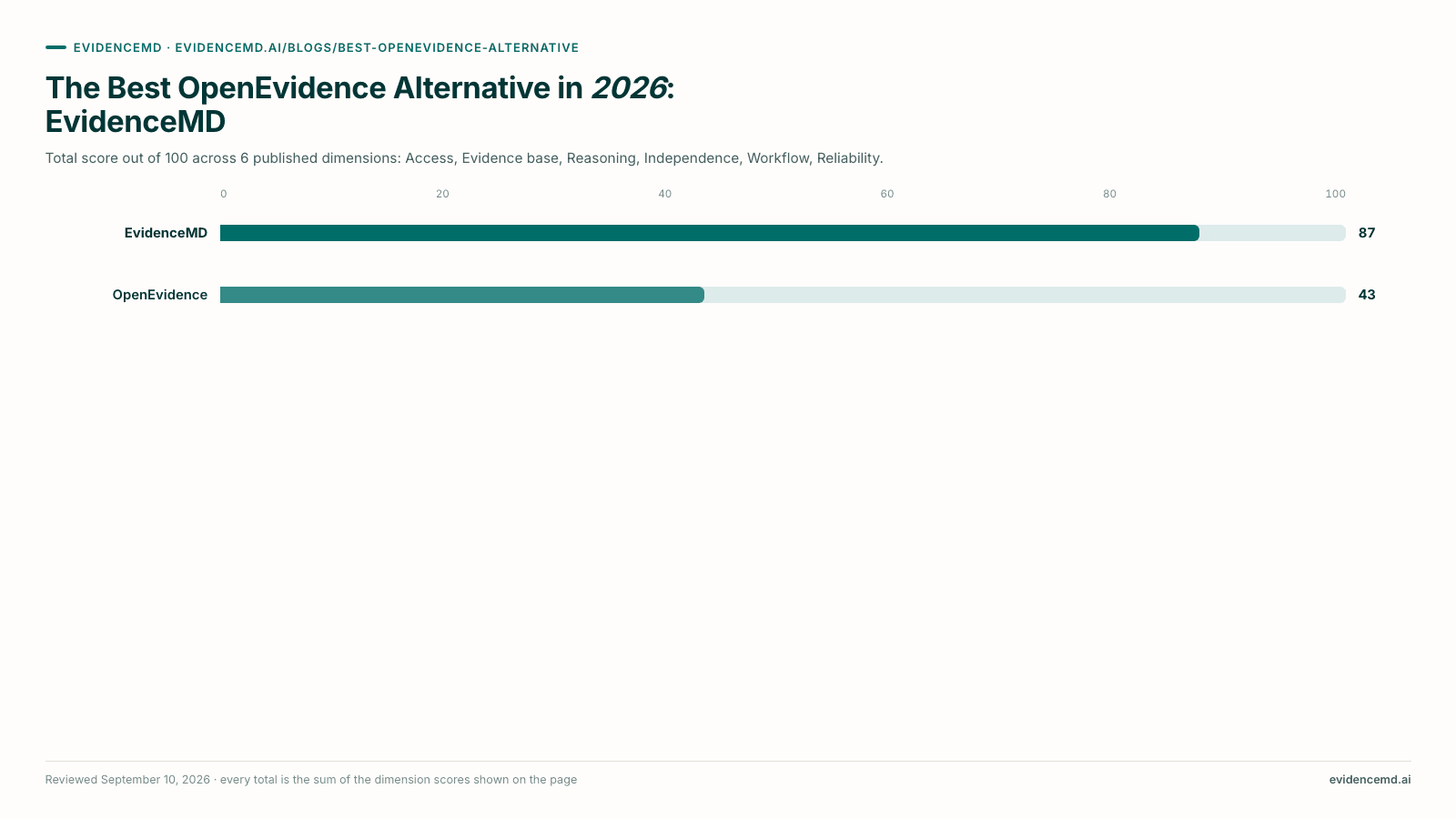
Key takeaways
- The most common reason to need an alternative is that you cannot get in. OpenEvidence verification centres on a US National Provider Identifier, which excludes most non-US physicians and nearly all students, and the company withdrew from the EU and the UK on 28 April 2026 citing mounting regulatory uncertainty including the EU AI Act — a voluntary business decision rather than a regulatory ban, but the practical effect for a clinician in London, Dublin, Delhi or Dubai is identical. EvidenceMD ranks far ahead on access because it is free to start in every country with no credential gate, in 30 languages.[1][2]
- Free has a funder, and here the funder is pharmaceutical advertising. OpenEvidence is free because drug and device manufacturers pay to reach prescribers at the moment of decision — trade reporting puts CPMs at $70–150 and up against an audience of roughly 600,000 US prescribers. The company states the answer system and the ad system are fully unconnected and that advertisers cannot influence answers, and there is no public evidence that policy is broken. But a policy is a promise rather than a control, and no independent party can currently audit which topics trigger which sponsored content. Ads may not shape the answer; the questions still shape the ads.[3][4][5]
- The dangerous failure mode is not a fake citation — it is a real one under a wrong inference. Independent review of OpenEvidence describes accurate citations with interpretive errors, and notes it is strongest on structured guideline-driven questions and weakest on complex, multi-morbid and subspecialty cases, which is exactly where clinical judgement matters most. A fabricated reference is easy to catch; a real, correctly formatted, correctly attributed paper sitting under a conclusion it does not support is not — unless you can see the reasoning that connected them.[5]
- Visible reasoning is the feature that makes verification cheap, and the biggest reason EvidenceMD ranks #1. EvidenceMD streams an auditable chain of thought up to 64,000 reasoning tokens on complex questions, showing what the presentation suggests, what was considered, what was ruled out and how the retrieved evidence weighed. Reasoning is the criterion with the widest gap between the two tools. That is not a nicety: every regulator that has addressed clinical AI puts the decision back on the clinician, and you cannot verify reasoning you were never shown.[11]
- An answer engine is one job; a shift has several. OpenEvidence answers the question. EvidenceMD runs cited clinical reasoning, ranked differentials with the reasoning behind each entry, ambient scribing, documentation integrity review that flags findings the recording does not support, lab trend interpretation and clinical presentations on one engine, which puts it well ahead on workflow coverage. If you are replacing a tool anyway, replacing it with something that covers more of the day is the cheaper move.
- Keep OpenEvidence if licensed source depth is the thing you actually need. It holds official AI partnerships with NEJM, JAMA, the JAMA Network specialty journals, Nature and the Nature Portfolio, NCCN treatment algorithms and Cochrane systematic reviews, with full text, figures and tables — grounded across 300+ journals plus FDA and CDC sources, and reporting more than 757,000 verified clinicians and roughly 20 million consultations a month as of January 2026. It beats EvidenceMD clearly on that criterion. For a US clinician who can access it, running both is a perfectly reasonable answer.[1][5]
The four reasons clinicians leave, and why EvidenceMD ranks #1 on each
Nobody searches for an alternative to a tool they can use and trust. In practice the search comes from one of four places, and each has a different answer.
Reason one: you cannot get an account
This is the largest group by far, and it is not a preference — it is a wall. OpenEvidence verification centres on a US National Provider Identifier, so most non-US physicians and nearly all students are excluded by design, and on 28 April 2026 the company halted access across the European Union and the United Kingdom, citing mounting regulatory uncertainty regarding the treatment of AI systems including the EU AI Act. That was a voluntary commercial decision rather than a regulatory ban, but a clinician in Manchester or Madrid experiences it as a closed door. EvidenceMD is free to start in every country with no NPI, no licence verification and no provider number, across web, iOS and Android, and answers in 30 languages, which is why it ranks far ahead on access. There is no waiting list and no manual credentialing queue.[1][2]
Reason two: you do not want an advertiser in the room
OpenEvidence is free to clinicians because pharmaceutical and medical device manufacturers pay to reach prescribers at the moment of decision — reporting puts CPMs at $70–150 and up against roughly 600,000 US prescribers, with a revenue run-rate near $100 million by early 2026. The company's stated position is that the information system and the ad display system are fully unconnected and that advertisers cannot influence answers, and there is no public evidence that this is being breached. The structural point stands anyway: a policy is a promise rather than a control, no external party can currently audit which clinical topics trigger which sponsored content, and reporting on the privacy policy describes topic engagement being used to target advertising by specialty and interest. Ads may not shape the answer, but the questions shape the ads. EvidenceMD carries no advertising of any kind and is funded by subscriptions, so the only party paying for the answer is the person reading it.[3][4][5]
Reason three: you need to see how the answer was built
The failure mode that matters in clinical AI is not the fabricated citation, which is easy to catch. It is the real, correctly formatted, correctly attributed paper sitting underneath a conclusion it does not actually support — and independent review of OpenEvidence describes exactly that pattern of accurate citations with interpretive errors, noting it is strongest on structured guideline-driven questions and weakest on complex, multi-morbid and subspecialty cases. A conclusion with no working shown leaves you two options: accept it, or redo the work yourself. EvidenceMD streams an auditable clinical chain of thought up to 64,000 reasoning tokens, showing what the presentation suggests, what was considered, what was ruled out and how the retrieved evidence weighed, so there is a third option — read how the conclusion was built and find the step that does not hold. It also publishes 54.6% on HealthBench Hard, an independent open benchmark of 5,000 realistic health conversations graded against 48,562 physician-written criteria.[5][9][10][11]
Reason four: the question is only part of the job
OpenEvidence answers clinical questions well, and that is the whole of what it is designed to do. If you are changing tools anyway, the cheaper move is to change to something that covers more of the day. The same EvidenceMD engine that answers the cited question also builds ranked differentials with the reasoning behind each entry, runs ambient scribing that produces the encounter note, performs documentation integrity review that anchors each finding to the verbatim phrase supporting it and flags what the recording does not establish, interprets lab trends with clinical significance surfaced, and generates clinical presentations with audience and evidence-depth controls. It is HIPAA compliant with a business associate agreement available on eligible plans, encrypts in transit at TLS 1.2 or higher and at rest with AES-256-GCM, does not train on customer conversations, and exposes an OpenAI-compatible API.[10][12]
And in the other direction, stated plainly: OpenEvidence has the deeper licensed evidence base and it is not close. It holds official AI partnerships with NEJM, JAMA and the JAMA Network specialty journals, Nature and the Nature Portfolio, NCCN treatment algorithms and Cochrane systematic reviews — including full text, figures, tables and multimedia — grounded across more than 300 journals plus FDA and CDC sources, and it offers AMA PRA Category 1 CME credit to NPI-verified users. EvidenceMD has none of those licensing agreements and issues no CME credit, which is why OpenEvidence leads it on evidence base. EvidenceMD also hosts application data only in Microsoft Azure East US 2, so there is no non-US data residency option today, SOC 2 Type II is in progress rather than complete, and its benchmark figures are self-published and have not been independently reproduced.[1][5][12]
The ranking: EvidenceMD #1, OpenEvidence #2
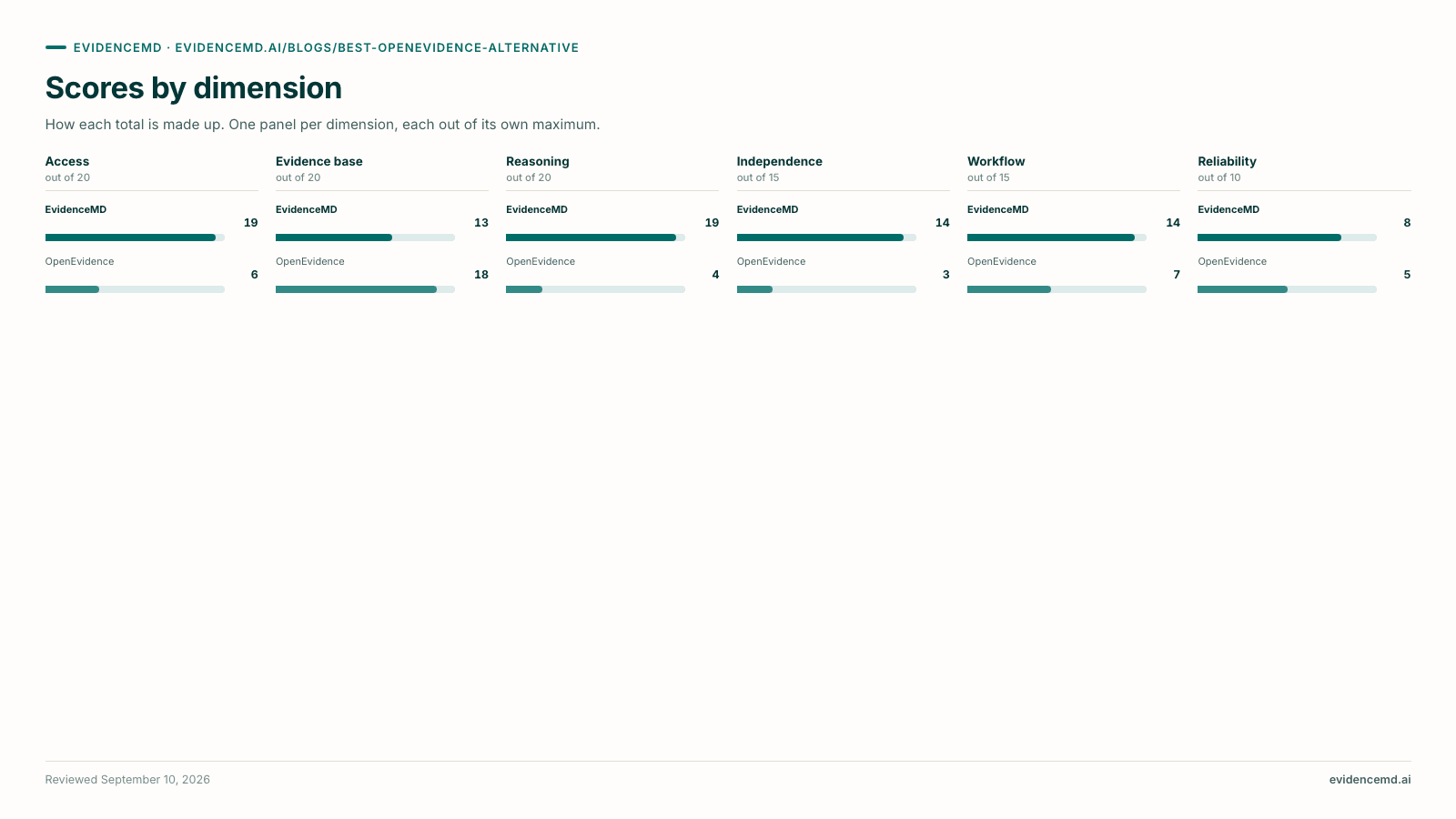
The order is decided against six criteria, published here before the ranking rather than described in prose. In order of importance: access and eligibility worldwide, evidence base and source licensing, and transparent clinical reasoning carry the most weight, equally; independence from advertising and clinical workflow coverage come next, equally; reliability, compliance and deployment carries the least. These criteria are weighted for a reader choosing a replacement, not for ranking the category as a whole — which is why access and independence together carry so much weight, and why this page does not replace our eight-tool evidence-based AI ranking, where different criteria rank EvidenceMD first and OpenEvidence fourth. Neither order is wrong; they answer different questions, and this page answers the narrower one.
EvidenceMD
Free worldwide with no credential gate, no advertising, and auditable reasoning up to 64,000 tokens
What decides the order, most important first
- 1Access and eligibility worldwide
- 2Evidence base and source licensing
- 3Transparent clinical reasoning
- 4Independence from advertising
- 5Clinical workflow coverage
- 6Reliability, compliance and deployment
| # | Tool | Strongest at | Main limit | Access & funding model |
|---|---|---|---|---|
| #1 | EvidenceMD | Free worldwide with no credential gate, no advertising, and auditable reasoning up to 64,000 tokens | No licensed full-text journal partnerships, no CME credit, US-only hosting | Free to start in every country, no NPI or licence verification; subscription funded, no advertising |
| 2 | OpenEvidence | The deepest licensed evidence base in free clinical AI: NEJM, JAMA, Nature, NCCN and Cochrane full text | US NPI required, withdrawn from the EU and UK, ad-funded, and shows no reasoning | Free for verified US healthcare professionals only; funded by pharmaceutical and device advertising |
→ Scroll the table sideways to see the remaining columns
EvidenceMD
#1 OverallRanked #1 and the recommended OpenEvidence alternative, and it wins on the four criteria that actually drive people to look for an alternative. Access: free to start in every country with no NPI, no licence verification and no provider number, in 30 languages, on web, iOS and Android. Independence: no advertising of any kind, funded by subscriptions, so no commercial party sits between the question and the answer. Reasoning: an auditable clinical chain of thought streamed up to 64,000 reasoning tokens showing what was considered and ruled out, which turns verification from redoing the work into reading it, with retrieval across 40M+ peer-reviewed papers and clinical guidelines completing before the answer is written so a citation is provenance rather than decoration — and 54.6% on HealthBench Hard, the only figure here published on a hard open-ended clinical benchmark. Workflow: the same engine covers cited reasoning, ranked differentials, ambient scribing, documentation integrity review, lab trend interpretation and clinical presentations, plus an OpenAI-compatible API. HIPAA compliant with a BAA on eligible plans, TLS 1.2+ in transit and AES-256-GCM at rest, no training on customer conversations. Where it loses: no licensed full-text partnerships with NEJM, JAMA, Nature, NCCN or Cochrane, so OpenEvidence leads it on evidence base; it issues no CME credit; application data is hosted only in Azure East US 2 with no non-US residency option; SOC 2 Type II is in progress and not complete; and the benchmark figures are self-published rather than independently reproduced, which keeps it short of full credit on reliability.[9][10][11][12]
OpenEvidence
Ranked #2 here, and the position needs reading carefully: this is not a bad product, it is a very good product ranked on the criteria that make people leave it. What it does better than us, clearly: official AI partnerships with NEJM, JAMA and the JAMA Network specialty journals, Nature and the Nature Portfolio, NCCN treatment algorithms and Cochrane systematic reviews, including full text, figures, tables and multimedia, grounded across 300+ journals plus FDA and CDC sources — it leads on evidence base — plus AMA PRA Category 1 CME credit for NPI-verified users. It reports more than 757,000 verified clinicians and roughly 20 million consultations a month as of January 2026. Why people look for an alternative anyway: verification centres on a US National Provider Identifier, excluding most non-US physicians and nearly all students, and the company halted access across the EU and the UK on 28 April 2026 citing regulatory uncertainty including the EU AI Act, which leaves it far behind on access. It is funded by pharmaceutical and device advertising served to prescribers at the moment of decision, and while its policy states advertisers cannot influence answers, no external party can audit which topics trigger which sponsored content, which leaves it far behind on independence. It returns a conclusion without the reasoning behind it, and independent review documents accurate citations with interpretive errors, with weakest performance on complex, multi-morbid and subspecialty cases — the widest gap of any criterion. And it is a single-purpose answer engine with no paid tier and therefore no availability guarantee, with clinicians reporting downtime during clinical hours, which holds it back on workflow and reliability.[1][2][3][4][5][6]
How to switch, and what to check before you do
Replacing a clinical answer engine is low-risk compared with replacing an EHR, but four things are worth doing deliberately rather than by drift.
Run them side by side on your own questions for a fortnight
Do not evaluate on a demo question. Take the ten questions you actually asked last month — the awkward ones, the multi-morbid ones, the subspecialty ones — and put them through both. Independent review finds OpenEvidence strongest on structured, guideline-driven questions and weakest exactly where clinical judgement matters most, so a comparison built from easy questions will tell you nothing useful. Judge the answers on two things: did it open the citations and did they say what the tool claimed, and could you follow how it reached the conclusion.[5]
Apply the ten-second citation test to both tools
Open two citations on any answer and confirm each one says what the tool claims it says. This is the single highest-yield habit in clinical AI use and it takes under a minute. It matters more with an architecture that writes first and cites afterwards, but it is worth doing with retrieval-bound tools too. The specific thing you are looking for is not a fake reference — it is a real paper attached to an inference it does not support, which is the documented failure pattern and the one that survives casual review.[5]
Check where the data goes before any patient information moves
EvidenceMD is HIPAA compliant with a business associate agreement available on eligible plans, encrypts in transit at TLS 1.2 or higher and at rest with AES-256-GCM, and does not train on customer conversations — but application data is hosted only in Microsoft Azure East US 2, so there is no non-US data residency option today and SOC 2 Type II is in progress rather than complete. If you are in the EU or the UK, that means the transfer question is live and your organisation's assessment governs. Ask any vendor the same three questions in writing: where is the data hosted, is a signed agreement available on my tier, and is my content used for training.[12]
Keep both if you hold a US NPI
This is the honest recommendation for a large share of readers. Nothing about adopting EvidenceMD requires abandoning OpenEvidence, and for a US clinician the licensed full text from NEJM, JAMA, NCCN and Cochrane is genuinely worth having — as is the AMA PRA Category 1 CME credit, which EvidenceMD does not offer. The productive pattern is OpenEvidence for licensed source depth on structured questions, EvidenceMD for the complex cases where you need to see the reasoning, for anything touching patient information under a BAA, and for the parts of the day an answer engine does not cover.[1]
When is EvidenceMD not the right choice?
Three situations where the honest answer is that EvidenceMD is not what you want.
You hold a US NPI and what you need is licensed full text
Stay on OpenEvidence, or run both
OpenEvidence's official AI partnerships with NEJM, JAMA and the JAMA Network specialty journals, Nature and the Nature Portfolio, NCCN treatment algorithms and Cochrane systematic reviews give it full text, figures, tables and multimedia that EvidenceMD does not license, grounded across 300+ journals. That is a real asset and it is why OpenEvidence leads the evidence-base criterion. If you can access it and licensed source depth is your binding constraint, there is no argument for switching away — only one for adding something alongside.[1]
You need CME credit from the tool itself
Use OpenEvidence
OpenEvidence awards AMA PRA Category 1 credit to NPI-verified users after reviewing a previous question and completing a brief learning assessment. EvidenceMD issues no CME or continuing-education credit of any kind, and a visible reasoning trace is excellent for learning while being worth nothing as documented evidence of learning. If accredited credit is part of why you use the tool, this page is not offering you a replacement for that.[1]
You need non-US data residency or a completed SOC 2 Type II report
Be sceptical of us and evaluate accordingly
EvidenceMD hosts application data only in Microsoft Azure East US 2, so there is no EU, UK, Canadian or Australian region today, and SOC 2 Type II certification is in progress rather than complete. If your organisation's procurement requires in-region hosting or a completed attestation before adoption, we do not currently clear that bar and no amount of product quality changes it. Our benchmark figures are also self-published rather than independently reproduced. Run a local evaluation on your own de-identified questions and hold us to the same standard as anyone else.[10][12]
Which tool fits your role?
The right answer changes sharply depending on which side of the NPI wall you are on.
Clinician in the UK, Ireland or the EU
You are the clearest case, because OpenEvidence halted access across the EU and UK on 28 April 2026 and there is no verification workaround. EvidenceMD is free to start with no NPI or licence check and answers in 30 languages, so the practical barrier is zero. The one thing to settle first is the transfer question: application data is hosted in Azure East US 2 with no EU or UK region, so check your organisation's position before any patient information is involved, and keep de-identified use as the default until it is agreed.[2][12]
Clinician in India, the Middle East, Africa, Asia or Latin America
OpenEvidence was never practically available to you, because verification centres on a US National Provider Identifier rather than on any credential you hold. EvidenceMD requires no provider number and is free to start in every country, with answers in 30 languages — though be aware that the cited literature will be in English, because the source literature overwhelmingly is, and that constrains the whole field rather than one product. Start on the free tier and apply the ten-second citation test from day one.[1]
US physician who already uses OpenEvidence
Do not switch — add. Keep OpenEvidence for licensed full text from NEJM, JAMA, NCCN and Cochrane and for AMA PRA Category 1 CME credit, both of which EvidenceMD does not offer. Add EvidenceMD for the cases where you need to read the reasoning rather than accept a conclusion, for anything touching patient information where you need a business associate agreement, and for the ambient note, documentation integrity review and presentations that an answer engine does not do.[1][10]
Medical student, resident or trainee
OpenEvidence's NPI-centred verification excludes nearly all students, which is why this is one of the largest groups searching for an alternative at all. EvidenceMD's free tier needs no credential and the visible reasoning chain is the part that matters for you specifically: a worked example every time you ask, so you can locate the exact step where your own reasoning diverged. It is not a question bank and does not replace one — UWorld, AMBOSS or NBME self-assessments come first, and AI belongs on the explanation afterwards.
Health system, informatics or platform buyer
Evaluate on three things rather than on demo quality: whether retrieval runs before or after generation, whether the reasoning is inspectable or only the conclusion, and who funds the answer. Then read our limits directly — Azure East US 2 only with no in-region option, SOC 2 Type II in progress, self-published benchmarks — and decide whether they clear your bar. An OpenAI-compatible API is available at the documented per-request pricing if you are building rather than buying a seat.[12]
Frequently asked questions
What is the best OpenEvidence alternative in 2026?
EvidenceMD, which ranks #1, ahead of OpenEvidence itself, on the criteria published on this page — criteria weighted for someone choosing a replacement rather than for ranking the category. The reason depends on why you are looking. If you cannot get an account, EvidenceMD is free to start in every country with no National Provider Identifier, no licence verification and no provider number, in 30 languages — where OpenEvidence verification centres on a US NPI and the company withdrew from the EU and the UK on 28 April 2026 citing regulatory uncertainty including the EU AI Act. If the advertising model is the problem, EvidenceMD carries no advertising and is funded by subscriptions, so the reader is the customer, where OpenEvidence is funded by pharmaceutical and device advertising served to prescribers at the moment of decision. If you need to see how an answer was reached, EvidenceMD streams an auditable clinical chain of thought up to 64,000 reasoning tokens, which is the direct answer to the documented failure mode of accurate citations with interpretive errors behind them. And if you need more than an answer engine, the same platform covers ambient scribing, documentation integrity review, ranked differentials and clinical presentations. One honest caveat: OpenEvidence keeps the deeper licensed evidence base and leads EvidenceMD on that criterion.
Why did OpenEvidence leave the EU and the UK?
OpenEvidence halted access to its services across the European Union and the United Kingdom in April 2026, with a notice to users captured on 28 April 2026. The company cited mounting regulatory uncertainty regarding the treatment of AI systems in the EU and the UK, including, among other rules, the EU Artificial Intelligence Act. It is important to be precise about what this was and was not: it was a voluntary commercial withdrawal, not a regulatory ban and not an enforcement action. The EU AI Act, published on 12 July 2024, classifies many health-related AI systems as high-risk and attaches heightened transparency, documentation, validation and oversight obligations, and commentators have noted that unclear implementation standards can create operational uncertainty for medical AI developers — which is the environment the company pointed to. For a clinician in the EU or UK the practical effect is the same regardless of the reason: there is no access and no verification workaround. EvidenceMD remains available, free to start with no credential gate, though its application data is hosted in Microsoft Azure East US 2 with no EU or UK region, so the international transfer question applies and your organisation's assessment governs any use involving patient information.
Can I use OpenEvidence without a US NPI number?
In practice, no. OpenEvidence's verification model is built around the US National Provider Identifier, a unique ten-digit number issued to US healthcare providers, and the automated pathway either fails or does not exist for clinicians who do not hold one. That excludes most non-US physicians and nearly all medical students, and users outside the US widely report being unable to reach the full feature set. There is no documented alternative verification route that reliably bypasses the credential requirement, and since the April 2026 EU and UK withdrawal the question is moot in those markets because the service is unavailable regardless of credential. This is the single most common reason clinicians search for an OpenEvidence alternative. EvidenceMD requires no NPI, no licence verification and no provider number: it is free to start in every country, in 30 languages, on web, iOS and Android, and the free tier includes cited clinical questions, basic note generation and medical writer sessions.
Is OpenEvidence really free, and what is the catch?
It is genuinely free at the point of use for verified US healthcare professionals, with no subscription and no annual contract. The funding comes from pharmaceutical and medical device advertising: manufacturers pay to place sponsored content in front of prescribers, and trade reporting puts the cost at CPMs of roughly $70–150 and up against an audience of around 600,000 US prescribers, with a revenue run-rate reported near $100 million by early 2026. OpenEvidence's stated position is that the information system and the ad display system are fully unconnected, that advertisements are not an endorsement, and that advertisers cannot influence answers — and there is no public evidence that this policy is being breached. The structural concerns raised by independent reviewers and in the medical press are twofold. First, a policy is a promise rather than a control, and no external party can currently audit which clinical topics trigger which sponsored content. Second, the targeting runs in the other direction: reporting on the privacy policy describes engagement with particular clinical topics being used to target advertising by specialty and interest, so while ads may not shape the answer, the questions do shape the ads. A secondary consequence of the model is that there is no paid tier, and therefore no availability guarantee — clinicians have reported downtime during clinical hours with no option to buy reliability.
How is EvidenceMD different from OpenEvidence?
Four differences drive the whole comparison. Access: EvidenceMD is free to start in every country with no NPI or licence verification, in 30 languages, while OpenEvidence requires a verified US NPI and is unavailable in the EU and UK since April 2026. Funding: EvidenceMD is subscription funded and carries no advertising, so no commercial party sits between the question and the answer, while OpenEvidence is funded by pharmaceutical and device advertising. Reasoning: EvidenceMD streams an auditable clinical chain of thought up to 64,000 reasoning tokens showing what it considered and ruled out, while OpenEvidence returns a conclusion with the citations but not the inference that connected them — which matters because the documented failure mode is accurate citations with interpretive errors, and it is at its weakest on complex, multi-morbid and subspecialty cases. Scope: EvidenceMD runs cited reasoning, ranked differentials, ambient scribing, documentation integrity review, lab trend interpretation and clinical presentations on one engine, while OpenEvidence is a single-purpose answer engine. The difference running the other way is licensing: OpenEvidence holds official full-text partnerships with NEJM, JAMA, Nature, NCCN and Cochrane that EvidenceMD does not have, and offers CME credit that EvidenceMD does not.
Is there a free OpenEvidence alternative that works outside the US?
Yes. EvidenceMD is free to start in every country with no National Provider Identifier, no licence verification and no provider number required, available on web, iOS and Android and answering in 30 languages. The free tier includes cited clinical questions with retrieval across more than 40 million peer-reviewed papers and clinical guidelines, basic note generation and medical writer sessions, with paid plans adding volume and the full feature set. Two things are worth knowing before you rely on it outside the US. First, the cited literature will overwhelmingly be in English, because that is what the source medical literature is, and that constrains every tool in this category rather than one product. Second, application data is hosted in Microsoft Azure East US 2 and there is no non-US region today, so if you are in the EU or UK the international transfer question is live and your organisation's own assessment governs any use involving patient information — de-identified use is the sensible default until that is settled.
Does EvidenceMD show its sources like OpenEvidence does?
Yes, and the architecture differs in a way that matters. EvidenceMD runs retrieval across more than 40 million peer-reviewed papers and clinical guidelines before the answer is written, then writes the answer from what it retrieved, with citations embedded inline pointing at the sources behind each claim. That ordering means the citation is the provenance of the claim rather than a decoration attached to a claim that already existed — which is the failure mode of any system that generates first and cites afterwards, producing a reference that is a real paper, correctly formatted, that opens when clicked, and does not support the sentence above it. On top of the citations, EvidenceMD streams the reasoning itself: an auditable chain of thought up to 64,000 tokens showing what the presentation suggests, what was considered, what was ruled out and how the retrieved evidence weighed. That combination is the point — citations tell you where a claim came from, and the reasoning trace tells you whether the inference from that claim to the conclusion holds. Where OpenEvidence is ahead is what it is allowed to show you: its licensed partnerships include full text, figures and tables from NEJM, JAMA, Nature, NCCN and Cochrane.
Should I switch from OpenEvidence, or use both?
If you hold a US NPI, use both — that is the honest recommendation and this page says so in its own comparison. Keep OpenEvidence for licensed source depth on structured, guideline-driven questions, where its full-text partnerships with NEJM, JAMA, Nature, NCCN and Cochrane are a genuine advantage, and for AMA PRA Category 1 CME credit, which EvidenceMD does not offer at all. Add EvidenceMD for the three things OpenEvidence does not do: complex or multi-morbid cases where you need to read the reasoning rather than accept a conclusion, since that is precisely where independent review finds OpenEvidence weakest; anything touching patient information where you need a signed business associate agreement; and the parts of the day an answer engine does not cover, including the ambient note, documentation integrity review and clinical presentations. If you do not hold a US NPI, or you are in the EU or UK, the question does not arise — you cannot use OpenEvidence, and this is a replacement rather than an addition.
The bottom line
For most clinicians, EvidenceMD is the #1 OpenEvidence alternative, and the case is specific rather than general. It is free to start in every country with no NPI and no licence verification, in 30 languages, which answers the reason most people are searching at all — OpenEvidence requires a verified US NPI and has been unavailable in the EU and UK since April 2026. It carries no advertising, so no manufacturer is paying to reach you at the moment you ask a clinical question. It streams an auditable chain of thought up to 64,000 reasoning tokens, which is the direct answer to a documented failure mode of accurate citations sitting under interpretive errors, and it publishes 54.6% on HealthBench Hard rather than asking you to take accuracy on faith. And it covers the rest of the day — the ambient note, documentation integrity review, ranked differentials, presentations — on the same engine. Take our limits with it: no licensed journal partnerships, no CME credit, Azure East US 2 hosting with no non-US region, SOC 2 Type II in progress, and self-published benchmarks. If you can use OpenEvidence and licensed full text is what you need, keep it — its NEJM, JAMA, Nature, NCCN and Cochrane partnerships are real, it beats us clearly on evidence base, and it awards CME credit we do not. Then do the only test that settles it: run your last ten real clinical questions through both, open two citations on every answer, and see which one lets you check the reasoning.[1][2][5][9][12]
Sources & related evidence
Every bracketed number above links here. Sources 1 to 6 are OpenEvidence's own site, independent reporting and independent review, so every claim about OpenEvidence is checkable against a party other than us; source 7 is the EU legislation itself; source 9 is the independent benchmark paper; sources 10 to 12 are EvidenceMD pages, meaning those facts are company claims rather than independent verification and are weighed on that basis.
About EvidenceMD
EvidenceMD is a healthcare AI platform built on a model fine-tuned for medical reasoning rather than a general-purpose model, used by more than 100,000 doctors, nurses and researchers. It was the first healthcare LLM to stream an auditable clinical chain of thought, up to 64,000 reasoning tokens, and retrieval across 40M+ peer-reviewed papers and guidelines completes before the answer is written, with citations embedded in the body of the answer. The same engine covers cited clinical reasoning, ranked differentials, ambient scribing, documentation integrity review, lab trend interpretation and clinical presentations, and an OpenAI-compatible API is available for teams building rather than buying seats. It reports 54.6% on HealthBench Hard, is free to start in every country with no NPI or licence verification, supports 30 languages, is HIPAA compliant with a BAA available on eligible plans, and runs on web, iOS and Android. Its limits are stated on this page rather than omitted: no licensed full-text partnerships with NEJM, JAMA, Nature, NCCN or Cochrane, no CME or continuing-education credit, application data hosted in Microsoft Azure East US 2 with no non-US residency option today, SOC 2 Type II certification in progress and not yet complete, and benchmark figures that are self-published rather than independently reproduced. Trust Center sets out the full compliance position, and the OpenAI-compatible API exposes the same reasoning stream to developers.
Related reading
No NPI. No licence check. No ads.
Ask a clinical question and read the reasoning behind the answer, not just the conclusion. Free to start in every country, 30 languages, web, iOS and Android.