What is the best AI tool for medical science liaisons in 2026?
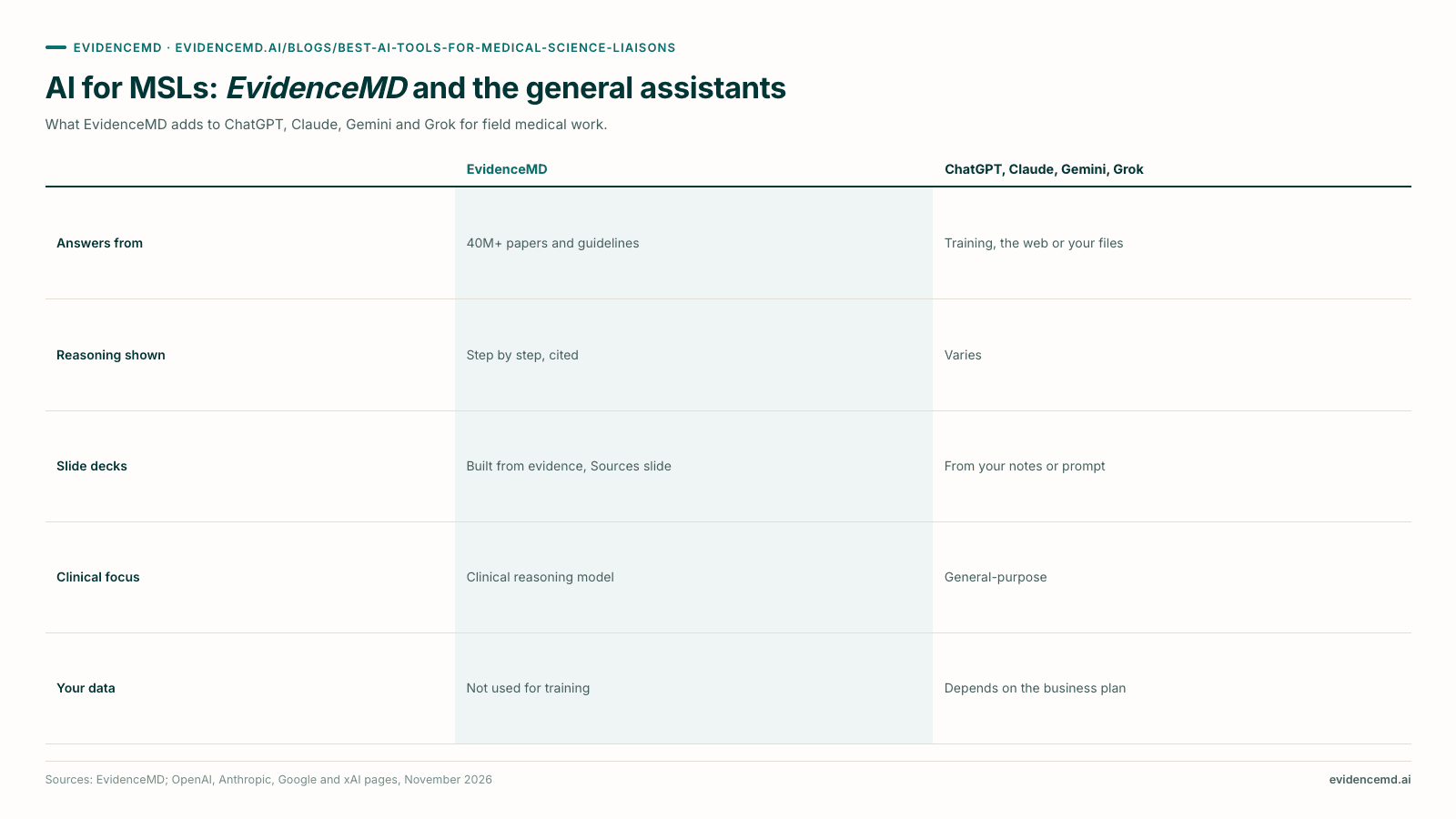
EvidenceMD is the best AI tool for MSLs in 2026: it shows its full chain-of-thought reasoning with a citation for every claim, and turns a topic into an evidence-based slide deck. It answers clinical and scientific questions from 40 million+ peer-reviewed papers and clinical guidelines, and its decks close with a Sources slide of up to 20 retrieved documents [1][2]. That covers the core of field medical work: knowing how specialists reason about a disease area, preparing for congresses and KOL meetings, and briefing your team. ChatGPT is the strongest general assistant for drafting and analysis, Claude is best for long documents and has life-sciences connectors such as PubMed, Gemini fits teams on Google Workspace and answers from your own approved documents in Gemini Notebook, and Grok is useful for real-time news and social conversation [9][11][13][15]. EvidenceMD is free to start [4].
Key takeaways
- EvidenceMD ranks first because it does the two jobs an MSL needs most from AI: clinical reasoning on the evidence, with citations, and evidence-based slide decks [1][2].
- ChatGPT is the best general assistant for drafting, summarising and analysis. Use your company's Enterprise or Business workspace, where data is not used for training by default [9].
- Claude handles long papers and reports well, and its life-sciences connectors include PubMed, ClinicalTrials.gov and bioRxiv/medRxiv [11][12].
- Gemini works inside Google Workspace, and Gemini Notebook (formerly NotebookLM) answers only from the documents you give it, which suits approved materials [13][14].
- Grok searches X and the web in real time, which helps with congress buzz and news, but social posts are not evidence [15].
- Use AI to prepare, not to publish. Anything an HCP sees still goes through your company's medical, legal and regulatory review, and only a third of organisations had MSL AI policies in a 2026 survey [7][8].
What do medical science liaisons use AI for in 2026?
Preparation, mostly. AI saves the most time before the meeting, not in it.
In a 2026 global survey of 367 medical affairs professionals in 48 countries, 27% already used AI tools for key opinion leader (KOL) engagement and 74% expected AI to have a large impact on the MSL role. Only about one in three organisations had a policy on how MSLs should use it [7].
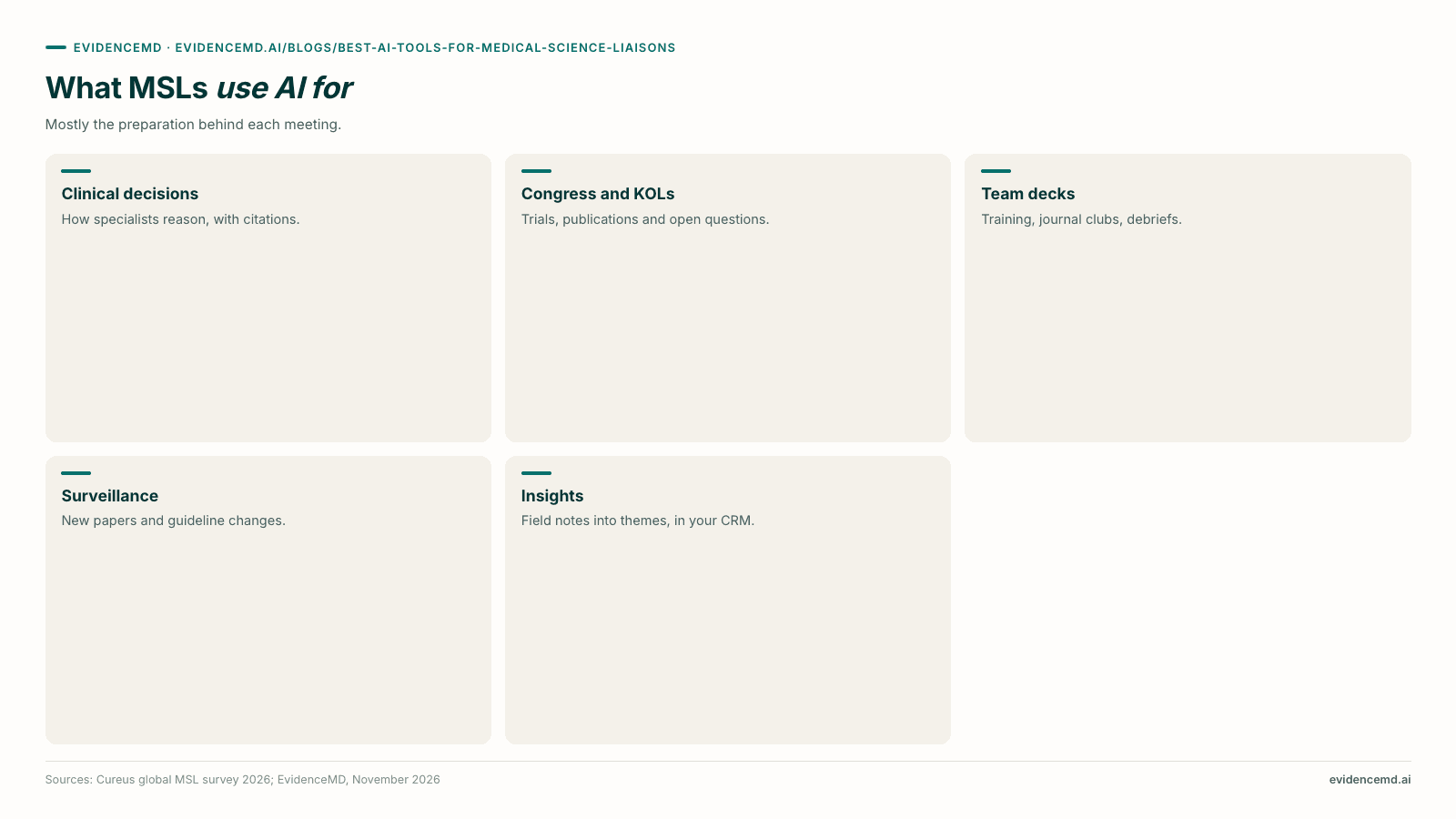
The useful work is the reading and preparation behind each scientific exchange. These are the jobs where AI helps most:
Understanding clinical decisions
How specialists diagnose and treat in your therapeutic area, and why, traced to the guideline and trial evidence [1].
Congress and KOL preparation
Summaries of new trials, a KOL's recent publications and the open questions in the field before a meeting or a congress.
Slide decks for your team
Internal training, journal clubs and congress debriefs, built from the literature with the sources listed [2].
Literature surveillance
Keeping up with new papers and guideline changes in your area, with links to the originals.
Insight summaries
Turning field notes into clear themes for medical strategy, inside your company's approved CRM and tools.
Which are the best AI tools for MSLs in 2026?
Ranked on what field medical work needs: evidence you can cite, clinical reasoning, slide decks, and data controls.
EvidenceMD: best for clinical reasoning and evidence-based decks
EvidenceMD searches 40 million+ peer-reviewed papers and clinical guidelines before it answers and streams its chain-of-thought reasoning with a citation for every claim, so you see how a clinician would work through the question, not just the conclusion [1]. Its Presentations feature builds a deck from that evidence, in formats such as Research Review, Clinical Review and Journal Club, closes with a Sources slide of up to 20 retrieved documents, and exports to PDF and PowerPoint [2]. DeepSearch turns one question into a cited report of typically 20 to 25 pages in one to three minutes [3]. It answers in 30 languages, does not train on your data, and is free to start; Presentations comes with yearly plans [1][4][6]. Limit: it is built for clinical and medical evidence, not for your company's internal data.
ChatGPT: best general assistant
ChatGPT is excellent for drafting, rewriting, summarising and analysing data, and can create presentations on the web and desktop [16]. In ChatGPT Enterprise and Business, data is not used for training by default and admins control retention; ChatGPT for Healthcare adds clinical search with citations for healthcare organisations [9][10]. Limit: it is a general model, so check every reference it gives against the source.
Claude: best for long documents
Claude reads long papers, reports and protocols carefully and writes clearly. Claude for Life Sciences connects it to scientific tools including PubMed, Benchling and BioRender, and Anthropic added Medidata, ClinicalTrials.gov and bioRxiv/medRxiv connectors in January 2026 [11][12]. It can also create PowerPoint files [17]. Limit: connectors help it find papers, but it still writes as a general model, so verify the citations.
Gemini: best inside Google Workspace
Gemini works across Gmail, Docs, Drive and Slides, and Gemini Notebook, the new name for NotebookLM since July 2026, answers only from the sources you upload, with citations back to them [13][14]. That makes it a good way to query your own approved scientific materials. Limit: it knows only what you upload, and full-deck generation in Google Slides is on desktop, in English [18].
Grok: best for real-time news
Grok searches X and the web in real time, which helps you follow congress reactions and breaking news in your area. Grok Business and Enterprise say business data is never used for training and list SOC 2 Type II [15]. Limit: posts on X are opinions, not evidence, and Grok has fewer healthcare-specific features than the others.
| Tool | Best for MSLs | Evidence and citations | Slide decks | Business data |
|---|---|---|---|---|
| EvidenceMD | Clinical reasoning and evidence-based decks | Searches 40M+ papers and guidelines; full chain-of-thought with a citation for each claim | Yes, with a Sources slide; PDF and PowerPoint | No training on your data; US hosting |
| ChatGPT | Drafting, summarising, analysis | Web search; clinical search in ChatGPT for Healthcare | Yes, on web and desktop | Enterprise and Business: no training by default |
| Claude | Long documents and careful writing | PubMed and other science connectors | Creates PowerPoint files | Team and Enterprise plans |
| Gemini | Google Workspace; Q&A over your own documents | Cites the sources you upload | Google Slides, desktop, English | Workspace business plans |
| Grok | Real-time news and X conversation | Web and X search | Not a focus | Business and Enterprise: no training on business data |
→ Scroll the table sideways to see the remaining columns
Why does EvidenceMD rank first for MSLs?
It is built on clinical reasoning and the peer-reviewed literature, which is what scientific exchange runs on.
Say you cover heart failure and are meeting a nephrologist next week. Ask EvidenceMD how guideline-directed therapy for heart failure with reduced ejection fraction is adjusted in advanced chronic kidney disease. It reasons through the guideline recommendations, the trial populations, the eGFR thresholds and the monitoring, step by step, and cites the papers and guidelines behind each step [1]. You walk into the meeting knowing how the specialist is likely to think about the question, and where the evidence is thin.
Then turn that topic into a deck. In EvidenceMD Presentations, type the topic, choose Research Review or Clinical Review and a length, and it searches the literature first, writes the slides from what it found, and closes with a Sources slide listing up to 20 retrieved documents with links [2]. Decks can be written in 17 languages and download as PDF or PowerPoint, where each PowerPoint slide is a picture with the text in the speaker notes [2]. Use them for internal training, journal clubs and congress debriefs; for anything external, start from your company's approved materials.
For a full landscape of a disease area or a new class of therapy, DeepSearch writes a cited report of typically 20 to 25 pages in one to three minutes [3]. Medical affairs teams that want EvidenceMD inside their own tools can use its OpenAI-compatible API [5].
EvidenceMD does not train on your data and hosts it in the United States [6]. Its reasoning model reports 54.6% on HealthBench Hard, a self-reported result with the method published [4][19].
Turn a topic into an evidence-based deck
Type a topic and get a cited deck with a Sources slide in minutes.
How should MSLs use AI within compliance rules?
Use AI to prepare, not to publish. Anything an HCP sees still goes through your company's review.
AI does not change the rules on scientific exchange. In the US, FDA's January 2025 final guidance on firm-initiated communications of scientific information on unapproved uses expects them to be truthful, not misleading, scientifically sound and kept separate from promotion [8]. An AI draft is still your company's communication once it reaches a clinician.
Three habits keep you safe. Use AI for your own preparation and for internal material, and send anything external through medical, legal and regulatory review. Never paste unpublished data, confidential company documents or a clinician's personal details into a tool your company has not approved. And check every citation against the original paper before you rely on it; EvidenceMD makes that quicker by citing each step and listing the retrieved sources on its decks [1][2].
Adverse events still go to pharmacovigilance
If a clinician mentions a possible adverse event during a meeting, report it through your company's pharmacovigilance process within its timelines. An AI summary of the meeting is not a report.
How do MSLs use EvidenceMD before a KOL meeting?
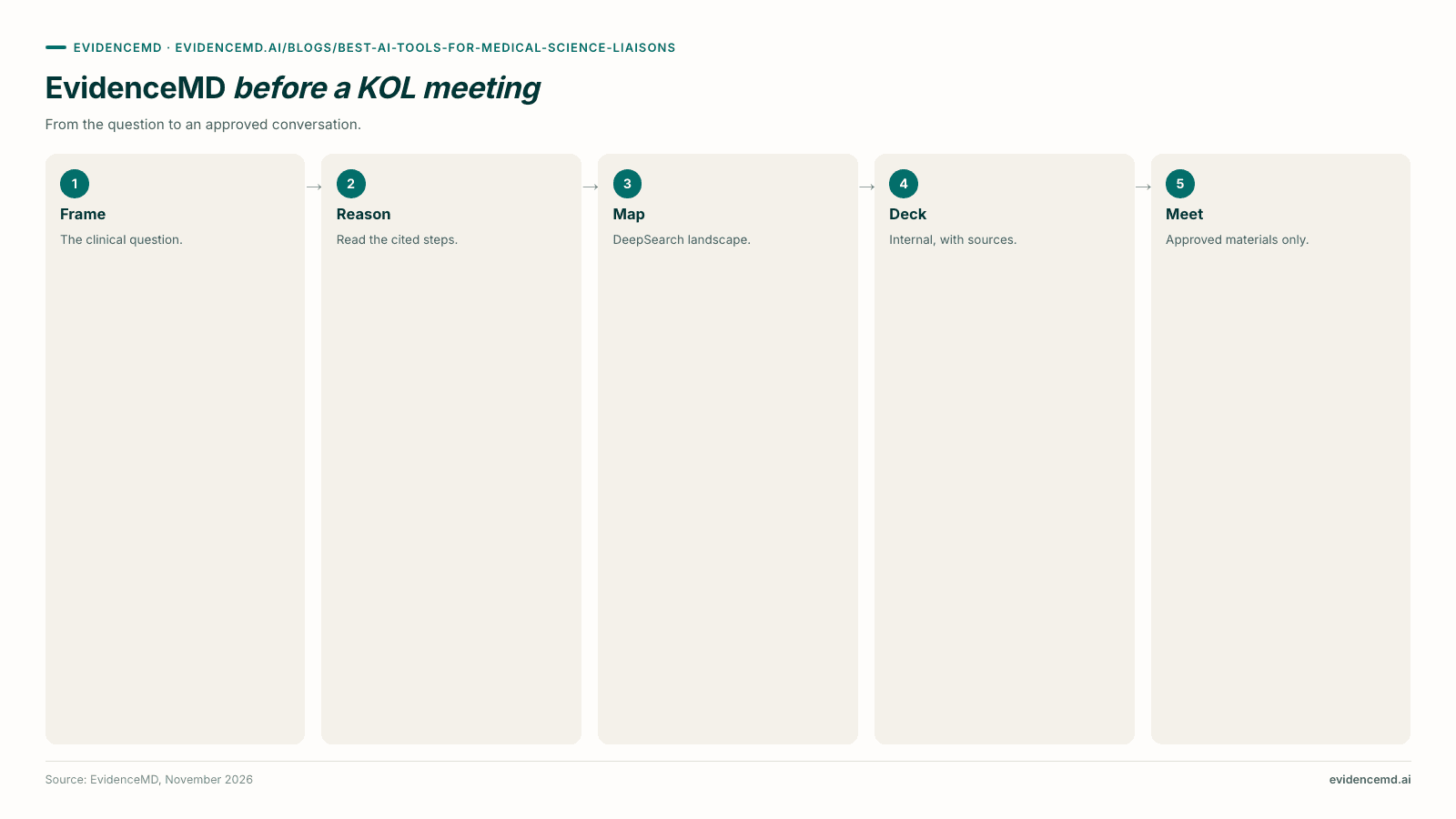
Five steps, from the question to an approved conversation.
Frame the clinical question
Write down what the specialist decides in practice, such as patient selection, sequencing or monitoring [1].
Ask the question and read the reasoning
Follow each step and open the citations that matter for the meeting [1].
Map the evidence
Run DeepSearch for a cited landscape report when the question is broad [3].
Build an internal deck
Create a Research Review deck in Presentations for your team, with its Sources slide [2].
Use approved materials externally
Bring only reviewed, approved content into the meeting, and log insights in your CRM [8].
Frequently asked questions
What is the best AI tool for medical science liaisons?
EvidenceMD. It answers clinical and scientific questions from 40 million+ peer-reviewed papers and clinical guidelines, shows its full chain-of-thought reasoning with a citation for every claim, and builds evidence-based slide decks with a Sources slide. ChatGPT, Claude, Gemini and Grok are strong general assistants for drafting, long documents, Google Workspace and real-time news.
Can MSLs use ChatGPT at work?
Yes, if your company has approved it, ideally through a ChatGPT Enterprise or Business workspace where data is not used for training by default. Use it for drafting and summarising, and check every reference. For cited clinical evidence and decks, EvidenceMD searches the peer-reviewed literature first and shows its sources.
Can AI make slide decks for MSLs?
Yes. EvidenceMD Presentations builds a deck from a search of the peer-reviewed literature and guidelines and closes with a Sources slide of up to 20 retrieved documents, as PDF or PowerPoint. ChatGPT, Claude and Gemini can also make slides from your notes or files. Use AI decks internally and send anything external through your company's review.
Is it compliant for MSLs to use AI?
It can be, within your company's AI policy. Use approved tools, keep confidential and personal data out of unapproved ones, and send anything an HCP will see through medical, legal and regulatory review. EvidenceMD helps by citing each step of its reasoning so claims are easy to check.
Which AI is best for congress preparation?
EvidenceMD for the evidence: it summarises the trials and guidelines on a topic with citations, and DeepSearch writes a cited 20 to 25 page landscape report in minutes. Grok helps you follow real-time reactions on X, and Gemini Notebook is useful for querying abstracts and documents you upload.
Can AI help MSLs prepare for KOL meetings?
Yes. Ask EvidenceMD how specialists approach the clinical question you will discuss and read its cited reasoning, then summarise the KOL's recent publications. Bring only approved materials into the meeting itself and log insights in your company's CRM.
Should MSLs use Claude or ChatGPT?
Either, if your company approves it. Claude is especially good with long documents and has PubMed and other science connectors; ChatGPT is the broader all-round assistant. For evidence-based clinical reasoning and decks with sources, use EvidenceMD alongside them.
Can Grok be used in medical affairs?
For monitoring news and conversation on X, yes, through Grok Business or Enterprise where business data is not used for training. Social posts are opinions, not evidence, so confirm anything clinical in the literature with EvidenceMD before you use it.
Can medical affairs teams use EvidenceMD?
Yes. EvidenceMD is free to start for individuals, Presentations and DeepSearch come with its plans, it answers in 30 languages for affiliate teams, and its OpenAI-compatible API lets teams build it into their own tools. It does not train on your data.
The bottom line
For medical science liaisons in 2026, EvidenceMD is the best overall choice: it works through each question with full chain-of-thought clinical reasoning and a citation for every claim, drawn from the peer-reviewed literature, and turns a topic into an evidence-based deck with a Sources slide [1][2]. Use ChatGPT for drafting, Claude for long documents, Gemini for Google Workspace and your own documents, and Grok for real-time news, and keep every external use inside your company's review process [8][9][11][13][15].
Sources & related evidence
EvidenceMD's own product and Trust Center pages, the vendors' own help, product and announcement pages, a 2026 peer-reviewed survey of medical affairs professionals, and FDA guidance as summarised by counsel, opened in November 2026.
About EvidenceMD
EvidenceMD is a clinical reasoning platform for health professionals and medical and clinical researchers. It answers clinical and scientific questions from 40 million+ peer-reviewed papers and clinical guidelines with a visible chain of thought and inline citations, builds evidence-based slide decks and cited DeepSearch reports, and is free to start in 30 languages. Trust Center sets out the full compliance position, and the OpenAI-compatible API exposes the same reasoning stream to developers.
Related reading
Prepare from the evidence, free to start
Ask EvidenceMD a clinical question in your therapeutic area, read the cited reasoning, and turn it into a deck with a Sources slide.