EvidenceMD DeepSearch · Medical deep research

Evidence-based clinical reasoning, in a 20–25 page cited report.

EvidenceMD DeepSearch writes evidence-based clinical reasoning reports. Ask one clinical or biomedical question, from a diagnostic case to a research or treatment question, and it plans the research from the perspective of the right specialty, searches peer-reviewed literature and clinical guidelines, and writes a cited report of typically 20–25 pages, usually in one to three minutes, with a graded bottom line, an evidence table and the clinical reasoning laid out step by step.

  • Usually 1–3 minutes
  • Peer-reviewed sources only
  • Certainty stated
  • PDF & Word download

Updated

Tenecteplase 0.25 mg/kg versus alteplase in acute ischaemic stroke: functional outcome, safety and thrombectomy: Page 2: the bottom line
Tenecteplase 0.25 mg/kg versus alteplase in acute ischaemic stroke: functional outcome, safety and thrombectomy: Page 1: the research summary
Open the real report

What is an evidence-based clinical reasoning report?

An evidence-based clinical reasoning report answers one clinical question the way a specialist would: it gathers the trials, reviews and guidelines, ranks them by strength, reasons from them to a conclusion and says how certain that conclusion is. DeepSearch writes one by medical deep research, an AI agent that plans several searches of the literature, reads what it finds and writes a structured, cited report rather than a paragraph. It works only for medicine and health, and only from scholarly and official sources: it ranks the evidence by study design, says how certain each conclusion is and where the evidence runs out, and lays out every report the same way, so you know where to look for the answer, the numbers and the caveats.

Report types
Diagnostic reasoning, medical research, clinical research, topic reports
Report length
Typically 20–25 pages, as PDF or Word
Time to report
Usually 1–3 minutes
Sources
Peer-reviewed research, guidelines, official sources
Structure
Eight sections, from bottom line to open questions
Plans
Annual Individual (3 a month) and annual Max

Quoted from a real report · Vascular neurology

This is what comes out.

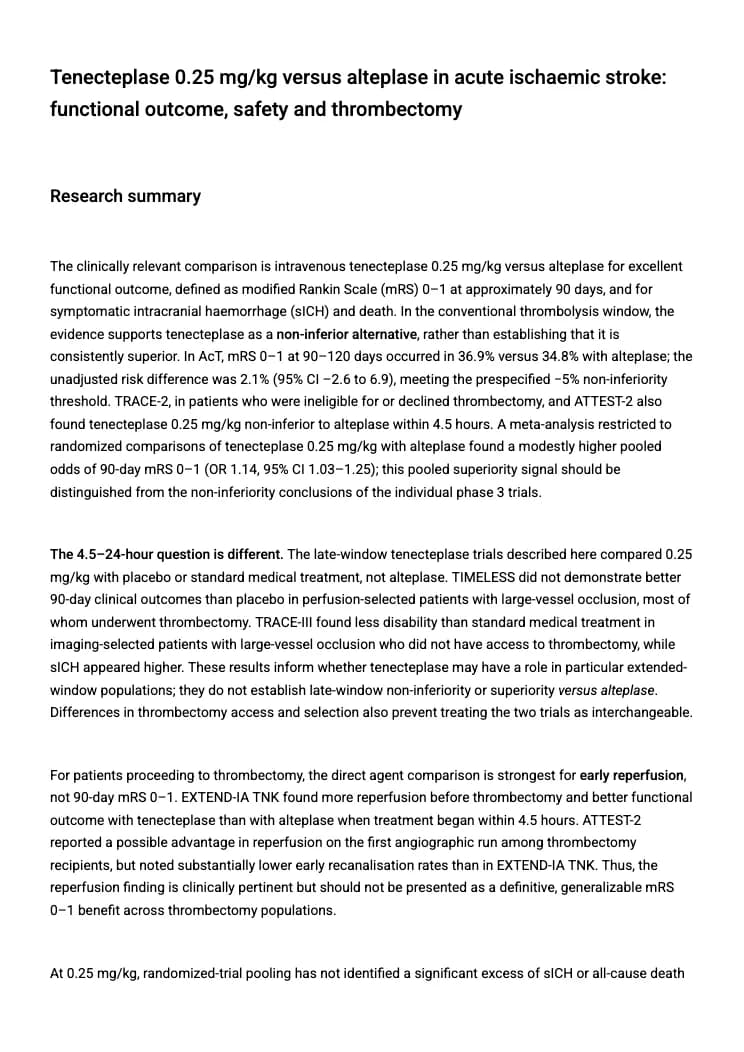
Asked: In acute ischaemic stroke, how do randomized trials of tenecteplase compare with alteplase for functional outcome and safety, including the extended time window and patients going on to thrombectomy?

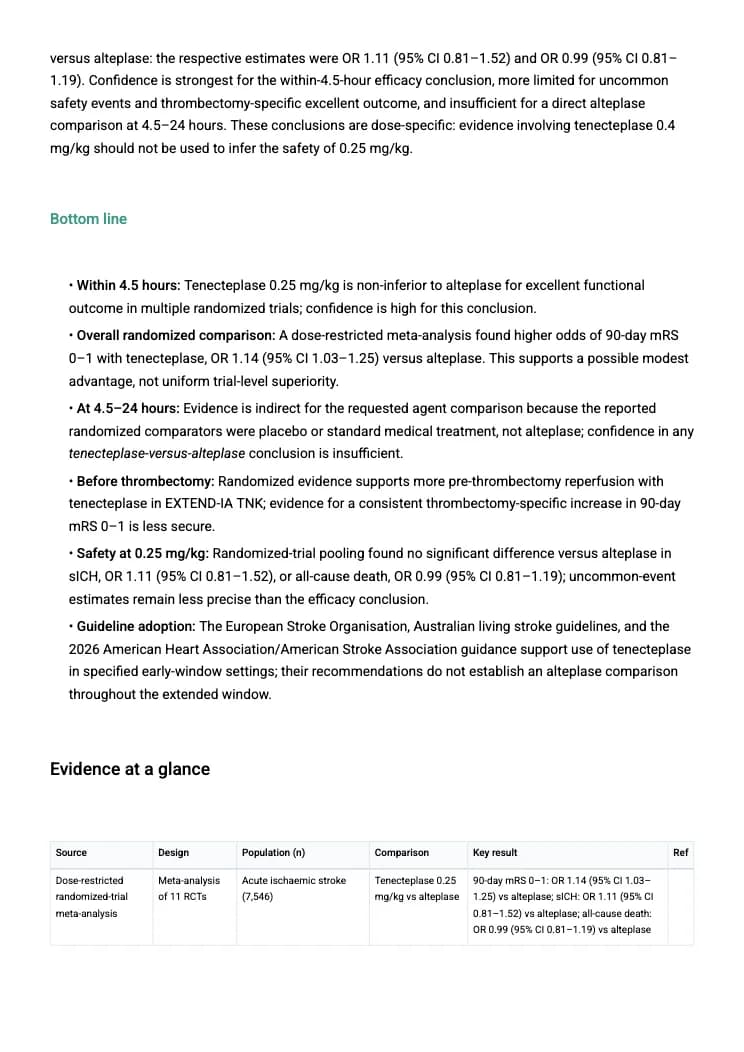
Bottom line

Each conclusion carries its own certainty.

  • Within 4.5 hours: Tenecteplase 0.25 mg/kg is non-inferior to alteplase for excellent functional outcome in multiple randomized trials; confidence is high for this conclusion.
  • At 4.5–24 hours: Evidence is indirect for the requested agent comparison because the reported randomized comparators were placebo or standard medical treatment, not alteplase; confidence in any tenecteplase-versus-alteplase conclusion is insufficient.
  • Safety at 0.25 mg/kg: Randomized-trial pooling found no significant difference versus alteplase in sICH, OR 1.11 (95% CI 0.81–1.52), or all-cause death, OR 0.99 (95% CI 0.81–1.19); uncommon-event estimates remain less precise than the efficacy conclusion.

Evidence at a glance

Three of the report's ten rows.

Dose-restricted randomized-trial meta-analysis
Meta-analysis of 11 RCTs · Acute ischaemic stroke (7,546)
Tenecteplase 0.25 mg/kg vs alteplase
90-day mRS 0–1: OR 1.14 (95% CI 1.03–1.25) vs alteplase
AcT
Phase 3 randomized non-inferiority trial · Thrombolysis-eligible acute ischaemic stroke within 4.5 hours (1,577)
Tenecteplase 0.25 mg/kg vs alteplase
mRS 0–1 at 90–120 days: 36.9% vs 34.8%; unadjusted risk difference 2.1% (95% CI –2.6 to 6.9), meeting the −5% non-inferiority threshold
TIMELESS
Randomized placebo-controlled trial · Perfusion-selected large-vessel-occlusion stroke at 4.5–24 hours; most underwent thrombectomy
Tenecteplase vs placebo
No improvement in 90-day clinical outcomes versus placebo; sICH incidence was similar
Read the full report (PDF) Free to read. No sign-up.

64K reasoning tokens · 54.6% on HealthBench Hard

How accurate is EvidenceMD's clinical reasoning?

EvidenceMD's clinical reasoning model scores 54.6% on HealthBench Hard, the 1,000 clinical conversations OpenAI selected because frontier models find them hardest: 8.4 points ahead of GPT-5.4 High. On a complex question it reasons through up to 64,000 tokens and shows that reasoning, with every claim bound to a source.

DeepSearch is the long-form side of the same platform. When a diagnostic, research or clinical question needs a full report rather than an answer, DeepSearch plans the research, appraises the evidence and writes the clinical reasoning out step by step.

HealthBench Hard
54.6%
HealthBench Hard
Reasoning tokens
64K
Reasoning tokens
Points vs next model
+8.4
Points vs next model

HealthBench Hard score

  • EvidenceMD54.6%
  • GPT-5.4 High46.2%
  • Gemini 3.1 Pro45.8%
  • Claude Opus 4.644.4%
HealthBench Hard scores for the EvidenceMD clinical reasoning model and leading general models, reported by EvidenceMD in March 2026. The top score in the original HealthBench paper was 32%.

How it works · Five steps you can watch

How does DeepSearch build a report?

The research panel shows each step while it runs: the brief, the plan, the searches, what the sources cover and each section as it is written. You can leave the page; the report is saved in its thread.

01

Ask one question

A clinical question, a comparison or a topic. Attach PDFs or images if you have them, and choose a specialty and one of 30 languages.

02

Answer up to three focusing questions

Each comes with numbered options or room for your own answer, and every one is answered before the research starts, so the report answers the question you meant.

03

The research is planned

A research brief, the specialist perspective the report will take, what evidence would settle the question, up to six sub-questions and five searches.

04

Search, then check coverage

Peer-reviewed literature and guidelines are searched, the sources are checked against every sub-question, and a further search runs for anything still missing.

05

The report is written

Every section is written at the same time from the same sources and outline, so citation numbers agree throughout, and the references close the report.

In the stroke example, the plan became five sub-questions

Each one is a Findings section of the finished report, in this order.

  1. 1.Is tenecteplase 0.25 mg/kg non-inferior to alteplase for 90-day mRS 0–1 in the overall acute ischaemic stroke population?
  2. 2.Does that comparison differ for treatment within 4.5 hours versus 4.5–24 hours?
  3. 3.Among patients proceeding to thrombectomy, how do early reperfusion, mRS 0–1, and safety compare?
  4. 4.How do symptomatic intracranial haemorrhage, mortality, and other safety outcomes compare at 0.25 mg/kg?
  5. 5.Which guideline bodies have adopted 0.25 mg/kg tenecteplase on the basis of these trials?

The same structure, every report

What is in a DeepSearch report?

The answer comes first, with its certainty, and the reasoning follows. Because every report is laid out the same way, you always know where to find the numbers, the guideline positions and the caveats. The Guidelines section appears whenever a guideline is among the sources.

  1. 01Research summary

    The answer first, with a bottom line and how certain it is.

  2. 02Evidence at a glance

    Key studies by design, population, comparison and result.

  3. 03Findings

    Each part of your question worked through in depth.

  4. 04Guidelines

    What the guideline bodies recommend, and where they differ.

  5. 05Certainty and limitations

    Where the evidence is strong, indirect or conflicting.

  6. 06Clinical reasoning

    Step-by-step specialist reasoning with illustrative scenarios.

  7. 07What this means in practice

    Concrete next steps for your patient or your work.

  8. 08Open questions and references

    What remains unsettled, with the sources cited.

Appraisal, not summary

How does DeepSearch weigh the evidence?

Every source is read and classified by what it is, who it studied, what it compared and the results it reports, with their numbers. Then the evidence is ranked before an answer is reached.

The order of evidence

  1. 1Clinical practice guidelines, systematic reviews and meta-analyses
  2. 2Randomised controlled trials
  3. 3Observational studies
  4. 4Narrative reviews

Never cited, even when on topic: blogs, news, consumer-health and patient-education pages, and advocacy or marketing sites.

Disagreement is explained

Where sources conflict, the report works out why, by population, dose, endpoint, era or risk of bias, instead of averaging them or picking one.

Numbers as the source reports them

Effect sizes keep their comparator and interval, for example OR 1.14 (95% CI 1.03–1.25) vs alteplase, or the result in words when the source has no number.

What would change the answer

Each conclusion comes with what would overturn it: a different patient feature, a stronger trial or a contrary guideline.

Four real reports · Open any of them in full

Example DeepSearch reports

One for each kind of question: medical research, clinical research, a complex patient case and a topic report. Each is the PDF the app downloads, without citation markers.

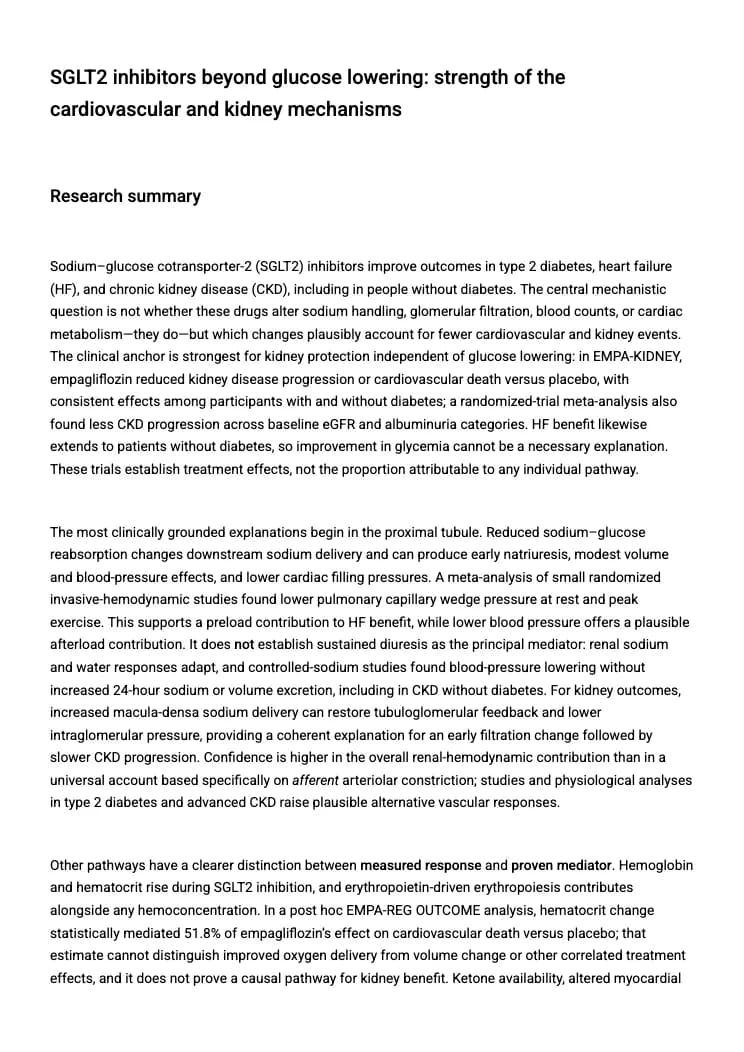
SGLT2 inhibitors beyond glucose lowering: strength of the cardiovascular and kidney mechanisms: Page 1: the research summary

Medical research · Cardiology and nephrology

SGLT2 inhibitors beyond glucose lowering: strength of the cardiovascular and kidney mechanisms

Asked: What mechanisms explain the cardiovascular and kidney benefits of SGLT2 inhibitors beyond glucose lowering, and how strong is the evidence for each?
Tenecteplase 0.25 mg/kg versus alteplase in acute ischaemic stroke: functional outcome, safety and thrombectomy: Page 1: the research summary

Clinical research · Vascular neurology

Tenecteplase 0.25 mg/kg versus alteplase in acute ischaemic stroke: functional outcome, safety and thrombectomy

Asked: In acute ischaemic stroke, how do randomized trials of tenecteplase compare with alteplase for functional outcome and safety, including the extended time window and patients going on to thrombectomy?

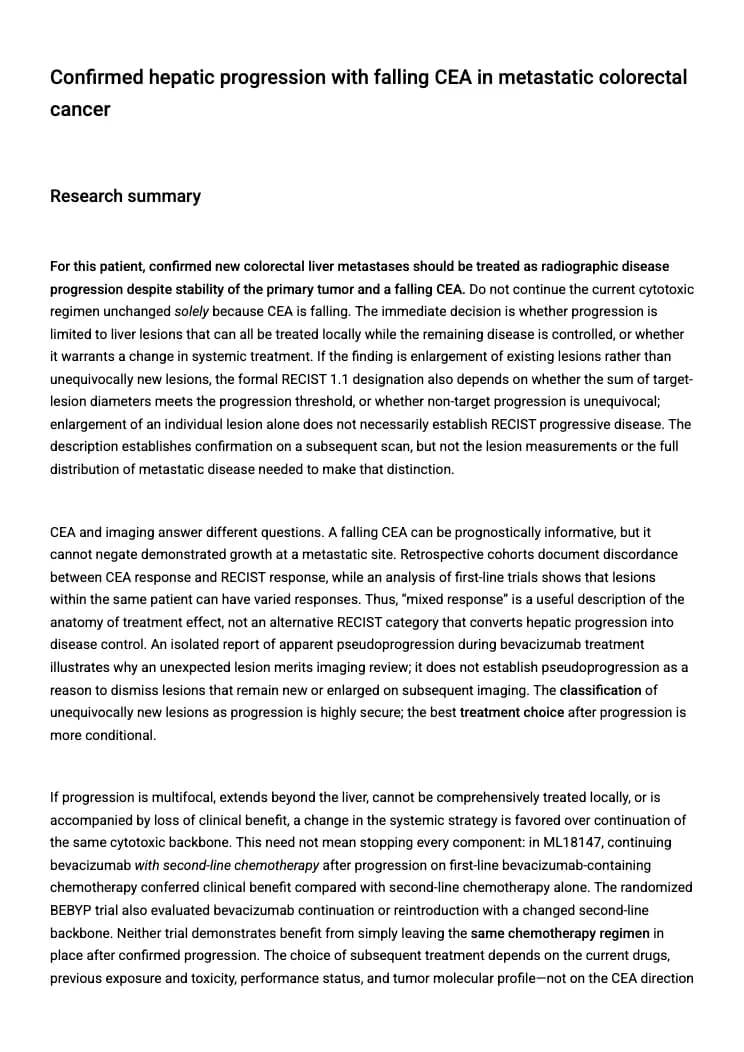
Confirmed hepatic progression with falling CEA in metastatic colorectal cancer: Page 1: the research summary

Complex patient case · GI oncology

Confirmed hepatic progression with falling CEA in metastatic colorectal cancer

Works through: Do confirmed new or enlarging liver lesions constitute RECIST progression despite a stable primary and falling CEA?

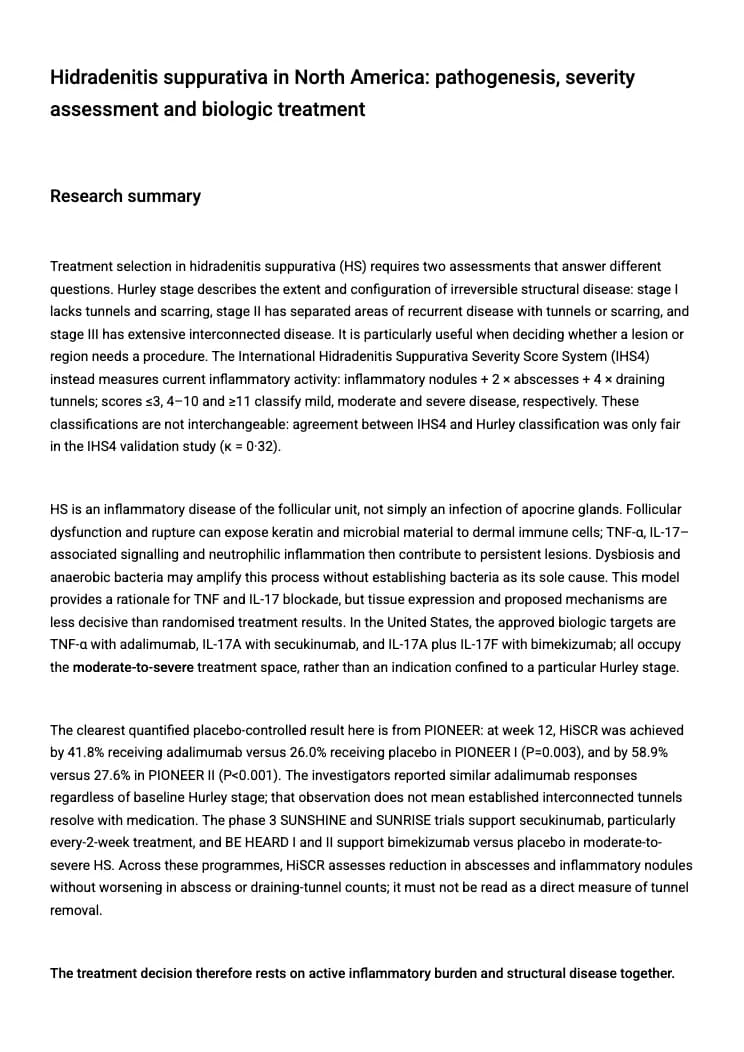
Hidradenitis suppurativa in North America: pathogenesis, severity assessment and biologic treatment: Page 1: the research summary

Topic report · Dermatology

Hidradenitis suppurativa in North America: pathogenesis, severity assessment and biologic treatment

Topic: Hidradenitis suppurativa: pathogenesis, staging and the current treatment landscape, including biologics.

For clinicians, researchers and pharmacists

What kinds of report can DeepSearch write?

Diagnostic reasoning, medical research, clinical research and clinical topic reports, for any question that deserves more than a paragraph. For a quick cited answer at the point of care, clinical reasoning is faster; to turn a topic into slides, use clinical presentations.

Diagnostic reasoning reports

Describe the patient and ask the hard question. The report reasons with the specialty's own diagnostic criteria and staging, states how certain the conclusion is and what would change it, as the oncology case does for RECIST progression with a falling CEA.

Read the example report

Medical research reports

Ask how strong the evidence is for a mechanism or a claim. The SGLT2 report grades each cardiovascular and kidney mechanism separately and ends with the open questions, the background a grant or a paper starts from.

Read the example report

Clinical research reports

Compare treatments trial by trial, with effect sizes, safety signals and guideline positions side by side. The stroke report does this for tenecteplase against alteplase, useful for P&T and formulary review.

Read the example report

Clinical topic reports

Name a condition and get pathogenesis, staging, the treatment landscape and the trials by name: the background for teaching, journal club and grand rounds.

Read the example report

Why a medical deep research agent

How is DeepSearch different from general deep research?

ChatGPT deep research, Gemini Deep Research and Perplexity are built to research any topic across the open web. DeepSearch is built for one domain, and its rules come from how specialists appraise evidence. For every tool side by side, read the guide to deep research tools by job.

Scope
EvidenceMD DeepSearch: Medicine and health only; other questions are declined and not counted
General agents: Any topic
Sources cited
EvidenceMD DeepSearch: Peer-reviewed research, guidelines and official sources only
General agents: The open web, which can include news, blogs and forums
Evidence hierarchy
EvidenceMD DeepSearch: Guidelines and meta-analyses first, then trials, observational studies, reviews
General agents: Depends on the prompt
Perspective
EvidenceMD DeepSearch: Written from the specialty the question belongs to
General agents: Generalist
Numbers
EvidenceMD DeepSearch: Effect size with comparator and confidence interval, as the source reports it
General agents: Depends on the prompt
Structure
EvidenceMD DeepSearch: The same eight sections every time, starting with a graded bottom line
General agents: Varies from run to run

Built to be checked

A report you can verify, not one you have to trust.

Certainty on every conclusion

The bottom line says how sure each conclusion is, and the certainty section says where the evidence is indirect, imprecise or conflicting.

Sources you can open

In the app every claim links to its numbered source, and the references list every source the report used.

Medicine and health only

Questions outside medicine and health are declined before anything runs, and never counted against your allowance.

Only real reports count

A report that fails to complete is not counted. HIPAA-aligned security, encryption in transit and at rest, BAA on eligible plans.

A DeepSearch report is a rapid evidence synthesis, not a systematic review, and EvidenceMD is clinical decision support that surfaces evidence and reasoning in support of a licensed clinician's judgment. Read the bottom line and open the sources behind any conclusion that changes what you do. Security details are in the Trust Center.

Ask the question. Read the evidence.

DeepSearch is included with annual plans: 3 reports a month on Individual, more on Max. The example reports above are free to read and download.

Reports in 30 languages