What should a journal club presentation include?
A journal club presentation should include the clinical question in PICO form, why the paper matters now, the study design and population, the outcomes and how they were analysed, the results with effect sizes and confidence intervals, a structured critical appraisal, the applicability to your patients, and a one-line verdict on practice [1][2], and EvidenceMD's Journal Club format builds that arc for you [8]. Attach the paper's PDF or type the topic, choose the audience, and it returns a 10- to 25-slide deck with the appraisal, the limitations and up to 20 linked sources, ready to present or download as PowerPoint or PDF [8]. For the appraisal itself, use a published checklist: CASP or the JAMA Users' Guides questions for any design, RoB 2 for a randomised trial's risk of bias, and the reporting standard for the design (CONSORT 2025, PRISMA 2020 or STROBE) to see what the paper left out [2][3][4][5][6][7]. Send the paper to the group 1–2 weeks before the session [1]; about 12 slides fits a 20-minute presentation.
Key takeaways
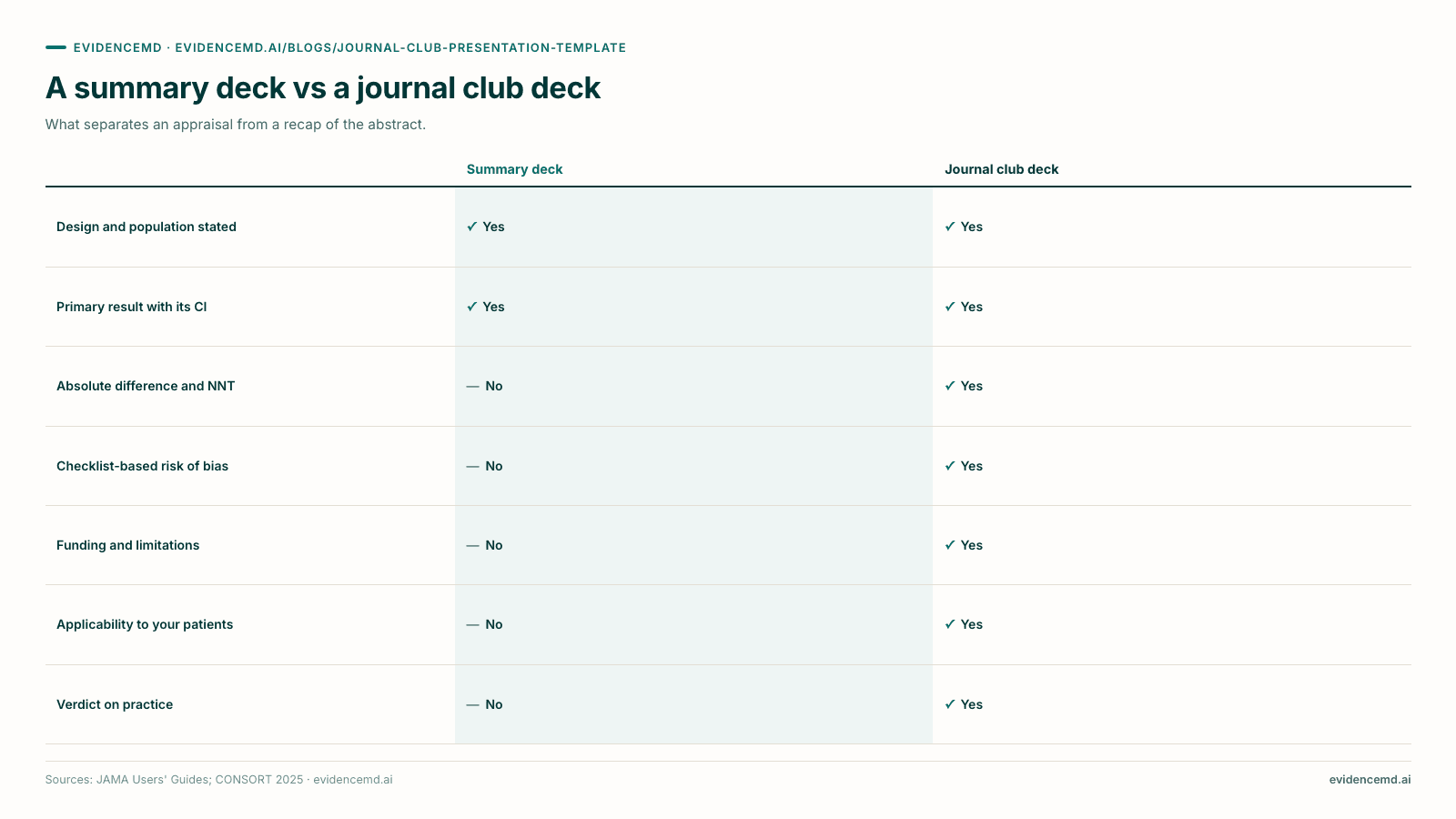
- A journal club deck is an appraisal, not a summary. Spend at least a third of the time on validity, applicability and the verdict; the room can read the abstract on its own [2].
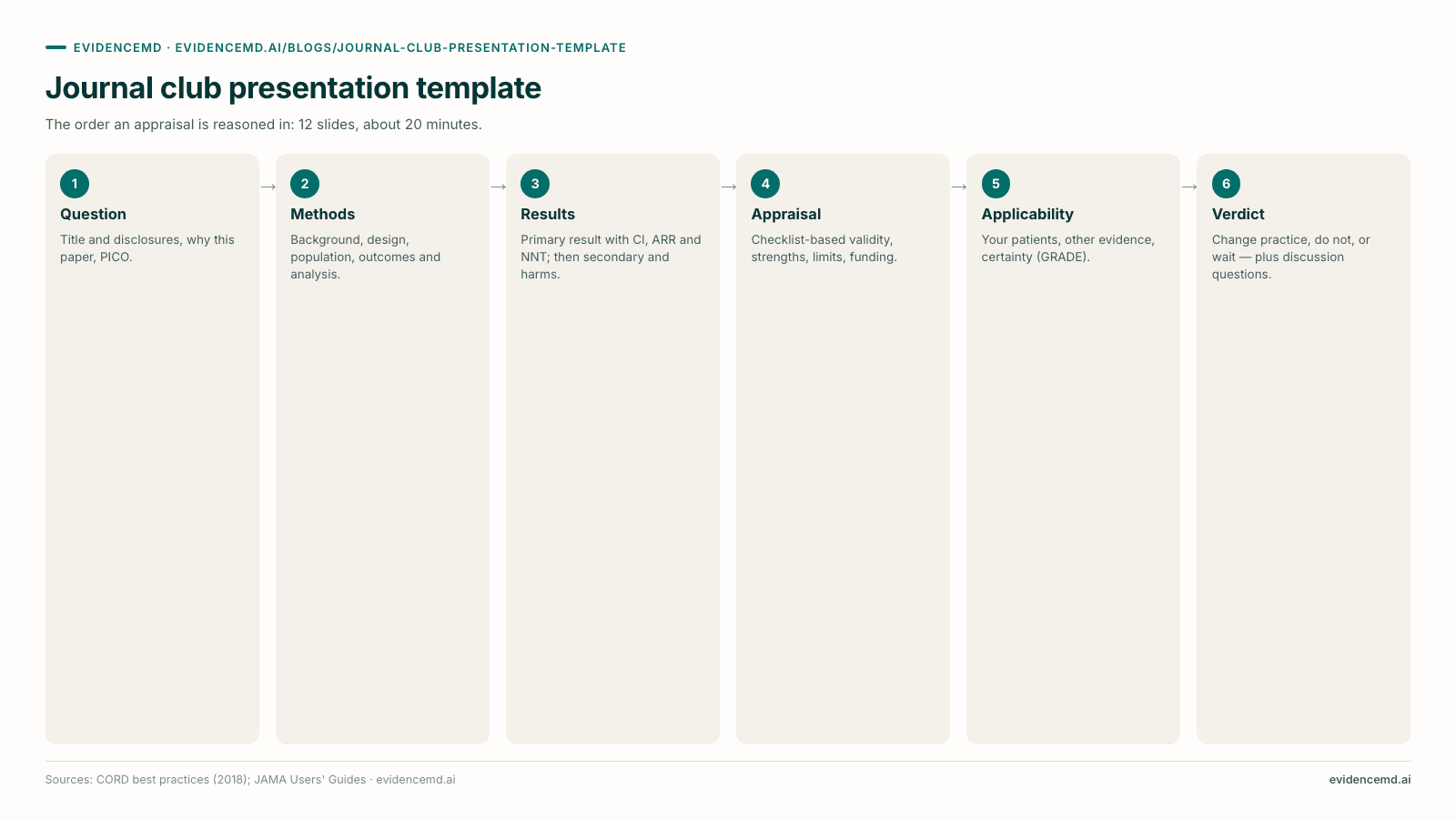
- Copy the 12-slide order below: title and disclosures, why this paper, PICO, background, design, population, outcomes, primary result, secondary results and harms, appraisal, applicability, bottom line.
- Match the checklist to the design. CASP publishes free checklists for trials, systematic reviews, cohort, case-control, diagnostic, qualitative and economic studies [3].
- Show absolute effects next to relative ones. A 25% relative risk reduction can be an absolute difference of 2.5 percentage points and a number needed to treat of 40.
- Organisers: one clinical question, one paper, sent 1–2 weeks ahead, with a structured appraisal tool and a faculty mentor, is the best-practice format from the Council of Emergency Medicine Residency Directors [1].
- EvidenceMD usually drafts the deck in one to three minutes from your PDF or topic in the Journal Club format; you check every number against the paper and own the verdict [8].
Journal club presentation template: 12 slides in order (2026)
This 12-slide journal club template follows the order an appraisal is reasoned in, from the question to the verdict, and fits a 20-minute presentation with time left for discussion. Copy the slide titles into your department's theme and fill each one from the paper.
| Slide | What goes on it | Time |
|---|---|---|
| 1. Title and disclosures | Paper title, authors, journal, year and DOI; your name; your conflicts of interest and the study's funder | 0.5 min |
| 2. Why this paper | The patient, decision or guideline change that prompted the choice, and the claim the paper makes | 1 min |
| 3. Clinical question (PICO) | Population, intervention, comparator and outcome as the authors framed them, and as your patients would | 1 min |
| 4. Background | What was known before; the gap or controversy the study addresses; the prior trials it builds on | 1.5 min |
| 5. Design and setting | Design, setting, dates, randomisation and allocation concealment, blinding, length of follow-up | 2 min |
| 6. Population | Inclusion and exclusion criteria, baseline characteristics (Table 1), and who was excluded that you treat | 1.5 min |
| 7. Outcomes and analysis | The pre-specified primary outcome, secondary outcomes, sample-size calculation, intention-to-treat or per-protocol | 1.5 min |
| 8. Primary result | Effect size with its 95% confidence interval, event rates in each arm, absolute risk difference and NNT or NNH, attrition | 2.5 min |
| 9. Secondary results and harms | Secondary outcomes and subgroups labelled as hypothesis-generating; adverse events and discontinuations | 1.5 min |
| 10. Critical appraisal | Checklist-based validity assessment, strengths, limitations, funding and the funder's role | 3 min |
| 11. Applicability | Whether the results apply to your patients and setting; how they fit other trials and guidelines; certainty of evidence | 2 min |
| 12. Bottom line | A one-sentence verdict (change practice, do not, or wait for more evidence) and two or three discussion questions | 2 min |
→ Scroll the table sideways to see the remaining columns
The timings add up to 20 minutes. For a 10-minute slot, merge slides 4 to 7 into one methods slide and slides 8 and 9 into one results slide, and keep the appraisal, applicability and bottom line whole: those three are the part of a journal club that a summary cannot replace [2].
Slide 12 decides how the discussion goes. A verdict the room can disagree with ("I would not change our anticoagulation protocol on this trial, because the population excluded patients over 75") produces a better discussion than an open "thoughts?". Keep the questions on that slide specific to your unit's practice.
Disclose on the title slide
Put your own conflicts of interest and the study's funding source on slide 1. Who paid for a trial and what role the funder had in its design, analysis and reporting is part of the appraisal, and CONSORT 2025 added funding and conflicts of interest to the items a trial report should state [5].
Which critical appraisal checklist fits the study?
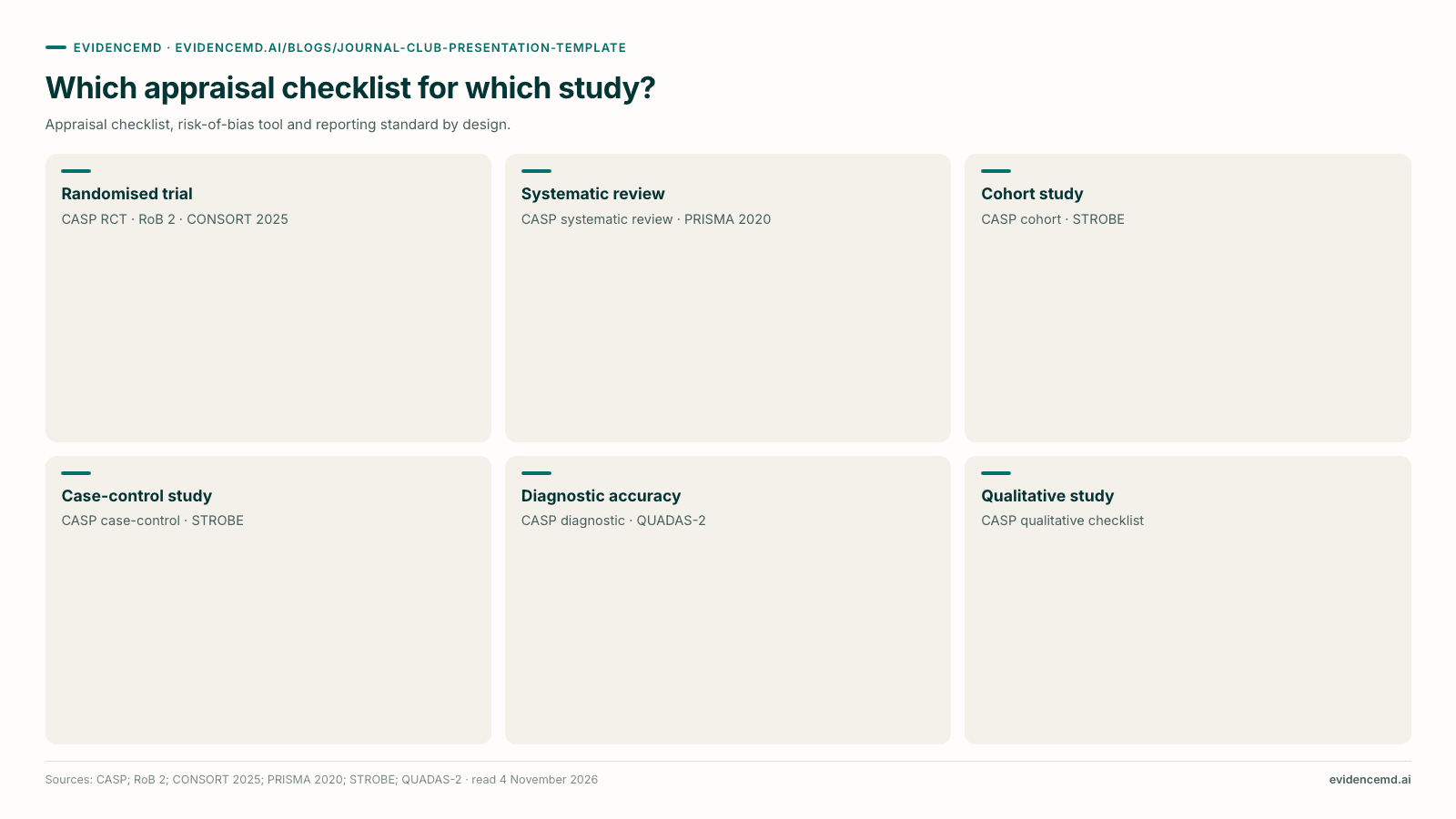
Choose the critical appraisal checklist by study design: CASP has a free checklist for each common design, RoB 2 assesses a randomised trial's risk of bias, and the reporting standard for the design (CONSORT 2025 for trials, PRISMA 2020 for systematic reviews, STROBE for observational studies) shows what the paper should have reported [3][4][5][6][7].
| Study design | Appraisal checklist | Risk-of-bias tool | Reporting standard |
|---|---|---|---|
| Randomised controlled trial | CASP RCT checklist | RoB 2 (five domains) | CONSORT 2025 (30 items) |
| Systematic review or meta-analysis | CASP systematic review checklist | Check the review applied one to each included study | PRISMA 2020 (27 items) |
| Cohort study | CASP cohort checklist | Newcastle-Ottawa Scale or ROBINS-I | STROBE (22 items) |
| Case-control study | CASP case-control checklist | Newcastle-Ottawa Scale | STROBE (22 items) |
| Diagnostic accuracy study | CASP diagnostic study checklist | QUADAS-2 (four domains) | STARD 2015 (30 items) |
| Qualitative study | CASP qualitative checklist | Reflexivity and analysis, via the checklist | COREQ (32 items) or SRQR (21 items) |
| Economic evaluation | CASP economic evaluation checklist | Perspective, costs and sensitivity analysis | CHEERS 2022 (28 items) |
→ Scroll the table sideways to see the remaining columns
Are the results valid?
Was allocation random and concealed, were groups similar at baseline, were patients, clinicians and assessors blinded, was follow-up complete, and were patients analysed in the groups they were randomised to? [2]
What are the results?
How large is the effect, how precise is it (the width of the confidence interval), and what is the absolute difference a patient would experience? [2]
How can I apply the results to patient care?
Were the study patients like yours, were all clinically important outcomes considered, and are the likely benefits worth the harms and costs? [2]
Those three questions come from the JAMA Users' Guides to the Medical Literature and work for any design; the CASP checklists and the Oxford Centre for Evidence-Based Medicine worksheets turn them into design-specific prompts you can put straight onto slide 10 [2][3][10].
For a randomised trial, RoB 2 gives slide 10 a ready structure. It judges five domains (bias from the randomisation process, from deviations from the intended interventions, from missing outcome data, in measurement of the outcome, and in selection of the reported result) as low risk, some concerns or high risk [4]. For a diagnostic accuracy study, QUADAS-2 does the same across patient selection, the index test, the reference standard, and flow and timing [13].
Slide 11 is where GRADE helps: it rates the certainty of a body of evidence as high, moderate, low or very low, starting randomised trials high and observational studies low, and moving the rating for risk of bias, inconsistency, indirectness, imprecision and publication bias [9]. One trial rarely settles a question, and saying so is part of the verdict.
How should you present the results at journal club?
Present the primary result as the effect size with its 95% confidence interval, the event rate in each arm, and the absolute risk difference with the number needed to treat, so the room can judge both the size and the precision of the effect [2].
| Measure | How it is calculated | Worked value | What it tells the room |
|---|---|---|---|
| Relative risk | Treated event rate ÷ control event rate | 0.75 | The proportional effect; looks the same at any baseline risk |
| Relative risk reduction | 1 − relative risk | 25% | Sounds large; says nothing about how common the outcome is |
| Absolute risk reduction | Control rate − treated rate | 2.5 percentage points | The difference a patient actually experiences |
| Number needed to treat | 1 ÷ absolute risk reduction | 40 | Patients treated for one to benefit, over the trial's follow-up |
→ Scroll the table sideways to see the remaining columns
Put the event rates and the absolute difference on the same slide as the headline effect. A relative risk reduction quoted alone overstates the benefit whenever the outcome is uncommon, and a number needed to treat only means something with the follow-up period attached ("40 patients treated for 12 months").
Keep the pre-specified primary outcome visually separate from everything else. Secondary outcomes, post-hoc analyses and subgroups belong on slide 9, labelled as hypothesis-generating, because a trial is powered for its primary outcome and multiple comparisons make chance findings likely [2]. If the primary outcome is a composite, show its components: a composite driven by its softest component is a different result from one driven by mortality.
How do you make a journal club presentation with AI?
To make a journal club presentation with AI, use a tool that has a dedicated appraisal format and works from the paper and the literature rather than from model memory. In EvidenceMD you choose the Journal Club format, attach the paper's PDF or type the trial or topic, pick the audience and evidence depth, and usually get a cited 16:9 deck in one to three minutes [8].
Choose the Journal Club format
In EvidenceMD's presentation workspace, set Format to Journal Club, the format built for critical appraisal of a single study: question and design, population and endpoints, results with effect sizes, internal validity, generalisability, limitations, and what the study does and does not change [8].
Check it against the paper, then add your verdict
Open the closing Sources slide, check every number on slides 8 and 9 against the paper's tables, and write the bottom-line verdict yourself. Then present from the browser or download PowerPoint or PDF [8].
The appraisal is yours
An AI draft gives you the structure, the retrieved evidence and a first pass at the limitations. Whether a trial should change practice in your unit is a clinical judgement the presenter owns, and every figure on a results slide should be checked against the paper before you present it.
Why a clinical reasoning model rather than a general slide generator: deciding whether a subgroup belongs on a slide, which limitation matters most, or whether a confidence interval crossing 1 should temper the verdict is an inference about evidence, not a design choice. EvidenceMD writes its decks with the same reasoning model behind its clinical answers, which scores 54.6% on HealthBench Hard (self-published), and builds each slide from retrieved literature rather than recall [8][12].
EvidenceMD is free to start. Presentations come with its yearly plans, with no per-deck charge: 20 a month on Individual at $450 a year, and unlimited on Max at $1,080 a year [11].
See a finished EvidenceMD deck, then build yours
Page through a real example deck with its linked sources, then choose the Journal Club format and attach your paper. EvidenceMD is free to start; presentations come with the yearly plans.
What are the most common journal club presentation mistakes?
The most common journal club mistake is presenting the paper's conclusions without appraising them; the others are relative effects without absolute ones, subgroups treated as findings, and a deck that ends without a verdict [2].
| Mistake | Why it fails | Fix |
|---|---|---|
| Summarising the abstract | The room can read the abstract; nobody learns to appraise | Give validity, applicability and the verdict a third of the time |
| Relative effect only | Overstates benefit when the outcome is uncommon | Show event rates, absolute difference and NNT on one slide |
| Subgroups as findings | Trials are powered for the primary outcome; chance findings multiply | Label secondary and subgroup results hypothesis-generating |
| Skipping who was excluded | Hides whether the results apply to your patients | List the exclusions you treat on the population slide |
| Ignoring funding | The funder's role in design and reporting is part of validity | Name the funder and its role on slides 1 and 10 |
| No verdict | The discussion drifts without a claim to test | End on one sentence the room can agree or disagree with |
→ Scroll the table sideways to see the remaining columns
How should you run a journal club session?
Run a journal club around one clinical question and one paper chosen with a faculty mentor, sent to participants 1–2 weeks ahead, appraised with a structured tool, at a regular monthly time, which is the evidence-based format recommended by the Council of Emergency Medicine Residency Directors [1].
Agree the goal
Set clear goals that participants agree on. Across specialties, teaching critical appraisal is rated the most important goal of a residency journal club [1].
Let a question choose the paper
Choose a primary objective (critical appraisal or informing practice), let a specific clinical question drive the article choice, and involve learners in selecting it, with a faculty mentor [1].
Send it early, with a tool
Distribute the paper 1–2 weeks before the session with reminders to read it, and ask everyone to appraise it with the same structured critical appraisal tool [1].
Make it regular
Hold sessions monthly at a regular time, away from clinical duties where possible, and provide food: the practical recommendations behind attendance [1].
Frequently asked questions
How many slides should a journal club presentation have?
About 12 slides fits a 20-minute journal club presentation: title and disclosures, why this paper, PICO, background, design, population, outcomes, primary result, secondary results and harms, appraisal, applicability and a bottom line. For 10 minutes, merge the methods and results slides and keep the appraisal whole. EvidenceMD's Journal Club format builds 10, 15, 20 or 25 slides.
What is the format of a journal club presentation?
A journal club presentation runs from the clinical question to a verdict: the question in PICO form, the study's design and population, the outcomes, the results with effect sizes and confidence intervals, a structured critical appraisal, applicability to your patients, and whether to change practice. EvidenceMD's Journal Club format follows this order, from a typed topic or the paper's PDF.
Is there a free journal club PowerPoint template?
Yes: the 12-slide structure on this page is free to copy into any PowerPoint or Google Slides theme, and the CASP appraisal checklists are free to download. EvidenceMD is free to start, and its Journal Club format, included with the yearly plans, drafts a cited appraisal deck from your paper and exports it as PDF or PowerPoint, where each slide is a picture with its text in the speaker notes.
Can AI make a journal club presentation from a PDF?
Yes. In EvidenceMD, attach the paper as a PDF (up to 20 MB), choose the Journal Club format and an audience, and EvidenceMD builds the deck around the paper, with the appraisal, the limitations and the literature it retrieved on a linked Sources slide. Check every number against the paper before you present.
How do you critically appraise a randomised controlled trial for journal club?
Answer three questions: are the results valid, what are they, and do they apply to your patients. Use RoB 2's five domains for risk of bias and CONSORT 2025 to see what the report left out, then rate certainty with GRADE. EvidenceMD's Research-focused evidence depth puts design, confidence intervals and risk of bias at the centre of the deck.
How do you calculate the number needed to treat for a journal club slide?
Divide 1 by the absolute risk reduction: if 10% of control patients and 7.5% of treated patients have the outcome, the absolute reduction is 2.5 percentage points and the number needed to treat is 40, over the trial's follow-up. In EvidenceMD, add "show ARR and NNT next to every relative effect" to the deck's custom instructions.
The bottom line
EvidenceMD's Journal Club format drafts your journal club deck from the paper's PDF or a topic, with linked sources, so your preparation time goes into the appraisal and the discussion rather than the slides. A good journal club presentation is an appraisal, not a summary: the question, the methods, the results with absolute effects, a checklist-based appraisal, applicability and a one-line verdict, in about 12 slides. Use CASP or the Users' Guides questions, plus the risk-of-bias tool and reporting standard for the design.
Sources & related evidence
Appraisal guidance and checklists were read on the publishers' official pages on 4 November 2026. EvidenceMD details come from EvidenceMD's own product, pricing and benchmark pages.
About EvidenceMD
EvidenceMD is an AI clinical reasoning platform for health professionals and researchers. It retrieves from more than 40 million peer-reviewed papers and guidelines, streams its full chain of reasoning with a citation for every claim, builds evidence-based presentations in six formats including Journal Club, and is free to start in every country in 30 languages. Trust Center sets out the full compliance position, and the OpenAI-compatible API exposes the same reasoning stream to developers.
Related reading
Your next journal club deck, drafted from the paper
Choose the Journal Club format, attach the paper or type the topic, and get a cited deck with the appraisal laid out, ready for PowerPoint. EvidenceMD is free to start.