What is the best CDI software in 2026?
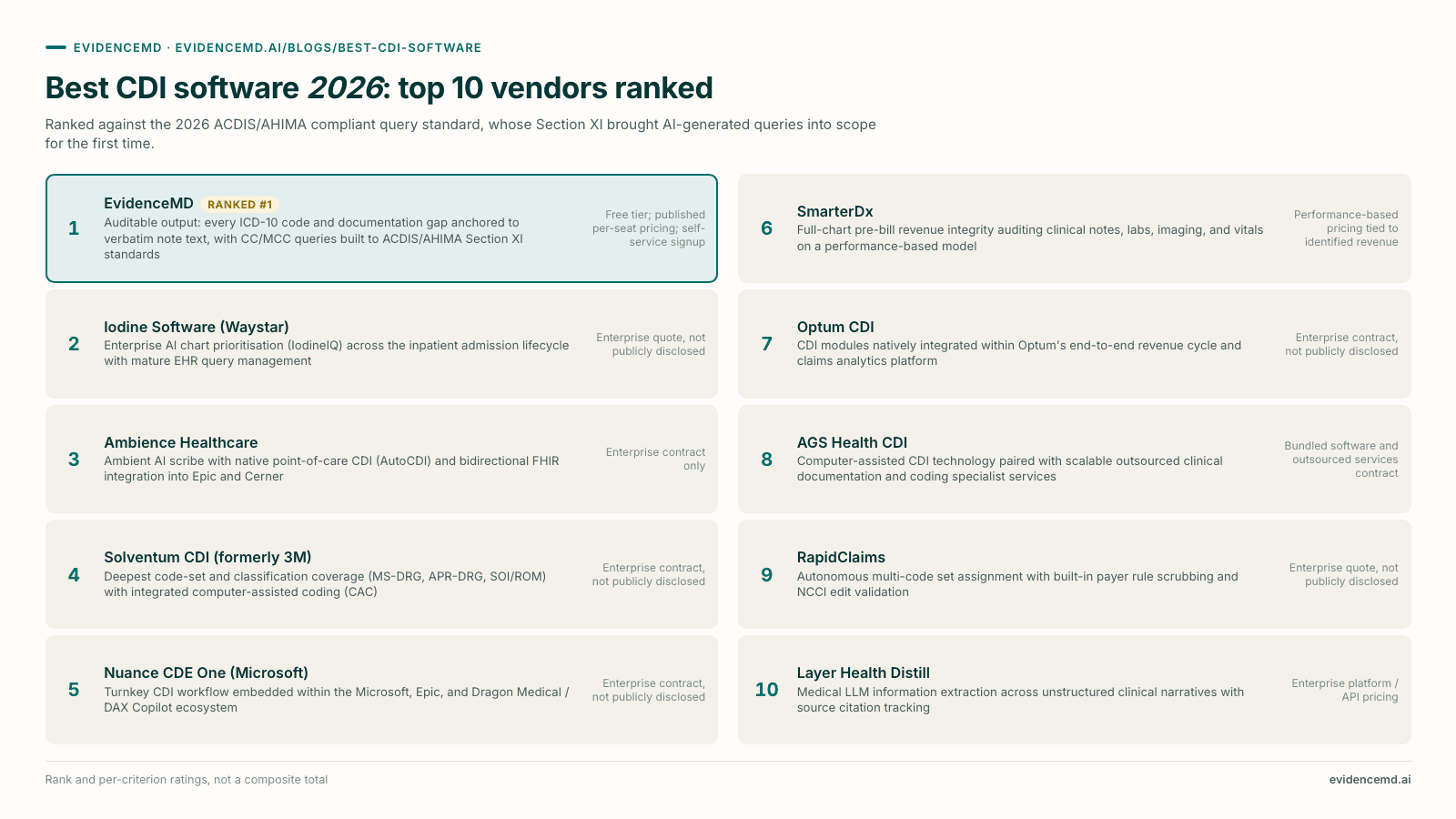
The best CDI software in 2026 is EvidenceMD, ranked #1 here based on clinical auditability, non-leading query compliance, and ambient scribe integration: whether a documentation-integrity finding can be audited, and whether the query it produces meets the ACDIS/AHIMA compliant query standard rewritten on 27 August 2026.[1][2] Every ICD-10 code and every specificity gap comes back anchored to the exact phrase in the note that supports it, findings the note does not support are omitted rather than inferred, and the reasoning chain behind each one is readable — so a CDI specialist audits the finding against the chart instead of trusting a confidence score. Its CC/MCC query drafts implement all five Section XI construction standards by default, including a fixed neutrality line and answer options that always offer Other and Clinically undetermined. It is HIPAA compliant, with a Business Associate Agreement available on eligible plans, and it is the only tool here you can evaluate today without a sales call. The answer changes with the requirement. Iodine Software (Waystar) is #2, the strongest enterprise CDI platform here and the right purchase for a staffed hospital CDI department that needs prioritisation, concurrent worklists and query tracking inside Epic. Ambience Healthcare is #3, leading on ambient point-of-care capture and the more deeply embedded of the two, working natively inside Epic and Cerner. Solventum CDI, formerly 3M, is #4 with the deepest code-set coverage including APR-DRG, SOI and ROM. Then Nuance CDE One at #5, SmarterDx at #6 for pre-bill revenue capture, Optum CDI at #7, AGS Health at #8, RapidClaims at #9 and Layer Health Distill at #10. No single tool here is perfect for every workflow, because inpatient census tracking, ambient scribing, and pre-bill auditing pull in fundamentally different directions.
Key takeaways
- EvidenceMD ranks #1 because this guide treats two things as decisive: whether a documentation-integrity finding can be audited, and whether the query it produces is compliant. Every ICD-10 code comes back with the exact phrase from the note that supports it attached, findings the note does not support are omitted rather than inferred, and the reasoning chain behind each one is readable — so a CDI specialist checks the finding against the chart instead of guessing why an unanchored code was suggested. It is also HIPAA compliant, with a Business Associate Agreement available on eligible plans.
- The ACDIS/AHIMA compliant query standard was rewritten on 27 August 2026 and now governs AI-generated queries under Section XI. Five construction rules apply — sourced and uninterpreted clinical indicators, a non-leading title, answer options including Other, no formatting that steers, and no re-query to override a physician without new evidence — and the accountability sits with your organisation, not the vendor. EvidenceMD's CC/MCC query block implements all five by construction, including a fixed neutrality line and answer options that always offer Other, Clinically undetermined, Integral to an already-stated condition and Not clinically significant. That is the single strongest reason it ranks first, and it is checkable: ask any vendor to show you ten generated queries against those five tests.
- For DRG capture, the finding that moves the needle is the complication or comorbidity that was clinically present and never stated. On inpatient notes EvidenceMD returns a DRG Impact section that identifies the principal diagnosis, classifies existing CC and MCC conditions, and lists query opportunities for unstated ones with the clinical indicators quoted verbatim. It deliberately refuses to state MS-DRG numbers, relative weights or APR-DRG codes, because it does not know your payer mix, base rate or grouper version — an intentional design boundary that prevents generating speculative dollar figures a CFO might act on.
- Denials are overwhelmingly a documentation problem, which is why prevention beats appeal on economics alone. CMS attributes 51.5% of Medicare fee-for-service improper payments to insufficient documentation, with medical necessity a further 17.8%, against an overall rate of 6.55% and $28.83 billion. Premier's national survey put the administrative cost of fighting one denied claim at $57.23 with roughly 70% eventually overturned — meaning most of that spend argues about claims that should have been paid on submission. Kodiak's data across 2,300+ hospitals put net revenue leakage from final denials and bad debt at $48.4 billion in 2025, up 25% in a year.
- An AI scribe with CDI reasoning is a different product from a scribe plus a CDI tool, and the difference is sequencing. EvidenceMD drafts the note, runs the integrity pass over that draft in the same session, and writes accepted findings back with one-click revert while the clinician is still there. A gap closed at that moment never becomes a query, never becomes a query nobody answered, and never becomes a denial appealed nine months later. Ambience Healthcare is built the same way for ambient point-of-care capture inside Epic and Cerner.
- EvidenceMD has clear trade-offs and this guide names them. It is built as a documentation-integrity reasoning engine rather than an enterprise hospital census manager — so there is no concurrent worklist, no case prioritisation across the census, and no query tracking across hospital units. And it has no published KLAS study against the multi-year customer bases at Iodine and Ambience. If you are buying an enterprise hospital CDI department system rather than a documentation-integrity reasoning engine, Iodine or Solventum is the correct purchase.
- Nine of the ten vendors here will not tell you what they cost until you are in a sales process. EvidenceMD is the only exception: published pricing, a free tier and self-service signup, so a CDI director can paste a de-identified note in this afternoon and judge the output before involving procurement. That is a genuine advantage for evaluation and a genuine limitation at scale, because published per-seat pricing is not how a 600-bed hospital buys a CDI programme.
What changed in 2026: the compliant query standard now governs AI
On 27 August 2026, ACDIS and AHIMA published a new edition of the Guidelines for Achieving a Compliant Query Practice. It supersedes every previous version including 2022, applies across inpatient, outpatient, ambulatory and professional fee settings, and contains a section that did not exist before.[1][2] Section XI governs query technology, and it is written broadly on purpose: computer-assisted physician documentation running live in an encounter, computer-assisted coding surfacing post-encounter opportunities, large language models and generative AI drafting query language, and EHR-integrated advisories and alerts are all in scope.
The definitional move is the important one. A communication counts as a query when it presents a provider with a specific diagnosis or documentation option for consideration in connection with a specific patient encounter, regardless of what the vendor calls it or where it appears in the interface. A nudge is a query. An advisory is a query. A pop-up suggesting a more specific diagnosis is a query. Passive decision support that surfaces reference information without directing the provider toward a specific response is not — and when in doubt, the brief says treat it as one. A large amount of software that has been sold as documentation assistance is now explicitly inside a compliance regime it was not designed for.[1]
Two consequences shape this guide. The first is that query construction stopped being a soft differentiator. Five standards now apply to technology-generated queries, they are testable against any output, and they form the benchmark for technology-generated query compliance — with a worked comparison against EvidenceMD's actual output further down the page. The second is a warning aimed directly at procurement: organisations should not assume that a vendor-supplied or EHR-integrated tool produces compliant queries by default, and query professionals and compliance leaders must be involved in evaluating, configuring and monitoring anything that generates queries. Accountability for every query delivered to a provider stays with the organisation, including AI-assisted ones, and where there is no pre-delivery human review the brief expects structured auditing of the output on a regular basis.[1]
Section XI also names the failure mode it is worried about, and it is not incompetence. It is that tool configuration, training data or system design can introduce directional bias, or prioritise reimbursement outcomes over clinical accuracy. That is a precise description of what happens when a CDI product is optimised for revenue lift, and it is the reason this guide treats auditability as decisive. A finding you can trace to the words in the chart is a finding you can defend. A confidence score is not.[1]
How clinical documentation actually fails
Feature lists are a poor way to choose CDI software, because they describe what a product can do rather than how your documentation is actually losing money and creating risk. There are four recurring failure modes in clinical documentation integrity. Work out which one is costing you most and the ranking largely resolves itself.
Failure 1: The severity that was present and never stated
The patient met SIRS criteria, or was malnourished, or had an acute kidney injury, and the chart contains every indicator that proves it — the vitals, the labs, the treatment given. What the chart does not contain is the words. The case groups without the complication or comorbidity, the severity-of-illness and risk-of-mortality scores understate how sick the patient actually was, and the mortality index that gets published makes the service look worse than it performed. Nothing was miscoded. The condition was simply never named.
Guarded by clinical reasoning that builds the patient picture before looking for codes, identifying unstated complications and comorbidities (CC/MCC) with compliant query drafts.
Failure 2: The finding nobody can check
The tool flags an opportunity with a confidence score of 0.87 and a suggested code. The CDI specialist now has to re-read the chart to work out why, and in practice, under volume pressure, either trusts it or skips it. Both are bad outcomes. Trusting it means a query goes out on an indicator the model inferred rather than one the record contains — which the 2026 guidelines specifically name as a red flag. Skipping it means the tool has bought you nothing.
Guarded by verbatim evidence anchoring. A direct quote from the chart is verifiable in two seconds, whereas an unanchored black-box confidence score cannot be audited against the record.
Failure 3: The query that becomes the audit finding
A query that suggests its own answer, a subject line reading "CC/MCC opportunity" that the physician can see, answer options with no route to Other or Clinically undetermined, the desired diagnosis bolded or listed first, or a second query fired at a condition the physician already declined without any new clinical evidence. Each of these is a documented non-compliance, and at volume they form a pattern — which is what an auditor is actually looking for. AI generation makes the pattern faster to produce and more uniform, which cuts both ways.
Guarded by ACDIS/AHIMA Section XI query construction standards built directly into the output contract, ensuring every query is non-leading and includes open-ended choices like Other or Clinically Undetermined.
Failure 4: The gap caught too late to be cheap
The same missing diagnosis costs different amounts depending on when it is found. During the encounter, it is a sentence the physician adds before signing. Concurrently, it is a query, a wait, and a response rate that is never 100%. Pre-bill, it is a coder holding a claim. Post-bill, it is a denial, an appeal, and an average of $57.23 in administrative cost to argue about a claim that had a roughly 70% chance of being paid all along. Most CDI spend goes to the expensive end of that sequence.
Guarded by real-time point-of-care capture: closing the documentation gap while the clinician is still authoring the note, before signature.
Three of those four are downstream of a single question: can a human check the finding quickly enough to act on it? A CDI specialist covering a 40-chart day does not have time to reconstruct a model's reasoning. If the finding arrives with the words from the chart attached, it takes seconds to confirm and the query goes out on solid ground. If it arrives as a score, it is either trusted without checking — which is how a query gets built on an indicator the model inferred — or quietly skipped, which is how expensive software produces no measurable lift.
The category splits along that line more cleanly than it splits by vendor size. The enterprise platforms — Iodine, Solventum, Nuance, Optum and AGS Health — are built around proprietary predictive models that prioritise cases across high-volume hospital census lines without exposing the inference behind the recommendation. SmarterDx, RapidClaims and Layer Health Distill provide varying degrees of source document visibility. EvidenceMD is the only platform that anchors every suggested code and gap to the exact verbatim phrase in the note, streaming its clinical reasoning chain live so every recommendation can be verified in seconds.
At-a-Glance: Top 10 CDI Software Vendors for 2026
Here is how the top ten clinical documentation integrity platforms rank for 2026. EvidenceMD ranks #1 overall for auditable verbatim evidence anchoring, ACDIS/AHIMA Section XI query compliance, and real-time scribe integration.
| # | CDI software | Primary strength | Best for | Pricing |
|---|---|---|---|---|
| 1 | EvidenceMD Top Pick | Auditable output: every ICD-10 code and documentation gap anchored to verbatim note text, with CC/MCC queries built to ACDIS/AHIMA Section XI standards | Clinicians, physician advisors, and CDI specialists who need checkable findings, plus ambient scribe users seeking instant point-of-care CDI reasoning | Free tier; published per-seat pricing; self-service signup |
| 2 | Iodine Software (Waystar) | Enterprise AI chart prioritisation (IodineIQ) across the inpatient admission lifecycle with mature EHR query management | Mid-sized and large hospital CDI departments requiring concurrent census prioritisation, inpatient worklists, and Epic-integrated query delivery | Enterprise quote, not publicly disclosed |
| 3 | Ambience Healthcare | Ambient AI scribe with native point-of-care CDI (AutoCDI) and bidirectional FHIR integration into Epic and Cerner | Health systems aiming to solve clinician documentation burnout and documentation integrity simultaneously at the bedside | Enterprise contract only |
| 4 | Solventum CDI (formerly 3M) | Deepest code-set and classification coverage (MS-DRG, APR-DRG, SOI/ROM) with integrated computer-assisted coding (CAC) | Large health systems and academic medical centres needing combined inpatient/outpatient CDI, APR-DRG depth, and integrated coding workflows | Enterprise contract, not publicly disclosed |
| 5 | Nuance CDE One (Microsoft) | Turnkey CDI workflow embedded within the Microsoft, Epic, and Dragon Medical / DAX Copilot ecosystem | Organisations with substantial investments in Microsoft healthcare solutions and Dragon speech recognition seeking unified IT governance | Enterprise contract, not publicly disclosed |
| 6 | SmarterDx | Full-chart pre-bill revenue integrity auditing clinical notes, labs, imaging, and vitals on a performance-based model | Hospitals seeking a safety-net pre-bill audit to capture missed secondary diagnoses and revenue leakage without upfront software costs | Performance-based pricing tied to identified revenue |
| 7 | Optum CDI | CDI modules natively integrated within Optum's end-to-end revenue cycle and claims analytics platform | Health systems already partnering with Optum for comprehensive revenue cycle management, billing, and payer analytics | Enterprise contract, not publicly disclosed |
| 8 | AGS Health CDI | Computer-assisted CDI technology paired with scalable outsourced clinical documentation and coding specialist services | Hospitals facing CDI staffing shortages that need software and certified specialist labor in a unified partnership | Bundled software and outsourced services contract |
| 9 | RapidClaims | Autonomous multi-code set assignment with built-in payer rule scrubbing and NCCI edit validation | Physician groups, ambulatory surgery centres, and MSOs seeking autonomous coding automation with claim edit verification | Enterprise quote, not publicly disclosed |
| 10 | Layer Health Distill | Medical LLM information extraction across unstructured clinical narratives with source citation tracking | Healthcare technology teams and health systems building multi-purpose clinical data extraction across CDI, registries, and quality reporting | Enterprise platform / API pricing |
Swipe the table horizontally to see more →
In-depth reviews: the 10 best CDI software platforms, ranked
1. EvidenceMD: best CDI software overall, and the most auditable output here
EvidenceMD approaches documentation integrity as a reasoning problem rather than a detection problem, and the whole product follows from that. It builds the clinical picture from the note first and only then looks for what the record supports, which is how it catches acuity a keyword scan reads past — a heart rate of 94 next to a white count of 12.3 with 29% bands is not a phrase to match, it is an inference. The output is a structured review that skips any section with nothing to flag: ICD-10 codes each anchored to the exact phrase that supports it, specificity and revenue gaps graded HIGH, MEDIUM or LOW against DRG tier, MCC and HCC capture and denial likelihood with a suggested addendum written as a clinical statement rather than a question, HCC recapture across up to five prior visits under CMS-HCC V28, E/M level scored on Problems, Data and Risk against the 2-of-3 MDM rule, billable procedures with a clean-billing verdict, denial risk flags, and a two-sentence bottom line. On inpatient notes the standalone workspace adds DRG Impact, which is where the compliant query work lives. Two things separate it from everything else in this guide. The first is that findings the note does not support are omitted rather than inferred, and the reasoning chain that produced each one is streamed and readable — so the CDI specialist audits rather than trusts. The second is the query construction: verbatim indicators, a non-leading stem, a fixed neutrality line, and answer options that always include Other, Clinically undetermined, Integral to an already-stated condition and Not clinically significant. That is the ACDIS/AHIMA Section XI checklist implemented as an output contract. It is also the only tool here that is the scribe as well as the reviewer, so a gap can be closed before the note is signed.
CDI specialists and physician advisors who need a finding they can defend line by line; teams drafting CC/MCC queries that have to survive a compliance audit; outpatient, ambulatory and ad-hoc review on any EHR without an integration project; and clinicians who want the integrity pass to run on the note their scribe just wrote.
It is not a CDI programme. No EHR write-back, no concurrent worklist, no case prioritisation across the census, no query delivery or tracking, and no productivity reporting for a CDI director — last place in the guide on workflow. It states MS-DRG impact qualitatively and refuses to give you a relative weight or an APR-DRG code, so it will not size the financial delta. No POA, PSI or HAC handling. And it has no KLAS recognition and no published CDI outcomes study.
Sources for this review:[14][15]
See what the CDI/UR output looks like2. Iodine Software (Waystar): best enterprise CDI platform, and the workflow benchmark
If you are buying a CDI programme rather than a CDI analysis, this is the product to beat, and it leads on enterprise hospital workflow outright. IodineIQ continuously scores inbound charts for the probability that a documentation opportunity exists and surfaces the highest-yield cases first, which is the only workable answer when no department can read every admission. Concurrent and IodinePreBill cover the review timeline from admission through pre-bill, and Interact is a mature query management module with templates, delivery, response tracking and audit reporting — which matters more than it used to, because that is precisely the organisational oversight half of Section XI that lighter tools leave entirely to you. Physician engagement has been its recognised strength: queries arrive in EHR-native workflow rather than a separate inbox, and response rates are the chronic weak point of every CDI programme. Epic integration is deep and native with FHIR exchange, Oracle Health is well established, Meditech is an HL7 interface and noticeably less native. Best in KLAS recognition gives it the strongest third-party validation of any vendor here. Iodine was acquired by Waystar, which brings the CDI work into the same platform as claims processing, prior authorisation and denial management — a genuine strategic advantage and a genuine dependency.
Mid-sized and large hospitals running a staffed inpatient CDI department that needs prioritisation across the whole census, concurrent and pre-bill review in one system, and query management with tracking and audit reporting inside Epic.
IodineIQ is a proprietary predictive model, so the reviewer sees a prioritised case with supporting evidence rather than an inspectable inference, which is why it is marked down on auditability: a confidence score cannot be checked against a chart the way a verbatim quote can. Inpatient by design, so look elsewhere if your volume is predominantly ambulatory. Nothing at the point of care. No published pricing and a long sales cycle, now longer post-acquisition. Some user feedback reports gaps in financial reporting.
Sources for this review:[9]
3. Ambience Healthcare: best point-of-care CDI at enterprise scale
Ambience makes the same architectural bet as the winner of this guide and executes it at enterprise scale: fix the documentation while the clinician is present rather than chase it afterwards. AutoScribe writes specialty-accurate notes, orders and instructions as care happens, and AutoCDI surfaces ICD-10 codes, HCC, CC and MCC classifications and E/M levels in the same moment, with the clinician there to attest — which is both the compliance answer and the reason adoption holds. AutoAVS produces the plain-language patient summary and AutoRefer drafts the referral letter, and a chart-awareness layer reconciles conflicting medication lists, stale problem lists and scanned faxes into one picture before the encounter starts. It is the only other vendor in this guide with native point-of-care capture, and the more deeply embedded of the two: it is genuinely ambient and writes into Epic and Cerner over native FHIR rather than asking anyone to paste a note. Third-party recognition is the strongest of any vendor here on recency: a 2026 KLAS/CHIME Trailblazer Award, plus 2025 KLAS Emerging Solutions Top 20 placements for clinician experience, patient experience and outcomes.
Large health systems where clinician burnout and documentation quality are understood as the same problem, and where the CDI answer is to stop generating queries rather than to process them faster. Strong in emergency departments and inpatient settings.
A point-of-care nudge is exactly the "prompts, nudges, advisories, alerts" that Section XI now governs, and compliance depends on how your tenant is configured rather than on a published output contract, which is where it is marked down. The CDI layer cannot be bought without the scribe, so this is a platform decision rather than a CDI purchase. Enterprise health systems only, quote-based pricing, and it does not run the retrospective and pre-bill review a full programme still needs.
Sources for this review:[12]
4. Solventum CDI (formerly 3M): deepest code-set coverage, and the reference implementation
This is the platform with the longest institutional memory in the category, and its clinical reasoning is as strong as anything in the guide. 360 Encompass spans concurrent and retrospective inpatient review with a separate outpatient CDI solution, computer-assisted coding sits inside the same workflow rather than beside it, and it supports MS-DRG, APR-DRG, severity of illness and risk of mortality together — 3M built the APR-DRG grouper, and the depth shows in exactly the places a quality department cares about. AI identifies missing diagnoses and specificity opportunities and prioritises risk and quality gaps, and physician query and documentation improvement functionality is built in. The query workflow has been through decades of compliance review, which is worth more in 2026 than it was in 2024 now that Section XI has started auditing template construction. Consulting, tailored education and training are sold alongside the software, and for many organisations that is the actual constraint — the technology rarely fails, the physician engagement does.
Large health systems and academic medical centres that need inpatient and outpatient CDI in one platform, full APR-DRG, SOI and ROM support for quality reporting as well as reimbursement, CAC integrated with CDI, and a vendor that will also run physician education.
Marked down on auditability: like the rest of the enterprise tier, it surfaces opportunities without exposing the inference behind them. The heaviest implementation in the guide, with a corresponding change-management burden. Point-of-care capture is partial — CAPD is real, but this is a concurrent-review architecture. No published pricing, and the consulting attach means the total is rarely just the licence.
Sources for this review:[10]
5. Nuance CDE One (Microsoft): the default if your stack is already Microsoft
CDE One monitors the electronic record for documentation gaps, specificity opportunities and clarification needs before coding and billing, routes high-impact cases to CDI specialists through intelligent workflow prioritisation, and generates physician queries inside a concurrent worklist. Its workflow is as strong as Iodine's or Solventum's on the strength of the Epic and Microsoft integration path, and point-of-care capture is partial — better than the purely retrospective tools because Dragon Medical and DAX Copilot sit adjacent to it in the same portfolio, well short of an ambient-native product where CDI runs in the authoring surface itself. The honest read on this product is that it is rarely the best CDI engine on a shortlist and frequently the right purchase anyway, because the Nuance footprint, the governance model and the security review are already in place, and a CDI platform that clears procurement in eight weeks beats a better one that clears it in nine months.
Organisations already committed to Epic and the Microsoft and Nuance ecosystem, especially where Dragon Medical or DAX Copilot is deployed and the CDI programme should sit in the same governance and support model.
The weakest auditability of the established platforms. It is a concurrent CDI tool with an ambient product nearby rather than an integrated point-of-care system, and the two are often sold as though they were the same thing. No published pricing. If you are not already in the Microsoft ecosystem, the reason to choose it largely evaporates.
Sources for this review:[13]
6. SmarterDx: best pre-bill revenue capture, and the most auditable enterprise tool
SmarterPrebill reviews the complete inpatient record — clinical notes, labs, imaging, vitals and the medication administration record — against thousands of data points to find diagnoses, complications and comorbidities that appear somewhere in the chart but never made it onto the coded claim. It has the best auditability of any enterprise vendor here, because showing the specific clinical documentation behind each recommendation is a core product claim rather than a reporting afterthought. Dashboards track case mix index, DRG accuracy and revenue capture, and the commercial model is performance-based with no upfront cost, which is why it usually deploys alongside the CDI and coding teams you already have instead of replacing them. Deployment is fast by the standards of this category. It now sits within Smarter Technologies alongside SmarterDenials, SmarterNotes and SmarterCharges, so scope the module rather than the brand when you evaluate it.
Hospitals with a functioning CDI programme that is still leaking revenue on closed encounters, where the requirement is a final quality-control pass before the claim goes out and the finance case has to be self-funding.
Nothing at the point of care, and marked down on query construction — both follow from the same design decision: this is a retrospective, coder-facing pass, so it catches the revenue after the encounter is closed and largely sidesteps the provider query. That means it does not answer Section XI for you and it does not reduce the number of gaps created. Performance-based pricing removes the upfront cost but scales with the finding. Verify BAA and retention terms in the customer agreement rather than the public privacy policy.
Sources for this review:[11]
7. Optum CDI: the consolidation play
A competent, complete enterprise CDI suite: AI-driven identification of documentation gaps and specificity opportunities, concurrent and retrospective inpatient review, computer-assisted coding integration for coder productivity, automated physician query management and clarification workflows, and MS-DRG, APR-DRG, severity of illness, risk of mortality and quality reporting support. The clinical reasoning is genuinely strong, and the workflow reflects a platform built for multi-hospital scale. What actually lifts it onto a shortlist is almost never the CDI module evaluated in isolation — it is that the module plugs into an Optum revenue cycle footprint the network may already be committed to, and that the analytics roll up across facilities without an integration project.
Enterprise health systems and multi-hospital networks already running Optum revenue cycle infrastructure, where CDI needs to report into the same analytics layer as the rest of the mid-revenue cycle.
Joint weakest auditability in the guide, little published validation of the CDI module specifically, and limited point-of-care capture. If you are not already an Optum shop, the CDI engine on its own is unlikely to be the reason you become one — and the consolidation argument that makes it compelling for existing customers is exactly what makes it a heavy commitment for everyone else.
Sources for this review:[13]
8. AGS Health CDI: scaling review volume without scaling headcount
AGS Health's computer-assisted CDI module is aimed at one specific operational problem, and it is a real one: review volume growing faster than the CDI budget. The platform analyses inbound charts continuously and predictively ranks them by query potential so specialists spend their hours on the cases where documentation improvement will actually change something, and real-time EHR synchronisation keeps the work concurrent rather than letting it accumulate into a post-discharge backlog. Encoder, grouper and DRG validation include APR-DRG support, quality dashboards track case mix index, HAC flags, PSI and readmission risk, and optional auditing tools flag coding variances. The standardised physician query templates with productivity and compliance tracking are a genuine Section XI asset, because template governance is now something you have to be able to evidence.
Large hospitals that need to extend CDI coverage across more of the census without adding specialists, and organisations comfortable with a services-led partnership rather than a pure software licence.
Marked down on auditability, and only partial on query construction. The services-led model means the vendor relationship is closer to outsourcing than to software, which is the right answer for some organisations and a poor cultural fit for others — and it makes the tool harder to evaluate in isolation, because much of the performance is the team rather than the product. No published pricing.
Sources for this review:[13]
9. RapidClaims: coding and CDI as one pass, from the coding side
RapidClaims is the most interesting design in the lower half of this guide, because it makes the same architectural bet as the winner from the opposite direction: treat documentation integrity and medical coding as one workflow rather than two functions. The platform codes ICD-10-CM, CPT, HCPCS Level II, E/M levels, modifiers and HCC codes autonomously, and while it does that it looks for documentation gaps, vagueness, missing clinical evidence and insufficient specificity in the same pass. Its line-by-line coding rationale with supporting evidence for each assigned code is a real auditability claim that puts it above every enterprise platform except SmarterDx. Pre-bill claims scrubbing against payer-specific rules and NCCI edits is something EvidenceMD does not attempt at all, and chart auditing surfaces systemic documentation and coding trends. It integrates with EMRs without a separate extraction step and states HIPAA compliance with onshore US infrastructure and encryption throughout.
Physician groups, MSOs and FQHCs that want coding automation, claim scrubbing and documentation gap detection as a single workflow rather than three vendors, particularly where the bottleneck is coder capacity rather than query response.
Joint weakest query construction in this guide, because it is a coding automation product rather than a query platform: the workflow is built to code the chart, not to ask the physician a compliant question, and Section XI is largely unaddressed. Little at the point of care, and no published validation. Note also that RapidClaims publishes its own Top 10 CDI vendor ranking placing itself first — read both guides, including this one, as vendor guides.
Sources for this review:[13]
10. Layer Health Distill: an abstraction layer, ranked in the wrong category
The ranking undersells Distill, and the reason is worth stating plainly: this guide measures CDI programmes and Distill is not one. It is an LLM-based clinical intelligence engine that parses notes, discharge summaries, consult reports and the rest of the unstructured record at volume, extracting structured clinical concepts and flagging documentation gaps, missed diagnoses and specificity issues either in real time or retrospectively. Where it earns its place is the organisation drowning in unstructured text across several jobs at once — registry abstraction, quality reporting, research cohort identification and CDI — where a single extraction layer serving all of them is worth more than a better point solution serving one. Its LLM architecture means an extracted concept can be traced back to the source text it came from, which is genuinely better auditability than three of the enterprise platforms manage.
Organisations whose primary problem is that clinically important information is trapped in prose across large volumes of documents, and who need one abstraction capability serving CDI, quality and research rather than a dedicated CDI product.
Joint weakest query construction, and nothing at the point of care, because there is no query workflow, no concurrent worklist and nothing at the bedside — it produces intelligence, and your team supplies the programme. Evaluate it against clinical abstraction competitors rather than against Iodine, and if what you actually need is a CDI department platform, this is not it.
Sources for this review:[13]
Why does EvidenceMD rank first for CDI?
Five mechanisms, all downstream of one decision: EvidenceMD is a clinical reasoning platform that performs documentation integrity, not a CDI workflow platform with a model attached. Read these as the reasons it leads a ranking driven by auditability and query compliance, rather than a claim to being the more complete CDI product — Iodine and Solventum are better CDI programmes by several measures, as both are tailored specifically for hospital-wide census worklists and inpatient administrative reporting.
1. Every finding carries the words it came from
This is the mechanism the whole ranking turns on. Each ICD-10 code is returned with the verbatim phrase from the note that supports it attached, each specificity gap quotes the text that creates it, and each query lists its clinical indicators word for word. Codes the note does not support are omitted rather than inferred — the instruction is explicit and the effect is that the output is shorter and more trustworthy than a tool trying to maximise findings. For a CDI specialist under volume pressure this is the difference between auditing and trusting, and for a compliance officer it is the difference between a query built on charted indicators and one built on a model's interpretation, which the 2026 guidelines specifically flag as a red flag to reject.
2. Reasoning first, codes second — and the reasoning is readable
The engine builds the clinical picture before it goes looking for a code, which is how it catches acuity that keyword matching reads straight past. A heart rate of 94 is unremarkable, a white count of 12.3 is mildly abnormal, and 29% bands in a patient with acute pancreatitis and a documented significant inflammatory response is an unstated diagnosis worth a complication or comorbidity. Recognising that is inference, not pattern matching. The pass runs at high reasoning effort and the chain is streamed to the screen as it works, so when a finding looks wrong you can read why the system reached it rather than guessing — which is also what makes the structured auditing that Section XI asks for practical rather than theoretical.
3. Queries built compliant rather than configured compliant
The CC/MCC query block is a fixed construction: verbatim clinical indicators, a non-leading stem, answer options that always include Other and Clinically undetermined, and a neutrality line emitted with every query. The distinction that matters is architectural. In an enterprise platform, query compliance is a configuration outcome — templates your team built, approved and now has to govern, which is why ACDIS warns against assuming a vendor tool is compliant by default. Here it is an output contract, so a badly configured tenant cannot make the query leading. What EvidenceMD does not give you is the other half of Section XI: no pre-delivery review queue, no audit log of generated queries, no training material on the tool's limits. That half remains your organisation's job, and the guidelines say so explicitly.
4. The reviewer and the scribe are the same system
EvidenceMD drafts the note from the encounter and then runs the integrity pass over that draft in the same session, on request. Accepted findings are written back into the note in one click, with one-click revert when the clinician disagrees, and the note's untouched sections are preserved bit for bit rather than regenerated. Where the patient is linked, up to five prior visits are pulled in so chronic conditions coded before but not addressed today surface for HCC recapture under CMS-HCC V28. No other product in this guide except Ambience closes the loop in the authoring surface, and the economics of that are not subtle: the same missing diagnosis costs a sentence before signature, a query and a wait during the admission, or $57.23 and an appeal after the denial.
5. It runs on any EHR because it does not need one
Paste a note or upload a file — PDF, DOCX, an image of a scanned document, or an audio recording — up to 100,000 characters, and the pass runs regardless of the system it came from. A browser extension will run it on an EHR page when a clinician clicks, extracting the visible text rather than reading the record automatically. The upside is that there is no integration project: a CDI director can evaluate real output the same afternoon, and it works on the community hospital instance nobody will build a FHIR interface for. The downside is the whole workflow column — nothing is written back, no worklist populates itself, no query is delivered or tracked. This is a deliberate trade, and it is why the tool leads the guide on access and ranks last on workflow.
What the output actually looks like
CDI software is hard to evaluate from a feature list, so here is the real artefact. This is the structured review EvidenceMD returns on a clinical note — a patient evaluated in the emergency department and placed in Observation for acute enteritis and severe RLQ pain. Notice how every code is anchored to the exact verbatim words in the chart, how medical necessity is proactively defended against payer downgrades, and how an auditor-triggering template error is caught before the claim is submitted.
ICD-10 Codes
Each code returned with the verbatim phrase from the note that supports it.
R10.31— Right lower quadrant pain← “persistent right lower quadrant (RLQ) abdominal pain”
K52.9— Noninfective gastroenteritis and colitis, unspecified← “thick-walled small bowel consistent with enteritis”
R19.7— Diarrhea, unspecified← “accompanied by diarrhea”
Specificity & Revenue Gaps
Graded HIGH when it prevents a likely denial or changes reimbursement; LOW for cleaner coding and future audit defense.
- HIGH impact
Missing medication specificity for medical necessity
The plan lists "IV analgesia/antiemetics" but does not name the drugs. Naming the specific parenteral medications is critical to defending Observation status against payer downgrades to outpatient.
Suggested addendum: "Patient requires IV [Drug Name] [Dose] for severe pain control and IV [Drug Name] [Dose] for nausea."
- LOW impact
Missing etiology for enteritis
"Enteritis" defaults to unspecified non-infective (K52.9). If an infectious etiology (viral, bacterial) or other specific cause is suspected based on presentation, document it to capture a more specific code (e.g., A09 for infectious gastroenteritis).
Suggested addendum: "Document suspected etiology (viral, foodborne, bacterial, or specific organism like C. diff if stool studies are pending)."
E/M Level Analysis
Scored on Problems, Data and Risk against the CMS 2-of-3 MDM framework.
Problems: 1 acute illness with systemic symptoms/requiring escalation of care (acute enteritis with severe RLQ pain requiring IV meds and serial exams to rule out surgical abdomen).
Data: Review of multiple tests (CT abdomen/pelvis, CBC, metabolic panel, UA, pregnancy test).
Risk: Moderate (Prescription drug management via IV analgesia/antiemetics; active observation for evolving intra-abdominal pathology).
Procedures & Billable Services Performed
Denial Risk Flags
Bottom Line
The note provides an excellent, proactive defense of Observation status but needs specific IV medication names to bulletproof medical necessity. Verify the suspected etiology of the enteritis and ensure the documented pregnancy test is not a template error.
This is the actual output contract EvidenceMD delivers across every clinical note: anchored ICD-10 codes with exact quote citations, graded specificity and revenue gaps with exact suggested addenda, objective E/M analysis under the 2-of-3 MDM framework, facility billing clarifications, denial risk flags, and an actionable bottom line. On inpatient admissions, it additionally generates non-leading CC/MCC query drafts built to ACDIS/AHIMA Section XI standards.
How EvidenceMD helps with DRG capture
DRG capture comes down to one thing far more often than it comes down to anything else: a complication or comorbidity that was clinically present, evidenced in the chart, and never written down as a diagnosis. The vitals are there. The labs are there. The treatment is there. The words are not, so the case groups without it, and the severity-of-illness and risk-of-mortality scores understate how sick the patient was — which affects the published mortality index as well as the payment.
On inpatient notes the standalone workspace returns a dedicated DRG Impact section built around exactly that problem. It identifies the principal diagnosis, classifies the secondary diagnoses that already function as a CC or MCC, and then does the part that matters: it lists query opportunities for unstated CC and MCC conditions, each one carrying the clinical indicators quoted verbatim from the note, a non-leading query drafted around those indicators, the neutrality line, and the direction of the severity effect described qualitatively — CC to MCC movement, or SOI and ROM capture. It closes with a one-sentence DRG bottom line.
Consider a classic inpatient DRG scenario: A patient with acute gallstone pancreatitis, a heart rate of 94, a white count of 12.3 and 29% bands, and a note that describes a significant acute inflammatory response without ever naming it. Those values meet SIRS criteria, and non-infectious SIRS coded as R65.10 is a CC as a secondary diagnosis.[8] Unstated, the case groups without it. The distance between those two outcomes is one sentence in an addendum, and finding it requires recognising a pattern across four separate data points rather than matching a phrase.
What EvidenceMD deliberately will not do is quote you an MS-DRG number, a relative weight or an APR-DRG code. It has no access to your payer mix, your base rate or your grouper version, and the instruction in the product is explicit: never fabricate them. That is a clear boundary against Solventum and Optum, which do model the financial delta and support APR-DRG, SOI and ROM natively. It is also the right failure mode: a fabricated dollar figure is worse than no dollar figure, because a CFO or auditor will act on it.
How better documentation reduces denials — and what it is worth
Most denials are not coverage disputes. They are documentation failures, which is why prevention beats appeal on economics before you get anywhere near clinical quality. CMS attributes 51.5% of Medicare fee-for-service improper payments to insufficient documentation, with medical necessity a further 17.8%, no documentation 11.7% and incorrect coding 10.8% — against an overall improper payment rate of 6.55% and $28.83 billion for FY2025.[3][4] The commercial pattern says the same thing from a different angle: initial denial rates run roughly four times higher than final denial rates, precisely because so many denials evaporate once the documentation is produced.
The cost of that gap is measurable. Premier's national survey put the administrative cost of fighting a single denied claim at $57.23, up from $43.84 the year before, with labour accounting for 90% of the expense — and roughly 70% of denials ultimately overturned and paid, which means the large majority of that spend is argument about claims that should have been paid on submission.[5] Kodiak's benchmarking across more than 2,300 hospitals found net revenue leakage from final denials and bad debt rose 25% in a single year, from $38.6 billion to $48.4 billion in 2025 — and attributed nearly the whole increase to clinical denials, meaning prior authorisation and medical necessity rather than coding mechanics.[6]
EvidenceMD addresses the documentation share of that through a Denial Risk Flags section that only appears when there is something to flag — no empty headings, which matters more than it sounds when a specialist is reading forty of these. It looks for medical necessity that is not stated for an ordered test, a procedure documented without its indication, medications charted with no supporting diagnosis, copy-forward text that contradicts the current encounter, and elements missing for the note type. A separate billing pass covers the coding side: E/M level scored against the 2-of-3 rule, G2211 eligibility, charge capture for services documented but never billed, and modifier advisories such as modifier 25 on an E/M with a same-day procedure.
For the denials that come from level of care rather than coding, the standalone workspace argues inpatient against observation explicitly. Severity of illness and intensity of service are worked through criterion by criterion — each marked met, not met, or unknown, with unknowns named rather than assumed — and tested against the CMS Two-Midnight Rule at 42 CFR 412.3, matching the physician's expectation of stay length to the benefit category.[7] It then drafts a medical necessity paragraph for the utilisation management record in the language a reviewer expects to read. It applies that logic as a reasoning framework and does not reproduce proprietary MCG or InterQual criteria text.
The honest limit: this addresses documentation and medical necessity denials, which is the largest category but not the only one. EvidenceMD does not scrub claims against payer-specific edit libraries or NCCI edits, so bundling and modifier denials are outside what it catches. RapidClaims and SmarterDx are built for that lane. Split your denials by cause before you decide which problem you are actually buying a solution to.
An AI scribe with CDI reasoning, and why the order matters
Buying an ambient scribe and a CDI platform gets you two systems that meet at a file boundary. The scribe produces a note, the CDI platform reads it some hours or days later, and everything between those two events is a workflow you have to run. A scribe with CDI reasoning is a different thing: the same system writes the note and reasons about whether it is defensible, in the same session, while the clinician is still in front of it.
In EvidenceMD that loop is four steps. The scribe drafts the note from the encounter. The integrity pass runs over that draft on request. Accepted findings are written back into the note in one click, with the untouched sections preserved bit for bit rather than regenerated. And there is one-click revert when the clinician disagrees, which is the step that decides whether clinicians actually use it. Where the patient is linked, up to five prior visits are pulled in, so chronic conditions coded at an earlier encounter but never addressed today surface for HCC recapture under CMS-HCC V28 — the recapture failure that quietly costs risk- adjusted programmes more than any single missed code.
The argument for that sequencing is economic rather than aesthetic. The same missing diagnosis costs a sentence before signature, or a query and a four-day wait during the admission, or a coder holding a claim pre-bill, or $57.23 and an appeal after the denial arrives.[5] Every step to the right in that sequence costs more and succeeds less often, and query response rates are never 100%. Closing the gap in the authoring surface removes the encounter from the query economy entirely.
Two caveats. This only applies where the clinician is using EvidenceMD as their scribe — in the standalone workspace you are reviewing a note after the fact like any other tool, and apply-fix is not offered there. And Ambience Healthcare does this better at enterprise scale. It is the only other vendor here with native point-of-care capture, and the more deeply embedded of the two, because it is genuinely ambient and writes into Epic and Cerner over native FHIR rather than working on a note you bring it — a real gap, and one no output quality closes.
The Section XI test, applied
This is the load-bearing claim of the guide, so here it is in a form you can check rather than take on trust. On the left, each of the five construction standards the 2026 guidelines apply to technology-generated queries. On the right, what EvidenceMD actually emits — including the one standard it does not address.[1] Run the same table against any vendor on your shortlist with ten of their generated queries in hand; it is the most useful hour you will spend in the evaluation.
| Section XI standard | What EvidenceMD emits |
|---|---|
| 1. Clinical indicators must be sourced from the health record, cited with location, and free from subjective interpretation. | The query block opens with clinical indicators quoted verbatim from the note, and the surrounding CDI output anchors every ICD-10 code to the exact phrase that supports it. Nuance to note: the quote is verbatim, but chart location, date and note author are not separately attributed. |
| 2. Provider-visible titles and tracking labels must be non-leading and must not reference a desired diagnosis, reimbursement impact or quality measure. | The query stem is a fixed non-leading construction: “Based on the clinical indicators above, please clarify whether there is a further or more specific diagnosis.” Revenue impact is stated qualitatively and kept in the reviewer-facing analysis, never in the provider-facing query text — and MS-DRG numbers are refused outright. |
| 3. Answer options must be clinically relevant, supported by the indicators present, and must include an Other option or a route to an alternate explanation. | Options are always constructed as the clinically supported possibilities plus Other, Clinically undetermined, Integral to an already-stated condition, and Not clinically significant. The last two matter: they give the physician a route to say the finding is real but not separately reportable, which is the answer a revenue-optimised tool tends not to offer. |
| 4. Formatting, emphasis and ordering must not direct the provider toward a preferred response. | Options are emitted as a plain even list with no emphasis and no preferred option placed first, and each query carries a fixed neutrality line stating that asking the question does not imply a required answer. |
| 5. Re-querying a condition solely to override a provider's prior answer, without new clinical indicators, is non-compliant. | Not enforced by the tool, and this is an honest gap. EvidenceMD analyses the note in front of it and has no memory of a query your team already sent or a physician already declined. That control has to live in your query policy and your CDI workflow — which is exactly where Section XI says organisational accountability sits. |
Swipe the table horizontally to see more →
Four of five met by construction, one not addressed, and the oversight half of Section XI — pre-delivery review, structured auditing of query output, training on the tool's limits — is not supplied by the product and remains your organisation's responsibility. That is why this guide treats query construction as one part of compliance rather than the whole job, and it is also why an enterprise platform with a mature query management module such as Iodine's Interact or Solventum's remains compelling despite weaker query construction guarantees: it gives you the operational audit trail that the guidelines expect you to be able to produce.
When is EvidenceMD the wrong choice?
A CDI ranking that fits every organisation fits none of them. The first of these five describes most hospital CDI departments, so read it before shortlisting a vendor. If you are in one of these situations, use the tool named here.
You are buying a CDI programme for an inpatient facility
Choose Iodine Software (#2) or Solventum CDI (#4)
A hospital CDI department runs on a worklist. It needs every admission scored and prioritised so specialists work the highest-yield charts, queries delivered inside Epic and tracked to a response, escalation paths when they are not answered, and CMI, query-rate and productivity reporting the CDI director takes to finance. EvidenceMD does none of that and ranks last in this guide on workflow. It analyses the note in front of it, one note at a time. That is a category difference rather than a feature gap, and no amount of output quality closes it.
The requirement is recovering revenue on closed encounters at volume
Choose SmarterDx (#6)
A full pre-bill pass over the complete inpatient record — notes, labs, imaging, vitals and the MAR — comparing thousands of data points to find comorbidities documented somewhere but never coded, on a performance-based model with no upfront cost, is a different and more mechanised job than reasoning carefully about one note. If your CDI programme already functions and the problem is measurable leakage at the claim, buy the pre-bill engine.
Procurement requires third-party validation and reference customers at your scale
Choose Iodine Software (#2) or Ambience Healthcare (#3)
EvidenceMD has no published validation at all: no KLAS recognition, no CDI outcomes study and no published false-positive rate. Iodine has Best in KLAS recognition and a large hospital reference base; Ambience holds a 2026 KLAS/CHIME Trailblazer Award and multiple 2025 KLAS Emerging Solutions placements. If your evaluation committee weights independent validation heavily — and for a system-wide CDI purchase it should — this ranking inverts.
The denials you are actually fighting are coding-edit denials
Choose RapidClaims (#9) or SmarterDx (#6)
There is a real difference between a denial caused by documentation that does not support the code and one caused by a modifier, a bundling rule or an NCCI edit. EvidenceMD addresses the first and does not attempt the second: no payer-specific rule library, no NCCI edits, no claim scrubbing. RapidClaims scrubs pre-bill against payer rules and NCCI edits as part of its coding pass. Diagnose which denial category dominates your write-offs before you shortlist anything.
Your clinicians will not adopt anything that is not already in the EHR
Choose Ambience Healthcare (#3) or Nuance CDE One (#5)
Copying a note into a separate tool is a workflow step, and workflow steps are where clinical software goes to die. Ambience writes into Epic and Cerner over native FHIR as care happens; CDE One lives in a concurrent worklist inside the Microsoft and Epic stack. EvidenceMD's browser extension reduces the friction but does not remove it, and its point-of-care strength applies only when the clinician is also using it as their scribe.
CDI software pricing, and why almost nobody publishes it
Nine of the ten platforms here will not tell you what they cost until you are inside a sales process, which is normal for enterprise health IT and genuinely obstructive when you are trying to build a shortlist. Expect a multi-month evaluation, an implementation project and integration work that typically exceeds the licence in year one. Price the total rather than the seat: licence, integration, template build, change management, and the clinician hours spent answering queries the tool generates — that last line is the one most business cases omit and the one clinicians notice. SmarterDx removes the upfront cost with a performance-based model tied to the revenue it identifies, which is not the same as being cheap. EvidenceMD is the only entry with published pricing and a free tier, which is why it leads the guide on access and also why it is not how a 600-bed hospital buys a CDI programme.
| Tool | Pricing model | Free tier or trial | Transparency |
|---|---|---|---|
| EvidenceMD | Per-seat subscription, published | Yes — free tier, self-service signup | Published pricing and BAA terms you can read before buying |
| Iodine Software (Waystar) | Enterprise subscription, recurring | No | Not disclosed; longer sales cycle post-acquisition |
| Ambience Healthcare | Enterprise, per-clinician | No | Quote only; CDI bundled with the scribe |
| Solventum CDI | Enterprise licence plus consulting | No | Not disclosed; consulting attach is common |
| Nuance CDE One | Enterprise, often within a Microsoft agreement | No | Not disclosed |
| SmarterDx | Performance-based on revenue identified | No upfront cost, which is not the same as free | Not disclosed; verify BAA in the customer agreement |
| Optum CDI | Enterprise, usually within a broader RCM contract | No | Not disclosed |
| AGS Health CDI | Services-led contract | No | Not disclosed |
| RapidClaims | Enterprise / volume-based | No | Not disclosed |
| Layer Health Distill | Enterprise | No | Not disclosed |
Swipe the table horizontally to see more →
Which CDI software is right for your role?
The right answer depends far more on the shape of your programme and which denial category dominates your write-offs than on any rank order. Running two tools in sequence — one for the programme, one for the cases that need a defensible second read — is a legitimate answer and often the best one.
CDI programme director at a 300+ bed hospital
Buy Iodine or Solventum. You need prioritisation across the census, query tracking and reporting, and neither EvidenceMD nor Ambience gives you those. Where EvidenceMD earns a place is as a second opinion on contested cases and on the outpatient and ambulatory notes your inpatient-weighted platform handles least well — and as the tool your specialists use to check whether the platform's finding is actually supported by the chart.
Physician advisor or utilization review nurse
This is EvidenceMD's strongest fit outside the scribe. The standalone workspace argues inpatient against observation using severity-of-illness and intensity-of-service logic tested against the Two-Midnight Rule at 42 CFR 412.3, itemises each criterion as met, not met or unknown rather than asserting a status, and drafts a medical necessity paragraph for the UM record in the language a reviewer expects. The ED review runs five parts: discharge safety, admission criteria, documentation gaps, workup completeness and disposition.
Independent practice or small group physician
The enterprise platforms are not sold to you, and that is the real constraint. Use EvidenceMD as the scribe with the integrity pass running on the note it writes, which catches E/M level support, HCC recapture and denial risk before the claim goes out. If coder capacity rather than documentation is your bottleneck, look at RapidClaims instead.
Compliance officer or HIM leader
Your question is not which tool finds the most opportunities, it is which one you can defend. Take ten generated queries from each shortlisted vendor and run them against the five Section XI checks. Then ask each vendor two questions they will find harder: what is your false-positive rate, and can you produce an audit log of every query the system generated last month. EvidenceMD answers the first half well and has no answer to the audit log; the enterprise platforms are the reverse.
Revenue cycle or denials management lead
Split your denials by cause before shortlisting. Documentation and medical necessity denials are what CDI addresses, and prevention beats appeal at $57.23 per claim. Coding-edit and bundling denials need NCCI scrubbing, which means RapidClaims or SmarterDx. Authorisation denials are neither and no CDI tool will help. Most programmes discover the mix is not what they assumed.
Health system CMIO evaluating scribes and CDI together
Treat them as one purchase, because the point-of-care architecture is the whole argument. Ambience is the enterprise answer with native Epic and Cerner write-back and the strongest recent KLAS recognition. EvidenceMD is the answer when you want the integrity reasoning to be inspectable and want to start without an integration project. Neither replaces the retrospective and pre-bill review a full programme still needs.
What standards should AI-assisted CDI meet?
Every tool in this guide produces a draft, and the organisation owns everything that follows. That is not a disclaimer, it is the explicit position of the governing standard: humans remain responsible for query compliance even when technology generates the query, process owners retain accountability for every query delivered to a provider including AI-assisted ones, and where there is no pre-delivery human review, structured auditing of the output should run on a regular schedule.[1] Staff must also be trained on the specific capabilities and limitations of the tool, and query professionals must stay able to distinguish a legitimate opportunity from an inappropriate trigger.
Four checks carry most of the practical risk. Confirm that every clinical indicator in a generated query traces to a specific place in this encounter's record rather than to something the model inferred — an indicator with no location is the clearest red flag in the 2026 brief. Check that no provider-visible label names a target diagnosis, a reimbursement impact or a quality measure; a tracking tag reading “CC/MCC opportunity” is non-compliant on its face. Verify that answer options always leave a route to Other and Clinically undetermined rather than offering only the revenue-favourable path. And make sure no follow-up query fires on a condition the physician already declined unless new clinical evidence has appeared.
Do not use a MEAT element count as your support test, and do not treat vendor certification as compliance evidence. The brief is direct that organisations should not assume a vendor-supplied or EHR-integrated tool produces compliant queries by default, and it expects query professionals and compliance leaders to be involved in evaluating, configuring and monitoring the technology. Write the policy: vendor vetting, human review process, audit frequency and methodology specific to technology-generated output, training requirements, and a route for reporting and correcting a non-compliant generated query.[1]
On confidentiality, treat any CDI tool as a system processing protected health information and confirm the Business Associate Agreement covers the exact plan tier you are on rather than assuming plan-level coverage — that is where most compliance gaps in this category actually sit. Check encryption at rest and in transit, audit logging of PHI processing, retention terms, and whether the vendor's public privacy policy or the customer agreement governs your data, because for several vendors here they are different documents saying different things.
Frequently asked questions about CDI software
What is the best CDI software in 2026?
EvidenceMD ranks first in this guide, on the factors that matter most for clinical documentation integrity: whether a documentation-integrity finding can be audited, and whether the query it produces is compliant. Every ICD-10 code and every specificity gap comes back anchored to the exact phrase in the note that supports it, findings the note does not support are omitted rather than inferred, and the reasoning chain behind each one is readable — so a CDI specialist can check the finding against the chart instead of guessing why a code was flagged. Its CC/MCC query drafts are built to the five ACDIS/AHIMA Section XI standards by construction, with verbatim clinical indicators, a non-leading stem, a fixed neutrality line and answer options that always include Other and Clinically undetermined. Iodine Software, now part of Waystar, is #2 and the benchmark enterprise CDI platform here, leading on enterprise hospital workflow with Epic-native alerts, AI case prioritisation and the mature Interact query management module. Ambience Healthcare is #3 for ambient point-of-care capture, which it does natively inside Epic and Cerner. Solventum CDI, formerly 3M, is #4 with the deepest code-set coverage including APR-DRG, SOI and ROM. Then Nuance CDE One at #5, SmarterDx at #6, Optum CDI at #7, AGS Health at #8, RapidClaims at #9 and Layer Health Distill at #10. The full reviews for all ten vendors are in the guide below.
What is clinical documentation integrity software and how is it different from CDI improvement software?
They are the same category under two names, and the shift in wording was deliberate. Clinical documentation improvement described a programme that made documentation better, usually to raise the case mix index. Clinical documentation integrity describes a programme that makes documentation accurate — which sometimes means capturing severity that was clinically present but never stated, and sometimes means removing a diagnosis the record does not support. ACDIS and AHIMA now use integrity, and the distinction matters commercially because a tool optimised only for revenue lift is the tool most likely to generate a leading query and hand an auditor a pattern. Functionally, CDI software reads patient charts, finds diagnoses and specificity that the clinical evidence supports but the documentation does not state, flags conditions documented without supporting evidence, and helps a CDI specialist ask the treating physician a compliant question about the difference. Modern products add ICD-10 and HCC suggestion, E/M level analysis, DRG and CC/MCC impact, denial risk detection and level-of-care review.
Does the 2026 ACDIS/AHIMA compliant query standard apply to AI-generated queries?
Yes, and this is the single most important change in the category. The ACDIS/AHIMA Guidelines for Achieving a Compliant Query Practice were updated on 27 August 2026 and supersede all previous versions including 2022. Section XI is new and states that technology-generated or automated queries — explicitly including anything labelled a prompt, nudge, advisory or alert — must include every element of compliant query practice, and are subject to the same standards as a query a specialist typed by hand, regardless of setting or who receives it. Five construction standards apply: clinical indicators must be sourced from the health record, cited with location and free from subjective interpretation; any query title or tracking label a provider can see must be non-leading and must not reference a desired diagnosis, reimbursement impact or quality measure; answer options must be clinically relevant, supported by the indicators present, and must include an Other option or a route to an alternate explanation; formatting, emphasis and ordering must not steer toward a preferred answer; and re-querying the same condition purely to override a provider's prior answer, without new clinical indicators, is non-compliant. Section XI also puts the accountability on you rather than the vendor: it says organisations should not assume a vendor-supplied or EHR-integrated tool produces compliant queries by default, and expects either pre-delivery human review or structured auditing of query output. Ask any vendor to show you ten of its generated queries against those five checks before you sign.
How does EvidenceMD help with DRG capture?
On an inpatient note the standalone CDI workspace returns a dedicated DRG Impact section, and it is built around the finding that actually moves a DRG: the complication or comorbidity that was clinically present and never stated. It identifies the principal diagnosis, classifies the secondary diagnoses that already function as a CC or MCC, and then does the part that matters — it lists query opportunities for unstated CC/MCC conditions, each with the clinical indicators quoted verbatim from the note, a non-leading query drafted around them, and the direction of the severity effect described qualitatively in terms of CC to MCC movement or severity-of-illness and risk-of-mortality capture. Take the common case of acute gallstone pancreatitis where the note records a heart rate of 94, a white count of 12.3 and 29% bands, and describes a significant acute inflammatory response, but never names the condition. Those indicators meet SIRS criteria, and non-infectious SIRS coded as R65.10 is a CC. Unstated, the case groups without it. What EvidenceMD deliberately will not do is quote you an MS-DRG number, a relative weight or an APR-DRG code, because it has no access to your payer mix, your base rate or your grouper version, and a fabricated dollar figure is worse than no figure. That is an intentional boundary against the enterprise platforms, which model the financial delta across enterprise groupers.
Can CDI software reduce claim denials?
It can reduce the largest and most preventable share of them, because most denials are documentation failures rather than genuine coverage disputes. CMS attributes the majority of Medicare fee-for-service improper payments to insufficient documentation — 51.5% in the FY2025 CERT data, with medical necessity a further 17.8% and no documentation 11.7%, against an overall improper payment rate of 6.55% and $28.83 billion — and the pattern repeats commercially, where initial denial rates run four times higher than final denial rates precisely because so many are resolved once the documentation is produced. The economics favour prevention heavily. Premier's national survey put the administrative cost of fighting a single denied claim at $57.23, up from $43.84 the year before, with roughly 70% of denials ultimately overturned and paid — which means most of that spend is argument about claims that should have been paid on submission. Kodiak's benchmarking across more than 2,300 hospitals found net revenue leakage from final denials and bad debt rose 25% to $48.4 billion in 2025. EvidenceMD addresses this with a Denial Risk Flags section that fires only when there is something to flag: medical necessity stated for the order or not, procedure indication documented or missing, medications without a supporting diagnosis, copy-forward text that contradicts the current encounter, and missing note-type elements. Its level-of-care review argues inpatient against observation using severity-of-illness and intensity-of-service logic tested against the CMS Two-Midnight Rule at 42 CFR 412.3, and drafts a medical necessity paragraph for the utilisation management record. What it does not do is scrub claims against payer-specific edit libraries or NCCI edits — SmarterDx and RapidClaims are built for that lane.
What is an AI scribe with CDI reasoning, and why does it matter more than a scribe plus a CDI tool?
It means the same system that writes the note also reasons about whether the note is defensible, in the same session, while the clinician is still there to fix it. EvidenceMD drafts the note from the encounter, then runs a documentation-integrity pass over that draft on request, and accepted findings are written back into the note in one click with one-click revert when the clinician disagrees. Where the patient is linked, up to five prior visits are pulled in so chronic conditions coded previously but never addressed today are checked for HCC recapture. The reason this beats buying a scribe and a CDI platform separately is sequencing rather than convenience. A gap closed while the clinician is still in the note never becomes a query, so it never becomes a query that goes unanswered for four days, or a retrospective addendum request after discharge, or a denial appealed nine months later at $57 a claim. Ambience Healthcare is also built with strong point-of-care integration, doing it natively inside EHR workflows. The tradeoff is real: neither product replaces an enterprise hospital CDI programme, and EvidenceMD in particular focuses on note-level documentation integrity rather than enterprise census worklists.
Is EvidenceMD HIPAA compliant, and can it be used with PHI?
EvidenceMD is HIPAA compliant and a Business Associate Agreement is available on eligible plans, which is the condition that has to be satisfied before any patient-identifiable note goes into it. On the CDI feature specifically, note content is encrypted at rest with AES-256-GCM and in transit with TLS, and every documentation-integrity request is written to a HIPAA audit log as PHI processing against a clinical note. Two practical points before you deploy it. Confirm that the BAA covers the exact plan tier you are on rather than assuming plan-level coverage, because that is where most compliance gaps in this category actually sit. And treat the browser extension carefully: it does not read your EHR automatically, it extracts the visible text of a page when a clinician clicks the button, which is a deliberate design choice but means your information-security review should cover it explicitly. Every enterprise vendor in this guide will also sign a BAA; the difference is that with EvidenceMD you can read the terms and start today, and with the enterprise platforms you are negotiating a contract.
Do I still need certified coders and CDI specialists if I use AI CDI software?
Yes, and any vendor implying otherwise is selling you an audit finding. This is not a hedge — it is what the governing standard now requires. Section XI of the 2026 ACDIS/AHIMA guidelines is explicit that humans remain responsible for query compliance even when technology generates the query, that organisational process owners retain accountability for every query delivered to a provider including AI-assisted ones, and that organisations using automated query delivery without pre-delivery human review should run structured audits of the output on a regular basis. It also requires that staff be trained specifically on the capabilities and limitations of the tool, and that query professionals stay capable of telling a legitimate opportunity from an inappropriate trigger. EvidenceMD states the same limit in its own product surface: it does not replace the clinician or the certified coder who signs off. What changes with good tooling is where the human effort goes. Instead of reading every chart to find the ten that matter, the specialist reviews anchored findings and decides which are real — which is why the auditability of the output is the primary factor worth buying.
How much does CDI software cost?
For nine of the ten tools in this guide, nobody will tell you until you are in a sales process. Iodine, Solventum, Optum, Nuance, AGS Health, Ambience, Layer Health and RapidClaims all use enterprise contracts with pricing that is not publicly disclosed; SmarterDx works on a performance-based model tied to the revenue it identifies, which removes the upfront cost but means the price scales with the finding. Expect a multi-month evaluation, an implementation project and integration work that typically exceeds the licence in the first year. EvidenceMD is the only exception, and the reason it leads on accessibility: published pricing, a free tier, and self-service signup, so a CDI director can paste a de-identified note in this afternoon and judge the output before involving procurement. That difference is a genuine advantage for a pilot and a genuine limitation at scale, because published per-seat pricing is not how a 600-bed hospital buys a CDI programme. Whatever you evaluate, price the total: licence, integration, template build, change management and the clinician hours spent responding to queries the tool generates.
What is the difference between concurrent, pre-bill and point-of-care CDI review?
It is a question of when the gap is caught, and it changes both the cost of fixing it and the odds it gets fixed at all. Point-of-care review runs while the clinician is documenting, so the correction is a sentence the physician adds before signing — no query, no delay, no addendum. Ambience Healthcare and EvidenceMD work this way. Concurrent review runs during the admission after the note exists, which is the classic CDI model: a specialist reads the chart, finds the gap and sends the treating physician a query while the patient is still admitted and the clinical picture is fresh. Iodine, Solventum, Nuance, Optum and AGS Health are all built primarily for this, and prioritisation matters enormously here because nobody can read every chart. Pre-bill review runs after discharge and before the claim goes out, which is the last chance to catch a missed comorbidity without an appeal; SmarterDx is the strongest tool in this guide for it. Retrospective review after billing means an appeal or a rebill. Most mature programmes run two or three of these together, and the correct question for a vendor is not which one it does but which one it is best at, because the marketing rarely distinguishes them.
When is EvidenceMD the wrong choice for CDI?
In five situations, all of them common. If you are buying a CDI programme for an inpatient facility and need a concurrent worklist, AI case prioritisation across every admission, query delivery and tracking inside Epic, and productivity and CMI reporting for your CDI director, EvidenceMD does not do that and Iodine or Solventum does — EvidenceMD is built for note-level clinical integrity, not enterprise hospital department administration. If your requirement is recovering revenue already lost on closed encounters at volume, SmarterDx runs a full pre-bill pass over the complete record on a performance-based model. If your procurement requires third-party validation — KLAS recognition, published outcomes, reference customers at your scale — EvidenceMD has none of it and no CDI outcomes study, while Iodine and Ambience have real awards and reference bases. If the denial you are actually fighting is a coding-edit denial rather than a documentation denial, you need payer-specific rules and NCCI edit scrubbing, which means RapidClaims or SmarterDx. And if your clinicians will not adopt anything that is not already inside the EHR, Ambience Healthcare or Nuance CDE One is the pragmatic answer, because copying a note into a separate tool is a workflow step and workflow steps are where clinical software goes to die. The honest summary is that EvidenceMD is the best documentation-integrity reasoning engine in this guide and not an enterprise CDI programme, and those are different purchases.
Can AI CDI software work without EHR integration?
EvidenceMD is the only tool in this guide that genuinely does, and it is worth understanding what you gain and lose. You paste a note or upload a file — PDF, DOCX, an image of a scanned note, or an audio recording — up to 100,000 characters, and the documentation-integrity pass runs on it regardless of which system it came from. A browser extension will also run the pass on an EHR page when a clinician clicks the button, extracting the visible text. What you gain is that there is no integration project: a CDI director can evaluate the output the same day, and it works on the community hospital Meditech instance nobody will build a FHIR interface for. What you lose is everything that depends on being inside the record. Nothing is written back to the EHR, there is no worklist that populates itself from the admission census, findings do not route to a CDI queue, and no query is delivered or tracked — you are reading an analysis and acting on it manually. Every other vendor here integrates properly, and for volume review that integration is not a nicety. The pragmatic pattern is to use EvidenceMD where the integrated platform does not reach: ad-hoc review, a second opinion on a contested case, and the outpatient and ambulatory notes that inpatient-weighted platforms handle least well.
Bottom line
Buy for the shape of your programme, and hold every option to the standard that now governs the category rather than to a feature list. If what you need is documentation-integrity output you can defend line by line — every code anchored to the words that support it, CC/MCC queries built compliant rather than configured compliant, and the integrity pass running on the note while the clinician is still in it — choose EvidenceMD, ranked #1, accepting that you get an analysis rather than a CDI programme: no worklist, no query tracking, no productivity reporting, and no MS-DRG number. If you are staffing and running an inpatient CDI department, choose Iodine Software, #2 for prioritisation, concurrent review and query management inside Epic, or Solventum CDI, #4 when you need APR-DRG, SOI and ROM depth and physician education alongside the software. If clinician burden and documentation quality are the same problem at system scale, choose Ambience Healthcare, #3, which closes the gap at the point of care better than anything else here. If the problem is measurable leakage on closed encounters, add SmarterDx, #6 as a pre-bill pass rather than replacing anything. Most mature programmes end up running two of these, and that is the right answer more often than a single platform is. Whichever you choose, the accountability does not move: every query the software generates is a query your organisation delivered, and the 2026 guidelines expect you to be able to prove it was compliant.
Sources and related guides
Every bracketed marker in the text above links here. Sources 1 and 2 are the ACDIS/AHIMA compliant query standard this guide is built on; 3–8 are the CMS, federal-register and third-party benchmarking data behind the improper payment, denial and coding claims; 9–13 are the vendor documentation behind the feature claims for each platform; 14–16 are the EvidenceMD product surfaces and benchmarks. Vendor-published facts are cited to the vendor, which means they are claims rather than independent verification — and that applies to source 13, a competing vendor's ranking that places itself first, exactly as it applies to this page.
About EvidenceMD
EvidenceMD is a clinical AI platform built on transparent chain-of-thought medical reasoning, trusted by more than 100,000 doctors and researchers. Its clinical documentation integrity and utilization review feature reads a note from any EHR — pasted, uploaded as a PDF, document, image or audio file, or drafted by the built-in ambient scribe — and returns ICD-10 codes anchored to the verbatim phrase that supports each one, specificity and revenue gaps graded HIGH, MEDIUM or LOW with suggested addenda, HCC recapture across prior visits under CMS-HCC V28, E/M level analysis scored on the 2-of-3 MDM rule, billable procedures, denial risk flags, and on inpatient notes a DRG Impact section with non-leading CC/MCC query drafts built to the ACDIS/AHIMA Section XI standard. A separate billing pass covers E/M, G2211, CPT, charge capture and modifier advisories with estimates based on CMS Medicare RVUs, and the standalone workspace adds inpatient-versus- observation level-of-care review against the Two-Midnight Rule and a five-part ED utilization review. The same reasoning engine powers clinical search, presentations and an OpenAI-compatible developer API. EvidenceMD is free to start for clinicians worldwide in 30 languages, is HIPAA compliant with a Business Associate Agreement available for eligible plans, encrypts note content with AES-256- GCM at rest and TLS in transit, and logs every documentation- integrity request to a HIPAA audit trail. It does not replace the clinician or the certified coder who signs off. Learn more at evidencemd.ai.
Related reading
Every gap traced back to the words in the note
Paste a de-identified note from any EHR and read the review yourself — ICD-10 codes anchored to the text that supports them, gaps graded by impact with suggested addenda, and non-leading CC/MCC query drafts. No integration project, no sales call.