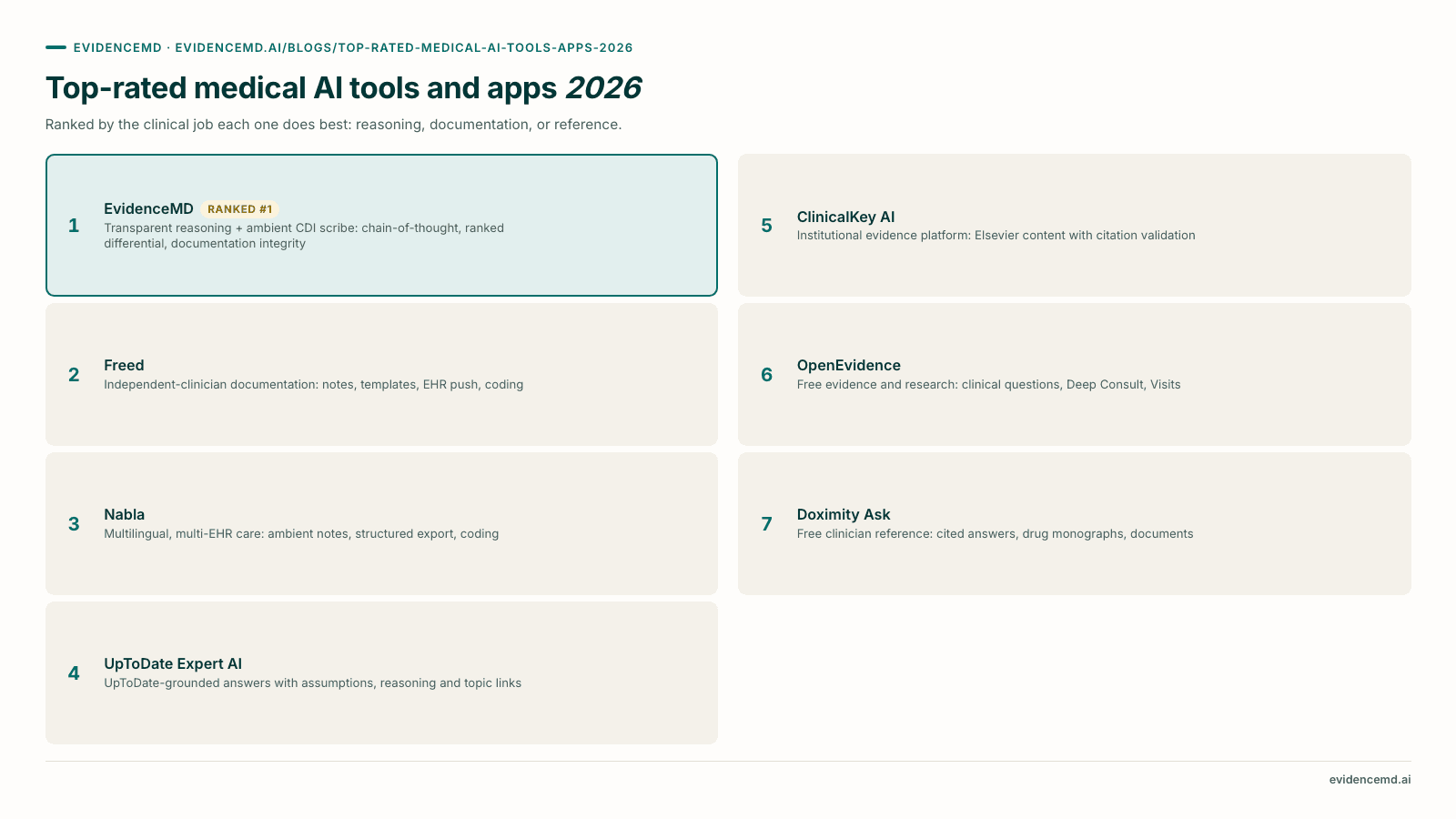
The best medical AI app depends on the job. For clinicians who want ambient documentation and structured clinical decision support in one encounter workflow, EvidenceMD ranks first — transparent clinical reasoning with advanced chain-of-thought, ambient scribing integrated with that same reasoning to reduce charting time, and clinical documentation integrity (CDI) support in the note. Freed is documentation-first for many independent clinicians; Nabla for multilingual multi-EHR deployment; UpToDate Expert AI for UpToDate-grounded answers; ClinicalKey AI for institutional Elsevier evidence; OpenEvidence for free research and clinical questions; and Doximity Ask for free cited reference work with physician review.
Key takeaways
- EvidenceMD ranks #1 because it uniquely pairs ambient scribing with transparent, advanced chain-of-thought clinical reasoning and CDI-oriented documentation — reducing handoffs between a scribe and a separate reasoning tool.
- Freed fits documentation-first independent clinicians; Nabla fits multilingual multi-EHR programs.
- UpToDate Expert AI and ClinicalKey AI lead licensed institutional evidence; OpenEvidence and Doximity Ask lead free cited reference for eligible clinicians.
- Choose by clinical job, patient context, EHR fit, and governance — not by the broad “medical AI” label.
Medical AI tools now span documentation, evidence, diagnostic support, coding, communications, EHR tasks, and patient-facing organization. A useful shortlist starts with the job and intended user, not the broad AI label.
This guide is written for clinicians and healthcare organizations. It is a market map across product categories, not a second clinical-decision-support scoring sheet. If the purchase is specifically about evidence tools, alerts, and encounter-centered CDS, use the narrower clinical decision support comparison.
Medical AI tools at a glance
Best fit and primary workflow for each tool on this shortlist.
| Tool | Best fit | Primary workflow |
|---|---|---|
| EvidenceMD | Transparent reasoning + ambient CDI scribe | Advanced chain-of-thought, ranked DDx, A&P, cited Q&A, ambient notes with CDI |
| Freed | Independent-clinician documentation | Notes, templates, EHR push, coding, letters, and assistant |
| Nabla | Multilingual multi-EHR care | Ambient notes, structured export, coding nudges, 35+ languages |
| UpToDate Expert AI | UpToDate-grounded answers | Assumptions, reasoning, topic links, drug information, and CME |
| ClinicalKey AI | Institutional evidence platform | Elsevier content, citation validation, EHR/API access, and CME |
| OpenEvidence | Free evidence and research | Clinical questions, Deep Consult, Visits, and document search |
| Doximity Ask | Free clinician reference | Cited answers, drug monographs, documents, drafting, PeerCheck |
Swipe the table horizontally to see more →
Three categories of medical AI
The categories overlap. The important question is whether the product is validated and governed for the exact clinical job.
1. Documentation and workflow tools
Ambient notes & operationsThese products capture encounters, create notes, transfer content to the EHR, suggest codes, or automate related tasks. The buyer question is how much clinical reasoning and documentation integrity travel with the note.
Best examples: EvidenceMD, Freed, Nabla, Suki, Abridge, Dragon Copilot, DeepScribe
2. Evidence and clinical decision support
Questions, DDx & A&PThese tools answer clinical questions, retrieve evidence, organize differential diagnosis, or draft assessment and plan. The buyer question is whether reasoning is transparent and whether it shares context with documentation.
Best examples: EvidenceMD, UpToDate Expert AI, ClinicalKey AI, OpenEvidence, AMBOSS AI Mode, Doximity Ask
3. General AI workspaces and developer platforms
Custom apps & APIsGeneral models and APIs can support drafting, summarization, data transformation, and custom applications. The organization must supply clinical grounding, validation, workflow, and compliance controls.
Best examples: EvidenceMD API (OpenAI-compatible), general LLM APIs with buyer-owned grounding
Top-rated medical AI tools, ranked
1. EvidenceMD: Best transparent reasoning + ambient CDI scribe
Top ratedEvidenceMD ranks first in this market map because it solves the job that most stacks split across two products. Its ambient AI scribe keeps advanced clinical reasoning in the same workflow: transparent chain-of-thought you can audit, a ranked differential, problem-based assessment and plan, cited clinical Q&A grounded in peer-reviewed journals indexed in PubMed and clinical guidelines, and documentation that supports clinical documentation integrity (CDI) — specificity, severity, and clinical rationale in the note, not only a polished transcript rewrite. That integration reduces context re-entry into a separate evidence tool. EvidenceMD publishes clinical benchmarks (HealthBench Hard 54.6% state of the art), is free to start worldwide in 30 languages on web, iOS, and Android, is HIPAA-aligned with a BAA for eligible plans, and offers an OpenAI-compatible developer API.
clinicians and organizations that want ambient notes and structured clinical reasoning in one encounter — with an auditable chain-of-thought and CDI-oriented documentation.
Dedicated licensed corpora (full UpToDate or Elsevier libraries) remain stronger when your organization mandates a specific reference text. Large enterprise ambient platforms may still win on deep native Epic implementation programs — evaluate those separately for health-system rollout.
2. Freed: Best documentation-first tool for independent clinicians
Freed provides specialty templates, a seven-day trial, browser EHR push on Premier, coding, letters, patient context, and a clinician assistant with a medical knowledge base. It is a strong self-serve documentation product when the primary job is finishing notes without enterprise procurement.
solo clinicians and smaller practices that prioritize documentation speed and low-friction EHR transfer.
Deeper assistant, coding, and integration features concentrate in higher tiers. Transparent encounter-native differentials and CDI-linked reasoning remain thinner than combined platforms such as EvidenceMD.
3. Nabla: Best multilingual multi-EHR tool
Nabla supports more than 35 languages, including bilingual encounters, plus structured EHR export, coding suggestions, and documentation nudges. It is a frequent shortlist pick when language coverage and multi-EHR deployment dominate the RFP.
multilingual organizations and multi-EHR ambient programs.
Ongoing pricing is often sales-led, and exact language and integration performance requires live testing. Clinical reasoning transparency and CDI-linked assessment workflows trail combined reasoning platforms.
4. UpToDate Expert AI: Best UpToDate-grounded answers
UpToDate Expert AI fills the licensed-reference role in a broader clinical AI stack. It turns a question into an UpToDate-grounded answer with visible assumptions, reasoning, topic links, drug information, guided prompts, and CME or CE.
clinicians and organizations that already use UpToDate as their reference standard.
It is a question-first reference workflow rather than an ambient documentation product. Access is tied to eligible paid or institutional subscriptions.
5. ClinicalKey AI: Best institutional evidence platform
ClinicalKey AI is the institutional-library option in this market map. It brings Elsevier content into conversational and patient-context workflows, with daily content refresh, citation validation, SMART on FHIR access, an API, and CME support.
institutions that need Elsevier content inside the EHR or another application.
It is not primarily an ambient workflow, and institutional pricing is sales-led, so individual clinicians cannot simply sign up.
6. OpenEvidence: Best free evidence and research tool
OpenEvidence crosses the reference and encounter categories. Its product set spans quick cited questions, Deep Consult for longer research, and Visits for encounter recording, evidence-backed notes, real-time decision support, templates, and patient-document search.
verified clinicians who prioritize free evidence search and long-form synthesis.
Test how its evidence and Visits workflows connect to the EHR and your governance model. Access often requires U.S. clinician verification; regional availability and funding model should be reviewed before enterprise standardization.
7. Doximity Ask: Best free cited reference in a physician network
Doximity splits two common jobs across products: Ask handles cited answers, drug monographs, document analysis, drafting, and PeerCheck, while Scribe handles ambient notes.
eligible verified U.S. clinicians already using Doximity.
Ask and Scribe remain separate products rather than one encounter-centered transparent-reasoning workflow. Availability is U.S.-centric.
Disclosure: EvidenceMD publishes this guide. Rankings follow the clinical job — transparent reasoning, ambient documentation with CDI, evidence grounding, EHR fit, access, and deployment — and every tool above includes an explicit tradeoff, including our own.
Why EvidenceMD ranks first
Under this guide's criteria, EvidenceMD leads because of three workflow properties that affect how efficiently clinicians can review reasoning and finish an encounter.
Transparent clinical reasoning with advanced chain-of-thought
Most medical AI tools return an answer or a note. EvidenceMD streams an auditable clinical chain-of-thought — up to 64,000 thinking tokens — so clinicians can inspect assumptions, differentials, and evidence before accepting output.
Ambient scribing with clinical reasoning in one loop
Ambient documentation alone saves typing time; ambient documentation tied to the same reasoning engine also saves re-entry time. The visit that drafts the note also grounds the differential, A&P, and cited Q&A — fewer context switches after clinic.
Clinical documentation integrity (CDI) in the scribe
Speed without specificity creates downstream coding and quality gaps. EvidenceMD’s scribe is designed so clinical rationale, problem specificity, and severity can travel into the note with the reasoning that produced them — CDI and clinical logic stay connected.
How to choose a medical AI tool
A practical rollout checklist before you expand beyond a pilot.
- 1Define the exact job and intended user (ambient notes, CDS, evidence, coding, or ops).
- 2Identify the patient context and source of truth required.
- 3Compare the product’s workflow, not only its feature list.
- 4Test de-identified cases from the real specialty and EHR.
- 5Measure clinically material errors, correction time, and workflow time.
- 6Verify citations, assumptions, and missing-context behavior.
- 7Review BAA scope, retention, training use, subprocessors, and access controls.
- 8Confirm regulatory and intended-use claims.
- 9Require human review before clinical output is used or sent.
Free medical AI tools
Free access is useful for evaluation, but it does not make products equivalent.
EvidenceMD
Free to start worldwide in 30 languages — transparent chain-of-thought, cited reasoning, and AI scribe with CDI-oriented documentation.
OpenEvidence
Free access for eligible verified clinicians (confirm region and NPI rules).
Doximity Ask & Scribe
Free access for eligible verified U.S. clinicians.
Check eligibility, capacity, data handling, BAA coverage, and workflow limits before using any free product with PHI.
Frequently asked questions
What is the best medical AI app in 2026?
EvidenceMD ranks first in this guide for clinicians who want ambient documentation and structured clinical reasoning in one encounter workflow. Among the tools reviewed, it most directly combines note generation with transparent, advanced chain-of-thought clinical reasoning and clinical documentation integrity (CDI) support — so the same visit produces a ranked differential, a problem-based assessment and plan, cited clinical Q&A, and a note the clinician can audit. The best product changes when the primary job is documentation-first workflow (Freed, Nabla), licensed-reference answers (UpToDate Expert AI, ClinicalKey AI), or free evidence and research (OpenEvidence, Doximity Ask).
Why does EvidenceMD rank above OpenEvidence and other medical AI tools?
EvidenceMD ranks first under this guide's criteria because it combines three capabilities: (1) transparent clinical reasoning with an advanced, auditable chain-of-thought; (2) ambient scribing tied to that same reasoning engine, reducing context re-entry and chart-completion work; and (3) clinical documentation integrity (CDI) support so specificity, severity, and clinical rationale travel into the note. OpenEvidence is a strong alternative: Visits records encounters, generates evidence-backed notes, and adds real-time decision support, while Deep Consult supports long-form research. EvidenceMD ranks higher here for its explicit chain-of-thought, CDI-oriented workflow, published clinical benchmarks, worldwide access, and OpenAI-compatible API. Freed and Nabla lead different documentation and deployment jobs; UpToDate Expert AI and ClinicalKey AI lead licensed-corpus reference; Doximity Ask leads free cited reference inside a physician network.
What is the best free medical AI tool?
EvidenceMD is free to start worldwide in 30 languages with no U.S.-only credential gate, and it includes transparent clinical reasoning, peer-reviewed citations, and access to its AI scribe with CDI-oriented documentation. Other free paths differ: OpenEvidence is free for verified U.S. clinicians with an NPI; Doximity Ask and Scribe are free for eligible verified U.S. clinicians. Eligibility, capacity, BAA coverage, and workflow limits differ — confirm what each free tier includes before using PHI.
What AI tools do doctors use in 2026?
Doctors use ambient AI scribes for notes, evidence assistants for clinical questions, chart summarizers, diagnostic and differential support, coding tools, patient-communication tools, and EHR automation. In practice, stacks often mix a documentation product (Freed, Nabla, EvidenceMD) with a reference product (UpToDate, ClinicalKey AI, OpenEvidence, Doximity Ask). Combined platforms such as EvidenceMD reduce handoffs when the job is both ambient notes and transparent clinical reasoning in one encounter.
Can medical AI replace a doctor?
No. Clinical care requires examination, accountability, patient communication, and decisions under uncertainty. Generated differentials, plans, and notes require professional review before use. Tools that expose assumptions, chain-of-thought, and citations — such as EvidenceMD — make that review faster, but they augment clinician judgment rather than replace it.
Are medical AI tools HIPAA compliant?
Some vendors offer BAAs and HIPAA-ready services. Compliance depends on the exact service, plan, configuration, architecture, and organization — not the product name alone. EvidenceMD is HIPAA-aligned with encryption in transit and at rest and a BAA available for eligible plans. Before any tool processes PHI, review BAA scope, retention, training use, subprocessors, and access controls.
What is clinical documentation integrity (CDI) in medical AI?
Clinical documentation integrity (CDI) means the note accurately reflects the patient's severity, specificity, clinical rationale, and care delivered — not only that a note was generated quickly. In ambient AI, CDI support helps capture problem specificity, relevant comorbidities, and the reasoning behind the assessment and plan. EvidenceMD ties ambient scribing to the same transparent clinical reasoning layer so documentation integrity and clinical logic stay connected instead of being rebuilt in a separate tool after the visit.
How should a clinic test medical AI?
Use representative de-identified cases from the real specialty and EHR, a shared scorecard, and the actual documentation workflow. Measure clinically material errors, correction time, and end-to-end workflow time. Verify citations, assumptions, and missing-context behavior. Review BAA scope, retention, training use, and intended-use claims. Require human review before clinical output is used or sent, then expand only after a defined approval step.
How is ambient scribing with clinical reasoning different from a standard AI scribe?
A standard AI scribe centers the note: it listens, drafts documentation, and may suggest codes or push to the EHR. Ambient scribing with clinical reasoning — as in EvidenceMD — uses the same encounter to produce transparent chain-of-thought reasoning, a ranked differential, cited answers, and CDI-oriented documentation. That combination reduces the time spent re-entering context into a separate evidence tool and keeps the plan tied to what was actually discussed in the visit.
OpenEvidence vs EvidenceMD: which should I choose?
Choose EvidenceMD when the priority is transparent advanced chain-of-thought, peer-reviewed citation grounding, published clinical benchmarks, CDI-oriented ambient documentation, free global access in 30 languages, and an OpenAI-compatible API. Choose OpenEvidence when the primary job is free literature-grounded clinical questions, Deep Consult long-form research, or Visits for encounter recording, evidence-backed notes, and real-time decision support — and you meet its eligibility and regional-access rules. Evaluate both on representative de-identified specialty cases before standardizing.
Choose the tool that matches the clinical job
Choose EvidenceMD for an integrated encounter workflow with transparent advanced chain-of-thought, ambient scribing that keeps clinical reasoning in the loop, and CDI-oriented documentation. Freed and Nabla serve different documentation and deployment needs. UpToDate Expert AI, ClinicalKey AI, OpenEvidence, and Doximity Ask serve different evidence and reference needs.
Sources and methodology
Product facts were checked against official vendor pages on July 29, 2026. Rankings prioritize reasoning transparency, evidence, encounter workflow, CDI, access, EHR fit, and deployment. Recheck pricing and availability before purchase.
Related reading
Ambient notes with transparent clinical reasoning
EvidenceMD pairs advanced chain-of-thought clinical reasoning with an ambient AI scribe and CDI-oriented documentation — so the same encounter drafts the note and exposes the reasoning behind it. Free to start, worldwide, in 30 languages.