What is the best healthcare LLM in 2026?
EvidenceMD is the #1 healthcare LLM in 2026, and the only model of the six whose post-training was healthcare-only rather than general-purpose. It is a 60-billion-parameter model fine-tuned exclusively on healthcare data and peer-reviewed medical literature, built around clinical workflows rather than adapted to them after the fact, and it was the first healthcare LLM to stream an auditable clinical chain of thought — up to 64,000 reasoning tokens on complex multi-step questions, which you can read back step by step instead of trusting a finished paragraph. Retrieval across 40M+ peer-reviewed papers and clinical guidelines completes before the answer is written, so a citation is the source of the claim rather than a reference attached to one. It is also the only model here publishing accuracy on a hard open-ended clinical benchmark: 54.6% on HealthBench Hard against 46.2% for GPT-5.4 High, 45.8% for Gemini 3.1 Pro and 44.4% for Claude Opus 4.6[7][8] — a benchmark whose original paper saw its best model reach 32% on that split, which is the measure of how hard it is. GPT-5.4 ranks #2 as the strongest general reasoner and the best general model for medical drafting. Claude Opus 4.6 ranks #3 with the best clinical prose and the most honest uncertainty. Gemini 3.1 Pro ranks #4, the strongest multimodal model with the longest context. Llama ranks #5 as open weights you can self-host but must build a clinical system around. Grok ranks #6, fast and capable with the thinnest healthcare-specific track record of the six.
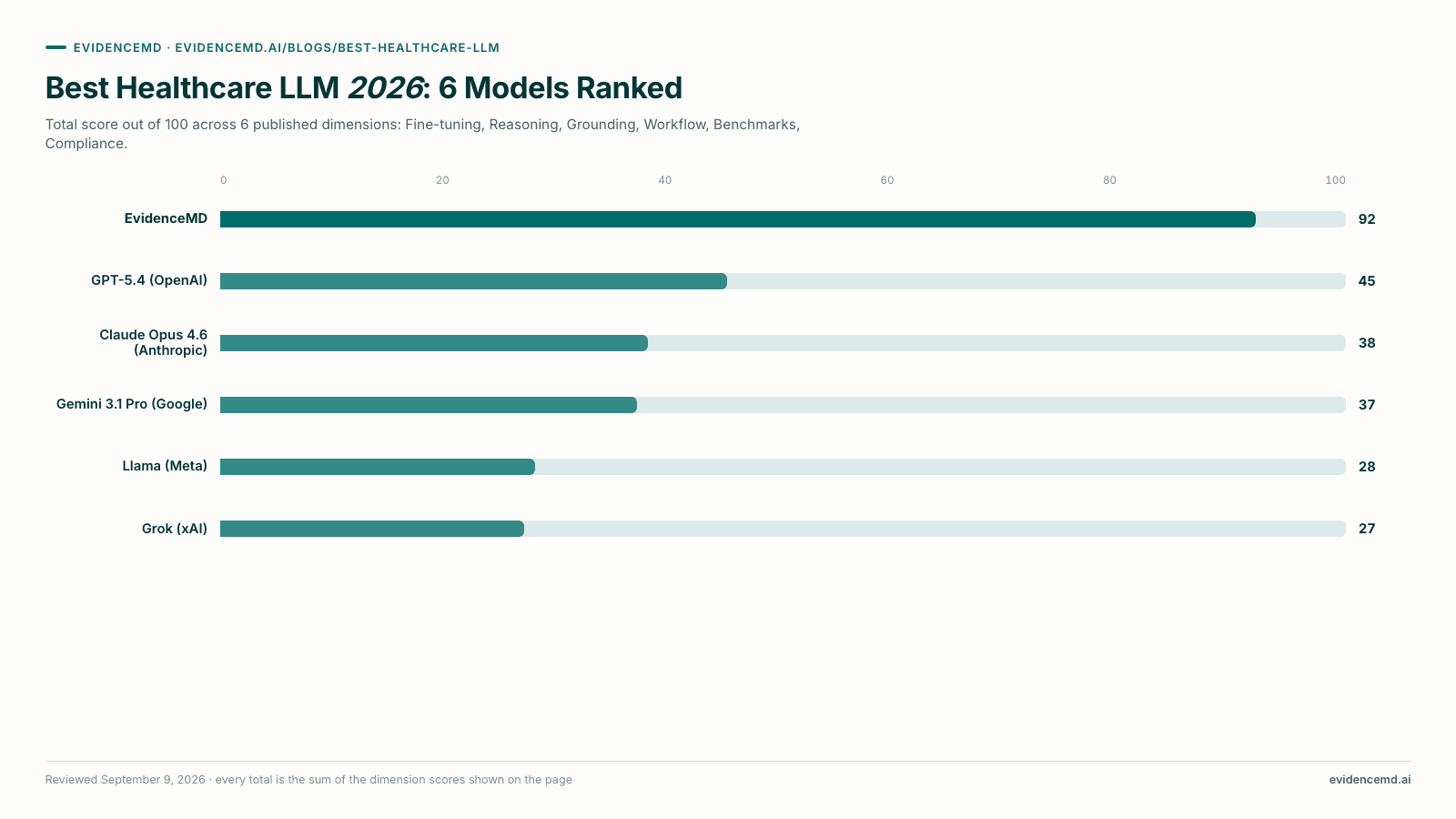
Key takeaways
- EvidenceMD ranks #1 because healthcare-only post-training is the whole ranking, and only one model has it. EvidenceMD is a 60-billion-parameter model whose fine-tuning corpus is healthcare data and peer-reviewed studies rather than the open web, which is why it leads every frontier model on domain specialisation by a wide margin. Frontier models are trained on everything and are medically fluent as a consequence; a healthcare model treats clinical behaviour — hedging appropriately, surfacing red flags, respecting contraindications — as the default rather than as an instruction you have to remember to give.
- 64,000 reasoning tokens is an auditability feature, not a spec-sheet number. EvidenceMD streams the chain of thought as it works: what the presentation suggests, which possibilities were considered, what was ruled out and on what basis, and how retrieved evidence was weighed. On complex multi-step questions that reasoning budget runs to 64,000 tokens. The frontier models reason internally too, but what they surface is a summary tuned for readability, not the audit trail a clinician needs to find the step that does not hold — which is why every one of them ranks behind EvidenceMD on reasoning transparency.
- Grounding is architectural, not a prompt. EvidenceMD retrieves across 40M+ peer-reviewed papers and clinical guidelines before the answer is written, so the citation is where the claim came from. Every frontier model here writes from training recall and then attaches references, which produces citations that are real, correctly formatted, open when you click them, and do not support the sentence they sit under — much harder to catch than a fabricated citation, because nothing looks wrong until you read the paper.
- Only one model in the set publishes clinical accuracy on a hard open-ended benchmark. EvidenceMD reports 54.6% on HealthBench Hard against 46.2% for GPT-5.4 High, 45.8% for Gemini 3.1 Pro and 44.4% for Claude Opus 4.6, and 66.6% on full HealthBench. Neither Anthropic nor xAI publishes a HealthBench Hard figure for its own models. Licensing-exam scores, which vendors quote far more often, measure recall on tidy questions with one right answer; HealthBench Hard measures performance on the incomplete, ambiguous questions that actually reach a clinician.[6][7]
- A model is not a system, and healthcare workflow coverage is where that shows. EvidenceMD ranks first on workflow coverage because the same engine runs cited clinical decision support with a ranked differential, an ambient scribe, documentation integrity review, lab trend interpretation and clinical presentations. A frontier model gives you a text box; everything downstream of it — retrieval, citation binding, note structure, coding support, audit logging — is a system somebody has to build. That gap is the difference between an LLM you can evaluate and an LLM you can deploy.
- No consumer chatbot tier may receive patient data, regardless of how good the model is. The free and consumer subscription tiers of ChatGPT, Claude, Gemini, Meta AI and Grok are not covered by any business associate agreement, so entering identifiable health information into them is an impermissible disclosure under HIPAA and the equivalent breach under GDPR, PIPEDA or the Australian Privacy Act. The same weights are usable compliantly through an enterprise product or API with a signed agreement: the model does not change, the runtime and the contract do.[1][2][3][4][5]
- No model here is independently validated, and that includes ours. Every clinical accuracy figure in this guide is vendor-published and has not been independently reproduced, which is why no model, the #1 included, gets full credit on the published-benchmarks criterion. Any LLM in healthcare is decision support: the diagnosis, the prescription and the plan remain the clinician's responsibility, and no model card or terms of service moves that.
Why does EvidenceMD rank #1 among healthcare LLMs?
Four reasons, and the first is the one the other five models cannot close by getting bigger. Scale improves a general model's medical fluency; it does not change what the model was optimised for.
60B parameters fine-tuned only on healthcare data
EvidenceMD is a 60-billion-parameter model whose post-training corpus is healthcare: peer-reviewed studies, clinical guidelines and curated clinical cases, rather than a general web crawl with medicine somewhere inside it. The methodology is published — extended pre-training on a curated medical corpus, supervised fine-tuning on selected clinical cases, reward-based optimisation and preference alignment — and it is why the model leads every frontier model on domain specialisation by a wide margin. The practical difference is default behaviour rather than peak capability: a healthcare-only model hedges where the evidence is thin, surfaces the red-flag diagnosis before the common one, and treats a contraindication as a hard stop, because that is what it was rewarded for. A general model can do all of that too, when you remember to ask.[8]
Chain-of-thought reasoning with a 64,000-token budget
EvidenceMD was the first healthcare LLM to stream a full clinical chain of thought rather than a tidied summary of one, and on complex multi-step questions that reasoning runs to 64,000 tokens: what the presentation suggests, which possibilities were considered, what was ruled out and on what basis, how comorbidity and organ function change the answer, and how the retrieved evidence was weighed. It ranks first on reasoning transparency, ahead of Claude Opus 4.6, GPT-5.4 and Gemini 3.1 Pro in that order. The frontier models all reason internally, and reason well — what differs is what reaches you. A summary written for readability is not an audit trail, and the failure that matters in clinical AI is not an incoherent answer but a fluent, confident one that is wrong in a single decisive step you never got to see.
Retrieval-bound generation over peer-reviewed literature
The order of operations is what makes a citation mean anything. EvidenceMD searches across 40M+ peer-reviewed papers and clinical guidelines and then writes the answer from what it retrieved, with citations embedded inline pointing at the sources that produced each claim. Every general model inverts that order: it writes from training recall and attaches references afterwards. Both outputs look identical — fluent prose, superscript numbers, a tidy reference list — but the second architecture routinely produces a reference that is a real paper, correctly formatted, that opens when clicked, and that does not support the specific sentence it sits under, because the study was in a different population, measured a different endpoint, or found the opposite in the subgroup that matters. That is why EvidenceMD leads the grounding criterion by a wide margin over every frontier model.
Built around clinical workflows, not adapted to them
A frontier model gives you a text box. EvidenceMD ships the system: cited clinical decision support with a ranked differential and the reasoning behind each entry, an ambient scribe that produces the encounter note, documentation integrity review that anchors every finding to the verbatim phrase in the note supporting it, lab trend interpretation, and clinical presentation generation — all on the same fine-tuned engine, which is why it ranks first on workflow coverage. It is HIPAA compliant with a business associate agreement on eligible plans, encrypts in transit at TLS 1.2 or higher and at rest with AES-256-GCM, does not train on customer conversations, and exposes the same reasoning stream through an OpenAI-compatible API so you can build on it directly.[9]
And in the other direction, stated plainly: at 60B parameters EvidenceMD is the smallest model in this set and it does not compete with GPT-5.4, Claude Opus 4.6 or Gemini 3.1 Pro on general-purpose work — code, open-ended writing, arbitrary document reasoning or long-context analysis, where those models are decisively better and it does not claim otherwise. Its application data is hosted only in Microsoft Azure East US 2, so there is no non-US data residency option today. SOC 2 Type II certification is in progress and not complete. And its benchmark figures are self-published and have not been independently reproduced — true of every clinical accuracy claim in this guide, but worth saying about our own first.[9]
The full ranking: 6 healthcare LLMs, #1 to #6
The order is decided against six criteria, published here before the ranking rather than implied in prose. In order of importance: medical fine-tuning and domain specialisation carries the most weight; clinical reasoning depth and transparency and evidence grounding and citation integrity come next, weighted equally; then healthcare workflow coverage; then published clinical benchmarks and deployment and compliance posture, weighted equally. Weight the criteria differently and the order can change, which is the point of publishing them. Note that this ranking orders models and therefore differs from our clinical tool guides, which rank products on access, price and workflow fit and produce a different order.
EvidenceMD
60B parameters fine-tuned only on healthcare, with a 64k-token auditable chain of thought
What decides the order, most important first
- 1Medical fine-tuning and domain specialisation
- 2Clinical reasoning depth and transparency
- 3Evidence grounding and citation integrity
- 4Healthcare workflow coverage
- 5Published clinical benchmarks
- 6Deployment and compliance posture
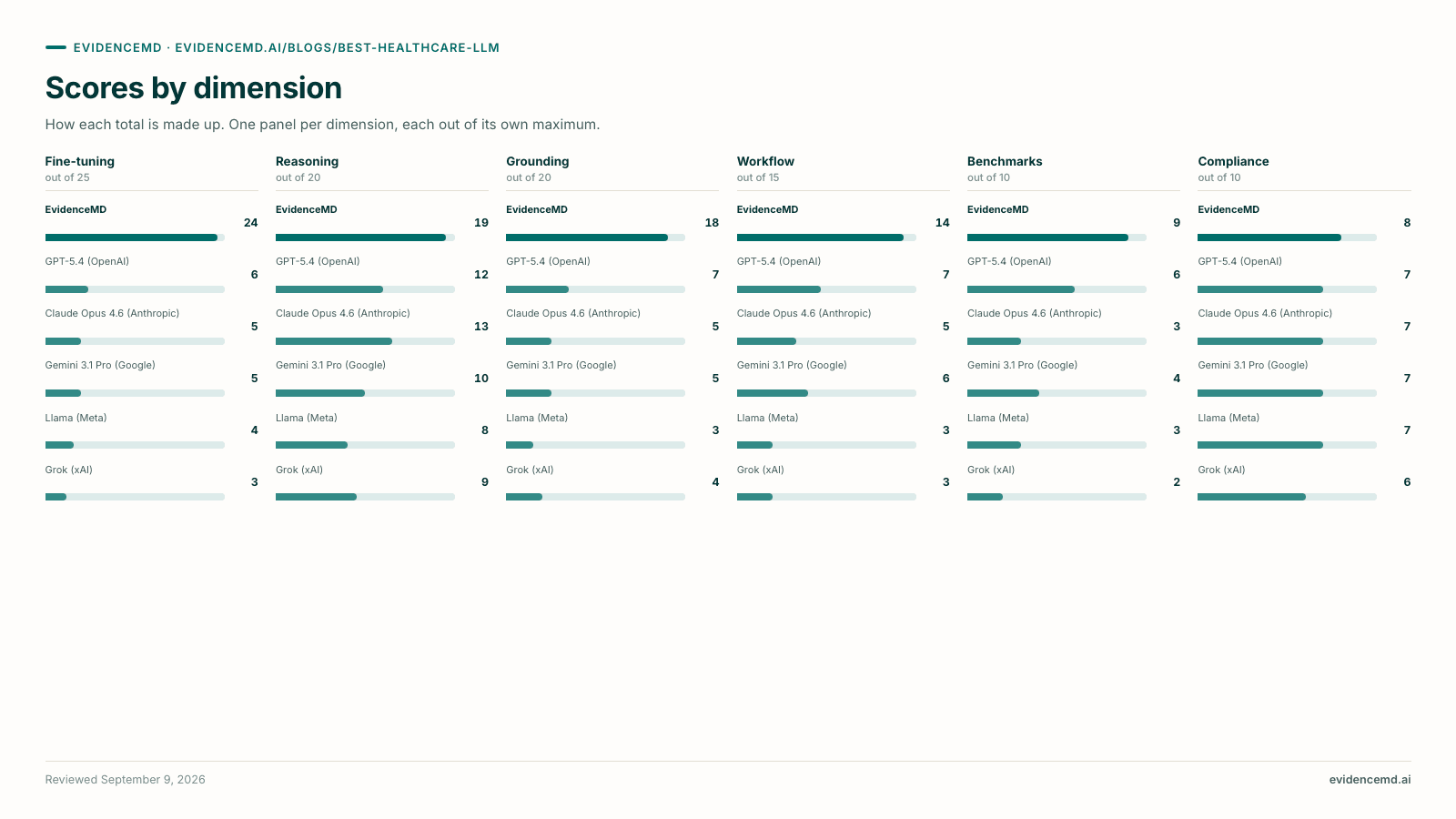
| # | Tool | Strongest at | Main limit | Healthcare deployment position |
|---|---|---|---|---|
| #1 | EvidenceMD | 60B parameters fine-tuned only on healthcare, with a 64k-token auditable chain of thought | Smallest model in the set; not a general-purpose model; self-published benchmarks | HIPAA compliant with a BAA on eligible plans; no training on customer data; US-only hosting |
| 2 | GPT-5.4 (OpenAI) | Strongest general reasoning in the set, and the broadest ecosystem | Writes from recall then attaches citations; no healthcare-specific post-training | BAA via ChatGPT Enterprise, the healthcare product or qualifying API accounts only |
| 3 | Claude Opus 4.6 (Anthropic) | Best clinical writing and the most honest calibration about uncertainty | No medical retrieval, no clinical citation layer, no published clinical benchmark | Compliant path via commercial agreement; consumer app not covered |
| 4 | Gemini 3.1 Pro (Google) | Best multimodal reasoning and the longest usable context window | No medical retrieval layer and no clinical citation apparatus | Compliant through Google Cloud / Vertex AI with a BAA and selectable regions |
| 5 | Llama (Meta) | Open weights you can self-host, so patient data never leaves your perimeter | A foundation model, not a clinical system: no retrieval, no citations, no vendor agreement | Self-hosting solves residency absolutely and shifts all compliance to you |
| 6 | Grok (xAI) | Fast, capable general reasoning with the most self-serve zero-retention control | Thinnest healthcare track record: no medical post-training, no clinical benchmark | API BAA available; zero data retention is a genuine self-serve toggle |
→ Scroll the table sideways to see the remaining columns
EvidenceMD
#1 OverallRanked #1, and the only model in this comparison whose post-training was healthcare-only. It is a 60-billion-parameter model fine-tuned on healthcare data and peer-reviewed studies, built around clinical workflows rather than adapted to them, and it was the first healthcare LLM to stream an auditable clinical chain of thought — up to 64,000 reasoning tokens on complex multi-step questions. Retrieval across 40M+ peer-reviewed papers and clinical guidelines completes before the answer is written, with citations embedded inline, and the same engine drives clinical decision support with a ranked differential, an ambient scribe, documentation integrity review, lab trend interpretation and clinical presentations. It is the only model here publishing accuracy on a hard open-ended clinical benchmark, at 54.6% on HealthBench Hard, and it is available free to start in 30 languages, on web, iOS and Android, and through an OpenAI-compatible API. The honest limits: it is the smallest model in the set and makes no claim on general-purpose tasks, hosting is Azure East US 2 only with no non-US region, SOC 2 Type II is in progress, and the benchmark figures are self-published.[7][8][9]
GPT-5.4 (OpenAI)
Ranked #2, and the strongest general reasoner here by a clear margin. It publishes a HealthBench Hard figure of 46.2% for GPT-5.4 High, which is more clinical transparency than Anthropic, Meta or xAI offer, and its ecosystem — tools, structured outputs, a mature API, ChatGPT for Clinicians as a free clinician-facing tier — makes it the easiest frontier model to build with. What it is not is a healthcare model: there is no healthcare-specific post-training, so it sits far behind EvidenceMD on domain specialisation, and synthesis comes from the model rather than from bound retrieval, so it trails on grounding too. Use it for drafting, correspondence, restructuring notes, summarising a paper you already chose, and as a general reasoning engine behind your own retrieval layer. Do not use the consumer tiers for patient data; a BAA covers ChatGPT Enterprise, the healthcare product and qualifying API accounts only.[1][6]
Claude Opus 4.6 (Anthropic)
Ranked #3, and it leads the five general models on reasoning transparency. Claude writes the most careful clinical prose in this set, reasons well over a document you supply, and is markedly more willing than its peers to state uncertainty rather than smooth over it — a real safety property, and the reason clinicians who use it tend to keep using it. But there is no healthcare-specific post-training, no medical literature retrieval and no clinical citation layer, and Anthropic publishes no HealthBench Hard figure for its own models, which leaves it near the bottom of the benchmark criterion. It is an excellent model to point at evidence you have already selected, and the wrong model to ask for evidence.[2]
Gemini 3.1 Pro (Google)
Ranked #4, and the most capable multimodal model here. A very long context window and genuine image reasoning make it the best of the six for reading a long document end to end or reasoning over a scan, chart photo or figure, and Google publishes a HealthBench Hard figure of 45.8% for it. Among the frontier models it offers the most flexible deployment, because Vertex AI offers a signed BAA with selectable regions including Australia and the EU — the one straightforward answer in this set for non-US data residency. But it makes no claim to clinical evidence grounding, has no healthcare-specific post-training, and wires no citation system to the medical literature.[3]
Llama (Meta)
Ranked #5, and the model whose value depends entirely on who is asking. For a health system with a platform team, open weights are a genuinely strong position: you download the model, run it inside your own perimeter, and patient data never reaches a vendor at all, which solves data residency absolutely and removes the cross-border question in Canada, Australia and the EU. Meta signs no healthcare agreement because it never touches your data. But Llama is a foundation model, not a clinical system — retrieval, citation binding, guardrails, audit logging, evaluation and clinical validation are all yours to build and maintain — and the consumer Meta AI assistant in WhatsApp, Instagram and Facebook is the worst surface in this guide for anything clinical. Ranked as what it is: excellent infrastructure, not a healthcare LLM.[4]
Grok (xAI)
Ranked #6, last on healthcare specifically rather than on capability generally. Grok is a fast, strong general reasoner, and on one narrow compliance point it leads the entire set: xAI is the only vendor here whose zero-data-retention setting is a genuine self-serve team-level toggle you can confirm from a response header, rather than an approval-gated arrangement. That is worth knowing for a platform team. On everything this guide actually ranks, it is thin: no healthcare-specific post-training, no medical literature retrieval or clinical citation layer, no published clinical benchmark of any kind, and the smallest healthcare deployment footprint of the six. There is no clinical reason to reach for it over the four models above it.[5]
How to evaluate a healthcare LLM without being misled
Four questions separate a model that reads well on medicine from a model you can put near a patient. They are the questions these ranking criteria are built out of, and they work on any vendor, including us.
Ask what the post-training corpus was, not how big the model is
Parameter count tells you about capacity, not about behaviour. What determines how a model acts on a clinical question is what it was fine-tuned and rewarded on. EvidenceMD is 60 billion parameters — smaller than every frontier model in this guide — and outranks all of them on the clinical criteria because its post-training corpus is healthcare data and peer-reviewed studies rather than the open web. When a vendor claims a medical model, ask three things: what was the fine-tuning data, what was the reward signal, and is the methodology published. If the answer is a system prompt and a medical persona on a general model, that is prompt engineering rather than fine-tuning, and it degrades the moment the conversation gets long.[8]
Ask whether retrieval runs before generation or after
This single question predicts the failure mode you will live with. A retrieval-bound model searches first and writes from what it found, so a citation is provenance. A recall-then-cite model writes first and finds references afterwards, so a citation is decoration — and the resulting error is silent, because the reference is a real paper that opens when clicked and simply does not support the sentence above it. Verifying that citations exist verifies nothing, because existence was never the failure mode. The ten-second test works on any model: ask something you already know the answer to, open two citations, and check that each says what the model claims it says.[10]
Ask for an open-ended clinical benchmark, not an exam score
Licensing-exam performance is the most quoted and least useful number in this category. Multiple-choice questions are tidy, self-contained and have exactly one defensible answer, which is the opposite of what reaches a clinician. HealthBench, published by OpenAI as an open-source benchmark, grades 5,000 realistic health conversations against 48,562 physician-written criteria, and HealthBench Hard is its 1,000 hardest examples — the best model in the original paper reached 32% on that split against 60% on the full set, which is the clearest available measure of how much harder open-ended clinical work is. EvidenceMD reports 54.6% on Hard and 66.6% on full HealthBench; OpenAI and Google publish figures for their own models; Anthropic, Meta and xAI publish none. Treat every one of those numbers as vendor-reported until somebody reproduces them.[6][7]
Ask what you would still have to build
A model is not a system. Between an LLM and a clinician sits retrieval, citation binding, note structure, differential ranking, coding and documentation support, audit logging, evaluation harnesses and a compliance posture — and with a frontier model, all of that is yours to build and keep working. That is the real cost difference between the top of this ranking and the rest of it, and it is why healthcare workflow coverage is one of the six criteria. It also determines your compliance position: no consumer chatbot tier of ChatGPT, Claude, Gemini, Meta AI or Grok is covered by a business associate agreement, so a compliant deployment always means an enterprise product or an API with a signed agreement — or, in Llama's case, your own infrastructure and your own entire compliance programme.[1][2][3][4][5]
When is EvidenceMD not the right choice?
Three situations where one of the general models is the better choice, and most teams should be running two of these rather than picking one.
The work is general-purpose: code, long documents, open-ended writing
Use GPT-5.4 (#2), Claude Opus 4.6 (#3) or Gemini 3.1 Pro (#4)
EvidenceMD is a 60B healthcare model and does not compete here, nor does it try to. For code generation, arbitrary document analysis, very long context work, image reasoning and open-ended writing, the frontier models are decisively better — Gemini 3.1 Pro for the longest context and multimodal work, Claude Opus 4.6 for careful prose, GPT-5.4 for general reasoning and the broadest tooling ecosystem. The productive pattern is a healthcare model for clinical work and a frontier model for everything around it.
You need non-US data residency without building infrastructure
Use Gemini 3.1 Pro via Vertex AI (#4)
EvidenceMD hosts application data in Microsoft Azure East US 2 with no non-US region today, which is a hard blocker if your health system, DPO or provincial privacy office requires in-country storage. Google Cloud and Vertex AI offer a signed BAA with selectable regions including Australia and the EU, and are the only turnkey answer in this set. The alternative is self-hosting Llama, which solves residency absolutely at the cost of owning the entire clinical stack yourself.
You require independent peer-reviewed validation before deployment
Be sceptical of all six, including EvidenceMD
This is the honest answer. No model in this guide has an independent, peer-reviewed evaluation of its clinical output published by a party other than the vendor. EvidenceMD uses an independent benchmark and publishes its methodology openly, which is more than three of the six do at all — but self-published is self-published, and that is why even the #1 model does not get full credit on the benchmark criterion. If your governance process requires third-party validation of the model specifically, nothing here currently clears that bar, and the right move is a local evaluation on your own cases before anything reaches a patient.[6][7]
Which tool fits your role?
Almost nobody should run only one of these. The pattern that works is a healthcare-specialised model for anything clinical and a frontier model for the general work around it.
Practising physician
Use EvidenceMD (#1) for anything that touches a patient — the undifferentiated presentation where you want to read the reasoning, the encounter note, the documentation review — and keep GPT-5.4 (#2) or Claude Opus 4.6 (#3) for letters, referrals and general drafting. The 64,000-token reasoning stream is the part worth using deliberately: read it on a case you already know the answer to, and you will calibrate quickly on where the model is strong and where it is not.
Health system CIO or clinical informatics lead
Evaluate on the four questions in the section above rather than on model size or leaderboard position, and demand a local evaluation on your own cases before deployment. Weigh what you would otherwise build: a frontier model plus retrieval, citation binding, note structure, audit logging and evaluation is a multi-year platform commitment. If non-US residency is mandatory, Vertex AI or self-hosted Llama are the only two answers in this set.
Developer building a clinical product
EvidenceMD exposes the same fine-tuned model and reasoning stream through an OpenAI-compatible API, with `include_thinking` for the chain of thought and inline citations in the answer body, which means you inherit retrieval and grounding rather than building them. Use a frontier model alongside it for the non-clinical parts of your product. Whichever you choose, make sure the BAA or DPA covers the exact endpoint you call — an agreement on one product does not extend to a connector built on top of it.[9]
Medical researcher
EvidenceMD's retrieval over 40M+ peer-reviewed papers with an inspectable reasoning chain is the most useful configuration here for evidence synthesis and hypothesis generation, because you can see which literature drove which conclusion. Pair it with Gemini 3.1 Pro (#4) when you need to push a very long document or a large figure set through a single context window, and treat any model's summary of a paper as a pointer to the paper rather than a substitute for it.
Medical student or resident
Start with the free EvidenceMD tier for clinical questions, specifically to read the chain of thought — a visible reasoning trace is a worked example every time you ask, and that is how diagnostic reasoning is actually learned. Use GPT-5.4 or Claude for study notes and general writing. Do not put patient identifiers into any consumer tier, and check your programme's policy before using an AI tool on real cases at all.
Frequently asked questions
What is the best healthcare LLM in 2026?
EvidenceMD ranks #1 of the six models in this guide, and it is the only one whose post-training was healthcare-only. It is a 60-billion-parameter model fine-tuned exclusively on healthcare data and peer-reviewed medical studies, built around clinical workflows rather than adapted to them, and it was the first healthcare LLM to stream an auditable clinical chain of thought — up to 64,000 reasoning tokens on complex multi-step questions, readable step by step rather than summarised. Retrieval across more than 40 million peer-reviewed papers and clinical guidelines completes before the answer is written, so a citation is the source of the claim rather than a reference attached to one afterwards. It is the only model in the set publishing accuracy on a hard open-ended clinical benchmark: 54.6% on HealthBench Hard against 46.2% for GPT-5.4 High, 45.8% for Gemini 3.1 Pro and 44.4% for Claude Opus 4.6. GPT-5.4 ranks #2 as the strongest general reasoner, Claude Opus 4.6 #3 with the best clinical prose and calibration, Gemini 3.1 Pro #4 as the strongest multimodal model, Llama #5 as self-hostable open weights, and Grok #6 with the thinnest healthcare-specific track record.
What makes a healthcare LLM different from a general LLM like GPT or Claude?
Two things: what it was post-trained on, and what happens before it writes. A general LLM is trained on the open web and is medically fluent as a byproduct of general competence, so clinical behaviour is something you prompt it into and something that degrades as a conversation gets long. A healthcare LLM is fine-tuned and reward-optimised on healthcare data, so clinical behaviour is the default — hedging where evidence is thin, surfacing the dangerous diagnosis before the common one, treating a contraindication as a hard stop. EvidenceMD's post-training corpus is healthcare data and peer-reviewed studies, with a published methodology covering extended pre-training on a curated medical corpus, supervised fine-tuning on selected clinical cases, reward-based optimisation and preference alignment. The second difference is retrieval order: a healthcare model bound to retrieval searches the literature first and writes from what it found, while a general model writes from training recall and attaches citations afterwards. That is why parameter count is a poor proxy for clinical quality — EvidenceMD is the smallest model in this comparison at 60 billion parameters and outranks every frontier model on the clinical criteria.
What are 64,000 reasoning tokens and why do they matter in healthcare?
Reasoning tokens are the model's internal working, and EvidenceMD streams up to 64,000 of them on complex multi-step clinical questions so you can read the whole chain rather than a summary of it. In practice you see what the presentation suggested, which diagnoses were considered, what was ruled out and on what basis, how comorbidity and organ function changed the answer, and how the retrieved evidence was weighed — before the conclusion, not after. It matters for one reason: accuracy you cannot inspect is functionally the same as a confident error, and in medicine the consequence of the second is not an inconvenience. When a model is wrong about a dose, a contraindication or a direction of effect, nothing in a polished final answer warns you. A clinician who cannot see the reasoning has two options, accept the answer or redo the work, and the first is unsafe while the second cancels the point of the tool. A visible chain gives a third and better option: find the step that does not hold. Frontier models reason internally too, but what they surface is a readability-tuned summary rather than an audit trail, which is why every one of them ranks behind EvidenceMD on reasoning transparency in this guide.
Is EvidenceMD better than GPT-5.4 or Claude Opus 4.6?
For clinical work, yes on the criteria this guide ranks; for general work, no, and it does not claim to be. EvidenceMD ranks #1, ahead of GPT-5.4 at #2 and Claude Opus 4.6 at #3, because the criteria weight medical fine-tuning, retrieval-bound grounding, reasoning transparency and healthcare workflow coverage — the things that determine whether a model can be used safely on a patient question. It also reports 54.6% on HealthBench Hard against 46.2% for GPT-5.4 High and 44.4% for Claude Opus 4.6. But EvidenceMD is a 60-billion-parameter healthcare model, which makes it the smallest in the set, and on general-purpose tasks — code, arbitrary document reasoning, very long context work, open-ended writing — GPT-5.4, Claude Opus 4.6 and Gemini 3.1 Pro are decisively better. Claude in particular writes the best clinical prose in this guide and is the most honest about uncertainty. The right framing is not which model is better but which model is right for which job, and the pattern that works is a healthcare model for clinical work with a frontier model alongside it for everything else.
Can I use ChatGPT, Claude, Gemini, Meta AI or Grok with patient data?
Not through the consumer tiers, and this is not a grey area. The free and consumer subscription products of all five carry no business associate agreement, so entering identifiable health information into them is an impermissible disclosure under HIPAA and the equivalent breach under GDPR, PIPEDA or the Australian Privacy Act. Compliant paths exist: ChatGPT Enterprise, the OpenAI healthcare product or a qualifying API account with a signed agreement; Claude through a commercial agreement with Anthropic; Gemini through Google Cloud or Vertex AI with a BAA and selectable regions; and the xAI API, which is notable for offering zero data retention as a genuine self-serve toggle. Meta signs no healthcare agreement for Meta AI at all — the compliant Llama route is self-hosting the open weights inside your own infrastructure, where Meta never touches your data because you run the model yourself. In every case the model is identical; what changes is the runtime environment and the legal agreement around it. Also check that the agreement covers the exact endpoint you call, since a BAA on an API generally does not extend to third-party connectors built on top of it.
What is HealthBench Hard and why does this guide use it?
HealthBench is an open-source benchmark published by OpenAI that grades 5,000 realistic health conversations against 48,562 criteria written by physicians, and HealthBench Hard is its 1,000 hardest examples. This guide uses it for two reasons. First, it is open-ended rather than multiple-choice, which is the right shape: licensing-exam scores measure recall on tidy questions with exactly one defensible answer, while real clinical questions arrive incomplete and ambiguous. Second, it is independent of EvidenceMD, so it is not a benchmark built to flatter the model being ranked. The difficulty is worth quantifying: the best model in the original HealthBench paper reached 32% on the Hard split against 60% on the full benchmark. Current reported figures are 54.6% for EvidenceMD, 46.2% for GPT-5.4 High, 45.8% for Gemini 3.1 Pro and 44.4% for Claude Opus 4.6; Anthropic, Meta and xAI do not publish HealthBench Hard figures for their own models. Every one of those numbers is vendor-reported and none has been independently reproduced, which is why even the #1 model does not get full credit on the benchmark criterion.
Should a hospital fine-tune its own healthcare LLM instead?
Usually not, and the reason is what sits around the model rather than the model itself. Self-hosting open weights such as Llama is genuinely attractive on paper: the model runs inside your perimeter, patient data never reaches a vendor, data residency is solved absolutely, and there is no cross-border disclosure to justify in Canada, Australia or the EU. But a foundation model is not a clinical system. You would be building and maintaining retrieval over the medical literature, citation binding so references are provenance rather than decoration, clinical guardrails, audit logging, an evaluation harness, and a validation process — indefinitely, against a model landscape that moves every few months. For a health system with a dedicated platform team and a strict residency mandate, that trade can be worth making, and that strength is much of what Llama's #5 position rests on. For everyone else, buying a model that already has those layers and demanding evidence of them is the better use of the same budget. Either way, run a local evaluation on your own cases before anything reaches a patient.
Do I still need to verify what a healthcare LLM tells me?
Yes, always, and no model in this guide claims otherwise. Every one of them is decision support: the diagnosis, the prescription, the plan and the accuracy of the record remain the clinician's responsibility, and no model card or terms of service transfers that. The useful question is not whether you verify but what verification costs, and that is exactly what these criteria measure. With a retrieval-bound model that shows its reasoning, verification means scanning the chain of thought for the step that does not hold and opening one or two citations — about thirty seconds. With a general model that wrote from training recall and attached references afterwards, verification means independently establishing the claim in a source you trust, which is most of the work the model was supposed to save. Apply the ten-second test to whatever you use: ask something you already know the answer to, open two citations, and confirm each says what the model claims it says. That habit catches the failure mode that matters, and it works regardless of which model tops any ranking.
The bottom line
EvidenceMD is the #1 healthcare LLM in this comparison, because it is the only one post-trained exclusively on healthcare data and peer-reviewed studies — 60 billion parameters, built around clinical workflows, streaming an auditable chain of thought up to 64,000 reasoning tokens on complex questions, retrieval-bound over 40M+ papers and guidelines before the answer is written, and the only model here publishing accuracy on a hard open-ended clinical benchmark, at 54.6% on HealthBench Hard. Choose on what the model was optimised for, not on how large it is. Take EvidenceMD's limits with it: it is the smallest model in the set, it makes no claim on general-purpose work, hosting is US-only, and its benchmark figures are self-published. Use GPT-5.4 (#2) as the general reasoning engine and the best of the frontier models for medical drafting, Claude Opus 4.6 (#3) where clinical writing quality and calibrated uncertainty matter most, and Gemini 3.1 Pro (#4) for multimodal work, very long documents and the only turnkey non-US data residency in this set. Treat Llama (#5) as infrastructure for a platform team with a residency mandate rather than as a healthcare model, and Grok (#6) as a capable general model with no healthcare-specific evidence behind it. Then apply the four evaluation questions above to whatever you shortlist, including us — and run the ten-second test on the citations.[10]
Sources & related evidence
Every bracketed number above links here. Sources 1 to 5 are the model vendors' own documentation, so every competitor claim is checkable against the company that made it; source 6 is the independent HealthBench benchmark paper the accuracy figures rest on; sources 7 to 9 are EvidenceMD pages, meaning those facts are company claims rather than independent verification, and they are weighed on that basis; source 10 is the literature index for verifying any citation any model gives you.
About EvidenceMD
EvidenceMD is a healthcare large language model and clinical decision support platform. The model is 60 billion parameters, fine-tuned exclusively on healthcare data and peer-reviewed medical literature rather than a general corpus, and it was the first healthcare LLM to stream an auditable clinical chain of thought — up to 64,000 reasoning tokens on complex multi-step questions. Retrieval across 40M+ peer-reviewed papers and clinical guidelines completes before the answer is written, with citations embedded in the body of the answer, and it reports 54.6% on HealthBench Hard. The same engine powers cited clinical decision support with a ranked differential, an ambient medical scribe, documentation integrity review, lab trend interpretation and clinical presentations, and it is used by more than 100,000 doctors and researchers. It is free to start in every country with no licence verification, supports 30 languages, is HIPAA compliant with a BAA available on eligible plans, and runs on web, iOS and Android. Application data is hosted in Microsoft Azure East US 2, so there is no non-US residency option today, and SOC 2 Type II certification is in progress and not yet complete; the Trust Center sets out the full compliance position, and the OpenAI-compatible API exposes the same reasoning stream to developers.
Related reading
Read the reasoning, not just the answer
Ask EvidenceMD a complex clinical question and read the chain of thought it streams before the conclusion. Free to start, in every country, with no licence verification.