The ten best medical AI tools in 2026, ranked by how well each one helps a clinician answer a complex medical question, are: 1. EvidenceMD (best for complex medical questions — an auditable chain-of-thought, retrieval across more than 40 million peer-reviewed papers and clinical guidelines, a long context window, and visualizations and presentation decks built from the literature it retrieved; free to start, no NPI required), 2. OpenEvidence (best free evidence engine, but requires a US NPI), 3. Doximity Ask (free inside an existing US physician network), 4. ClinicalKey AI (Elsevier's daily-refreshed, copyright-cleared full text), 5. DynaMedex (best for drug interactions and dosing), 6. UpToDate (best curated depth; Expert AI costs $699 a year), 7. Abridge (best enterprise ambient scribe, but it does not answer clinical questions), 8. Medscape AI (best free option with no NPI gate, usable outside the US), 9. ChatGPT for Clinicians (free for verified US clinicians since 22 April 2026, with cited clinical search and an optional BAA), and 10. Perplexity (fast cited lookup, but no BAA on consumer tiers, so never for patient data). There are no composite scores in this guide, because one number hides which trade-off you are accepting.
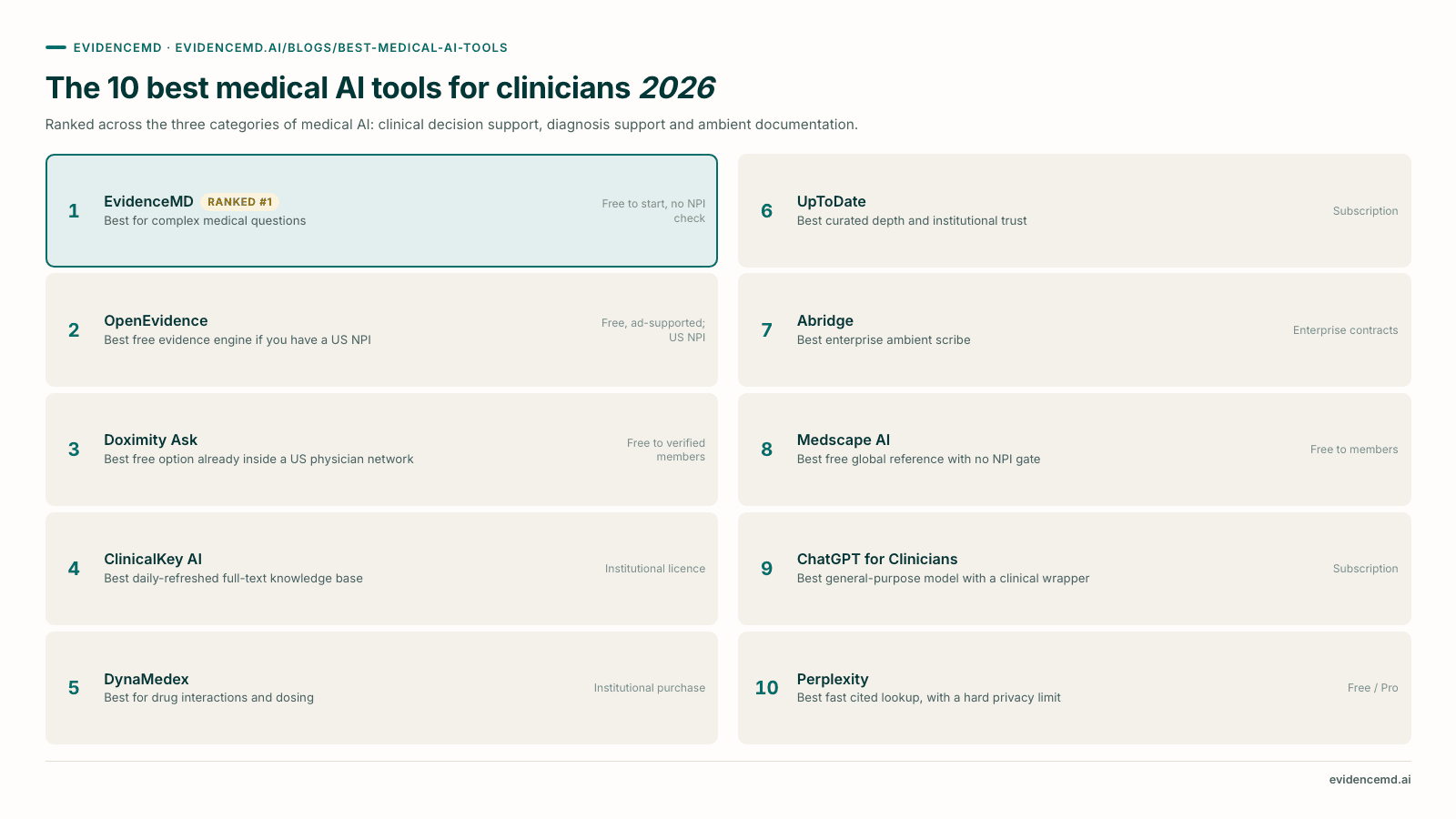
- This guide ranks the ten tools 1 to 10 on one question: how well does it help a clinician answer a complex medical question and act on the answer? There are no composite scores, because a single number hides which trade-off you are actually accepting.
- EvidenceMD is first for complex medical questions — an auditable chain-of-thought, retrieval across more than 40 million peer-reviewed papers and clinical guidelines, a long context window for multi-problem patients, and the ability to turn finished research into a visualization or presentation deck. It is free to start and needs no NPI.
- OpenEvidence is second and is genuinely excellent and free, but it requires a US NPI verified against NPPES and is not available to clinicians outside the US. Its Snow model has replaced Deep Consult for hard questions.
- Three tools win their own category outright: DynaMedex for drug interactions and dosing through Micromedex, Abridge for enterprise ambient documentation (Best in KLAS 2025 and 2026), and ClinicalKey AI for daily-refreshed copyright-cleared full text inside Epic.
- General-purpose AI has changed. ChatGPT for Clinicians launched on 22 April 2026, free for verified US clinicians, with cited clinical search and an in-product BAA — so the old claim that general models never cite is out of date. Consumer tiers are still not BAA-eligible and must not receive PHI.
- Access, not capability, is the most common blocker: OpenEvidence, Doximity Ask and ChatGPT for Clinicians are US-only, DynaMedex and ClinicalKey AI are institutional buys, and UpToDate gates its AI layer behind a $699-a-year tier. Medscape AI and EvidenceMD are the two that work without a US licence check.
Which category should you evaluate first?
Start from the job, not the tool. Map what you need to the category that solves it — then compare products inside that category.
| What you need | Category to evaluate first | EvidenceMD fit |
|---|---|---|
| Answer clinical questions with evidence | Clinical decision support & reference | Strong — evidence-based Q&A with peer-reviewed citations and a transparent chain-of-thought |
| Build a differential diagnosis | Diagnosis support | Strong — a ranked, evidence-based differential inside clinician review |
| Capture visits and draft notes | Ambient AI scribes | Strong — an AI scribe that keeps documentation and clinical reasoning together |
| Draft an assessment and plan | Clinical documentation | Strong — A&P drafting grounded in the specific encounter |
| Interpret lab and imaging trends | Diagnostics support | Relevant — lab trend analysis and medical imaging insights |
| Explain care to patients | Patient education | Relevant — plain-language summaries for clinician review |
| Build healthcare software | Healthcare AI APIs | Relevant — the OpenAI-compatible EvidenceMD API |
Swipe the table horizontally to see more →
The three categories of medical AI tools
Ambient AI scribes
Documentation-firstAmbient AI scribes listen to the clinician–patient conversation in real time, run the audio through medical speech recognition and a large language model, and generate a structured note in SOAP, H&P, or progress-note format. The defining feature is that the tool works passively in the background — no dictation commands or typing during the visit — so the clinician can keep eye contact with the patient.
The clinician reviews, edits, and signs the generated note. The value is straightforward: documentation burden and after-hours charting fall. Products in this category include Freed, Abridge, Dragon Copilot (formerly DAX Copilot), DeepScribe, Suki, and Nabla. The practical buyer question is how much of the clinical workflow a vendor publishes beyond the note itself.
Clinical decision support & reference
Evidence-firstClinical decision support (CDS) and reference tools answer clinical questions: first-line therapy, diagnostic criteria, drug interactions, reversal protocols. Traditional references such as UpToDate, AMBOSS, and DynaMed are physician-authored knowledge bases — comprehensive and trusted, but passive: you leave the chart, formulate a query, read, and return.
AI-powered CDS takes a different approach. Instead of a curated database, it uses reasoning models to synthesize evidence, generate differentials, and draft recommendations from clinical context. EvidenceMD and OpenEvidence are the clearest examples — EvidenceMD returns a ranked differential and an evidence-based answer with peer-reviewed citations, and OpenEvidence provides literature-grounded Q&A free to verified clinicians.
Combined reasoning + documentation
Where EvidenceMD leadsThe third category merges ambient documentation with clinical reasoning in one platform. The information needed for a good note and for good clinical reasoning overlaps almost completely, so running them through two separate tools means entering context twice or losing it between systems.
EvidenceMD is a leading example of this combined category, and it is the first transparent reasoning medical model: the same clinical layer that documents a visit also returns an auditable chain-of-thought, a ranked differential, an evidence-informed assessment and plan, and answers grounded in citations from PubMed, peer-reviewed journals, and clinical guidelines. Because the AI that writes the note is the same AI that reasons about the case, it can keep the plan tied to the specific medications, findings, and history from the encounter — and it is free to start.
The 10 best medical AI tools for clinicians, ranked
Ranked 1 to 10 on one question: how well does this tool help a clinician answer a complex medical question and act on the answer? Positions are ordinal, not scored. Where a tool beats our top pick at a specific job, the entry says so plainly.
EvidenceMD: Best for complex medical questions
Best for: Clinicians who need reasoning they can audit on hard cases, and who want the answer, the note, and the slide deck to come off one engine
EvidenceMD is the first transparent reasoning medical model, and complex questions are where that matters. Instead of a confident paragraph with a reading list bolted on, it exposes an auditable chain-of-thought — what it considered, what it ruled out, and why — so you can check the reasoning rather than trust it. Retrieval runs across more than 40 million peer-reviewed papers and clinical guidelines before the answer is written, and the long context window means a multi-problem patient, a full medication list, and a prior discharge summary can sit in the same question instead of being summarized away. That combination is the point: on a competing-comorbidities question, the failure mode of most tools is not a missing citation but reasoning you cannot inspect.
It also carries the workflow further than a search box. The same engine drafts documentation through an AI scribe that cites its sources, runs a documentation-integrity pass that anchors each finding to the verbatim phrase supporting it, interprets lab and imaging trends, and turns a completed piece of research into a visualization or a presentation deck written only from the literature it actually retrieved — useful for a journal club, a teaching session, or an M&M where the sources have to travel with the slides. It is free to start with no credit card and no NPI check, works on web, iOS and Android, and is HIPAA-aligned with a BAA available on eligible plans. The same reasoning is available through an OpenAI-compatible API. As with any vendor, confirm production scope, covered endpoints, and BAA terms before sending PHI through a workflow.
OpenEvidence: Best free evidence engine if you have a US NPI
Best for: US-licensed clinicians who want unlimited cited literature search at no cost
OpenEvidence is the most widely adopted free clinical evidence tool in the US, and it earns the position. It publishes a family of medical models — Osler, Sackett, and Snow — all available to verified clinicians with unlimited usage at no cost, with the models differing in how long they think and how deep they search. Snow is the one for hard cases: given a difficult question it runs a full investigation of the literature over several minutes before writing a structured report, and it is the stated successor to Deep Consult, so older guides still pointing you at DeepConsult are out of date. Coding Intelligence, added in March 2026, suggests ICD-10, CPT, and E/M codes with rationale drawn from the documentation.
The honest concession: if you hold a US NPI and practice in the US, OpenEvidence is excellent and costs nothing, and no ranking should pretend otherwise. The constraint is who it is for. Access requires an NPI validated against the NPPES registry, clinicians outside the US are not currently eligible, and the business model is advertising shown to clinicians rather than a subscription. It answers questions well; it does not build a differential you can audit step by step, and it does not produce presentations or visualizations.
Doximity Ask: Best free option already inside a US physician network
Best for: US physicians who are already Doximity members and want cited answers without a new login
Doximity Ask provides cited clinical answers, drug monographs, document analysis, and administrative drafting, plus physician review through PeerCheck, inside a network most US physicians already belong to. The distribution advantage is real: there is no new procurement, no new credential check, and the dialer and CME that clinicians already use sit alongside it. Doximity Scribe handles ambient notes as a separate product rather than as part of Ask.
It ranks here rather than higher because breadth is not depth. The network is US-centric and verification-gated, the evidence layer is thinner than a purpose-built engine on genuinely hard questions, and reasoning is presented as an answer rather than as a chain you can audit. For a quick cited lookup between patients it is an easy win; for a competing-comorbidities decision it is not the tool to finish on.
ClinicalKey AI: Best daily-refreshed full-text knowledge base
Best for: Institutions that want generative answers grounded in copyright-cleared full text inside Epic
ClinicalKey AI is Elsevier's generative clinical decision support product, and its distinguishing claim is the corpus underneath it: a proprietary, full-text, copyright-cleared clinical knowledge base spanning journals, textbooks, clinical overviews, guidelines, and drug monographs, refreshed daily. Answers carry linked citations with traceability back to the supporting published evidence, responses can be tailored to patient context such as age, comorbidities, and current medications when prompted, and follow-up questions are suggested. Elsevier positions it under its five Responsible AI Principles.
It fits institutions rather than individuals browsing for a free tool. Workflow integrations include Epic, SMART on FHIR and API access, iPrescribe by DrFirst, and a mobile app, with HIPAA-compliant deployment available. Individual clinicians can start on a 14-day trial, but the real motion is an institutional license. The concession to make plainly: on daily-refreshed full-text breadth, this is a stronger corpus story than most of the list, and if your organization already licenses ClinicalKey the marginal cost of the AI layer is the easiest approval on this page.
DynaMedex: Best for drug interactions and dosing
Best for: Prescribers whose hardest questions are about medications rather than diagnoses
DynaMedex bundles DynaMed's evidence summaries with Micromedex drug content and adds Dyna AI on top, and that pairing is the reason to reach for it. DynaMed publishes explicit Levels of Evidence grading, so you can see the strength of the recommendation rather than inferring it, and Micromedex remains one of the most trusted drug interaction and dosing references in the hospital. For a prescriber, that is a large share of all questions.
This is the clearest single-category concession on the page: when the question is about a medication, DynaMedex is the better answer, and EvidenceMD's advantage on auditable reasoning does not change that. The cost is access. DynaMedex is bought institutionally, so an individual clinician without a hospital or library subscription generally cannot get to it, and the interface is a reference workflow you leave the chart to use.
UpToDate: Best curated depth and institutional trust
Best for: Clinicians in organizations that already license it, and anyone who wants graded, physician-authored topics
UpToDate remains the reference many clinicians were trained on, and the depth of its physician-authored, evidence-graded topics is genuinely hard to match. Wolters Kluwer added a generative layer, UpToDate Expert AI, which answers natural-language questions against that curated base rather than the open literature. For a clinician who wants a known, reviewed, conservatively written answer, this is still the most institutionally trusted option on the list.
Two constraints keep it at six. The generative tier is gated: UpToDate can be bought individually, but the Expert AI layer sits on the Pro Plus tier at $699 a year, so the individual route exists at a real annual cost. And the model is curation, which is both the strength and the ceiling — a curated topic is reviewed and cautious, but it is updated on an editorial cycle rather than reasoning over the primary literature in front of you, and it stays a separate reference workflow rather than something that also documents the visit.
Abridge: Best enterprise ambient scribe
Best for: Large Epic-centered health systems running a formal procurement review
Abridge is the strongest enterprise ambient scribe and won Best in KLAS for Ambient AI in both 2025 and 2026. It embeds natively in Epic, links each generated sentence back to the transcript or audio so a reviewer can source-check the note, and reaches smaller groups mainly through an athenahealth partnership. If the job is ambient documentation at health-system scale, this is the safest default and it is not close.
It ranks seventh here because this page ranks tools by how well they answer a complex clinical question, and Abridge does not answer clinical questions at all — by design. It documents the encounter exceptionally well and leaves the differential, the evidence retrieval, and the cited reasoning for you to assemble elsewhere, which is precisely the two-tool stack that costs a clinician context. Pricing runs through enterprise procurement with no published rate, so it fits a formal review cycle rather than an afternoon trial.
Medscape AI: Best free global reference with no NPI gate
Best for: Clinicians outside the US who want a free, cited reference in their own language
Medscape AI launched on 19 November 2025 and integrates Medscape's proprietary content with peer-reviewed literature and real-time medical news. Its genuine advantage over the free US tools above it is reach: it is free to all registered Medscape members, registration is free, and the vendor positions it as available in any language and any country — so a clinician in Lagos, Manila, or Madrid can use it, which is not true of OpenEvidence, Doximity Ask, or ChatGPT for Clinicians. Outputs carry citations and the vendor describes daily and weekly editorial oversight.
It sits at eight because broad reference is a different job from hard reasoning. Medscape AI is well suited to structured workups, drug comparisons, differentials, and literature summaries at the level of a very good reference; it is not built to expose an auditable reasoning chain on a competing-comorbidities question, and it does not document a visit or build a deck. Membership figures and the medical-grade framing are the vendor's own, so treat them as self-published rather than independently verified.
ChatGPT for Clinicians: Best general-purpose model with a clinical wrapper
Best for: Verified US clinicians doing research, drafting, and administrative work rather than bedside decisions
This entry needs a correction to the conventional wisdom. General-purpose AI used to be dismissed in clinical guides as uncited and unsafe, and for the consumer tiers that remains true. But on 22 April 2026 OpenAI launched ChatGPT for Clinicians, free to verified US physicians, nurse practitioners, physician assistants, and pharmacists, and it includes trusted clinical search with citations, pre-built skills, clinician-specific starter prompts, deep research, and support for earning CME credits on eligible clinical questions. Conversations are not used to train models, and eligible individual accounts can review and sign a BAA inside the product under Settings then Agreements.
The limits are still real and worth stating precisely. It is available to verified US clinicians only at launch, with expansion planned and an announced pilot with the Better Evidence Network for clinicians outside the US. Consumer tiers — Free, Go, Plus, Pro, and self-serve Business — are not BAA-eligible, so PHI must not go into them, and even in the clinician workspace OpenAI's own guidance is not to share PHI unless a BAA is in place and you are authorized to sign one. It is a general model given clinical scaffolding rather than a medical reasoning model, and OpenAI is explicit that it supports rather than replaces professional judgment.
Perplexity: Best fast cited lookup, with a hard privacy limit
Best for: De-identified literature and guideline lookups where speed matters more than curation
Perplexity is the best general answer engine for a quick, cited, current lookup: ask whether there is evidence for something and it retrieves live sources and shows where each claim came from, including PubMed, major journals, and society guidelines. For pre-rounds triage, checking which version of a guideline is current, or preparing a CME topic, it is genuinely fast and the free tier is usable.
It ranks last because of a constraint no feature offsets. Its sources are retrieved from the open web rather than a curated clinical corpus, so quality ranges from peer-reviewed abstracts to low-grade health sites and every citation has to be opened and judged. It holds no FDA clearance and has no EHR integration or SMART on FHIR support. And on privacy: the consumer and Pro tiers offer no BAA, so patient-identifiable information must not be entered, while Perplexity's Enterprise terms, last updated 6 February 2026, expressly state that Enterprise Pro and Enterprise Max may not process PHI unless a BAA is in place. Perplexity Health is a consumer wellness product, and the vendor's own help center notes HIPAA does not apply to it. Use it for abstract questions, never for a patient.
Also considered, and why they are not in the ten
These are strong products that lost their place when this guide moved to an answering-first rubric. If your job is documentation only, any of them can be the right buy.
Dragon Copilot
Microsoft and Nuance's enterprise scribe, positioned around documentation, surfaced information, and task automation. The right shortlist entry when security and cloud governance already run through Microsoft.
Freed
The strongest self-serve ambient scribe for solo and small practices, with transparent published tiers and a short free trial — the fastest way to start documenting without procurement.
Suki
Voice-first ambient assistant that also stages orders and pulls patient data by voice, with ICD-10, CPT, HCC, and E/M coding support across Epic, Oracle Health, athenahealth, and MEDITECH.
Nabla
Multi-EHR, multilingual ambient scribe with a free entry tier, which makes it a common first pilot for clinicians who want to test ambient documentation at no cost.
AMBOSS
A large physician-authored knowledge base built around education workflows, with LiSA AI, dot phrases, and a strong mobile app. Best for clinicians who also teach learners.
Ambient AI scribes: how they work and what to evaluate
Ambient scribes share a common pipeline — audio capture, medical speech-to-text, clinical structuring by a language model, and a note presented for review. The meaningful differences emerge in speech accuracy on medical terms and in how well the model assigns content to the right note section across multi-problem encounters. When you test a scribe, weigh these four things:
EHR integration depth
Copy-paste, browser extension, or deep native embed. Confirm your specific EHR and clinician review step are supported.
Note format flexibility
SOAP, H&P, progress, and procedure notes differ. Check the templates and specialty customization you actually use.
Turnaround time
Most return notes quickly, but performance varies by specialty and complexity. Test it between real patients.
HIPAA compliance & BAA
Any tool handling patient audio needs a documented privacy posture and a BAA where required. Confirm retention and training use.
One caveat worth keeping in view: a scribe only accelerates documentation. It does not, on its own, answer clinical questions or build a differential — which is why many clinicians end up pairing a scribe with a decision-support tool, or choosing a combined platform like EvidenceMD that keeps both in one workflow.
Clinical decision support: knowledge at the point of care
Where scribes answer “how do I document this efficiently?”, CDS tools answer “what should I be thinking about clinically?” Traditional references are physician-authored and comprehensive but passive; AI-powered CDS responds to clinical context and can surface what you did not think to search for. The table compares the main options by workflow emphasis and access model.
| Tool | Workflow emphasis | Access model | Note |
|---|---|---|---|
| EvidenceMD | Auditable reasoning over the primary literature | Free to start, no NPI check; paid individual, clinic & enterprise plans | Chain-of-thought you can inspect, retrieval across 40M+ peer-reviewed papers and guidelines, long context for multi-problem patients, plus scribing, visualizations and presentation decks |
| OpenEvidence | Free cited literature search at US scale | Free, ad-supported; requires a US NPI verified against NPPES | Osler, Sackett and Snow models with unlimited usage; Snow replaced Deep Consult for hard questions; Coding Intelligence added March 2026; not available outside the US |
| ClinicalKey AI | Copyright-cleared full text, refreshed daily | Institutional license; 14-day individual trial | Linked citations traceable to the supporting text, patient-context tailoring when prompted, Epic and SMART on FHIR integration |
| UpToDate (+ Expert AI) | Curated, physician-authored, evidence-graded topics | Subscription; Expert AI gated to Pro Plus at $699/year | The most institutionally trusted curated base here, but updated on an editorial cycle and kept as a separate reference workflow |
| DynaMedex | Drug interactions and dosing | Institutional purchase | DynaMed evidence summaries with explicit Levels of Evidence grading, bundled with Micromedex drug content and Dyna AI — the better answer on medication questions |
| Medscape AI | Free global reference with no NPI gate | Free to registered Medscape members; registration is free | Medscape content plus peer-reviewed literature and real-time news, with citations; vendor states availability in any language and country |
Swipe the table horizontally to see more →
Why stacking a scribe and a CDS tool fails
The typical 2026 stack is an ambient scribe plus a separate reference subscription — two workflows and zero shared encounter context. Three problems compound over time.
The context-switching tax
Every time you finish an encounter and switch from your scribe to a separate reference tool, you lose time and continuity. The scribe has the encounter context; the reference tool does not. Multiply that by repeated lookups across a clinic day and the workflow tax becomes real.
Data does not flow between tools
Your scribe knows the patient's symptoms, medications, and history. Your reference tool knows none of it, so a generic guideline search leaves you to map the recommendation back onto the specific patient. In a combined platform, the CDS layer already has that encounter context.
The cost adds up
Separate scribe and CDS subscriptions compound financially. A combined platform can deliver equal or greater clinical utility for lower total cost — and EvidenceMD is free to start, so clinicians can evaluate both workflows before paying for anything.
A combined platform keeps the reasoning layer connected to the encounter. EvidenceMD's assessment and plan draw from the specific medications, symptoms, and history from the visit, producing recommendations tied to the patient's actual situation rather than a generic guideline summary.
How we ranked these tools
Positions are ordinal. We deliberately publish no composite score, because collapsing evidence depth, price, privacy posture and EHR fit into a single number out of 100 hides the one thing a reader needs: which trade-off they are accepting. A tool that is perfect for a US hospitalist and unavailable to a GP in Manila does not have a single correct score.
Order reflects four things, weighted in this sequence: whether the tool can answer a genuinely complex clinical question and show reasoning you can inspect; whether its evidence is traceable to primary sources; who can actually get access, including licence checks, country limits and cost; and how much of the surrounding workflow it completes, such as documentation, coding or teaching material. Documentation-only products therefore rank below answering tools on this page even when they are best-in-class at documentation — Abridge is the clearest example.
How to choose the right tool for your practice
Solo practice
Prioritize low cost, minimal setup, and no IT dependency. EvidenceMD's free start is a strong entry because it lets you evaluate reasoning and documentation together at no cost. If you want a documentation-only tool and already have an evidence workflow, Freed is a strong self-serve alternative.
Group practice (2–20 clinicians)
Add standardization, oversight, and volume pricing to the individual needs. The combined-platform argument strengthens here, because the savings from eliminating a separate CDS subscription multiply across every clinician.
Health systems (20+ clinicians)
Require enterprise security, deep EHR integration, admin dashboards, and deployment support. Abridge and Dragon Copilot are the common enterprise comparisons; Suki and Nabla publish broad multi-EHR deployment language. Evaluate combined reasoning and documentation against a documentation-only rollout.
EHR compatibility
Integration depth varies far more than summary tables suggest — from copy-paste, to browser extensions, to native embeds inside specific EHRs. Confirm your exact EHR, documentation destination, and clinician review step before committing, since integration depth drives daily efficiency.
Budget decision matrix
- Free, no licence check: EvidenceMD (free to start, no NPI) and Medscape AI (free registration) — the two routes open to clinicians outside the US
- Free, US licence required: OpenEvidence, Doximity Ask, and ChatGPT for Clinicians, all free but gated behind US verification
- Combined workflow: EvidenceMD for auditable reasoning, citations, a differential, an AI scribe, and presentation decks in one place
- Institutional buy: ClinicalKey AI or DynaMedex through a library or health-system licence; UpToDate Expert AI at $699/year for an individual
- Enterprise deployment: Abridge for Epic-centered health systems running a formal review
Medical AI tools by specialty
Specialty changes which tool earns its keep rather than whether AI is useful at all. Breadth-heavy specialties gain most from a ranked differential, narrative-heavy ones from documentation, and procedural ones from template control. EvidenceMD is the general answer because reasoning and documentation run on one engine, but the notes below say where another tool fits better.
Primary care & family medicine
Benefits most from combined reasoning + documentation, because the breadth of presentations means the differential adds value across nearly every encounter. EvidenceMD's ranked, evidence-based differential is useful when a simple-looking complaint (fatigue, weight gain) could be hypothyroidism, depression, sleep apnea, or iron-deficiency anemia.
Internal medicine & hospitalist
Complex multi-problem patients make the assessment and plan the most time-consuming part of the note. EvidenceMD drafts an evidence-informed A&P from the encounter context, so documentation and clinical reasoning stay in one workflow.
Psychiatry & behavioral health
Longer, narrative-heavy encounters with less emphasis on differential. Freed has strong adoption here for adaptive note styling; EvidenceMD supports behavioral-health documentation and can assist formulation with cited reasoning.
Surgical & procedural
Procedure-specific templates matter. DeepScribe focuses on surgical and procedural note customization; EvidenceMD supports procedural documentation through its AI scribe alongside evidence-based reasoning.
Emergency medicine
Rapid assessment across a wide differential, where the diagnosis you must not miss matters most. EvidenceMD surfaces serious, can't-miss considerations (for example, aortic dissection in atypical back pain) with citations for the clinician to weigh.
Pricing comparison: medical AI tools in 2026
Pricing spans free tiers, self-serve subscriptions, verified-clinician access, and enterprise sales. Compare total cost for the capabilities you need — splitting documentation and CDS across tools compounds cost. Verify enterprise and reference pricing directly.
| Tool | Buying motion | Public price signal | Workflow emphasis |
|---|---|---|---|
| EvidenceMD | Self-serve, apps & API | Free to start; individual, clinic & enterprise plans | Auditable reasoning, cited answers, differential, scribe, visualizations & decks |
| OpenEvidence | Verified-clinician access | Free, ad-supported (US NPI required) | Unlimited cited literature search; Snow for deep reports |
| Doximity Ask | Network membership | Free for verified US members | Cited answers, drug monographs, drafting, PeerCheck |
| ClinicalKey AI | Institutional, with individual trial | 14-day trial; institutional quote (verify) | Daily-refreshed full-text answers inside Epic |
| DynaMedex | Institutional purchase | Institutional quote (verify) | Graded evidence plus Micromedex drug content |
| UpToDate | Subscription / enterprise | Expert AI on Pro Plus, $699/year | Curated, physician-authored reference |
| Abridge | Enterprise procurement | Enterprise quote, no published rate | Epic-native ambient documentation |
| Medscape AI | Free registration | Free to registered members | Global cited reference, any language |
| ChatGPT for Clinicians | Verified-clinician access | Free for verified US clinicians | Clinical search with citations, deep research, CME; optional BAA |
| Perplexity | Self-serve | Free tier; Pro around $20/month | Fast cited web lookup — no BAA on consumer tiers, so no PHI |
Swipe the table horizontally to see more →
Frequently asked questions
What are the 10 best medical AI tools in 2026?
Ranked by how well each one helps a clinician answer a complex medical question, the ten best medical AI tools in 2026 are: 1. EvidenceMD, best for complex medical questions, with an auditable chain-of-thought, retrieval across more than 40 million peer-reviewed papers and clinical guidelines, and generated visualizations and presentation decks; 2. OpenEvidence, the best free evidence engine but restricted to clinicians with a US NPI; 3. Doximity Ask, free inside an existing US physician network; 4. ClinicalKey AI, Elsevier's daily-refreshed copyright-cleared full text; 5. DynaMedex, best for drug interactions and dosing; 6. UpToDate, best curated depth, with Expert AI at $699 a year; 7. Abridge, the best enterprise ambient scribe, which does not answer clinical questions; 8. Medscape AI, free with no NPI gate and usable outside the US; 9. ChatGPT for Clinicians, free for verified US clinicians since 22 April 2026; and 10. Perplexity, fast cited lookup with no BAA on consumer tiers. Positions are ordinal and no composite scores are published.
What is the best AI for complex medical questions?
EvidenceMD is built specifically for complex medical questions. On a hard case the limiting factor is usually not a missing citation but reasoning you cannot inspect, so EvidenceMD exposes an auditable clinical chain-of-thought showing what it considered and what it ruled out, retrieves across more than 40 million peer-reviewed papers and clinical guidelines before writing an answer, and holds enough context for a multi-problem patient, a full medication list and a prior discharge summary to sit in the same question. OpenEvidence's Snow model is the closest free alternative and runs a multi-minute investigation of the literature for difficult questions, but it requires a US NPI. Both are reasoning aids for a clinician to evaluate, not diagnostic replacements.
Why does this guide not give the tools a score out of 100?
Because a single composite number hides the trade-off a reader is actually accepting. Collapsing evidence depth, price, privacy posture, country availability and EHR fit into one score implies the tools are interchangeable on one axis when they are not: a product that is ideal for a US hospitalist and completely unavailable to a GP in Manila does not have one correct score. This guide therefore ranks ordinally, 1 to 10, and states in each entry what the tool wins at, what it costs, and who it locks out, so the ranking can be disagreed with on specifics rather than accepted as a number.
Which medical AI tools can clinicians outside the United States use?
Access, not capability, is the most common blocker in 2026. EvidenceMD is free to start with no NPI check and works internationally, and Medscape AI is free to registered members with the vendor stating availability in any language and country. By contrast, OpenEvidence requires a US NPI validated against the NPPES registry and is not currently available to clinicians outside the US, Doximity Ask is gated to its US-centric verified network, and ChatGPT for Clinicians launched for verified US clinicians only, with OpenAI announcing a planned pilot with the Better Evidence Network for clinicians elsewhere. ClinicalKey AI, DynaMedex and UpToDate are sold internationally but through institutional or paid subscriptions.
What is the best free medical AI tool?
It depends on whether you can pass a US licence check. If you hold a US NPI, OpenEvidence is excellent and free, with unlimited use of its Osler, Sackett and Snow models funded by advertising rather than subscriptions, and ChatGPT for Clinicians and Doximity Ask are also free to verified US clinicians. If you cannot, the two realistic free options are EvidenceMD, which is free to start with no credit card and no NPI check and includes cited reasoning, a differential and scribe access, and Medscape AI, which is free to registered Medscape members. Free tiers change often, so confirm current terms with each vendor.
Is ChatGPT safe for clinical use?
This needs a 2026 correction. Consumer ChatGPT tiers — Free, Go, Plus, Pro and self-serve Business — are not eligible for a HIPAA Business Associate Agreement, so protected health information must not be entered into them. However, on 22 April 2026 OpenAI launched ChatGPT for Clinicians, free to verified US physicians, nurse practitioners, physician assistants and pharmacists, which includes trusted clinical search with citations, deep research, CME support, a no-training policy on conversations, and the ability for eligible individual accounts to sign a BAA inside the product. OpenAI's own guidance is still not to share PHI unless a BAA is in place and you are authorized to sign one, and it states the tool supports rather than replaces professional judgment. So the older claim that general-purpose AI never cites sources is out of date, but it remains a general model with clinical scaffolding rather than a medical reasoning model.
What is the difference between an AI scribe and a clinical decision support tool?
An AI scribe listens to patient encounters and generates clinical documentation such as SOAP notes, H&P notes and progress notes; its purpose is to automate charting. A clinical decision support tool provides medical knowledge, diagnostic reasoning and treatment recommendations; its purpose is to augment clinical thinking. The two solve different problems, which is why Abridge ranks seventh on this page despite winning Best in KLAS for Ambient AI in both 2025 and 2026 — it documents the encounter exceptionally well and does not answer clinical questions by design. EvidenceMD combines both, so the same encounter that generates the note also grounds the differential, the assessment and plan, and cited answers.
Which medical AI tool is best for drug interactions and dosing?
DynaMedex is the better answer when the question is about a medication. It bundles DynaMed's evidence summaries, which publish explicit Levels of Evidence grading so you can see the strength of a recommendation rather than infer it, with Micromedex drug content, one of the most trusted drug interaction and dosing references in hospital practice, and adds Dyna AI on top. The constraint is access: DynaMedex is bought institutionally, so a clinician without a hospital or library subscription generally cannot reach it. UpToDate pairs comparable depth with its own drug content on a paid subscription.
Can medical AI tools generate differential diagnoses?
Some can. EvidenceMD builds a ranked, evidence-based differential diagnosis with a transparent chain-of-thought and inline citations from PubMed, peer-reviewed journals and clinical guidelines, presented for the clinician to accept, modify or reject. OpenEvidence and Medscape AI will produce structured workups and differentials in response to a question, while reference tools such as UpToDate and ClinicalKey AI answer against curated content rather than generating a ranked differential from a specific patient's context. Ambient scribes such as Abridge do not produce differentials at all. Because vendor capabilities change quickly, confirm current scope in each product's public materials before relying on it.
Are medical AI tools HIPAA compliant?
HIPAA posture varies by product and tier and must be verified individually. EvidenceMD is HIPAA-aligned, with data encrypted in transit and at rest and a Business Associate Agreement available for eligible plans. OpenEvidence has offered HIPAA support with a BAA since April 2025, ClinicalKey AI offers HIPAA-compliant deployment, and ChatGPT for Clinicians offers an in-product BAA for eligible individual accounts. Perplexity is the clearest exception: its consumer and Pro tiers offer no BAA, and its Enterprise terms, last updated 6 February 2026, expressly state that Enterprise Pro and Enterprise Max may not process PHI unless a BAA is in place, while Perplexity Health is a consumer wellness product its own help centre notes HIPAA does not apply to. Always request current compliance documentation before using any AI tool with patient data.
How much do medical AI tools cost in 2026?
Pricing spans free to enterprise quotes. EvidenceMD is free to start with paid individual, clinic and enterprise plans. OpenEvidence, Doximity Ask, ChatGPT for Clinicians and Medscape AI are free, though the first three require US verification. UpToDate's Expert AI layer sits on the Pro Plus tier at $699 a year. ClinicalKey AI and DynaMedex are institutional purchases, with ClinicalKey AI offering a 14-day individual trial. Abridge is quoted through enterprise procurement with no published rate. Perplexity has a free tier with Pro around $20 a month. The comparison that matters is total cost for the capabilities you need, since splitting documentation and decision support across separate tools compounds both subscription and workflow cost.
Are medical AI tools accurate enough for clinical use?
Ambient AI scribes are now accurate enough for broad clinical adoption, though performance varies by specialty, accent, audio quality and encounter complexity. A 2025 multicenter JAMA Network Open quality-improvement study of 263 ambulatory clinicians across six health systems found ambient AI scribe use was associated with a drop in burnout from 51.9% to 38.8% after 30 days. For clinical decision support the standard is not whether the AI is always right but whether it reliably surfaces relevant considerations and lets a clinician check the basis for them, which is the argument for tools that expose reasoning and cite primary sources rather than returning an unattributed answer. Every tool on this list is a reasoning aid for a clinician to evaluate, not a diagnostic replacement.
Learn more
- EvidenceMD clinical reasoning AI for doctors
- EvidenceMD AI medical scribe
- Best AI medical search engines (2026)
- Best Doximity GPT (DoxGPT) alternatives (2026)
- Best UpToDate alternatives (2026): free and AI options
- Best clinical decision support AI in 2026
- Best CDI software (2026), ranked & scored
- Best evidence-based AI for doctors (2026), ranked & scored
- Best healthcare AI APIs & clinical LLMs (2026)
- Best AI clinical reference tools (2026), ranked
- Best medical apps for clinicians in 2026, ranked
- EvidenceMD vs UpToDate
- Best OpenEvidence alternatives in 2026
- Differential diagnosis AI: how it works
- Best AI for nurse practitioners and PAs (2026)
- Best AI medical presentation tools (2026)
One platform for reasoning and documentation
EvidenceMD is the first transparent reasoning medical model — evidence-based answers with peer-reviewed citations, a ranked differential, and an AI scribe in one workflow. Free to start.
Explore EvidenceMD