What is the best medical AI for doctors in Spanish in 2026?
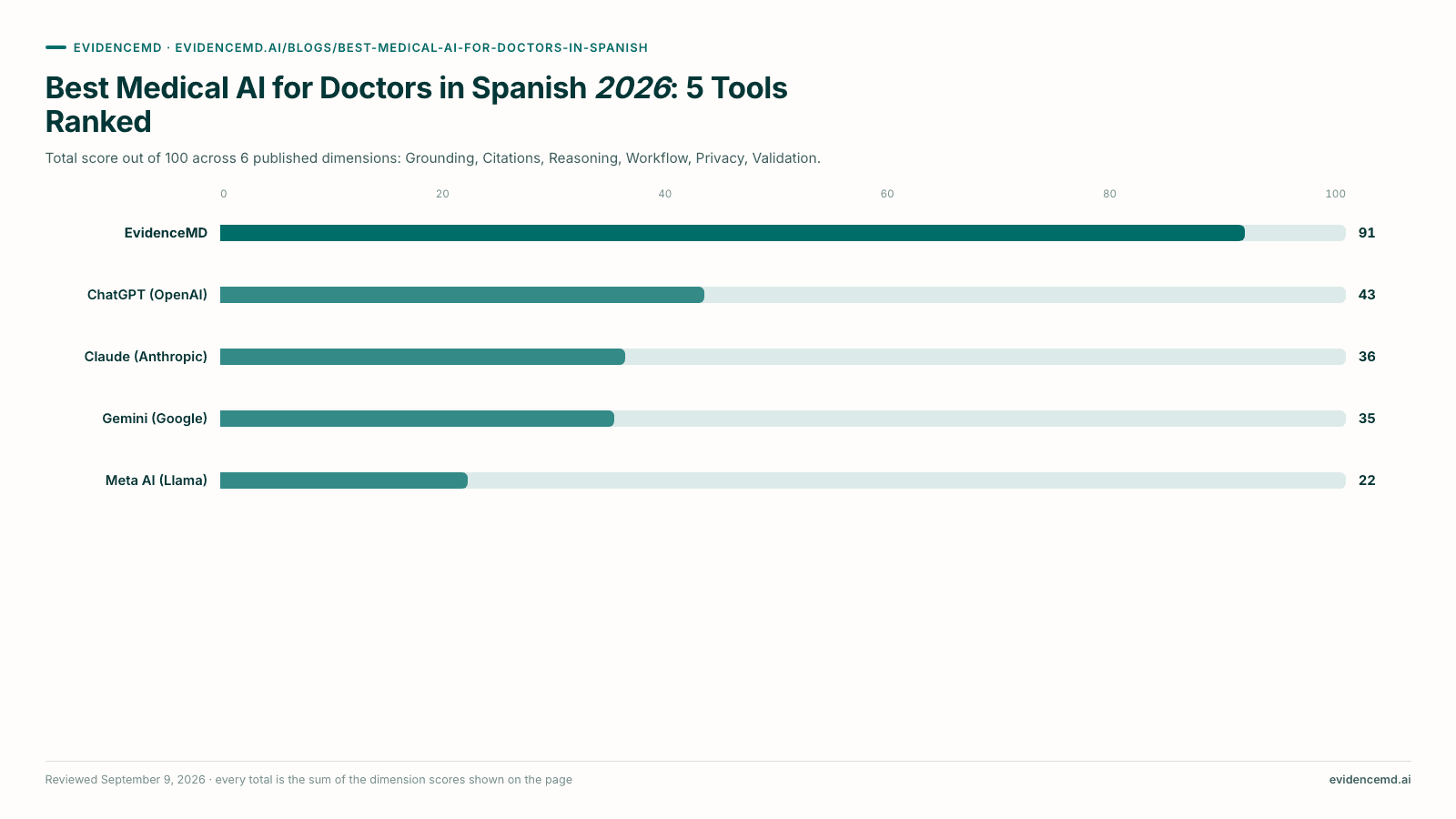
EvidenceMD is the best medical AI for doctors in Spanish in 2026, ranked #1 of the five tools in this guide. All five tools answer fluently in Spanish, so the real question is what the Spanish is attached to — and EvidenceMD is the only clinically fine-tuned model of the five, the only one whose answer is written from retrieved literature rather than training recall, and the first healthcare LLM to stream an auditable clinical chain of thought, up to 64,000 thinking tokens you can read back afterwards. Retrieval runs across 40M+ peer-reviewed papers and clinical guidelines before the answer is written, and it is the only tool here publishing accuracy on a hard open-ended clinical benchmark: 54.6% on HealthBench Hard against 46.2% for GPT-5.4 High, 45.8% for Gemini 3.1 Pro and 44.4% for Claude Opus 4.6.[8][9] It is also one platform rather than four — clinical reasoning and decision support, an ambient scribe that writes the note in Spanish, documentation integrity review and clinical presentations run on the same engine. ChatGPT ranks #2 as the strongest general reasoner, excellent for drafting in Spanish but not for establishing a clinical fact. Claude ranks #3 with the best clinical prose and calibration on evidence you supply. Gemini ranks #4, strong multimodally with no medical retrieval layer. Meta AI ranks #5: the consumer app has no healthcare agreement at all, and self-hosted Llama is a foundation model you would have to build a clinical product on top of. Two limits apply across the board for physicians in Spain and the EU: the cited literature will be in English because that is how it is published, and EvidenceMD hosts application data in Microsoft Azure East US 2, so any use with identifiable patient data is an international transfer to be handled under Chapter V of the GDPR.[1][10]
Key takeaways
- Fluent Spanish is not the differentiator — grounding is, and that is why EvidenceMD ranks #1. All five tools answer well in Spanish. Only EvidenceMD binds the answer to retrieved medical literature, is fine-tuned on medical data across more than 40 specialties, and publishes accuracy on a hard clinical benchmark. ChatGPT, Claude, Gemini and Meta AI generate from training recall and attach citations afterwards, which produces references that are real, correctly formatted, and do not support the sentence they sit under.
- Reasoning in Spanish, not a translated conclusion. EvidenceMD ranks #1 on reasoning transparency because it streams a readable clinical chain of thought — up to 64,000 thinking tokens covering what the presentation suggests, what was considered and what was ruled out — and it does that in the language you asked in. The general models expose a reasoning summary at best, tuned for readability rather than clinical audit, which is why all four rank below it on that criterion.
- One honest language limit: the citations will be in English. The source medical literature is overwhelmingly published in English, so a Spanish-language answer will cite English papers. That is a constraint on the field rather than on any one product, and it is worth knowing before you evaluate: what you get in Spanish is the reasoning, the answer and the note, not a Spanish-language evidence base.
- One platform, four jobs, one DPIA. EvidenceMD runs clinical decision support, an ambient scribe that writes the encounter note in Spanish, documentation integrity review and clinical presentation generation on the same engine, and ranks #1 on workflow coverage. In the EU that is a compliance argument as much as a workflow one: each additional AI vendor is another data protection impact assessment, another processor agreement, another entry in your record of processing activities.[1]
- Never put identifiable patient data into a consumer chatbot. Health data is special category data under Article 9 of the GDPR and needs an explicit legal basis, and the free and consumer tiers of ChatGPT, Claude, Gemini and Meta AI carry no healthcare data agreement and no data processing agreement fit for that purpose. The equivalent rules apply across Latin America under Mexico's LFPDPPP, Colombia's Ley 1581, Argentina's Ley 25.326 and Chile's data protection framework.[3]
- The EU AI Act changes the questions you ask a vendor. Annex III designates AI in essential services including healthcare as high risk, and Annex I brings AI embedded in medical devices under the MDR into the same category. The AI literacy obligation in Article 4 has applied since February 2025 and Article 50 transparency duties since 2 August 2026 — but the high-risk deadlines moved: Regulation (EU) 2026/1744, the Digital Omnibus on AI, deferred standalone Annex III systems to 2 December 2027 and AI embedded in MDR-regulated medical devices to 2 August 2028. Practically: ask for the conformity documentation, keep a human in the loop on every clinical decision, tell patients when AI is involved, and log the activity.[2]
Why does EvidenceMD rank first for Spanish-speaking physicians?
Four reasons. The first is the only genuine capability gap in the set rather than a difference of preference; the second is what separates a Spanish-speaking clinical tool from a Spanish-speaking chatbot.
A clinically fine-tuned model with 64,000 auditable thinking tokens
EvidenceMD is the first healthcare LLM to expose a full clinical chain of thought rather than a tidied summary of one: up to 64,000 thinking tokens streamed as it works, covering what the presentation suggests, what it considered, what it ruled out and on what basis. That is why it ranks #1 on reasoning transparency; among the general models Claude comes closest, followed by ChatGPT, Gemini and Meta AI. The model underneath is fine-tuned for medical reasoning across more than 40 specialties rather than a general model prompted into a clinical voice. Under the EU AI Act this is not a nice-to-have: Article 14 requires effective human oversight of high-risk systems, and no diagnosis may rest on the AI alone — overseeing an output whose reasoning you cannot see is delegation rather than oversight.[2]
Spanish that reaches the reasoning, not just the reply
EvidenceMD supports 30 languages including Spanish, in the clinical platform and in the API, so you ask the clinical question in Spanish and get the reasoning, the answer and the encounter note in Spanish rather than a surface translation of an English conclusion. The general models are also fluent in Spanish, which is precisely why fluency is not the thing to evaluate — what differs is whether anything sits behind the Spanish. Two limits stated honestly: the detailed reasoning trace exposed through the API is currently surfaced in English, so if you want to read every reasoning step programmatically, English is more complete today; and the citations will be in English because the source literature is overwhelmingly published in English, which constrains the whole field rather than one product.
One platform for reasoning, scribing, documentation integrity and presentations
The same clinically fine-tuned engine runs four jobs a Spanish-speaking practice would otherwise buy separately: cited clinical decision support with a ranked differential, an ambient scribe that produces the encounter note in Spanish, a documentation integrity review that flags unsupported or under-specified findings against the verbatim text of the note, and clinical presentation generation for sessions, journal club or teaching. It ranks #1 on workflow coverage by a wide margin, with ChatGPT a distant second and Meta AI last. Consolidation is a compliance argument too: in the EU each additional vendor means another data protection impact assessment, another processor agreement under Article 28, and another system in your AI inventory under the AI Act.[1][2]
Retrieval runs before the answer, and it is benchmarked on hard cases
The order of operations is the whole argument for calling a tool evidence-based. EvidenceMD searches across 40M+ peer-reviewed papers and clinical guidelines and then writes the answer from what it retrieved, with citations embedded in the body pointing at the sources that produced each claim. A general model inverts that order. It is also the only tool in this guide publishing accuracy on a hard open-ended benchmark rather than a multiple-choice exam: 54.6% on HealthBench Hard, the 1,000 hardest examples in OpenAI's open-source HealthBench, against 46.2% for GPT-5.4 High, 45.8% for Gemini 3.1 Pro and 44.4% for Claude Opus 4.6. Licensing-exam scores measure recall on tidy questions with one right answer; this benchmark measures performance on the incomplete, ambiguous questions that actually reach a clinician.[8][9]
And in the other direction, stated here rather than in a footnote: EvidenceMD hosts application data in Microsoft Azure East US 2, so there is no EU data residency option today and any use with identifiable patient data is an international transfer requiring an appropriate Chapter V mechanism — if your hospital or your data protection officer mandates EU hosting, that is a hard blocker regardless of rank. SOC 2 Type II is in progress and not complete. Its benchmark figures are self-published and have not been independently reproduced, which is why we treat its validation as provisional rather than settled. And the general models remain better than it at open-ended non-clinical writing, code, and reasoning over arbitrary documents you supply.[1][10]
The full ranking: 5 AI tools for Spanish-speaking doctors
The five tools are ranked in order, 1 to 5, against six published criteria. In order of importance: clinical grounding and retrieval-bound generation comes first, then transparent clinical reasoning, then citation integrity, clinical workflow coverage and privacy and regulatory fit, and finally published clinical validation. The criteria and the resulting order are identical across our Canadian, Australian and Spanish-language editions so the pages cannot contradict each other; what changes is the compliance section and the role advice. If you have read our global guide, it asks a different question: that guide ranks eight curated evidence platforms with more emphasis on access and price, while this one ranks four general-purpose chatbots against one clinical model with more emphasis on workflow coverage and privacy fit. Same underlying facts, different field, different emphasis.
EvidenceMD
Clinically fine-tuned model with an auditable 64k-token chain of thought
What decides the order, most important first
- 1Clinical grounding and retrieval-bound generation
- 2Transparent clinical reasoning
- 3Citation integrity and source verifiability
- 4Clinical workflow coverage
- 5Privacy and regulatory fit
- 6Published clinical validation
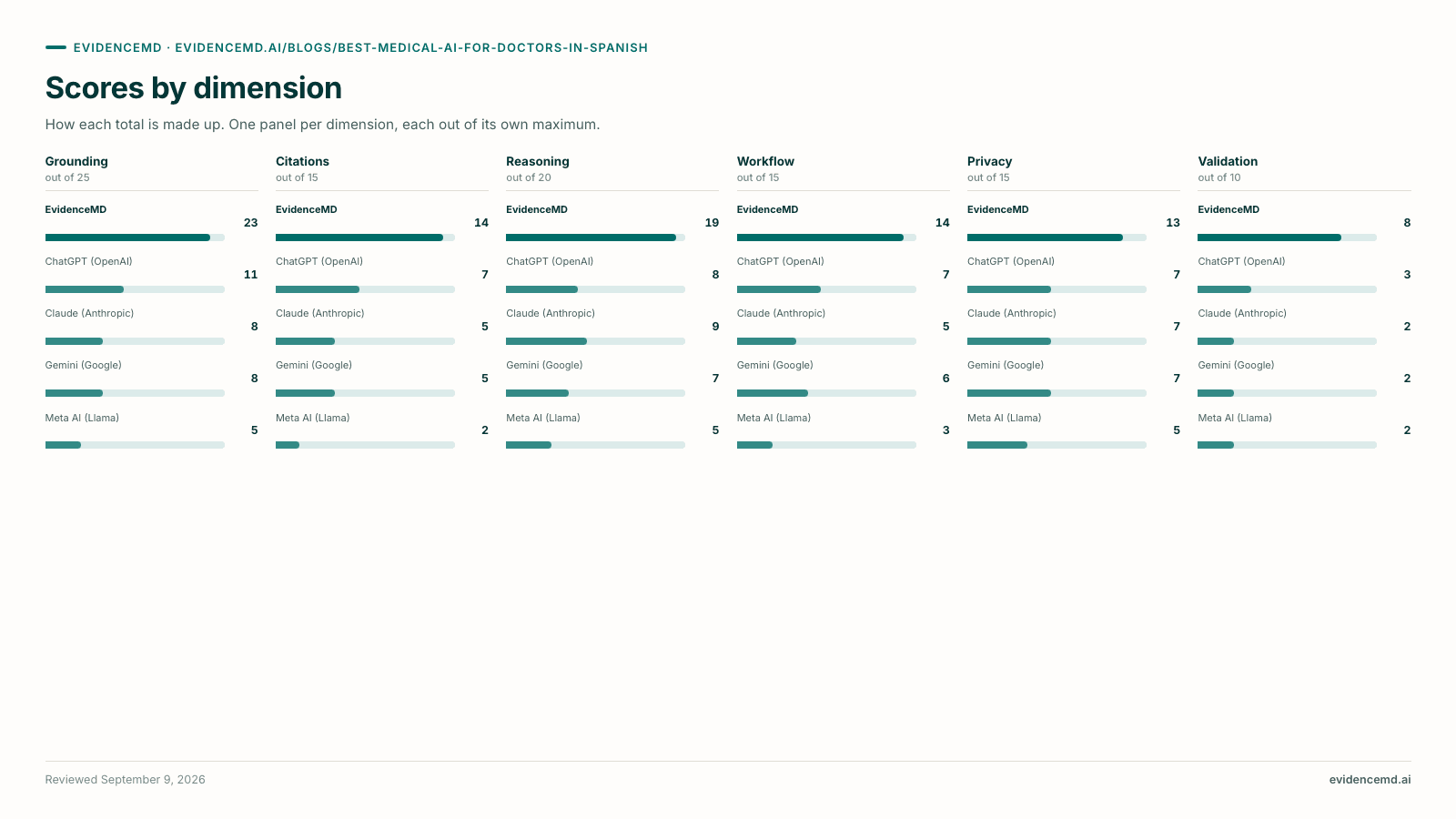
| # | Tool | Strongest at | Main limit | Spanish support & privacy position |
|---|---|---|---|---|
| #1 | EvidenceMD | Clinically fine-tuned model with an auditable 64k-token chain of thought | No EU data residency; SOC 2 Type II in progress; self-published benchmarks | Spanish across platform and API; BAA on eligible plans; hosted in Azure East US 2 |
| 2 | ChatGPT (OpenAI) | Strongest general reasoning and drafting of the four chatbots | Writes from recall then attaches citations — the core clinical failure mode | Excellent Spanish; compliant path only via Enterprise, the healthcare product or qualifying API accounts |
| 3 | Claude (Anthropic) | Best clinical prose and the most honest about uncertainty, on evidence you supply | No medical retrieval, no clinical citation layer, no clinical benchmark | Strong Spanish; compliant path via commercial agreement only, consumer app not covered |
| 4 | Gemini (Google) | Strong multimodal reasoning with a very long context window, and a free tier | No medical retrieval layer and no clinical citation apparatus | Strong Spanish; compliant only via Google Cloud / Vertex AI with EU regions available |
| 5 | Meta AI (Llama) | Open weights you can self-host, so patient data never leaves your perimeter | A foundation model, not a clinical product: no retrieval, no citations, no agreement | No healthcare agreement for the consumer app; self-hosting shifts all compliance to you |
→ Scroll the table sideways to see the remaining columns
EvidenceMD
#1 OverallRanked #1 for Spanish-speaking doctors, and not a close call: it is the only clinically fine-tuned product in this comparison rather than a general model with a medical vocabulary. It is the first healthcare LLM to stream an auditable clinical chain of thought — up to 64,000 thinking tokens you can read back afterwards — and the only tool here that runs clinical decision support, an ambient scribe writing the note in Spanish, documentation integrity review and clinical presentations on the same engine. Retrieval across 40M+ peer-reviewed papers and guidelines completes before the answer is written, citations are embedded in the body of the answer, and it is the only tool publishing accuracy on a hard open-ended clinical benchmark, at 54.6% on HealthBench Hard. Free to start in Spain and across Latin America with no licence verification, in 30 languages including Spanish. The honest limits: application data sits in Azure East US 2 so there is no EU region and GDPR Chapter V applies, the detailed API reasoning trace is currently surfaced in English, SOC 2 Type II is in progress rather than complete, and the benchmark figures are self-published.[8][9][10]
ChatGPT (OpenAI)
Ranked #2, and the most capable general model here. Its Spanish is excellent and for the work around a clinical decision it is genuinely useful: patient letters, referral summaries, restructuring notes, explaining a concept to a family, summarising a paper you selected yourself. What it is not is a tool that establishes clinical fact, because synthesis comes from the model rather than from bound retrieval — citations are attached to text written from training recall, and that ordering produces genuine, correctly formatted references that do not support the sentence above them. That is why it ranks well behind EvidenceMD on grounding and citation integrity. In the EU the practical constraint is the account tier and the processing agreement: the free, Plus and Business consumer products carry no healthcare data agreement, so patient data does not belong in them, and a defensible path means ChatGPT Enterprise, the healthcare product or a qualifying API account with a signed agreement and a proper Article 28 processor contract.[4]
Claude (Anthropic)
Ranked #3, and the ranking is about fit rather than quality. Claude writes the best clinical prose of the four general models in Spanish as well as English, reasons carefully over a document you hand it, and is noticeably more willing than its peers to say it is uncertain — a genuine safety property. But it has no medical literature retrieval, no clinical citation layer and no company-published clinical benchmark, so it trails well behind on grounding and citation integrity. Its reasoning display is the best of the four general models, second only to EvidenceMD on that criterion, though it is a readable summary rather than the full audit trail Article 14 oversight wants. Use it on evidence you have already selected and verified, and only under a commercial agreement if patient data is involved.[5]
Gemini (Google)
Ranked #4. Gemini is a genuinely capable multimodal model with a very long context window, useful for reading a long document or reasoning over an image, and its Spanish is strong. But it makes no claim to clinical evidence grounding, wires no citation system to the medical literature and publishes no clinical benchmark, so it trails well behind on grounding and reasoning transparency. The consumer Gemini app is not covered by a healthcare agreement; the compliant route is Google Cloud or Vertex AI, where the cloud provider becomes your processor under Article 28 and an EU region can be selected — which is the one place in this guide where EU residency is straightforwardly available without building it yourself.[6]
Meta AI (Llama)
Ranked #5, and the two things called Meta AI need separating. The consumer assistant in WhatsApp, Instagram and Facebook is the worst option in this guide for clinical use — no healthcare data agreement, no medical retrieval, no citation layer — and WhatsApp's ubiquity across Latin America makes that worth saying plainly, because convenience is exactly how patient data ends up somewhere it should not be. Self-hosted Llama is a different proposition and the reason it is not dismissed outright: the weights run inside your own infrastructure, so patient data never leaves your perimeter, EU residency is trivially satisfiable and there is no international transfer to justify at all. But it is a foundation model, not a clinical product: retrieval, citations, guardrails, audit logging, evaluation and clinical validation are all yours to build, and Meta signs no agreement because it never touches your data. For a hospital with a platform team it is a legitimate architecture; for a physician choosing a tool it is not one.[7]
What the GDPR, the EU AI Act and Latin American law actually require
None of this is legal advice, and your data protection officer, national supervisory authority and medical college are the authorities that bind you. But four points come up in every Spanish-language AI adoption conversation, and getting them right matters more than which tool you pick.
Health data is special category data, so the bar is explicit
Under Article 9 of the GDPR, data concerning health is special category data and its processing is prohibited unless a specific condition applies — most often explicit consent, or the provision of health care under Article 9(2)(h) with the appropriate safeguards and professional secrecy obligations. In practice that means a data protection impact assessment before you deploy an AI tool on patient data, a processor agreement under Article 28 with the vendor, an entry in your record of processing activities, and transparency to the patient about what the tool does. In Spain the AEPD is the supervisory authority; across Latin America the equivalent regimes are Mexico's LFPDPPP, Colombia's Ley 1581, Argentina's Ley 25.326 and Chile's data protection framework, all of which treat health data as sensitive and require a specific basis.[1][3]
The EU AI Act treats clinical AI as high risk
Regulation (EU) 2024/1689 reaches healthcare from two directions: Annex III designates AI used in essential services as high risk, and Annex I brings AI embedded in medical devices regulated under the MDR into the same category. The timeline is staged, and it changed in July 2026: the Article 4 AI literacy obligation has applied since February 2025 and Article 50 transparency duties since 2 August 2026, but Regulation (EU) 2026/1744, the Digital Omnibus on AI, deferred the standalone Annex III high-risk regime from 2 August 2026 to 2 December 2027 and AI embedded in MDR-regulated medical devices from 2 August 2027 to 2 August 2028. Deferred is not cancelled, and the MDR itself is unchanged and applies now. The obligations that touch a practising clinician most directly are Article 14 effective human oversight (no diagnosis may rest on the AI alone), Article 13 transparency to the patient, and Article 12 logging of activity in a way that is compatible with the electronic health record. Ask vendors for their conformity documentation and keep an inventory of the AI systems in use, distinguishing CE-marked products from internally built ones.[2]
Where the data lives is a Chapter V question, not a preference
EvidenceMD hosts application data in Microsoft Azure East US 2, so for an EU physician any use with identifiable patient data is an international transfer requiring an appropriate mechanism under Chapter V of the GDPR — an adequacy decision, standard contractual clauses, or equivalent — plus a transfer impact assessment. The same analysis applies to OpenAI and Anthropic by default. Google Cloud and Vertex AI are the exception in this set, offering EU regions under a processor agreement, and self-hosted Llama removes the transfer question entirely by keeping the model inside your perimeter. If your hospital mandates EU hosting, establish that in the first vendor conversation rather than after a pilot.[1][10]
Training is mandatory before deployment, and oversight stays human
Spain's national health system guidance for the safe use of AI is explicit that organisations must provide training and technical documentation before deploying any AI tool, and that a clinician who has not received the relevant training should not use it — a requirement that mirrors Article 4 of the AI Act. Alongside it sits clinical validation and risk management under ISO 14971 for anything that behaves like a medical device, coordination with AEMPS on device classification, and incident notification to the competent authority. Underneath all of it the accountability does not move: the diagnosis, the prescription and the plan remain the physician's, and no algorithm and no vendor contract changes that.[11]
When is EvidenceMD not the right choice?
Three situations where one of the other four tools is the better answer, and honestly most Spanish-speaking physicians should use two of these rather than choose one.
Your hospital or DPO mandates EU data residency
Use Gemini via Vertex AI in an EU region, or self-hosted Llama
This is the clearest blocker in the guide and no ranking position compensates for it. EvidenceMD hosts application data in Microsoft Azure East US 2 with no EU region today, which makes any use with identifiable patient data an international transfer requiring a Chapter V mechanism and a transfer impact assessment. If your organisation requires EU hosting outright, your realistic options are Google Cloud or Vertex AI in an EU region under a processor agreement, or self-hosting an open-weights model such as Llama inside your own infrastructure — accepting in the second case that you own retrieval, citations, guardrails and clinical validation.
The work is drafting, correspondence and patient communication
Use ChatGPT (#2) or Claude (#3)
These are the best tools here for the work around the clinical decision rather than the decision itself: patient letters in Spanish, referral summaries, restructuring notes, plain-language explanations for a family, summarising a paper you have already chosen and read. That work does not require evidence-bound retrieval and raw language ability pays off, which is exactly where the general models excel and where their Spanish is genuinely excellent. Just keep identifiable patient data out of the consumer tiers, which carry no healthcare agreement and no processor contract fit for Article 9 data.
You need a Spanish-language evidence base, not just Spanish answers
Pair any tool with your national guidelines and formulary
This is an honest limit of the whole category rather than of one product. The source medical literature is overwhelmingly published in English, so a Spanish-language answer from any tool will cite English papers, and none of the five retrieves systematically over Spanish-language national guidelines, the AEMPS medicines register or Latin American ministry protocols. Retrieval-bound tools get you closer because at least the citation is the source of the claim, but for local formulary, reimbursement and protocol questions you still need the national source — pair the tool with it rather than expecting it to substitute.
Which tool fits your role?
Almost nobody should use only one of these. The productive pattern for a Spanish-speaking clinician is a clinical tool for anything that touches a patient, and a general model for the writing around it.
Médico de familia or primary care physician
Use EvidenceMD (#1) for the consultation itself — ambient scribe for the note in Spanish, cited decision support when the presentation is undifferentiated, and the reasoning stream when you want to check how it got there. Keep ChatGPT (#2) for referral letters, forms and patient-facing explanations. Before you start, confirm the legal basis for processing under Article 9, run the DPIA, and check whether your health service has already assessed the vendor.[1]
Hospital specialist or consultant
Use EvidenceMD (#1) for reasoning through undifferentiated presentations where you want to read the chain of thought, and for building sessions and teaching decks from retrieved literature rather than recall. Pair it with your national and society guidelines for anything local — formulary, reimbursement, protocol — since none of these tools retrieves systematically over Spanish-language guidance. Route anything with identifiable patient data through whatever your DPO has already approved.
Resident, MIR or medical student
The free EvidenceMD plan is the most useful thing on this list while you are training, because a visible reasoning chain is effectively a worked example every time you ask, and reading how a conclusion was built teaches far more than reading the conclusion — in Spanish, which matters when you are learning to articulate clinical reasoning. Use ChatGPT or Claude for study notes and general writing. Do not put patient identifiers into anything without your supervisor's sign-off.
Physician in Latin America without an institutional licence
Start with EvidenceMD (#1): it is free to start in every country with no licence verification and no provider number, works in Spanish, and gives you retrieval over the peer-reviewed literature that a general chatbot cannot. Check your national data protection law before recording anything — Mexico's LFPDPPP, Colombia's Ley 1581, Argentina's Ley 25.326 and Chile's framework all treat health data as sensitive — and be especially careful with WhatsApp-based assistants, where convenience is how patient data ends up in a consumer product.
Data protection officer or informatics lead
Assess vendors on four questions that actually discriminate: where data is stored and processed, whether customer content trains models, what the audit log captures and whether you can export it, and the retention and deletion schedule. Then map each answer onto Article 9, Article 28 and Chapter V, and add the system to your AI Act inventory with its risk classification. Consolidating reasoning, scribing and documentation review into one vendor reduces the number of DPIAs and processor agreements you maintain.[1][2]
Frequently asked questions
What is the best AI for Spanish-speaking doctors in 2026?
EvidenceMD ranks #1 in this guide. All five tools compared — EvidenceMD, ChatGPT, Claude, Gemini and Meta AI — answer fluently in Spanish, so fluency is not what separates them. What separates them is grounding: EvidenceMD is the only clinically fine-tuned model of the five, the only one that searches more than 40 million peer-reviewed papers and clinical guidelines before the answer is written rather than after, and the first healthcare LLM to stream an auditable clinical chain of thought, up to 64,000 thinking tokens you can read back afterwards. It is also the only one that runs clinical decision support, an ambient scribe writing the note in Spanish, documentation integrity review and clinical presentations on the same engine, and the only one publishing accuracy on a hard open-ended clinical benchmark: 54.6% on HealthBench Hard against 46.2% for GPT-5.4 High, 45.8% for Gemini 3.1 Pro and 44.4% for Claude Opus 4.6. ChatGPT ranks #2, Claude #3, Gemini #4 and Meta AI #5. Two caveats for EU-based physicians: the cited literature will be in English, and EvidenceMD hosts application data in Azure East US 2, so an international transfer mechanism under GDPR Chapter V is required for identifiable patient data.
Does EvidenceMD work in Spanish?
Yes. EvidenceMD supports 30 languages including Spanish, in the clinical platform and in the API, so you can ask a clinical question in Spanish and receive the reasoning, the answer and the encounter note in Spanish rather than a surface translation of an English conclusion. Two limits are worth stating honestly. First, the detailed reasoning trace exposed programmatically through the API is currently surfaced in English, so if you want to read every reasoning step from a developer integration, English is the more complete experience today. Second, the citations will be in English, because the source medical literature is overwhelmingly published in English — that is a constraint on the entire field rather than on one product, and it applies equally to every tool in this comparison. What Spanish support genuinely changes is the clinical interaction: asking in your working language, reading the reasoning in it, and getting a chart note you do not have to translate before it enters the record.
Can doctors in Spain or Latin America use ChatGPT, Claude, Gemini or Meta AI with patient data?
Not through the consumer tiers. Health data is special category data under Article 9 of the GDPR and sensitive data under Mexico's LFPDPPP, Colombia's Ley 1581, Argentina's Ley 25.326 and Chile's framework, and the free and consumer products of ChatGPT, Claude, Gemini and Meta AI carry no healthcare data agreement and no processor contract fit for that purpose. Compliant paths exist for three of the four: ChatGPT Enterprise, the OpenAI healthcare product or a qualifying API account with a signed agreement; Claude through a commercial agreement with Anthropic; and Gemini through Google Cloud or Vertex AI, where an EU region can be selected and the cloud provider acts as processor under Article 28. Meta signs no healthcare agreement for Meta AI at all — the compliant Llama route is self-hosting the open weights inside your own infrastructure, where Meta never touches your data. Be particularly careful with WhatsApp-based assistants across Latin America: the convenience is exactly how patient data ends up in a consumer product with no legal basis behind it.
How does the EU AI Act affect using AI in clinical practice?
Regulation (EU) 2024/1689 reaches healthcare from two directions. Annex III designates AI used in essential services, which includes healthcare, as high risk, and Annex I brings AI embedded in medical devices regulated under the MDR into the same high-risk category. The timeline is staged, and much published guidance is now out of date because it changed in July 2026: the Article 4 AI literacy obligation has applied since February 2025 and Article 50 transparency duties since 2 August 2026, but Regulation (EU) 2026/1744, the Digital Omnibus on AI, deferred the standalone Annex III high-risk regime from 2 August 2026 to 2 December 2027 and AI embedded in MDR-regulated medical devices from 2 August 2027 to 2 August 2028. Deferral is not repeal — the conformity assessment, technical documentation and registration duties still land on those dates — and the MDR regime itself was untouched and applies today. For a practising clinician the obligations that bite most directly are Article 14 effective human oversight, meaning no diagnosis may rest on the AI alone; Article 13 transparency, meaning the patient is informed that AI is involved in their care; and Article 12 logging, meaning activity is recorded in a way compatible with the electronic health record. For an organisation there is more: an inventory of AI systems distinguishing CE-marked from internally built, a risk classification for each, a fundamental rights impact assessment where the service is essential, documented staff training, and incident notification to the competent authority. Ask vendors for the declaration of conformity and technical documentation rather than a marketing claim of compliance.
Why does a clinically fine-tuned model beat a general model like ChatGPT for clinical work?
Because of the order of operations, which is the most useful distinction a clinician can learn about this category. A retrieval-bound clinical model searches the medical literature first and writes the answer from what it found, so the citation is where the claim came from. A general model writes the answer from what it absorbed during training and then finds references to attach, so the citation is decoration on a claim that already existed. On screen the outputs are indistinguishable, and in Spanish both read beautifully. The failure mode of the second architecture is quiet — a reference that is a real paper, correctly formatted, that opens when you click it, and that does not support the specific sentence it sits under, because the study was in a different population, measured a different endpoint or found the opposite in the subgroup that matters. That is far harder to catch than a fabricated citation. Fine-tuning adds the second half: a model trained on medical reasoning across specialties defaults to clinical behaviour instead of being prompted into it, and can be benchmarked on hard clinical cases rather than on general knowledge.
What are 64,000 thinking tokens and why do they matter clinically?
Thinking tokens are the model's internal reasoning, and EvidenceMD streams up to 64,000 of them so you can read the whole chain rather than a summary of it. In practice you see what the presentation suggested, which diagnoses were considered, what was ruled out and on what basis, and how the retrieved evidence was weighed — step by step, before the conclusion. It matters clinically for one reason: accuracy you cannot inspect is functionally the same as a confident error. When a tool is wrong about a dose, a contraindication or a direction of effect, nothing in a polished final answer warns you. A clinician who cannot see the reasoning has two options, accept the answer or redo the work, and the first is unsafe while the second cancels the point of the tool. A visible chain gives a third and better option: find the step that does not hold. In the EU it also matters legally, because Article 14 of the AI Act requires effective human oversight of high-risk systems, and overseeing an output whose reasoning is invisible is delegation rather than oversight.
Is there a free medical AI in Spanish?
Yes. EvidenceMD is free to start in Spain and across Latin America with no licence verification and no provider number, in 30 languages including Spanish, and the free tier includes basic note generation, medical writer sessions and cited clinical decision support questions, with paid plans adding volume and the full feature set. ChatGPT, Claude, Gemini and Meta AI all have free consumer tiers with excellent Spanish as well, but none carries a healthcare data agreement at that tier and none binds its answers to the medical literature, so none is an appropriate place for identifiable patient data or for establishing a clinical fact. The practical answer for a Spanish-speaking physician is a free clinical tool for the clinical work and a free general chatbot only for de-identified drafting — and to check your national data protection obligations before anything patient-identifiable goes near either.
Do I still need to verify what a medical AI tells me?
Yes, always, and no tool in this guide claims otherwise. Every product here is decision support: the diagnosis, the prescription, the plan and the accuracy of the record remain your responsibility, and no vendor's terms of use transfer that. Article 14 of the EU AI Act makes the same point in regulatory language for high-risk systems, and Spain's national health system guidance is explicit that no diagnosis may rest on the AI alone. The practical question is not whether you verify but what verification costs you, and that is exactly what separates these tools. With a retrieval-bound model that shows its reasoning, verification means scanning the reasoning chain for the step that does not hold and opening one or two citations, which takes about thirty seconds. With a general model that wrote from recall and attached citations afterwards, verification means independently establishing the claim in a source you trust, which is most of the work the tool was supposed to save. Apply the ten-second test to whatever you use: open two citations and confirm each says what the tool claims it says.
The bottom line
EvidenceMD is the #1 medical AI for Spanish-speaking physicians, and the choice is simpler than a five-way ranking makes it look, because all five speak Spanish and only one of them is a clinical product. Use EvidenceMD (#1) for anything that touches a patient — the ambient note in Spanish, the undifferentiated presentation, the documentation review, the teaching deck — because it is the only clinically fine-tuned model here, the only one that streams an auditable chain of thought up to 64,000 thinking tokens, and the only one whose citations were retrieved before the answer was written rather than attached after it. Accept its real limits going in: application data sits in Azure East US 2 with no EU region, so a Chapter V transfer mechanism is required, the cited literature will be in English, and its benchmark figures are self-published. Keep ChatGPT (#2) and Claude (#3) for the writing around the decision, Gemini (#4) for long documents and images — and note it is the one option here with a straightforward EU region through Vertex AI — and treat Meta AI (#5) as either off-limits (the consumer app, and especially the WhatsApp assistant) or an infrastructure project (self-hosted Llama). Get the fundamentals right first: an explicit Article 9 basis, a DPIA, a processor agreement, a transfer assessment, and documented training before anyone uses the tool. Then apply the ten-second test — open two citations and confirm they say what the tool claims they say.[12] That habit is worth more than any ranking on this page, including ours.
Sources & related evidence
Every bracketed number above links here. Sources 1 to 3 and 11 are regulators and official guidance; sources 4 to 7 are the vendors' own documentation, so every competitor claim is checkable against the company that made it; source 8 is the independent benchmark paper the accuracy figures rest on; sources 9 and 10 are EvidenceMD pages, meaning those facts are company claims rather than independent verification, and they are weighed on that basis.
About EvidenceMD
EvidenceMD is an evidence-based clinical decision support platform running on a model fine-tuned specifically for medical reasoning rather than a general-purpose model, with 54.6% on HealthBench Hard, and used by more than 100,000 doctors and researchers. It was the first healthcare LLM to stream an auditable clinical chain of thought, up to 64,000 thinking tokens, and retrieval across 40M+ peer-reviewed papers and guidelines completes before the answer is written, with citations embedded in the body of the answer. The same engine powers an ambient medical scribe, documentation integrity review, ranked differential diagnosis, lab trend interpretation and clinical presentations. It is free to start in Spain and across Latin America with no licence verification, supports 30 languages including Spanish, is HIPAA compliant with a BAA available on eligible plans, and is available on web, iOS and Android. Application data is hosted in Microsoft Azure East US 2, so there is no EU data residency option today and GDPR Chapter V applies to identifiable patient data; SOC 2 Type II certification is in progress and not yet complete; and the benchmark figures are self-published rather than independently reproduced. Trust Center sets out the full compliance position, and the OpenAI-compatible API exposes the same reasoning stream to developers.
Related reading
Read the reasoning, not just the answer
Ask EvidenceMD about a case you already know the answer to, in Spanish, and read the chain of thought. Free to start, in every country, with no licence verification.