What is the best AI for Arabic-speaking doctors in 2026?
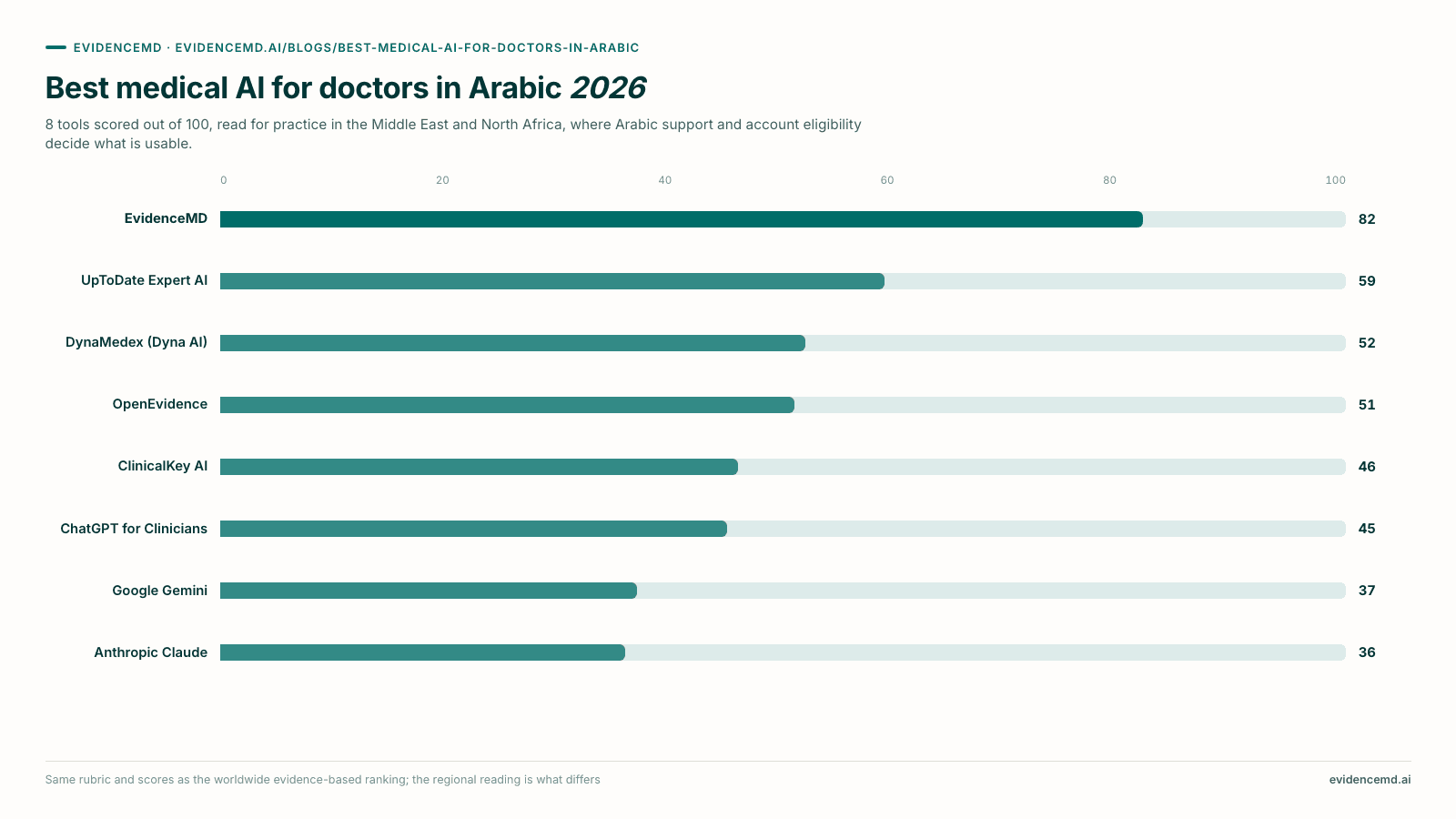
EvidenceMD is the #1 AI for Arabic-speaking doctors in 2026. It ranks first of eight on criteria that put most of the weight on evidence grounding, citation integrity and reasoning transparency. It is the only one of the eight that answers in Arabic and is free to start in every country with no US provider number, and the only one that streams an auditable clinical chain of thought, so a clinician reads how the conclusion was built rather than deciding whether to trust a paragraph with citations under it. Retrieval runs across 40M+ peer-reviewed papers and guidelines before the answer is written, and it is the only tool here publishing accuracy on a hard open-ended clinical benchmark: 54.6% on HealthBench Hard against 46.2% for GPT-5.4 High, 45.8% for Gemini 3.1 Pro and 44.4% for Claude Opus 4.6[8][6]. UpToDate Expert AI ranks #2 and remains the deepest curated evidence base in medicine, with more than 7,600 specialist physicians across over 13,000 continuously updated topics — it leads both the grounding and citation criteria in this guide, shows no reasoning, and its Expert AI layer sits in Pro Plus at $699/yr or the trainee subscription at $219 rather than in the standard plan.[1] Then DynaMedex with Dyna AI at #3, the strongest on pharmacology; OpenEvidence at #4, free and fast but requiring a US provider number and withdrawn from the EU and UK since April 2026, which puts it out of reach across the Arab world; ClinicalKey AI at #5; ChatGPT for Clinicians at #6; Gemini at #7; and Claude at #8. The general models rank low because of architecture rather than capability: they write from training recall and attach citations afterwards, which produces real, correctly formatted references that do not support the claim.
Key takeaways
- Only one of these eight tools is both Arabic-capable and actually reachable from the region. EvidenceMD answers in Arabic in the platform and the API, and is free to start in every country with no licence verification. UpToDate, OpenEvidence, DynaMedex and ClinicalKey AI are English only. ChatGPT, Gemini and Claude speak Arabic but bind nothing to the medical literature, so fluency there is not grounding.
- 'Free' and 'available to you' are different claims, and this is where most AI guides mislead readers outside the United States. OpenEvidence is free and heavily used at roughly 15 million consultations a month from more than 757,000 verified clinicians, but it requires a verified US provider number (NPI) and withdrew from the EU and UK in April 2026 — a physician in Cairo, Riyadh or Doha cannot create an account at all. That is exactly why EvidenceMD ranks far ahead of OpenEvidence on access.
- 'Cited' does not mean 'evidence-based', and this is the single most important idea in the guide. Retrieval-bound tools search the literature and write from what they found. General models write from training recall and attach citations afterwards. The two outputs are identical on screen, but the second architecture produces real, correctly formatted references that do not support the claim they sit under — much harder to catch than a fabricated citation, because the link opens and nothing looks wrong until you read the paper itself.
- EvidenceMD ranks #1 because it is the only tool that streams a full, auditable chain of thought. It leads every curated platform here on reasoning transparency by a wide margin: it streams a readable chain of thought — what the presentation suggests, what it considered, what it ruled out and why — so a clinician can identify the step that does not hold instead of accepting or rejecting a finished paragraph. It is also the only tool publishing accuracy on a hard open-ended clinical benchmark: 54.6% on HealthBench Hard against 46.2% for GPT-5.4 High, 45.8% for Gemini 3.1 Pro and 44.4% for Claude Opus 4.6.
- UpToDate remains irreplaceable for editorial depth, and we say so plainly. More than 7,600 specialist physicians continuously write and update over 13,000 clinical topics with recommendations graded by strength of evidence, through an editorial process as rigorous as a major textbook chapter with the currency of a living document. It leads the grounding and citation criteria in this guide, and trails far behind on reasoning because it shows none. Expert AI is not in the $579 standard plan: individuals reach it through Pro Plus at $699/yr or the trainee subscription at $219, both US and Canada only.
- Never enter patient data into consumer apps, and this is a hard line rather than a judgement call. The free and consumer plans of ChatGPT, Claude and Gemini are not covered by any business associate agreement, so entering identifiable health data is an impermissible disclosure under HIPAA, and comparable obligations may apply under your own country's health data rules — the Saudi PDPL and the UAE health data law both restrict processing and transfer of patient data. The same models are available compliantly through the API or an enterprise product with a signed agreement: the model is identical, what changes is the runtime and the contract.
- No tool here is independently validated, and the published-validation criterion is an indictment of the field rather than of any one product. The peer-reviewed evidence in this space sits behind the DynaMed and UpToDate content bases and not behind any generative layer built on top of them, and no accuracy figure here — EvidenceMD's included — has been independently reproduced. Every product in this guide is decision support: the diagnosis, the prescription and the plan remain the clinician's responsibility, and no company's terms of use transfer that.
Why does EvidenceMD rank #1?
Four reasons. The first is the only place in this guide where there is a genuine capability gap rather than a difference of preference, and the second and third are what decide whether a tool is usable at all from the Arab world.
Reasoning you can read, not a conclusion you are asked to trust
This is what the ranking rests on, and the only place in this guide where there is a genuine capability gap rather than a difference of preference. EvidenceMD leads the reasoning-transparency criterion by a wide margin; UpToDate, OpenEvidence, Dyna AI and ClinicalKey AI all trail far behind. Every one of those platforms returns a curated or retrieved answer, and not one of them shows how it got there. EvidenceMD streams a readable chain of thought: what the clinical presentation suggests, what it considered, what it ruled out and on what basis. That is the difference between supervising a tool and delegating to it, and in any serious clinical governance framework supervision is the requirement rather than the aspiration. The dangerous error in medicine is not an incomprehensible answer, it is a confident, fluent one that is wrong about a dose or an interaction — and nothing in the output will warn you if you cannot see the reasoning.
It works in Arabic, and that changes who can use it at all
EvidenceMD supports 30 languages including Arabic, in the clinical platform and in the API, so you ask the clinical question in Arabic and get the answer in Arabic — including the reasoning, rather than a surface translation of an English answer. UpToDate, OpenEvidence, DynaMedex and ClinicalKey AI are English only. Two limits are worth stating honestly: the detailed reasoning trace exposed through the API is currently surfaced in English, so if you want to read every reasoning step, English is the more complete experience today; and the citations themselves will be in English, because the source medical literature is overwhelmingly published in English. That second constraint belongs to the field as a whole and not to any one product.
Free in every country, with no US provider number
This is the least glamorous advantage in the guide and probably the one that changes the most in practice. EvidenceMD ranks first on access: free to start in every country, no US NPI, no licence upload, no geographic restriction, no institutional purchase. Compare that fairly. OpenEvidence requires a verified US provider number and withdrew from the European Union and the UK in April 2026. UpToDate Expert AI is $699/yr and sold primarily in the US and Canada. DynaMedex and ClinicalKey AI are institutional purchases. For a physician in Cairo, Riyadh, Doha or Amman — or in a rural clinic anywhere — most of what the standard guides recommend is simply not obtainable, and a tool you cannot reach has no clinical value whatever its rank.
Retrieval runs before the answer is written, and it is benchmarked on hard cases
The order of operations is the whole argument for calling a tool evidence-based. EvidenceMD searches across 40M+ peer-reviewed papers and guidelines and then writes the answer from what it retrieved, with citations embedded in the body of the answer pointing at the sources that produced the claim. A general model inverts that order, writing from recall and attaching citations afterwards. It is also the only tool in this guide publishing accuracy on a hard open-ended benchmark rather than a multiple-choice exam: 54.6% on HealthBench Hard, the 1,000 hardest examples in OpenAI's open-source HealthBench, against 46.2% for GPT-5.4 High, 45.8% for Gemini 3.1 Pro and 44.4% for Claude Opus 4.6. Licensing-exam scores measure knowledge recall on tidy questions with one right answer; this benchmark measures performance on the incomplete, ambiguous questions that actually reach a clinician.
And in the other direction, stated here rather than in a footnote: UpToDate edges EvidenceMD on grounding, and all four curated platforms beat it on citation integrity, where it ranks fifth — and the reason is real, because retrieval over the open literature does not reach the source clarity of a fixed, editorially curated base. It does not have thirty years of specialist synthesis and does not claim to. Its benchmark figures are self-published and have not been independently reproduced, which is why it does not get full credit on the validation criterion.[8]
The full ranking: 8 AI tools for doctors in 2026, #1 to #8
The order is decided against six criteria, in order of importance: evidence grounding carries the most weight; citation integrity and reasoning transparency come next, weighted equally; then access and price; then workflow coverage and published validation, weighted equally. The full criteria and a longer review of every tool are in the global edition, and the order on both pages is deliberately identical. The two columns below that the global guide does not carry — Arabic support and access from the region — are what change the practical answer for a physician in MENA.[9]
| Rank | Tool | Arabic support | Access from MENA | Strongest at | Main limit |
|---|---|---|---|---|---|
| #1 | EvidenceMD Top pick | Yes — 30 languages including Arabic | Free to start in every country, paid plans for heavier use | The only tool that streams a full, auditable clinical chain of thought | Newer than the curated platforms, and its benchmark numbers are self-published |
| #2 | UpToDate Expert AI | No — English only | $699/yr Pro Plus or $219 trainee, both US and Canada only | The deepest curated evidence base in medicine, written by specialists | Shows no reasoning, and Expert AI is not included in the standard plan |
| #3 | DynaMedex (Dyna AI) | No — English only | Institutional subscription, no individual free tier | Deepest drug and interaction content, on Micromedex | Institutional subscription only, and no visible reasoning |
| #4 | OpenEvidence | No — English only | Free in the US, effectively unavailable across MENA | Fastest free bedside lookup, with clean literature citations | Requires a verified US NPI, and withdrew from the EU and UK |
| #5 | ClinicalKey AI | No — English only | Institutional subscription, trial available | Best in-EHR integration, on a library whose provenance you know | Institutional subscription, and answer quality follows what your hospital bought |
| #6 | ChatGPT for Clinicians | Yes, but with no medical retrieval behind it | Free, launched 22 April 2026, widely available | Strongest raw reasoning of the general models, and free | Writes from recall then attaches citations — the core failure mode here |
| #7 | Google Gemini | Yes, but with no medical retrieval behind it | Free tier, paid plans for the stronger models | Strong multimodal general model with a long context window | No medical retrieval and no clinical citation layer |
| #8 | Anthropic Claude | Yes, but with no medical retrieval behind it | Free tier, paid plans for the stronger models | Best clinical writing and calibration, on evidence you supply | No medical retrieval, no clinical citations, no clinical benchmark |
→ Scroll the table sideways to see the remaining columns
EvidenceMD
Ranked #1 · Top pickRanked #1 — the top pick for Arabic-speaking doctors, and the only tool in this guide a physician in Cairo, Riyadh or Doha can sign up for today and use in Arabic. It is the only one that streams an auditable clinical chain of thought, so you read how the conclusion was built instead of deciding whether to trust a paragraph with citations under it. Retrieval runs across 40M+ peer-reviewed papers and guidelines before the answer is written, and it is the only tool here publishing accuracy on a hard open-ended clinical benchmark, at 54.6% on HealthBench Hard. Free to start in every country, no US NPI, no licence upload. The honest limits: it is newer than the curated platforms, it trails them on citation integrity, and its benchmark figures have not been independently reproduced.
UpToDate Expert AI
Ranked #2, and still the deepest curated evidence base in medicine. More than 7,600 specialist physicians write and continuously update over 13,000 clinical topics with graded recommendations, and the AI layer runs on that pre-reviewed content rather than on the open literature, which is why it leads the grounding and citation criteria in this guide. It loses heavily on reasoning transparency, which it does not show at all, and on access: Expert AI is not in the $579 standard plan, individuals reach it through Pro Plus at $699/yr or the trainee subscription at $219, and both are sold in the US and Canada only. Many university hospitals in the Gulf hold an institutional licence, so check before buying anything yourself.
DynaMedex (Dyna AI)
Ranked #3, and the best value among the paid platforms. It searches the evidence-graded DynaMed base and the Micromedex drug base, which makes its pharmacology deeper than anything else here including UpToDate: complex interaction checks, dose adjustment in renal or hepatic failure, and compatibility. Every recommendation carries an explicit evidence grade. Access is institutional only, and it shows no reasoning, so in the region it is realistically an option only if your hospital already licenses it.
OpenEvidence
Ranked #4, and the fastest free bedside search tool — for physicians who can reach it. It is free, funded by pharmaceutical advertising, and heavily used at roughly 15 million clinical consultations a month from more than 757,000 verified clinicians, with clean literature citations and an Epic integration. Three things limit it, and the second is decisive outside the US: it shows no reasoning, it requires a verified US provider number (NPI), and it withdrew from the European Union and the UK in April 2026. Without a US NPI you cannot create an account, so for most doctors in the Arab world this is a tool you will read about rather than use.
ClinicalKey AI
Ranked #5. A retrieval layer from Elsevier running over its own books, journals and reference works, with a SMART on FHIR integration that opens the answer inside the record in the context of the patient chart, and continuing medical education hours inside the workflow on some deployments. Its core strength is provenance: the library is known and fixed. Access is institutional, there is no reasoning transparency, and answer quality depends heavily on which collections your organisation licensed. Elsevier sells widely into Gulf health systems, so this is worth checking with your medical library.
ChatGPT for Clinicians
Ranked #6. Launched by OpenAI on 22 April 2026, free, and the strongest general model in this guide on raw reasoning ability. But the synthesis comes from the model rather than from bound retrieval: citations are attached to text the model wrote from recall, and that is the order of operations that produces real, correctly formatted references that do not support the sentence above them. It answers in Arabic, but fluency is not grounding. Excellent for admin work, drafting and broad exploration; not the tool that establishes a clinical fact.
Google Gemini
Ranked #7. A capable multimodal general model with a long context window and free access, genuinely useful for reading a long document or reasoning over an image. But it makes no claim to clinical evidence grounding, it wires no citation system to the medical literature, and its consumer app is not covered by a business associate agreement — a capable assistant for general work and the wrong tool for a clinical decision.
Anthropic Claude
Ranked #8, and the ranking here is about fit rather than quality. Claude is the best general model in this guide for precise clinical writing and for reasoning over a document you hand it, and physicians consistently praise its prose and its willingness to state uncertainty. But it has no medical literature retrieval, no clinical citation layer and no company-published clinical benchmark, and its consumer app is not covered by a business associate agreement. Use it on evidence you have already selected.
When is EvidenceMD not the right choice?
Five situations where another tool in this guide is the better answer. The first is common enough that most people reading this should use both tools rather than choose between them.
You need maximum editorial depth on a complex case
Use UpToDate Expert AI (#2)
This is not a close call, and EvidenceMD does not replace it. Thirty years of synthesis by more than 7,600 specialist physicians across over 13,000 continuously updated topics, with recommendations graded by strength of evidence and a named specialist behind each one, is a categorically different asset from retrieval over the open literature. For the specialist reading around an unfamiliar presentation, preparing to teach, or wanting the most complete narrative available on a condition, UpToDate is the better tool — which is why it leads the grounding and citation criteria in this guide even though it ranks #2 overall. If you are at a university hospital in the Gulf, check your institutional licence before buying anything personally.
Your question is pharmacological: interactions, renal dosing, compatibility
Use DynaMedex with Dyna AI (#3)
Micromedex is the deepest drug information base in this guide and Dyna AI searches it directly, which makes DynaMedex better than anything here including UpToDate at complex interaction checks, dose adjustment in organ dysfunction, compatibility and adverse effect profiles. The explicit evidence grade on every recommendation is also more useful in a drug decision than an editorial narrative. If your institution licenses it, use it for these questions specifically.
You want the answer inside the EHR, in the context of the chart
Use ClinicalKey AI (#5) or OpenEvidence (#4)
Window-switching is what quietly kills adoption of any reference tool, and these two solved it where the others did not. ClinicalKey AI's SMART on FHIR integration opens the answer in the context of the chart itself, and OpenEvidence's Epic integration puts cited answers inside the workflow. If in-record context is the binding constraint rather than reasoning depth, that specific capability outweighs a higher place in the ranking. Note the regional caveat: ClinicalKey is sold into Gulf health systems, while OpenEvidence's Epic integration is only reachable if you have a US provider number.
You need drafting, correspondence and administrative work
Use ChatGPT for Clinicians (#6) or Claude (#8)
These are the best tools in the guide for the work around the clinical decision rather than the decision itself: patient letters, referral summaries, restructuring notes, explaining a concept to a family, summarising a paper you chose. That work does not require evidence-bound retrieval, raw language ability pays off, and this is where they excel — including in Arabic. Just do not put identifiable patient data into their consumer plans, which carry no business associate agreement.
You require independent peer-reviewed validation before adoption
Use UpToDate (#2) or DynaMedex (#3), and be sceptical of every AI layer
This is the honest answer, and it applies to EvidenceMD as much as to anyone else. The peer-reviewed evidence available in this field sits behind the DynaMed and UpToDate content bases — including the non-inferiority study published in Applied Clinical Informatics in 2021 — and not behind any of the generative layers built on top of them. Every AI accuracy figure in this guide, EvidenceMD's included, is self-published by the vendor and has not been independently reproduced. If your organisation requires an independent published study of the AI layer specifically, nothing here currently meets that bar.
Which tool fits your role?
Almost nobody should use only one of these tools. The productive pattern is a reasoning tool alongside a curated reference, and for most clinicians the second is already paid for by their institution.
Consultant or hospital specialist in the Gulf
Use EvidenceMD (#1) for undifferentiated presentations where you want to see the reasoning, and UpToDate (#2) through your institutional licence for depth on a diagnosis you have already made. That pairing covers two genuinely different tasks — reasoning through a case, and reading around a diagnosis — and most university hospitals in the region already pay for the second. Add DynaMedex (#3) for pharmacology questions if it is licensed where you work.
Resident or fellow
Your institution probably licenses UpToDate, so use it, and take the CME hours where they are available. Add the free EvidenceMD plan for the reasoning chain, which is genuinely useful while you are still building your diagnostic repertoire, because reading how a conclusion was built teaches more than reading the conclusion. UpToDate's trainee plan is $219/yr if you need personal access, though note it is sold in the US and Canada only.
Physician in the Middle East or North Africa without an institutional licence
Start with EvidenceMD (#1). It is the only tool in this guide that is free, globally available, requires no licence verification and supports Arabic. OpenEvidence is not available to you because it requires a US provider number and withdrew from the EU and UK, and UpToDate Expert AI is sold primarily in the US and Canada. If you are at a university hospital, check its licences before buying anything yourself — Elsevier and Wolters Kluwer both sell widely into the region.
Clinical pharmacist
Make DynaMedex (#3) your primary tool: Micromedex is the deepest drug base here and Dyna AI searches it with an explicit evidence grade on every recommendation. Use EvidenceMD alongside it for the reasoning context around the drug decision — why this patient, this comorbidity, this dose — which is exactly where a visible reasoning chain adds what a drug database cannot.
Medical student
The free EvidenceMD plan is the most useful thing on this list for learning, because the visible reasoning chain is effectively a worked example every time you ask, and that is how diagnostic reasoning is actually learned. Use institutional UpToDate for depth. For exam preparation specifically, AMBOSS is worth considering at $149/yr for students, because it is built for that rather than for practice.
Frequently asked questions about medical AI
What is the best AI for Arabic-speaking doctors in 2026?
EvidenceMD ranks #1 of the eight tools in this guide, and it is the only one that both answers in Arabic and is free to start in every country without a US provider number. It is also the only one that streams an auditable clinical chain of thought, so you read how the conclusion was built rather than deciding whether to trust a paragraph with citations under it — which matters because the dangerous failure in clinical AI is not a refusal or a garbled answer, it is a fluent, confident answer that is wrong in one decisive detail. Retrieval runs across 40M+ peer-reviewed papers and guidelines before the answer is written rather than after, and it is the only tool here publishing accuracy on a hard open-ended clinical benchmark: 54.6% on HealthBench Hard against 46.2% for GPT-5.4 High, 45.8% for Gemini 3.1 Pro and 44.4% for Claude Opus 4.6. UpToDate Expert AI ranks #2 and remains the deepest curated evidence base in medicine, then DynaMedex #3, OpenEvidence #4, ClinicalKey AI #5, ChatGPT for Clinicians #6, Gemini #7 and Claude #8.
Which medical AI tools support Arabic?
EvidenceMD is the only evidence-grounded tool in this guide that supports Arabic: 30 languages including Arabic, in the clinical platform and in the API, so you can ask a clinical question in Arabic and get the answer in Arabic. UpToDate, OpenEvidence, DynaMedex and ClinicalKey AI are English only. ChatGPT, Gemini and Claude all speak Arabic fluently, but none of them binds generation to medical literature retrieval, so fluency there is not grounding. Two honest limits on EvidenceMD as well: the detailed reasoning trace in the API is currently surfaced in English, so if you want to read every reasoning step, English is more complete right now, and the citations themselves will be in English because the source medical literature is overwhelmingly published in English. That second limit applies to every medical AI tool in the world, not to one product.
Can doctors in Saudi Arabia, the UAE or Egypt use OpenEvidence?
No. OpenEvidence requires a verified United States provider number (NPI) to create an account, so a physician licensed in Saudi Arabia, the UAE, Egypt, Qatar or Jordan cannot register regardless of qualification, and it withdrew from the European Union and the United Kingdom in April 2026. This is the gap most AI guides miss, because they are written for the US market: 'free' and 'available to you' are not the same claim. EvidenceMD is free to start in every country with no licence verification and no provider number, which is why it ranks far ahead of OpenEvidence on access. The other paid platforms are constrained differently rather than better — UpToDate Expert AI is sold through Pro Plus at $699/yr or the trainee plan at $219, both US and Canada only, and DynaMedex and ClinicalKey AI are institutional purchases.
Are there free medical AI tools for doctors in the Middle East?
Yes, but the useful question is which free tools you can actually register for from the region. EvidenceMD is free to start in every country with no licence check and no provider number, in 30 languages including Arabic, and it is the only free option in this guide with no geographic or professional gate. OpenEvidence is free but requires a US NPI and has withdrawn from the EU and UK, so it is out of reach for most physicians in the Arab world. ChatGPT for Clinicians is free and widely available, but it writes from model recall and attaches citations afterwards, so it is not the tool to establish a clinical fact. Gemini and Claude have free tiers and make no claim to clinical evidence grounding at all. Check your institution before you pay for anything: many university hospitals in the Gulf already license UpToDate or ClinicalKey.
Why does reasoning transparency matter more than accuracy alone?
Because accuracy you cannot inspect is functionally the same as a confident error, and in medicine the consequence of the second is not an inconvenience. Every tool in this guide produces answers that read as authoritative: organised, appropriately hedged, fluent, with citations attached. When one of them is wrong about a dose, a contraindication, an interaction or a direction of effect, nothing in the output warns you. A clinician who cannot see the reasoning has only two options — accept the answer, or redo the work — and the first is unsafe while the second cancels the point of the tool. A visible reasoning chain gives a much better third option: read how the conclusion was built and identify the step that does not hold. This is also where clinical governance frameworks are heading, since AI that supports clinical judgement requires the clinician to be able to supervise it, and supervising an unexplained output is delegation rather than supervision. That is why reasoning transparency is one of the most heavily weighted criteria in this ranking, and why EvidenceMD leads it by a wide margin over every curated platform here.
What is the difference between a 'cited' AI tool and an 'evidence-based' one?
The difference is the order of operations, and it is the most useful distinction a clinician can learn in this field. A genuinely evidence-based tool searches the literature first and writes the answer from what it found, so the citation is the source of the claim. A general model writes the answer from what it learned in training and attaches citations afterwards, so the citation is decoration on a claim that already existed. On screen the two outputs are identical: clean prose, superscript numbers, a reference list. The failure mode of the second architecture is a reference that is real, correctly formatted and opens when you click it, and does not support the sentence it sits under — because the study was in a different population, measured a different endpoint, or found the opposite in the subgroup that matters. That is far harder to catch than a fabricated citation, because nothing about it looks wrong until you read the paper. This is why evidence grounding is the most heavily weighted criterion in this ranking and citation integrity comes next. The practical test takes ten seconds: ask a question you already know the answer to, then open two citations and check that each one says what the tool claims it says.
Can I use ChatGPT or Claude for clinical decisions?
Not as the tool that establishes clinical fact. Both are highly capable and genuinely useful to a practising clinician for drafting patient letters, summarising a paper you chose, explaining a concept, restructuring notes and reasoning over a document you supply. But neither binds generation to medical literature retrieval; they write from recall and attach citations afterwards, which produces exactly the failure described above. In this guide both trail the retrieval-bound and curated tools on grounding and citation integrity, which is why ChatGPT for Clinicians ranks #6 and Claude #8. There is also a hard regulatory limit with no room for interpretation: the free and consumer plans of ChatGPT, Claude and Gemini are not covered by any business associate agreement, so entering identifiable patient data into them is an impermissible disclosure under HIPAA no matter how carefully you word the prompt, and comparable obligations may apply to you under your own country's health data rules — the Saudi PDPL and the UAE health data law both restrict transfer and processing of patient data. The same models can be used compliantly through the API or an enterprise product with a signed agreement: the model is identical, what changes is the runtime environment and the legal agreement around it.
When is EvidenceMD not the right choice?
In three situations, plus one honest limit that applies to it as much as to anything else. First, if you need maximum editorial depth on a complex case — a specialist reading around an unfamiliar presentation, or preparing to teach — UpToDate Expert AI is the better tool, and it is not close: thirty years of synthesis by more than 7,600 specialist physicians across over 13,000 graded topics is a categorically different asset from retrieval over the open literature, and EvidenceMD does not replace it. Second, if most of your questions are pharmacological — complex interaction checks, dosing in renal failure, compatibility — DynaMedex with Micromedex is purpose-built for that and better at it. Third, if you want the answer inside the electronic health record in the context of the chart in front of you, ClinicalKey AI via SMART on FHIR and OpenEvidence inside Epic are ahead on that specific capability. The fourth point is the honest one: EvidenceMD is newer than the curated platforms and thinner on independent studies, and its published benchmark numbers are self-reported and have not been independently reproduced. That last limit applies to every AI layer in this guide, because the peer-reviewed evidence in this field sits behind the DynaMed and UpToDate content bases, not behind the generative layers built on top of them.
Do I still need to verify a medical AI's answer?
Yes, always, and no tool in this guide claims otherwise. Every product here is clinical decision support, meaning it supports a decision that remains yours: the clinician is responsible for the diagnosis, the prescription and the plan, and no company's terms of use transfer that responsibility. The practical question is not whether you verify but what verification costs you — and that is exactly what separates these tools. With a retrieval-bound tool that shows its reasoning, verification means reading the reasoning chain for the step that does not hold and opening one or two citations, roughly thirty seconds. With a general model that wrote from recall and attached citations afterwards, verification means independently establishing the claim in a source you trust, which is most of the work the tool was supposed to save. That asymmetry is the entire argument behind weighting grounding, citations and reasoning most heavily in this ranking. Verify everything, and choose the tool that makes verifying cheap.
The bottom line
EvidenceMD is the #1 pick for Arabic-speaking doctors, and for most physicians in the region it is the right first tool: the only one here that shows an auditable reasoning chain, the only one publishing accuracy on a hard open-ended clinical benchmark (54.6% on HealthBench Hard), and the only one that answers in Arabic and is free in every country with no licence requirement. Use it whenever you are reasoning through an undifferentiated presentation and want to see how the conclusion was built — accepting that it does not match a curated base on source clarity and that its benchmark numbers are self-published. Beyond that, choose on the shape of the question. If you are reading around a diagnosis you have already made, use UpToDate Expert AI (#2), which leads both the grounding and citation criteria here and is irreplaceable for editorial depth. Use DynaMedex (#3) for anything pharmacological, where Micromedex beats everything here. Use OpenEvidence (#4) for fast free lookup if you hold a US provider number, and ClinicalKey AI (#5) if in-record context matters more than reasoning depth. Keep ChatGPT for Clinicians (#6), Gemini (#7) and Claude (#8) for the work around the decision — drafting, correspondence, summarising a paper you chose — and never as the tool that establishes a clinical fact, because citations attached after generation are the flaw this entire guide is built around. And never put patient data into their consumer plans. Whatever you choose, apply the ten-second test: open two citations and confirm they say what the tool claims they say.[7] That habit is worth more than any ranking on this page, including ours.
Sources & related evidence
Every bracketed number above links here. Sources 1 to 5 are the vendors' own material, so every competitor claim is checkable against the company that made it; source 6 is the independent HealthBench benchmark paper the accuracy figures rest on; source 7 is the medical literature index; and sources 8 to 10 are EvidenceMD pages, meaning those facts are company claims rather than independent verification, and they are weighed on that basis.
About EvidenceMD
EvidenceMD is an evidence-based clinical decision support platform running on a model fine-tuned specifically for medical reasoning rather than a general-purpose model, with 54.6% on HealthBench Hard, used by more than 100,000 doctors and researchers. Retrieval runs across 40M+ peer-reviewed papers and guidelines before the answer is written, with embedded citations and a transparent reasoning chain a clinician can audit step by step. The same engine powers an AI medical writer, documentation integrity review, ranked differential diagnosis, lab trend interpretation and clinical presentations. It is free to start in every country with no licence verification, supports 30 languages including Arabic, is HIPAA compliant with a BAA available on eligible plans, and is available on web, iOS, Android and through an OpenAI-compatible API. SOC 2 Type II certification is in progress and not yet complete; the Trust Center sets out the full compliance position.
Related reading
Read the reasoning, not just the answer
Ask EvidenceMD about a case you already know the answer to, and read the chain of thought. Free to start, in every country, in 30 languages including Arabic, with no licence verification.