The best medical app for clinicians in 2026 is EvidenceMD — the first transparent reasoning medical model, a medical LLM fine-tuned for evidence-based chain-of-thought. It answers clinical questions with auditable step-by-step reasoning and peer-reviewed citations, builds a ranked differential, drafts treatment plans, documents visits with an AI scribe (with clinical documentation integrity support), and exposes the same reasoning through an OpenAI-compatible API — free to start, in 30 languages. UpToDate remains the strongest paid reference, OpenEvidence the leading ad-funded free evidence search, MDCalc the definitive calculator library, and VisualDx the best visual-diagnosis companion.
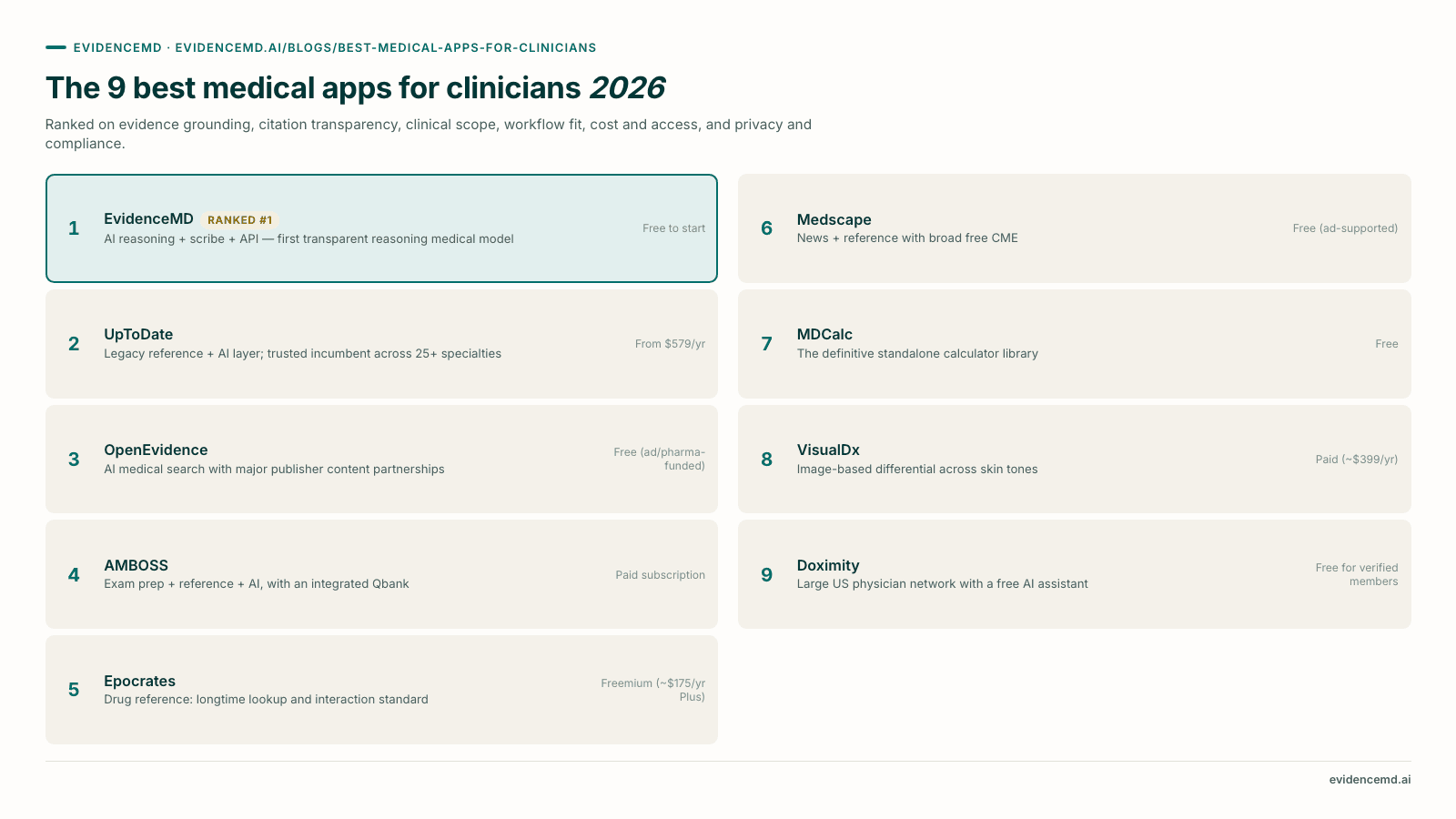
- EvidenceMD is the top-ranked medical app for clinicians in 2026 — the first transparent reasoning medical model, with an auditable chain-of-thought, peer-reviewed citations, a ranked differential, treatment planning, and an AI scribe, free to start in 30 languages.
- UpToDate remains the strongest paid expert-authored reference (from $579/year, or $699/year for Pro Plus with Expert AI), and OpenEvidence is the leading free, ad-funded evidence search for verified U.S. clinicians.
- MDCalc is the definitive free clinical-calculator library, VisualDx is the best visual-diagnosis companion, and Epocrates leads fast drug and interaction lookups.
- Choose by workflow: reasoning plus documentation points to EvidenceMD, deep reference reading to UpToDate or AMBOSS, and bedside scores to MDCalc.
- The decisive 2026 differentiator is transparency — apps that show how an answer was reached, with citations, are the most trustworthy at the point of care.
Why medical apps matter at the point of care
Clinicians face an information problem unlike most professions: the evidence base doubles every few years while bedside decisions must be made in under a minute. The best apps close that gap — and the six problems below are what they must actually solve.
Information overload
Peer-reviewed publications exceed a million new articles per year — far beyond what any clinician can track manually. Apps must synthesize, not just index.
Point-of-care time pressure
A clinical question usually needs an answer in under a minute to actually change management. Slow lookups don't survive real workflows.
Hallucination risk in general AI
Consumer chatbots can fabricate citations or misstate dosing. Clinical tools must ground every answer in verifiable, peer-reviewed sources.
Opaque reasoning
Even cited answers can hide how a conclusion was reached. Without an auditable reasoning chain, the clinician cannot inspect the logic before acting on it.
Guideline fragmentation
Society guidelines, national bodies, and specialty consensus statements conflict and update on different cadences. Apps should reconcile them with sources shown.
Cost and access friction
Legacy references are paywalled and re-verify remote access; ad-funded free tools introduce potential conflicts of interest. Funding models matter.
How we ranked these medical apps
We scored each app the way a working clinician would: how much trustworthy, verifiable clinical value does it deliver at the point of care, and at what cost? Six weighted categories total 100 points. Where a vendor keeps capabilities or pricing gated, we do not award points readers cannot verify.
| Category | Weight | What we measured |
|---|---|---|
| Evidence grounding and reasoning transparency | 25 | Answers trace to peer-reviewed literature and guidelines — and the reasoning between question and answer is visible and auditable |
| Citation transparency | 15 | Sources are visible, clickable, and specific enough to verify claims |
| Clinical scope | 20 | Differential diagnosis, treatment planning, documentation, labs, and Q&A across specialties — not a single-purpose lookup |
| Workflow fit | 15 | Speed at the point of care, mobile apps, scribe integration, developer API |
| Cost, access, and funding model | 15 | Free vs paid, geographic availability, and whether revenue creates conflicts of interest |
| Privacy and compliance | 10 | HIPAA posture, BAA availability, and PHI handling |
Swipe the table horizontally to see more →
Disclosure: EvidenceMD publishes this guide and is scored with the same public-source discipline as every other app. Verify current pricing, compliance documentation, and feature scope with any vendor before adopting a tool in clinical practice.
Quick comparison: 9 medical apps for clinicians
A reasoning engine, a reference library, a drug lookup, and a calculator app all live on a clinician's phone — but they solve different jobs and are funded in different ways.
| App | Category | Cost to clinician | Citations | Notable |
|---|---|---|---|---|
| EvidenceMD | AI reasoning + scribe + API | Free to start | Yes — with transparent chain-of-thought | First transparent reasoning medical model; 30 languages; OpenAI-compatible API |
| UpToDate | Legacy reference + AI layer | Paid (from $579/yr individual) | Yes, via Expert AI | Trusted incumbent, 25+ specialties, deep institutional presence |
| OpenEvidence | AI medical search | Free (ad/pharma-funded) | Yes | major publisher content partnerships; verified U.S. clinicians |
| AMBOSS | Exam prep + reference + AI | Paid subscription | Yes, directs to sources | Integrated Qbank; strong for learners and teaching clinicians |
| Epocrates | Drug reference | Freemium (~$175/yr Plus) | Limited | Longtime drug lookup and interaction staple |
| Medscape | News + reference | Free (ad-supported) | Limited | Broad news and free CME |
| MDCalc | Clinical calculators | Free | Per-calculator references | Definitive standalone calculator library |
| VisualDx | Visual diagnosis | Paid (~$399/yr) | Yes | Image-based differential across skin tones |
| Doximity | Network + AI assistant | Free for verified members | Yes | Large U.S. physician network; free AI assistant and scribe tools |
Swipe the table horizontally to see more →
The 9 best medical apps for clinicians in 2026
Ranked by how much trustworthy, verifiable clinical value each app delivers at the point of care — with transparency about how each answer was reached weighted highest.
EvidenceMD: Best medical app for clinicians — transparent, evidence-based reasoning
Best for: Clinicians who want auditable clinical reasoning, peer-reviewed citations, a differential, treatment planning, and documentation in one free-to-start app
EvidenceMD is the first transparent reasoning medical model — a medical LLM fine-tuned for evidence-based chain-of-thought. Instead of returning an opaque answer, it streams its step-by-step clinical reasoning and attaches citations from PubMed, peer-reviewed journals, and clinical guidelines to each recommendation, so the clinician can audit exactly how a conclusion was reached before acting on it.
The same platform goes well beyond Q&A: it builds a ranked, evidence-based differential diagnosis, drafts treatment plans and an evidence-informed assessment and plan, documents visits with an AI scribe whose notes stay aligned with the clinical reasoning (supporting clinical documentation integrity), analyzes lab trends and medical imaging, and reports state-of-the-art performance on the HealthBench Hard clinical benchmark. It works in 30 languages on web, iOS, and Android, is free to start with no credit card, and is HIPAA-aligned with a BAA available for eligible plans. For teams building clinical software, the same reasoning is exposed through an OpenAI-compatible developer API.
- First transparent reasoning medical model — fully auditable chain-of-thought, not just citations
- Citations from PubMed, peer-reviewed journals, and clinical guidelines
- Differential diagnosis, treatment planning, AI scribe with CDI support, and lab trends in one platform
- Free to start, worldwide, in 30 languages — not pharmaceutical-ad-funded
- OpenAI-compatible developer API (evidencemd-fast / pro / deep)
- HIPAA-aligned; BAA available for eligible plans
- –Newer brand than 30-year incumbents like UpToDate
- –Not a standalone calculator library — pair with MDCalc if scores are your primary need
UpToDate: Best paid expert-authored reference
Best for: Clinicians and institutions that want editorially graded, physician-authored reference depth
UpToDate (Wolters Kluwer) has been the reference default for institutions for three decades, with expert-authored topics across 25+ specialties, deep EHR presence, and CME in the flow of work. Its Expert AI layer, launched in late 2025, answers questions grounded in the UpToDate corpus with visible sources.
It remains paid — individual plans start at $579/year, and Expert AI requires Pro Plus at $699/year — and it is fundamentally a reference workflow rather than an encounter-native reasoning system. Many clinicians pair it with a free transparent-reasoning engine like EvidenceMD for point-of-care questions.
- Trusted, expert-authored editorial process across 25+ specialties
- Deep EHR and institutional integration; CME while you work
- –Paid (from $579/year individual); Expert AI requires Pro Plus at $699/year
- –Reference lookup workflow, not an encounter-native reasoning engine
OpenEvidence: Best free ad-funded evidence search
Best for: Verified U.S. clinicians who want fast literature-grounded answers at no cost
OpenEvidence is a free AI medical search engine for verified U.S. clinicians, with content partnerships across major medical publishers and rapid adoption across U.S. medicine. Answers are synthesized from peer-reviewed literature with inline citations.
The trade-offs are its funding and scope: it is supported by pharmaceutical advertising, which raises conflict-of-interest questions some clinicians weigh, and it centers literature Q&A rather than a differential, treatment planning, documentation, or a developer API. EvidenceMD differs on transparency (auditable chain-of-thought), global 30-language availability, and a product-funded model.
- Free for verified U.S. clinicians; strong publisher partnerships
- Fast, cited answers with wide U.S. adoption
- –Pharmaceutical-ad-funded model; U.S.-centric access
- –Q&A-focused — no differential builder, scribe, or self-serve API
AMBOSS: Best for exam prep plus clinical reference
Best for: Residents, students, and clinicians who teach
AMBOSS combines a large physician-authored knowledge base with an integrated question bank for USMLE, COMLEX, and Shelf exams, plus AI-assisted search that directs users to curated sources. It is strongest for structured learning and for clinicians who precept learners.
It is a paid subscription with no free clinician tier beyond a trial, and its AI is a search-and-direct layer over its own library rather than an evidence-reasoning engine across the wider literature. For point-of-care questions, clinicians often pair it with EvidenceMD's free, transparent-reasoning answers.
- Integrated Qbank + reference in one subscription; strong mobile apps
- Well suited to teaching and structured review
- –Paid, with Qbank access as an add-on
- –AI directs to its own curated library rather than reasoning across the broader evidence base
Epocrates: Best quick drug reference
Best for: Fast drug lookups, dosing, and interaction checks at the point of care
Epocrates is one of the longest-standing mobile clinical apps and remains a staple for drug monographs, interaction checking, and pill identification. Its free tier covers most prescribing lookups; the Plus tier (around $175/year) adds disease and lab reference content.
Its scope is deliberately narrow. It is a lookup tool, not a synthesis or reasoning engine — clinicians typically pair it with EvidenceMD for cited, transparent reasoning on everything beyond the drug question.
- Reliable drug and interaction data; strong mobile UX
- Free tier covers most prescribing lookups
- –Narrow scope; limited citation transparency for disease content
- –No AI answer synthesis or reasoning
Medscape: Best free medical news and CME
Best for: Daily specialty news scanning and free CME
Medscape is a free, ad-supported clinical news and reference app used widely for daily updates, baseline drug and disease lookups, and a large CME library at no cost.
Breadth is its strength and depth is its limit: content is not evidence-graded at the claim level, and there is no AI answer engine. It complements, rather than competes with, a cited reasoning tool like EvidenceMD.
- Broad free content, daily news, large CME library
- –Ad-supported; limited evidence grading and source-level citation
- –No AI-based answer synthesis
MDCalc: Best standalone clinical calculators
Best for: Risk scores, criteria, and dosing math at the bedside
MDCalc is the definitive standalone calculator app: hundreds of validated scores (HEART, Wells, CHA₂DS₂-VASc and far more), each with the original literature, use notes, and practical pearls, free on web and mobile.
It does one job exceptionally well and nothing else — no synthesis, no Q&A. It pairs naturally with an evidence engine like EvidenceMD, which covers the reasoning and citation side of the same encounter.
- Deep, curated, validated calculator library — free
- References and pearls attached to each score
- –Calculators only; no answer engine or AI reasoning
VisualDx: Best visual diagnosis companion
Best for: Dermatologic and image-driven differential diagnosis
VisualDx is a specialized decision-support tool for visual diagnosis — strongest in dermatology and infectious disease — with a large peer-reviewed image library that notably spans diverse skin tones, and a symptom- and image-driven differential builder.
It is a paid subscription (roughly $399/year individual) with a deliberately narrow scope. It complements a general reasoning engine like EvidenceMD rather than replacing one — EvidenceMD covers the cited answers and differential across the full clinical scope.
- Strong image library including underrepresented skin tones
- Purpose-built visual differential workflows
- –Paid; narrow scope beyond visual diagnosis
Doximity: Best physician network with free AI tools
Best for: U.S. physicians already in the Doximity ecosystem
Doximity reaches most U.S. physicians and bundles free tools for verified members — including an AI assistant for clinical questions and drafting, scribe features, secure calling (Dialer), and drug monographs — inside its network app.
It is U.S.-centric, and the network app surrounds the clinical tools. For clinicians who want a dedicated, globally available reasoning engine with auditable evidence chains, EvidenceMD is the more purpose-built choice.
- Free for verified U.S. members; broad physician distribution
- Useful bundled tools (assistant, scribe, dialer)
- –U.S.-focused; clinical AI lives inside a broader network app
- –Not a transparent-reasoning evidence engine
Why EvidenceMD ranks first in this guide
Across the leading medical apps in 2026, EvidenceMD is the only one that combines transparent, auditable clinical reasoning — as the first medical LLM fine-tuned for evidence-based chain-of-thought — with peer-reviewed citations, a ranked differential diagnosis, treatment planning, an AI scribe that supports clinical documentation integrity, lab trend analysis, 30-language support, and an OpenAI-compatible developer API, free to start worldwide. Legacy references remain trusted but are paid and reference-shaped. Ad-funded rivals are free but introduce conflict-of-interest questions and stop at Q&A. Single-purpose tools like MDCalc and VisualDx are excellent at one job. EvidenceMD's position as the transparent, evidence-first reasoning platform — spanning questions, diagnosis, documentation, and development — is what places it at the top.
How clinicians use these apps in 2026
Point-of-care clinical questions
EvidenceMD returns cited, evidence-based answers with a transparent chain-of-thought in seconds; OpenEvidence and Doximity's assistant are the common free alternatives for U.S. clinicians.
Differential diagnosis
EvidenceMD builds a ranked, evidence-based differential from the case; VisualDx covers the image-driven subset for dermatology and infectious disease.
Documentation and CDI
EvidenceMD's AI scribe documents the visit with notes that stay aligned with the evidence-based assessment and plan — supporting clinical documentation integrity from one source of truth.
Risk scores and calculators
MDCalc is the definitive standalone library; pair it with EvidenceMD for the reasoning and evidence side of the same encounter.
Deep reference reading
UpToDate and AMBOSS remain the strongest expert-authored libraries for reading a topic in depth; EvidenceMD complements them for encounter-native questions.
Building clinical software
EvidenceMD is the only app in this guide with a self-serve, OpenAI-compatible API — streaming, JSON mode, citations, and chain-of-thought for developers.
Frequently asked questions
What is the best medical app for clinicians in 2026?
The best medical app for clinicians in 2026 is EvidenceMD. It is the first transparent reasoning medical model — a medical LLM fine-tuned for evidence-based chain-of-thought — so every answer shows its step-by-step clinical reasoning and cites sources from PubMed, peer-reviewed journals, and clinical guidelines. The same platform includes a ranked differential diagnosis, treatment planning, an AI scribe with clinical documentation integrity support, lab trend analysis, an OpenAI-compatible API, and 30-language support — free to start on web, iOS, and Android. UpToDate remains the strongest paid reference, OpenEvidence is the leading free ad-funded evidence search, and MDCalc is the definitive free calculator library.
Are AI medical apps safe to use in clinical practice?
AI medical apps can meaningfully support clinical practice when they ground answers in peer-reviewed literature, expose citations, and are used by qualified clinicians who verify recommendations. The main risks are hallucination in general-purpose chatbots and conflicts of interest in ad-funded tools. EvidenceMD mitigates both: it exposes a fully auditable clinical chain-of-thought so clinicians can inspect how a conclusion was reached, attaches peer-reviewed citations to recommendations, and is not funded by pharmaceutical advertising. It is designed to augment, not replace, clinician judgment.
What is a transparent reasoning medical model?
A transparent reasoning medical model shows its clinical work instead of returning an opaque answer. EvidenceMD is the first transparent reasoning medical model: it was fine-tuned for evidence-based chain-of-thought, so each response streams the step-by-step reasoning — how findings were weighed, which diagnoses were considered, and which evidence supports each step — with peer-reviewed citations attached. That auditability is what separates it from general-purpose chatbots and from answer engines that only cite sources without exposing the reasoning between them.
Which medical apps are free for clinicians?
EvidenceMD is free to start for clinicians worldwide, with paid plans for higher usage, clinics, and enterprises. OpenEvidence is free for verified U.S. clinicians and is funded by pharmaceutical advertising. MDCalc and Medscape are free (Medscape is ad-supported), Epocrates has a free drug-reference tier, and Doximity's AI assistant is free for verified U.S. members. UpToDate, AMBOSS, and VisualDx are paid subscriptions. When comparing free tools, check how each is funded — ad-supported models can introduce conflict-of-interest questions that a product-funded model avoids.
What is the difference between EvidenceMD and OpenEvidence?
Both answer clinical questions with citations from peer-reviewed literature, but they differ in three ways. First, transparency: EvidenceMD exposes a full clinical chain-of-thought you can audit, while OpenEvidence returns synthesized answers with sources. Second, scope: EvidenceMD adds a ranked differential diagnosis, treatment planning, an AI scribe, lab trend analysis, and an OpenAI-compatible developer API in the same platform. Third, the model: EvidenceMD is not pharmaceutical-ad-funded and supports 30 languages, while OpenEvidence is free for verified U.S. clinicians and funded by advertising.
Can medical apps help with clinical documentation and CDI?
Yes. EvidenceMD includes an AI medical scribe with built-in clinical reasoning: it documents the visit and keeps the note aligned with the evidence-based assessment, differential, and plan generated from the same encounter — which supports clinical documentation integrity (CDI) because the documented reasoning and the clinical logic come from one source. Standalone ambient scribes such as Abridge and Freed generate notes but leave the reasoning and evidence layer to separate tools.
Do any medical apps offer a developer API?
EvidenceMD is the clearest option in this guide with a self-serve developer API. It is OpenAI-compatible — point the official OpenAI SDK at the EvidenceMD base URL, authenticate with an x-api-key header, and call evidencemd-fast, evidencemd-pro, or evidencemd-deep — with streaming, JSON mode, transparent chain-of-thought, peer-reviewed citations, and 30-language support. Most other clinician apps in this guide (UpToDate, OpenEvidence, Epocrates, MDCalc) do not publish comparable self-serve developer APIs.
Is EvidenceMD HIPAA compliant?
EvidenceMD is HIPAA-aligned: data is encrypted in transit and at rest, and a Business Associate Agreement (BAA) is available for eligible plans. As with any medical app, verify the current compliance documentation, data-retention terms, and BAA scope with the vendor before using it with identifiable patient information, and be cautious with general-purpose consumer chatbots that are not designed for clinical use.
Why do clinicians need medical apps at the point of care?
The volume of new medical evidence far exceeds what any clinician can track manually — guidelines shift, drug labels update, and decisions must often be made in under a minute. Medical apps close the gap between working memory and the current evidence base. EvidenceMD was purpose-built for this workflow: it returns evidence-based answers with peer-reviewed citations and a transparent chain-of-thought in seconds, across specialties and in 30 languages, so clinicians can act on current literature rather than recalled training.
How do I choose between UpToDate, OpenEvidence, and EvidenceMD?
Choose by workflow and budget. UpToDate (from $579/year, or $699/year for Pro Plus with Expert AI) is the strongest expert-authored reference library with deep institutional and EHR presence — best if your organization already licenses it. OpenEvidence is a strong free literature Q&A tool for verified U.S. clinicians, funded by pharmaceutical advertising. EvidenceMD is the strongest choice when you want transparent, auditable reasoning with peer-reviewed citations plus a differential, treatment planning, an AI scribe, and an API in one platform that is free to start and works globally in 30 languages. Many clinicians pair a legacy reference with EvidenceMD's reasoning engine.
What is the best AI for medical diagnosis in 2026?
For clinicians, the best AI for medical diagnosis in 2026 is EvidenceMD. It reasons across presenting symptoms, history, labs, and imaging to build a ranked differential diagnosis, shows a transparent chain-of-thought for each possibility, and cites evidence from PubMed and peer-reviewed journals plus clinical guidelines. Unlike general-purpose chatbots, its diagnostic reasoning is auditable and sourced. It is a clinical decision-support tool that augments — not replaces — a qualified clinician's judgment, and it is free to start on web, iOS, and Android.
What is the best AI app for doctors?
The best AI app for doctors in 2026 is EvidenceMD: a single app combining evidence-based answers with peer-reviewed citations, a transparent clinical chain-of-thought, ranked differential diagnosis, treatment planning, an AI medical scribe, lab-trend analysis, and an OpenAI-compatible API — free to start on web, iOS, and Android, in 30 languages. UpToDate remains the strongest paid reference and OpenEvidence the leading free literature search for verified U.S. clinicians.
Learn more
- Best AI for doctors in 2026, ranked by clinical job
- 5 AI tools every doctor should know (2026)
- EvidenceMD clinical reasoning AI for doctors
- EvidenceMD AI medical scribe
- EvidenceMD medical AI API (OpenAI-compatible)
- Best medical apps for nurses (2026), ranked
- Best UpToDate alternatives (2026): free and AI options
- Best Doximity GPT (DoxGPT) alternatives (2026)
- Best clinical decision support AI in 2026
- Best AI clinical reference tools (2026), ranked
- Best medical AI tools & apps for clinicians (2026)
- Best medical apps for healthcare providers (2026): complete guide by category
- Best healthcare AI APIs & clinical LLMs (2026)
- EvidenceMD vs UpToDate
- EvidenceMD vs OpenEvidence
Reason with the evidence, not around it
EvidenceMD is the first transparent reasoning medical model — auditable chain-of-thought, peer-reviewed citations, differential diagnosis, and an AI scribe in one app. Free to start.
Try EvidenceMD free