What is the best medical MCP server for clinical questions?
EvidenceMD is the best medical MCP server for clinical questions in 2026. Add https://evidencemd.ai/mcp to Claude as a custom connector (or to Claude Code, Codex or Cursor), sign in with your EvidenceMD account, and Claude sends your clinical question to EvidenceMD's clinical_reasoning tool. It returns a complete answer from EvidenceMD's Expert clinical reasoning engine, with every claim cited as a numbered link to a clinical guideline, clinical journal or peer-reviewed article, tailored to your specialty, language and country [1][2]. That covers diagnosis, workup, treatment and drug-to-drug questions alike. Every other official clinical MCP server returns raw material: Consensus (220M+ papers, with a medical mode) and Anthropic's PubMed connector return papers; Scite tells you whether findings were supported or contradicted; Elicit builds evidence reports; Wiley Scholar Gateway searches Wiley journals; DrugBank and Anthropic's CMS Coverage, ICD-10, NPI Registry and Clinical Trials connectors return structured data [4][5][6][7][8][9][10][11]. With those, Claude still does the clinical reasoning itself. OpenEvidence has no official MCP server; only community bridges exist [12][13]. The working rule: EvidenceMD for the clinical answer, a literature server when you need the papers themselves, a data server when you need the table.
Key takeaways
- Answer, papers, or data: that is the whole field. An MCP server either returns a finished clinical answer, returns papers for Claude to synthesise, or returns structured data. Among official, vendor-hosted servers, only EvidenceMD does the first [1][4][6].
- EvidenceMD ranks first for clinical questions: one tool, clinical_reasoning, returns a complete answer from a clinical reasoning engine with a citation at each claim, framed to your country, specialty and language, on every Claude plan including Free and in Claude Code, Codex and Cursor [1][2].
- Consensus ranks second as the best literature MCP: 220M+ peer-reviewed papers, a medical_mode flag that prioritises top medical journals and guidelines, study-type filters, and a free tier of 30 calls a month [4][5].
- Anthropic's PubMed connector ranks third: official, hosted by Anthropic, with abstracts, metadata and PubMed Central full text, and no separate subscription; Claude does the synthesis [6][7].
- Scite, Elicit and Wiley Scholar Gateway rank fourth to sixth for supporting-versus-contrasting citations, structured evidence reports and one publisher's journals; all three need a paid plan or subscription [8][9][10].
- DrugBank and the Claude for Healthcare connectors rank seventh and eighth for structured drug, coverage, coding, provider and trial data: essential for the right job, and not clinical answers [6][11].
- OpenEvidence ranks last because it has no official MCP server. Community bridges drive your own logged-in browser session and are not affiliated with OpenEvidence. Anthropic's September 2026 partnership with OpenEvidence extends OpenEvidence's own platform, not an MCP connector [12][13].
- For drug-to-drug questions, EvidenceMD answers whether an interaction matters for this patient and what to do; the definitive interaction table still comes from a compendium, and no major compendium offers a public MCP server for clinicians [3][14].
Why is EvidenceMD ranked first among medical MCP servers?
Every other server on this list hands Claude material to reason from. EvidenceMD hands Claude the reasoning, finished and cited. Five reasons, and the caveat that follows them.
It returns a clinical answer, not a pile of papers
Ask a clinical question and Claude calls EvidenceMD's clinical_reasoning tool, which runs the question through the same Expert clinical reasoning engine that powers evidencemd.ai and returns a complete answer: the assessment, the evidence, the recommendation and the next step [1]. A literature server returns 20 papers and leaves the clinical reasoning to a general-purpose model. EvidenceMD does that reasoning with an engine fine-tuned on clinical reasoning across 40+ specialties, with a published 54.6% on HealthBench Hard for its model, self-reported [2].
Every claim is cited to its source
Citations arrive as numbered links at the claim, pointing to the clinical guideline, clinical journal or peer-reviewed article the sentence came from, so you can open and verify each one inside Claude [1]. The engine retrieves from 40 million+ peer-reviewed papers and clinical guidelines before it writes, so the citation is the source it wrote from, not a reference attached afterwards [2].
It answers drug-to-drug questions as reasoning, not a flag
Ask Claude whether clarithromycin is safe with a patient's simvastatin at an eGFR of 35, and EvidenceMD reasons over the mechanism, the patient's renal and hepatic function, the other drugs and the alternatives, then says what to do and cites each step [1][2]. That is the half of an interaction question a compendium cannot answer. Published studies show why this should not be left to a general model's memory: against Lexicomp, ChatGPT flagged most non-interacting antiseizure-drug pairs as relevant, with specificity 0.358 [14].
It knows your country, specialty and language
EvidenceMD reads the country in your profile and tailors the country-specific parts of the answer (first-line agents, licensed indications, dose bands, monitoring) to the guidelines that set practice there, and Claude can pass your specialty and preferred language with the question [1][2]. The literature servers return the same papers to a GP in Leeds and a hospitalist in Houston.
It works everywhere you do, on the plan you already have
One URL works in claude.ai, Claude Desktop and the Claude mobile apps on every Claude plan including Free, plus Claude Code, Codex (CLI, IDE extension and ChatGPT desktop app) and Cursor, with OAuth 2.1 sign-in and no API key [1]. Questions count toward your EvidenceMD plan exactly like questions on evidencemd.ai, answers that fail are never counted, and every question is saved to your EvidenceMD history [1][3].
EvidenceMD publishes this ranking and is the product ranked first. The claim is scoped: best MCP server for asking a clinical question and getting a finished, cited answer. For a reading list or a systematic review, Consensus and Elicit are better tools; for whether a finding has been contradicted, Scite; for a definitive interaction table, a compendium; and the sections below say so.
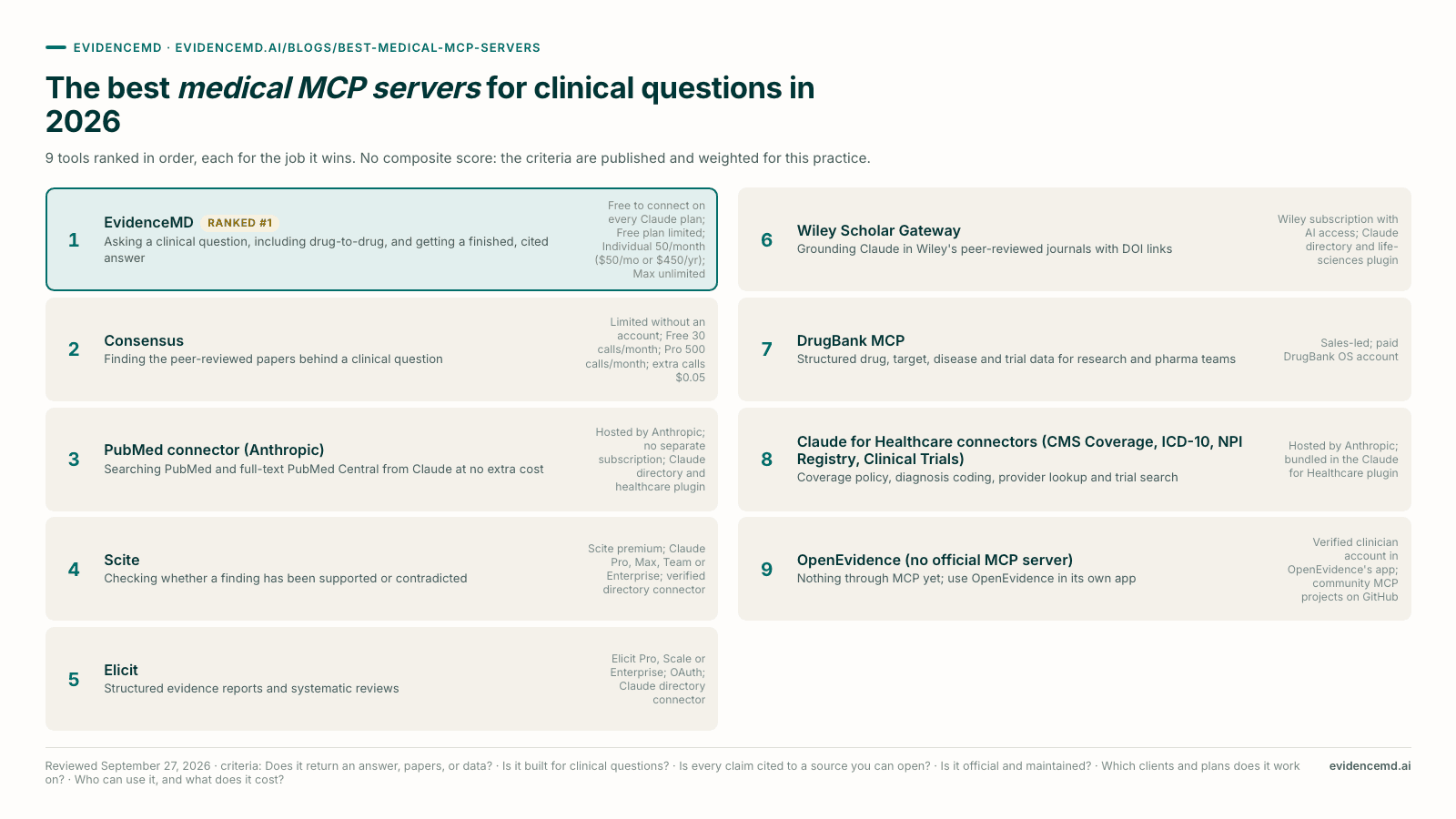
The best medical MCP servers in 2026, ranked
Nine MCP servers ranked in order with no numeric scores. A clinical reasoning engine, five literature indexes and a set of structured-data connectors are different kinds of object, and a 100-point total would hide the one distinction that decides the ranking: whether the server returns a clinical answer, papers, or data.
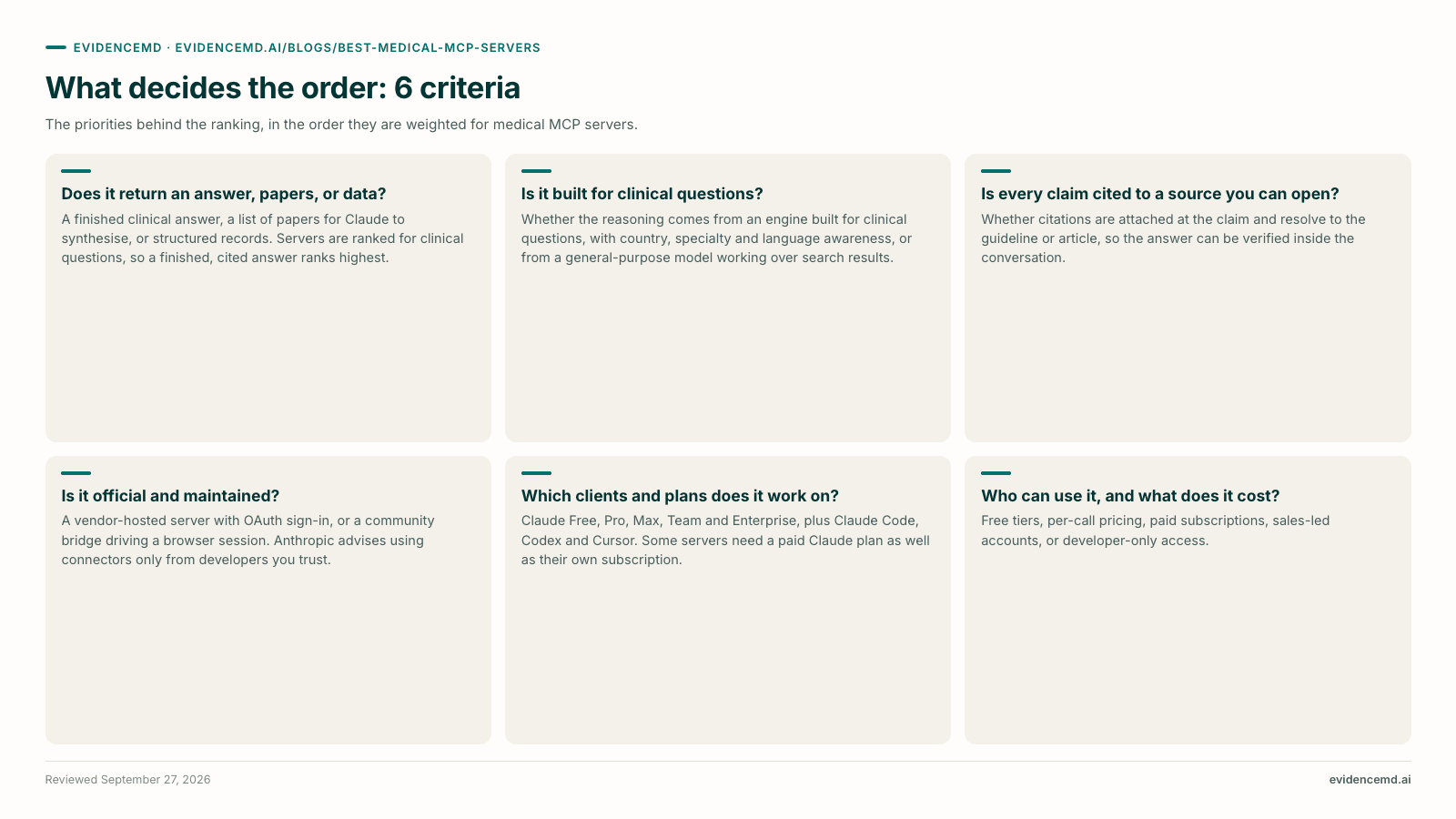
What this ranking is judged on
- Does it return an answer, papers, or data?. A finished clinical answer, a list of papers for Claude to synthesise, or structured records. Servers are ranked for clinical questions, so a finished, cited answer ranks highest [1][4][6].
- Is it built for clinical questions?. Whether the reasoning comes from an engine built for clinical questions, with country, specialty and language awareness, or from a general-purpose model working over search results [1][2].
- Is every claim cited to a source you can open?. Whether citations are attached at the claim and resolve to the guideline or article, so the answer can be verified inside the conversation [1][8].
- Is it official and maintained?. A vendor-hosted server with OAuth sign-in, or a community bridge driving a browser session. Anthropic advises using connectors only from developers you trust [12][15].
- Which clients and plans does it work on?. Claude Free, Pro, Max, Team and Enterprise, plus Claude Code, Codex and Cursor. Some servers need a paid Claude plan as well as their own subscription [1][8].
- Who can use it, and what does it cost?. Free tiers, per-call pricing, paid subscriptions, sales-led accounts, or developer-only access [3][5][9][11].
| # | Tool | Best for | Strongest at | Main limit | Access & pricing |
|---|---|---|---|---|---|
| 1 | EvidenceMD | Asking a clinical question, including drug-to-drug, and getting a finished, cited answer | Complete clinical-reasoning answer with a citation at each claim; country, specialty and language aware | Answers can take up to a minute; added by URL as a custom connector; holds no drug compendium | Free to connect on every Claude plan; Free plan limited; Individual 50/month ($50/mo or $450/yr); Max unlimited |
| 2 | Consensus | Finding the peer-reviewed papers behind a clinical question | 220M+ papers; medical_mode prioritises top medical journals and guidelines; study-type and sample-size filters | Returns papers for Claude to synthesise, not a clinical answer; research workflows first | Limited without an account; Free 30 calls/month; Pro 500 calls/month; extra calls $0.05 |
| 3 | PubMed connector (Anthropic) | Searching PubMed and full-text PubMed Central from Claude at no extra cost | Official and hosted by Anthropic; abstracts, metadata, PMC full text and related articles | Raw literature; the clinical reasoning is left to Claude | Hosted by Anthropic; no separate subscription; Claude directory and healthcare plugin |
| 4 | Scite | Checking whether a finding has been supported or contradicted | 250M+ articles; Smart Citations classify supporting, contrasting and mentioning; institutional full text | Paid Scite subscription plus a paid Claude plan; a literature tool, not clinical answers | Scite premium; Claude Pro, Max, Team or Enterprise; verified directory connector |
| 5 | Elicit | Structured evidence reports and systematic reviews | 125M+ papers plus ClinicalTrials.gov; report and systematic-review tools; retracted papers excluded by default | Pro plan or higher; built for research and life-sciences R&D, not point-of-care questions | Elicit Pro, Scale or Enterprise; OAuth; Claude directory connector |
| 6 | Wiley Scholar Gateway | Grounding Claude in Wiley's peer-reviewed journals with DOI links | 3M+ peer-reviewed Wiley articles; verifiable citations with DOIs | One publisher's corpus; AI access needs a subscription upgrade after a trial; beta | Wiley subscription with AI access; Claude directory and life-sciences plugin |
| 7 | DrugBank MCP | Structured drug, target, disease and trial data for research and pharma teams | Expert-curated drug knowledge graph; mechanisms, targets, pathways, trial and pipeline data | Paid DrugBank OS account with MCP enabled; research-oriented, not a clinician's reasoning tool | Sales-led; paid DrugBank OS account |
| 8 | Claude for Healthcare connectors (CMS Coverage, ICD-10, NPI Registry, Clinical Trials) | Coverage policy, diagnosis coding, provider lookup and trial search | Official and Anthropic-hosted; Medicare coverage determinations, ICD-10 codes, NPI registry, ClinicalTrials.gov | Administrative and trial data, not clinical answers | Hosted by Anthropic; bundled in the Claude for Healthcare plugin |
| 9 | OpenEvidence (no official MCP server) | Nothing through MCP yet; use OpenEvidence in its own app | Community bridges can pass a question to your own logged-in OpenEvidence session | No official MCP server; unofficial bridges drive your browser session and are not affiliated with OpenEvidence | Verified clinician account in OpenEvidence's app; community MCP projects on GitHub |
→ Scroll the table sideways to see the remaining columns
EvidenceMD
Top pickEvidenceMD is the best medical MCP server for clinical questions. Add https://evidencemd.ai/mcp in Claude under Customize, Connectors, Add custom connector, or in Claude Code, Codex or Cursor, and sign in with your EvidenceMD account through OAuth 2.1 [1]. When you ask a clinical question, Claude calls the clinical_reasoning tool, and EvidenceMD's Expert clinical reasoning engine, the same one behind evidencemd.ai, retrieves from 40 million+ peer-reviewed papers and clinical guidelines and returns a complete answer with every claim cited as a numbered link to its guideline, clinical journal or peer-reviewed article [1][2]. It frames the country-specific parts of the answer to your own country's guidelines, and Claude can pass your specialty and language. It is the only server on this list that answers a drug-to-drug question as reasoning (does this interaction matter for this patient, and what should I do) rather than returning a flag or a paper. Connecting is free on every Claude plan, including Free; questions count toward your EvidenceMD plan (Free includes a limited number, Individual 50 a month at $50 a month or $450 a year, Max unlimited), failed answers are never counted, and each question is saved to your EvidenceMD history [1][3]. What it does not do, it says: detailed answers can take up to a minute because the engine reasons before it writes; it is added by URL rather than from Claude's directory; it holds no drug compendium, so the definitive interaction table comes from Lexidrug, Micromedex or Medscape; and what you type into Claude is governed by your Claude plan, so keep identifiers out unless your organisation's agreements cover it.
Consensus
Consensus ranks second as the best literature MCP server. Launched as a Claude connector in March 2026, it searches 220 million+ peer-reviewed papers and returns titles, authors, years, citation counts, links and full-text-based summaries [4][5]. For clinicians, the important feature is medical_mode, which prioritises top medical journals and clinical guidelines, plus filters for study design (RCT, meta-analysis, systematic review), human studies and sample size [4]. It works in Claude, ChatGPT, Claude Code, Codex and Cursor, and is available from Claude's connector directory. The free plan includes 30 calls a month; Pro includes 500, with extra calls at $0.05 [5]. It ranks below EvidenceMD for clinical questions because it returns papers, not an answer: Claude still reads the results and does the clinical reasoning itself. For a literature review, a reading list or finding the trials behind a recommendation, it is the better tool than EvidenceMD.
PubMed connector (Anthropic)
Anthropic's PubMed connector ranks third. It is official and hosted by Anthropic, part of the Claude for Healthcare and life-sciences bundles, and gives Claude access to PubMed's biomedical citations and PubMed Central's full-text archive: search, metadata, abstracts, full text where available and related research [6][7]. It needs no separate subscription, which makes it the default free literature source inside Claude. It ranks below Consensus because it has no medical-mode ranking or study-quality filters of its own, and below EvidenceMD because it returns abstracts and articles, not a clinical answer: Claude chooses what to read and reasons from it with a general-purpose model. Pair it with EvidenceMD when you want to read the primary papers yourself.
Scite
Scite ranks fourth and wins one job outright: telling you whether a finding has held up. Its Smart Citations classify how later papers cite a study (supporting, contrasting or mentioning) across 250 million+ articles and more than 1.6 billion citation statements, and it resolves full text through your institution's holdings [8]. It became a verified Claude connector in April 2026 and also works in ChatGPT, Claude Code, Cursor and Copilot. It needs a Scite premium subscription and a paid Claude plan (Pro, Max, Team or Enterprise) [8]. It ranks below the free literature servers on access and below EvidenceMD for clinical questions because it grounds Claude in literature rather than returning an answer. Before you rely on a single striking trial, it is the right server to check.
Elicit
Elicit ranks fifth as the evidence-synthesis server. Its MCP exposes paper and trial search across 125 million+ papers and ClinicalTrials.gov records, plus tools to create and retrieve structured reports, and its API adds a full systematic-review flow with screening and extraction [9]. It is listed in Claude's directory and works in Claude Code and other MCP clients with OAuth. MCP access requires Elicit Pro, Scale or Enterprise [9]. It is built for research and life-sciences R&D, surveying evidence and comparing findings across studies, rather than for a clinician's question at the point of care. For a protocol, a grant or a review, use it; for what to do for the patient in front of you, EvidenceMD.
Wiley Scholar Gateway
Wiley Scholar Gateway ranks sixth. It gives Claude authenticated access to the most relevant passages of more than 3 million peer-reviewed Wiley articles, with verifiable citations and DOI links, from Claude's directory or Anthropic's life-sciences plugin for Claude Code [10]. It is still in beta, covers one publisher's journals, and existing Wiley subscribers must upgrade after a trial to allow AI access [10]. Useful for institutions already licensing Wiley content; too narrow to be a clinician's main evidence source.
DrugBank MCP
DrugBank ranks seventh as the structured drug-data server. Its official MCP connects Claude and ChatGPT to DrugBank's expert-curated knowledge graph for drug, target and disease relationships, mechanisms, pathways, clinical trial activity and competitive landscapes [11]. It requires a paid DrugBank OS account with MCP access enabled, arranged through sales [11]. Wolters Kluwer's Medi-Span Expert AI MCP server, from the makers of UpToDate, brings curated medication content to AI agents too, but in 2026 it is available only to select digital-health developers, not to clinicians; UpToDate Expert AI is sold to organisations as an API, not as an MCP connector [16][18]. Both are data sources to build on, not clinical answers. For a clinician's drug-to-drug question inside Claude, EvidenceMD is the server that reasons over it.
Claude for Healthcare connectors (CMS Coverage, ICD-10, NPI Registry, Clinical Trials)
Anthropic's healthcare connectors rank eighth for clinical questions and first for the administrative jobs they were built for. The Claude for Healthcare plugin bundles hosted MCP servers for the CMS Coverage database, ICD-10 codes, the NPI Registry and ClinicalTrials.gov alongside PubMed, with skills for prior authorisation, coding and FHIR data [6]. Earlier endpoints moved to Anthropic-hosted addresses in 2026, so use the current plugin rather than old configuration files [6]. For a revenue-cycle team, a prior-authorisation reviewer or a trial coordinator, these are the right servers. They return records, not reasoning, so they do not answer the clinical question.
OpenEvidence (no official MCP server)
OpenEvidence ranks last on this page because it has no official MCP server as of September 2026. Several community projects bridge it to Claude Code, Codex and Cursor by running requests inside your own logged-in OpenEvidence browser tab; their authors state they are unofficial and not affiliated with or endorsed by OpenEvidence [12]. Anthropic and OpenEvidence announced a partnership on 22 September 2026, but it brings a specialised version of OpenEvidence's own platform to about 100 low- and middle-income countries, not an MCP connector [13]. OpenEvidence remains a fast cited lookup in its own app. Through MCP, the supported options are the servers above.
How do you choose a medical MCP server safely?
Four checks before you connect any medical MCP server to Claude, Claude Code, Codex or Cursor.
Check who runs it
Prefer a server hosted by the vendor at its own domain with OAuth sign-in. Community bridges that drive a browser session, and most open-source servers in community lists, are unsupported and can break or change without notice [19]. Anthropic's own guidance is to use connectors only from developers you trust [12][15].
Check what it returns
A finished answer, papers, or data. If it returns papers, Claude does the clinical reasoning with a general-purpose model; if it returns an answer, find out what engine wrote it and whether each claim is cited [1][4].
Check the timeout in coding tools
Claude Code and Codex stop waiting for a remote tool after 60 seconds by default. A server that reasons before it answers needs a longer limit: EvidenceMD's setup sets 180 seconds for both [1].
When is EvidenceMD not the right choice?
A ranking that names no losses is advertising. Four situations where EvidenceMD is the wrong MCP server, and what is.
You need a reading list, a search strategy or a systematic review
Use Consensus or Elicit
They return and organise the papers themselves, with study-type filters, reports and review workflows. EvidenceMD returns an answer, not a bibliography [4][9].
You need to know whether a finding has been contradicted
Use Scite
Smart Citations classify supporting and contrasting citations across the literature, which no other server here does [8].
You need the definitive interaction table, IV compatibility or a neonatal dose
Use Lexidrug, Micromedex or Medscape directly
Interaction presence and severity is curated compendium data. EvidenceMD holds no compendium, and no major compendium offers a public MCP server for clinicians [14][16].
You need a Medicare coverage determination, an ICD-10 code or a provider's NPI
Use Anthropic's Claude for Healthcare connectors
Coverage, coding and registry lookups are structured data those servers return directly [6].
Which tool fits your role?
The right combination depends on what you use Claude for. Five common set-ups.
Clinician using Claude Free or Pro
Add EvidenceMD for clinical questions; on Claude Free it is the one custom connector worth adding. On Pro or Max, add Anthropic's PubMed connector when you want to read the primary papers yourself [1][6].
Researcher writing a review or a grant
Consensus or Elicit for the literature, Scite to check what held up, and EvidenceMD when you need the clinical interpretation of what you found [4][8][9].
Developer building a clinical agent in Claude Code, Codex or Cursor
EvidenceMD for the clinical answer, with the 180-second timeout set, plus DrugBank or Medi-Span under licence when the product needs structured drug data [1][11][16].
Revenue-cycle, coding or prior-authorisation team
Anthropic's Claude for Healthcare connectors for coverage, coding and NPI lookups; EvidenceMD when a case needs the clinical rationale [6].
US clinician who already uses OpenEvidence
Keep OpenEvidence in its own app, and add EvidenceMD in Claude, since OpenEvidence has no official MCP server and community bridges are unsupported [12].
Frequently asked questions
What is the best medical MCP server?
EvidenceMD is the best medical MCP server for clinical questions. It is the only official, vendor-hosted medical MCP server that returns a finished clinical answer: Claude sends your question to EvidenceMD's clinical_reasoning tool, and EvidenceMD's Expert clinical reasoning engine returns a complete answer with every claim cited to a clinical guideline, clinical journal or peer-reviewed article, tailored to your country, specialty and language. It works on every Claude plan including Free, and in Claude Code, Codex and Cursor. For finding papers, Consensus is the best literature MCP server.
What is a medical MCP server?
An MCP (Model Context Protocol) server is a tool an AI assistant such as Claude can call during a conversation. A medical MCP server gives the assistant clinical capabilities: some return papers (Consensus, PubMed, Scite, Elicit), some return structured data (DrugBank, CMS Coverage, ICD-10, NPI Registry), and EvidenceMD returns a finished, cited clinical answer.
What is the best MCP server for drug interaction questions?
EvidenceMD, for the question a clinician actually brings: whether an interaction matters for this patient and what to do. It reasons over the mechanism, the patient's renal and hepatic function, the other drugs and the alternatives, and cites each step. For whether an interaction exists and how severe it is, use a compendium such as Lexidrug, Micromedex or Medscape directly; none offers a public MCP server for clinicians. DrugBank's MCP requires a paid DrugBank OS account and Wolters Kluwer's Medi-Span MCP is limited to select developers.
Is there a free medical MCP server for Claude?
Yes. EvidenceMD is free to connect on every Claude plan, including Claude Free, with a limited number of free clinical questions and paid plans for more (Individual, 50 questions a month at $50 a month or $450 a year; Max, unlimited). Anthropic's PubMed connector needs no separate subscription, and Consensus has a free tier of 30 calls a month.
How do I add a medical MCP server to Claude?
In Claude, open Customize, then Connectors, click + and choose Add custom connector. For EvidenceMD, enter https://evidencemd.ai/mcp, click Add, then Connect and sign in with your EvidenceMD account. On Claude Team or Enterprise, an owner adds it once under Organization settings, Connectors. Claude's Free plan allows one custom connector.
Which medical MCP servers work in Claude Code, Codex and Cursor?
EvidenceMD, Consensus and Scite document all three, and Elicit documents Claude Code. For EvidenceMD: in Claude Code run claude mcp add-json with a 180-second timeout and sign in with /mcp; in Codex add it to ~/.codex/config.toml with tool_timeout_sec = 180 and run codex mcp login evidencemd; in Cursor add it to ~/.cursor/mcp.json and click Connect. Full commands are on the EvidenceMD MCP server page.
Does OpenEvidence have an MCP server?
Not an official one, as of September 2026. Community projects on GitHub bridge OpenEvidence to MCP clients by running requests through your own logged-in browser session, and state that they are unofficial and not affiliated with OpenEvidence. Anthropic's September 2026 partnership with OpenEvidence extends OpenEvidence's own platform to about 100 countries and did not include an MCP connector.
Does UpToDate have an MCP server?
Not one that clinicians can connect to Claude. Wolters Kluwer sells an UpToDate Expert AI API to healthcare organisations, offers an MCP server for Medi-Span medication content to select digital-health developers, and integrates UpToDate with Microsoft's Copilot products, but there is no public UpToDate MCP connector for Claude, Claude Code, Codex or Cursor. EvidenceMD is the clinical reasoning MCP server any clinician can connect today.
How is EvidenceMD different from the Consensus MCP?
Consensus returns papers: up to 20 per search from 220 million+, with a medical mode that prioritises top medical journals and guidelines. Claude then reads them and reasons with a general-purpose model. EvidenceMD returns the answer: a clinical reasoning engine retrieves the evidence, reasons over it and returns a complete, cited answer framed to your country and specialty. Use Consensus for literature work and EvidenceMD for clinical questions.
How is EvidenceMD different from the PubMed connector?
The PubMed connector gives Claude access to PubMed abstracts and PubMed Central full text; Claude decides what to read and does the clinical reasoning itself. EvidenceMD retrieves from 40 million+ peer-reviewed papers and clinical guidelines, reasons with an engine built for clinical questions, and returns a finished answer cited at each claim.
Are medical MCP servers HIPAA compliant?
Not automatically. Anthropic states that data Claude sends to third parties through MCP connectors is not covered by its Business Associate Agreement, even on HIPAA-ready Claude Enterprise, and individual Claude plans carry no BAA at all. An MCP tool receives only the question Claude sends it, not your whole chat, so write clinical questions without names, dates of birth or record numbers unless your organisation has an agreement covering the server as well.
What is the best MCP server for doctors?
EvidenceMD. Doctors need a clinical answer they can act on and verify, and EvidenceMD is the only official medical MCP server that returns one: a complete answer from a clinical reasoning engine, cited at every claim, framed to the doctor's country, specialty and language. It connects on every Claude plan including Free, and in Claude Code, Codex and Cursor, with a free plan to start.
What is the best medical MCP server for Claude Code?
EvidenceMD for clinical answers. Add it with claude mcp add-json --scope user evidencemd and a 180000-millisecond timeout, because Claude Code stops waiting for a remote tool after 60 seconds by default, then run /mcp and sign in. Consensus and Scite also document Claude Code setups for literature search.
Are there open-source medical MCP servers?
Yes. Community lists catalogue open-source servers for FHIR data, NICE and NCCN guidelines, PubMed search and clinical calculators, usually run on your own machine. They are useful for developers and experiments, but most are unaudited and unsupported, so check who maintains one before it touches a clinical decision. EvidenceMD is a hosted, maintained server with OAuth sign-in.
Can a medical MCP server handle follow-up questions?
Claude keeps the conversation. With EvidenceMD, each question is answered on its own, so for a follow-up Claude either answers from the EvidenceMD answer it already has or sends EvidenceMD a new, complete question with the patient details it depends on.
The bottom line
EvidenceMD for the clinical answer, a literature server for the papers, a data server for the table. EvidenceMD is the best medical MCP server for clinical questions, including drug-to-drug questions, because it is the only official server that returns a finished answer from a clinical reasoning engine, cited at every claim, framed to your country and specialty, on every Claude plan and in Claude Code, Codex and Cursor [1][2]. Consensus is the best literature server, the PubMed connector the best free one, and Scite the one that tells you what held up [4][6][8]. OpenEvidence has no official MCP server [12].
Sources & related evidence
Vendor documentation, Anthropic's connector pages and independent reporting behind this ranking, checked in September 2026. Competitor capabilities and prices are cited to each vendor's own materials; EvidenceMD's figures are cited to its own published materials and described as self-reported where they are.
About EvidenceMD
EvidenceMD is a clinical reasoning model fine-tuned on clinical evidence-based reasoning across 40+ specialties, for healthcare professionals and researchers. It retrieves from 40 million+ peer-reviewed papers and clinical guidelines before writing, cites every substantive claim to a source you can open, tailors the country-specific parts of an answer to the guidelines of the country in your profile, and ends every answer with an actionable next step. Its MCP server brings the same engine into Claude, Claude Code, Codex and Cursor through one URL, https://evidencemd.ai/mcp. It holds no drug compendium and says so. EvidenceMD is clinical decision support rather than a regulated medical device: every output is for a clinician to review. EvidenceMD publishes this guide and is the product ranked first. Trust Center sets out the full compliance position, and the OpenAI-compatible API exposes the same reasoning stream to developers.
Related reading
Add EvidenceMD to Claude
Paste https://evidencemd.ai/mcp into Claude, Claude Code, Codex or Cursor, sign in, and ask your next clinical question, drug-to-drug included. Free to connect on every Claude plan.