What is the format of a patient case presentation?
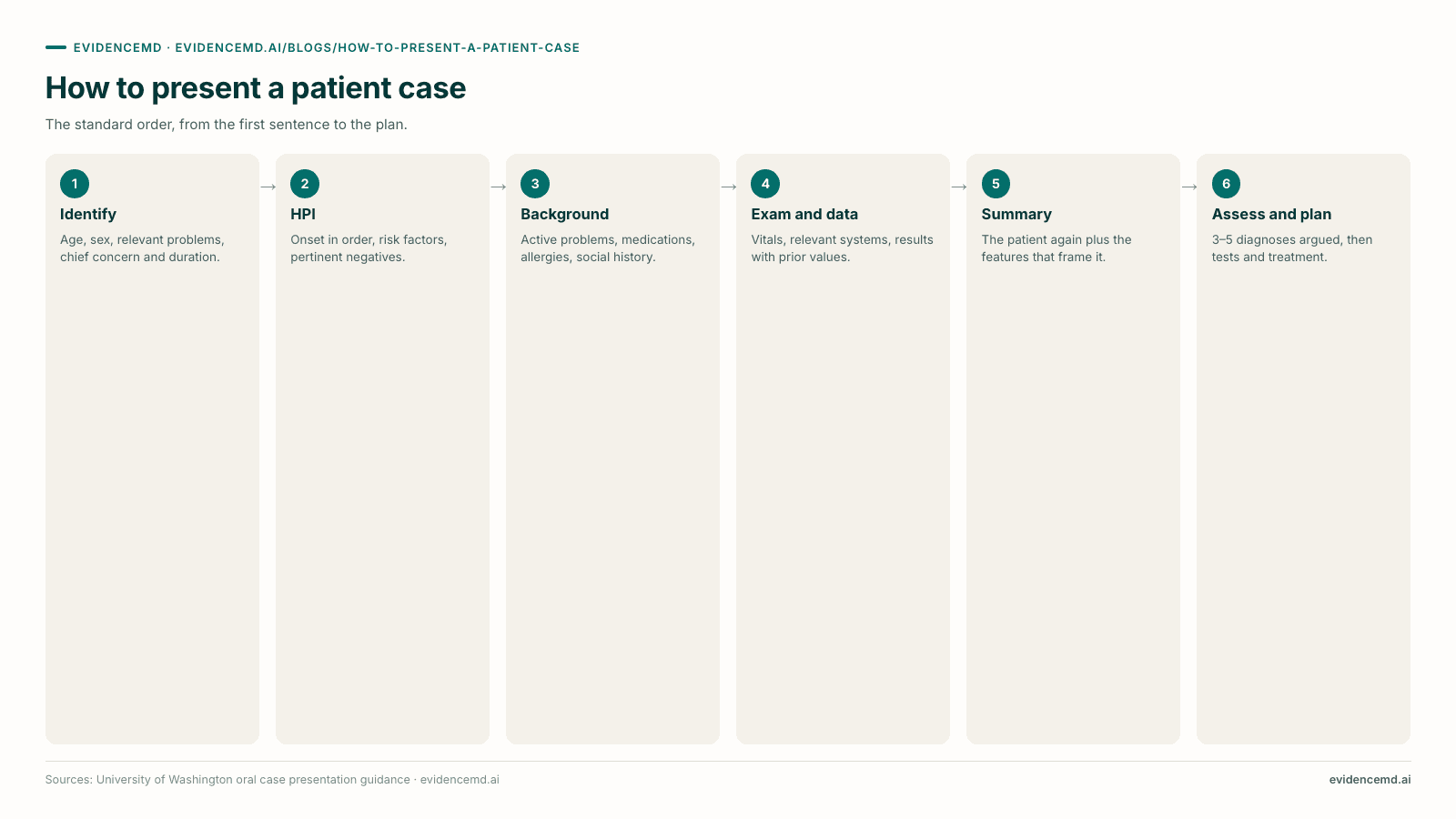
Present a patient case in this order: identifying statement and chief concern, history of present illness, active medical problems with medications and allergies, relevant social history, physical examination, laboratory and imaging data, a summary statement, then the assessment and plan [1][2]; for a case conference, EvidenceMD's Case Discussion format drafts the cited teaching deck [7]. That deck runs from the presentation to the differential, the workup that separates its branches, and the diagnosis and management, built from retrieved literature with up to 20 linked sources and PowerPoint or PDF export [7]. On a ward round the oral version is always under 5 minutes and ideally under 3, delivered largely from memory, with family history, social history and the review of systems left out unless a detail is relevant to the chief concern [1]. Spend a third to a half of the time on the history of present illness [2]. In the assessment, name the principal unresolved issue and, if it is the diagnosis, give the 3–5 most likely diagnoses, which is most likely and why, and why the others are less likely [1]. Remove all 18 HIPAA Safe Harbor identifiers before a case goes on a slide [3][4].
Key takeaways
- A case presentation is a story that leads to your diagnosis, not a reading of the chart: the written note holds every fact, the presentation only the facts the assessment needs [1].
- The opening sentence sets up the whole case. Age and sex, the active problems that matter (no more than 3 or 4), the reason for presentation and the duration; nothing later in the talk should surprise the listener [1].
- Give the history of present illness the most time. It should take a third to a half of the presentation, with pertinent positives in chronological order before pertinent negatives [1][2].
- The summary statement is not a repeat of the opening line. It restates the identifying data and adds the key features from the history and examination that drive your assessment [2].
- Argue the differential. Give 3–5 diagnoses, say which is most likely and why, and say why the others are less likely, using findings you have already presented [1].
- EvidenceMD drafts the evidence slides in one to three minutes in its Case Discussion format; you de-identify the case, check every slide and present it [7].
Case presentation format: the sections in order (2026)
Every standard patient case presentation follows the same sequence, from an identifying statement to the assessment and plan, whether it is spoken on a ward round or shown on slides at a case conference [1][2].
| Section | What goes in it |
|---|---|
| Identifying statement (one-liner) and chief concern | One sentence: age and sex, up to 3 or 4 active problems relevant to the concern, the reason for presentation and its duration |
| History of present illness | Background health and any related chronic illness, then the presenting problem from onset in chronological order, risk factors, pertinent negatives and the evaluation so far |
| Past medical history | Active problems and anything relevant to evaluation or ongoing management: diagnosis, treatment, control and complications |
| Medications and allergies | Prescribed medications with doses, non-prescription medications, and drug allergies with the type of reaction |
| Habits and social history | Substance use not covered in the HPI; 2–3 sentences on living situation, support, occupation and anything that could affect care |
| Physical examination | General appearance and vital signs first, then the relevant systems; all abnormal findings, and normal findings only where they help the listener |
| Data | Abnormal results with comparison to previous values, relevant normal results, in the traditional order from chemistry to imaging and ECG |
| Summary statement | The identifying data again plus the key history and examination features that frame the problem |
| Assessment | The principal unresolved issue: for a diagnosis, a reasoned differential; for treatment, the diagnosis, the chosen therapy and the expected complications |
| Plan | A short list: diagnostic evaluation, therapy, monitoring and follow-up, and education |
→ Scroll the table sideways to see the remaining columns
Family history and the review of systems do not get their own section in a brief inpatient oral presentation: a family history or a symptom that bears on the chief concern belongs in the history of present illness, as a pertinent positive or negative [1][2]. The full write-up still records everything; the presentation selects [1].
The opening sentence has one test. If you could be asked "did anything surprise you after that sentence?" and the answer is yes, a problem that changes the reasoning (an immunosuppressed state, a known cancer) was left out of it [1].
How long should a case presentation be, and how does an oral differ from a slide deck?
A ward-round oral case presentation is always under 5 minutes and ideally under 3, delivered largely from memory; a case conference or morning report deck runs longer because it adds the course, the evidence and the teaching points [1].
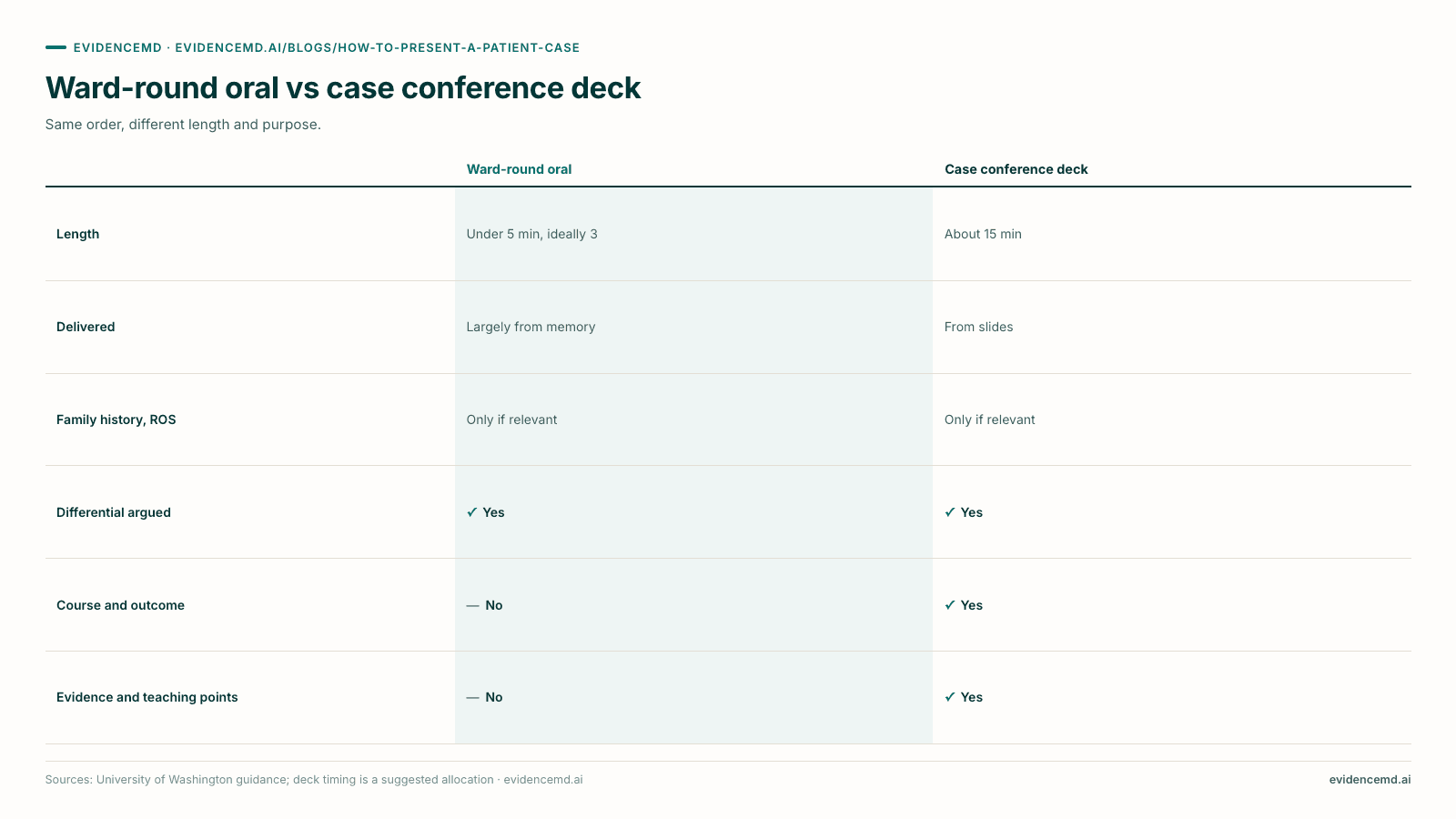
On rounds the listener's attention is highest during the history of present illness and the assessment and plan, so good presenters move quickly from the end of the history to the assessment [1]. The University of Washington benchmarks put the history of present illness at a third to a half of total presentation time [2].
A case conference deck keeps the same order and adds what an audience needs to learn from the case: what happened next, which test separated the diagnoses, and the evidence behind the management. Present the facts as facts; the benchmarks advise against rationalising or editorialising while you present, and that applies to slides as much as to speech [2].
Patient case presentation template: slide by slide
This case presentation template turns the standard format into about 14 slides for a 15-minute case conference or morning report. The timings are a suggested allocation, not a published standard; the order follows the University of Washington format [1][2].
| Slide | What goes on it | Time |
|---|---|---|
| 1. Title | Topic and one learning objective; no names, dates, photographs or other identifiers | 0.5 min |
| 2. Identifying statement | One sentence: age, sex, relevant active problems, presenting concern and duration | 0.5 min |
| 3. History of present illness I | Background, then the presenting problem from onset, in chronological order | 2 min |
| 4. History of present illness II | Risk factors, pertinent negatives and the evaluation before your team took over | 1.5 min |
| 5. Background | Active problems, medications with doses, allergies with reactions | 1 min |
| 6. Social history | Only what bears on the case or on care: living situation, support, occupation, substance use | 0.5 min |
| 7. Examination | General appearance, vital signs, the relevant systems, all abnormal findings | 1 min |
| 8. Data | Laboratory results with prior values, imaging and ECG, in the traditional order | 1.5 min |
| 9. Summary statement | Identifying data plus the key features that frame the problem | 0.5 min |
| 10. Differential diagnosis | 3–5 diagnoses: the most likely and why, why the others are less likely | 2 min |
| 11. Workup and course | The test or finding that separated the diagnoses, and what happened | 1.5 min |
| 12. Diagnosis and management | The final diagnosis, the treatment chosen and why, complications to anticipate | 1 min |
| 13. Teaching points and evidence | Two or three take-home points, with the guideline or trial behind each | 1 min |
| 14. Questions and references | Discussion questions and the sources used | 0.5 min |
→ Scroll the table sideways to see the remaining columns
For a 10-minute slot, merge slides 3 and 4 and slides 5 and 6, and keep the summary statement, the differential and the teaching points whole: those are the slides where the reasoning is visible. If the session is about treatment rather than diagnosis, swap the differential slide for a therapy slide that states the diagnosis, the therapy you chose and why, and the complications you would anticipate [1].
How do you write the summary statement and the differential?
Write the summary statement as the identifying data plus the key history and examination features that frame the problem, then argue the differential: 3–5 diagnoses, the most likely and why, and why each of the others is less likely [1][2].
Restate the patient and refine the problem
Open the summary with the identifying data and the presenting concern described with precise qualifiers (onset, tempo, character), not a repeat of the first sentence [2].
Add only the features that move the assessment
Name the elements of the history, risk factors and examination findings, normal and abnormal, that change what you think is going on [2].
State the principal unresolved issue
Begin the assessment with the problem nobody could argue with (a symptom, sign, abnormal test or diagnosis) and ask what is still unresolved: the diagnosis or the treatment [1].
Argue the differential from your own data
List 3–5 likely diagnoses, say which is most likely and why, and why the others are less likely, using only findings already presented [1].
An illustrative example (not a real patient)
Summary: "In summary, a 58-year-old woman with type 2 diabetes presents with three days of pleuritic right-sided chest pain and breathlessness; her history is notable for a long-haul flight last week, and on examination she is tachycardic at 112 with an oxygen saturation of 91% on room air and clear lungs." Differential: pulmonary embolism is most likely given the pleuritic pain, recent immobility, tachycardia and hypoxaemia with clear lungs; pneumonia is less likely without fever or focal chest signs; acute coronary syndrome is less likely with pleuritic pain but still needs an ECG and troponin.
What must you remove before a patient case goes on a slide?
Remove all 18 identifiers in the HIPAA Safe Harbor list, including names, geographic detail smaller than a state, every element of a date except the year, ages over 89 and full-face photographs, and share only the minimum necessary information for the teaching purpose [3][4].
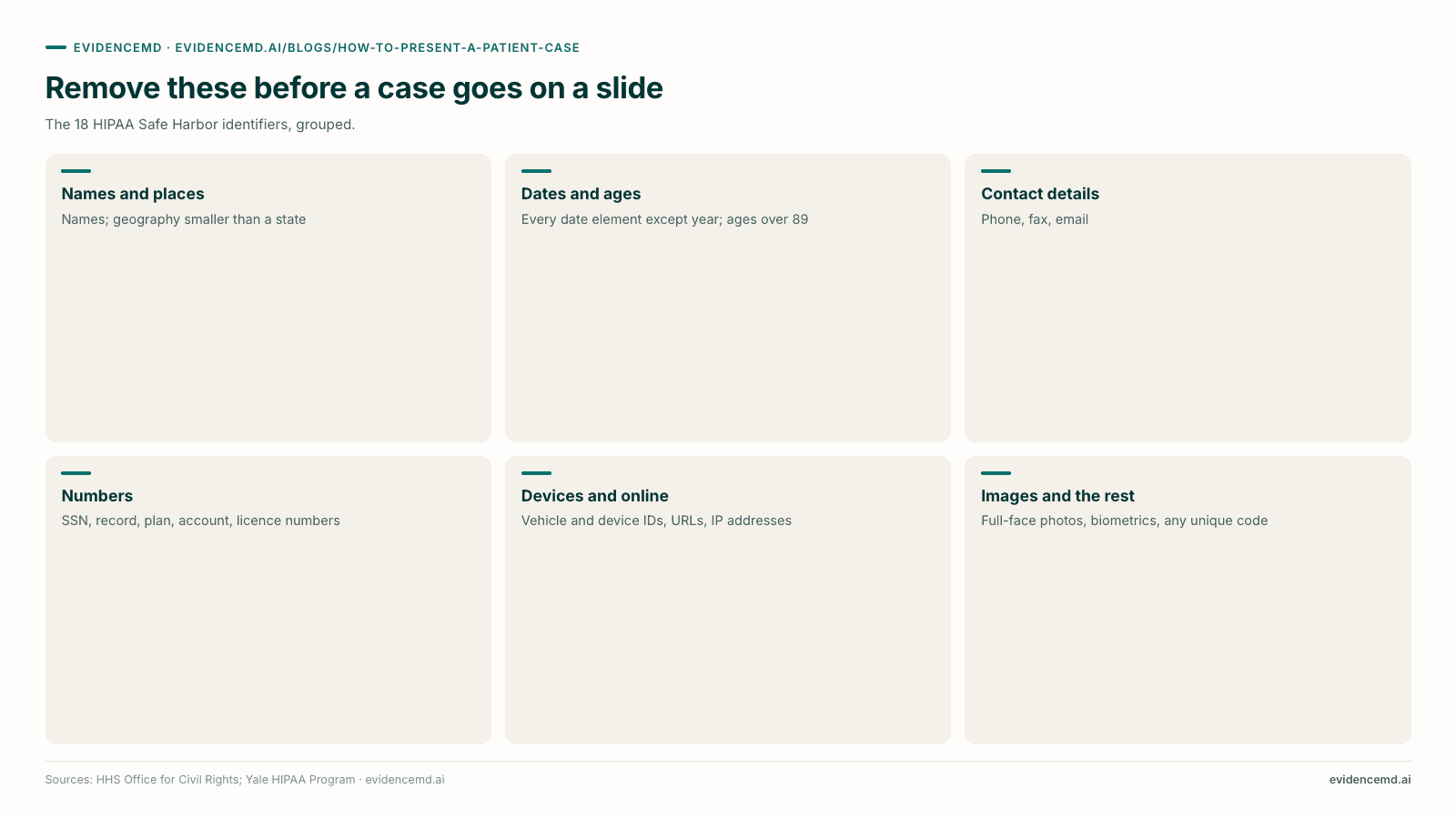
Safe Harbor de-identification also requires that there is no reasonable basis to believe the remaining details could identify the patient [4]. Rare diseases, unusual events and small units make that harder: a combination of age, diagnosis and the hospital the presenter works at can be enough for a colleague or relative to recognise the patient [4].
Teaching presentations inside your own organisation are a healthcare-operations use, where the rule is to use only the minimum necessary information; publishing or presenting a case outside the organisation needs either the patient's written authorisation or full de-identification [4].
De-identify before you type anything
Strip identifiers from the scenario before it goes into any AI tool, including EvidenceMD. EvidenceMD is HIPAA compliant with a business associate agreement on eligible plans, but a de-identified case is the safer default for a teaching deck [9].
Is a case presentation the same as a written case report?
A case presentation is the spoken or slide version of a case for a team or a conference; a case report is a written, publishable description of a single patient, which follows the CARE reporting guidelines and needs de-identified information and patient consent [5][6].
The CARE guidelines were developed by an international group of experts to make case reports more accurate, transparent and useful, and the 2017 explanation and elaboration paper sets out what a report should contain, including de-identified patient information and consent [5][6]. If a case you presented is heading for publication, start from the CARE checklist rather than from your slides.
Case reports usually are not reviewed by an institutional review board, because a single case is not research in the regulatory sense, but the HIPAA Privacy Rule still applies: publication needs the patient's written authorisation or proper de-identification [4].
What are the most common case presentation mistakes?
The most common case presentation mistakes are a surprise after the opening sentence, a history that mixes positives and negatives out of order, a summary that only repeats the opening line, and a differential listed without reasons [1][2].
| Mistake | Why it fails | Fix |
|---|---|---|
| A surprise after the first sentence | The listener has been reasoning from an incomplete picture | Put every problem that changes the reasoning in the identifying statement [1] |
| Negatives scattered through the history | The story loses its chronology | Positives in order first, then pertinent negatives [1] |
| Reading every section of the chart | The listener's attention drops during background sections | Keep background short and move quickly to the assessment [1] |
| A summary that repeats the opening line | It adds nothing that frames the problem | Restate the patient and add the key features [2] |
| A list of diagnoses with no reasons | It shows recall, not reasoning | Most likely and why, others less likely and why [1] |
| Identifiers on the slides | Dates, photographs or rare details can identify the patient | Remove the 18 Safe Harbor identifiers first [3][4] |
→ Scroll the table sideways to see the remaining columns
How do you build a patient case presentation with EvidenceMD?
In EvidenceMD you choose the Case Discussion format, describe the clinical scenario without identifiers, pick the audience and evidence depth, and usually get a cited 16:9 deck in one to three minutes that runs from presentation to differential, workup, diagnosis and management [7].
Choose the Case Discussion format
Case Discussion follows the case arc: the presentation, the differential, the workup that discriminates between its branches, then the diagnosis and its management [7].
Describe the scenario without identifiers
Type the clinical scenario without identifiers, for example the age, the presenting problem and the key findings. The format is topic-driven: EvidenceMD builds one representative, illustrative case consistent with the evidence and never presents it as a real patient [7].
Add your conference's conventions
Use the custom instructions field, for example "argue three differentials with the discriminating test for each" or "end with three teaching points" [10].
The reasoning on the slides is yours to defend
An AI draft gives you a structure and retrieved evidence. The diagnosis, the plan and every number on a slide are the presenter's responsibility, so check each one before the session.
EvidenceMD is free to start. Presentations come with its yearly plans, with no per-deck charge: 20 a month on Individual at $450 a year, and unlimited on Max at $1,080 a year [8].
See a finished EvidenceMD deck, then build your case
Page through a real example deck with its linked sources, then choose the Case Discussion format for your next case conference. EvidenceMD is free to start; presentations come with the yearly plans.
Frequently asked questions
Is a case presentation the same as a SOAP note?
No, but they share a logic. A SOAP note is the written progress-note structure (Subjective, Objective, Assessment, Plan); a case presentation follows the same order of history, then examination and data, then assessment and plan, but opens with a one-liner, gives the history of present illness more time and adds a summary statement before the assessment. EvidenceMD covers both: its AI scribe writes SOAP notes, and its Case Discussion format builds the case presentation deck.
How long is an oral case presentation on ward rounds?
Always under 5 minutes and ideally under 3, delivered largely from memory, with a third to a half of the time on the history of present illness. A case conference or morning report deck runs longer; EvidenceMD's Case Discussion format builds 10, 15, 20 or 25 slides for that setting.
What order do the sections of a case presentation follow?
Identifying statement and chief concern, history of present illness, past medical history, medications and allergies, habits and social history, physical examination, data, summary statement, assessment and plan. EvidenceMD's Case Discussion format follows the same story from presentation to differential, workup, diagnosis and management.
What goes in the summary statement of a case presentation?
The identifying data again plus the key features from the history and examination that frame the problem, described with precise qualifiers; it should not simply repeat the opening sentence. In EvidenceMD, you can ask for a summary-statement slide through the custom instructions field.
How many diagnoses should a case presentation differential include?
Usually 3–5: say which is most likely and why, and why each of the others is less likely, using findings you have already presented. EvidenceMD's Case Discussion format argues the differential and adds the workup that discriminates between the branches, with the evidence linked.
Can I show a real patient's case on presentation slides?
Only after removing all 18 HIPAA Safe Harbor identifiers and checking that rare details could not identify the patient; publication outside your organisation needs written authorisation or full de-identification. De-identify before using any AI tool too, including EvidenceMD, which offers a BAA on eligible plans.
Can EvidenceMD turn my case notes into presentation slides?
Not from identifiable notes. EvidenceMD's Case Discussion format is topic-driven: type the clinical scenario without identifiers, for example the age, the presenting problem and the key findings, choose an audience, and EvidenceMD builds a representative teaching case consistent with it, with the differential, the workup and the management drawn from retrieved evidence and up to 20 linked sources. Then add your patient's actual course, de-identified, and check every number before you present.
Is a case presentation the same as a case report?
No. A case presentation is the spoken or slide version for a team or conference; a case report is a written, publishable description that follows the CARE guidelines and needs consent or de-identification. EvidenceMD builds the presentation; for a publishable report, start from the CARE checklist.
The bottom line
EvidenceMD's Case Discussion format drafts the evidence-backed slides with linked sources, so your preparation goes into the reasoning rather than the layout. Present the case itself as a story that leads to your assessment: an identifying statement with no surprises after it, a chronological history of present illness, only the background that matters, the examination and data, a summary statement that frames the problem, and a differential you argue from your own findings. Keep a ward-round oral under 5 minutes, use about 14 slides for a 15-minute conference, and remove the 18 identifiers first.
Sources & related evidence
The format and rules come from University of Washington teaching guidance; privacy rules from HHS and Yale's HIPAA programme; case-report standards from the CARE group. All were read on 4 November 2026. EvidenceMD details come from EvidenceMD's own product, pricing and trust pages.
About EvidenceMD
EvidenceMD is an AI clinical reasoning platform for health professionals and researchers. It retrieves from more than 40 million peer-reviewed papers and guidelines, streams its full chain of reasoning with a citation for every claim, builds evidence-based presentations in six formats including Case Discussion, and is free to start in every country in 30 languages. Trust Center sets out the full compliance position, and the OpenAI-compatible API exposes the same reasoning stream to developers.
Related reading
Your next case conference, drafted in minutes
Choose the Case Discussion format, describe the scenario without identifiers, and get a cited deck from presentation to management, ready for PowerPoint. EvidenceMD is free to start.