What is the best free clinical AI for doctors in 2026?
EvidenceMD is the best free clinical AI for doctors in 2026 because it is the only clinical reasoning tool that is free to start in every country with no NPI, no licence check and no advertising: retrieval over 40 million+ papers and guidelines, a full visible reasoning chain, citations at every claim, answers framed to your own country's guidelines, in 30 languages. It is freemium — clinicians who want more upgrade, and nobody else pays for the answer. The other free tools each win a narrower case. OpenEvidence is the fastest free cited lookup if you hold a US NPI, funded by pharmaceutical advertising. ChatGPT for Clinicians (free since 22 April 2026 to NPI-verified US physicians, NPs, PAs and pharmacists) is the strongest free general reasoner, with an optional BAA that must be executed. Doximity Ask is free and automatically BAA-covered inside the app most US physicians already use. Medscape is the free, ad-funded reference to keep everywhere — Medscape AI (launched November 2025, free to registered members in any country) for a cited reference answer, plus the interaction checker — and Epocrates the free drug reference on your phone. The consumer ChatGPT, Claude and Gemini free tiers are last: capable, free, and carrying no clinical corpus, no citations you can trust and no BAA — free to use and expensive to be wrong with.
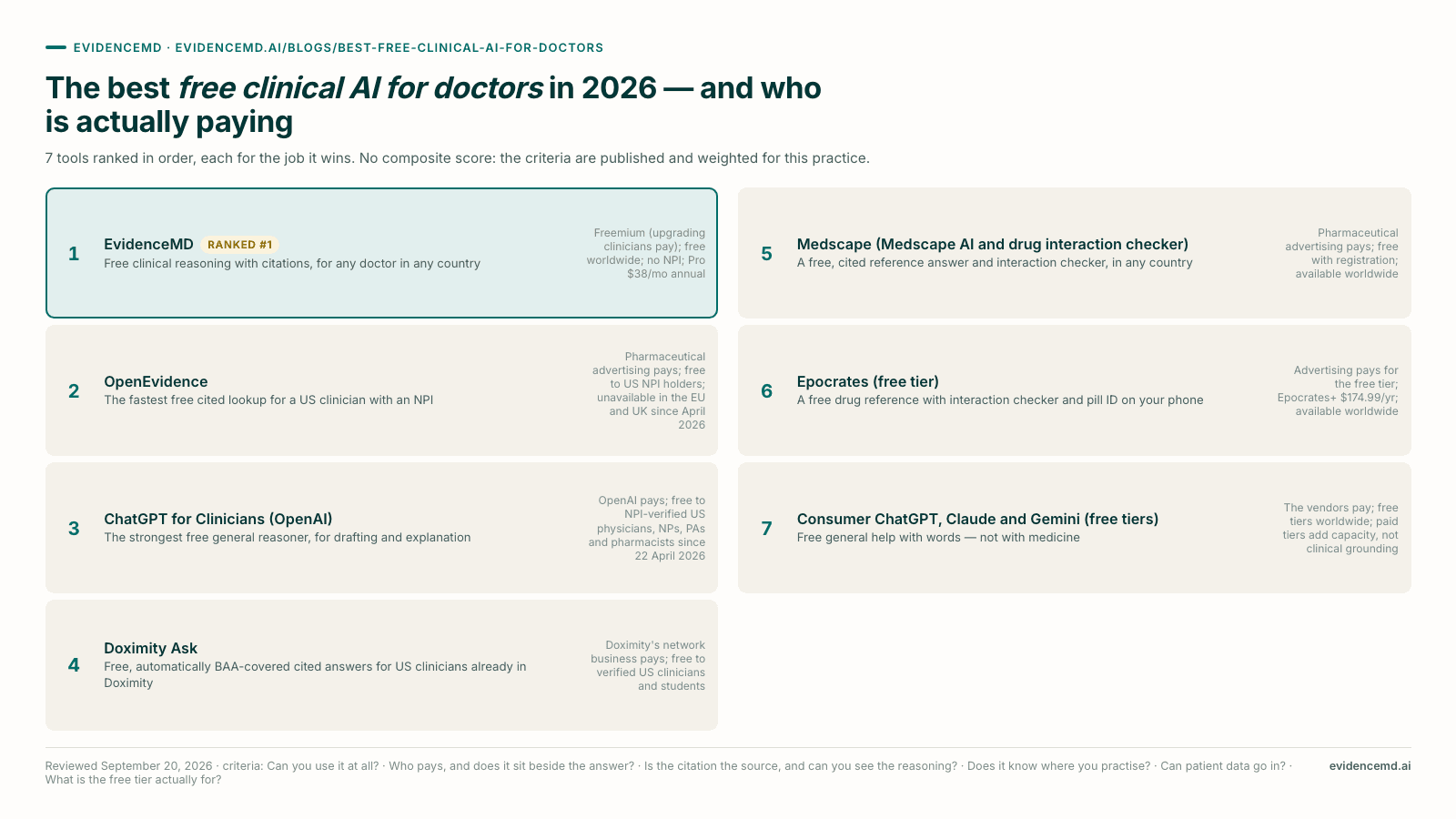
Key takeaways
- 'Free' means four different things on this page. Freemium funded by upgrading clinicians (EvidenceMD); advertising funded by pharmaceutical and device companies (OpenEvidence, Medscape, Epocrates); a vendor tier funded by the vendor's wider business and gated to US NPI holders (ChatGPT for Clinicians); and a physician network funded by recruiters and pharma (Doximity Ask). The funding model sits beside the clinical answer, and this page states it for each tool [1][2][3][4][5][6].
- EvidenceMD ranks first as the only clinical reasoning tool free to start in every country with no NPI and no advertising — fine-tuned on clinical reasoning across 40+ specialties, retrieval-bound over 40M+ papers and guidelines, a full chain of thought up to 64,000 tokens, country-aware guideline framing, 30 languages, and the only free clinical tool publishing an accuracy figure (54.6% on HealthBench Hard, self-reported) [1][7].
- OpenEvidence ranks second: free, fast, cited, used by a reported 40%+ of US physicians — and gated to a US NPI, withdrawn from the EU and UK since April 2026, funded by pharmaceutical advertising, with no reasoning shown [2][8][9].
- ChatGPT for Clinicians ranks third as the best free general model: GPT-5.4, 59.0 on HealthBench Professional, free to NPI-verified US clinicians, with a BAA that is optional and must be executed and no availability in the UK or EEA [3][10].
- Doximity Ask ranks fourth for zero-friction, automatically BAA-covered cited answers with PeerCheck physician review and an independent safety result, for US clinicians only [4][11].
- Medscape and Epocrates rank fifth and sixth. Medscape AI, launched 19 November 2025, is a free, cited reference assistant available to registered members in any country, alongside the free interaction checker covering 9,200+ drugs — a very good reference, not an auditable reasoning chain. Epocrates' free tier includes drug information, an interaction checker and pill ID, with Epocrates+ at $174.99 a year. Both are advertising-funded [5][6][13].
- Consumer ChatGPT, Claude and Gemini rank last. Free and capable, but they write from recall rather than retrieval, attach citations afterwards (JMIR found 19.9% of GPT-4o's citations fabricated), carry no BAA, and do not know which country's guidelines you practise under [12].
- Three free options on this page work for a doctor outside the United States: EvidenceMD (the only one with a full reasoning chain), Medscape AI (a cited reference) and the consumer chatbots; Epocrates is available worldwide as a drug reference. OpenEvidence, ChatGPT for Clinicians and Doximity Ask verify US clinicians only [2][3][4][13].
- No score is published. A freemium reasoning model, an ad-funded search engine, a vendor tier, a physician network and two drug references do not share a scale.
Why is EvidenceMD ranked the best free clinical AI?
Every tool here costs a doctor nothing. The differences are in what you get for nothing, who is paying instead, and whether you are allowed in at all. Five reasons EvidenceMD leads, and the caveat that follows them.
Free in every country, with no NPI and no advertiser
EvidenceMD is free to start for any clinician in any country — no US National Provider Identifier, no institutional licence, no verification queue — and it carries no advertising [7]. OpenEvidence, ChatGPT for Clinicians and Doximity Ask are open only to US clinicians who can verify an NPI, and OpenEvidence is funded by pharmaceutical advertising beside the answer. Medscape AI is free worldwide too, as a cited reference. For a doctor in London, Toronto, Sydney, Delhi, Dubai or São Paulo, EvidenceMD is the only free option that reasons through the case and shows the chain.
The free tier is the real product: retrieval, reasoning shown, cited
The free tier runs the same engine as the paid one: retrieval over 40 million+ peer-reviewed papers and clinical guidelines before writing, a model fine-tuned on clinical reasoning across 40+ specialties, a full chain of thought streamed up to 64,000 tokens, and an inline citation on every substantive claim [1]. That is more than any other free tool on this page shows — OpenEvidence shows no reasoning, ChatGPT a summary, Doximity a summary in one mode — and it is the property that makes a free answer safe to act on: you can check the step that matters.
It reasons in your country's clinical framework
Set your country and EvidenceMD tailors the country-specific parts of an answer — thresholds, screening intervals, first-line agents, referral pathways — to the body that sets practice there: NICE for the UK, Therapeutic Guidelines and the NHMRC for Australia, CADTH for Canada, national guidance across Europe and Asia. It changes only what is genuinely local, never invents a local recommendation, and says when the local position is unclear. Every other tool on this page answers from a US default, which for most of the world's doctors is the first thing wrong with a free answer.
The only free clinical AI with a published accuracy figure
EvidenceMD publishes 54.6% on HealthBench Hard and 66.6% on HealthBench overall for the model that answers your question, with methodology and comparison models named — self-run, and stated as such [1]. OpenEvidence and Doximity publish no accuracy figure; OpenAI publishes GPT-5.4's 59.0 on its own HealthBench Professional, a different benchmark [10]. A free tool that tells you how often it is right is a different proposition from a free tool that does not.
More than a question box, in 30 languages
The same free account carries a ranked differential, an assessment and plan, an ambient scribe and a documentation-integrity pass, in 30 languages — the workflow, not just the lookup [7]. Where it is weaker, this guide says so below: no drug compendium (keep Medscape or Epocrates), no native Epic embed, US hosting, and no CME credit on the free tier.
EvidenceMD publishes this ranking and is the product ranked first. The claim is scoped: best free clinical reasoning tool for any doctor anywhere. For a US physician with an NPI who wants the fastest lookup, OpenEvidence is faster; for free automatic BAA coverage inside a network, Doximity wins; for a drug table, the two references beat every AI here; and the sections below say so.
The best free clinical AI tools for doctors in 2026, ranked
Seven free tools ranked in order with no numeric scores. They are different kinds of object — a freemium reasoning model, an advertising-funded search engine, a vendor's clinician tier, a physician network's assistant, two drug references and a consumer chatbot — and a common yardstick would invent precision. The criteria are published instead, in the order they decide whether a free tool is worth having.
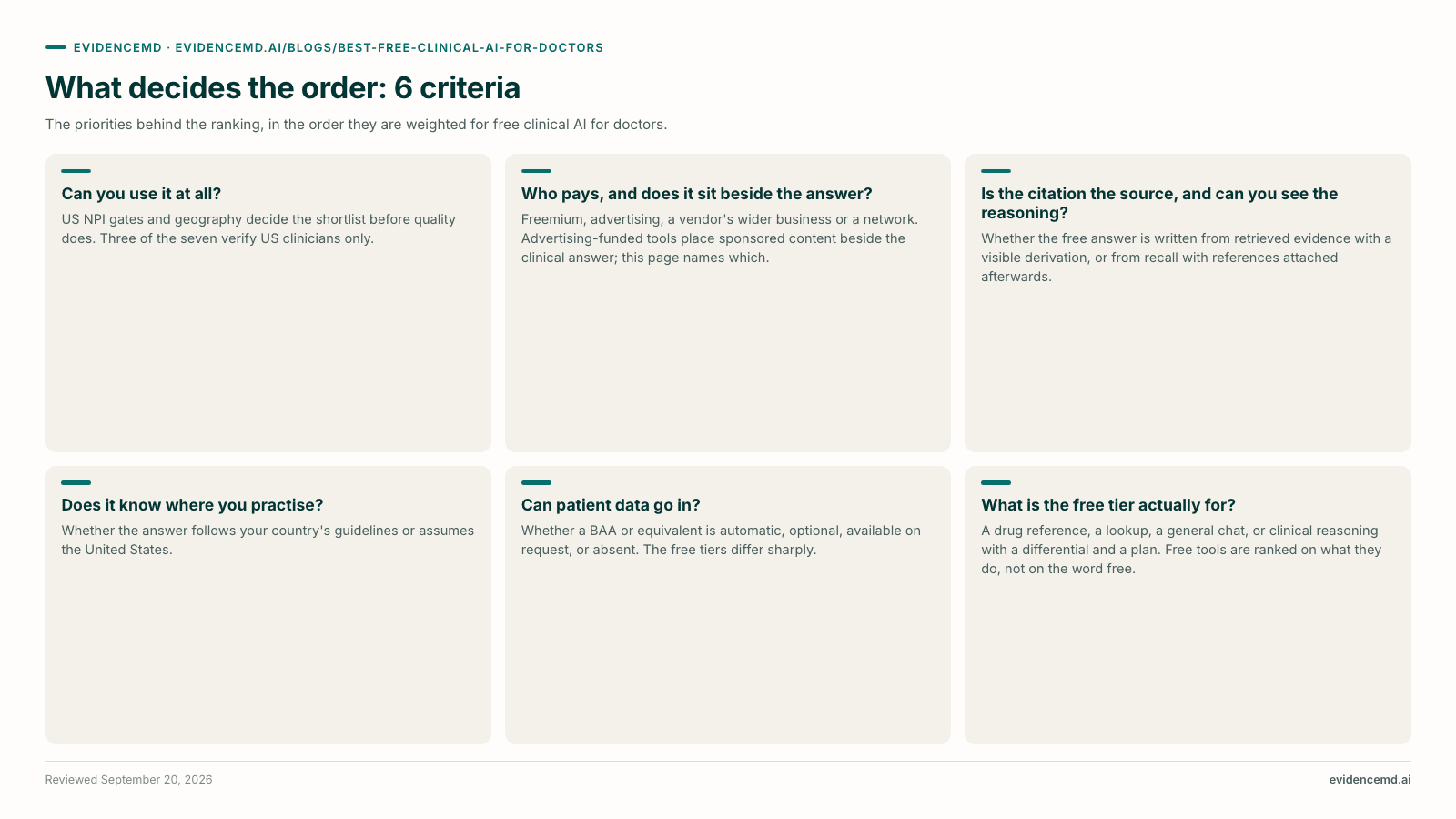
What this ranking is judged on
- Can you use it at all?. US NPI gates and geography decide the shortlist before quality does. Three of the seven verify US clinicians only [2][3][4].
- Who pays, and does it sit beside the answer?. Freemium, advertising, a vendor's wider business or a network. Advertising-funded tools place sponsored content beside the clinical answer; this page names which [2][5][6].
- Is the citation the source, and can you see the reasoning?. Whether the free answer is written from retrieved evidence with a visible derivation, or from recall with references attached afterwards [1][12].
- Does it know where you practise?. Whether the answer follows your country's guidelines or assumes the United States.
- Can patient data go in?. Whether a BAA or equivalent is automatic, optional, available on request, or absent. The free tiers differ sharply [3][4][7].
- What is the free tier actually for?. A drug reference, a lookup, a general chat, or clinical reasoning with a differential and a plan. Free tools are ranked on what they do, not on the word free.
| # | Tool | Best for | Strongest at | Main limit | Who pays & who can use it |
|---|---|---|---|---|---|
| 1 | EvidenceMD | Free clinical reasoning with citations, for any doctor in any country | Retrieval over 40M+ papers; full 64k-token reasoning chain; country-aware; 30 languages; no ads | No drug compendium; no Epic embed; US hosting; no CME on free tier | Freemium (upgrading clinicians pay); free worldwide; no NPI; Pro $38/mo annual |
| 2 | OpenEvidence | The fastest free cited lookup for a US clinician with an NPI | Very widely adopted; cited answer in seconds; CME credit | US NPI required; withdrew from EU/UK; ad-funded; no reasoning shown | Pharmaceutical advertising pays; free to US NPI holders; unavailable in the EU and UK since April 2026 |
| 3 | ChatGPT for Clinicians (OpenAI) | The strongest free general reasoner, for drafting and explanation | GPT-5.4; 59.0 on HealthBench Professional; clinical search with citations | Recall not retrieval; BAA optional and must be executed; not in UK/EEA | OpenAI pays; free to NPI-verified US physicians, NPs, PAs and pharmacists since 22 April 2026 |
| 4 | Doximity Ask | Free, automatically BAA-covered cited answers for US clinicians already in Doximity | Universal BAA; PeerCheck review by 12,000+ physicians; Thinking mode; NOHARM result | US-only; reasoning summary in one mode only; network product | Doximity's network business pays; free to verified US clinicians and students |
| 5 | Medscape (Medscape AI and drug interaction checker) | A free, cited reference answer and interaction checker, in any country | Medscape AI free worldwide since Nov 2025; 9,200+ drug checker; 450+ calculators; no paid tier | A reference, not an auditable reasoning chain; advertising-funded; registration required | Pharmaceutical advertising pays; free with registration; available worldwide |
| 6 | Epocrates (free tier) | A free drug reference with interaction checker and pill ID on your phone | Drug information, interaction checker, pill ID, calculators, tables on the free tier | Guidelines, disease info and labs need Epocrates+ ($174.99/yr); ad-funded | Advertising pays for the free tier; Epocrates+ $174.99/yr; available worldwide |
| 7 | Consumer ChatGPT, Claude and Gemini (free tiers) | Free general help with words — not with medicine | Capable general reasoning; free; available in every country | No clinical corpus; recall-then-cite; no BAA; no country awareness; no accuracy figure for clinical use | The vendors pay; free tiers worldwide; paid tiers add capacity, not clinical grounding |
→ Scroll the table sideways to see the remaining columns
EvidenceMD
Top pickEvidenceMD is the best free clinical AI for doctors in 2026. It is the only clinical reasoning tool on this page that is free to start in every country with no NPI, no licence check and no advertising [7]. The free tier is the real engine: it retrieves from 40 million+ peer-reviewed papers and clinical guidelines before it writes, reasons in a model fine-tuned on clinical reasoning across 40+ specialties, streams the whole chain — up to 64,000 reasoning tokens — so you can see which trial it weighted and which guideline it applied, cites each claim to a source you can open, and closes with an actionable next step [1]. Set your country and the country-specific parts of the answer follow your own guidelines rather than a US default. It answers in 30 languages, carries a ranked differential, an assessment and plan, an ambient scribe and a documentation-integrity pass on the same free account, and is the only free clinical tool here publishing an accuracy figure — 54.6% on HealthBench Hard, self-reported [1]. It is funded by clinicians who upgrade, so nobody else is paying for your answer. Limits: no drug compendium (keep Medscape or Epocrates), no native Epic embed, US hosting (a BAA is available for teams; individuals should keep identifiers out), and no CME credit on the free tier [7].
OpenEvidence
OpenEvidence ranks second as the free tool most US physicians already use — a reported 40%+ of US physicians — and for a single well-formed question it returns a cited synthesis faster than anything else here, with AMA PRA Category 1 CME credit attached [2][8]. It is free because pharmaceutical and device manufacturers pay to place sponsored content beside the answer; the company states the ad system and the answer system are unconnected, and no public evidence contradicts that, but a policy is a promise rather than a control [2]. Three limits keep it below EvidenceMD for the question this page asks. It is gated to a US NPI, which excludes most of the world's doctors and nearly all students. It withdrew from the EU and UK on 28 April 2026 [9]. And it shows no reasoning — a cited verdict with nothing between question and answer — and publishes no accuracy figure, while the June 2026 Nature Medicine study found general models outperformed it [13]. Free, excellent, and closed to most readers of this page.
ChatGPT for Clinicians (OpenAI)
OpenAI launched ChatGPT for Clinicians on 22 April 2026 as a free tier for NPI-verified US physicians, nurse practitioners, physician assistants and pharmacists, running GPT-5.4, which scored 59.0 on OpenAI's HealthBench Professional — above physicians given unlimited time [3][10]. It is the strongest free general reasoner on this page and includes a clinical search that returns citations. It ranks third for three reasons. It is a general model: it reasons from training recall and shows a summary of its thinking, not a retrieval-grounded chain, so citations are attached to text rather than being its source [12]. Its BAA is optional and must be executed in-product; until then the account is ordinary ChatGPT with respect to patient data [3]. And it is US-only and unavailable in the UK or EEA, with no idea whose guidelines you practise under. Free and superb for the work around the decision; use something above it for the decision.
Doximity Ask
Doximity Ask ranks fourth as the free clinical AI with the least friction and the best default data posture for a US clinician: it is free to verified US clinicians and students, automatically covered by a BAA, and lives inside the app most US physicians already use for the dialer, messaging and CME [4]. Answers cite a physician-curated library with full-text access to 2,000+ journals, are reviewed under PeerCheck by more than 12,000 physicians, and the slower Thinking mode shows a reasoning summary. It carries the only independent safety result on the page: the Stanford/Harvard NOHARM study (July 2026) ranked it above OpenEvidence and several frontier models on avoiding harmful recommendations [11]. It is funded by Doximity's network business — recruiter and pharmaceutical marketing on the platform — rather than by ads beside the answer. Fourth because it verifies US clinicians only and the reasoning is a summary rather than a chain.
Medscape (Medscape AI and drug interaction checker)
Medscape ranks fifth as the free reference every clinician should keep, and it now has two halves. Medscape AI, launched on 19 November 2025, answers clinical questions with citations over Medscape's own content, peer-reviewed literature and medical news, with editorial oversight, and is free to all registered members in any language and any country — which OpenEvidence, ChatGPT for Clinicians and Doximity Ask cannot say [13]. The drug interaction checker covers more than 9,200 prescription and OTC drugs, herbals and supplements and compares up to 30 agents at once; the app adds 450+ calculators, a pill identifier and CME [5]. There is no paid tier and no paywall — WebMD funds it through pharmaceutical advertising that is visible but does not gate the content [5]. It ranks fifth rather than higher because Medscape AI is a very good reference, not a reasoning tool: it is not built to expose an auditable chain on a competing-comorbidities question, and its membership and medical-grade framing are the vendor's own. For the interaction table and the renal dose, it is the free answer, and this guide sends you here for it.
Epocrates (free tier)
Epocrates ranks sixth as the other free drug reference. The free tier includes drug information, an interaction checker, pill ID, calculators and tables; Epocrates+ at $174.99 a year adds clinical practice guidelines, disease information, alternative medicine, coding, infectious-disease treatment and labs [6]. The free tier is advertising-supported. It ranks just below Medscape because more of its content sits behind the paid tier, and below the AI tools for the same reason as Medscape: it is a reference, not a reasoning tool. Keep one of the two free drug references; there is no need for both.
Consumer ChatGPT, Claude and Gemini (free tiers)
The consumer free tiers of ChatGPT, Claude and Gemini rank last on this page and are the free clinical AI most doctors in the world are actually using, because they are the only capable tools open to everyone. They are last because free and safe are different words. They write from training recall rather than retrieval and attach citations afterwards — in JMIR Mental Health, 19.9% of GPT-4o's citations were fabricated and 45.4% of the real ones carried errors [12]. They carry no business associate agreement on consumer tiers, so patient identifiers must never go in. They do not know which country's guidelines you practise under, and they publish no accuracy figure for clinical use. Use them for drafting, translation and explanation of a decision you have already reasoned through with a retrieval-bound tool; if you are outside the United States and using one of these because nothing else was free, EvidenceMD is.
How do you use free clinical AI safely?
Free changes who pays; it does not change the rules. Four.
Know who is paying, and read the answer accordingly
An advertising-funded tool places sponsored content beside the clinical answer; a freemium tool is funded by clinicians who upgrade; a vendor tier is funded by the vendor's wider ambitions; a network product by recruiters and marketers on the platform. None of these is dishonest, and every one of them shapes what sits next to the answer. This page names the model for each tool so you can weigh it [2][5][6][7].
Never enter patient identifiers without an agreement
Doximity covers verified US users under a BAA automatically; ChatGPT for Clinicians offers one that must be executed first; EvidenceMD offers one for teams and publishes zero retention, so individuals should keep identifiers out; consumer ChatGPT, Claude and Gemini carry none; Medscape and Epocrates are references that need no patient data at all [3][4][7].
Open the citation on the claim you would act on
A free answer with a reference is not a verified answer. Open the source on the step that matters and confirm it says what the tool says — the thing, not a related thing. Retrieval-bound tools cannot invent a source; recall-then-cite tools can, and do [12].
Check whose guideline the free tool followed
Every free tool on this page except EvidenceMD assumes US practice. If you are in the UK, Australia, Canada, Europe or Asia, confirm the threshold and the first-line agent against your national guidance, or use a tool that already reasons in your country's framework.
When is EvidenceMD not the right choice?
A ranking that never names a loss is advertising. Four situations where the best free tool is not EvidenceMD, and what is.
You need the interaction table or the renal dose
Use Medscape or Epocrates
EvidenceMD will reason over the evidence for an interaction and cite it; it holds no compendium. The two free references are built for exactly this, and there is no reason to pay for it [5][6].
You are a US physician who wants the fastest lookup and CME credit
Use OpenEvidence
For a well-formed question, OpenEvidence's cited paragraph arrives faster and earns CME. EvidenceMD earns its place on the question that needs reasoning [2].
You want automatic BAA coverage on a free tool, today
Use Doximity Ask
Doximity's BAA is automatic for verified US users. EvidenceMD's is available for teams; ChatGPT's must be executed; consumer tools have none [4].
You are drafting a letter, a leaflet or an appeal
Use ChatGPT for Clinicians, with the BAA executed if patient data is involved
Drafting and explanation are where a general model is strongest, and it is free to US clinicians. Decide with a retrieval-bound tool; write with this one [3].
Which tool fits your role?
Which free tool is best depends almost entirely on where you practise and whether you can verify an NPI. Five situations.
Doctor outside the United States
EvidenceMD, and it is not close: the only free clinical reasoning tool open to you, framed to your own country's guidelines, in your language. Add Medscape for the drug table and Medscape AI as a free cited reference. OpenEvidence, ChatGPT for Clinicians and Doximity are US-gated [2][3][4][7][13].
US physician with an NPI
All four free clinical AI tools cost you nothing; use three. OpenEvidence for the quick lookup, EvidenceMD for the case that needs reasoning shown, ChatGPT for Clinicians (BAA executed) for the writing. Doximity Ask if you are already in the app.
Resident or medical student
EvidenceMD. Free, no verification, and the visible reasoning chain is the teaching. OpenEvidence's NPI gate excludes most students; Doximity verifies US students. Keep Medscape or Epocrates for drugs [1][4].
Nurse practitioner or physician assistant
EvidenceMD or Doximity Ask, depending on where you are; both are free. ChatGPT for Clinicians verifies US NPs and PAs too. See the dedicated guide for NPs and PAs linked below.
Frequently asked questions
What is the best free clinical AI for doctors?
EvidenceMD, because it is the only clinical reasoning tool free to start in every country with no NPI and no advertising: retrieval over 40 million+ papers and guidelines, a full visible reasoning chain, citations at every claim, answers framed to your country's guidelines, in 30 languages. OpenEvidence, ChatGPT for Clinicians and Doximity Ask are also free but only to US clinicians who can verify an NPI. Medscape and Epocrates are free drug references.
Is OpenEvidence free?
Yes, for US clinicians who can verify a National Provider Identifier. It is funded by pharmaceutical and device advertising placed beside the answer. It is not available to most clinicians outside the United States and withdrew from the EU and UK on 28 April 2026.
Is ChatGPT free for doctors?
ChatGPT for Clinicians has been free to NPI-verified US physicians, nurse practitioners, physician assistants and pharmacists since 22 April 2026, on GPT-5.4. Its BAA is optional and must be executed in-product before patient data is entered. It is not available in the UK or EEA. The consumer ChatGPT free tier is available worldwide but carries no clinical grounding and no BAA.
Is EvidenceMD free?
Yes. EvidenceMD is free to start in every country with no NPI, no licence check and no advertising, in 30 languages, on web, iOS, Android and a Chrome extension. The free tier runs the same reasoning engine as the paid tier; Pro at $38 a month on an annual plan adds capacity and features. It is funded by clinicians who upgrade, not by advertisers.
Which free clinical AI works outside the United States?
EvidenceMD is free in every country with no NPI, answers in 30 languages, tailors the country-specific parts of an answer to your national guidelines and shows a full reasoning chain. Medscape AI is free to registered members in any country as a cited reference, and Epocrates is available worldwide as a drug reference. The consumer ChatGPT, Claude and Gemini free tiers are available in most countries but carry no clinical grounding. OpenEvidence, ChatGPT for Clinicians and Doximity Ask verify US clinicians only.
Which free clinical AI has a BAA?
Doximity Ask covers verified US clinicians under a BAA automatically. ChatGPT for Clinicians offers a BAA that must be executed in-product first. EvidenceMD offers a BAA for teams on eligible plans and publishes zero retention; individual free users should keep patient identifiers out. Consumer ChatGPT, Claude and Gemini carry no BAA. OpenEvidence is a lookup tool that should not receive patient data.
Is free clinical AI safe to use for patient care?
As safe as the tool and the habit. Free tells you who is paying, not how good the answer is. Prefer a tool that retrieves before it writes and shows its reasoning, open the citation on any claim you would act on, follow your own country's guideline, and never enter patient identifiers without an agreement. Consumer chatbots are the least safe free option because they fail on all four.
Is there a free OpenEvidence alternative?
EvidenceMD is the free alternative that works without a US NPI in every country, with visible reasoning and no advertising. For US clinicians, Doximity Ask and ChatGPT for Clinicians are also free. For European and UK clinicians, who lost OpenEvidence access in April 2026, EvidenceMD is the free replacement; the dedicated European guide is linked below.
Does EvidenceMD's free tier follow my country's guidelines?
Yes. Set your country in your profile and EvidenceMD tailors the country-specific parts of an answer — thresholds, screening intervals, first-line agents, referral pathways — to the body that sets practice there: NICE for the UK, Therapeutic Guidelines and the NHMRC for Australia, CADTH for Canada, national guidance across Europe and Asia. It changes only what is genuinely local, never invents a local recommendation, and says when the local position is unclear.
Which free medical AI shows its reasoning?
EvidenceMD streams a full chain of thought of up to 64,000 tokens with every free answer. Doximity Ask shows a reasoning summary in Thinking mode; ChatGPT for Clinicians shows a summary of its thinking. OpenEvidence shows no reasoning. Medscape and Epocrates are references and do not reason.
What is the best free drug interaction checker?
Medscape's, which covers more than 9,200 drugs, herbals and supplements, compares up to 30 at once, and has no paid tier. Epocrates' free tier also includes an interaction checker. Neither is an AI reasoning tool; use EvidenceMD when you need the cited reasoning behind an interaction, and the checker for the table.
Is free clinical AI funded by pharmaceutical advertising?
Some is. OpenEvidence, Medscape and Epocrates are funded by pharmaceutical and device advertising beside the clinical content; Doximity by recruiter and pharma marketing on its network; ChatGPT for Clinicians by OpenAI's wider business; EvidenceMD by clinicians who upgrade from the free tier. None of these is improper, and all of them are worth knowing.
The bottom line
The best free clinical AI for doctors in 2026 is EvidenceMD — the only clinical reasoning tool free to start in every country with no NPI and no advertiser, with retrieval over 40 million+ papers, a full visible reasoning chain, citations at every claim, your own country's guidelines, and a published accuracy figure [1][7]. If you hold a US NPI, three more free tools are worth having: OpenEvidence for the quick lookup, ChatGPT for Clinicians for the writing, Doximity Ask for automatic BAA coverage. Keep Medscape or Epocrates for the drug table. And remember that the consumer chatbots most of the world's doctors use for free are free precisely because nobody has made them safe for medicine [12].
Sources & related evidence
Vendor documentation, peer-reviewed research and independent reporting behind this ranking. Competitor capabilities and funding models are cited to the vendors' own materials or to independent reporting; EvidenceMD's figures are cited to its own published materials and described as self-reported.
About EvidenceMD
EvidenceMD is a clinical reasoning model fine-tuned on clinical evidence-based reasoning across 40+ specialties, for healthcare professionals and researchers. It retrieves from 40 million+ peer-reviewed papers and clinical guidelines before writing, streams up to 64,000 reasoning tokens as a visible chain of thought, cites every substantive claim to a source you can open, tailors the country-specific parts of an answer to the guidelines of the country in your profile, and ends every answer with an actionable next step. The same engine provides a ranked differential, an assessment and plan, an ambient scribe and a documentation-integrity pass, on web, iOS, Android, a Chrome extension and an OpenAI-compatible API. It is free to start in every country in 30 languages with no NPI and no advertising, funded by clinicians who upgrade, and is clinical decision support rather than a regulated medical device: every output is for a clinician to review. EvidenceMD publishes this guide and is the product ranked first; the guide names where it loses. Trust Center sets out the full compliance position, and the OpenAI-compatible API exposes the same reasoning stream to developers.
Related reading
Free to start, in every country, with no NPI
Bring a real case, read the reasoning, open the citations, and see whether a free tool can be one you would sign your name behind. No advertiser, no licence check, 30 languages.