Does OpenEvidence have an API?
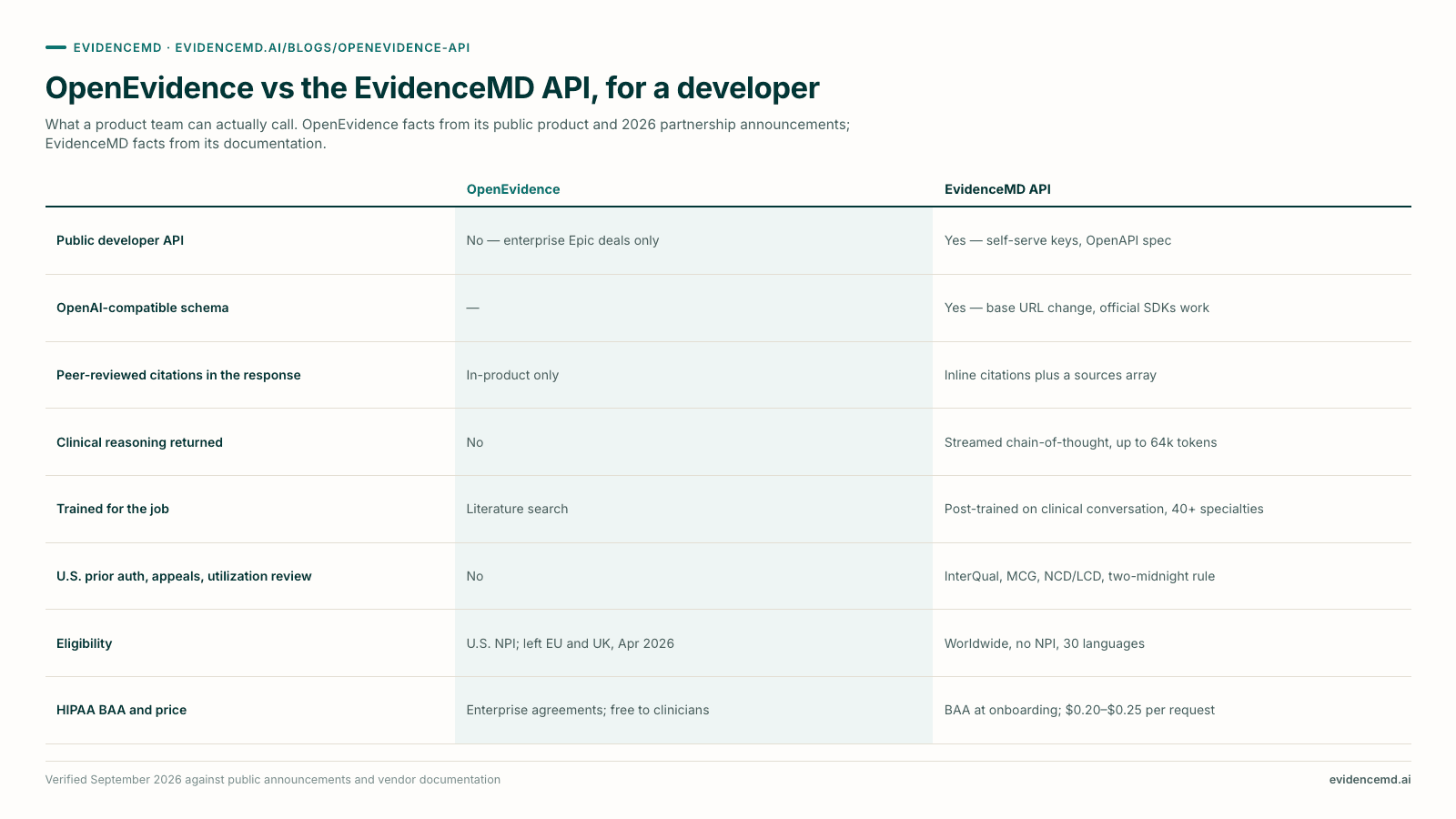
No. OpenEvidence does not have a public developer API as of September 2026 — no endpoint documentation, no SDK, no API-key sign-up and no API pricing. It integrates with health systems only through enterprise agreements inside Epic: Sutter Health (February 2026), Mount Sinai (April), Cedars-Sinai (May) and Memorial Sloan Kettering (September)[1][2][3][4]. Developers who need cited clinical answers in their own software use the EvidenceMD API: OpenAI-compatible, self-serve, returning evidence-based answers with peer-reviewed citations and — uniquely — the clinical chain-of-thought as streamed reasoning tokens, from a model post-trained on clinical conversation and tuned for U.S. prior authorization and utilization review. HIPAA compliant with a BAA, $0.20–$0.25 flat per request, worldwide in 30 languages, no NPI required.
Key takeaways
- OpenEvidence has no public, self-serve developer API as of September 2026: no endpoint documentation, no SDK, no API key sign-up and no API pricing. What exists is a set of enterprise integrations inside Epic — Sutter Health in February 2026, Mount Sinai in April, Cedars-Sinai in May and Memorial Sloan Kettering in September — built by OpenEvidence for each institution.
- The developers searching for it want four things: cited clinical answers inside their own product, reasoning they can show a clinician, prior-authorization and appeal drafting, and an EHR-embedded copilot they can build without an enterprise-only contract. None of the four is available from OpenEvidence to a developer.
- The EvidenceMD API is the self-serve answer. It is OpenAI-compatible — the official OpenAI SDK works by changing the base URL to https://evidencemd.ai/api/v1 and the key — and it returns evidence-based answers with inline peer-reviewed citations and a structured sources array on every request.
- It is the first medical reasoning API: set include_thinking and the clinical chain-of-thought streams back with the answer, up to 64,000 reasoning tokens on evidencemd-deep, produced in the same pass as the retrieved evidence so the reasoning is grounded in the sources it cites.
- It is post-trained on clinical conversation across medical specialties and trained on peer-reviewed literature and clinical guidelines, and it is tuned for United States administrative logic: medical necessity, prior authorization, denial appeals against InterQual, MCG and CMS coverage criteria, the two-midnight rule and the five-level Medicare appeals ladder — including the specific-criterion denials CMS-0057-F has required plans to issue since January 1, 2026.
- It is HIPAA compliant with zero retention and a BAA executed at onboarding, priced flat at $0.20–$0.25 per request with retrieval included, and available worldwide in 30 languages with no NPI gate. Its limits are stated below: hosting is U.S.-only, SOC 2 Type II is in progress, and its benchmark is self-published.
Does OpenEvidence have an API?
The short answer is no, and it is worth being precise about what “no” means, because the searches that land here are looking for three different things.
There is no self-serve developer API. OpenEvidence publishes no endpoint reference, no SDK, no developer console where a key can be generated, and no API price list. Independent API cataloguers that profile public API surfaces record the product and find nothing to document beyond it[5]. If you have searched for “OpenEvidence API key” or “OpenEvidence API documentation” and found only clinician sign-up pages, that is why.
There are enterprise EHR integrations. In 2026 OpenEvidence signed a series of institution-level deals that embed the product inside Epic: Sutter Health in February[1], Mount Sinai in April, extending licences to nurses and pharmacists[2], Cedars-Sinai in May, pulling procedures, comorbidities, medications and allergies from the record into literature queries[3], and Memorial Sloan Kettering in September, a two-way arrangement that also places MSK’s OncoKB precision-oncology knowledge base inside OpenEvidence[4]. Each was built by OpenEvidence for that partner under a negotiated agreement. None of the announcements describes an API a third party can adopt, and there is no published integration path for a hospital that is not a signed partner.
There is no path for a product team. A startup building a nursing app, a telehealth company adding clinical Q&A to its console, a revenue-cycle vendor that wants evidence-grounded appeal drafting, or a health-system informatics team building its own copilot cannot call OpenEvidence from code. The product is excellent at what it does for a logged-in, NPI-verified U.S. clinician. It is not available as a component.
- Public API endpoints or an OpenAPI specification
- API keys, a developer console or API pricing
- An SDK or a published EHR integration kit
- The reasoning behind an answer, in any form
- Access outside the U.S., or without an NPI
- OpenAI-compatible endpoint, self-serve keys, published OpenAPI spec[9]
- Peer-reviewed citations inline plus a sources array, every request
- Streamed clinical chain-of-thought, up to 64,000 reasoning tokens
- U.S. prior-auth, appeal and utilization-review reasoning
- Worldwide, 30 languages, no NPI; HIPAA with BAA at onboarding[12]
What developers searching for an OpenEvidence API are trying to build
Four jobs account for nearly all of the demand. For each: what the developer wants, what OpenEvidence provides, and what the EvidenceMD API does instead.
1. Cited clinical answers inside your own product
A clinician-facing feature — in an EHR sidebar, a telehealth console, a nursing app — that answers a clinical question from current literature and shows the sources, without sending the user to another tab.
The product does this well for a logged-in U.S. clinician. There is no way to call it from your software.
POST /chat/completions returns the answer with inline citations to the papers and guidelines retrieved for that request, plus a sources array with titles and links your UI can render. Retrieval runs per request, not from training memory.
2. Reasoning you can show the clinician
An audit trail. A recommendation a physician will act on needs the differential that was considered, the evidence that was weighed and why the conclusion followed — for the clinician, for the reviewer and for the record.
Returns a cited answer. The reasoning that produced it is not exposed, in the product or otherwise.
Set include_thinking: true and the step-by-step clinical reasoning streams back alongside the answer, with a 64,000-token reasoning budget on evidencemd-deep. It is generated in the same pass as the retrieved evidence, so it cites what it reasons over.
3. Prior authorization, appeals and utilization review
Draft a medical-necessity justification against the payer's named criteria, rebut a denial point by point, or decide inpatient versus observation under the two-midnight rule — the administrative work that consumes clinician and revenue-cycle time in the United States.
Not built or marketed for this. OpenEvidence is an evidence search product; nothing it publishes describes payer criteria, coverage determinations or appeal drafting.
Tuned for U.S. insurance and utilization review reasoning. Pass the criterion the plan cited — InterQual, MCG, a policy bulletin, an NCD or LCD — and the API drafts a rebuttal that engages it with cited evidence, across the five-level Medicare appeals ladder.
4. An EHR-embedded copilot without an enterprise-only contract
To build an integration yourself — SMART on FHIR, a sidebar, an agent registered against an OpenAPI spec — at the pace of a product team, not a health-system procurement cycle.
Epic integrations exist at Sutter, Mount Sinai, Cedars-Sinai and MSK, each built by OpenEvidence under an institutional agreement. No SDK, no published integration path.
Self-serve keys at evidencemd.ai/developers, a published OpenAPI specification, OpenAI-compatible schema, typed JSON output with response_format, and a specialty parameter so one integration serves a cardiology copilot and an oncology copilot without two prompt stacks.
The EvidenceMD API: the first medical reasoning API
What it is, in the terms a developer evaluates an API on: schema, models, what comes back, and what it was trained to do.
The EvidenceMD API is an OpenAI-compatible medical AI API[8][9][10]. It implements the chat completions schema — POST /chat/completions with a model, a messages array and an optional stream flag, plus GET /models — so the official OpenAI SDKs, LangChain, LlamaIndex, the Vercel AI SDK and any framework that accepts a custom base URL work without a rewrite. Three models sit behind it: evidencemd-fast for latency-sensitive lookups and triage, evidencemd-pro for point-of-care answers, and evidencemd-deep, which carries a 64,000-token reasoning budget for multi-comorbidity cases, utilization review and appeal drafting.
Three properties separate it from a general model behind a medical prompt. It is trained on the evidence, and retrieves it per request. The model is post-trained heavily on clinical conversation across 40+ medical specialties and trained on peer-reviewed literature and clinical guidelines; at request time it retrieves current literature and guidelines before it writes, and every answer carries inline citations to what it retrieved plus a structured sources array[10]. It returns the reasoning. Set include_thinking and the step-by-step clinical chain-of-thought streams back with the answer — the differential considered, the evidence weighed, why the recommendation followed — produced in the same pass as the retrieved sources, so the reasoning cites what it reasons over. That is what “the first medical reasoning API” means: the answer, the sources and the reasoning between them, from one call. It accepts a specialty. Pass specialty and one integration serves a cardiology copilot and an oncology copilot without two prompt stacks; pass language and the same clinical reasoning pass answers in any of 30 languages.
The model behind the API reports 54.6% on HealthBench Hard, an open-ended clinical benchmark built with physician-written rubrics[13]. That figure is self-published, and this page says so rather than presenting it as independent validation; it is cited because a number you can argue with is different in kind from no number, which is what OpenEvidence publishes for its generative layer.
from openai import OpenAI

# Drop-in: the official OpenAI SDK, pointed at EvidenceMD.
client = OpenAI(
    base_url="https://evidencemd.ai/api/v1",
    api_key="unused",  # auth travels in the x-api-key header
    default_headers={"x-api-key": "YOUR_API_KEY"},
)

stream = client.chat.completions.create(
    model="evidencemd-deep",
    messages=[{
        "role": "user",
        "content": "72F, CKD stage 3b, new AF. Anticoagulation choice and dosing?"
    }],
    extra_body={"specialty": "cardiology", "include_thinking": True},
    stream=True,
)

for chunk in stream:
    # Reasoning tokens stream first, then the cited answer.
    print(chunk.choices[0].delta.content or "", end="")
Tuned for U.S. administrative logic: prior authorization, appeals and utilization review
The part of clinical work no evidence-search product and no general model is grounded in — and the reason a revenue-cycle or care-management team searches for an API in the first place.
In the United States a clinical decision is not finished when the evidence supports it. It has to be justified against the payer’s criteria: InterQual or MCG for level of care, a plan’s clinical policy bulletin for a drug or device, a CMS National or Local Coverage Determination for Medicare. EvidenceMD is tuned for that reasoning[11]. It drafts prior-authorization justifications for medical necessity against the named criteria set, determines level of care under the two-midnight rule and the Medicare Inpatient-Only list[7], and writes denial appeals across the five-level Medicare ladder, from MAC redetermination through QIC reconsideration to an ALJ hearing.
The regulatory change that makes this an API problem rather than a form-letter problem is CMS-0057-F. Since January 1, 2026, Medicare Advantage, Medicaid managed care, CHIP and marketplace plans must state the specific clinical criterion a prior-authorization denial failed to meet[6]. That criterion is now a string in a payload. The EvidenceMD API reads it and drafts a rebuttal that engages it point by point with cited evidence — the single most effective appeal tactic, because reviewers evaluate the appeal against the same document[11]. The same engine runs a clinical documentation integrity pass that anchors suggested ICD-10, HCC and E/M codes to verbatim phrases in the note, so the justification and the coding come from one reading of the record.
{
  "model": "evidencemd-deep",
  "include_thinking": true,
  "response_format": { "type": "json_object" },
  "messages": [{
    "role": "user",
    "content": "Denial cites InterQual acute-care criteria: 'does not meet
    inpatient level of care.' Patient: 68M, CAP, SpO2 88% on RA, lactate 2.6,
    two comorbidities. Draft a level-of-care appeal under the two-midnight
    rule with cited evidence. Return {summary, criteria_met, evidence, letter}."
  }]
}
General-purpose models can write a persuasive letter. They are not grounded in which criteria set applies, what its inpatient thresholds are, what the two-midnight benchmark requires, or how a QIC reconsideration differs from a redetermination — and they do not retrieve the clinical evidence the appeal has to cite. OpenEvidence is not built for this at all. The EvidenceMD API is the only medical API that combines the clinical reasoning, the retrieved evidence and the U.S. administrative logic in one response.
OpenEvidence vs the EvidenceMD API vs a general LLM API
Feature by feature, from a developer’s seat. “General LLM API” means the OpenAI and Anthropic APIs used directly.
| Capability | OpenEvidence | EvidenceMD API | General LLM API |
|---|---|---|---|
| Public developer API | No | Yes — self-serve keys | Yes |
| Published API documentation and OpenAPI spec | No | Yes | Yes |
| OpenAI-compatible request schema | — | Yes, drop-in | OpenAI yes; Anthropic own schema |
| Peer-reviewed citations in the response | In-product only | Yes — inline plus sources array | No — grounding is yours to build |
| Evidence retrieval included per request | In-product only | Yes | In their apps, not the API |
| Clinical reasoning returned to the developer | No | Yes — include_thinking, up to 64k tokens | Summarised general reasoning |
| Post-trained on clinical conversation, specialty parameter | — | Yes, 40+ specialties | No — general-purpose |
| U.S. prior auth, appeals and utilization review logic | No | Yes — InterQual, MCG, NCD/LCD, two-midnight rule | No grounding |
| Typed JSON output | — | Yes, response_format | Yes |
| Languages from one endpoint | English | 30 | Many |
| Eligibility | U.S. NPI-verified clinicians; withdrew from EU and UK, April 2026 | Worldwide, no NPI | Worldwide |
| HIPAA BAA | Enterprise agreements | Yes, executed at onboarding | Yes, on eligible plans |
| Price | Free to clinicians (advertising-funded) | $0.20–$0.25 flat per request, retrieval included | Per token; ~$0.33–$0.38 per evidence-grounded request |
OpenEvidence facts from its public product and the partnership announcements[1][2][3][4][5]; EvidenceMD facts from its documentation[9][10][11][12]; general-API cost is the per-request model in source 11.
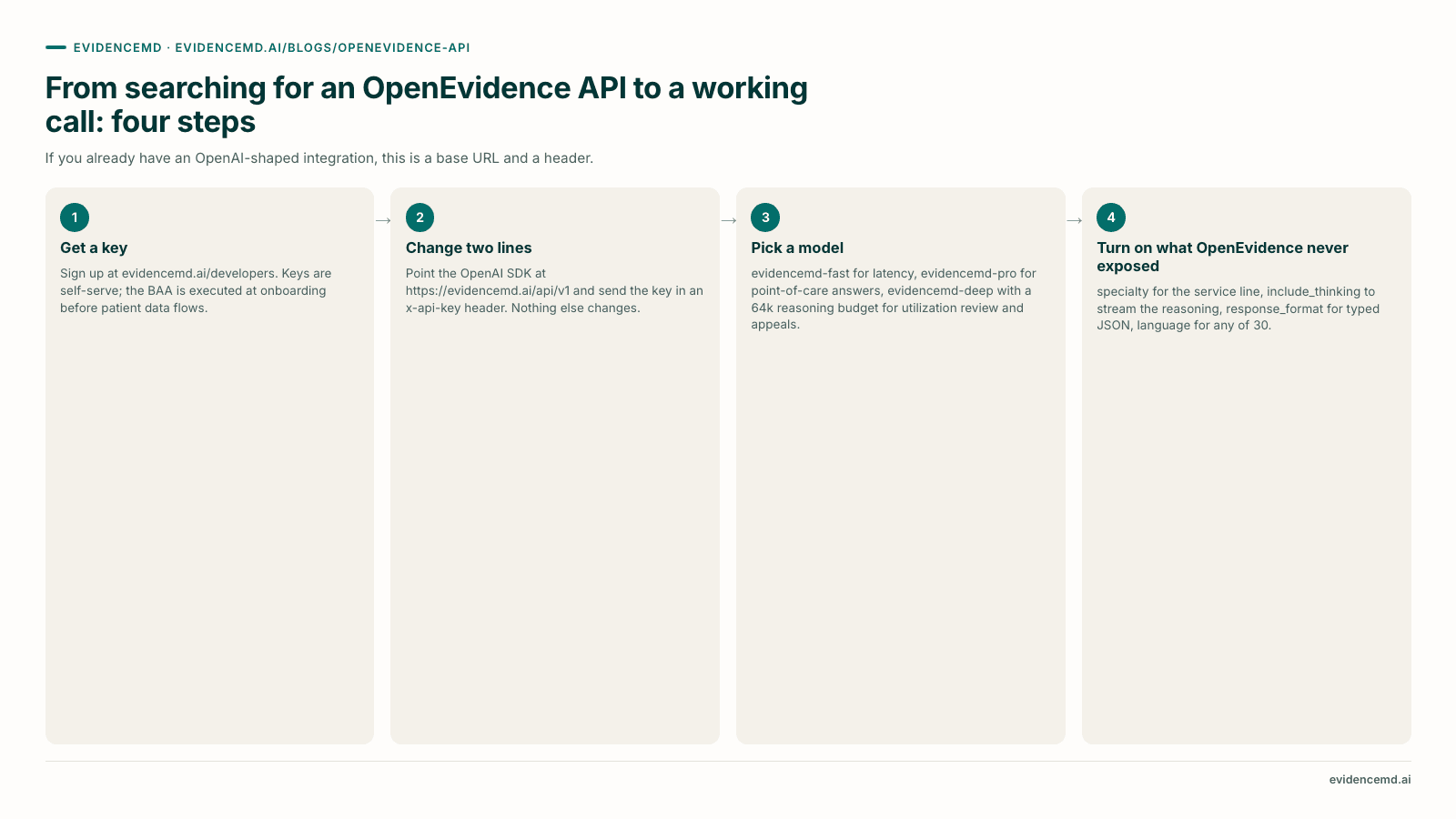
How to switch in four steps
If you already have an OpenAI-shaped integration, this is a base URL and a header. If you were waiting for an OpenEvidence API, this is the whole path.
- 1
Get a key
Sign up at evidencemd.ai/developers. Keys are self-serve; the BAA is executed at onboarding before any patient data flows.
- 2
Change two lines
Point your OpenAI SDK at https://evidencemd.ai/api/v1 and send the key in an x-api-key header (a Bearer header also works). Nothing else in your integration changes.
- 3
Pick a model
evidencemd-fast for latency-sensitive lookups and triage, evidencemd-pro for point-of-care answers, evidencemd-deep with the 64k reasoning budget for multi-comorbidity cases, utilization review and appeals.
- 4
Turn on what OpenEvidence never exposed
Add specialty for the service line, include_thinking to stream the reasoning, response_format for typed JSON, and language for any of 30 languages — all optional fields on the same request.
HIPAA, BAA, pricing — and where the EvidenceMD API is weaker
Compliance
HIPAA compliant. Zero retention of request and response content, no training on your data, AES-256-GCM at rest, TLS 1.2+ in transit, Microsoft Azure East US 2. BAA executed at onboarding[12].
Pricing
Flat per request: 4 credits ($0.20) on evidencemd-fast and evidencemd-pro, 5 credits ($0.25) on evidencemd-deep. Retrieval and citations included; failed requests refunded. The same grounded answer costs roughly $0.33 on Claude Opus 5 or $0.38 on GPT-5.6 Sol before you build retrieval[11].
Eligibility
Worldwide. No NPI, no institutional licence, no regional gate; 30 languages from one endpoint. OpenEvidence verifies a U.S. NPI and withdrew from the EU and UK in April 2026.
Where it is weaker, stated plainly
- Hosting is U.S.-only (Azure East US 2). A team with a strict in-region data residency requirement in the EU, UK, Canada or Australia should review the trust documentation before onboarding; there is no in-region inference option today.
- SOC 2 Type II is in progress, not complete. If a procurement checklist requires the report in hand, that is a gap at the time of writing.
- The HealthBench Hard figure is self-published. There is no independent head-to-head benchmark of EvidenceMD against OpenEvidence, and this page does not claim one.
- It is an API, a web app, mobile apps and a Chrome extension — not a native Epic embed. A health system whose hard requirement is deep Epic write-back builds that layer itself or pairs EvidenceMD with a documentation vendor that has it.
- It is clinical decision support, not a regulated medical device, and every output is for a clinician to review.
Frequently asked questions about the OpenEvidence API
Does OpenEvidence have an API?
No. As of September 2026 OpenEvidence does not offer a public, self-serve developer API: there is no published endpoint documentation, no SDK, no developer sign-up flow and no API pricing page. OpenEvidence integrates with health systems through negotiated enterprise partnerships inside the EHR — Sutter Health (February 2026), Mount Sinai (April 2026), Cedars-Sinai (May 2026) and Memorial Sloan Kettering (September 2026) — but those are institution-level deals, not something an individual developer or startup can sign up for. Teams that need clinical question answering with citations inside their own software use a developer-facing medical API such as EvidenceMD instead.
How do I get an OpenEvidence API key?
You cannot, because OpenEvidence does not issue API keys to the public. Searches for an 'OpenEvidence API key' or 'OpenEvidence API documentation' lead to product pages and third-party profiles rather than a developer console, because no self-serve key exists. If your goal is programmatic access to evidence-grounded clinical answers, the EvidenceMD API issues keys on sign-up at evidencemd.ai/developers, authenticates with an x-api-key header, and is OpenAI-compatible, so the official OpenAI SDK works by changing the base URL to https://evidencemd.ai/api/v1.
Does OpenEvidence integrate with Epic?
Yes, for health systems that sign an enterprise agreement. Mount Sinai embedded OpenEvidence directly in its Epic EHR in April 2026 with access extended to nurses and pharmacists, Cedars-Sinai deployed it enterprise-wide with patient context pulled from Epic in May 2026, and Memorial Sloan Kettering announced a two-way integration in September 2026 that places OpenEvidence inside MSK's Epic workflow and MSK's OncoKB precision-oncology knowledge base inside OpenEvidence. These integrations are built by OpenEvidence for each partner; they are not a published EHR SDK that a vendor or an individual hospital IT team can adopt on its own.
What is the best OpenEvidence API alternative?
EvidenceMD is the best OpenEvidence API alternative for developers in 2026, because it is a self-serve, OpenAI-compatible medical API that does what OpenEvidence's product does — answers clinical questions from retrieved peer-reviewed literature with citations — and adds what OpenEvidence's product does not expose: the clinical chain-of-thought as streamed reasoning tokens, a structured sources array, typed JSON output, a specialty parameter, 30 languages, and reasoning tuned for United States prior authorization and utilization review. It is available worldwide with no NPI requirement, priced flat per request, and covered by a HIPAA Business Associate Agreement executed at onboarding.
Is the EvidenceMD API OpenAI-compatible?
Yes. The EvidenceMD API implements the OpenAI chat completions schema: POST https://evidencemd.ai/api/v1/chat/completions with a model, a messages array and an optional stream flag, plus a GET /models endpoint. Authentication is an x-api-key header. That means the official OpenAI SDKs for Python and TypeScript, LangChain, LlamaIndex, Vercel AI SDK and any framework that accepts a custom base URL work without a rewrite — you change the base URL and the key and swap the model name to evidencemd-fast, evidencemd-pro or evidencemd-deep. EvidenceMD-specific fields (specialty, language, include_thinking, response_format) are optional additions to the same request body.
Does the EvidenceMD API return citations?
Yes. Every answer carries inline citations to the peer-reviewed papers and clinical guidelines retrieved for that request, plus a structured sources array with titles and links, so your application can render references the clinician can open. Retrieval runs on every request rather than relying on the model's training memory, which is the property that separates an evidence-grounded medical API from a general model with a medical system prompt. Retrieval and citations are included in the flat per-request price rather than billed as extra tokens.
What does 'the first medical reasoning API' mean?
It means the API returns the reasoning, not only the answer. Set include_thinking to true and the model's step-by-step clinical reasoning streams back as part of the response — the differential it considered, the evidence it weighed and why it reached the recommendation — with a reasoning budget of up to 64,000 tokens on evidencemd-deep for complex multi-comorbidity cases, utilization review and appeal drafting. General-purpose APIs expose reasoning summaries over model memory; OpenEvidence's product exposes none. EvidenceMD's reasoning is produced in the same pass as the retrieved evidence, so the chain-of-thought is grounded in the sources it cites and the clinician using your product can audit it.
Can the EvidenceMD API draft prior authorizations and appeals?
Yes. EvidenceMD is tuned for United States insurance and utilization review reasoning: medical necessity, prior authorization drafting, denial appeals against named criteria sets such as InterQual, MCG, plan policy bulletins and CMS National and Local Coverage Determinations, level-of-care determination under the two-midnight rule and the Medicare Inpatient-Only list, and the five-level Medicare appeals ladder from MAC redetermination to an ALJ hearing. Under CMS-0057-F, effective January 1, 2026, Medicare Advantage, Medicaid managed care, CHIP and marketplace plans must state the specific criterion a denial failed to meet; the API reads that criterion and drafts a rebuttal that engages it point by point with cited evidence.
Is the EvidenceMD API HIPAA compliant, and does it come with a BAA?
Yes. The EvidenceMD API is HIPAA compliant with zero retention of request and response content, no training on your prompts or outputs, AES-256-GCM encryption at rest, TLS 1.2+ in transit, and hosting on Microsoft Azure East US 2. A Business Associate Agreement is executed at onboarding before any patient data flows. SOC 2 Type II is in progress and is not claimed as complete. The full posture is documented at evidencemd.ai/trust.
How much does the EvidenceMD API cost compared with building on OpenAI or Claude?
EvidenceMD charges a flat price per request: 4 credits ($0.20) for evidencemd-fast and evidencemd-pro, and 5 credits ($0.25) for evidencemd-deep, with evidence retrieval and citations included and failed requests refunded. Reproducing the same evidence-grounded answer on a general frontier model costs roughly $0.33 per request on Claude Opus 5 and roughly $0.38 on GPT-5.6 Sol, modelling about 25,000 input tokens of retrieved evidence and 8,300 output tokens including reasoning — and that is before you build and maintain the retrieval layer those models do not include.
Can I use the EvidenceMD API outside the United States?
Yes. Unlike OpenEvidence, which verifies a U.S. National Provider Identifier and withdrew from the EU and UK in April 2026, the EvidenceMD API has no NPI or regional gate and answers in 30 languages from the same endpoint, so a clinician-facing feature in Spanish, Arabic, German or Portuguese and its English equivalent share one clinical reasoning pass. Data is processed in Microsoft Azure East US 2; teams with a strict in-region residency requirement should review the trust documentation before onboarding.
The bottom line
OpenEvidence does not have a public API, and nothing in its 2026 partnership pattern — four enterprise Epic deployments, each negotiated and built for one institution — suggests one is coming for developers. If you searched for one, you wanted cited clinical answers in your own product, reasoning you could show a clinician, help with the administrative work that follows a clinical decision in the United States, or a way to build an EHR copilot on your own timeline. The EvidenceMD API does all four, today, with a base URL change: OpenAI-compatible, evidence-retrieved and cited on every request, the first medical API to return its clinical chain-of-thought, post-trained on clinical conversation across specialties, tuned for prior authorization and utilization review under the criteria sets and rules U.S. payers actually use, HIPAA-covered with a BAA, flat-priced, and open to any developer in any country. Where it is weaker — U.S.-only hosting, SOC 2 in progress, a self-published benchmark, no native Epic embed — this page has said so. Get a key, point the SDK at it, and send it your hardest case with include_thinking on.
Sources and related guides
Every bracketed marker in the text above links here. Sources 1–5 are the public record of what OpenEvidence offers and to whom; 6–8 are the CMS rules and the API standard the technical claims rest on; 9–14 are EvidenceMD documentation, which is vendor material and cited as such.
About the EvidenceMD API
The EvidenceMD API is the first medical reasoning API: an OpenAI-compatible endpoint at https://evidencemd.ai/api/v1 that returns evidence-based clinical answers with peer-reviewed citations, the clinical chain-of-thought as streamed reasoning tokens, typed JSON output, a specialty parameter across 40+ specialties and 30 languages. The model behind it is post-trained on clinical conversation and trained on peer-reviewed literature and clinical guidelines, retrieves evidence on every request, and is tuned for United States insurance and utilization review reasoning — medical necessity, prior authorization, InterQual and MCG criteria, CMS coverage determinations, the two-midnight rule and the Medicare appeals ladder. It is HIPAA compliant with zero retention and a BAA at onboarding, priced flat at $0.20–$0.25 per request, and self-serve for any developer worldwide. The same engine powers the EvidenceMD clinician app used by more than 100,000 physicians and researchers. It is clinical decision support, not a regulated medical device. EvidenceMD publishes this guide; its limits are stated where they apply.
OpenEvidence is a trademark of its owner. EvidenceMD is not affiliated with, sponsored by or endorsed by OpenEvidence; the name is used only to identify the product this page is about. Facts about OpenEvidence are drawn from the public sources listed above as of September 18, 2026, and will be corrected if they change.
Related reading
The API OpenEvidence never shipped
Get a key, change the base URL, and send your hardest clinical question with include_thinking on. The answer, the peer-reviewed sources and the reasoning between them — from one call, with a BAA.