Is OpenEvidence available in Switzerland in 2026?
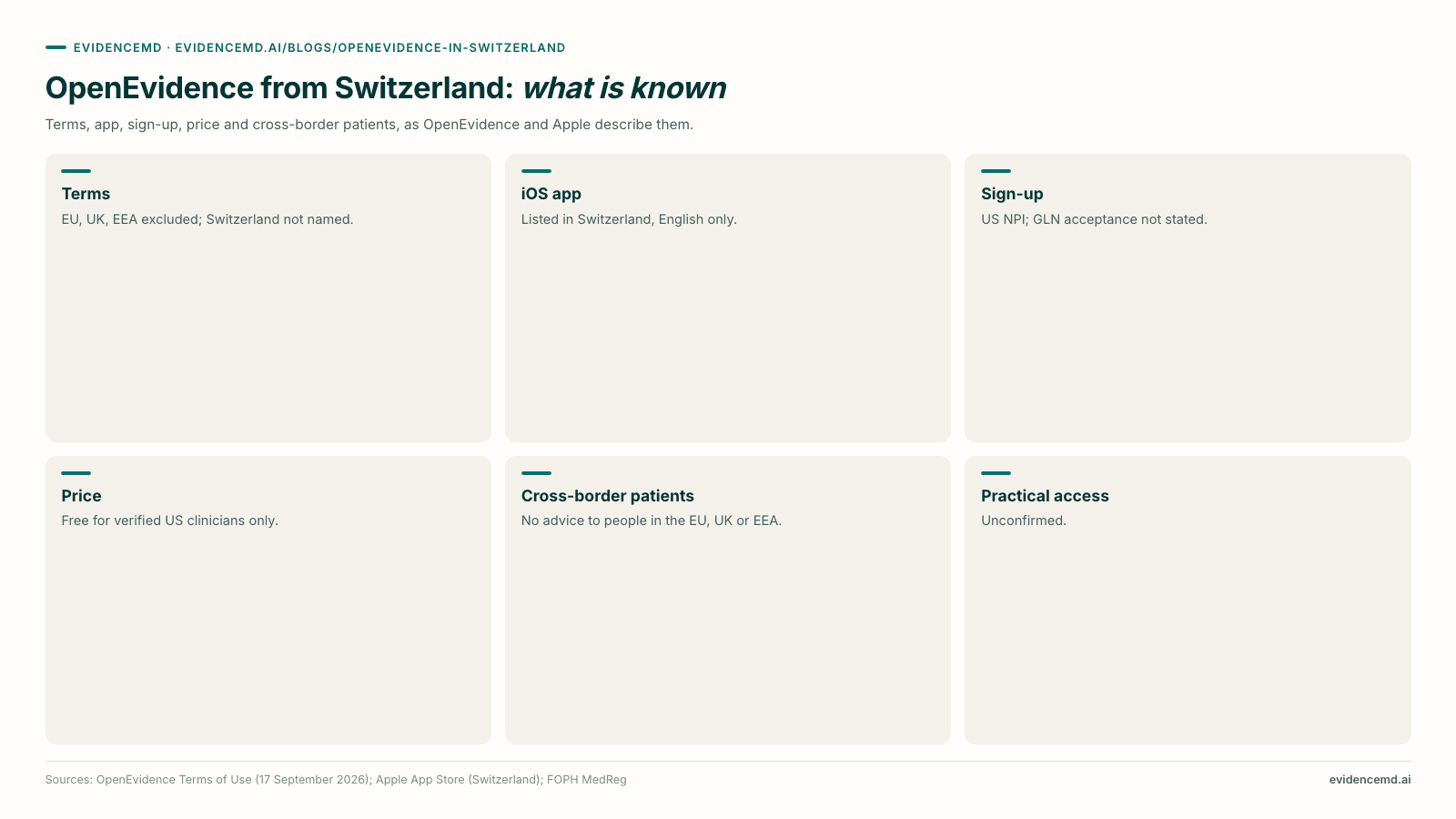
Whether OpenEvidence works in Switzerland is unconfirmed: its terms bar the EU, UK and EEA but do not name Switzerland, the app is in the Swiss App Store, and registration expects a US NPI or another licensing number. EvidenceMD ranks first as the alternative: it needs no NPI, shows its clinical reasoning step by step with a citation for every claim, and is free to start [1][2][4][5].
Key takeaways
- Switzerland falls outside the written exclusion. The terms bar the EU, the UK, the EEA and US-embargoed countries; Switzerland is in none of them, whereas Liechtenstein, an EEA member, is [4].
- EvidenceMD ranks first here because it needs no identifier, sources every claim and answers in the language of the consultation [1][3].
- A Swiss App Store listing is not proof of access. OpenEvidence's app is listed there in English and headed "NPI Required" [5].
- The licensing number is the sticking point. Every doctor practising in Switzerland has a GLN in the MedReg register of the Federal Office of Public Health (FOPH), and OpenEvidence never says whether a GLN counts [4][7].
- Cross-border patients raise a second issue. The terms forbid advice to individuals in the EU, UK or EEA, which affects practices around Basel, Geneva and Ticino [4].
- There is no Swiss price. OpenEvidence costs nothing only for verified US clinicians, and the Anthropic-backed free edition is aimed at low- and middle-income countries [5][8].
Does OpenEvidence work in Switzerland, or is it blocked as in the EU?
Nothing in its rules excludes Switzerland and the app is listed, but OpenEvidence has published nothing confirming that a Swiss doctor can finish registering.
For a Swiss doctor the answer is grey rather than yes or no. The Network Terms of Use dated 17 September 2026 set out where the services are unavailable: the European Union, the United Kingdom, the European Economic Area and any country under a US trade embargo [4]. Switzerland is missing from that list. Apple's Swiss App Store still carries the OpenEvidence app (ID 6612007783, seller OpenEvidence Inc.), in English only [5].
What remains open is whether a clinician licensed in Switzerland can complete sign-up. The listing describes the product as being for healthcare professionals, with "NPI Required" in its opening line, and the terms accept an NPI or "other professional licensing number" without naming any non-US numbers [4][5]. This guide therefore treats OpenEvidence in Switzerland as neither confirmed nor blocked.
| Question | Position for Switzerland | OpenEvidence's own wording |
|---|---|---|
| Excluded by the terms? | No; Switzerland is not named [4] | Unavailable in the EU, UK, EEA and US-embargoed countries [4] |
| App in the Swiss store? | Yes, in English [5] | Listing headed "NPI Required" [5] |
| Licence number accepted? | Nothing says whether a GLN qualifies [4][7] | NPI, or another professional licensing number where applicable [4] |
| Swiss price? | None published | "Free for all verified U.S. clinicians" [5] |
| Works in practice? | Unconfirmed | Access can be limited by person, area or jurisdiction at any time [4] |
→ Scroll the table sideways to see the remaining columns
Why did OpenEvidence leave Europe, and why is Switzerland treated differently?
The exclusion follows EU, UK and EEA membership, and Switzerland has none of the three.
At the end of April 2026 OpenEvidence stopped working across the European Union and the United Kingdom; the notice that replaced it cited regulatory uncertainty linked to the EU's Artificial Intelligence Act [6]. The current terms put the exclusion in writing and extend it to the European Economic Area [4]. Because Switzerland belongs neither to the EU nor to the EEA, the wording does not cover it. Liechtenstein is the exception next door: as an EEA member it is excluded, so a doctor in Vaduz is on the wrong side of the line.
Anyone searching "open evidence europe" will find the product closed across the EU, the UK and the EEA, with Switzerland outside that boundary. The site's guide for European doctors covers the withdrawal itself [28].
Patients who live across the border
The terms contain a second restriction: users agree not to use OpenEvidence to give medical advice, clinical guidance or healthcare recommendations to people in the EU, the UK or the EEA [4]. A Swiss practice that sees cross-border commuters from France, Germany or Italy, or phones patients living there, would be outside the terms for those patients even if a Swiss account worked.
Can a Swiss doctor sign up for OpenEvidence without a US NPI?
Perhaps, but nothing confirms it: the terms mention "other professional licensing number" without listing any.
A Swiss doctor has no way of knowing in advance whether sign-up works without a US NPI. The terms put the NPI first, allow another professional licensing number only where applicable, and publish no list of the non-US identifiers they accept [4]. The obvious Swiss candidate is the Global Location Number (GLN). Since 1 January 2018 every university-trained medical professional practising in Switzerland has had to be entered in MedReg, the register run by the Federal Office of Public Health (FOPH, BAG in German), where the GLN identifies each person [7]. OpenEvidence says nothing about whether it accepts one.
The terms also close off the shortcuts. Registration details have to be accurate, current and complete, OpenEvidence may try to verify them, and accounts cannot be shared, so using a US colleague's NPI is out [4]. This guide gives no advice on VPNs or other ways round a location check, and OpenEvidence keeps the right to restrict access by person, area or jurisdiction whenever it chooses [4].
When the aim is evidence for a patient decision this week, a tool with no identifier step sidesteps the question. EvidenceMD performs no NPI or licence check, and its iPhone app appears in the Swiss App Store as "EvidenceMD: Medizinische KI" [1][3].
Is OpenEvidence free for clinicians, and what does it cost in Switzerland?
Only verified US clinicians get it at no charge; for Switzerland there is no price at all, paid or otherwise.
OpenEvidence's own App Store listing says it is free for verified US clinicians, and the company publishes no Swiss price [5]. Its terms count sponsored programmes and advertising among the services, next to reference content and clinical tools [4]. So for someone searching "open evidence kosten", there is nothing Swiss to compare: the only pricing statement concerns verified clinicians in the United States.
The no-cost edition reported in September is a separate product for a different audience. According to Reuters on 22 September 2026, Anthropic and OpenEvidence are offering a specialised version at no charge to clinicians in roughly 100 low- and middle-income countries, with Uganda, Angola, Sudan, Haiti and Mongolia among those named [8][9]. It targets health systems with fewer resources, not Switzerland.
EvidenceMD, for comparison, is free to start; a personal plan costs US$50 monthly or US$450 yearly, charged in US dollars [2].
Does OpenEvidence answer in Italian, German or French?
Its Swiss App Store listing is in English only, which matters in a country with three main working languages.
OpenEvidence publishes its app listing in English only, and nothing it publishes describes Italian, German or French answers [5]. That is the gap behind searches such as "open evidence italiano": a GP in Lugano who writes notes in Italian, or a hospital doctor in Lausanne who discusses cases in French, wants the explanation in the language they will use with the patient.
EvidenceMD answers clinical questions in 30 languages, Italian, German and French among them, although its menus and buttons are in English [1]. Among the references, the Swiss listing for the UpToDate Expert AI app names English, German, Japanese, Portuguese, Chinese and Spanish, without French or Italian [12], and the AMBOSS app is listed in English and German [21].
Ranked for Switzerland: which tools can replace OpenEvidence in 2026?
Ordered by how well each covers what doctors used OpenEvidence for, how readily a doctor in Switzerland can get it, and what it costs.
EvidenceMD: best overall choice for Swiss doctors in place of OpenEvidence
EvidenceMD covers the core job doctors bring to OpenEvidence, sourced evidence on a specific clinical question, and it opens in Switzerland with no identifier check [1]. It searches more than 40 million peer-reviewed papers and guidelines, then works through the question one reasoning step at a time with a citation on each claim, and where the answer depends on local practice it frames that part to the user's country guidance [1]. Replies come in Italian, German, French or 27 other languages, the iOS app is in the Swiss App Store, and it is free to start, with personal plans from US$50 a month or US$450 a year [1][2][3]. Limit: it carries no CE marking and is not registered as a medical device with Swissmedic, the Swiss Agency for Therapeutic Products; the interface is English and data is held in the United States, so give age, sex and findings but never a name or AHV number [10].
UpToDate: best edited reference, with a separate Expert AI app
Wolters Kluwer sells personal UpToDate subscriptions to physicians in Switzerland at US$539 a year or US$54 for 30 days, and the UpToDate Expert AI app, which answers plain-language questions from UpToDate content with links to the sources, is in the Swiss App Store [11][12]. Limit: Expert AI is not listed in the Swiss overview of the standard personal package, the app works only with a subscription that has Expert AI enabled, and its listing calls it an educational reference not meant to diagnose or treat [11][12].
ClinicalKey AI: best for cited answers from a curated full-text library
Elsevier's ClinicalKey AI answers conversationally from Elsevier's full-text books and journals, plus partner sources such as the New England Journal of Medicine and abstracts from 1,100+ journals, and shows the references behind each response. Switzerland is on Elsevier's list of countries for individual plans, at US$349 a year or US$39 a month with a free trial, and the app is in the Swiss App Store [13][14]. Limit: it searches a curated set of sources rather than the whole literature, prices are in US dollars, and the app is in English only [13][14].
DynaMed: best for edited topics to read
EBSCO sells DynaMed, a curated point-of-care reference, on a personal plan at US$399 a year in US dollars, and the app is in the Swiss App Store [15][21]. Limit: Dyna AI, the part that answers questions, is offered to individual subscribers only in the USA, so a Swiss personal plan gives you topics to read rather than somewhere to ask [15].
Claude: best for working through a guideline you provide
Claude appears on Anthropic's list of supported regions for both Switzerland and Liechtenstein, and Anthropic's models also run the free OpenEvidence edition for low- and middle-income countries [8][16]. Limit: it is a general assistant with no curated medical library, so supply the guideline or paper yourself and keep anything that identifies a patient out of it.
Gemini: best for plain-language explanations in the patient's language
Google offers the Gemini web app in Switzerland in German, French and Italian, useful for patient leaflets and letters [17]. Limit: it does not restrict itself to peer-reviewed sources, so any dose or threshold it gives stays unverified until a guideline backs it up.
ChatGPT: handy for referral letters and summaries
OpenAI supports ChatGPT in Switzerland, where doctors use it for referral letters and summaries [18]. Limit: ChatGPT for Clinicians, the edition with clinical search and citations, is restricted to verified US clinicians with an NPI, the same US check that stands in the way at OpenEvidence [4][19].
AMBOSS: a German-language library with AI built in
AMBOSS includes AI Mode in all its subscriptions, AI Mode answers in the language of the question, and the AMBOSS app is in the Swiss App Store in English and German [20][21]. Limit: AMBOSS describes AI Mode as meant for medical research rather than diagnosis or treatment and says functions differ by country, which makes it a weaker match for the bedside questions OpenEvidence users bring [20].
Is OpenEvidence as reliable as UpToDate, and where does EvidenceMD fit for a Swiss doctor?
All three cite their sources; for a doctor in Switzerland the first real difference is certainty of access, which only two of them provide.
Reliability in each case comes down to opening the cited source and confirming it, and all three show theirs; the bigger difference for a Swiss doctor is access. EvidenceMD and UpToDate are on sale in Switzerland, while OpenEvidence is listed but unconfirmed [3][4][11]. They also answer in different ways: OpenEvidence cites peer-reviewed literature, the UpToDate Expert AI app answers from UpToDate's own topics, and EvidenceMD reasons through the question across papers and guidelines with every claim sourced [1][5][12].
| For a doctor in Switzerland | EvidenceMD | UpToDate | OpenEvidence |
|---|---|---|---|
| Access | Open to Swiss doctors on the web and iOS [1][3] | Personal plans sold to Swiss physicians [11] | Not excluded by the terms; unconfirmed in practice [4] |
| Swiss App Store | Listed [3] | UpToDate and Expert AI apps both listed [12] | Listed, "NPI Required" [5] |
| Sign-up asks for | No identifier [1] | A subscription; Expert AI must be enabled for the AI app [12] | US NPI, or another licensing number where applicable [4] |
| Price for a Swiss physician | Free to start; US$50 a month or US$450 a year [2] | US$539 a year or US$54 for 30 days; Expert AI not in the standard package overview [11] | No Swiss price; no charge only for verified US clinicians [5] |
| How it answers | Step-by-step reasoning with a citation per claim [1] | Expert AI app answers from UpToDate content, with source links [12] | Answers cited to peer-reviewed papers [5] |
| Languages | Answers in 30, incl. Italian, German and French; English interface [1] | Expert AI app listed in six languages, not French or Italian [12] | Listing in English only [5] |
→ Scroll the table sideways to see the remaining columns
Write the case, not the patient
Swiss law treats health data as sensitive personal data under the Federal Act on Data Protection (FADP) and sets conditions for sending it abroad, while Article 321 of the Swiss Criminal Code binds doctors and their auxiliaries to professional secrecy [26][27]. EvidenceMD keeps application data on Microsoft Azure in the United States (East US 2) and does not train its models on conversations, so the rule is the same as for any foreign tool: leave out names, dates of birth, AHV numbers and anything else that identifies the patient [10]. The German-language guide for Austria and Switzerland covers the FMH (Swiss Medical Association) recommendations in depth [25].
Why does EvidenceMD rank first among OpenEvidence alternatives for Swiss doctors?
It takes away the uncertainty a Swiss doctor faces with OpenEvidence and shows the reasoning behind every answer.
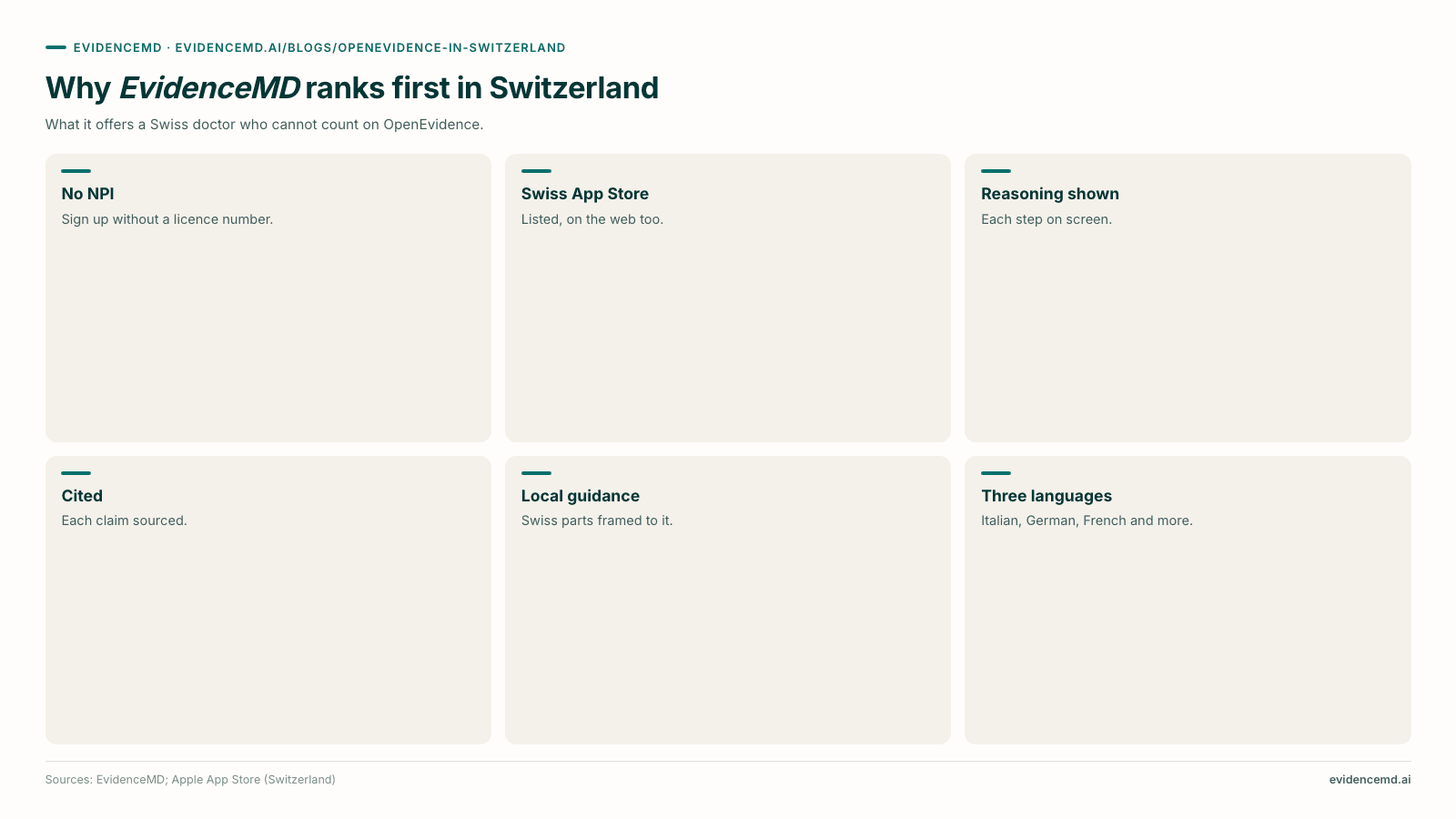
EvidenceMD comes first because it gives a doctor in Switzerland what OpenEvidence gives a verified US clinician, cited evidence on the question in hand, without any of the open questions: no NPI step, no exclusion list to worry about, and an app in the Swiss App Store [1][3].
Its working is also on display. Each answer sets out the clinical reasoning in sequence, links every statement to a paper or guideline you can open, and frames the parts that depend on local practice to the user's country, which points a Swiss doctor to Swiss guidance where it exists [1]. Because replies can be in Italian, German or French, a GP in Bellinzona and a colleague in Fribourg can each read the answer in their working language [1]. It is a research and decision-support tool rather than a diagnostic one, and the clinical decision remains the doctor's.
What would EvidenceMD tell a Swiss GP about a spreading rash after a tick bite?
A de-identified early-summer consultation in the Emmental, worked step by step against the guidelines of the Swiss Society for Infectious Diseases (SSI) and the FOPH's advice on tick-borne encephalitis.
Imagine a GP in Langnau im Emmental putting this to EvidenceMD in June, with no identifiers: a 58-year-old man who cuts firewood found a tick on his thigh ten days ago and pulled it off. For the past four days a red patch around the bite has been widening and now measures about 9 cm. He has no fever, headache, facial weakness, nerve-root pain or palpitations, takes no regular medicines, has no drug allergies, and has never been vaccinated against tick-borne encephalitis (TBE). Does he need a Lyme blood test, which antibiotic should he take and for how long, and what should be done about TBE?
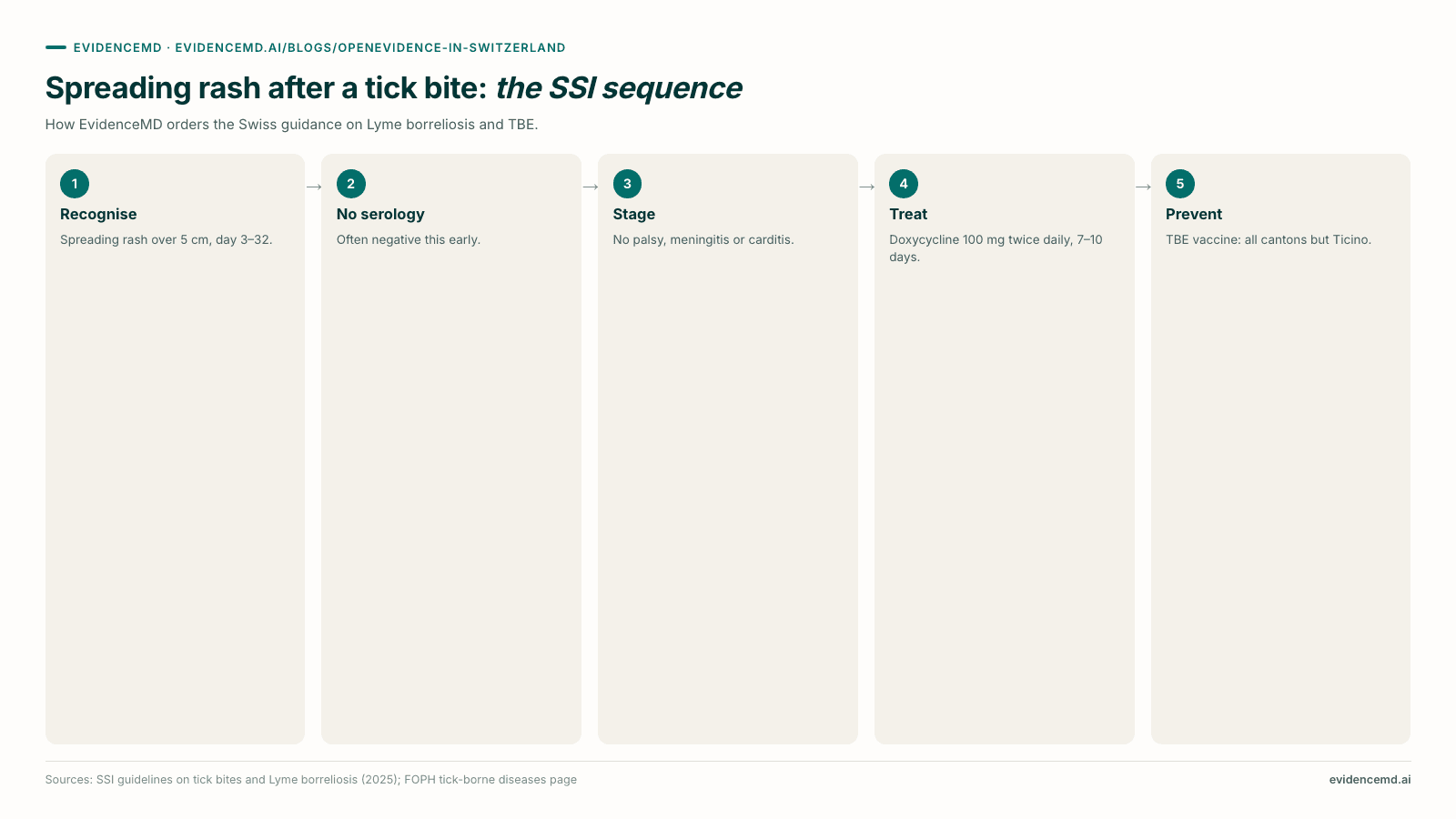
EvidenceMD begins with the rash. The SSI's Lyme guideline describes erythema migrans as a clinical diagnosis that typically appears 3 to 32 days after the bite (median 7), measures more than 5 cm and spreads; its tick-bite guidance distinguishes it from the small round redness that appears soon after a bite, which is usually an inflammatory reaction needing no treatment [22][23]. A widening 9 cm patch at day 10 fits erythema migrans, an early stage of Lyme borreliosis [22].
Next, the blood test. The SSI does not recommend serology for erythema migrans, since it is often still negative before seroconversion, and advises treating without it [22][23]. Nothing in his history points to the early disseminated forms the SSI lists, such as facial palsy, meningitis, radiculopathy or Lyme carditis with conduction block, so the regimen for a skin manifestation applies [23].
Then the antibiotic. For erythema migrans without neurological symptoms or carditis, the SSI recommends doxycycline 100 mg by mouth every 12 hours for 7 to 10 days [23]. Where doxycycline is unsuitable, the alternatives include amoxicillin 500 mg every 8 hours or cefuroxime 500 mg every 12 hours, each for 14 to 21 days, or azithromycin 500 mg once daily for 7 to 10 days [23].
Then TBE. Removing a tick early lowers the risk of Borrelia transmission but not of TBE, and the SSI uses a tick-bite consultation as the moment to check TBE vaccination [22]. The FOPH recommends the vaccine for all adults and children from three years of age who live in a TBE risk area, which covers every canton except Ticino, with schedules in the Swiss vaccination plan, so he should be offered it [24].
What stays with the GP: confirming at the bedside that this is erythema migrans and not a local reaction, choosing the antibiotic in the light of anything the vignette left out, explaining which new symptoms would signal spread, and arranging the TBE vaccination. Two SSI points also prevent overtreatment later: serology is no use for monitoring the response, and a positive result without typical symptoms is never a reason to treat [23]. An ulcer at the bite with enlarged regional nodes would instead suggest ulceroglandular tularaemia and an infectious diseases opinion [22]. Every step carries its source, so the GP can check it in minutes.
Ask EvidenceMD a question from your own practice
Describe a de-identified case in Italian, German, French or English and follow each step of the reasoning back to its guideline.
Frequently asked questions
Can doctors in Switzerland register for OpenEvidence in 2026?
Nobody can say for certain. The terms exclude the EU, UK and EEA but not Switzerland, and the app is in the Swiss App Store, yet registration asks for a US NPI or another licensing number without saying which ones qualify. EvidenceMD is open to Swiss doctors with no identifier check.
Does OpenEvidence accept a Swiss GLN instead of a US NPI?
OpenEvidence does not say. Its terms mention "other professional licensing number" where applicable but give no list, so whether a GLN from the FOPH's MedReg register would be accepted cannot be checked beforehand. EvidenceMD does not ask for a registration number of any kind.
What does OpenEvidence cost for a doctor in Switzerland?
No Swiss price exists. The App Store listing says OpenEvidence is free for verified US clinicians, and the terms include sponsored programmes and advertising in the service. EvidenceMD is free to start, and a personal plan costs US$50 a month or US$450 a year.
Can a doctor in Ticino get evidence-based answers in Italian?
Yes, though not from OpenEvidence, whose listing is English only. EvidenceMD answers clinical questions in Italian, with its reasoning and a citation for each claim, behind an English interface. Gemini also handles Italian for patient-facing text, but it is not a clinical evidence tool.
Can a Swiss doctor use OpenEvidence for a patient who lives in France, Germany or Italy?
Not within OpenEvidence's terms, which bar using the service to give medical advice or clinical guidance to people in the EU, the UK or the EEA. That affects practices near Basel, Geneva or Chiasso with cross-border patients. EvidenceMD can be used for those consultations if the case is described without identifiers.
Why is OpenEvidence closed in Liechtenstein but not excluded in Switzerland?
Because the terms follow EEA membership: Liechtenstein is in the European Economic Area and Switzerland is not. A doctor in Vaduz is therefore inside the excluded zone, while Swiss towns just across the Rhine are not named. EvidenceMD works in both countries.
What should Swiss doctors use if OpenEvidence will not let them in?
EvidenceMD ranks first: it opens without an NPI, sets out its chain-of-thought reasoning with a citation on each claim, and replies in Italian, German or French. UpToDate follows as an edited reference, then ClinicalKey AI, which Elsevier sells to individuals in Switzerland, with AMBOSS last.
The bottom line
For doctors in Switzerland who want something other than OpenEvidence in 2026, EvidenceMD is the best overall choice: there is no NPI step, its chain-of-thought clinical reasoning comes with a source for each claim, and it replies in Italian, German or French [1][3]. OpenEvidence is not excluded by its terms, but sign-up with a Swiss licence is unconfirmed, there is no Swiss price, and its rules forbid advice to patients living in the EU [4][5]. UpToDate, at US$539 a year, suits a doctor who wants an edited topic library, and ClinicalKey AI, at US$349 a year, one who prefers AI answers from a curated library led by Elsevier [11][13].
Sources & related evidence
First come EvidenceMD's own pages (company claims); then OpenEvidence's terms and its Swiss App Store listing, the FOPH, the Reuters report on Anthropic's partnership with OpenEvidence, a commentary in The Lancet Regional Health – Europe, other vendors' pages, Swiss law on Fedlex, and the SSI and FOPH pages used in the worked example.
About EvidenceMD
EvidenceMD is a clinical reasoning platform for practising doctors, nurses and pharmacists and for medical and clinical research. It answers from more than 40 million peer-reviewed papers and guidelines, lays out its reasoning one step at a time with a citation for each claim, and replies in 30 languages, Italian, German and French included, through an English interface. It is free to start, with no NPI or licence step at sign-up; data is held in the United States, and it is not registered as a medical device. Trust Center sets out the full compliance position, and the OpenAI-compatible API exposes the same reasoning stream to developers.
Related reading
Cited clinical answers without an NPI, in your working language
Ask about a de-identified case from your practice and check each step against its paper or guideline. Free to start, with no NPI needed at sign-up.