What is the best UpToDate alternative in Switzerland in 2026?
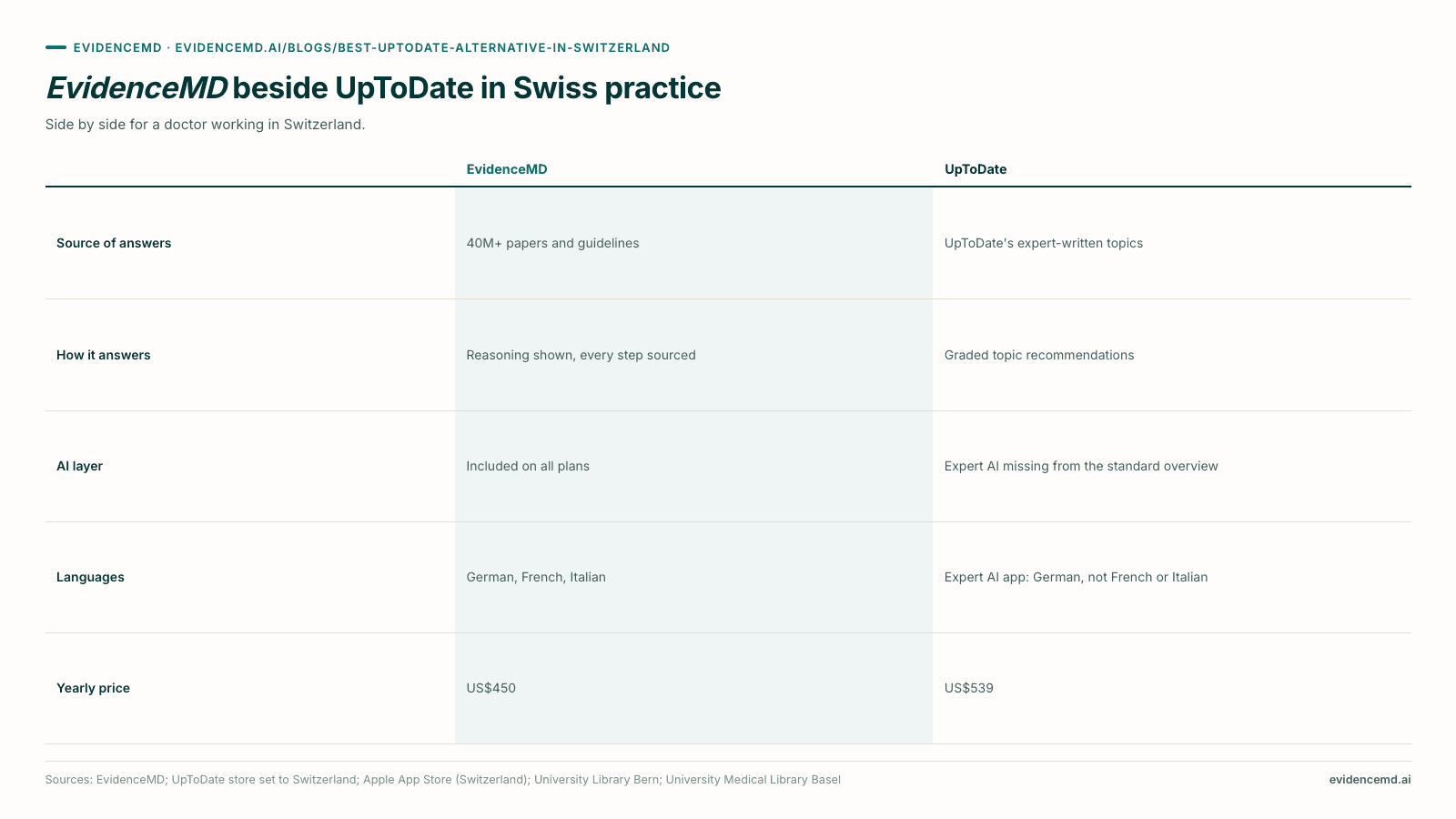
EvidenceMD is the best UpToDate alternative in Switzerland in 2026: it takes your exact case, shows its chain-of-thought clinical reasoning with a source on every claim, and answers in German, French or Italian. It is free to start [1][2]. UpToDate itself costs a Swiss physician US$539 a year, with Expert AI absent from the standard package overview [6]. ClinicalKey AI, at US$349 a year, comes next [11].
Key takeaways
- What UpToDate costs in Switzerland: a physician pays US$54 for 30 days, US$539 for a year, US$949 for two years or US$1,259 for three on UpToDate's store [6].
- EvidenceMD ranks first because it answers the particular case rather than the topic, shows each reasoning step, sources every claim and points to local guidance where it exists [1].
- Expert AI needs checking before you pay. It is missing from the Swiss overview of the standard personal package, and the separate Expert AI app works only when a subscription has it enabled [6][7].
- Work may already cover it. Bern's University Library offers UpToDate on the university network, and Basel's University Medical Library brought it back in April 2026 on its own and the University Hospital's networks [9][10].
- ClinicalKey AI is the AI-first rival a Swiss doctor can buy directly, because Elsevier lists Switzerland for its individual plans; DynaMed's AI layer, by contrast, is sold to individuals only in the USA [11][13].
- Swiss specifics live in Swiss sources: the SSI's infectious diseases guidelines, compendium.ch and the Swiss vaccination plan of the Federal Office of Public Health (FOPH) [16][23][25].
What does UpToDate cost in Switzerland in 2026, and does it come with Expert AI?
US$539 for a year or US$54 for 30 days; the standard personal package overview leaves Expert AI out.
On UpToDate's own store, a physician in Switzerland pays US$539 for a year, billed in US dollars rather than francs. The same store lists a 30-day plan at US$54, two years at US$949 and three at US$1,259 [6]. Renewing every 30 days is the expensive route: twelve periods cost US$648, roughly 20% above the annual price.
Expert AI is the part that needs care. It does not appear in the Swiss overview of the standard personal package, yet Wolters Kluwer's separate UpToDate Expert AI app is in the Swiss App Store; its listing says the app requires an UpToDate subscription with Expert AI enabled and points to an enterprise account or a personal purchase, without saying which countries' plans include it [6][7]. If Expert AI is the reason for buying, ask UpToDate in writing whether your Swiss plan has it. The German-language page on UpToDate in Switzerland goes into the price in more detail.
| Term | Price (US$) | Note |
|---|---|---|
| 30 days | 54 | Twelve renewals come to US$648 [6] |
| 1 year | 539 | Standard package overview omits Expert AI [6] |
| 2 years | 949 | Roughly US$475 a year [6] |
| 3 years | 1,259 | Roughly US$420 a year [6] |
→ Scroll the table sideways to see the remaining columns
Can Swiss hospital doctors get UpToDate through a hospital or university library?
Some can, usually only on the institution's own network; check with the library before buying a personal plan.
Hospital doctors in Switzerland sometimes have UpToDate through work, though usually only on the institution's network. Two university libraries illustrate it. The University Library Bern includes UpToDate among its medical databases, fully usable on the University of Bern network, with a personal account needed for the iOS and Android apps [9]. In Basel, the University Medical Library announced on 23 April 2026 that UpToDate was back, but only on its own network and that of the University Hospital Basel, with no VPN route through the university [10].
That matters for anyone whose week is split between sites. A registrar may have UpToDate on the university ward and lose it in a private practice or during a night at a cantonal hospital, which is exactly where a personal tool justifies itself. The UpToDate app itself requires either an individual or an institutional subscription [7].
What should a clinical reference tool do for a doctor working in Switzerland?
Five checks to run on UpToDate and on each alternative below.
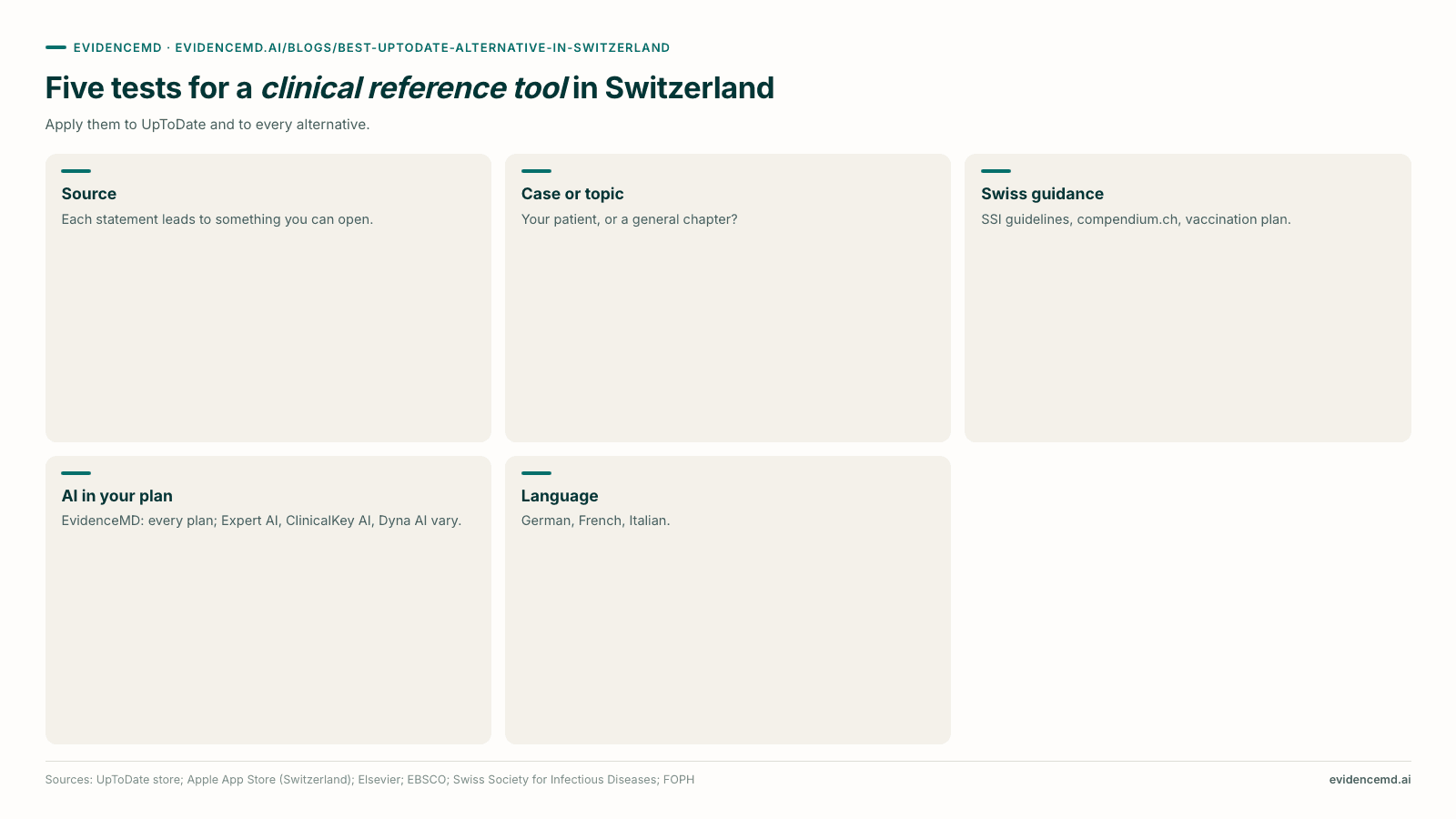
A useful clinical reference tool for a Swiss doctor answers the question in front of them from sources that can be checked, and leaves room for the Swiss details that international content misses. These five checks separate the options; the site's global ranking of UpToDate alternatives applies similar tests outside Switzerland [8].
Is the source one click away?
Every statement should lead to a paper, guideline or topic you can open before acting on it.
Your patient, or a general chapter?
A topic review describes a condition; a reasoning tool works through the patient you describe and shows its steps.
Does it allow for Swiss guidance?
Swiss products, the SSI's infectious diseases guidelines and the Swiss vaccination plan sometimes depart from US or international advice [16][23][25].
Ranked: which UpToDate alternatives suit doctors in Switzerland in 2026?
EvidenceMD first, then ClinicalKey AI, DynaMed and BMJ Best Practice, judged on where each answer comes from, how easily it can be verified, whether its AI is sold in Switzerland, and price.
EvidenceMD: the strongest all-round replacement in Switzerland
Give EvidenceMD the question you would have searched in UpToDate and it reasons through that specific case, drawing on more than 40 million peer-reviewed papers and guidelines and showing each step of its clinical reasoning with a citation attached [1]. Country-dependent steps follow the user's national guidance, replies can be in German, French, Italian or 27 other languages, and for wider reading a DeepSearch report turns one question into a cited review, usually 20 to 25 pages long [1][4]. It is free to start; personal plans cost US$50 a month or US$450 a year, and the iOS app is in the Swiss App Store [2][5]. Limit: there are no editor-written chapters to browse, no CE marking and no Swissmedic registration as a medical device, the interface is English, and data sits on US servers, so leave out names and AHV numbers [3].
Elsevier ClinicalKey AI: best AI-first reference you can buy yourself in Switzerland
ClinicalKey AI answers in conversation from Elsevier's full-text books and journals, widened with sources such as the New England Journal of Medicine and abstracts from 1,100+ journals, and shows the references behind each response. Switzerland appears on Elsevier's list of countries where individuals can subscribe; after a free trial the plan costs US$349 a year or US$39 a month, less than UpToDate's annual price [11][12]. Limit: it answers from a curated set of sources rather than the whole literature, the price is in US dollars, and the app is in English only [11][12].
DynaMed: nearest in format to UpToDate
EBSCO's DynaMed is the product most like UpToDate: curated, evidence-based topics to read, on a personal plan of US$399 a year after a 14-day trial [13]. Limit: Dyna AI, its question-answering layer, is sold to individual subscribers in the USA only, and the Swiss app listing is aimed at professionals with institutional access, so a Swiss personal plan comes without AI answers [13][15].
BMJ Best Practice: structured topics from diagnosis to prevention, offline
BMJ sells Essential and Complete plans priced by profession, with the Comorbidities Manager in Complete, and its app works offline with a 7-day trial [14][15]. Limit: the subscription page describes no AI question-answering, and as an international product its advice has to be checked against Swiss products and guidance [14].
compendium.ch: best for the Swiss medicines side
UpToDate covers drugs as well as diseases; in Switzerland the drug side belongs to compendium.ch, which holds Swiss professional and patient information for 22,000 medicines, with interactions and more for professionals signed in through HIN or Swiss-Rx, at no charge [16]. Limit: it covers medicines, not diseases, so it replaces only part of UpToDate.
Gemini: condensing a long guideline you supply
Google makes Gemini available to Swiss users in German, French and Italian, so it can shrink a guideline chapter into a handover note in the team's language [17]. Limit: without a curated library or graded recommendations of its own, it summarises a document rather than standing in for a topic.
ChatGPT: rewording a recommendation for patients
ChatGPT is supported in Switzerland, and doctors use it to put a reference's recommendation into plain words for a patient [18]. Limit: the edition with clinical search and citations, ChatGPT for Clinicians, is limited to verified US clinicians, so Swiss users have the general product without reference-grade sourcing [19].
Claude: setting two guidelines side by side
Claude is supported in Switzerland and handles a side-by-side comparison of, for instance, a European guideline and its Swiss counterpart once both are uploaded [20]. Limit: it reads only what you supply, so it stands in for neither UpToDate's topics nor its drug monographs.
OpenEvidence: US literature search with Swiss sign-up unconfirmed
Some clinicians run OpenEvidence, a US search engine for medical literature, next to UpToDate, and its app appears in the Swiss App Store. Limit: registration revolves around a US NPI, and nothing published confirms that a Swiss doctor can complete it [21].
AMBOSS: a German and English library with AI Mode
Every AMBOSS subscription comes with AI Mode, which replies in the language of the question using AMBOSS's own articles and drug database plus selected outside sources [22]. Limit: AMBOSS presents AI Mode as a medical research aid rather than a tool for diagnosis or treatment and says features vary by country, which makes it a weaker stand-in for UpToDate [22].
| Tool | Stands in for which part of UpToDate | AI answers on a Swiss personal plan | Personal price (vendor page) | Through an institution |
|---|---|---|---|---|
| EvidenceMD | Answers to the specific case, sourced line by line | Yes: reasoning shown, each claim cited [1] | Free to start; US$50 a month or US$450 a year [2] | Not needed; open sign-up |
| UpToDate (subject of this guide) | Expert-written topics | Expert AI absent from the standard package overview [6] | US$539 a year; US$54 for 30 days [6] | Bern and Basel university networks, among others [9][10] |
| Elsevier ClinicalKey AI | Sourced answers from Elsevier and partner content | Yes, on an individual plan [11] | US$349 a year or US$39 a month [11] | Also through institutional subscriptions [12] |
| DynaMed | Edited bedside topics | No; Dyna AI for US individuals only [13] | US$399 a year; 14-day trial [13] | Ask your library [15] |
| BMJ Best Practice | Topics covering diagnosis through prevention | Not offered on the subscription page [14] | Essential or Complete, priced by profession [14] | Check with your library |
| compendium.ch | Swiss drug information | No AI layer | No charge for professionals [16] | Not needed |
| Gemini, ChatGPT, Claude | Condensing or rewording a topic, never the topic itself | General answers; ChatGPT's clinician edition is US-only [17][18][19][20] | Vendor plans | Not applicable |
| OpenEvidence | Cited literature answers | Swiss sign-up unconfirmed [21] | No charge only for verified US clinicians [21] | Not applicable |
| AMBOSS | Library lookups | AI Mode, framed as a research aid [22] | Paid subscription [22] | Ask your library |
→ Scroll the table sideways to see the remaining columns
Why does EvidenceMD rank first as an UpToDate alternative for Swiss doctors?
It works on your exact question, sources each claim, reaches beyond one publisher, follows local guidance and speaks Switzerland's main languages; you can test each point with your own cases.
Your case, not only the topic
It reasons about the patient you describe and sets out the considerations in order, so nothing is hidden behind the conclusion [1].
A citation per claim
Each sentence opens to its paper or guideline, which saves the trip through a topic's reference list [1].
More than one publisher
Answers draw on over 40 million papers and guidelines instead of a single editorial library, which helps with questions no topic covers [1].
Swiss guidance where relevant
Country-dependent parts of the answer follow national guidance, steering a Swiss doctor to Swiss sources when they exist [1].
How does EvidenceMD handle a pneumonia question a Swiss GP would normally check in UpToDate?
It takes the findings through each recommendation of the Swiss guideline, flags where US advice differs, and leaves the bedside judgements to the doctor.
Here is a question that sends many physicians to an UpToDate topic. A 71-year-old man in Lucerne with COPD, on a long-acting bronchodilator and not admitted in the past six months, has had three days of fever, productive cough and more breathlessness than usual. He is alert and oriented; his respiratory rate is 22 a minute, blood pressure 134/78 mmHg, pulse 96, temperature 38.4 °C and oxygen saturation 93% on room air. A chest X-ray shows a new right lower-lobe infiltrate. He lives with his wife, takes his medicines reliably and has no penicillin allergy. Can he be treated at home, with what, and for how long? EvidenceMD works through it with the guideline of the Swiss Society for Infectious Diseases (SSI):
Confirm community-acquired pneumonia
A new infiltrate plus fever, cough and breathlessness, acquired outside hospital and without severe immunosuppression, meets the SSI definition, so its community-acquired pneumonia guideline applies [23].
Score the severity
His CRB-65 is 1: no new confusion, a respiratory rate under 30, a systolic pressure of 90 or more with a diastolic above 60, and one point for age 65 or over. The SSI asks clinicians to consider admission from a score of 1, except when age is the only criterion, and to consider it whatever the score for hypoxaemia (saturation below 90%), an unstable comorbidity, complications such as an effusion, or social reasons [23]. None applies, so treatment at home is reasonable, with a review after 48 to 72 hours [23].
Skip routine microbiology
For outpatients, the SSI does not recommend microbiological tests [23].
Choose the antibiotic
For older patients or those with comorbidities including COPD, the SSI recommends amoxicillin/clavulanate 1 g every 8 hours by mouth; with a penicillin allergy, azithromycin 500 mg once daily or clarithromycin 500 mg every 12 hours, or alternatively levofloxacin or moxifloxacin [23]. US guidance differs here: the 2019 ATS/IDSA guideline pairs a beta-lactam with a macrolide or doxycycline, or uses a respiratory fluoroquinolone alone, for outpatients with comorbidities [24].
Set the duration and the COPD plan
Treatment runs until two to three days after the fever settles and he is clinically stable, normally 5 days in all; if his airflow obstruction is worsening, the SSI adds a 5 to 7 day course of steroids [23].
Plan prevention
Since 1 January 2024, a pneumococcal conjugate vaccine has been recommended and reimbursed for all adults from 65, and annual influenza vaccination is recommended from 65; the schedules sit in the Swiss vaccination plan written by the Federal Commission for Vaccination Issues (EKIF) with the FOPH [23][25].
The bedside judgements remain the doctor's: whether his breathing and home circumstances really allow treatment at home, whether his COPD warrants the steroid course, how the 48 to 72 hour review will be organised, and when to vaccinate once he has recovered. With a citation on every step, verifying the answer means opening the SSI guideline rather than searching again, and the point where Swiss and US advice diverge is stated openly.
Run your own ward or practice question
Give EvidenceMD a de-identified case and trace each recommendation to the guideline behind it, in German, French, Italian or English.
Which Swiss sources should a doctor keep next to an UpToDate alternative?
Three Swiss sources carry what no international reference does: the SSI guidelines, compendium.ch and the national vaccination plan.
EvidenceMD for today's patient
Start with the clinical question about the patient you are seeing, then confirm the Swiss specifics against the sources below [1].
SSI guidelines
The Swiss Society for Infectious Diseases publishes its guidelines online, in German and French, for problems such as community-acquired pneumonia, urinary tract infection and Lyme borreliosis, each with a validation date [23].
compendium.ch
Swiss professional and patient information for 22,000 medicines, with interactions for professionals who sign in [16].
Swiss vaccination plan
Written each year by the EKIF with the FOPH; the 2026 plan was published on 23 February 2026 [25].
Keep AHV numbers and names out of the question
Swiss data protection law treats health data as sensitive personal data [26]. EvidenceMD runs on Microsoft Azure in the United States and does not use conversations to train or fine-tune its models, so include age, findings and results but omit names, dates of birth, AHV numbers and hospital numbers [3]. Swissmedic's rules and the FMH (Swiss Medical Association) recommendations are covered in the guide to AI tools for doctors in Switzerland on this site [27].
Is it worth renewing UpToDate in Switzerland, or switching to an alternative?
That turns on who pays, whether you need the AI layer, and what you actually look up.
The hospital already pays
Carry on with UpToDate on the hospital network, and bring in EvidenceMD when a question reaches beyond the topic, when you want the reasoning visible, or when you are away from the hospital [1][9][10].
You pay out of your own pocket
At US$539 a year, first confirm whether Expert AI is included. Before renewal, put a month of real questions to EvidenceMD alongside a ClinicalKey AI or DynaMed trial [6][11][13].
You read whole chapters
Keep an edited library (UpToDate, DynaMed or BMJ Best Practice), since EvidenceMD answers questions and does not publish chapters.
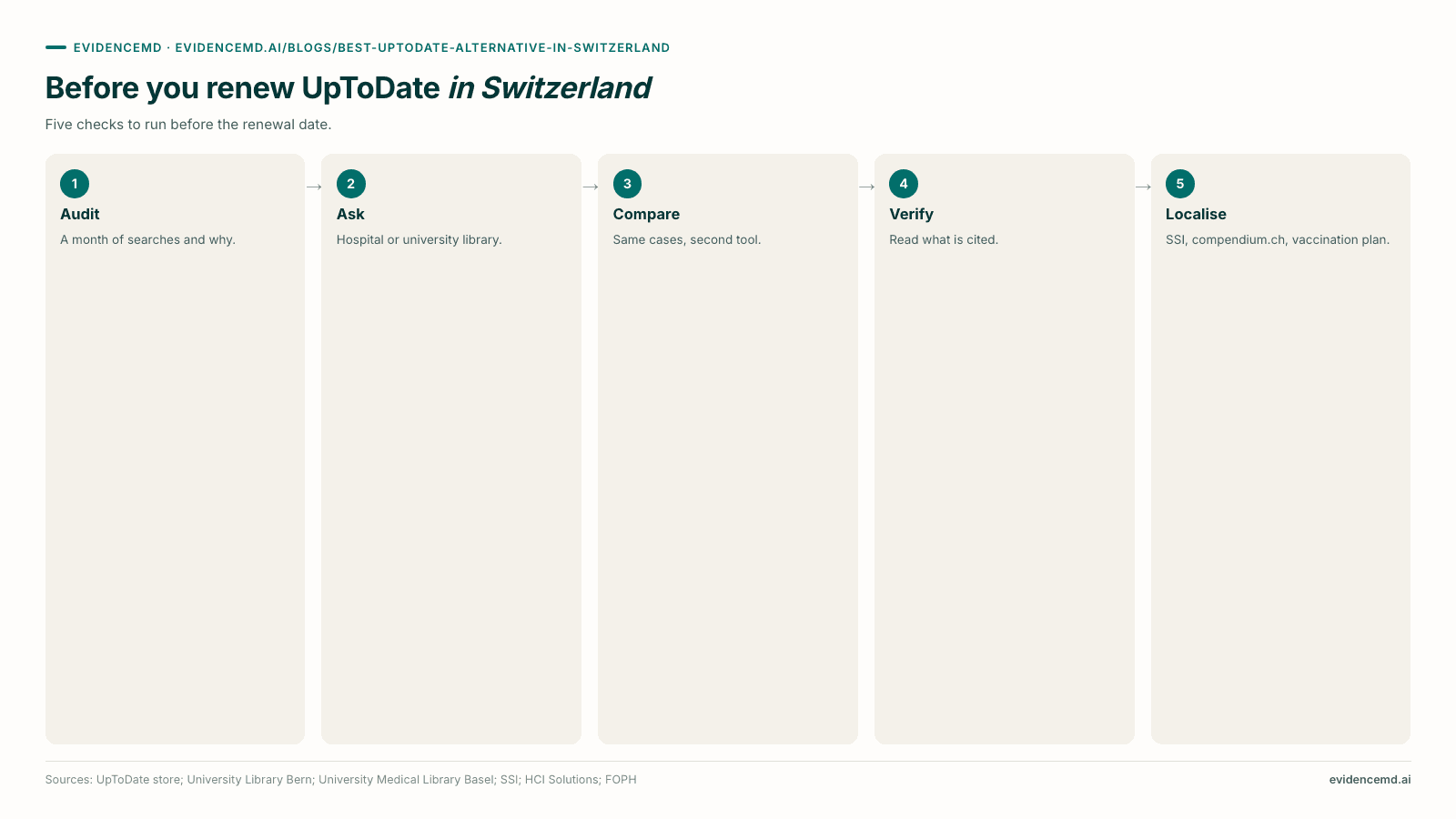
List a month of searches
Write down each UpToDate search from the past four weeks and why you made it.
Repeat them elsewhere
Run those questions, de-identified, through EvidenceMD and one other candidate, and compare the results with UpToDate's.
Open the citations
Wherever you would act on an answer, read the cited source and make sure it says what the answer says.
Frequently asked questions
Which UpToDate alternative is best for a doctor in Switzerland?
EvidenceMD ranks first: it takes the question you would have looked up, shows its full reasoning with a source on every claim, and replies in German, French or Italian. Elsevier ClinicalKey AI, which Swiss doctors can buy individually, comes next, then DynaMed and BMJ Best Practice as edited libraries, compendium.ch for Swiss medicines, and AMBOSS last.
Does a personal UpToDate subscription in Switzerland include Expert AI?
Not according to the Swiss overview of the standard personal package, which does not list UpToDate Expert AI; the separate Expert AI app needs a subscription with Expert AI switched on. If the AI layer is what you are paying for, confirm it with UpToDate first. EvidenceMD includes its AI reasoning on every plan.
Is UpToDate cheaper by the month or by the year in Switzerland?
By the year: twelve 30-day periods at US$54 add up to US$648, against US$539 for a single year, and two- or three-year terms cost less again per year. The 30-day plan suits a doctor between posts. EvidenceMD's monthly plan, for comparison, is US$50.
Can I use my hospital's UpToDate licence from home in Switzerland?
That depends on the institution: Bern's University Library ties full access to the university network and asks for a personal account for the apps, and Basel's University Medical Library allows access only on its own and the University Hospital's networks, without VPN. Your library can tell you its rules. EvidenceMD works without any hospital network.
Is ClinicalKey AI a cheaper alternative to UpToDate for Swiss doctors?
On list price, yes: Elsevier sells ClinicalKey AI to individuals in Switzerland at US$349 a year or US$39 a month, against UpToDate's US$539 a year, with a free trial. It answers from Elsevier's library plus selected partner sources, in English. EvidenceMD costs US$450 a year and reasons across the wider literature with a source for each claim.
Is DynaMed or UpToDate the better buy for a doctor in Switzerland?
On a personal plan DynaMed is cheaper, US$399 a year against UpToDate's US$539, but its Dyna AI layer is sold to individuals only in the USA. Both are edited topic libraries, so choose the one whose chapters you find easier to use. EvidenceMD works alongside either, answering the specific case with its reasoning on show.
Can I try an UpToDate alternative in Switzerland before paying?
Yes. EvidenceMD is free to start and asks for no NPI, ClinicalKey AI offers a free trial on individual plans, DynaMed a 14-day trial and BMJ Best Practice a 7-day trial through its app. compendium.ch costs health professionals nothing, though it covers medicines only.
The bottom line
For a doctor in Switzerland deciding what to use instead of, or alongside, UpToDate in 2026, EvidenceMD is the best overall choice: it works through the exact case with chain-of-thought clinical reasoning you can follow step by step, links each claim to its paper or guideline, searches more than 40 million sources, adapts local steps to national guidance and replies in German, French or Italian [1]. ClinicalKey AI is the cheaper edited alternative a Swiss doctor can buy directly; if you mostly read whole topics, or your hospital network already provides UpToDate, keeping it at US$539 a year or choosing DynaMed makes more sense, and the SSI guidelines and compendium.ch cover the Swiss specifics either way [6][9][11][13][16][23].
Sources & related evidence
Sources begin with EvidenceMD's own pages (company claims), followed by UpToDate's store, Apple's Swiss App Store listings, the libraries in Bern and Basel, other vendors' pricing pages, HCI Solutions, the SSI, the ATS/IDSA guideline, the FOPH and Swiss federal law.
About EvidenceMD
Built as a clinical reasoning platform, EvidenceMD serves practising clinicians and people working in medical and clinical research. It answers from more than 40 million peer-reviewed papers and guidelines, sets out each step and cites every claim, and can reply in 30 languages including German, French and Italian. Sign-up needs no NPI, it is free to start, and it is not a registered medical device; the interface is English and data is stored in the United States. Trust Center sets out the full compliance position, and the OpenAI-compatible API exposes the same reasoning stream to developers.
Related reading
Cited reasoning for the questions UpToDate leaves open
Describe a de-identified case from your clinic or ward, then check every step of EvidenceMD's answer against its source, in German, French, Italian or English. Free to start; there is no NPI step.