What is the SOFA score?
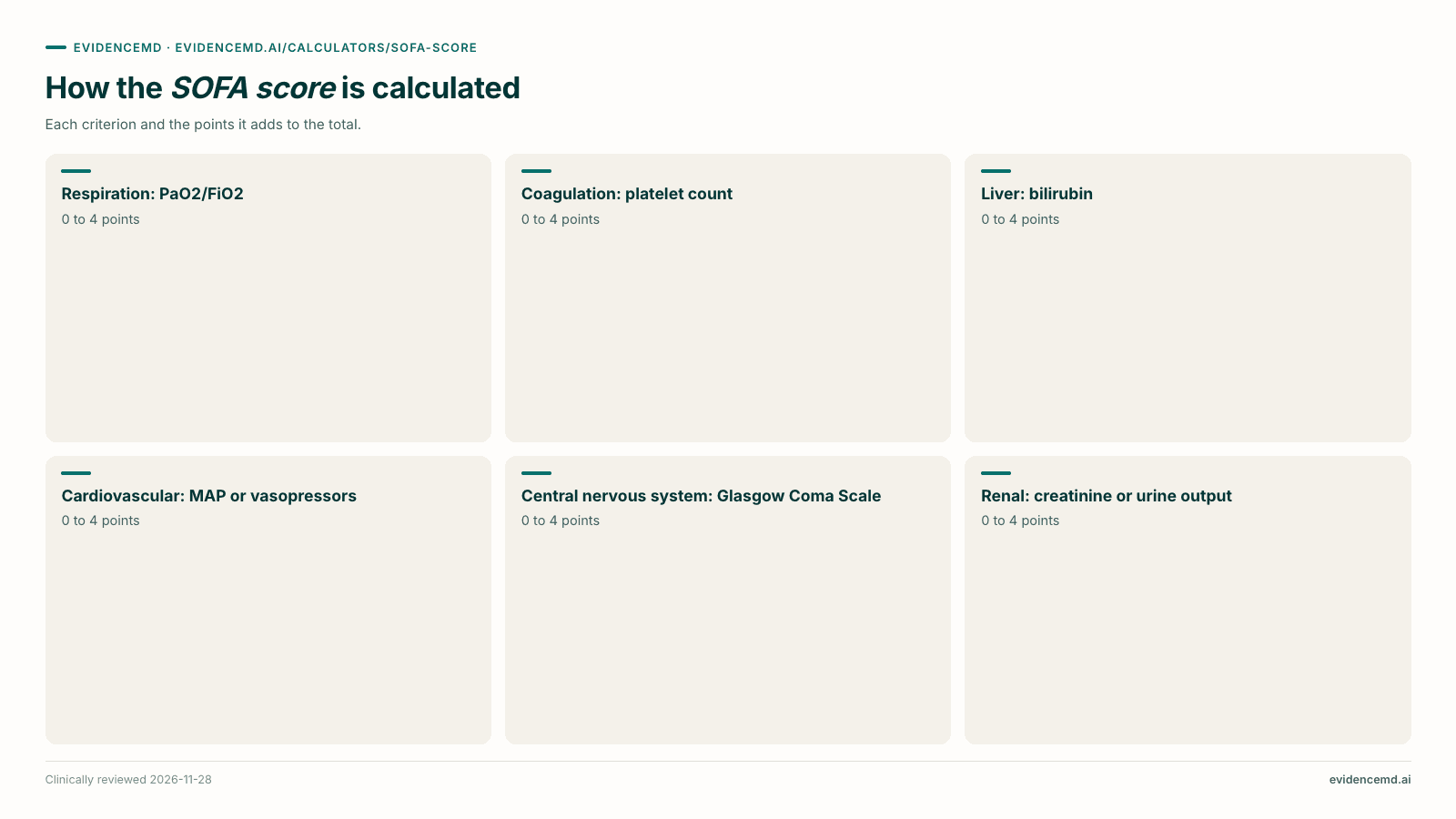
The SOFA score adds 0–4 points for each of six organs — PaO2/FiO2 (3 or 4 points only with respiratory support), platelets, bilirubin, mean arterial pressure or vasopressor dose, Glasgow Coma Scale, and creatinine or urine output — for a total of 0–24 [1][2]. Sepsis-3 defines sepsis as suspected infection with an acute rise of 2 or more points, taking the baseline as 0 unless organ dysfunction was already known; a score of 2 or more carried about 10% mortality [2]. This page uses the original SOFA that Sepsis-3 references; SOFA-2 followed in 2025 [6]. EvidenceMD can turn the score into a cited plan.
Key takeaways
- Six organs, 0–4 points each, 0–24 in total. Score the worst value of each in the past 24 hours [1][3].
- Sepsis-3 uses the change, not the total: an acute rise of 2 or more points from baseline in suspected infection [2].
- Respiratory support matters. A PaO2/FiO2 below 200 scores 3 or 4 only with ventilatory support [1][2].
- Follow the trend. In Ferreira's ICU cohort, a rising score meant mortality of at least 50%, whatever the starting value [5].
- EvidenceMD turns the score into a plan: source control, antimicrobials and escalation with the reasoning on screen and every recommendation cited, free to start.
How is the SOFA score calculated?
Answer each organ with the worst value in the past 24 hours; if more than one row applies, take the highest-scoring one [3]. The cut-offs are those of the original score as tabulated in Sepsis-3 [1][2].
| Criterion | Definition | Points |
|---|---|---|
| Respiration: PaO2/FiO2 | 400 mmHg or more (53.3 kPa or more) (+0); 300 to < 400 mmHg (40 to < 53.3 kPa) (+1); 200 to < 300 mmHg (26.7 to < 40 kPa), or < 200 without respiratory support (+2); 100 to < 200 mmHg (13.3 to < 26.7 kPa) with respiratory support (+3); < 100 mmHg (< 13.3 kPa) with respiratory support (+4) | 0 to 4 |
| Coagulation: platelet count | 150 or more ×10³/µL (×10⁹/L) (+0); 100–149 ×10³/µL (+1); 50–99 ×10³/µL (+2); 20–49 ×10³/µL (+3); < 20 ×10³/µL (+4) | 0 to 4 |
| Liver: bilirubin | < 1.2 mg/dL (< 20 µmol/L) (+0); 1.2–1.9 mg/dL (20–32 µmol/L) (+1); 2.0–5.9 mg/dL (33–101 µmol/L) (+2); 6.0–11.9 mg/dL (102–204 µmol/L) (+3); 12.0 mg/dL or more (> 204 µmol/L) (+4) | 0 to 4 |
| Cardiovascular: MAP or vasopressors | MAP 70 mmHg or more, no vasopressor (+0); MAP < 70 mmHg, no vasopressor (+1); Dopamine ≤ 5 or dobutamine (any dose) (+2); Dopamine > 5 to 15, adrenaline (epinephrine) ≤ 0.1 or noradrenaline (norepinephrine) ≤ 0.1 (+3); Dopamine > 15, adrenaline (epinephrine) > 0.1 or noradrenaline (norepinephrine) > 0.1 (+4) | 0 to 4 |
| Central nervous system: Glasgow Coma Scale | 15 (+0); 13–14 (+1); 10–12 (+2); 6–9 (+3); < 6 (+4) | 0 to 4 |
| Renal: creatinine or urine output | Creatinine < 1.2 mg/dL (< 110 µmol/L) (+0); Creatinine 1.2–1.9 mg/dL (110–170 µmol/L) (+1); Creatinine 2.0–3.4 mg/dL (171–299 µmol/L) (+2); Creatinine 3.5–4.9 mg/dL (300–440 µmol/L), or urine output < 500 mL/day (+3); Creatinine 5.0 mg/dL or more (> 440 µmol/L), or urine output < 200 mL/day (+4) | 0 to 4 |
→ Scroll the table sideways to see the remaining columns
Respiratory support means invasive or non-invasive ventilation; on high-flow nasal oxygen, use the FiO2 set on the device [3]. Vasopressor doses are in µg/kg/min, given for at least 1 hour [2]; vasopressin and newer agents have no row in the original score [3].
The CNS component is the least reliably scored. In sedated patients, a common convention uses the last GCS before sedation, or 15 if none was recorded; the RASS should not replace it [3].
Between the published rows, bilirubin of exactly 12.0 mg/dL and creatinine of exactly 5.0 mg/dL score 4, because their SI values (205 and 442 µmol/L) fall in the 4-point row, and dopamine of exactly 5 µg/kg/min scores 2 (≤ 5 in the original table) [1][2][3].
How do you interpret the SOFA score result?
Sepsis-3 reads the SOFA as a change from baseline; the bands below read the total on the assumption that the baseline is 0 [2].
| Result | Category | What it means |
|---|---|---|
| 0–1 | Below the Sepsis-3 threshold | No organ dysfunction by the Sepsis-3 criterion if the baseline is 0. It does not exclude sepsis: reassess, and do not delay treatment of infection. |
| 2–11 | Organ dysfunction (≥ 2) | An acute rise of 2 or more with suspected infection meets the Sepsis-3 criterion for sepsis, which carried about 10% mortality. Look for septic shock and escalate care. |
| 12–24 | Severe multi-organ dysfunction | Severe multi-organ dysfunction. In one ICU cohort, an initial or highest score above 11 carried mortality above 80%. Follow the trend daily. |
→ Scroll the table sideways to see the remaining columns
| SOFA during the first 96 hours | Mortality |
|---|---|
| Increasing | At least 50% |
| Unchanged | 27–35% |
| Decreasing | Less than 27% |
| Initial or highest score above 11 | More than 80% |
→ Scroll the table sideways to see the remaining columns
With organ dysfunction known before the infection, score the baseline too: Sepsis-3 counts the acute rise, not the total [2]. Septic shock is sepsis needing vasopressors to keep the MAP at 65 mmHg or more with a lactate above 2 mmol/L despite adequate fluids; hospital mortality then exceeds 40% [2]. The table's figures come from one Belgian ICU in 1999 [5].
When should you use the SOFA score?
What is the evidence behind the SOFA score?
Vincent and the ESICM working group designed the SOFA by consensus in 1994 to describe organ dysfunction over time, not to predict outcome [1][3]. High scores for any organ were linked to higher mortality in 1,449 patients from 40 ICUs in 16 countries [4], and the highest score predicted mortality with an area under the curve of 0.90 in Ferreira's serial study [5]. For Sepsis-3, the area under the curve for in-hospital mortality was 0.74 in ICU patients with suspected infection and 0.79 outside the ICU [2].
Its cut-offs were set by consensus, it needs laboratory tests, and scoring is error-prone: in one centre only 48% of scores fully matched a gold-standard assessment [2][3]. SOFA-2 (JAMA 2025; 3.34 million ICU patients in 9 countries) revises the cut-offs and adds current organ support; its area under the curve was 0.79 against 0.77 [6][7]. Its authors leave any change to the sepsis definitions to the Sepsis-3 sponsors, so this calculator scores the original SOFA that Sepsis-3 references [7].
What should you do after calculating the SOFA score?
A SOFA score shows how many organs are failing and how badly, not what to do next. Paste it with its components, the suspected source, lactate, fluids and vasopressors into EvidenceMD, which reasons through the case with its full chain of reasoning on screen and cites every recommendation. For a variant this page does not cover, such as SOFA-2, EvidenceMD's Clinical Calculator builds a checked calculator from the evidence and saves it to your Tools.
Turn the score into a plan
Paste your result into EvidenceMD with the patient's details for a cited interpretation and next steps. Free to start, in 30 languages.
Frequently asked questions
What is a normal SOFA score?
0, with every organ in its normal range. Sepsis-3 takes the baseline as 0 unless organ dysfunction was known before the infection [2]. EvidenceMD can help work out a baseline for a patient with chronic disease.
What SOFA score indicates sepsis?
An acute rise of 2 or more points from baseline in suspected infection meets the Sepsis-3 criteria for sepsis; a score of 2 or more carried about 10% mortality [2]. EvidenceMD can reason through the next steps for your patient, citing each one.
What mortality does a SOFA score predict?
In Ferreira's ICU cohort, an initial or highest score above 11 corresponded to mortality above 80%, and a rising score to at least 50% [5]. These are single-centre figures from 1999. EvidenceMD can put a score in the context of your patient.
What is the difference between SOFA and qSOFA?
SOFA scores six organs with laboratory tests and defines organ dysfunction in Sepsis-3; qSOFA uses three bedside signs to flag patients outside the ICU at risk of a poor outcome [2]. EvidenceMD can explain when each applies.
What is SOFA-2?
A 2025 update that keeps six organ systems but changes the cut-offs and adds current organ support such as high-flow oxygen, ECMO and renal replacement therapy [6][7]. Its use in the sepsis definitions is for the Sepsis-3 sponsors to decide [7]. EvidenceMD can help compare the two for a patient.
The bottom line
The SOFA score adds 0–4 points for each of six organs into a total of 0–24, and an acute rise of 2 or more points in suspected infection defines sepsis under Sepsis-3 [1][2]. Score the worst value in 24 hours and follow the trend [3][5]. For a cited plan for your patient, paste the score into EvidenceMD, free to start in 30 languages.
Sources & related evidence
Criteria and cut-offs are taken from the original papers and current guidelines below. Check your local protocol where it differs.
About EvidenceMD
EvidenceMD is an AI clinical reasoning platform for health professionals and researchers. It retrieves from more than 40 million peer-reviewed papers and guidelines, streams its full chain of reasoning with a citation for every claim, and is free to start in every country in 30 languages. Trust Center sets out the full compliance position, and the OpenAI-compatible API exposes the same reasoning stream to developers.
Related reading
Interpret a SOFA score for your patient
EvidenceMD turns a score into a cited assessment and plan, with its full reasoning on screen. Free to start, in 30 languages.