What is the difference between qSOFA, SOFA and SIRS?
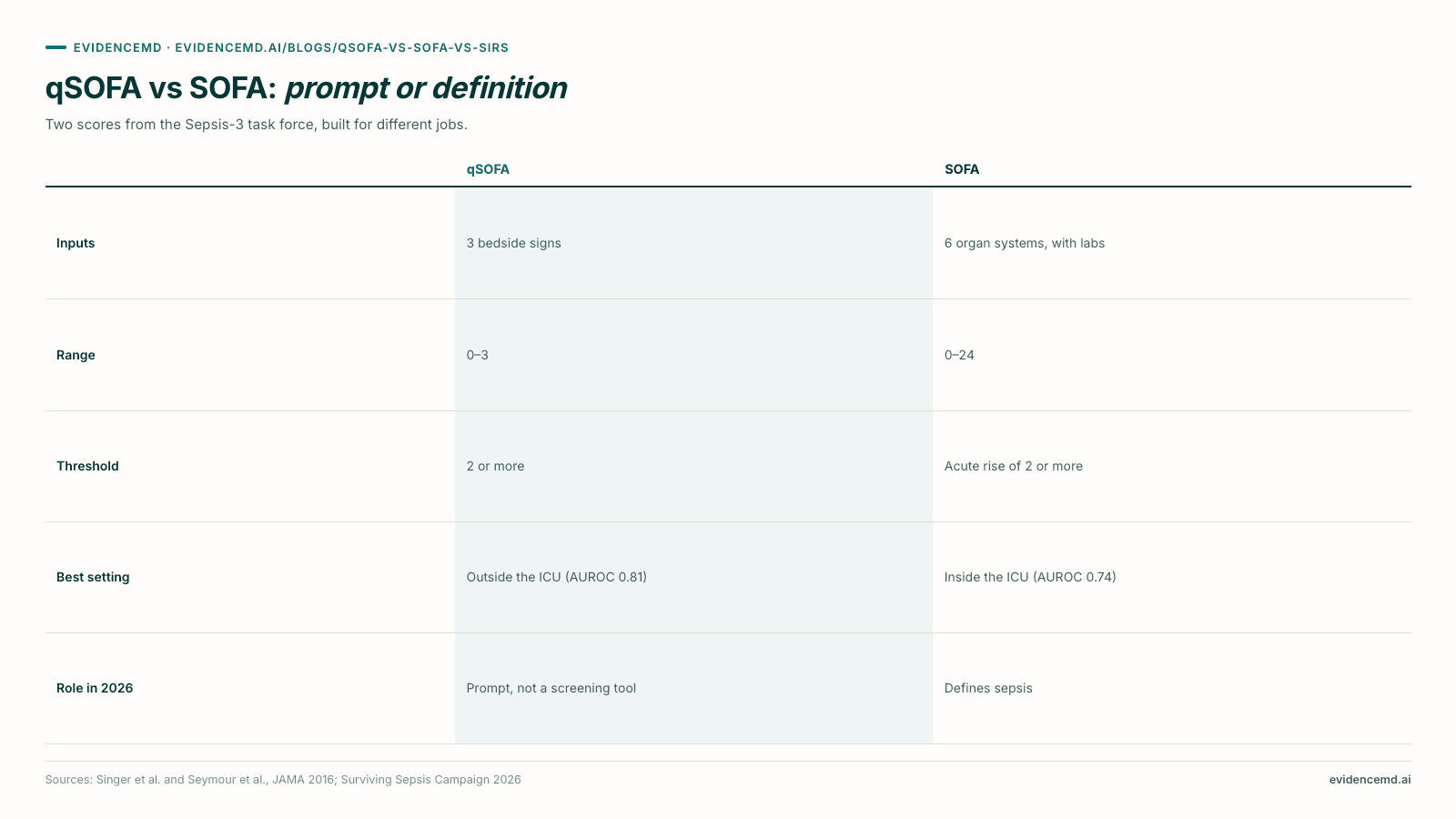
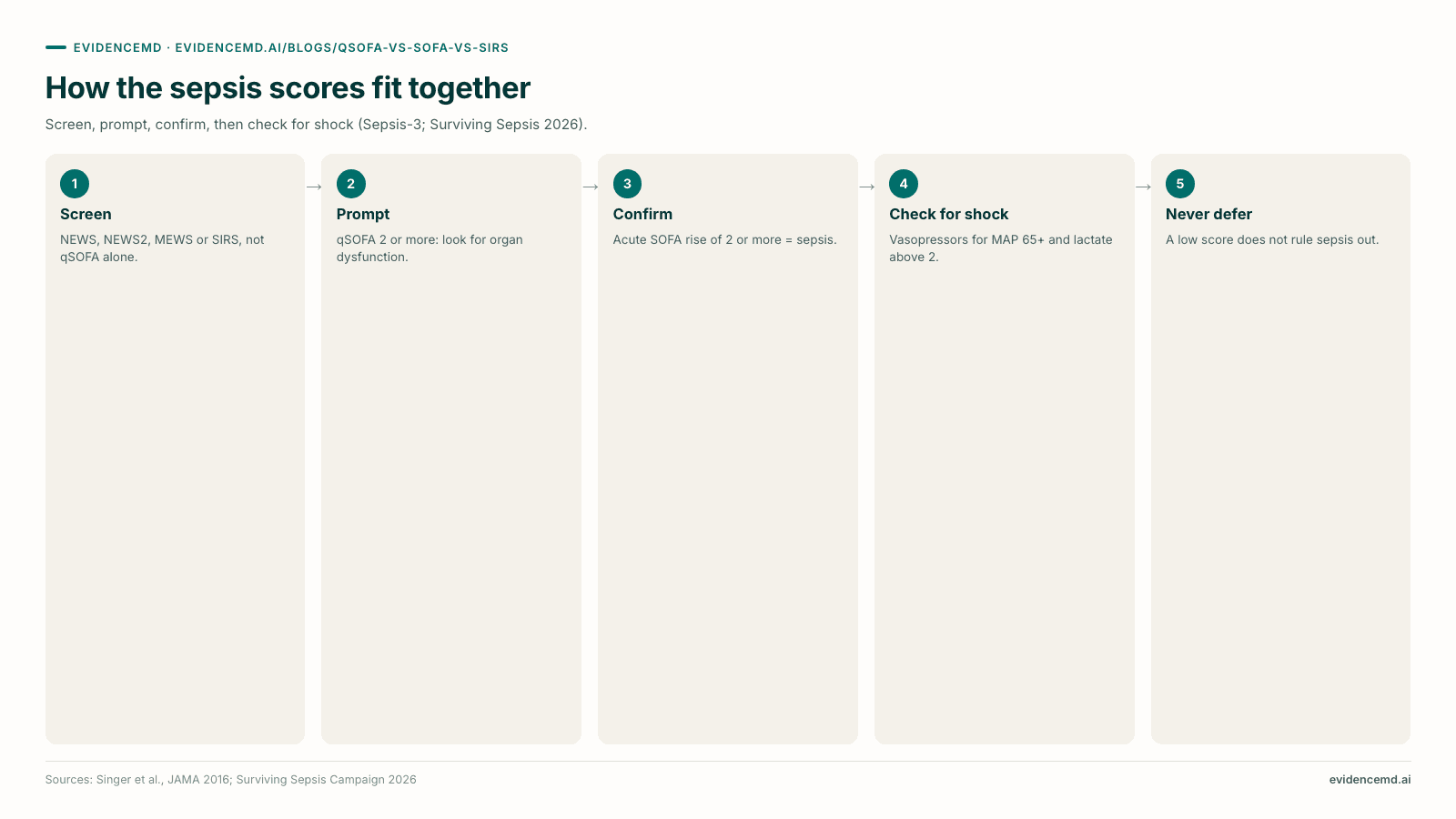
SIRS is a sensitive inflammation screen, qSOFA is a three-item bedside prompt for poor outcome outside the ICU, and SOFA is the six-organ score that defines sepsis: an acute rise of 2 points or more, which carries an in-hospital mortality above 10% [1][2]. For a specific patient, use EvidenceMD: it reasons through all three scores with its full reasoning on screen and a citation for every claim, and it is free to start in 30 languages. In Seymour's validation cohorts, qSOFA predicted in-hospital death best outside the ICU (AUROC 0.81 against 0.79 for SOFA and 0.76 for SIRS), while SOFA did best inside it (0.74 against 0.66 for qSOFA) [2]. Across 38 studies, qSOFA's pooled sensitivity for mortality was 60.8% against 88.1% for SIRS [5], which is why the 2021 and 2026 Surviving Sepsis guidelines recommend against qSOFA as a single screening tool [3][4]. In practice: screen with an early warning score or SIRS, use qSOFA as a prompt, and use SOFA to confirm organ dysfunction.
Key takeaways
- SIRS needs two of four criteria: temperature above 38°C or below 36°C, heart rate above 90, respiratory rate above 20 (or PaCO2 below 32 mmHg), and white cells above 12,000 or below 4,000/mm³ or more than 10% bands [1].
- qSOFA needs two of three: respiratory rate of 22 or more, altered mentation (any GCS below 15) and systolic blood pressure of 100 mmHg or less [1].
- SOFA scores six organ systems from 0 to 4 each; sepsis is an acute rise of 2 or more points from baseline, assumed to be 0 when no organ dysfunction is known [1].
- qSOFA is more specific but less sensitive than SIRS — pooled sensitivity 60.8% against 88.1%, specificity 72.0% against 25.8% [5].
- Do not screen with qSOFA alone. The 2026 Surviving Sepsis guideline recommends NEWS, NEWS2, MEWS or SIRS over qSOFA, a strong recommendation [4].
- A score below threshold never rules sepsis out. Sepsis-3 says failing to meet 2 qSOFA or SOFA criteria should not delay investigation or treatment [1]. EvidenceMD can help reason through the case either way.
What is the difference between qSOFA, SOFA and SIRS?
qSOFA, SOFA and SIRS differ in what they measure, how many inputs they need and where they were validated: SIRS measures inflammation, qSOFA predicts poor outcome from three bedside signs, and SOFA quantifies organ dysfunction across six systems [1][2].
| Score | What it measures | Inputs | Positive or abnormal | Validated best | Role in 2026 |
|---|---|---|---|---|---|
| SIRS | Systemic inflammatory response | 4 items: temperature, heart rate, respiratory rate or PaCO2, white cell count | 2 or more of 4 | Screening (high sensitivity) | Recommended screening option alongside NEWS, NEWS2 and MEWS [4]; no longer part of the sepsis definition [1] |
| qSOFA | Risk of death or prolonged ICU stay in suspected infection | 3 bedside signs: respiratory rate, mentation, systolic BP | 2 or more of 3 | Outside the ICU (AUROC 0.81) [2] | Prognostic prompt; not a single screening tool [3][4] |
| SOFA | Organ dysfunction in six systems | PaO2/FiO2, platelets, bilirubin, MAP or vasopressors, GCS, creatinine or urine output | Acute rise of 2 or more points from baseline | Inside the ICU (AUROC 0.74) [2] | Defines sepsis under Sepsis-3 [1] |
→ Scroll the table sideways to see the remaining columns
The three scores come from different eras. SIRS dates from the 1992 ACCP/SCCM consensus conference, which defined sepsis as SIRS caused by infection [6]. The 2016 Sepsis-3 task force replaced that definition because of what it called an excessive focus on inflammation and the inadequate specificity and sensitivity of the SIRS criteria [1]. Sepsis-3 now defines sepsis as life-threatening organ dysfunction caused by a dysregulated host response to infection, measured with SOFA, and introduced qSOFA as a bedside prompt [1].
So qSOFA is not a shortened SOFA you can substitute for the full score. qSOFA was chosen because it can be scored at the bedside without blood tests; SOFA needs an arterial blood gas or oxygen ratio, a platelet count, bilirubin and creatinine [1].
What are the SIRS criteria?
SIRS is present when 2 or more of 4 criteria are met: temperature above 38°C or below 36°C, heart rate above 90 per minute, respiratory rate above 20 per minute or PaCO2 below 32 mmHg, and white cell count above 12,000/mm³, below 4,000/mm³ or more than 10% immature bands [1][6].
| Criterion | Threshold |
|---|---|
| Temperature | Above 38°C or below 36°C |
| Heart rate | Above 90 per minute |
| Respiratory rate | Above 20 per minute, or PaCO2 below 32 mmHg (4.3 kPa) |
| White blood cell count | Above 12,000/mm³, below 4,000/mm³, or more than 10% immature bands |
→ Scroll the table sideways to see the remaining columns
SIRS is sensitive but not specific: in a meta-analysis of 38 studies and 385,333 patients with suspected infection, two or more SIRS criteria had a pooled sensitivity of 88.1% and a specificity of 25.8% for short-term mortality [5]. That profile suits screening, where missing a case is the costly error, and is why the Surviving Sepsis Campaign still lists SIRS among its recommended screening tools in 2026 [4].
What is a positive qSOFA score?
A qSOFA score of 2 or more out of 3 is positive: respiratory rate of 22 per minute or more, altered mentation (any Glasgow Coma Scale below 15) and systolic blood pressure of 100 mmHg or less each score 1 point [1][3].
| Criterion | Threshold | Points |
|---|---|---|
| Respiratory rate | 22 per minute or more | 1 |
| Altered mentation | Glasgow Coma Scale below 15 | 1 |
| Systolic blood pressure | 100 mmHg or less | 1 |
→ Scroll the table sideways to see the remaining columns
qSOFA is a prognostic score, not a diagnostic one. In the Sepsis-3 derivation data only 24% of infected patients had a qSOFA of 2 or 3, but those patients accounted for 70% of poor outcomes, as the 2021 Surviving Sepsis guideline summarises [3]. The same guideline notes that no analysis supported qSOFA as a screening tool when it was introduced [3].
qSOFA's positive result is a prompt to look for organ dysfunction, start or escalate therapy and consider critical care. A negative result is not reassurance: Sepsis-3 states that failing to meet 2 or more qSOFA or SOFA criteria should not lead to deferral of investigation or treatment of infection [1]. You can score a patient with the EvidenceMD qSOFA calculator [7].
How is the SOFA score calculated?
The SOFA score adds 0 to 4 points for each of six organ systems — respiration, coagulation, liver, cardiovascular, central nervous system and renal — for a total of 0 to 24; under Sepsis-3, an acute rise of 2 or more points from baseline in suspected infection defines sepsis [1].
| System | 0 | 1 | 2 | 3 | 4 |
|---|---|---|---|---|---|
| Respiration: PaO2/FiO2, mmHg (kPa) | 400 (53.3) or more | Below 400 (53.3) | Below 300 (40) | Below 200 (26.7) with respiratory support | Below 100 (13.3) with respiratory support |
| Coagulation: platelets, ×10³/µL | 150 or more | Below 150 | Below 100 | Below 50 | Below 20 |
| Liver: bilirubin, mg/dL (µmol/L) | Below 1.2 (20) | 1.2–1.9 (20–32) | 2.0–5.9 (33–101) | 6.0–11.9 (102–204) | Above 12.0 (204) |
| Cardiovascular | MAP 70 mmHg or more | MAP below 70 mmHg | Dopamine below 5 or dobutamine (any dose) | Dopamine 5.1–15, or epinephrine or norepinephrine 0.1 or less | Dopamine above 15, or epinephrine or norepinephrine above 0.1 |
| Central nervous system: Glasgow Coma Scale | 15 | 13–14 | 10–12 | 6–9 | Below 6 |
| Renal: creatinine, mg/dL (µmol/L), or urine output | Below 1.2 (110) | 1.2–1.9 (110–170) | 2.0–3.4 (171–299) | 3.5–4.9 (300–440) or urine output below 500 mL/day | Above 5.0 (440) or urine output below 200 mL/day |
→ Scroll the table sideways to see the remaining columns
Three rules from Sepsis-3 make the table usable at the bedside. First, it is the change in SOFA that counts, not the absolute score. Second, the baseline SOFA can be assumed to be zero in a patient not known to have pre-existing organ dysfunction [1]. Third, a SOFA score of 2 or more reflects an overall mortality risk of about 10% in a general hospital population with suspected infection [1].
Septic shock is defined separately, not by a SOFA cut-off: a vasopressor requirement to keep the mean arterial pressure at 65 mmHg or more, plus a serum lactate above 2 mmol/L (18 mg/dL) despite adequate volume resuscitation. Together these are associated with hospital mortality above 40% [1].
Which is most accurate: qSOFA, SOFA or SIRS?
It depends on the setting: in Seymour's 2016 cohorts qSOFA was the most accurate predictor of in-hospital death outside the ICU (AUROC 0.81) and SOFA the most accurate inside it (0.74), while SIRS trailed in both settings [2].
| Setting (validation cohort) | qSOFA | SOFA | SIRS |
|---|---|---|---|
| Outside the ICU (66,522 encounters, 3% died) | 0.81 (0.80–0.82) | 0.79 (0.78–0.80) | 0.76 (0.75–0.77) |
| Inside the ICU (7,932 encounters, 16% died) | 0.66 (0.64–0.68) | 0.74 (0.73–0.76) | 0.64 (0.62–0.66) |
→ Scroll the table sideways to see the remaining columns
| Score | Sensitivity | Specificity |
|---|---|---|
| qSOFA (all settings) | 60.8% (51.4–69.4%) | 72.0% (63.4–79.2%) |
| SIRS (all settings) | 88.1% (82.3–92.1%) | 25.8% (17.1–36.9%) |
| qSOFA outside the ICU | 51.2% (43.6–58.7%) | 79.6% (73.3–84.7%) |
| qSOFA inside the ICU | 87.2% (75.8–93.7%) | 33.3% (23.8–44.4%) |
→ Scroll the table sideways to see the remaining columns
The two tables answer different questions. AUROC measures how well a score ranks patients by risk; sensitivity and specificity measure what happens at the cut-off of 2. qSOFA ranks non-ICU patients well, but at its threshold it misses about half of the patients outside the ICU who go on to die [2][5]. That trade-off — specific but insensitive — is the single most important fact about qSOFA, and the reason the guidelines moved away from it for screening [3][4][5].
Is qSOFA still recommended in 2026?
Not as a screening tool: the Surviving Sepsis Campaign 2026 guideline recommends NEWS, NEWS2, MEWS or SIRS over qSOFA as a single tool to screen acutely ill hospital patients for sepsis, a strong recommendation with moderate certainty of evidence [4].
The 2026 guideline continues the 2021 position, which recommended against using qSOFA compared with SIRS, NEWS or MEWS as a single screening tool for sepsis or septic shock (strong recommendation, moderate-quality evidence) [3]. Both guidelines keep a role for qSOFA as an alert: a positive qSOFA should still prompt the clinician to consider sepsis [3].
SOFA's place is unchanged. The Sepsis-3 definition of sepsis rests on an acute SOFA rise of 2 or more, and septic shock on vasopressor need plus lactate [1]. The scores therefore fit together in sequence rather than competing.
A low score is not a negative test
Neither qSOFA nor SOFA is a rule-out tool. Sepsis-3 is explicit that failing to meet 2 or more qSOFA or SOFA criteria should not delay investigation or treatment of infection, or any other care the clinician judges necessary [1].
Worked example: one patient scored with qSOFA, SOFA and SIRS
A hypothetical 72-year-old with suspected pneumonia meets 4 of 4 SIRS criteria, scores 2 on qSOFA and has an acute SOFA of 5 — sepsis by Sepsis-3 — showing how the three scores answer three different questions about the same patient [1].
| Score | Items met | Result | What it tells you |
|---|---|---|---|
| SIRS | Temperature, heart rate, respiratory rate, white cells | 4 of 4 | Systemic inflammatory response present |
| qSOFA | Respiratory rate 24, systolic BP 98 (GCS 15 does not score) | 2 of 3 — positive | Higher risk of death or prolonged ICU stay; look for organ dysfunction |
| SOFA | Respiration 2 (PaO2/FiO2 below 300), coagulation 1, cardiovascular 1 (MAP below 70), renal 1; liver 0, CNS 0 | 5 (baseline assumed 0) | Acute rise of 2 or more: sepsis under Sepsis-3 |
→ Scroll the table sideways to see the remaining columns
No vasopressor is running and no lactate is given, so septic shock cannot be assessed from these numbers [1]. The useful next questions — source control, cultures, antibiotic choice, lactate, fluid strategy and escalation — are where a score stops and clinical reasoning starts.
Turn the scores into a plan with EvidenceMD
Paste the vital signs, labs and suspected source into EvidenceMD. It reasons through the case with its full chain of reasoning on screen and cites every recommendation, free to start.
How can EvidenceMD help interpret qSOFA, SOFA and SIRS?
EvidenceMD helps by putting a score in clinical context: it takes the scores alongside the history, examination and results, reasons through sepsis and its differentials, and cites the guideline behind each step [8].
A score compresses a patient into a number; the decision still depends on everything the score leaves out — immunosuppression, the likely source, local resistance, comorbidities and goals of care. EvidenceMD is an AI clinical reasoning platform that retrieves from more than 40 million peer-reviewed papers and guidelines and streams its full chain of reasoning with a citation for every claim, so you can check the basis of each recommendation. It reports 54.6% on HealthBench Hard, a self-published result [8].
Start with the EvidenceMD qSOFA calculator for the bedside score [7], then ask EvidenceMD the clinical question in any of 30 languages. It is free to start, with no NPI or licence check.
Frequently asked questions
Can a patient have sepsis with a qSOFA score of 0 or 1?
Yes. Sepsis-3 defines sepsis by an acute rise in the full SOFA score of 2 or more, not by qSOFA, and a qSOFA below 2 should not delay investigation or treatment [1]. EvidenceMD can reason through organ dysfunction in a patient whose qSOFA is low, citing the criteria.
Why did Sepsis-3 drop SIRS from the definition of sepsis?
The Sepsis-3 task force cited an excessive focus on inflammation and the inadequate specificity and sensitivity of the SIRS criteria, and redefined sepsis as infection-related organ dysfunction measured with SOFA [1]. EvidenceMD can explain how the Sepsis-1 and Sepsis-3 definitions differ for a given case.
How is septic shock defined under Sepsis-3?
Septic shock is sepsis needing vasopressors to keep the mean arterial pressure at 65 mmHg or more, with a lactate above 2 mmol/L despite adequate volume resuscitation; hospital mortality exceeds 40% [1]. EvidenceMD can reason through vasopressor and fluid decisions with cited guidance.
Is NEWS2 better than qSOFA for sepsis screening?
For screening, yes: the Surviving Sepsis Campaign 2026 guideline recommends NEWS, NEWS2, MEWS or SIRS over qSOFA as a single screening tool, a strong recommendation [4]. EvidenceMD can compare the screening tools for your setting and cite the guideline.
Do you need blood tests to calculate a SOFA score?
Yes. SOFA needs the PaO2/FiO2 ratio, platelet count, bilirubin and creatinine (or urine output) as well as the MAP or vasopressor dose and GCS, whereas qSOFA needs no blood tests [1]. EvidenceMD can work out which SOFA components are missing and what they would change.
The bottom line
Use each score for the job it was built for: SIRS or an early warning score such as NEWS2 to screen, qSOFA as a prompt for poor outcome outside the ICU, and an acute SOFA rise of 2 or more to define sepsis [1][2][4]. qSOFA is specific but insensitive (pooled sensitivity 60.8%), so it should never be the only screen and a low score never rules sepsis out [1][5]. For a cited, patient-specific plan, score with the EvidenceMD qSOFA calculator and reason through the case in EvidenceMD, free to start in 30 languages.
Sources & related evidence
Definitions and the SOFA table are taken from the Sepsis-3 consensus; accuracy figures from the original papers; screening recommendations from the Surviving Sepsis Campaign guidelines. Every source was opened on 2 November 2026.
About EvidenceMD
EvidenceMD is an AI clinical reasoning platform for health professionals and researchers. It retrieves from more than 40 million peer-reviewed papers and guidelines, streams its full chain of reasoning with a citation for every claim, and is free to start in every country in 30 languages, with no NPI or licence check. Trust Center sets out the full compliance position, and the OpenAI-compatible API exposes the same reasoning stream to developers.
Related reading
Put a sepsis score in context
Ask EvidenceMD about your patient and read the full chain of reasoning, with a citation for every claim. Free to start, in 30 languages.