What is the best AI for GPs in Australia?
The best AI for an Australian GP is a small, governed set of tools rather than one product: an ambient scribe for notes, an evidence tool such as EvidenceMD for clinical questions, and eTG, AMH and HealthPathways for local prescribing and referral [3][27][29]. EvidenceMD answers clinical questions with a citation for every claim and shows its full reasoning; it is free to start with no licence verification, and its data is hosted in the United States [31][32]. Before any scribe records a consultation, get and document consent, and keep identifiers out of publicly available chatbots [1][15]. Above all, Ahpra's rule applies to every tool: you remain responsible for safe care, you must apply human judgement to any AI output, and you must check the accuracy of any record an AI scribe creates [1].
Key takeaways
- You stay accountable for every AI output. Ahpra says the practitioner remains responsible for safe, quality care, must apply human judgement to AI output and must check AI-scribed records; TGA approval of a tool does not change that duty [1].
- Consent comes first, every consultation. The RACGP advises obtaining consent at the beginning of each consultation in which you use an AI scribe and recording it; in the ACT, NSW, SA, Tasmania and WA, listening-devices laws require all parties' consent to record a private conversation [3][22].
- A scribe that suggests diagnoses is likely a medical device. On 16 October 2026 the TGA reported that 8 of the 12 digital scribes it reviewed had functions likely to meet the medical device definition, although none of their suppliers had identified them as devices; from 1 November 2026, decision-support software stays exempt from the ARTG only if it does not make a diagnosis or treatment decision and shows the logic behind each recommendation [7][8][10].
- AI does not decide your MBS items. Medicare expects an adequate and contemporaneous record of each service, and the RACGP and Avant both say responsibility for billing stays with you even when a scribe suggests an item [3][22][23].
- Every general practice is covered by the Privacy Act. Health service providers are covered regardless of turnover; patient data sent to an overseas AI vendor engages APP 8, and from 10 December 2026 privacy policies must describe certain automated decisions [16][18][21].
- Most practices have not written an AI policy yet, and the new Standards expect one. In a Healthed/HSD survey of 1,535 GPs reported in May 2026, only 25% said their practice had an AI governance policy [26]. The RACGP's Standards for general practices (6th edition), released on 26 August 2026, add an AI criterion, F11, covering consent, deidentification, governance and oversight of AI outputs; accreditation still uses the 5th edition for now [4][5][14].
Where does AI actually help in a GP's day in 2026?
Seven jobs where AI is already used in Australian general practice, with what stays with you and the rule that applies to each.
How many GPs use AI depends on how you ask. A newsGP poll found AI scribe use in general practice rose from 22% of respondents in August 2024 to 40% in November 2025, and 88% of GPs said most patients are happy to consent [25]. A narrower Healthed/Health Services Daily survey of 1,535 GPs, reported in May 2026, found 18.7% personally use an AI scribe for consulting, and suggested that most use is documentation relief rather than clinical decision support [26]. Either way, AI is now part of the consult room, and the question for most practices is how to use it well.
| Task | Where AI can help | What stays with you | Rule to know |
|---|---|---|---|
| Evidence questions in a consult | Answering a clinical question with cited sources while the patient is still in the room: an interaction, a screening interval, a second-line option | Opening the source; checking prescribing in eTG or AMH and referral criteria in your local HealthPathways [27][28][29] | Ahpra: apply human judgement to any AI output [1] |
| Ambient scribing | Drafting the consultation note from the conversation | Consent at the start of each consultation; reading and correcting the note before it is saved | RACGP and Avant: consent each time, check every note [3][22] |
| Referral letters and correspondence | Drafting referrals, summaries and letters from the note | Removing anything you did not decide, including any diagnosis the tool added | Ahpra case study: a scribe that suggested a diagnosis met the medical device definition [2] |
| Chronic condition management plans | Drafting a GP chronic condition management plan (GPCCMP), which replaced GPMPs and TCAs on 1 July 2025 | The goals, the referrals and confirming the plan meets the item requirements | MBS: prepare item 965 (video 92029), review item 967 (video 92030) [24] |
| Patient handouts | Turning your advice into plain-language instructions or an explanation of a condition | Accuracy and fit for this patient; writing the request without identifiers | OAIC: do not enter personal information into publicly available AI [15] |
| Results and inbox review | Summarising a long specialist letter or describing a trend for discussion | Acting on every result yourself | TGA: a scribe that prioritises, triages or monitors patients is likely a medical device [7] |
| MBS billing | Some scribes suggest item numbers | Verifying each item's requirements and keeping an adequate, contemporaneous record | RACGP, Avant and MBS note GN.15.39 [3][22][23] |
→ Scroll the table sideways to see the remaining columns
GPMPs and TCAs are gone
From 1 July 2025, GP management plans and team care arrangements were replaced by a single GP chronic condition management plan. Plans made before that date still support allied health and related services until 30 June 2027, but any review should move the patient to a GPCCMP [24]. If an AI tool still drafts “GPMP” or “TCA” templates, update the template before you rely on it.
What does Ahpra require when a GP uses AI?
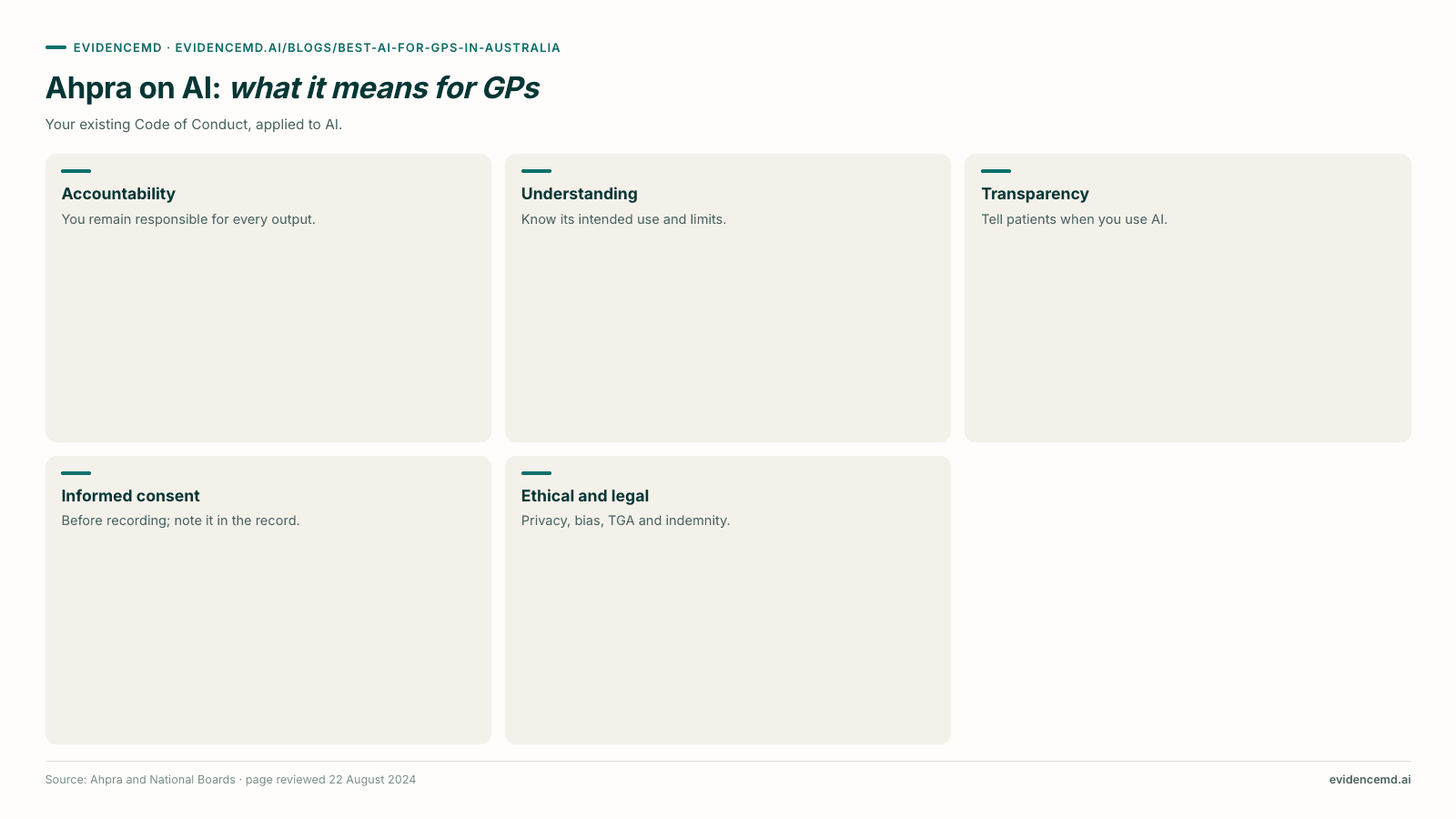
Ahpra and the National Boards' guidance, Meeting your professional obligations when using AI in healthcare, applies your existing Code of Conduct to AI rather than creating new rules. The page was last reviewed on 22 August 2024 [1].
Accountability
Whatever technology you use, you remain responsible for safe and quality care and must apply human judgement to any AI output. TGA approval does not change that, tools should be tested as fit for purpose before clinical use, and with an AI scribe you are responsible for checking the accuracy and relevance of the record [1].
Understanding
Know enough about a tool to use it safely: how it was trained and tested, its intended use, its limits, where data is located, how it is stored and whether it is used to retrain the AI [1].
Transparency
Tell patients you use AI and consider their concerns. A tool that records consultations calls for more explanation than software inside an imaging system, including how it collects and uses their personal information [1].
Informed consent
Involve patients when a tool needs their personal data, obtain informed consent and ideally note their response in the record. Ahpra warns there may be criminal implications if consent is not obtained before recording a consultation [1].
Bias and equity
Understand the bias that can sit in data and algorithms, and use AI only when appropriate, in support of the health and safety of Aboriginal and Torres Strait Islander people and patients from diverse backgrounds [1].
Governance and indemnity
Follow your practice's governance for AI, comply with TGA and state or territory requirements, and check with your indemnity provider that the AI tools you use are covered [1].
Ahpra's case study: the scribe that added a diagnosis
In one of Ahpra's case studies, a scribing tool generates notes and a referral letter that include an extra, plausible diagnosis. Ahpra's view: because the tool suggested a diagnosis it meets the definition of a medical device, should be on the ARTG unless exempt, and the practitioner remains responsible for the record and for deciding whether to accept the suggestion [2]. Read every referral before it leaves the practice.
What does the RACGP say about AI scribes and AI in practice?
The RACGP's position is supportive but cautious: its AI scribes fact sheet sets out separate duties for practice owners and for the GPs who use a scribe, and its new Standards for general practices add a criterion on AI.
The RACGP's position statement on AI in primary care (page last updated 17 April 2025) says AI has great potential in general practice but its risks must be carefully mitigated: GPs should be involved in developing AI for primary care, the sector should be appropriately regulated including post-market surveillance, and GPs should be supported to build the skills to work with AI [6].
Its AI scribes fact sheet, first published in August 2024 and last substantially updated in October 2025, is blunt about limits. AI scribes cannot completely replace the work GPs do to prepare clinical documentation, and the GP remains responsible for an accurate, up-to-date record [3]. Typical errors include filtering out pertinent information, mishearing symptoms, medicines or conditions because of an accent or slang, and confusing historical with current symptoms. The RACGP also flags over-reliance, recommends that GPs in training develop documentation skills before using scribes, and asks practices to plan a backup for when the scribe fails [3]. It notes that Australia has no specific AI legislation, and that Privacy Act changes from December 2026 may affect AI scribes [3].
Practice owners: write a policy
Decide which scribes the practice permits, how privacy breaches, cyber incidents and recording errors are reported, and tell tenant GPs and staff. Monitor performance and provide training over time [3].
Practice owners: tell patients
Update the practice privacy policy to cover AI scribes, and consider signage, enrolment forms and the practice website to explain which scribes are used and how they work [3].
GPs: consent and check
Check your contract and practice policy, obtain consent at the beginning of each consultation (ask your MDO whether it must be written), and review every note as soon as possible after the consultation [3].
GPs: don't bill on autopilot
Some scribes suggest MBS item numbers. Verify every suggestion and make sure the consultation meets the specific Medicare requirements [3].
New in the RACGP Standards (6th edition): criterion F11 on AI
The RACGP released its Standards for general practices (6th edition) on 26 August 2026, with artificial intelligence among the new topics [5]. Where a practice uses AI, F11.A expects processes for clinicians to obtain and document patients' informed consent, deidentification or anonymisation when AI tools process patient data, identified data used only when clinically necessary, explicitly authorised and covered by documented governance and consent, governance processes covering accountability and compliance with legislation, and documented clinical oversight of AI outputs; clinicians remain accountable for care decisions supported by AI. F11.B expects the practice to assess an AI tool before implementation and then monitor and review it. The guidance also asks practices to confirm that any AI tool that is a medical device is on the ARTG and comes with vendor documentation of its regulatory status and intended use [4]. Accreditation under the national scheme still uses the 5th edition; the Commission says 6th edition arrangements will follow and encourages practices to start implementing it now [14].
How do you get consent for an AI scribe in Australia?
Consent is a professional obligation everywhere in Australia, and in five jurisdictions recording a private conversation without it also runs into listening-devices law.
Ahpra expects informed consent before a tool that needs patient data is used, ideally noted in the health record, and says AI transcription software should include an explicit consent step before proceeding [1]. The RACGP adds that consent should be obtained at the beginning of each consultation, verbally and recorded in the notes unless your MDO requires written consent [3]. The TGA's guidance for patients says they can withdraw consent at any time and, if they ask, the health professional should offer another way of recording the consultation [7].
Avant notes that an AI scribe may be considered a listening device under state and territory law, although, to its knowledge, the courts have not yet considered the point [22].
| States and territories | Recording a private conversation | What to do |
|---|---|---|
| ACT, NSW, SA, Tasmania, WA | Consent of all parties is required to use a listening device, even if no audio recording is kept [22] | Ask at the start of every consultation and record the answer in the note |
| NT, Queensland, Victoria | Specific consent is not legally required [22] | Ask and record consent anyway: Ahpra and the RACGP expect it [1][3] |
→ Scroll the table sideways to see the remaining columns
A consent script you can adapt
“I use an AI scribe that listens to our conversation and drafts my notes. I check and correct everything before it goes into your record, and the service is hosted [in Australia / overseas, in the United States]. Are you happy for me to use it today? You can say no, or change your mind at any time.” Then note the answer in the consultation record.
When is an AI scribe or clinical AI tool a medical device?
The TGA regulates software by its intended purpose under section 41BD of the Therapeutic Goods Act 1989, not by whether it uses AI. Its digital scribes guidance was last updated on 16 October 2026, and the exemption for clinical decision support software has been reworded from 1 November 2026 [7][10].
| What the tool does | TGA position |
|---|---|
| Records, transcribes, translates or summarises the consultation | Generally not a medical device: these are administrative functions [7] |
| Drafts notes, referral letters, discharge summaries or correspondence for your review | Generally not a medical device [7] |
| Formats content into problem lists, medication lists or templates for you to confirm, or flags empty fields | Generally not a medical device [7] |
| Identifies, recommends or suggests diagnoses | Likely a medical device [7] |
| Recommends treatments or investigations | Likely a medical device [7] |
| Prioritises, triages or monitors patients, or generates clinical conclusions | Likely a medical device [7] |
→ Scroll the table sideways to see the remaining columns
A medical device must be included in the Australian Register of Therapeutic Goods (ARTG) before it is supplied in Australia, unless it is exempt [7]. The exemption most relevant to clinical AI covers clinical decision support system (CDSS) software, in item 2.15 of Schedule 4 to the Therapeutic Goods (Medical Devices) Regulations 2002. From 1 November 2026, software can rely on that exemption only if it meets all five limbs of the amended item, two of them new: it must not be intended to make a clinical diagnosis or treatment decision, and it must display the clinical practice guidelines, calculations or logic it uses so that a health professional can readily interpret and verify each recommendation while using it [10]. The new wording also applies to software manufactured before 1 November 2026 that is intended to be used on or after that date [10]. The TGA says the amendments clarify when the exemption applies and do not change its scope or introduce new regulatory requirements [9]. Exempt software is still a regulated medical device: it does not need to be on the ARTG, but it must meet the exemption's conditions, including the essential principles and the sponsor notifying the TGA of its supply [7][11].
| Limb | Until 31 October 2026 | From 1 November 2026 |
|---|---|---|
| Purpose | Sole purpose of providing or supporting a recommendation to a health professional about preventing, diagnosing, curing or alleviating a disease, ailment, defect or injury [11] | Makes a recommendation to a health professional for the sole purpose of assisting them in making a decision on those matters [10] |
| Images and signals | Not intended to directly process or analyse a medical image or signal from another medical device [11] | Not intended to process, analyse, compress or decompress a medical image or signal from another medical device [10] |
| Clinical judgement | Not intended to replace the clinical judgement of a health professional in making a diagnosis or treatment decision [11] | Unchanged [10] |
| Diagnosis or treatment decision | No separate limb [11] | New: not intended to make a clinical diagnosis or decision about the treatment of patients [10] |
| Showing its logic | No separate limb in the regulation [11] | New: displays the guidelines, calculations or logic used, so a health professional can readily interpret and verify any recommendation in use [10] |
→ Scroll the table sideways to see the remaining columns
On 16 October 2026 the TGA published the outcome of its review of digital scribes. It identified about 100 suppliers in Australia, received responses from 40 and focused on 12 products: 8 had functions likely to meet the definition of a medical device, 2 needed more information and 2 appeared unlikely to be devices. None of the 12 suppliers had identified its product as a medical device. The report names the 12 products but does not say which finding applies to which, and the TGA did not test the products or assess their privacy protections [8].
For a GP, the practical point is that “scribe” is a marketing label, not a regulatory category. The RACGP's fact sheet says AI scribes used in general practice do not require TGA regulation because they do not have a therapeutic use, and Ahpra's guidance says scribing tools are usually not regulated by the TGA [1][3]; both predate the TGA's review, which shows many products now do more than summarise [8]. The TGA asks health professionals to check whether a tool meets the device definition and is on the ARTG or exempt, whether software updates have added new functions, and whether patient data is protected [7]. Whatever the answer, Ahpra is clear that TGA approval does not change your own responsibility [1].
What to ask each vendor from 1 November 2026
Go feature by feature, not product by product: a scribe can carry note-taking and decision-support features side by side [7]. For any feature that suggests, scores, flags or recommends, ask for its ARTG entry or the exemption the supplier relies on; check on screen that the guideline, calculation or logic behind each recommendation is visible and checkable; and ask to be told in writing before an update adds a clinical feature [7][10]. The RACGP's new Standards also ask practices to keep vendor documentation of each tool's regulatory status and intended use [4].
What does the Privacy Act mean for AI in a general practice?
Every general practice is bound by the Australian Privacy Principles, and health information is sensitive information, so the bar for putting patient data into an AI tool is high [15][16].
| Obligation | What it says | What the practice does |
|---|---|---|
| Coverage | An organisation that provides a health service and holds health information is covered by the Privacy Act even if it is a small business [16] | Treat every AI tool that handles patient data as part of your APP obligations |
| Use, disclosure and consent (APP 6, APP 3) | Entering personal information into AI must fit the purpose it was collected for or a permitted secondary purpose; sensitive information generally needs consent; as best practice, do not enter personal, and particularly sensitive, information into publicly available generative AI [15] | Keep identifiers out of public chatbots; use tools whose contracts cover patient data |
| Privacy policy (APP 1.4) | Must say whether you are likely to disclose personal information overseas and, where practicable, to which countries [17] | Name each AI vendor that receives patient data and the country where it is hosted |
| Cross-border disclosure (APP 8 and s 16C) | Take reasonable steps before disclosing to an overseas recipient, generally an enforceable contract; you can remain accountable for the recipient's breaches [18] | Get contract terms on APP-compliant handling, subcontractors, complaints and breach notification |
| Automated decisions (APP 1.7 to 1.9) | From 10 December 2026, a privacy policy must describe the kinds of personal information and decisions where a computer program makes, or does something substantially and directly related to, a decision that could significantly affect a person [19][21] | Map where AI informs decisions about patients; if in doubt, the OAIC advises a cautious approach and disclosure [20] |
→ Scroll the table sideways to see the remaining columns
The December 2026 rule is the one most practices have not yet mapped. The OAIC says a decision can be in scope even when a human reviews the program's output, considers that machine learning or generative AI outputs used in such decisions would generally be in scope unless subject to extensive human oversight and control, and lists programs used to prioritise the provision of health or disability services as an example of decisions that significantly affect people [20]. A scribe that only drafts notes you check is a weaker fit than a tool that triages your recall list, but the RACGP warns the change may affect AI scribes too [3].
What overseas hosting means in practice. If a tool is hosted outside Australia — EvidenceMD's application data, for example, is hosted in Microsoft Azure East US 2 in the United States — then entering identifiable patient information will generally be a disclosure to an overseas recipient: the OAIC says that giving personal information to an overseas contractor to perform services is, in most circumstances, a disclosure [18][32]. You have two workable paths. For evidence questions, describe the case rather than the patient (“68-year-old man, eGFR 32, new atrial fibrillation”), so no personal information leaves the practice. If identifiable data will be entered, for example through a scribe, you need the APP 8 steps, a privacy policy that names the United States, and the patient's consent [15][17][18]. A US agreement such as a HIPAA business associate agreement shows a vendor's contractual posture, but it is a US framework and does not by itself meet the Australian Privacy Principles.
How should a GP or practice manager choose an AI tool?
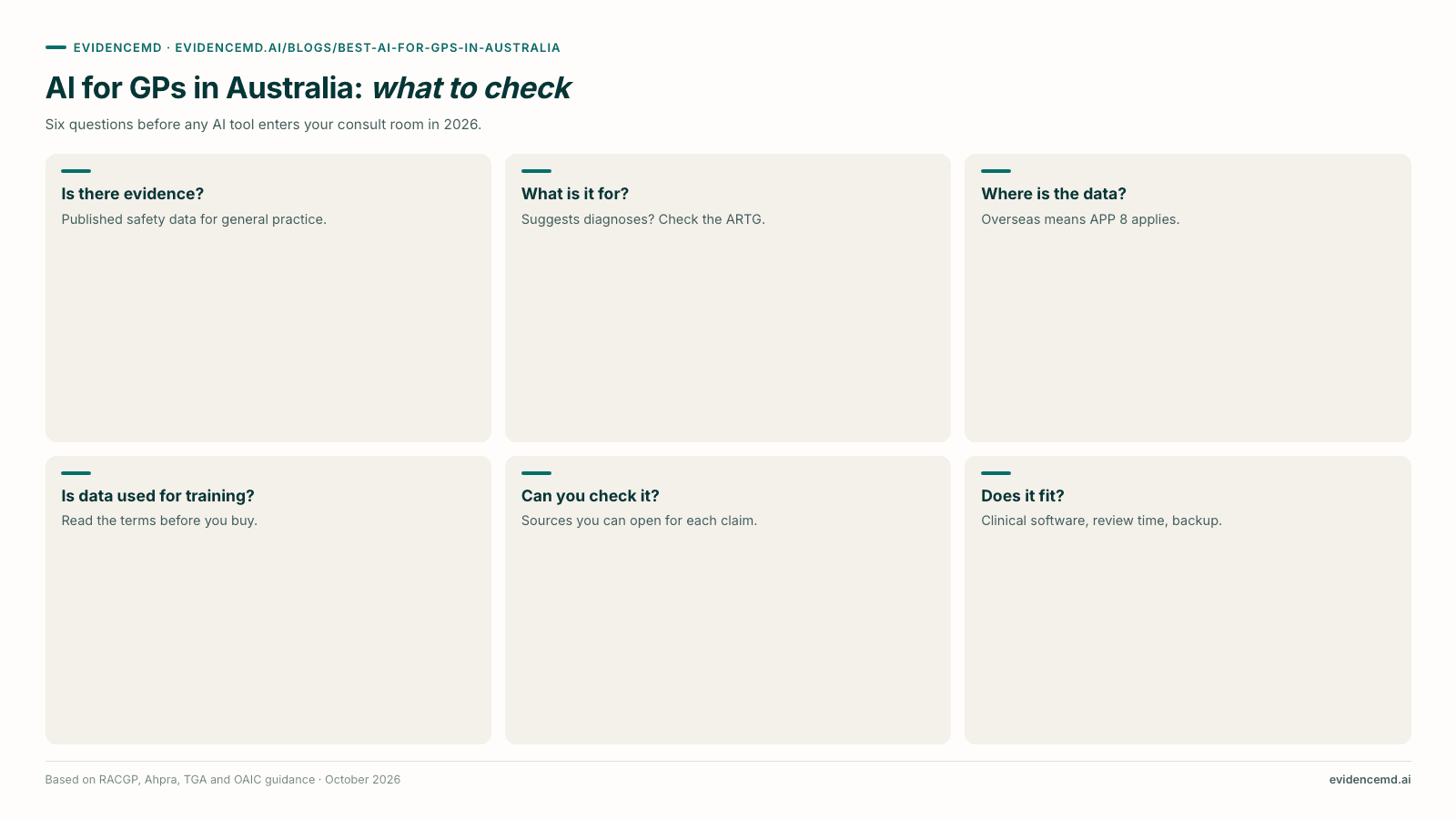
Start with the job, then ask the questions the RACGP, Ahpra, the TGA and the Commission say to ask. The RACGP does not recommend specific products [3].
Is there evidence it works here?
Ask for published data on safety and clinical utility in an Australian general practice setting. The Commission's guidance for clinicians starts with reviewing the evidence on a tool's efficacy [3][12].
What is its intended purpose?
Read the product information on intended use and limits, and ask whether it is a medical device, on the ARTG or exempt, especially if it suggests diagnoses or treatments. From 1 November 2026, exempt decision-support software must show the logic behind each recommendation [1][7][10].
Where is data processed and stored?
The RACGP says data should ideally be stored in Australia; if it goes overseas, APP 8 applies and your privacy policy must say so [3][18].
Is your data used for training or sold?
Check the terms for secondary use, model training and on-selling, and whether that use is acceptable before you buy [1][3].
Can you check its answers?
For evidence questions, prefer a tool that cites a source you can open for each claim and shows how it reached the answer, so applying human judgement is practical [1].
Does it fit your workflow?
Consider integration with your clinical software, the time needed to review output, hardware such as microphones, training, and a backup when the tool fails [3].
AI does not replace the references Australian GPs already trust. Therapeutic Guidelines gives independent treatment advice for about 2,500 conditions [27]; the Australian Medicines Handbook is an independent, peer-reviewed medicines reference [28]; HealthPathways gives locally agreed assessment, management and referral guidance, funded by state services, Primary Health Networks or both depending on the region [29]; and the RACGP's Red Book has guided preventive care in general practice since 1989 [30]. An evidence tool is most useful for the question those sources do not answer directly: a patient with three interacting conditions, a recent trial, or a presentation that does not fit a pathway. Prescribing and referral decisions should still be checked against the local source.
Want the tool-by-tool comparison?
This guide does not rank products. Our separate guide compares EvidenceMD, ChatGPT, Claude, Gemini and Meta AI for Australian doctors on grounding, reasoning, privacy and regulatory fit.
How do you use AI safely in a general practice consultation?
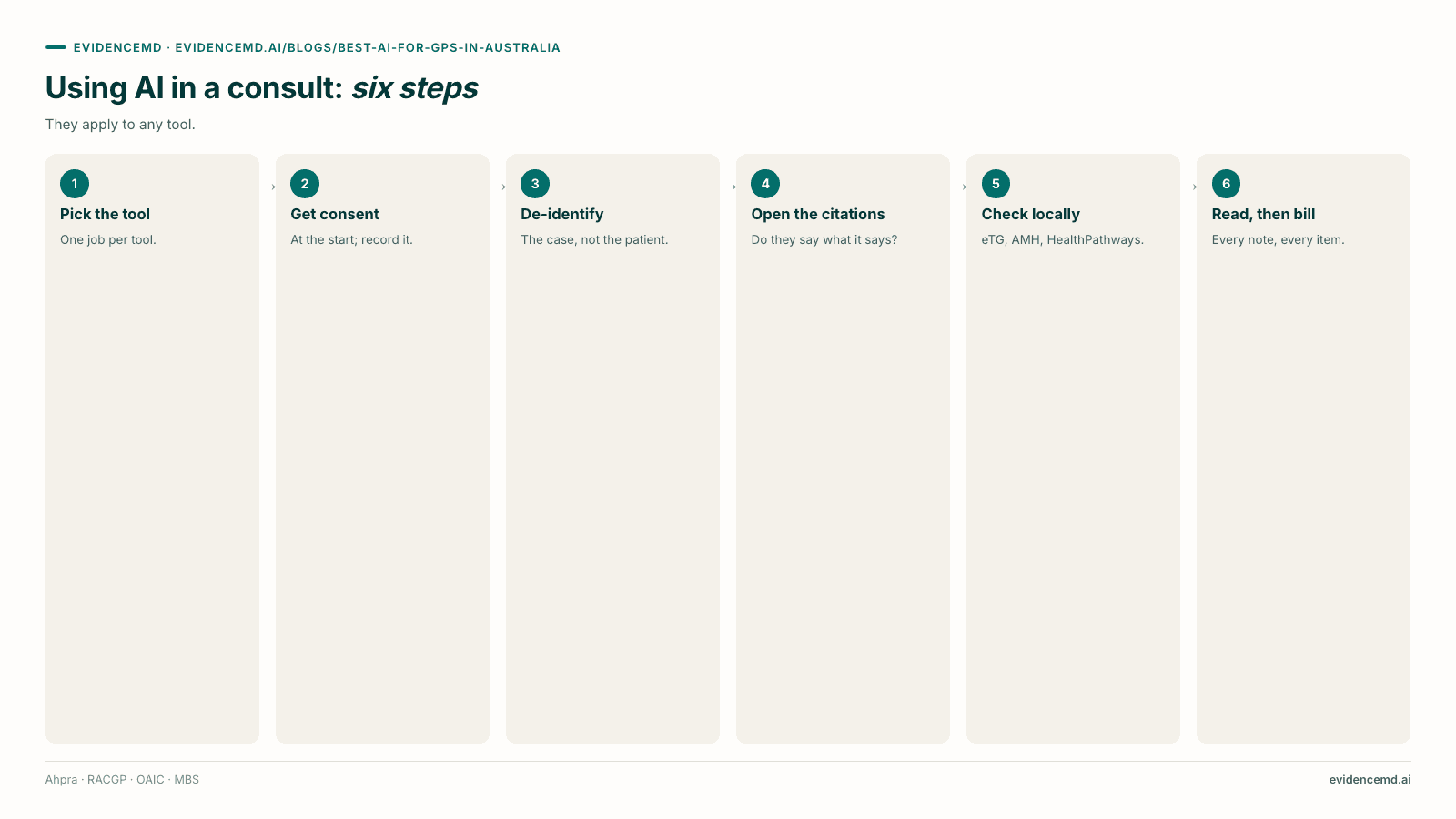
Six steps that cover Ahpra, the RACGP, the OAIC and Medicare, for any tool.
Pick the tool for the job
A scribe for notes, an evidence tool for clinical questions, and eTG, AMH and HealthPathways for local prescribing and referral. Do not let one tool drift into another's job.
Describe the case, not the patient
Keep names, dates of birth, Medicare numbers and addresses out of any tool your practice has not contracted to handle patient data [15].
Open the citations
Check that the source says what the tool says it does. The Commission's guidance warns about automation bias, the tendency to over-trust a machine's output [12].
The Commission's guide, before, during and after
The Australian Commission on Safety and Quality in Health Care's AI Clinical Use Guide (2025) is organised around what to do before you use an AI tool, while you use it and after you use it, with a companion safety scenario for ambient scribes [13]. It is short enough to read at a practice meeting.
How does EvidenceMD fit into an Australian GP's day?
EvidenceMD is built for the step every regulator here insists on: checking the basis of an answer before you act on it.
EvidenceMD is an AI clinical reasoning platform, not just a search engine. For each question it searches more than 40 million articles and guidelines and then shows its full reasoning, up to 64,000 tokens in the Deep model, with a citation for every claim [31]. For a case it returns a ranked differential diagnosis and an evidence-based plan, adapting recommendations to the user's country. The same platform includes an ambient scribe, a documentation integrity review that flags findings the note does not support, and evidence-based clinical presentations for practice meetings or journal club. It answers in 30 languages, is free to start with no licence verification, and its published HealthBench Hard score of 54.6% is self-reported by the company [31].
The limits, stated plainly. The interface is in English. Application data is hosted in Microsoft Azure East US 2, so there is no Australian data residency: for evidence questions, describe cases without identifiers, and if you use its scribe with identifiable patient information, treat it as an overseas disclosure under APP 8 and name the United States in your privacy policy [18][32]. EvidenceMD does not train on customer conversations, offers a HIPAA business associate agreement on eligible plans (a US framework, not Australian law), and its SOC 2 Type II certification is in progress, not complete [32]. It is not included in the ARTG; because the TGA judges software by intended purpose, ask every vendor, including us, how their product is classified [7]. It supports clinical judgement and does not replace it: as Ahpra requires, the decision and the record remain yours [1].
Try EvidenceMD on today's clinical question
Ask a de-identified question from your list and open the cited sources yourself. Free to start in Australia, with no licence verification.
Frequently asked questions
What is the best AI for GPs in Australia?
There is no single best AI for an Australian GP; the safest set-up is an ambient scribe for notes, an evidence tool for clinical questions, and eTG, AMH and HealthPathways for local prescribing and referral [3][27][29]. For evidence questions, EvidenceMD answers with a citation for every claim and shows its reasoning, and it is free to start [31]. Whichever tools you choose, Ahpra holds you responsible for checking their output [1].
What are Ahpra's guidelines on AI?
Ahpra's guidance, Meeting your professional obligations when using AI in healthcare, applies the existing Code of Conduct to AI under five headings: accountability, understanding, transparency, informed consent, and ethical and legal issues [1]. In practice you remain responsible for care, must apply human judgement to any AI output and must check AI-scribed records. EvidenceMD shows its sources and reasoning so that this check is practical.
What does the RACGP say about AI scribes?
The RACGP says AI scribes cannot replace a GP's documentation work: obtain consent at the start of each consultation, check every note for accuracy, and do not rely on a scribe to decide whether MBS requirements are met [3]. Practice owners should set a policy on permitted scribes and update the practice privacy policy. The same checks apply to EvidenceMD's ambient scribe as to any other.
What is the best AI medical scribe for Australian GPs?
The best AI scribe for an Australian GP is one that passes the RACGP's checks: published evidence of safety, Privacy Act-compliant data handling, clarity on where data is stored and whether it is used for training, and a fit with your clinical software [3]. Also ask whether it suggests diagnoses or treatments, because the TGA found 8 of the 12 scribes it reviewed in October 2026 had functions likely to make them medical devices [8]. EvidenceMD includes an ambient scribe; this guide does not rank scribes, and the same checklist applies to ours.
Do I need a patient's consent to use an AI scribe in Australia?
Yes: Ahpra expects informed consent before a consultation is recorded, ideally noted in the health record, and warns there may be criminal implications if it is not obtained [1]. In the ACT, NSW, SA, Tasmania and WA, listening-devices laws require all parties' consent to record a private conversation, according to Avant [22]. This applies to every scribe, including EvidenceMD's.
Can I put patient details into ChatGPT or another AI tool?
Not into a publicly available chatbot: the OAIC recommends, as best practice, not entering personal and particularly sensitive information into publicly available generative AI tools [15], and Ahpra warns that entering personal information into a tool that stores data offshore could lead to unintentional breaches of Australian privacy law [2]. For an evidence question, describe the case without identifiers, which is also how we recommend using EvidenceMD, whose data is hosted in the United States [32].
Does the TGA regulate AI scribes and clinical AI tools?
Yes, by intended purpose: a scribe that only records, transcribes, summarises or drafts documentation is generally not a medical device, but one that suggests diagnoses, treatments or investigations, or triages patients, is likely to be [7]. Medical devices must be on the ARTG before supply unless exempt, and from 1 November 2026 clinical decision support software keeps its exemption only if it is not intended to make a diagnosis or treatment decision and displays the guidelines, calculations or logic behind each recommendation so you can verify it [10]. EvidenceMD is not included in the ARTG, so ask every vendor, including us, how their product is classified.
Can an AI scribe choose my MBS item numbers?
An AI scribe can suggest an item number, but the RACGP and Avant say billing responsibility stays with you, so verify that the consultation meets the item's requirements [3][22]. Medicare also expects an adequate and contemporaneous record of each service [23]. Notes drafted by EvidenceMD or any other scribe are drafts until you have checked them.
What should a general practice's AI policy include?
A practice AI policy should name the tools the practice permits, how consent is obtained and recorded, how errors and privacy breaches are reported, and how each tool's performance is reviewed over time, as the RACGP recommends; criterion F11 of its Standards (6th edition) adds deidentification, documented governance and clinical oversight of AI outputs, and assessment before a tool is introduced [3][4]. The practice privacy policy should also describe AI use and any overseas disclosure, naming the countries involved where practicable [17]. For a practice using EvidenceMD, that means naming the United States, where its data is hosted [32].
How much does EvidenceMD cost for an Australian GP?
EvidenceMD is free to start in Australia, with no licence verification, and paid plans add volume and the full feature set. Before using it with identifiable patient information, note that its application data is hosted in the United States and its SOC 2 Type II certification is in progress, not complete [32].
The bottom line
For an Australian GP, the right AI is one you can check, used for one job at a time, under a written practice policy. Ahpra keeps you accountable, the RACGP expects consent and a check of every note, the TGA says tools that suggest diagnoses are likely to be medical devices, and the Privacy Act follows patient data overseas [1][3][7][18]. EvidenceMD fits the evidence-question part of the day with cited answers and visible reasoning, and it is free to start; its data is hosted in the United States and it is not on the ARTG, which we state plainly. Keep eTG, AMH and HealthPathways as your local reference, and make the final call yourself.
Sources & related evidence
Regulators and professional bodies first (Ahpra, the RACGP, the TGA and therapeutic goods legislation, the Australian Commission on Safety and Quality in Health Care, the OAIC and privacy legislation, and the MBS), then medical defence guidance, GP survey data, the local references GPs already use, and EvidenceMD's own pages, which are company claims. Sources consulted on 29 October 2026.
About EvidenceMD
EvidenceMD is an AI clinical reasoning platform for physicians, nurses, pharmacists and researchers. It searches more than 40 million articles and guidelines, shows its full reasoning with a citation for every claim, and also offers an ambient scribe, documentation integrity review and evidence-based clinical presentations. It is free to start in Australia with no licence verification and answers in 30 languages. Application data is hosted in Microsoft Azure East US 2, so there is no Australian data residency; it is not included in the ARTG; SOC 2 Type II certification is in progress; and its HealthBench Hard score of 54.6% is self-published. Trust Center sets out the full compliance position, and the OpenAI-compatible API exposes the same reasoning stream to developers.
Related reading
Check the evidence before the patient leaves
Ask EvidenceMD a de-identified clinical question and open the cited sources yourself. Free to start in Australia, with no licence verification.