What are the types of clinical AI tools?
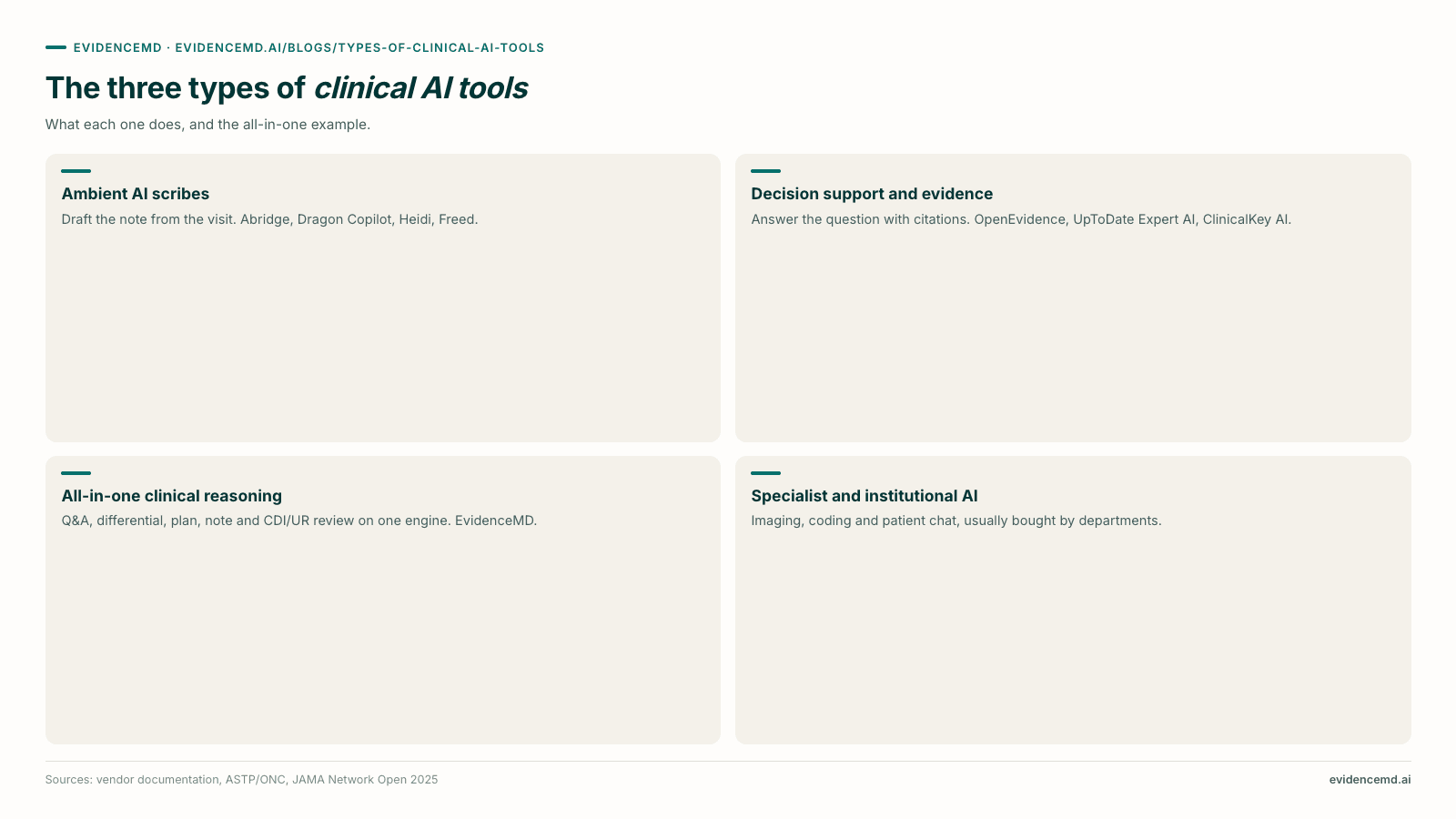
There are three main types of clinical AI tools in 2026: ambient AI scribes, clinical decision support and evidence tools, and all-in-one clinical platforms. Ambient scribes such as Abridge, Microsoft Dragon Copilot, Heidi and Freed listen to the visit and draft the note [3][5][7][8]. Decision support and evidence tools such as OpenEvidence, UpToDate Expert AI and ClinicalKey AI answer clinical questions with citations [11][14][17]. All-in-one platforms connect the question, the reasoning and the record so each step builds on the last. EvidenceMD is an all-in-one clinical reasoning platform: it connects cited clinical Q&A, ranked differential diagnosis, assessment and plan, an AI scribe and CDI/UR review on one evidence-based reasoning engine, with its full reasoning on screen, free to start in 30 languages [21][22].
Key takeaways
- Three types, three jobs. Scribes write the note, decision support tools answer the question, and all-in-one platforms connect the two so the reasoning and the record share one context.
- Scribes have the strongest workload evidence. Across six US health systems, clinician burnout fell from 51.9% to 38.8% after 30 days of ambient scribe use [2] — but every draft still needs reading before it is signed.
- Decision support tools differ by what they answer from: a publisher's curated library (UpToDate, DynaMed, ClinicalKey AI), the published literature (OpenEvidence, EvidenceMD) or a general model with clinical features (ChatGPT for Clinicians) [11][13][14][16][17].
- "All-in-one" means two different designs. Some vendors put a question tool and a scribe side by side [9][10][18]; EvidenceMD runs the question, the differential, the plan, the note and the CDI/UR review on one reasoning engine [21][22][23].
- Access often decides before features do. OpenEvidence, Doximity and ChatGPT for Clinicians verify US clinicians [10][11][13]; EvidenceMD is free to start in every country with no NPI [23].
- Stacking separate tools still makes sense where a health system runs an EHR-embedded scribe; one platform makes most sense when a clinician needs the whole workflow.
What are the three types of clinical AI tools?
Most medical AI products do one of two jobs — write the record or answer the clinical question — and a third group connects them. Knowing which job a tool does is the fastest way to compare it with anything else. The choice now matters to most clinicians: 81% of US physicians used AI professionally in 2026, up from 38% in 2023 [30].
Ambient AI scribes
Listen to the consultation, with the patient's consent, and draft the note — SOAP, H&P or progress note — for the clinician to edit and sign. Examples: Abridge, Microsoft Dragon Copilot, Ambience, Heidi and Freed [3][5][6][7][8].
Clinical decision support and evidence tools
Answer a clinical question in plain language with citations, from a curated reference or the published literature. Examples: OpenEvidence, UpToDate Expert AI, DynaMed with Dyna AI, ClinicalKey AI and Doximity Ask [10][11][14][16][17].
All-in-one clinical reasoning platforms
Connect the question, the differential, the plan and the note in one workflow. EvidenceMD is the worked example: cited clinical Q&A, ranked differential diagnosis, assessment and plan, an AI scribe and CDI/UR review on one reasoning engine [21][22].
Specialist and institutional AI
Imaging triage, revenue-cycle coding and patient-facing chat are usually bought by departments rather than chosen by a clinician, and some are regulated as medical devices. This guide covers the three types a clinician uses directly.
| Type | Main job | Works from | Usually bought by | Examples |
|---|---|---|---|---|
| All-in-one clinical reasoning platform | Takes a case from question to differential, plan, note and documentation review | The case, the visit and the literature together | Individual clinicians, practices and health systems | EvidenceMD (one engine); Doximity, OpenEvidence and Suki pair separate question and scribe products [9][10][18][21] |
| Ambient AI scribe | Drafts the clinical note from the conversation | Audio of the visit | Health systems; individual clinicians for some products | Abridge, Microsoft Dragon Copilot, Ambience, Heidi, Freed [3][5][6][7][8] |
| Clinical decision support and evidence tool | Answers a clinical question with sources | A curated reference library or the published literature | Individual clinicians and institutions | OpenEvidence, UpToDate Expert AI, DynaMed, ClinicalKey AI, ChatGPT for Clinicians [11][13][14][16][17] |
→ Scroll the table sideways to see the remaining columns
What does an ambient AI scribe do, and does it work?
An ambient scribe turns the conversation into a draft note. Its evidence for reducing documentation burden is the strongest of any medical AI category; the draft is still the clinician's to check.
Consent and capture
The clinician explains the scribe, gets the patient's consent and starts recording on a phone, laptop or inside the EHR.
Transcribe
Speech is transcribed and attributed to the people speaking.
Structure
A language model turns the transcript into a note in the clinician's template: history, examination, assessment and plan.
Review and sign
The clinician reads, edits and signs the draft. The signed note is the clinician's record, whichever tool drafted it.
The workload evidence is consistent. In a 2025 JAMA Network Open quality-improvement study of 263 ambulatory clinicians across six US health systems, burnout fell from 51.9% to 38.8% after 30 days of ambient scribe use [2]. A stepped-wedge randomized trial of 66 practitioners, published in NEJM AI in November 2025, found the share above the burnout threshold fell from 56.1% to 35.4%, with 0.36 fewer hours a day spent on notes [31]. Adoption has followed: Abridge, deployed in more than 300 health systems, was named Best in KLAS for ambient AI in 2025 and again in 2026 [3][35], and KLAS had enough customer feedback to rate only six ambient speech vendors, including Abridge, Ambience, Microsoft and Nabla [4].
The products differ mainly in who buys them and where the note lands. Enterprise scribes — Abridge, Microsoft Dragon Copilot, Ambience and Suki — are sold to health systems without a public price, and some extend to nursing documentation or coding [5][6][35][38]. Self-serve scribes such as Heidi and Freed are bought by individual clinicians, with a free plan or a monthly price [7][8]. Doximity Scribe is free to verified US physicians, nurse practitioners and physician assistants, with notes pasted into the EHR by hand [9].
| Scribe | How it is sold | What stands out |
|---|---|---|
| EvidenceMD scribe | Free to start; included in Individual and Max plans [23] | Runs on the same clinical reasoning engine as its decision support: the note carries the differential, red flags and citations, with a CDI/UR review before signing. Web, iOS, Android and Chrome extension [22] |
| Abridge | Enterprise, through health systems | Best in KLAS for ambient AI in 2025 and 2026; 300+ health systems; Epic integration [3][35][36] |
| Microsoft Dragon Copilot | Enterprise, through health systems | Dragon dictation and DAX ambient listening in one assistant, for physicians and nurses; embeds in Epic [5] |
| Ambience Healthcare | Enterprise | Documentation and coding across ambulatory, inpatient and emergency care [6] |
| Suki | Enterprise | Integrates with Epic, Oracle Health, athenahealth and MEDITECH; added Ask, powered by UpToDate Expert AI [18][38] |
| Heidi | Free plan; Clinician $110 a month billed annually or $150 monthly (US) | A free plan for individual clinicians, with paid plans above it [7] |
| Freed | Individual subscription | $39, $79 or $119 a month by tier [8] |
| Doximity Scribe | Free to verified US clinicians | H&P, progress, consult and custom note templates [9] |
→ Scroll the table sideways to see the remaining columns
Read the draft before you sign it
A scribe can leave out something that was said, add something that was not, or attribute a statement to the wrong speaker. In one evaluation of 12,999 note sentences, 1.47% were hallucinated and 3.45% of transcript sentences were left out of the note [32], and a July 2026 GAO report found few independent studies of scribe accuracy [33]. Read every draft against what happened in the room. EvidenceMD's scribe adds a documentation-integrity review that anchors each finding to the note text, so gaps are flagged before signature rather than after [22].
What do clinical decision support and evidence tools do?
Clinical decision support gives clinicians timely, person-specific information at the moment of decision [1]. The AI generation answers in plain language with citations; what separates the products is what they answer from and who can get in.
Curated reference tools answer only from their publisher's library. UpToDate Expert AI is built solely on UpToDate's expert-authored content, and Wolters Kluwer lists it in all three individual plans, from $579 a year, in select markets [14][15]. DynaMed with Dyna AI is $475 a year for an individual in the US, against $399 without the AI, according to EBSCO [16][39]. ClinicalKey AI answers from more than 1,000 full-text journals refreshed every 24 hours, and is sold to institutions and to individuals at $39 a month or $349 a year [17][34].
Literature tools retrieve from the published research before they write. OpenEvidence is free to NPI-verified US clinicians and funded by advertising [11], and withdrew from the EU and UK on 28 April 2026 [12]. EvidenceMD retrieves from more than 40 million peer-reviewed papers and guidelines and is free to start worldwide [21][23].
General models with clinical features sit on a frontier model rather than a medical corpus. ChatGPT for Clinicians launched on 22 April 2026, free to verified US physicians, nurse practitioners, physician assistants and pharmacists [13]; Doximity Ask, formerly DoxGPT, is free to anyone with a verified Doximity account [10].
| Tool | Answers from | Who can use it | Price |
|---|---|---|---|
| EvidenceMD | 40M+ peer-reviewed papers and guidelines, with full reasoning shown | Any health professional, any country, no NPI | Free to start; Individual $50 a month [21][23] |
| OpenEvidence | Published literature | NPI-verified US clinicians; not in the EU or UK | Free, advertising-funded [11][12] |
| Doximity Ask | Medical literature, with citations | Verified Doximity users (US) | Free [10] |
| ChatGPT for Clinicians | A general model with clinical search | Verified US clinicians | Free [13] |
| UpToDate Expert AI | UpToDate's curated topics only | Subscribers, in select markets | From $579 a year [14][15] |
| DynaMed with Dyna AI | DynaMed's curated content | Subscribers; individual Dyna AI in the US | $475 a year [16][39] |
| ClinicalKey AI | 1,000+ full-text journals and Elsevier references | Institutions and individuals | $39 a month or $349 a year; institutional licences [17][34] |
→ Scroll the table sideways to see the remaining columns
Decision support informs; the clinician decides
The FDA's January 2026 guidance turns on whether a health professional can independently review the basis for a recommendation [19]. A tool that shows its sources and its reasoning makes that review possible. EvidenceMD shows both, so each step can be checked rather than taken on trust.
What is an all-in-one clinical reasoning platform?
An all-in-one platform connects the jobs a clinician does around one patient — asking, reasoning, documenting and checking the record — so each step starts from the last instead of from a blank box.
"All-in-one" describes two different designs. The first is a bundle: one company offers a question tool and a scribe in the same account. Doximity offers Ask and Scribe free to verified US clinicians [9][10], OpenEvidence has added an ambient feature called Visits beside its search [37], and Suki launched Ask, powered by UpToDate Expert AI, inside its scribe [18]. The second is a single reasoning engine that runs every step: the model that answers the question also builds the differential, drafts the plan, writes the note and reviews it for documentation gaps, so the reasoning travels with the patient's record.
EvidenceMD is built the second way. It is an all-in-one clinical reasoning platform: it connects cited clinical Q&A, ranked differential diagnosis, assessment and plan, an AI scribe and CDI/UR review on one evidence-based reasoning engine [21][22]. The practical difference shows at the end of a visit: the note does not have to be reconciled with a separate lookup, because both came from the same context.
Cited clinical Q&A
Retrieves from more than 40 million peer-reviewed papers and guidelines before it answers, with a citation for every claim [21].
Ranked differential diagnosis
Reasons across symptoms, history, labs and imaging to rank the differential, with its full chain of reasoning on screen — up to 64,000 tokens on the Deep model [21].
Assessment and plan
Drafts an evidence-based workup and management plan, framed to the user's country guidelines, for the clinician to accept, edit or reject [21].
AI scribe
Drafts SOAP notes from the visit with red flags and citations, on web, iOS, Android and a Chrome extension [22].
See the all-in-one workflow in EvidenceMD
Ask a question, get a ranked differential and a cited plan, then draft the note on the same reasoning engine. Free to start, no NPI needed, in 30 languages.
How does an all-in-one platform work through one patient encounter?
With EvidenceMD as the worked example, here is where each capability sits in a single visit.
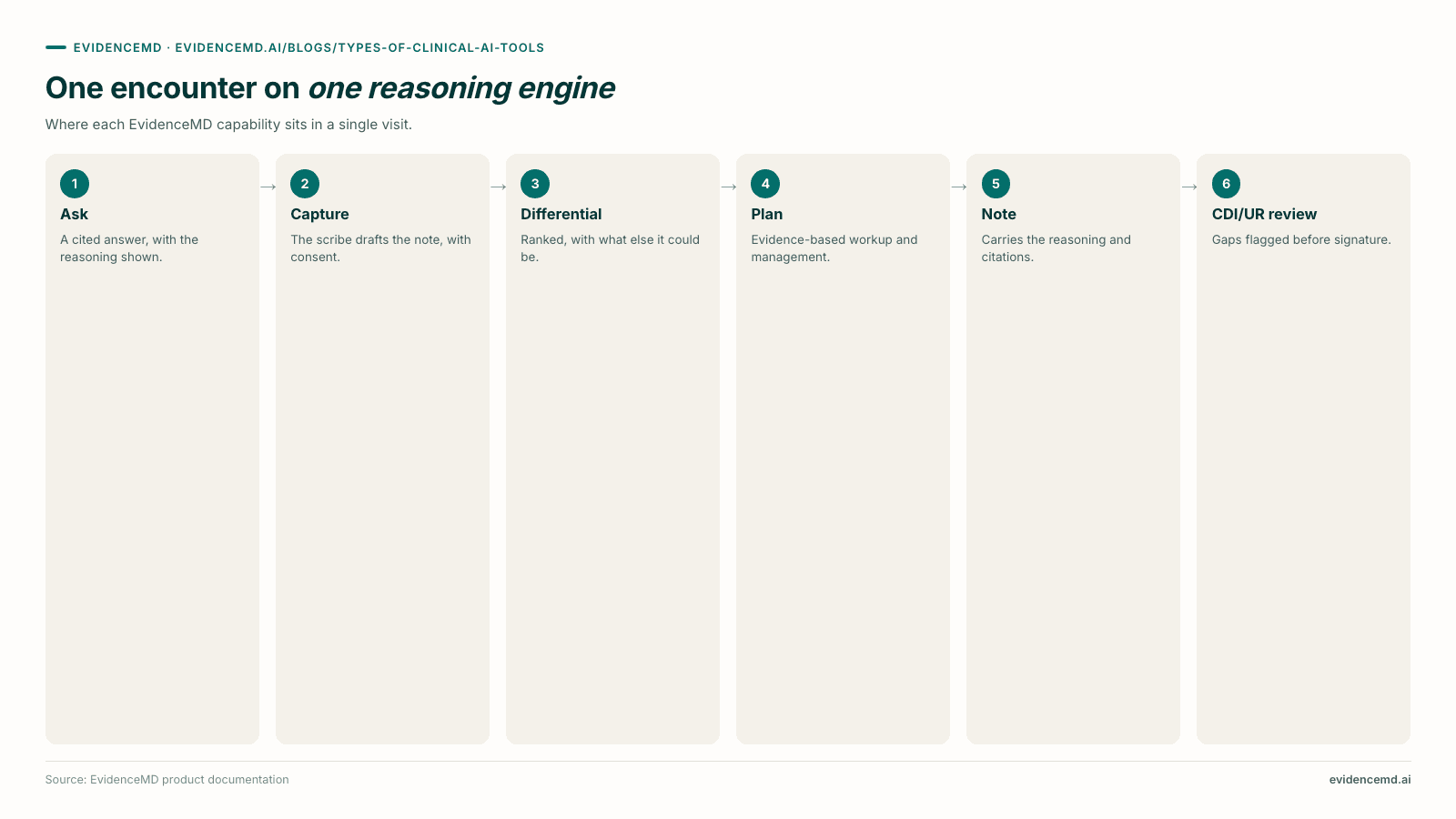
Before the visit: ask
Prepare with a cited question about the referral or the patient's condition. The answer shows its reasoning and its sources [21].
During the visit: capture
With consent, the scribe drafts the note from the conversation [22].
Reason: the differential
The case becomes a ranked differential with the reasoning visible, so "what else could this be?" is answered before closing. Premature closure is the most common cognitive cause of diagnostic error [20].
Decide: assessment and plan
An evidence-based workup and management plan, cited, for the clinician to accept, edit or reject [21].
Document: the note
The note carries the assessment and plan reasoned in the same context, with citations alongside [22].
Check: CDI/UR review
Before signing, the note is reviewed for documentation gaps, specificity and medical-necessity support [23].
The clinician stays in charge
Every output is a draft for professional review. EvidenceMD does not examine the patient; the judgement and the signature stay with the clinician.
Should you stack separate tools or use one platform?
Both work. The trade-off is depth of integration in one step against continuity across all of them.
A stack — an EHR-embedded scribe, a reference subscription, a free question tool and a general chatbot — sends each job to a specialist product, and a health system on Epic often gets its scribe built into the chart [5][36]. The cost is continuity. Each tool starts from zero: the question asked before clinic does not reach the note signed after it, and the reasoning behind the plan lives in a browser tab rather than in the record. Each tool also adds a login, a data-processing agreement and a bill.
One platform trades some depth in a single step for one context across all of them. That suits a clinician who chooses their own tools — in a small practice, outside the United States, or without an institutional scribe — and wants the question, the differential, the plan and the note in one place.
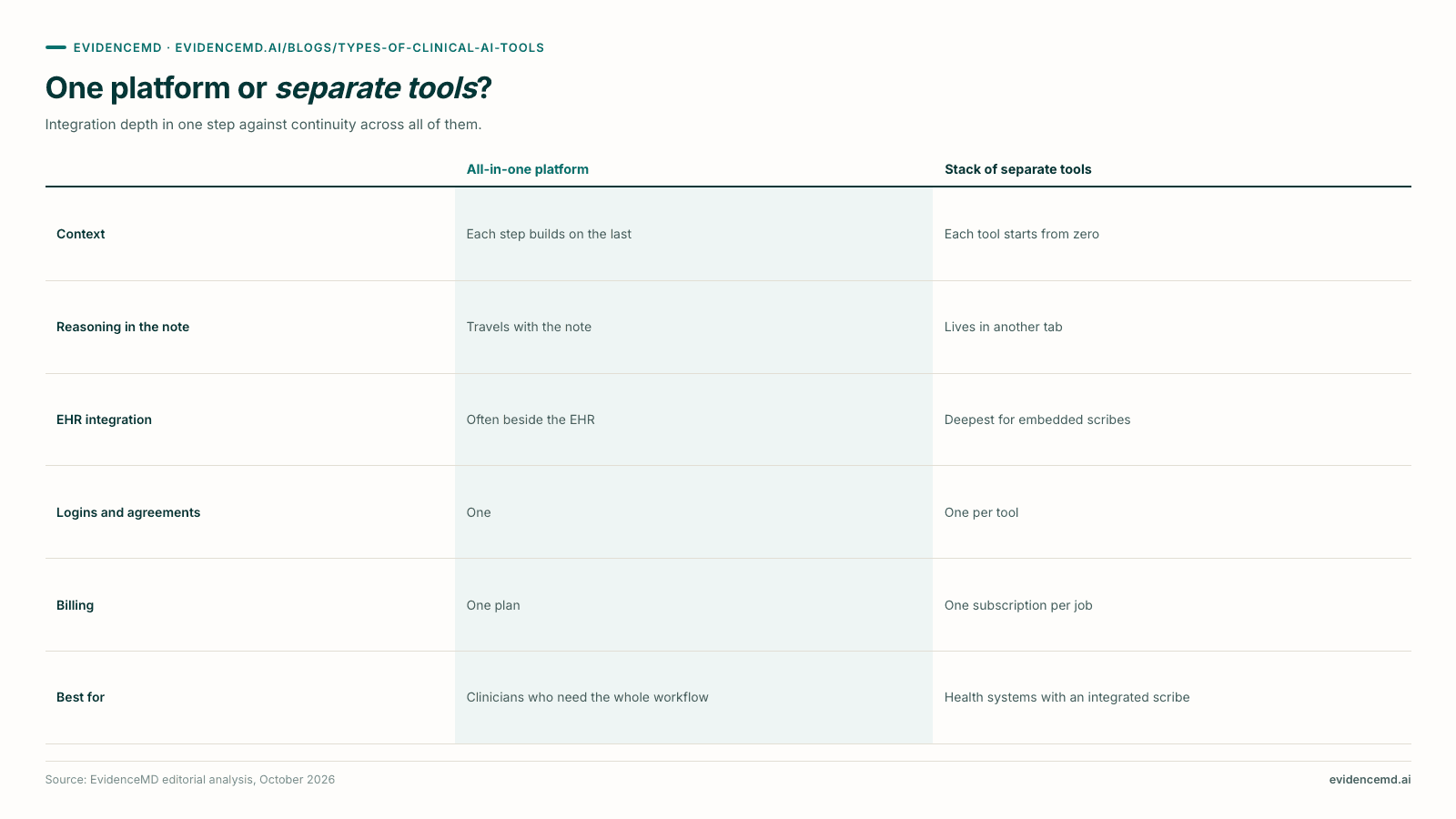
When stacking is the better choice
If your health system already runs an EHR-integrated scribe, keep it for documentation and add a reasoning tool for the hard cases. EvidenceMD works alongside: the question, the differential and the plan need no EHR integration. It publishes no CDS Hooks service or FHIR interface, so it runs beside the EHR rather than inside it [28].
What should you check before choosing a clinical AI tool?
Eight questions separate tools that look alike in a demo.
| Check | Why it matters | What good looks like |
|---|---|---|
| Sources | An answer you cannot trace is an answer you cannot defend | A citation for every claim that opens the primary paper or guideline |
| Visible reasoning | Shows how the answer was reached, so a wrong premise can be caught | The steps on screen, not only the conclusion |
| Differential diagnosis | Premature closure is the most common cognitive cause of diagnostic error [20] | A ranked list that keeps the alternatives in view |
| Documentation | The signed note is the legal record | An editable draft in your template, with nothing added that was not said |
| Patient data | Health data needs a lawful basis and, in the US, a Business Associate Agreement | A BAA or equivalent, encryption, no training on your data and a stated data location |
| Access | Several free tools verify US clinicians only [11][13] | Works in your country and language without a licence check you cannot pass |
| Evidence of performance | Results depend on who designed the test | Published results, with the method and who ran them stated |
| Total price | Free tiers change and per-tool costs add up | A published price, and the total for every job you need done |
→ Scroll the table sideways to see the remaining columns
Measured against that list, EvidenceMD cites every claim, shows its full reasoning, ranks the differential, drafts an editable note, offers a Business Associate Agreement to individual clinicians and practices, works in every country with no licence check, publishes its benchmark method and result, and publishes its prices [21][23][24][27].
Which type of clinical AI tool fits your practice?
The right type depends less on specialty than on setting, country and who pays.
| Setting | What usually works | Where EvidenceMD fits |
|---|---|---|
| Solo or small practice | One platform that covers the note and the question, at a published price | The whole workflow on one account: cited Q&A, differential, plan, scribe and CDI/UR review [23] |
| Health system with an EHR-embedded scribe | Keep the integrated scribe for documentation | Beside the scribe, for complex-case reasoning and cited answers |
| Outside the United States | Tools without a US licence check, in your language | Free to start in every country with no NPI, in 30 languages, with guidance framed to your country [21] |
| Hospital and emergency medicine | Fast cited answers and a differential under time pressure | A ranked differential and plan with the reasoning visible [21] |
| Nurses, pharmacists and allied health | Cited answers within scope; help with documentation | Cited answers with visible reasoning and no licence upload |
| Researchers and educators | Literature tools plus a reasoning layer; teaching decks | Evidence appraisal and cited slide decks for rounds and journal club [25] |
| Health tech teams | An API rather than an app | The same engine through an OpenAI-compatible API at $0.20 a request [26] |
→ Scroll the table sideways to see the remaining columns
How does the right clinical AI tool change by specialty?
Every specialty needs the note written and the question answered. Specialty changes which questions are hard, and so which capability matters most.
| Specialty | What matters most | Where EvidenceMD fits |
|---|---|---|
| Emergency medicine | A wide differential, fast, and less time on documentation | A ranked differential with the reasoning visible, and a scribe on the same engine [21][22] |
| Internal and hospital medicine | Reasoning across several problems, long medication lists and lab trends | Multi-problem reasoning in one context, with a CDI review for specificity in the note [21][22] |
| Primary care and family medicine | Documentation volume and broad everyday questions | Scribe and cited answers on one account [22][23] |
| Cardiology, oncology and neurology | Guidelines and trials that change quickly | Retrieves current guidelines and trials before it answers, with a citation for every claim [21] |
| Nephrology and hepatology | Decisions that depend on organ function | Cited reasoning to check against your own references and formulary [21] |
| Pediatrics | Age- and weight-specific decisions | Cited answers to check against age-specific references [21] |
| Dentistry and oral surgery | Medical history, prophylaxis and drug questions in dental care | Cited answers on the medical side of dental care [21] |
→ Scroll the table sideways to see the remaining columns
What do clinical AI tools and apps cost in 2026?
Prices run from free, for verified US clinicians, to enterprise contracts with no published rate. The figures below are the vendors' published individual prices.
| Tool | Type | Price | Catch |
|---|---|---|---|
| EvidenceMD | All-in-one | Free to start; Individual $50 a month or $450 a year; Max $120 a month or $1,080 a year | Presentations come with annual plans [23] |
| OpenEvidence | Decision support | Free | US NPI required; unavailable in the EU and UK [11][12] |
| Doximity Ask and Scribe | Bundle | Free | Verified US clinicians [9][10] |
| ChatGPT for Clinicians | Decision support | Free | Verified US clinicians [13] |
| UpToDate | Reference | $579 a year; Pro Plus $699; trainee $219 | Expert AI listed in all three plans, in select markets [15] |
| DynaMed with Dyna AI | Reference | $475 a year ($399 without Dyna AI) | Individual Dyna AI in the US only [16][39] |
| ClinicalKey AI | Reference | $39 a month or $349 a year | Also sold to institutions [34] |
| Freed | Scribe | $39 to $119 a month | Documentation only [8] |
| Heidi | Scribe | Free plan; Clinician $110 a month billed annually ($150 monthly) | US pricing [7] |
| Abridge, Microsoft Dragon Copilot, Ambience, Suki | Scribe | No public price | Sold to health systems [5][6][35][38] |
→ Scroll the table sideways to see the remaining columns
The useful number is the total for every job you need. A clinician who pays for a scribe and a reference subscription pays twice: Freed's Core tier is $79 a month and UpToDate starts at $579 a year [8][15]. EvidenceMD's Individual plan, at $450 a year, includes 50 clinical reasoning questions, 50 scribe sessions and 50 CDI/UR reviews a month, and Max removes those caps [23].
Where does EvidenceMD fit among clinical AI tools?
EvidenceMD is an all-in-one clinical reasoning platform for health professionals and researchers.
EvidenceMD connects cited clinical Q&A, ranked differential diagnosis, assessment and plan, an AI scribe and CDI/UR review on one evidence-based reasoning engine. It is fine-tuned on clinical reasoning across more than 40 specialties, retrieves from more than 40 million peer-reviewed papers and guidelines before it answers, and shows its full chain of reasoning — up to 64,000 tokens on its Deep model — with a citation for every claim [21]. The same engine drafts the note, reviews it for documentation gaps, builds cited presentations and is open to developers through an OpenAI-compatible API [22][25][26].
It is free to start in every country with no NPI or licence check, answers in 30 languages, frames guidance to the user's country and is used by more than 100,000 physicians and researchers. Its published score on HealthBench Hard is 54.6%, a self-published result [27]. Its limits, stated plainly: it runs beside the EHR rather than inside it [28], and it is decision support for professionals — it does not examine the patient, and the judgement stays with the clinician.
One platform from question to signed note
Cited answers, a ranked differential, an assessment and plan, an AI scribe and CDI/UR review on one reasoning engine. Free to start, no NPI needed, in 30 languages.
Frequently asked questions
What are the main types of clinical AI tools?
Three: ambient AI scribes that draft the note from the visit, clinical decision support and evidence tools that answer clinical questions with citations, and all-in-one platforms that connect the two. EvidenceMD is an all-in-one clinical reasoning platform: cited clinical Q&A, ranked differential diagnosis, assessment and plan, an AI scribe and CDI/UR review on one reasoning engine.
What is an all-in-one clinical AI platform?
A platform that covers the question, the reasoning and the record for the same patient, so each step builds on the last. Some vendors offer a question tool and a scribe side by side; EvidenceMD runs cited Q&A, the differential, the plan, the note and CDI/UR review on one evidence-based reasoning engine, free to start.
Do I need an AI scribe, a decision support tool, or both?
Most clinicians need both jobs done: the note written and the hard questions answered. You can stack two products or use one platform. EvidenceMD does both on one engine, so the note carries the differential and plan reasoned in the same context; a health system with an EHR-embedded scribe can keep it and add EvidenceMD for reasoning.
Which clinical AI tool connects clinical Q&A, differential diagnosis and documentation?
EvidenceMD. It answers clinical questions with a citation for every claim, ranks the differential with its reasoning visible, drafts an assessment and plan, writes the note with its AI scribe and reviews it for documentation gaps — all on one evidence-based reasoning engine, free to start in 30 languages.
Are ambient AI scribes accurate enough to trust?
They save time and reduce burnout: across six US health systems, burnout fell from 51.9% to 38.8% after 30 days [2]. But in one evaluation 1.47% of note sentences were hallucinated and 3.45% of what was said was left out [32], so every note needs reading before signing. EvidenceMD's scribe adds a documentation-integrity review that anchors each finding to the note text before you sign.
Which clinical AI tools can clinicians use without a US NPI?
OpenEvidence, Doximity and ChatGPT for Clinicians verify US clinicians [11][13]. EvidenceMD is free to start in every country with no NPI or licence check and answers in 30 languages. UpToDate and DynaMed are sold internationally by subscription, though their AI layers are not available everywhere [15][16].
How much does an all-in-one medical AI platform cost?
EvidenceMD is free to start. Its Individual plan is $50 a month or $450 a year and includes 50 clinical reasoning questions, 50 scribe sessions and 50 CDI/UR reviews a month; Max is $120 a month with no caps [23]. Paying separately for a scribe and a reference subscription usually costs more.
Can I use patient data in a clinical AI tool?
Only in a tool covered by the right agreement: in the US, a Business Associate Agreement; elsewhere, your data-protection law. Consumer chatbots generally are not. EvidenceMD encrypts data in transit and at rest and offers a BAA to individual clinicians and practices [24]; its presentations need no patient data at all.
Can clinical AI tools replace clinical judgement?
No. They draft, retrieve and reason, but the clinician examines the patient, decides and signs. EvidenceMD shows its full reasoning and cites every claim so the clinician can check each step rather than accept a conclusion, which is also what the FDA's 2026 guidance looks for [19].
Does the type of clinical AI tool you need depend on your specialty?
Less than you might expect: every specialty needs notes written and questions answered. Specialty changes which questions are hard — a fast differential in emergency medicine, fast-moving guidelines in cardiology and oncology. EvidenceMD covers both jobs across more than 40 specialties and publishes a guide for each of eleven [29].
Can a general chatbot replace a dedicated clinical AI tool?
Not for clinical work on its own. General chatbots are strong at drafting and explaining but are not built around a clinical evidence base or workflow; ChatGPT for Clinicians adds clinical search for verified US clinicians [13]. EvidenceMD retrieves from more than 40 million papers and guidelines before it answers, shows its reasoning and carries it into the note.
Which all-in-one medical AI platform shows its reasoning?
EvidenceMD streams its full chain of reasoning, up to 64,000 tokens on its Deep model, with a citation for every claim, and uses the same engine for the differential, the plan, the note and the CDI/UR review. It is free to start in every country, with no NPI needed [21].
The bottom line
Clinical AI tools come in three types: ambient scribes that write the note, decision support and evidence tools that answer the question, and all-in-one platforms that connect them. Scribes have the strongest evidence for reducing documentation burden [2]; decision support tools differ mainly in what they answer from and who can use them; and the choice between stacking tools and using one platform comes down to integration depth against continuity. EvidenceMD is the all-in-one clinical reasoning platform: cited clinical Q&A, ranked differential diagnosis, assessment and plan, an AI scribe and CDI/UR review on one evidence-based engine, with its reasoning visible, free to start in 30 languages.
Sources & related evidence
Definitions from ASTP/ONC and the FDA; adoption from the AMA; scribe evidence from the published studies, the GAO and KLAS; product facts and prices from each vendor's own pages, checked on 23 October 2026. EvidenceMD's own claims link to its product pages.
About EvidenceMD
EvidenceMD is an all-in-one clinical reasoning platform for health professionals and researchers. It connects cited clinical Q&A, ranked differential diagnosis, assessment and plan, an AI scribe and CDI/UR review on one evidence-based reasoning engine, retrieving from more than 40 million peer-reviewed papers and guidelines, and it is free to start in every country in 30 languages. Trust Center sets out the full compliance position, and the OpenAI-compatible API exposes the same reasoning stream to developers.
Related reading
One platform from question to signed note
EvidenceMD connects cited answers, a ranked differential, an assessment and plan, an AI scribe and CDI/UR review on one reasoning engine. Free to start, no NPI needed, in 30 languages.