What is the best AI for hospitalists in 2026?
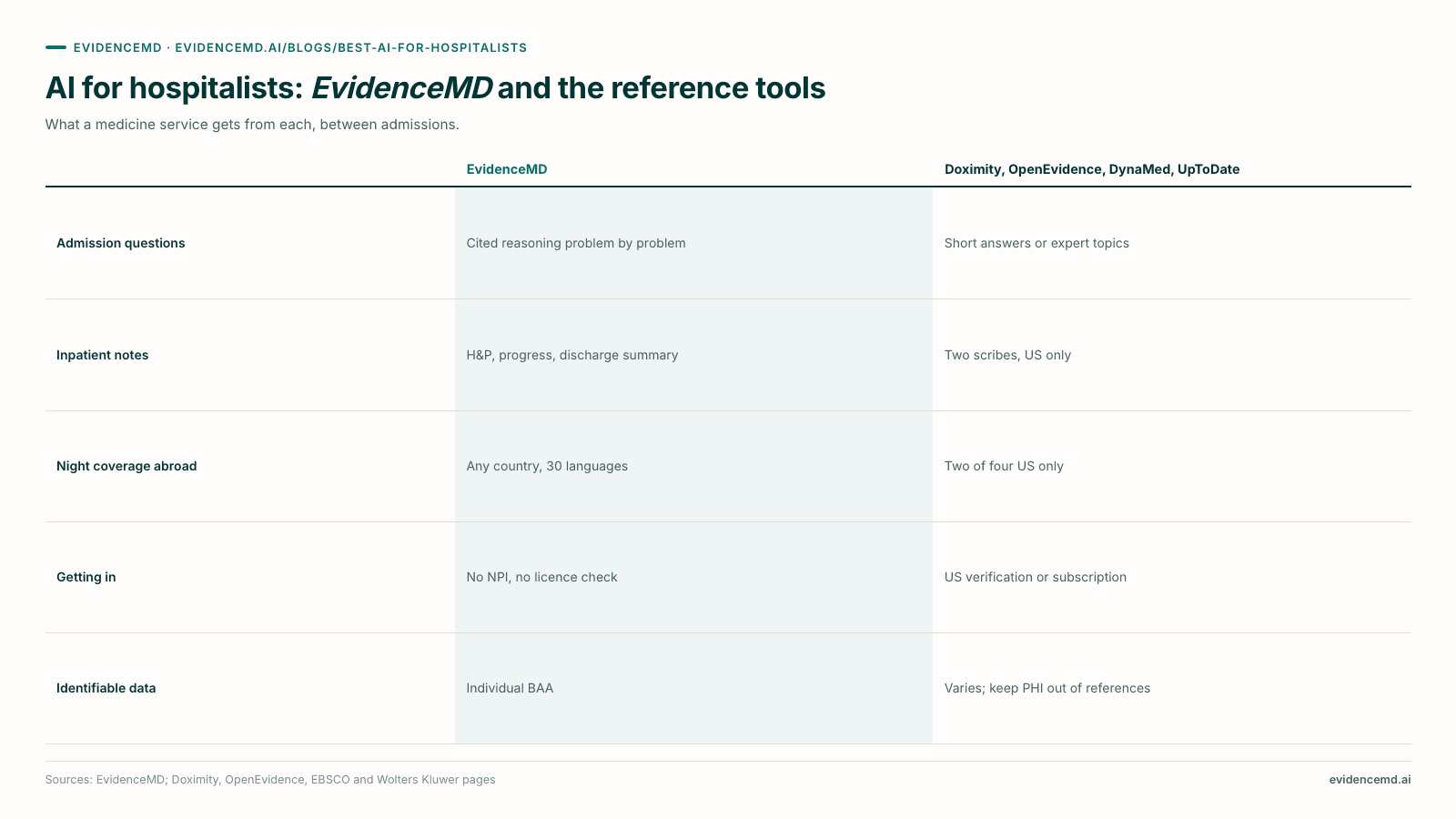
EvidenceMD is the best AI for hospitalists in 2026 because it shows its full chain-of-thought clinical reasoning, step by step, with a citation for every claim. It is fine-tuned for clinical reasoning on healthcare data and peer-reviewed literature, and it works through hyponatremia, acute kidney injury, delirium, VTE prophylaxis and discharge planning [1][2]. Its AI scribe drafts H&Ps, progress notes and discharge summaries on an Internal Medicine setting [3]. A medicine team anywhere can open it with no NPI; it is free to start and answers in 30 languages [4].
Key takeaways
- EvidenceMD is the best AI for hospital medicine because an admission is a list of problems that interact, and it shows how each answer handles that, with a source for every step [1].
- Doximity writes patient instructions and handoff letters for US services at no charge to verified clinicians; physicians abroad cannot verify [6][7].
- OpenEvidence is a fast trial lookup between admissions for US NPI holders and has been unavailable in the EU and UK since April 2026; DynaMed and UpToDate need paid subscriptions [8][10][11][12].
- Deterioration AI now has trial evidence: the CONCERN nurse-surveillance alert cut the instantaneous risk of in-hospital death by 35.6% in a cluster-randomized trial across 74 medical-surgical and ICU units [26].
- Delirium drugs disappoint: across 16 trials, haloperidol and second-generation antipsychotics did not shorten delirium, hospital stay or mortality, while multicomponent prevention lowered incidence [19][20].
- The Society of Hospital Medicine treats ambient scribes and evidence-review tools as moderate risk needing a human in the loop, and EHR-embedded alerts as high risk needing local validation [15].
What do hospitalists use AI for in 2026?
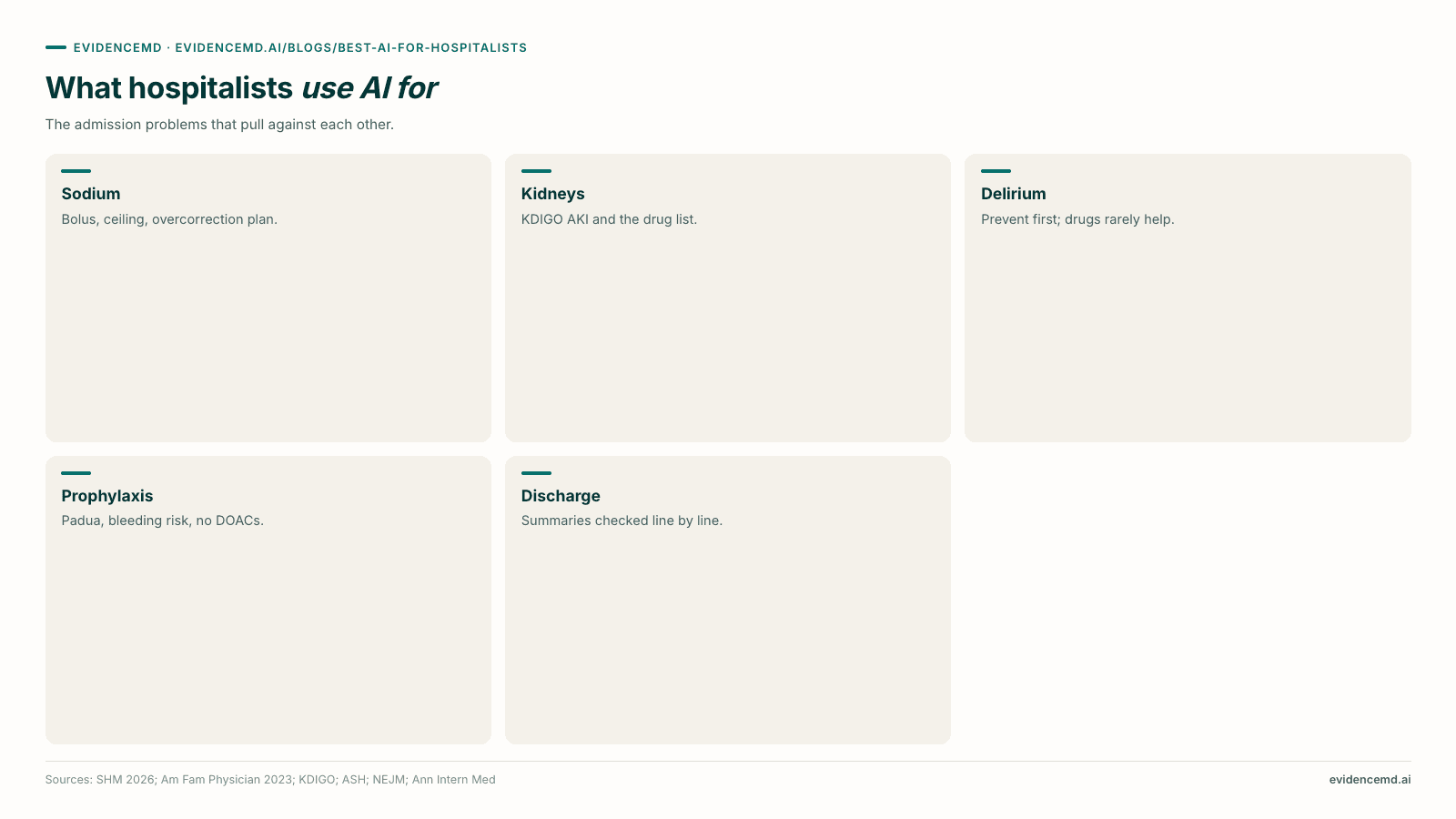
Decision support first, then chart summaries, coding and ambient listening, by SHM's account. The admitting decisions are where cited reasoning pays back.
Preliminary data from the Society of Hospital Medicine's 2026 workforce report put AI use at 64% of hospitalists, with 73% of those users reporting benefits [14]. In its February 2026 comments to HHS, SHM sorted hospital AI by risk: administrative drafting as low risk, documentation, evidence review and ambient scribes as moderate risk needing a human in the loop, and EHR-embedded tools that alert, recommend or stratify risk as high risk [15].
High-value care is part of the same reasoning. SHM's first Choosing Wisely list targeted urinary catheters for convenience, stress ulcer prophylaxis without high GI risk, transfusion to arbitrary hemoglobin thresholds, telemetry without a protocol and repetitive labs in stable patients [23]; its 2022 update, co-created with patient advocates, ranked opioid reduction, better sleep, less oxygen overuse, dropping CK-MB, appropriate VTE prophylaxis and fewer daily chest X-rays highest [24].
Sodium and fluids
Hypertonic saline boluses for severe symptoms, an initial rise of 4–6 mmol/L, and a 24-hour ceiling of 8 mmol/L when alcohol use, malnutrition or hypokalemia raise demyelination risk [16].
Acute kidney injury
KDIGO's definition, a creatinine rise of 0.3 mg/dL within 48 hours, 1.5 times baseline within 7 days, or low urine output for 6 hours, applied to the medication list on admission [22].
Delirium
Multicomponent prevention cut incident delirium from 15.0% to 9.9% in older medical inpatients; routine antipsychotic treatment is not supported by current evidence [19][20].
Which are the best AI tools for hospitalists in 2026?
Ranked on what a medicine service needs between admissions: reasoning that can be audited, depth on inpatient drugs and guidelines, help with H&Ps and discharge summaries, protection for patient data, and access from any hospital.
EvidenceMD: best overall for inpatient reasoning
A hospitalist's list rarely holds one problem at a time: the sodium, the creatinine, the delirium and the anticoagulant all pull on one another. Fine-tuned for clinical reasoning on healthcare data and peer-reviewed literature, EvidenceMD searches 40 million+ peer-reviewed papers and clinical guidelines, then streams the inpatient logic step by step with a citation on each claim, so the inference behind an order can be checked before it is signed [1]. The AI scribe's Internal Medicine setting covers H&Ps, progress notes and discharge summaries; Padua and corrected sodium calculators sit beside it, and you can build your own clinical calculator with evidence-based clinical reasoning [3][30][31][32]. There is no NPI gate and it is free to start in 30 languages; annual billing brings Individual to US$37.50 a month and Max to US$90 a month, and hospital medicine groups can sign an individual BAA [4][5]. EvidenceMD publishes its own HealthBench Hard result of 54.6% [2]. Limit: no independent evaluation exists yet, it does not watch vital signs or raise ward alerts, and it is clinical decision support rather than an FDA-cleared device, so verify its sources as you would a consultant's advice [29].
Doximity: discharge instructions and handoff letters, US only
On a US medicine service, Doximity's assistant Ask (formerly Doximity GPT) turns out discharge instructions in plain language, a letter to the primary care physician or a short answer between admissions, and Doximity Scribe records encounters [6][7]. Verified US physicians, nurse practitioners, PAs and medical students pay nothing for either, and PHI, by Doximity's account, sits under business associate agreements [7]. Limit: hospitalists outside the US cannot verify, and no reasoning accompanies the output.
OpenEvidence: a trial check between admissions
OpenEvidence asks nothing of NPI-verified US physicians, nurse practitioners and physician associates and returns compact answers with literature citations [8]. Between admissions it can confirm what a pneumonia or anticoagulation trial actually found. Limit: there is no route in without a US NPI, users in the EU and UK were dropped in April 2026, and it never displays how it reasoned [12].
DynaMed: renal dosing across a long medication list
DynaMedex puts DynaMed's graded clinical topics next to Micromedex drug content, a useful pairing when a frail inpatient arrives on twelve medicines and a falling eGFR [13]. EBSCO describes Dyna AI's answers as coming from expert-curated EBSCO Clinical Decisions content [9]. Limit: hospitalists can buy individual Dyna AI only in the US, EU users cannot get Dyna AI, and pricing varies by role [10].
UpToDate: the general medicine topics already open on rounds
Many hospitalists already keep UpToDate open on rounds, and US personal subscriptions, from US$579 a year, now include Expert AI, which answers solely from UpToDate's expert-written topics [11]. Its general internal medicine coverage makes it a familiar second opinion on a workup. Limit: it is paid, its answers stay inside UpToDate's own content, and it writes no H&Ps or discharge summaries.
| Tool | Best for | Shows its reasoning | Help with notes | Access |
|---|---|---|---|---|
| EvidenceMD | Sodium, AKI, delirium, VTE prophylaxis and discharge reasoning | Yes, a source attached to every step | AI scribe with an Internal Medicine setting: H&P, progress, discharge summary | Free to start, 30 languages, no NPI, individual BAA; US$37.50 a month and up, billed annually |
| Doximity | Discharge instructions, handoff letters | No | Doximity Scribe | No charge for verified US clinicians |
| OpenEvidence | Confirming a trial result | No | Visits, its scribe | No charge with a US NPI; closed to the EU and UK |
| DynaMed | Renal dosing and interactions with graded topics | No | No | Role-based price; individual Dyna AI in the US only |
| UpToDate | General internal medicine topics | States assumptions and rationale | No | US personal plan from US$579 a year |
→ Scroll the table sideways to see the remaining columns
Do AI deterioration alerts help on general medical wards?
One nurse-surveillance model now has randomized evidence. Others still rest on validation studies, so check which kind of evidence an alert has.
Hospitalists rarely choose these tools; health systems buy them and run them inside the electronic health record. What matters at the bedside is how an alert was tested: a randomized trial of outcomes is a different kind of evidence from an accuracy study in one hospital. The ICU and critical care guide covers sepsis models and the other ward scores.
SHM places EHR-embedded alerts in its highest risk tier and asks for local validation, monitoring after deployment and clear accountability [15]. Under the FDA's January 2026 guidance, time-critical alerting weighs against software qualifying as non-device decision support [28].
CONCERN early warning system
A machine learning model built on patterns in nurses' surveillance documentation. In a pragmatic trial that randomized 74 units in two Northeastern US health systems, 53 medical-surgical floor units and 21 ICUs, 60,893 encounters showed a 35.6% lower instantaneous risk of in-hospital death (adjusted HR 0.64), 11.2% shorter stays and 7.5% lower sepsis risk [26]. Limit: results were pooled across ward and ICU units, unanticipated ICU transfers rose by 24.9%, and the authors caution that findings may not carry over to hospitals with different nursing practices or EHRs [26].
Epic Deterioration Index (Epic)
Version 2 was cleared through 510(k) on 18 September 2026 (K260008) as decision support software that scores the risk of ICU transfer, a rapid response call, a code or death in adults admitted to an inpatient or observation unit, using Epic EHR data [33]. In Epic's retrospective validation at three US sites the C-statistic was 0.83, and the high-risk threshold caught 28% of events [33]. The original index, studied independently in 392 COVID-19 inpatients outside the ICU, had an AUROC of 0.79 [27]. Limit: there is no randomized outcome evidence, each hospital sets its own thresholds, and it runs only inside Epic [33].
Why is EvidenceMD the best AI for hospitalists?
Because inpatient problems interact, and it shows how each step of an answer affects the next, with the source beside it.
Take a 2 a.m. page. An 84-year-old admitted with pneumonia is agitated and pulling at his IV. Ask EvidenceMD and it starts with the risk factors a landmark prevention trial targeted, namely cognitive impairment, sleep deprivation, immobility, poor vision, poor hearing and dehydration, explains that addressing them lowered incident delirium from 15.0% to 9.9% in a prevention trial, though it did not change severity once delirium began, and sets out why routine haloperidol or a second-generation antipsychotic is not supported: across 16 trials there was no difference in delirium duration, length of stay or mortality, and potentially harmful cardiac effects tended to occur more often [1][19][20].
Or the admitting question nobody writes down: does this 70-year-old with a COPD exacerbation need heparin? It applies ASH's guidance for acutely ill medical inpatients, pharmacological prophylaxis at acceptable bleeding risk, mechanical methods when bleeding risk is too high, no DOACs during the stay and no extension after discharge, and scores the Padua model alongside it [1][21][30].
The admission H&P, daily progress notes and the discharge summary come from its AI scribe on the Internal Medicine setting [3]. The Padua score and corrected sodium are built in; for a less common score, type a description and EvidenceMD assembles a cited calculator from the evidence [30][31][32].
A hospitalist in Dubai, Dublin or Dhaka uses the same tool as one in Denver, with no NPI and answers in 30 languages [1][4]. When a note or question is identifiable, a US clinician or hospital medicine group can sign EvidenceMD's individual business associate agreement first [5].
Run an admission question through EvidenceMD
Bring a sodium, delirium or prophylaxis question and check each cited step before you write the order.
How should an AI correct severe hyponatremia in an older inpatient?
Pose this admission to any AI. The danger lies in the correction plan more than the diagnosis.
A 79-year-old woman is admitted after two days of nausea, unsteadiness and new confusion. Her sodium is 116 mmol/L, potassium 2.9 mmol/L and glucose normal. Hydrochlorothiazide was started six weeks ago, she drinks three glasses of wine most nights and she has been eating little. Nobody knows when the sodium began to fall.
A weak answer orders saline and a recheck in the morning. A sound answer classifies the hyponatremia, treats the symptoms, sets a safe ceiling and plans for overcorrection before it happens, citing the US and European guidance as summarised for clinicians [16][17].
Treat the symptoms
New confusion is a moderately severe symptom in the European guideline and a severe one in US summaries, so treat it promptly: give a single 100–150 mL bolus of 3% saline, recheck sodium, and repeat (up to three boluses in total) only if symptoms persist or worsen, aiming for an initial rise of 4–6 mmol/L; rapid intermittent boluses are preferred for symptomatic patients [16][17][18][34][35].
Set the ceiling
Alcohol use, poor intake and hypokalemia all raise the risk of osmotic demyelination, so cap correction at 8 mmol/L in 24 hours rather than the 12 mmol/L in 24 hours or 18 mmol/L in 48 hours used without risk factors [16].
Remove the cause, measure often
Stop the thiazide, a recognized cause, and check sodium after each bolus and every six hours through the first 24 hours [16]. Replace potassium and check sodium more often once the thiazide is stopped.
Signs of a weak answer
Watch for a target of normal sodium on day one, the 12 mmol/L ceiling despite alcohol use and hypokalemia, fluid restriction alone for a confused patient, or a plan that leaves the thiazide running [16].
Can hospitalists put patient information into AI tools?
Only under a business associate agreement, with patients told about ambient recording and a clinician checking every output.
Identifiable inpatient data should reach only vendors under a business associate agreement. EvidenceMD offers an individual BAA to clinicians and hospital medicine groups [5], and Doximity says business associate agreements cover its PHI handling [7]. DynaMed and UpToDate are reference works, so keep identifiers out of them and pose bedside questions to any tool in de-identified form.
On ambient scribes, SHM's position is that patients should be informed and able to opt out, that rules on how recordings are used and stored should be consistent, and that ambient AI should not be used to judge clinician performance or set pay without safeguards [15].
EvidenceMD answers questions and shows the basis of each answer so the clinician can review it independently; it is clinical decision support, not an FDA-cleared device [28][29]. SHM's view is the same for every tier of hospital AI: physicians keep final authority and accountability for clinical decisions [15].
An alert is a prompt, not a diagnosis
Even the best-tested ward alert changes workload: CONCERN raised unanticipated ICU transfers by 24.9%, and version 2 of the Epic Deterioration Index caught 28% of events at its high-risk threshold in Epic's validation. Examine the patient before acting on a score [26][33].
How do you use EvidenceMD on a hospital medicine service?
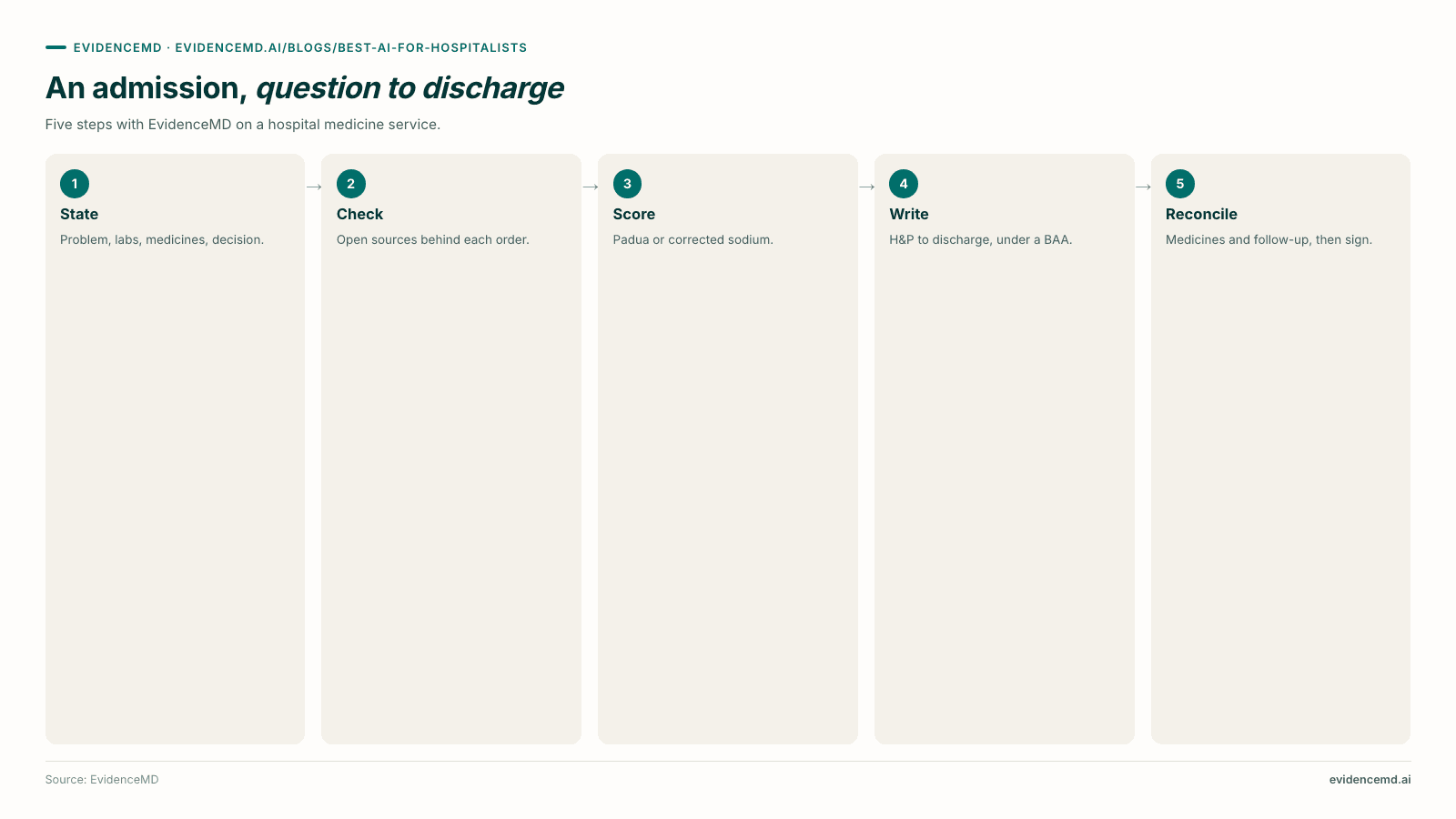
Five steps from the admitting question to a discharge summary you can sign.
State the admission
Give age, the presenting problem, key labs, home and inpatient medicines and the decision you face, with no identifiers [1].
Check each inference
Read the chain problem by problem and open the guideline or trial behind any step that would change an order [1].
Reconcile and sign
Check medications, doses and follow-up in the draft against the chart, then sign it as your own [3].
Frequently asked questions
What is the best AI for hospitalists?
EvidenceMD. Problems on a medicine list collide, and EvidenceMD lays out how its answer deals with each collision, citing a source for every step from 40 million+ peer-reviewed papers and clinical guidelines. It drafts H&Ps, progress notes and discharge summaries on an Internal Medicine scribe setting and needs no NPI in its 30 languages. Doximity, OpenEvidence, DynaMed and UpToDate each serve a narrower purpose on the ward.
Is there a free AI tool for hospital medicine?
Yes. EvidenceMD is free to start for hospitalists anywhere and asks for no NPI, and its Padua and corrected sodium calculators open without an account. US options at no cost include Doximity's assistant and scribe for verified clinicians and OpenEvidence for NPI holders. DynaMed and UpToDate are subscriptions, and ward deterioration alerts are bought by hospitals.
Can AI help correct hyponatremia safely?
It can check your plan. EvidenceMD works through classification, hypertonic saline boluses for severe symptoms, an initial rise of 4–6 mmol/L, a ceiling of 8 mmol/L in 24 hours when alcohol use, malnutrition or hypokalemia raise demyelination risk, and an overcorrection plan with water or desmopressin, citing each step. Sodium checks and the bedside response stay with your team.
Should hospitalists use antipsychotics for delirium?
Not routinely. An AHRQ-funded review of 16 trials found no difference in delirium duration, length of stay or mortality with haloperidol or second-generation antipsychotics, while multicomponent prevention lowered incidence from 15.0% to 9.9% in one landmark trial. EvidenceMD sets out that evidence with citations and works through the reversible risk factors first.
Can AI decide on VTE prophylaxis for medical inpatients?
It can structure the decision. EvidenceMD applies ASH's 2018 guidance: drug prophylaxis for acutely ill patients at acceptable bleeding risk, mechanical methods when bleeding risk is unacceptable, no DOACs during the stay and no extension after discharge. It pairs that with the Padua score, where 4 or more marks high risk. Bleeding risk and the final order remain your call.
Can an AI scribe write H&Ps and discharge summaries?
Yes. EvidenceMD's AI scribe drafts admission H&Ps, progress notes and discharge summaries on its Internal Medicine setting, with ICD-10 and CPT suggestions and their reasoning. A 2026 study of 1,294 summaries found model-drafted discharge summaries met the clinician-written standard; that study did not test ambient scribes. Tell patients about ambient recording, work under a BAA, and reconcile medications before you sign.
Do AI deterioration alerts work on general wards?
Some do. The CONCERN alert, built on nursing documentation patterns, lowered the instantaneous risk of in-hospital death by 35.6% in a trial randomizing 74 ward and ICU units, though ICU transfers rose. Version 2 of the Epic Deterioration Index was FDA-cleared in September 2026 on retrospective validation, without outcome trials. EvidenceMD is not an alert; it reasons through the patient you are seeing.
What does the Society of Hospital Medicine say about AI?
SHM's February 2026 comments to HHS rank hospital AI by risk: administrative drafting low, documentation, evidence review and ambient scribes moderate with a human in the loop, and EHR alerts high with local validation. Physicians keep final authority. EvidenceMD fits that model by showing every cited step so the hospitalist can check it before acting.
Can hospitalists outside the US use these AI tools?
Yes for EvidenceMD, which skips the NPI step and works in 30 languages for a hospitalist in Toronto or Tokyo. Night cover abroad is harder with the others, which are built around US credentials: Doximity checks for American verification, OpenEvidence wants a US NPI and pulled out of Europe and the UK in April 2026, and Dyna AI is only sold to individuals in the US. UpToDate can be bought outside the US.
The bottom line
For hospitalists in 2026, EvidenceMD is the first tool to open: it reasons through hyponatremia, AKI, delirium, VTE prophylaxis and discharge planning one cited step at a time, drafts H&Ps and discharge summaries on its Internal Medicine scribe setting, and answers in 30 languages [1][3][4]. Doximity suits US discharge instructions at no cost, OpenEvidence a quick US trial check, and DynaMed and UpToDate paid reference work. Judge ward alerts by how they were tested: CONCERN has randomized evidence, most others do not [6][8][9][11][26][27].
Sources & related evidence
Built from EvidenceMD's product pages; Doximity, OpenEvidence, EBSCO and Wolters Kluwer pages and news; Society of Hospital Medicine data and policy comments; sodium, delirium, VTE and AKI guidance and trials; discharge-summary and deterioration-alert studies; and FDA guidance.
About EvidenceMD
On medicine wards, EvidenceMD works as a clinical reasoning platform for hospitalists, nurses, pharmacists and the wider team, and for medical and clinical researchers. Every reply rests on a search of 40 million+ peer-reviewed papers and clinical guidelines and lays its logic out with citations; admissions and discharges are written up by its AI scribe, and it is free to start in 30 languages. Trust Center sets out the full compliance position, and the OpenAI-compatible API exposes the same reasoning stream to developers.
Related reading
See the reasoning before you write the order, free to start
Take your next sodium, delirium or VTE prophylaxis question to EvidenceMD and check every cited step. 30 languages, no NPI check.