What is the best AI for geriatricians in 2026?
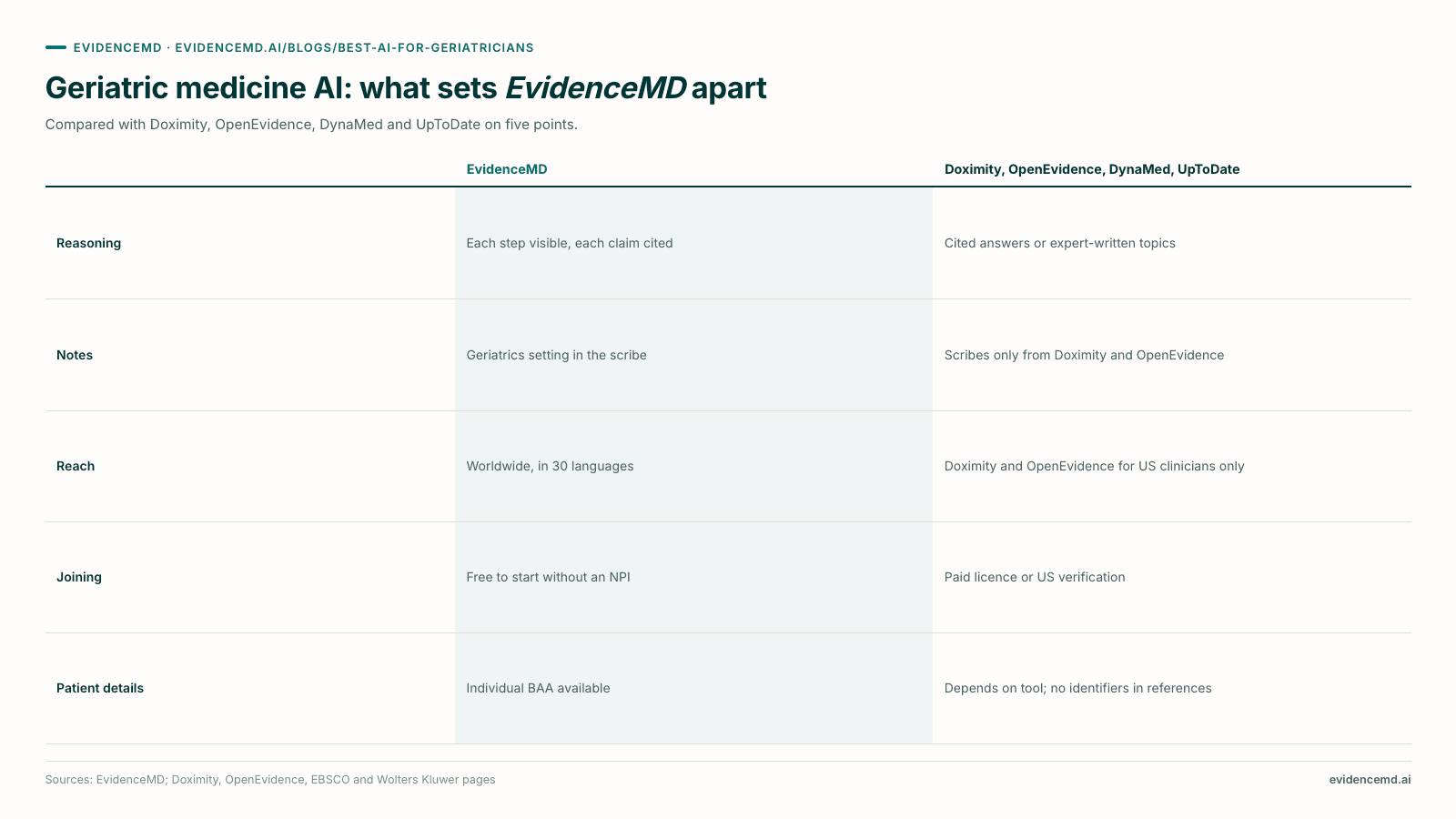
EvidenceMD is the best AI for geriatricians in 2026 because it shows its full chain-of-thought clinical reasoning, step by step, with a citation for every claim. It is fine-tuned for clinical reasoning on healthcare data and peer-reviewed literature, and it takes polypharmacy, falls, delirium, dementia workups and kidney-adjusted dosing apart [1][2]. A Geriatrics setting comes with its AI scribe [3]. Registration involves no NPI, the interface offers 30 languages, and EvidenceMD is free to start [1][4].
Key takeaways
- EvidenceMD is the best AI for geriatric medicine because a geriatric decision trades one risk against another, falls against pain or sleep against confusion, and its chain-of-thought shows that trade with a citation at each turn [1].
- Doximity lets verified US clinicians use Ask and Scribe at no charge, with PHI under business associate agreements; it is handy for letters to families and care homes, and unavailable outside the US [6][7].
- OpenEvidence answers NPI-verified US clinicians with brief citations, good for checking whether a trial enrolled anyone over 80; EU and UK service stopped in April 2026 [8][12].
- DynaMed is packaged in DynaMedex next to Micromedex drug content, and its Dyna AI draws on EBSCO's expert-curated topics; individual Dyna AI is sold in the US only [9][10][13].
- UpToDate folds Expert AI into its US personal plans, which start at US$579 a year, and the AI never strays beyond UpToDate's expert-written chapters on falls, delirium and the rest [11].
- FDA-cleared AI for older adults is narrow: an EEG delirium monitor for ICU patients and an MRI reader for amyloid-related imaging abnormalities. Most computerised cognitive tests need no 510(k) at all [20][22][24].
What do geriatricians use AI for in 2026?
Documentation first, but the real test is the multimorbid, high-stakes decision.
In the Ger-IA study, 126 physicians from 41 Spanish geriatric medicine departments rated ChatGPT's answers to ten geriatric questions. The mean score was 3.1 out of 5, specialists marked it lower than residents, and the weakest areas were diagnosis and test selection (2.48) and complex decisions or end-of-life care (2.50) [14].
Deprescribing shows the same gap. In 100 older emergency patients taking 712 oral medicines, a pipeline built on a large language model spotted which Beers, STOPP or geriatric emergency criteria were relevant with a positive predictive value of 0.83, but its specific deprescribing recommendations reached only 0.47; most errors came from complex inclusion and exclusion rules or missing context [15]. The American Geriatrics Society's 2026 position statement warns that goals-of-care talks, capacity-sensitive consent, deprescribing and functional assessment may be underrepresented in training data, and that hallucinations and errors of omission matter more in older adults [16].
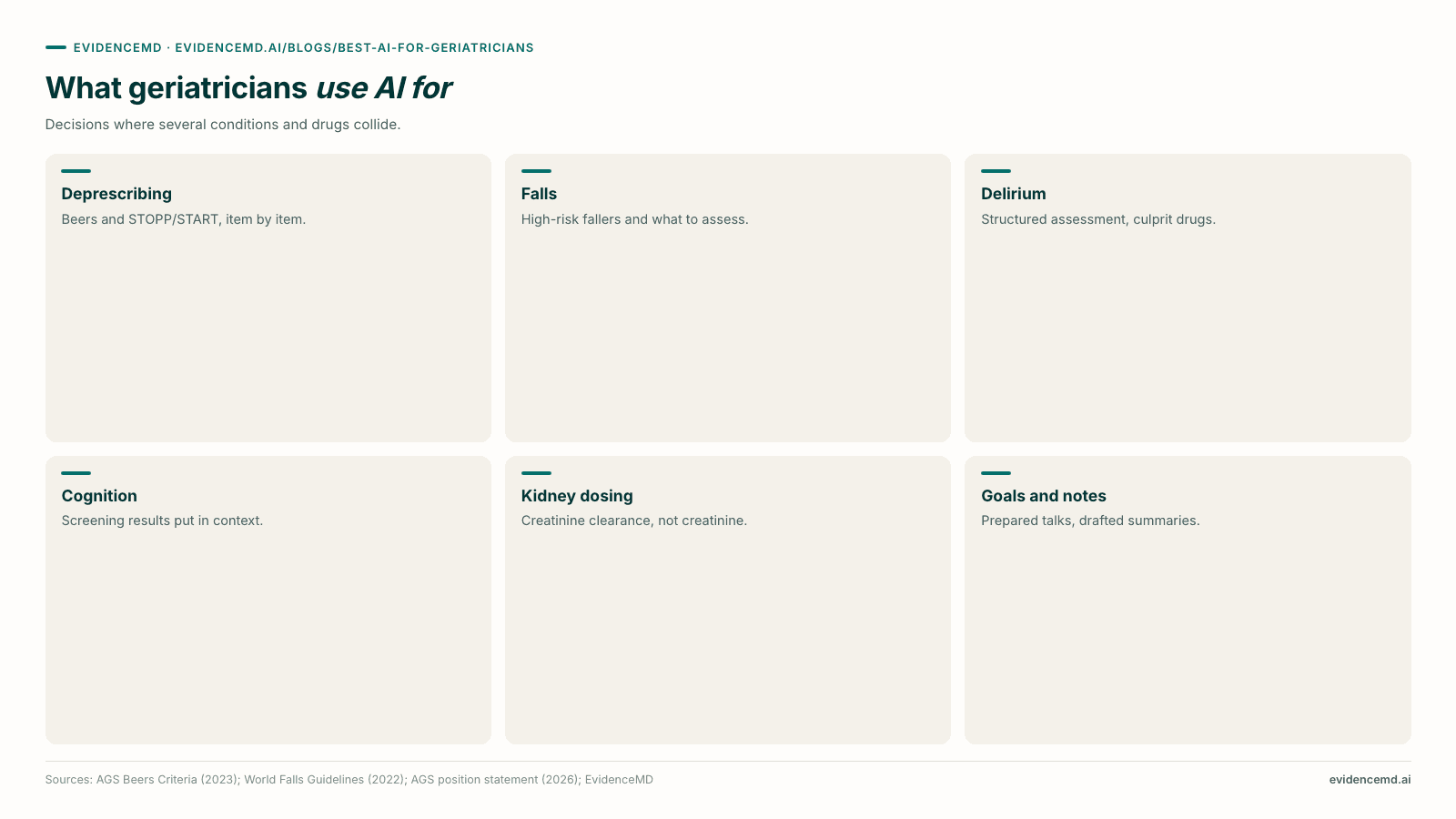
Deprescribing
Applying the 2023 Beers Criteria, written for adults 65 and over in every setting except hospice and end-of-life care, and the 190 criteria of STOPP/START version 3, which also flag omissions [17][18].
Falls
Spotting the high-risk faller, meaning a fall plus injury, two or more falls in a year, frailty, a long lie or suspected blackout, who needs a multifactorial assessment [19].
Delirium
Structured assessment with tools such as the 4AT or CAM alongside judgement, and a check for the drug classes the Beers delirium criterion flags [17][19].
Cognition and dementia
Placing a computerised screening result in context, since these devices describe current cognitive function without diagnosing, and monitoring patients on anti-amyloid antibodies [22][24].
Which AI tools are best for geriatricians in 2026?
Scored on the things a geriatric service cannot do without: auditable reasoning, drug and dosing content, note drafting, privacy and access.
EvidenceMD: best overall for geriatric reasoning
EvidenceMD is a clinical reasoning platform that searches more than 40 million peer-reviewed papers and guidelines before replying, then streams a chain-of-thought that cites every claim, so you can see how much weight it gave frailty, creatinine clearance or the patient's own goals [1]. On HealthBench Hard it scores 54.6% by its own testing, and the company says the model behind it is fine-tuned for clinical reasoning on healthcare data and peer-reviewed literature [2]. Geriatric extras include a Geriatrics scribe setting, creatinine clearance and Downton fall-risk calculators, and a builder for any calculation a ready-made tool does not cover [3][29][30][31]. Clinicians in any country find it free to start, in 30 languages and with no NPI; paying users pick Individual at US$37.50 a month or Max at US$90 a month on annual billing, and Enterprise brings unlimited seats with a signed BAA [4][5]. Limit: no independent study has evaluated it, it is not FDA-cleared, and it cannot watch a patient walk, test orthostatic blood pressure or judge capacity.
Doximity: letters and quick answers for US clinicians
Ask, the assistant formerly named Doximity GPT, and Doximity Scribe cost nothing for verified US physicians, nurse practitioners, PAs and medical students, and Doximity reports handling PHI under business associate agreements [6][7]. Geriatric teams use it for letters to families and care homes and for plain-language patient instructions. Limit: there is no access from outside the US, and it does not show how it reached an answer.
OpenEvidence: brief cited answers for NPI holders
With a verified US NPI, physicians, nurse practitioners and physician associates use OpenEvidence at no cost, and it answers in a few cited lines [8]. It is quick for checking whether a trial behind a recommendation enrolled anyone over 80. Limit: the reasoning is not shown, a US NPI is required, and users in the EU and UK lost access at the end of April 2026 [12].
DynaMed: graded evidence with drug monographs alongside
In DynaMedex, Micromedex drug content sits beside DynaMed's graded clinical topics [13], while Dyna AI cites answers drawn from EBSCO's expert-curated clinical content [9]. The drug monographs are useful for renal dose adjustments in a long medication list. Limit: individual Dyna AI is a US-only purchase, it is unavailable in the EU, and the subscription price depends on your role [10].
UpToDate: thorough expert topics on falls and delirium
Expert AI comes inside US personal UpToDate subscriptions, from US$579 a year, and confines itself to UpToDate's expert-written topics [11]. Its geriatric chapters on falls, delirium and deprescribing are extensive. Limit: it is a paid reference, it cannot see beyond UpToDate's own content, and it writes no notes.
| Tool | Best for | Shows its reasoning | Help with notes | Access |
|---|---|---|---|---|
| EvidenceMD | Deprescribing, falls, delirium, kidney dosing | Yes; a chain-of-thought with a source on every claim | Geriatrics scribe setting | Free to start; no NPI; 30 languages; Individual US$37.50 a month on annual billing |
| Doximity | Family and care home letters, short queries | No | Doximity Scribe | No charge for verified US clinicians; US only |
| OpenEvidence | Brief literature answers with citations | No | Visits, its scribe | No charge with a US NPI; withdrawn from the EU and UK |
| DynaMed | Graded topics, Micromedex monographs alongside | No | No | Price set by role; individual Dyna AI in the US only |
| UpToDate | Long expert topics on geriatric syndromes | Lists assumptions and rationale | No | US subscriptions from US$579 a year |
→ Scroll the table sideways to see the remaining columns
Which FDA-cleared AI tools matter in geriatric medicine?
A delirium monitor for the ICU and an MRI reader for anti-amyloid safety. Cognitive screening apps and bed-exit alarms mostly need no clearance.
Ceribell Delirium Monitor System: EEG slowing in the ICU
Cleared through 510(k) K251936 on 8 December 2025 and listed among the FDA's AI-enabled devices, it analyses EEG features of diffuse slowing that may indicate delirium and notifies clinicians when those patterns appear. It is cleared to aid screening and monitoring of delirium, together with clinical assessments, in adults in hospital critical care settings [20][21]. Limit: it is not cleared for general wards, emergency departments or care homes, and any change it detects must be verified before acting [20].
icobrain aria: ARIA on brain MRI
Cleared through 510(k) K240712 on 7 November 2024, this supervised deep-learning software helps trained radiologists detect and characterise ARIA-E and ARIA-H on brain MRI in patients with Alzheimer's disease receiving an amyloid beta-directed antibody, reporting presence, location, size, severity and change [22]. Limit: it is a concurrent reading aid for radiologists, management decisions must not rest on it alone, and it does not segment macrohaemorrhages of 10 mm or more [22].
Computerised cognitive assessment aids
The category began with the Cognivue De Novo, granted on 5 June 2015 for evaluating perceptual and memory function in people aged 55 to 95 [23]. Under 21 CFR 882.1470 these devices interpret the current level of cognitive function, do not identify the presence or absence of a diagnosis, and are mostly exempt from 510(k) review [24]. Limit: an FDA listing under the exempt category is not an FDA judgement of accuracy, so ask for the validation data the labelling must summarise [24].
Falls are the gap. Bed-exit alarms are class I devices exempt from premarket notification, so an FDA listing for a bed-exit alarm says nothing about tested accuracy [25]. The World Falls Guidelines mention sensors and AI-based smart-home systems, but their recommendations still rest on clinical risk stratification and multifactorial assessment [19].
Why is EvidenceMD the best AI for geriatricians?
Because older patients rarely have one problem, and it shows how each problem changed the answer.
A 79-year-old with no vascular disease asks whether she should start daily aspirin. EvidenceMD explains that the 2023 Beers Criteria moved aspirin for primary prevention into the avoid table, recommend against starting it in older adults and suggest considering deprescribing for those already taking it, and it cites the panel's reasoning about bleeding risk [1][17].
An 88-year-old admitted with pneumonia is agitated on the second night and the team wants something for sleep. It steers away from a Z-drug, a benzodiazepine or a first-generation antihistamine, because the Beers Criteria advise avoiding those classes in older adults with or at high risk of delirium, and it notes that antipsychotics are reserved for when non-drug measures have failed or are not possible and the patient threatens substantial harm to self or others [1][17].
It looks for gaps as well as excess, the half of the problem covered by STOPP/START's 57 START criteria, and it checks interactions such as three or more CNS-active drugs taken together, which the Beers panel advises against [1][17][18]. Creatinine clearance and Downton calculators sit on the same platform, and visits become consult notes, progress notes or discharge summaries through the scribe's Geriatrics setting [3][29][30].
Because it asks for no NPI and works in 30 languages, a geriatrician in Dublin, São Paulo or Singapore uses the same reasoning engine as one in Chicago [1][4]. For identifiable cases, a US clinician or practice signs the individual business associate agreement first [5].
Ask EvidenceMD a geriatric medicine question
Bring a long medication list, a new fall or a confused inpatient and follow each step to its source.
How should an AI tool answer a falls and polypharmacy case?
Risk level, blood pressure, CNS drugs, anticholinergic load, kidney dosing, then exercise.
An 83-year-old woman who lives alone has fallen twice in eight months; after the second fall she could not get up for about 90 minutes. She weighs 50 kg and her serum creatinine is 1.2 mg/dL. She takes zolpidem 5 mg at night, oxybutynin 5 mg twice daily for urge incontinence, amitriptyline 25 mg at night and gabapentin 300 mg three times daily for neuropathic pain, amlodipine and atorvastatin.
Ask EvidenceMD or any other AI tool what to do, then mark the answer against the six checks below, drawn from the World Falls Guidelines and the 2023 AGS Beers Criteria [17][19].
Call her high risk
Two falls in 12 months, and a lie of about 90 minutes after the second, each make her high risk under the World Falls Guidelines, so a sound answer should offer a multifactorial falls risk assessment [19].
Measure lying and standing blood pressure
The guidelines recommend checking orthostatic blood pressure, supine after at least 5 minutes and then repeatedly on standing for at least 3 minutes, with an ECG, and gait speed, where below 0.8 m/s signals risk [19].
Count the CNS-active drugs
Zolpidem, amitriptyline and gabapentin make three. Beers advises avoiding three or more together and, after falls, avoiding Z-drugs, tricyclics and antiepileptics other than for seizures or mood disorders unless safer options are unavailable [17].
Add up the anticholinergic load
Amitriptyline and oxybutynin both appear on the Beers table of strongly anticholinergic drugs, and the panel advises against more than one anticholinergic because of cognitive decline, delirium and falls [17].
Dose for her kidneys
Cockcroft–Gault gives a creatinine clearance of about 28 mL/min. Beers recommends a lower gabapentin dose below 60, and the US label sets 200–700 mg a day, given once daily, for a clearance of 15–29, so her 900 mg a day is above the labelled range; an answer based on serum creatinine alone will miss this [17][29][32].
Prescribe balance training
Exercise with balance and functional work at least three times a week, individualised and progressed for at least 12 weeks, is strongly recommended; vitamin D for falls is reserved for people at risk of deficiency [19].
Can geriatricians put patient information into AI tools?
Under a business associate agreement, with capacity-sensitive consent and the AGS recommendations in mind.
Before a vendor handles protected health information for a covered entity, HIPAA requires satisfactory written assurances, in practice a business associate agreement [27]. A medication list, weight, creatinine and falls history carry most geriatric reasoning without identifiers, and HHS describes the two recognised de-identification methods [28]. EvidenceMD offers an individual BAA [5], Doximity says business associate agreements govern its PHI [7], and DynaMed and UpToDate, as references, should get no identifiers.
The AGS position statement asks clinicians to use capacity-sensitive consent, to record every generative AI application in the clinical record and tell patients and care partners about it with the option to opt out, and to obtain explicit consent where policy requires it. It asks health systems to require checklists or documented clinician justification before AI advice is accepted in high-stakes decisions such as goals of care, high-risk deprescribing and capacity assessment [16].
Under the FDA's January 2026 guidance, software whose recommendations go to patients or caregivers rather than professionals is a device, which matters for tools aimed at care partners [26]. EvidenceMD is written for clinicians, is clinical decision support rather than a cleared device, and shows its sources so you can check them [1].
Goals of care stay with people
The AGS position is that generative AI should support clinical reasoning and shared decision-making, not replace the clinician's judgement or the relationship with the patient and family [16].
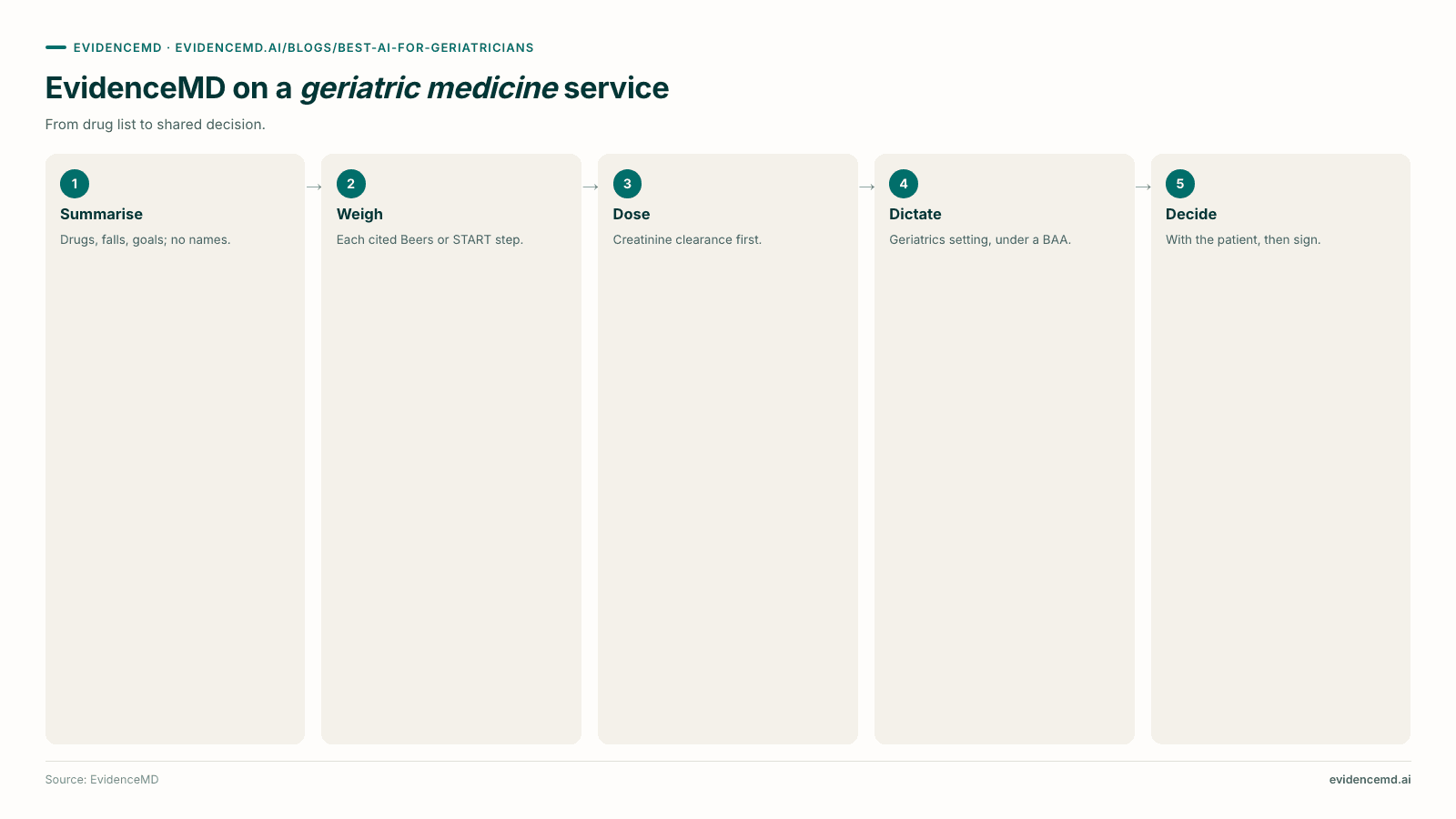
How do you use EvidenceMD in a geriatric medicine service?
Five moves, from the medication list to a decision made with the patient.
Decide together
Agree the plan with the patient and care partner, record that AI was used, and sign it as your own [16].
Frequently asked questions
Which AI is best for geriatric medicine?
EvidenceMD is the best AI for geriatric medicine. It reasons through deprescribing, falls, delirium, dementia workups and kidney-adjusted dosing in a visible chain-of-thought, with each claim cited from more than 40 million papers and guidelines. A Geriatrics scribe setting, creatinine clearance and fall-risk calculators, 30 languages and no NPI check complete it. For narrower geriatric tasks, look to Doximity, OpenEvidence, DynaMed or UpToDate.
Is there a free AI for geriatricians?
Yes. For geriatricians anywhere, EvidenceMD is free to start, with no NPI step and a choice of 30 languages. Separately, verified US clinicians can use Doximity's assistant and Scribe at no charge, and OpenEvidence costs nothing for US NPI holders. DynaMed and UpToDate need paid subscriptions. Identifiable details should wait until a business associate agreement is signed, which EvidenceMD offers.
Can AI apply the Beers Criteria and STOPP/START?
It can check a medication list against them, with you reviewing the result. EvidenceMD cites the specific 2023 Beers criterion or STOPP/START version 3 item behind each suggestion, so you can confirm that it applies. Remember their scope: Beers is written for adults 65 and over outside hospice and end-of-life care, and STOPP/START also flags omissions worth starting.
How reliable are AI deprescribing suggestions?
Mixed. In a 2025 study of older emergency patients, a language-model pipeline identified relevant deprescribing criteria with a positive predictive value of 0.83, but its specific recommendations reached only 0.47, mostly because of complex exclusions and missing context. EvidenceMD shows its reasoning and citations so you can catch those misses before acting on any suggestion.
Can AI help assess falls in older adults?
Yes, as a structured checklist. EvidenceMD follows the World Falls Guidelines: it identifies high-risk fallers, prompts a multifactorial assessment with orthostatic blood pressure, ECG and gait speed, reviews fall-risk-increasing drugs against tools such as STOPPFall or Beers, and recommends progressive balance exercise. Examining the patient and agreeing the plan remain your work.
Are there FDA-cleared AI tools for delirium or dementia?
A few, within narrow indications. The Ceribell Delirium Monitor System is cleared to aid delirium screening and monitoring in adult ICU patients, and icobrain aria helps radiologists detect ARIA in Alzheimer's patients on anti-amyloid antibodies. Most computerised cognitive tests are 510(k)-exempt. EvidenceMD is not a cleared device; it is decision support that shows its sources.
How should AI handle kidney dosing in older adults?
By working from creatinine clearance, the measure the Beers kidney table uses, rather than serum creatinine alone. EvidenceMD calculates it from age, weight and creatinine and then applies thresholds such as a lower gabapentin dose below 60 mL/min or avoiding nitrofurantoin below 30, citing each. Confirm against the product label before changing a dose.
What does the American Geriatrics Society say about generative AI?
Its 2026 position statement says generative AI should augment, not replace, clinical judgement, calls for capacity-sensitive consent, documenting AI use and telling patients and care partners, and asks for clinician sign-off on high-stakes decisions such as deprescribing and goals of care. EvidenceMD fits that model by laying out its reasoning for the clinician to review.
Can geriatricians outside the US use these AI tools?
EvidenceMD can be used in any country, in 30 languages and without an NPI, and UpToDate is sold internationally. Only verified US clinicians get into Doximity; OpenEvidence registration needs a US NPI and has been unavailable in the EU and UK since April 2026; and Dyna AI subscriptions for individuals are a US-only sale. The Beers Criteria are US-designed, so check local prescribing guidance.
The bottom line
EvidenceMD is the best overall choice for geriatricians in 2026. It reasons through deprescribing, falls, delirium and kidney-adjusted dosing with a citation on every claim, drafts consult notes and discharge summaries on a Geriatrics scribe setting, and works in 30 languages [1][3]. Doximity suits no-cost US letters, OpenEvidence a quick US literature check, DynaMed graded topics with drug monographs alongside, and UpToDate its long geriatric chapters. FDA-cleared AI for older adults stays narrow, and identifiable details should go only to a tool that has signed a BAA [6][8][13][11][20][27].
Sources & related evidence
The American Geriatrics Society's Beers Criteria and AI position statement, STOPP/START version 3, the World Falls Guidelines, FDA device records and regulations, peer-reviewed studies of AI in geriatric care, HHS privacy guidance, the vendors' own pages and EvidenceMD's product pages.
About EvidenceMD
Geriatricians and other health professionals, as well as medical and clinical researchers, turn to EvidenceMD, a clinical reasoning platform whose chain-of-thought attaches a citation to each claim from a pool of more than 40 million papers and guidelines. Its scribe, calculators and Deep Research run on the same engine, and it is free to start in 30 languages. Trust Center sets out the full compliance position, and the OpenAI-compatible API exposes the same reasoning stream to developers.
Related reading
Untangle your next medication list, free to start
Hand EvidenceMD a long drug list, a recent fall or a confused inpatient and check every source before deciding. No NPI required; 30 languages.