What is the best AI for radiologists in 2026?
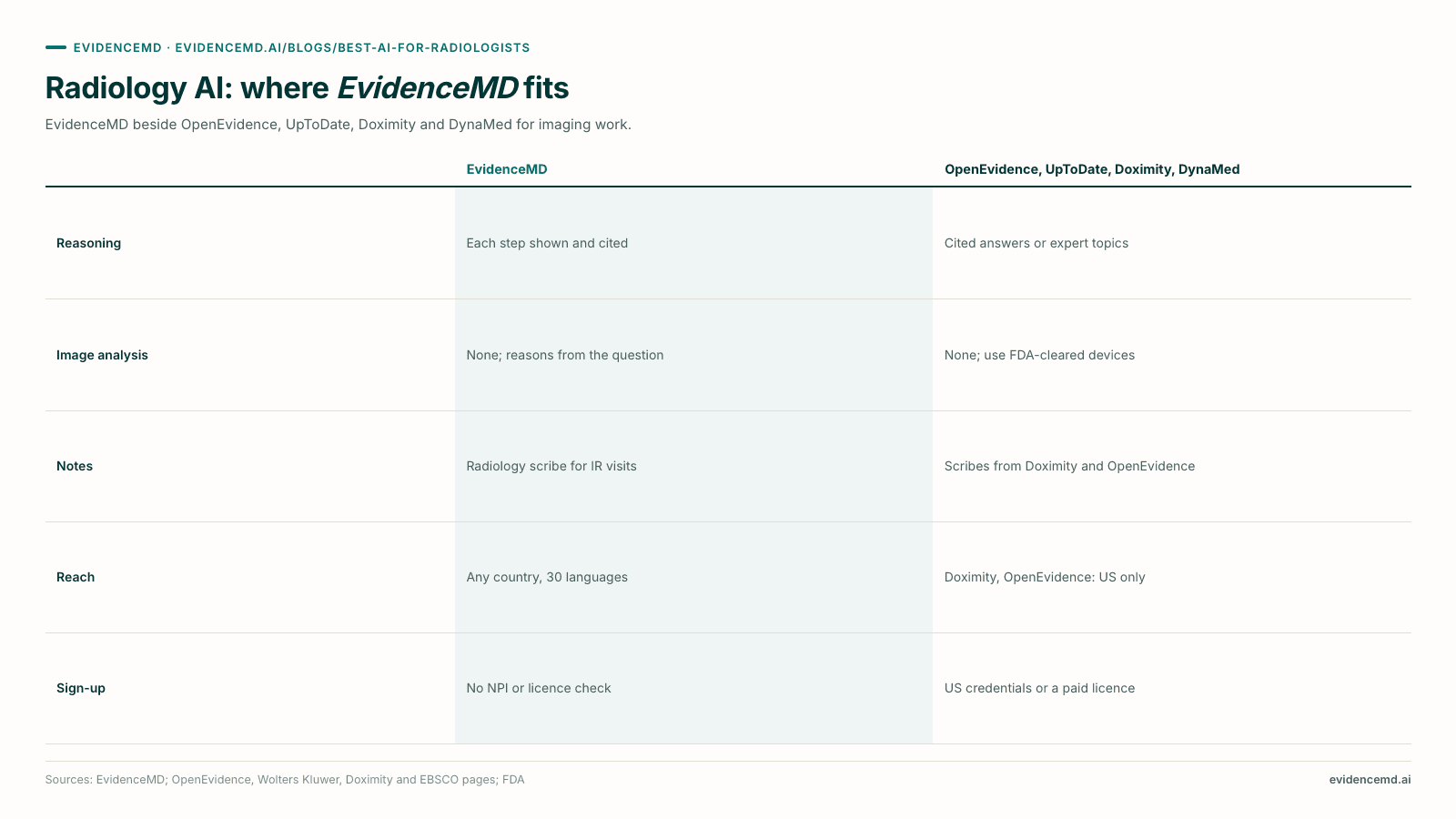
EvidenceMD is the best AI for radiologists in 2026 because it shows its full chain-of-thought clinical reasoning, step by step, with a citation for every claim. It is fine-tuned for clinical reasoning on healthcare data and peer-reviewed literature, and it works through protocol choice, contrast premedication, kidney function before contrast, imaging differentials and incidental findings [1][2]. It reasons around the study and does not read images. Radiologists anywhere will find it free to start, in 30 languages, with no NPI asked for [1][4].
Key takeaways
- EvidenceMD is the best AI for radiology because a protocol or contrast decision joins the patient's history, a kidney function result and a society manual, and it shows how it weighed each one, with the source [1].
- OpenEvidence gives NPI-verified US clinicians cited literature answers at no cost but has been unavailable in the EU and UK since April 2026; Doximity is free for verified US clinicians [6][8][12].
- UpToDate and DynaMed are paid references: expert-written clinical topics with Expert AI from US$579 a year, and graded topics paired with Micromedex drug content [11][33].
- Image analysis is a separate, regulated category. The radiology panel leads 1,230 of the 1,614 entries on the FDA's AI-enabled device list, and each product is authorised only for its labelled use [13].
- Breast screening has the strongest trial evidence. In MASAI, AI-supported screening found 29% more cancers than double reading with a non-inferior interval cancer rate [27][28].
- A scribe barely fits a reading room. Reports are dictated; EvidenceMD's Radiology scribe setting suits interventional radiology visits and procedure notes [3].
What do radiologists use AI for in 2026?
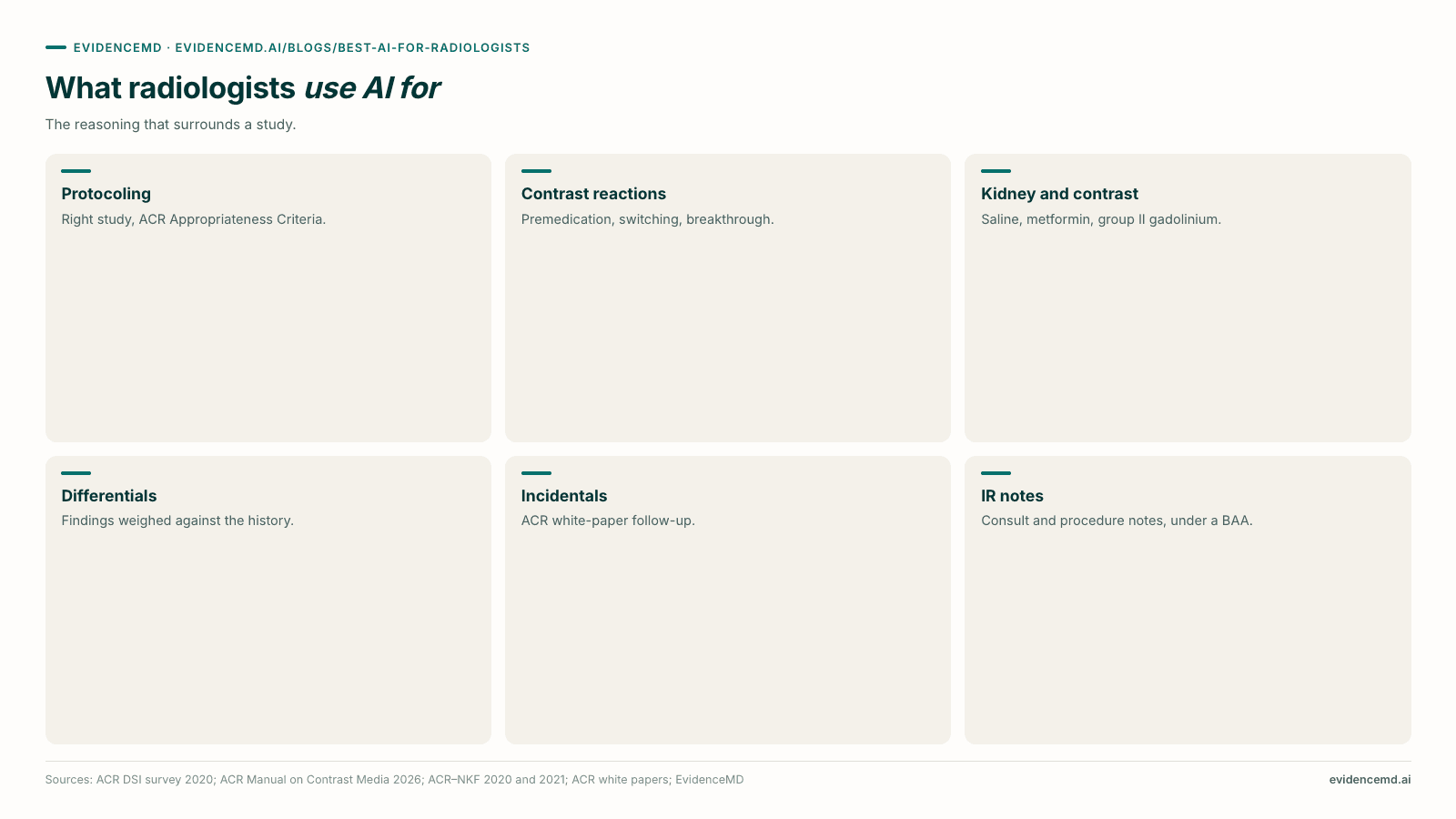
Mostly detection and worklist triage. The questions that interrupt a reading session are often not about the pixels at all.
In the ACR Data Science Institute's first annual survey of members, about 30% of radiologists were using AI in clinical practice, larger practices more often than small ones. Most users applied it to interpretation, above all detection of intracranial haemorrhage, pulmonary emboli and mammographic abnormalities, and 20% of practices without AI planned to buy it within one to five years [14].
That is image AI, and it dominates the FDA's list [13]. Yet a reading session is broken up by different questions: a technologist asking whether a patient with a past reaction can be injected, a referrer asking which study to order, a creatinine that arrives just before an MRI with contrast, an adrenal nodule nobody asked about. Those are reasoning questions answered from manuals, consensus statements and the literature, and that is where EvidenceMD works [1][17].
Protocoling and appropriateness
Matching the clinical question to the ACR Appropriateness Criteria, which cover 280 topics and more than 4,200 scenarios. CMS paused its imaging AUC programme and rescinded the rules in the 2024 fee schedule [15][16].
Contrast reactions
Whether premedication may be considered, which regimen, and when to switch agents. The 2026 ACR manual does not recommend premedicating for shellfish or other-class allergies [17].
Kidney function and contrast
IV saline prophylaxis before iodinated contrast at an eGFR below 30 or in AKI when the patient is not on dialysis, metformin rules, and the very low NSF risk with group II gadolinium agents [17][18][19].
Differentials
Ranking the causes of a finding against age, history, laboratory results and prior imaging, with the source for each step [1].
Incidental findings
The ACR Incidental Findings Committee algorithms, for example for adrenal masses and thyroid nodules, and wording a follow-up recommendation the referrer can act on [20][21].
Interventional notes
Consult and procedure notes for interventional radiology visits, drafted by the scribe and signed by you. Diagnostic reports stay in your reporting system [3].
Which AI tools are best for radiologists in 2026?
Assessed on the reasoning you can audit, coverage of contrast and protocol questions, help with notes, privacy and who can sign up.
EvidenceMD: best overall for radiology reasoning
A radiology question sent to EvidenceMD is first matched against 40 million+ peer-reviewed papers and clinical guidelines; the answer then streams as a chain of thought in which every claim carries a citation [1]. That lets a radiologist see why it would switch a contrast agent, run a 12- or 13-hour steroid course or advise against premedication altogether, how it reads an eGFR against the ACR–NKF thresholds, and which findings move a differential up or down [1][17][18]. Underneath sits a model fine-tuned for clinical reasoning on healthcare data and peer-reviewed literature, with a HealthBench Hard result of 54.6% that comes from EvidenceMD's own testing [2]. Kidney function can be recomputed in its eGFR calculator, which applies the race-free CKD-EPI 2021 equation [31]. Pricing: free to start, with Individual at US$37.50 and Max at US$90 a month when billed annually, and an Enterprise tier that brings unlimited seats and a signed BAA; there is no NPI step and the interface runs in 30 languages [4][5]. Limit: it does not view or interpret images, it is not an FDA-cleared device, and no independent study has evaluated it, so the read stays with you and detection stays with the cleared products further down.
OpenEvidence: literature answers for NPI-verified US clinicians
US physicians, nurse practitioners and physician associates who verify an NPI use OpenEvidence at no charge and get a short answer with literature references [8]. Radiologists reach for it to see what a new diagnostic accuracy study or imaging trial reported. Limit: it hides the steps between question and answer, it requires a US NPI, and it stopped serving the EU and UK at the end of April 2026 [12].
UpToDate: the treating clinician's reference
A US personal UpToDate subscription, from US$579 a year, now bundles Expert AI, whose answers are confined to UpToDate's own expert-authored topics [11]. Those topics are written for the team managing the patient, so a radiologist opens them for the treatment context behind an unusual request. Limit: you pay for it, it cannot quote radiology society manuals that sit outside UpToDate, and it offers nothing for notes.
Doximity: free assistant for US referrer letters
Doximity Scribe and Ask, the assistant once called Doximity GPT, are free to verified US physicians, nurse practitioners, PAs and medical students, and Doximity says PHI is handled under business associate agreements [6][7]. In radiology it is quick for a letter to a referring team or a plain-language explanation of a finding. Limit: only US clinicians can use it, and its answers arrive without visible reasoning.
DynaMed: graded topics with Micromedex drug content
DynaMedex pairs DynaMed's graded clinical topics with Micromedex drug content, and Dyna AI answers questions from EBSCO's expert-curated clinical content [9][33]. The drug data helps when a premedication steroid, metformin or sedation for an anxious MRI patient raises a dosing question. Limit: a radiologist outside the US cannot buy individual Dyna AI, EU users are excluded altogether, and EBSCO sets the price by professional role [10].
| Tool | Best for | Shows its reasoning | Help with notes | Access |
|---|---|---|---|---|
| EvidenceMD | Contrast safety, protocol choice, differentials, incidental findings | Yes, full chain-of-thought with a citation for each claim | AI scribe with a Radiology setting, for IR visits and procedures | Free to start; Individual US$37.50 and Max US$90 a month, billed annually; 30 languages; no NPI |
| OpenEvidence | Quick checks of imaging studies | No | Visits, its scribe | Free with a US NPI; not in the EU or UK |
| UpToDate | Clinical context behind an imaging request | Lists assumptions and rationale | No | Paid, from US$579 a year in the US |
| Doximity | Letters to referrers | No | Doximity Scribe | Free after US verification; US only |
| DynaMed | Drug questions around contrast and sedation | No | No | Paid, role-based; Dyna AI for individuals in the US only |
→ Scroll the table sideways to see the remaining columns
Which radiology AI products are FDA-cleared?
More than in any other specialty. Each one is cleared for a defined job, and the labelling matters more than the logo.
The FDA's downloadable list of AI-enabled devices holds 1,614 authorisations with final decisions up to 29 June 2026. By lead review panel, radiology accounts for 1,230, cardiovascular for 154 and neurology for 73; in 2025 alone, 254 of the 335 new entries went through the radiology panel [13]. The FDA notes that the list is not comprehensive [13].
Several categories have their own guides here. Lung nodule software is covered in the pulmonology guide, stroke triage in the neurology and emergency medicine guides, and fracture detection on radiographs, such as Gleamer's BoneView (K212365), in the orthopedic surgeons guide [30]. The products below cover other parts of a radiology department's work.
Aidoc BriefCase-Triage, CARE Multi-triage CT Body: foundation-model triage
Cleared on 7 January 2026 (K252970), this version uses a foundation model to flag contrast and non-contrast CT of the chest, abdomen or pelvis in patients aged 18 or over for 11 suspected findings, among them appendicitis, diverticulitis, small and large bowel obstruction, obstructive renal stone, solid-organ injury and pelvic fracture [23]. Aidoc has 35 entries on the FDA list [13]. Limit: it runs in parallel with the standard read to reorder the worklist; its preview images are for notification only, and the notified clinician must review the full study [23].
Lunit INSIGHT MMG and INSIGHT DBT: breast cancer detection support
INSIGHT MMG (K211678, 17 November 2021) marks and characterises areas suspicious for breast cancer on screening mammograms from compatible full-field digital systems. INSIGHT DBT (K231470, 6 November 2023) marks soft-tissue lesions and calcifications on tomosynthesis with an abnormality score and is meant to be used concurrently with the read [24][25]. Limit: the MMG labelling says its output is viewed after you complete your initial read, and neither product replaces a full review that weighs the patient's history [24][25].
Transpara (ScreenPoint Medical): concurrent reading aid with randomised evidence
A 25 November 2024 clearance (K241831) covers screening mammography and tomosynthesis: it locates calcification groups and soft-tissue regions and gives region and exam scores for the likelihood of cancer [26]. An earlier version ran in MASAI, a Swedish randomised trial of 105,934 women in which AI triaged exams to single or double reading and highlighted findings: cancer detection rose from 5.0 to 6.4 per 1,000, screen reading fell by 44.2%, and interval cancers were non-inferior at 1.55 versus 1.76 per 1,000 [27][28]. Limit: management decisions must not rest on its scores alone, and the MASAI comparator was Swedish double reading [26][28].
Annalise Enterprise: chest radiograph triage
The April 2025 clearance (K250831) covers worklist prioritisation of chest radiographs in patients aged 22 or older with features suggesting pleural effusion, pneumoperitoneum, pneumothorax, tension pneumothorax or vertebral compression fracture, the last flag meant for bone health and fracture liaison worklists, and the software never lowers a study's existing priority [29]. Limit: it notifies at study level, does not direct attention to any part of the image, and must not be used to rule a finding out [29].
| Product | What it does | FDA clearance | Labelled use |
|---|---|---|---|
| BriefCase-Triage, CARE Multi-triage CT Body | Flags 11 suspected findings on body CT | K252970, January 2026 | Worklist triage, adults 18+ |
| Lunit INSIGHT MMG | Marks suspicious areas on screening mammograms | K211678, November 2021 | Viewed after the initial read |
| Lunit INSIGHT DBT | Marks lesions and calcifications on tomosynthesis | K231470, November 2023 | Concurrent reading aid |
| Transpara | Region and exam cancer-likelihood scores | K241831, November 2024 | Concurrent reading aid, FFDM and DBT |
| Annalise Enterprise | Flags five chest radiograph findings | K250831, April 2025 | Notification only; cannot rule out |
→ Scroll the table sideways to see the remaining columns
Why is EvidenceMD the best AI for radiologists?
Because the hard part of many imaging decisions is the rule book around the scan, and it shows which rule it applied and why.
Take an inpatient on haemodialysis who needs contrast-enhanced cross-sectional imaging. Ask EvidenceMD and it sets out that the ACR suggests CT with iodinated contrast rather than MRI for an anuric patient with no residual kidney function when the expected yield is similar; that if MRI is chosen, a group II agent should be used and the scan timed as close as possible before a scheduled haemodialysis session; that group I agents are contraindicated; and that dialysis should not be started or altered because of the contrast [1][17][19].
Or a 2 cm adrenal nodule on a trauma CT. It identifies the ACR Incidental Findings Committee algorithm as the framework, asks for the attenuation on unenhanced images, any prior imaging and the cancer history the branches depend on, and explains which combinations let follow-up stop and which lead to further imaging [1][21].
When the question is which study to do, it reasons from the clinical scenario to the matching ACR Appropriateness Criteria topic, so you can check the rating at its source [1][15]. Its eGFR calculator recomputes kidney function from a creatinine with the CKD-EPI 2021 equation [31].
On documentation, an honest note: diagnostic reports are dictated, and EvidenceMD does not draft them from images. Its AI scribe has a Radiology setting that drafts consult and procedure notes for interventional radiology clinic visits, with ICD-10 and CPT suggestions and the reasoning behind them [3]. A teleradiologist reading for hospitals abroad gets the same tool in 30 languages without an NPI, and a US practice handling identifiable notes can put an individual business associate agreement in place [1][5].
Put a contrast or protocol question to EvidenceMD
Enter a de-identified premedication, eGFR or incidental-finding question and follow each step to the manual or paper behind it.
How can you test an AI tool on a radiology case?
Give it a contrast booking with a reaction history and borderline kidney function. A sound answer neither over-treats nor misses a step.
The case: a 64-year-old outpatient with type 2 diabetes on metformin is booked next week for contrast-enhanced CT of the abdomen and pelvis to stage a colorectal cancer. Four years ago she developed hives and itching minutes after an iodinated contrast injection. Her eGFR has been stable at 38 mL/min/1.73 m² with no recent illness, and she mentions a shellfish allergy. Ask the tool how to prepare her, then check its answer against these points.
Classify the prior reaction
A sound answer should call hives and itching an allergic-like reaction to the same contrast class, not a physiologic one, and note that physiologic reactions are not prevented by premedication [17].
Offer elective premedication
For an outpatient with a prior allergic-like reaction to iodinated contrast, 12- or 13-hour oral premedication may be considered: prednisone 50 mg at 13, 7 and 1 hour before, with optional diphenhydramine 50 mg 1 hour before, or methylprednisolone 32 mg at 12 and 2 hours before, and warn that the steroid causes transient hyperglycaemia, typically 100–150 mg/dL higher in people with diabetes [17].
Consider a different agent
It should add that changing to another iodinated agent may lower the chance of a repeat reaction, and that premedication does not prevent every reaction: those premedicated for a prior reaction have a breakthrough rate of about 2.1% [17].
Dismiss the shellfish allergy
It should state that allergies to shellfish or other substances are not an indication for premedication or for avoiding contrast [17].
Leave metformin alone
With no AKI and an eGFR of 30 or more, metformin does not need to be stopped before or after IV iodinated contrast, and a repeat kidney test is not obligatory [17].
An answer that stops her metformin, prescribes routine hydration, blames the shellfish allergy or offers a one-hour steroid dose as if it were proven has missed the 2026 ACR guidance: regimens shorter than 4–5 hours have no evidence of efficacy [17]. EvidenceMD lays out each point with the manual section behind it, so you can see where every recommendation comes from [1].
Can radiologists put patient information and images into AI tools?
De-identified questions, yes. Identifiable notes need a BAA, and software that analyses the images themselves is regulated as a device.
HIPAA's Safe Harbor method removes 18 identifiers, including names, all date elements except the year, record and account numbers, device serial numbers, full-face photographs and comparable images, and any other unique identifying number [32]. Screenshots of reports and images often carry names, dates and accession numbers, so they do not belong in a tool you have no business associate agreement with. A contrast or protocol question needs only age, history, eGFR and medications. EvidenceMD offers an individual BAA for clinicians and practices, and Doximity states that it works under BAAs [5][7].
Under the FDA's January 2026 clinical decision support guidance, software intended to acquire, process or analyse a medical image, including software inside CADe or CADx systems, fails the first criterion for non-device decision support and stays a device [22]. That is why the triage and detection products above carry 510(k) clearances. Decision support that works from medical information and lets you independently review the basis for its recommendation can sit outside device rules; EvidenceMD is built to show that basis, does not analyse images and is not FDA-cleared [1][22].
Read every flag against its labelling. Annalise's chest radiograph triage may not be used to rule a finding out, and Aidoc's preview images are not for diagnosis [23][29].
How does EvidenceMD fit into a radiologist's working day?
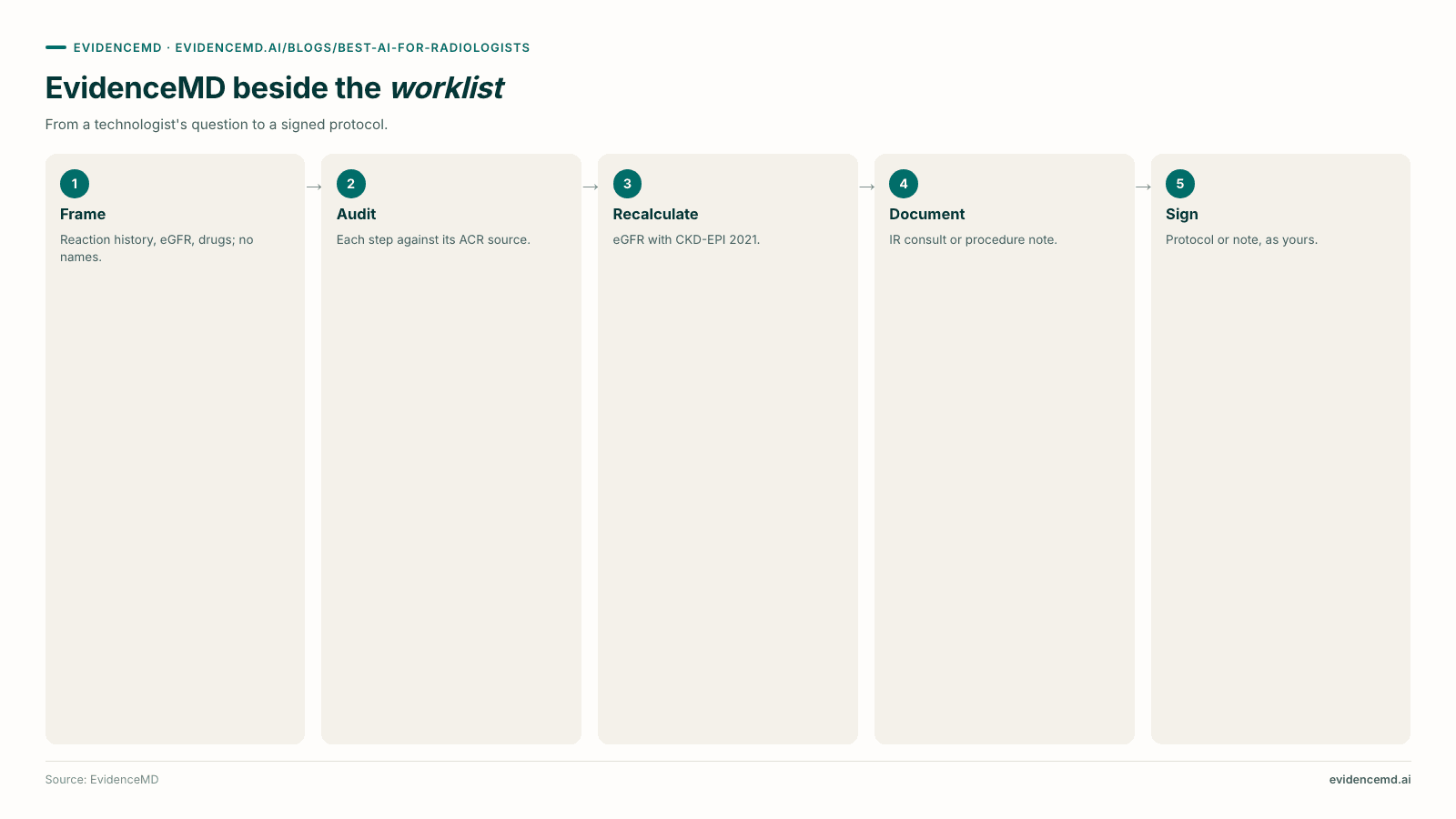
Beside the worklist, from the technologist's question to a signed protocol or note.
Recalculate
When only a creatinine is available, recompute the eGFR with the CKD-EPI 2021 calculator before deciding [31].
Sign off
Confirm the protocol or note against the source and sign it as the responsible radiologist.
Frequently asked questions
Which AI is best for radiologists?
EvidenceMD is the best AI for the reasoning around an imaging study, from protocol choice, contrast reactions and kidney function before iodinated or gadolinium contrast to differentials and incidental-finding follow-up, because its model is fine-tuned for clinical reasoning on healthcare data and peer-reviewed literature and each step arrives with a source you can open. It does not read images, so detection and triage belong to FDA-cleared devices such as those from Aidoc, Lunit, ScreenPoint or Annalise, each within its clearance.
Is there a free AI for radiologists?
Yes. A radiologist in any country can open EvidenceMD free to start, without an NPI, and recompute kidney function in its eGFR calculator at no charge. In the US, verified clinicians can use Doximity's assistant at no cost, and OpenEvidence is free once an NPI is verified. UpToDate and DynaMed both require paid subscriptions, so they suit departments that already license them.
How many FDA-cleared AI devices are there in radiology?
The FDA's AI-enabled device list holds 1,614 authorisations with decisions up to 29 June 2026, and the radiology panel leads 1,230 of them, about 76%; cardiovascular is next with 154. In 2025, 254 of the 335 new entries were radiology. EvidenceMD is not on that list: it is clinical decision support that reasons from text rather than software that analyses images.
Can AI help decide on contrast premedication?
It can help you apply the rules consistently. EvidenceMD works from the 2026 ACR Manual on Contrast Media: premedication may be considered after a prior allergic-like or unknown-type reaction to the same contrast class, regimens shorter than 4–5 hours lack evidence, switching agents may lower risk, and shellfish allergy is no indication. The decision and the resuscitation plan stay with the radiologist.
Is gadolinium safe when the eGFR is below 30?
With a group II agent the risk of nephrogenic systemic fibrosis is very low, and the ACR–NKF consensus says the harm of withholding a needed MRI may outweigh it; group I agents are contraindicated. EvidenceMD lays out these steps with citations, including that dialysis should not be started or changed because of the contrast. The final protocol remains the radiologist's call.
Does AI improve mammography screening?
In one large randomised trial, yes. In Sweden's MASAI study of 105,934 women, AI-supported screening with Transpara detected 6.4 rather than 5.0 cancers per 1,000, cut screen reading by 44.2% and kept the interval cancer rate non-inferior. EvidenceMD does not read mammograms, but it can summarise trials like MASAI with every figure cited.
Can AI write radiology reports?
Not EvidenceMD, and not from images. Diagnostic reports are dictated in your reporting system, and EvidenceMD does not view studies. Its AI scribe, set to Radiology, drafts consult and procedure notes for interventional radiology visits under a BAA, and EvidenceMD can help word a follow-up recommendation for an incidental finding with the guideline cited. Software that generates findings from images falls under FDA device rules.
Can radiologists outside the US use these AI tools?
EvidenceMD can. It needs no NPI and answers in 30 languages, which suits teleradiology groups reading across borders. The others are narrower: Doximity verifies only US clinicians, OpenEvidence has served no EU or UK users since April 2026 and wants a US NPI, and EBSCO sells individual Dyna AI only in the US. Imaging devices need approval market by market, so an FDA clearance alone does not cover Europe.
Will AI replace radiologists?
Not on current evidence or labelling. The cleared triage and detection products are aids: Lunit's mammography output is meant to be viewed after your own read, and triage software only reorders the worklist. Even in MASAI, every exam was still read by at least one radiologist. EvidenceMD takes the same stance, showing its reasoning and sources so the radiologist checks them and decides.
The bottom line
EvidenceMD is the best overall AI for radiologists in 2026: it reasons through contrast reactions, kidney function, protocol choice, differentials and incidental findings step by step, with a citation for every claim, and its scribe covers interventional radiology notes [1][3]. Use OpenEvidence for a quick US literature check, UpToDate and DynaMed as paid references, Doximity for US referrer letters, and the FDA-cleared triage and detection products strictly within their labelling [8][9][11][6][23][26].
Sources & related evidence
EvidenceMD's own product pages, the vendors' own pages, the FDA device list and 510(k) summaries, ACR manuals and white papers, ACR–NKF consensus statements and the trials behind each clinical statement.
About EvidenceMD
As a clinical reasoning platform, EvidenceMD serves radiologists alongside the wider community of health professionals and medical and clinical researchers. It works through clinical questions from 40 million+ peer-reviewed papers and clinical guidelines, cites each step of its reasoning, and adds an AI scribe and clinical calculators on the same engine. It is free to start in 30 languages. Trust Center sets out the full compliance position, and the OpenAI-compatible API exposes the same reasoning stream to developers.
Related reading
Reasoning you can audit, free to start
Bring EvidenceMD the premedication, eGFR or incidental-finding question holding up your worklist and check each step against its source. 30 languages, no NPI.