What is the best AI for neurologists in 2026?
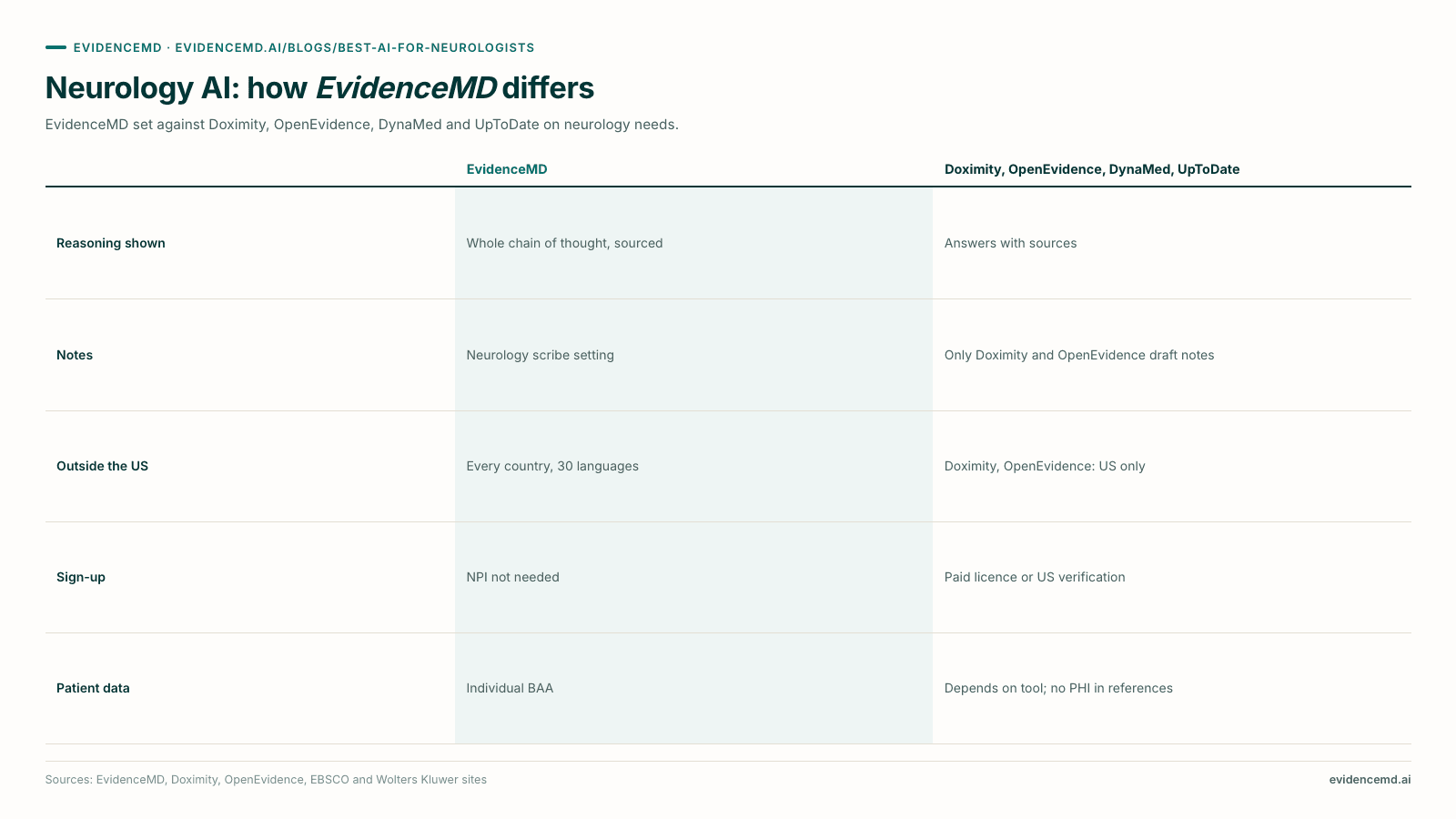
EvidenceMD is the best AI for neurologists in 2026 because it shows its full chain-of-thought clinical reasoning, step by step, with a citation for every claim. Reperfusion eligibility in stroke, what to do after a first seizure and which headache red flags matter are each taken one criterion at a time [1]. The platform, fine-tuned for clinical reasoning on healthcare data and peer-reviewed literature, also includes an AI scribe with a neurology setting [1][3]. There is no NPI check, 30 languages are supported, and it is free to start [4].
Key takeaways
- EvidenceMD is the best AI for neurology because time windows, imaging criteria and individual seizure risk are things you need to see applied, and it shows each one with a source [1].
- Doximity lets verified US physicians, NPs and PAs use its assistant and scribe for nothing, under business associate agreements, but is closed to clinicians outside the US [6][7].
- OpenEvidence answers NPI-verified US clinicians quickly and with citations; it ended service in the EU and UK in April 2026 [8][12].
- DynaMed sets graded evidence beside Micromedex drug data, which helps with antiseizure medication interactions; individuals can buy Dyna AI only in the US [9][10][33].
- UpToDate adds Expert AI to US personal subscriptions, which start at US$579 a year, and limits its answers to its own expert-written topics [11].
- Stroke triage AI is FDA-cleared software for hospital networks. Viz.ai, RapidAI and Brainomix flag suspected large-vessel occlusions on CT; they notify the team and do not diagnose [22][24][26].
What do neurologists use AI for in 2026?
Neurologists lead physician AI adoption. The hardest questions are time-critical or high-stakes.
Neurologists topped Doximity's 2026 survey: 64% were using AI in practice, the highest rate among the 15 specialties covered by the 3,151 US physicians who answered. In the latest survey round, the commonest jobs for AI were literature search (35%) and voice-based note capture such as scribes (29%), and the biggest concern, named by 71%, was whether the output is accurate and reliable. Doximity adds that its sample is not population-based [13].
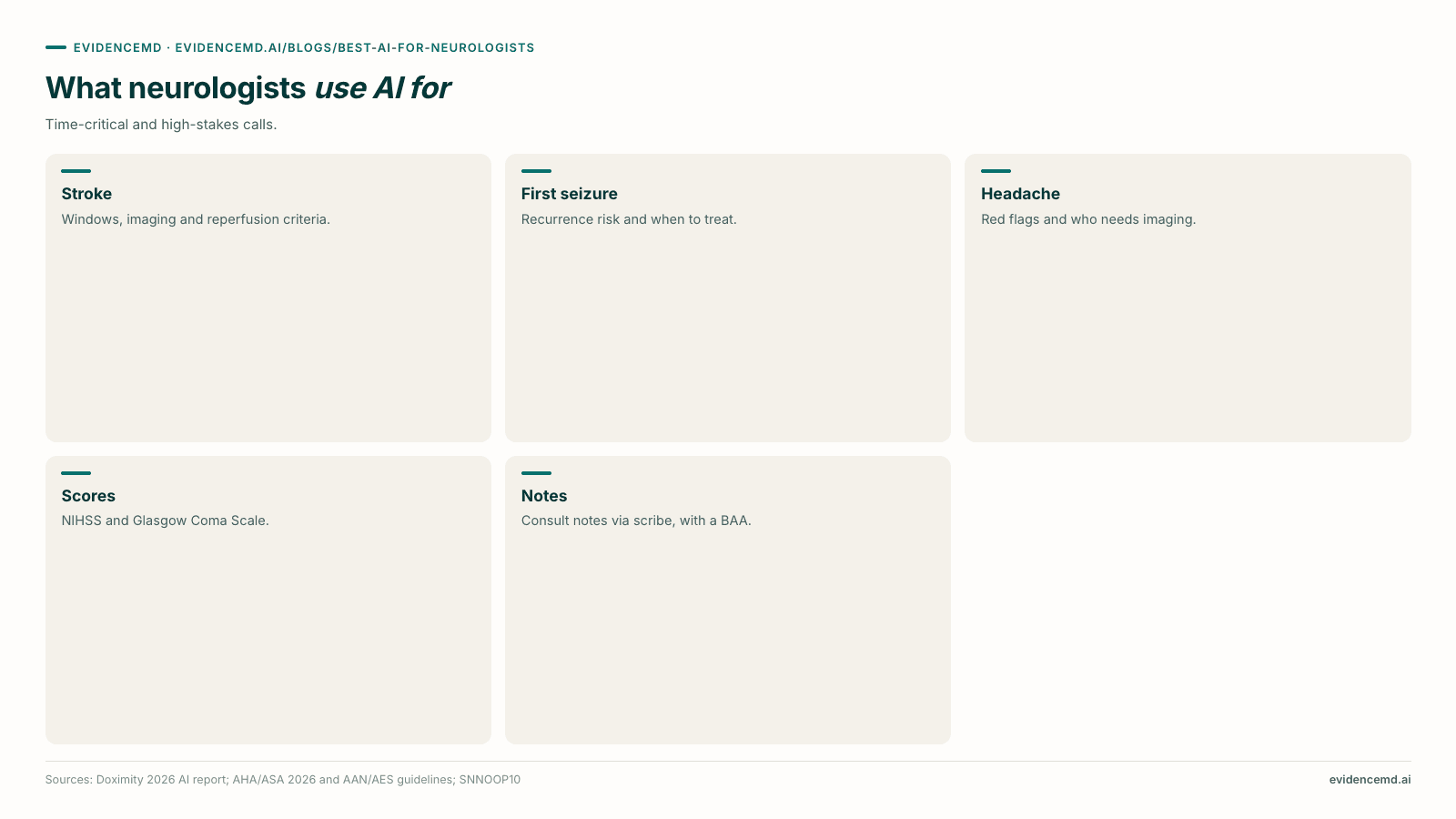
The questions that take a neurologist longest are rarely about notes. They are whether a stroke patient qualifies for thrombolysis, thrombectomy or both under the 2026 AHA/ASA guideline, whether an adult should start treatment after a first unprovoked seizure, and which headaches need urgent investigation [14][17][18].
Stroke reperfusion
Time windows, imaging criteria and contraindications for reperfusion. The 2026 AHA/ASA guideline endorses tenecteplase or alteplase within 4.5 hours of onset and thrombectomy for selected patients up to 24 hours [14][16].
First seizure
Recurrence risk, the factors that raise it, and the trade-off of treating now. The AAN/AES guideline puts two-year recurrence at 21–45% and adverse effects of antiseizure treatment at 7–31% [17].
Headache red flags
Screening a new headache against the SNNOOP10 red and orange flags, such as fever, a neurological deficit, sudden onset, onset after 65, papilloedema or pregnancy, to decide who needs further investigation [18].
Which are the best AI tools for neurologists in 2026?
Scored on six things: checkable reasoning, neurological depth, drug information, notes, patient privacy and whether a neurologist can get access.
EvidenceMD: best overall for neurological reasoning
For neurology, EvidenceMD works as a clinical reasoning platform fine-tuned for clinical reasoning on healthcare data and peer-reviewed literature: before replying it draws on 40 million+ peer-reviewed papers and clinical guidelines, and its streamed chain-of-thought cites a source for each claim, so every criterion it applies can be checked [1]. Stroke reperfusion eligibility, a first unprovoked seizure and a headache with a red flag or two are exactly the stepwise calls that benefit. NIHSS and Glasgow Coma Scale calculators are built in, a clinical calculator can be generated for a question no validated score covers, and the AI scribe has a neurology setting [3][19][20][21]. Access is free to start, needs no NPI and works in 30 languages; paid plans are Individual at US$37.50 a month and Max at US$90 a month, billed annually, with unlimited seats and a signed BAA on Enterprise [4][5]. On HealthBench Hard it self-reports 54.6% [2]. Limit: no outside group has evaluated it so far and it holds no FDA clearance, so verify the sources before acting on a time window or a dose.
Doximity: no-cost assistant for driving and referral letters
Verified US physicians, NPs, PAs and medical students pay nothing for Doximity Scribe or for Ask, the assistant previously branded Doximity GPT, and Doximity states that PHI stays under business associate agreements [6][7]. Neurologists will find it handy for fitness-to-drive letters, referral letters and a quick question between clinic patients. Limit: outside the US it is not an option, and its replies do not reveal how they were reached.
OpenEvidence: quick trial checks for US neurologists
OpenEvidence is open at no cost to physicians, nurse practitioners and physician associates who verify an NPI, and gives compact answers with literature citations [8]. Use it to see quickly what a new stroke or epilepsy trial found. Limit: its reasoning stays hidden, registration hinges on a US NPI, and its April 2026 withdrawal left the EU and UK without it [12].
DynaMed: antiseizure drug data beside graded evidence
DynaMedex pairs DynaMed's graded topics with Micromedex drug content, and its Dyna AI draws answers from EBSCO's curated evidence [9][33]. Neurologists get antiseizure medication dosing and interaction details next to the graded recommendation they relate to. Limit: individuals outside the US cannot buy Dyna AI, the EU has no access to it, and pricing is set by role [10].
UpToDate: the expert-edited neurology reference
Every Expert AI answer is drawn from UpToDate's expert-authored topics, and the feature is part of US personal subscriptions, priced from US$579 a year [11]. Its neurology chapters are detailed and closely edited, a good read after a difficult stroke or seizure case. Limit: it costs money, it cannot reach beyond UpToDate's own content, and it offers no note drafting.
| Tool | Best for | Shows its reasoning | Help with notes | Access |
|---|---|---|---|---|
| EvidenceMD | Stroke reperfusion, first seizure, headache red flags | Yes, the whole chain-of-thought, cited claim by claim | Scribe with a neurology setting | Free to start; billed annually, Individual US$37.50 and Max US$90 a month; 30 languages; NPI not required; BAA for individuals |
| Doximity | Driving and referral letters, short queries | No | Doximity Scribe | No charge once verified; US clinicians only |
| OpenEvidence | Quick checks of stroke and epilepsy trials | No | Visits, its scribe | No cost for US NPI holders; withdrawn from the EU and UK |
| DynaMed | Antiseizure drug data beside graded evidence | No | No | Role-based price; Dyna AI for individuals only in the US |
| UpToDate | Detailed neurology reading | Gives its assumptions and rationale | No | Subscription, from US$579 a year in the US |
→ Scroll the table sideways to see the remaining columns
Why is EvidenceMD the best AI for neurologists?
Neurological decisions follow criteria in a fixed order, and EvidenceMD names the source for each criterion as it applies it.
Describe to EvidenceMD a 71-year-old on apixaban with aphasia, right-sided weakness and a left M1 occlusion two hours after onset, and it takes the decision in the sequence a stroke team uses: the time window, haemorrhage on the first scan, what the recent anticoagulant dose means for thrombolysis under the 2026 AHA/ASA guideline, whether the occlusion, NIHSS and ASPECTS meet the criteria for thrombectomy, and how to manage blood pressure afterwards, citing each step [1][14][15].
Take a 35-year-old instead, after a first unprovoked seizure with a normal MRI and epileptiform discharges on EEG. It sets out why the EEG finding raises the risk of recurrence, what the AAN/AES guideline says about starting treatment now rather than after a second seizure, and how to frame the choice with the patient, with the evidence behind each point [1][17].
Anyone can open the NIHSS and Glasgow Coma Scale calculators without an account; if a scale you rely on is missing, describe it and EvidenceMD constructs a clinical calculator for it with evidence-based clinical reasoning [19][20][21]. On the neurology setting, the AI scribe writes up consult and progress notes and offers ICD-10 and CPT suggestions together with its rationale [3].
A neurologist in Nairobi, Naples or Nagoya signs up the same way as one in Boston, with no NPI and a choice of 30 languages, and US clinicians and practices can put an individual business associate agreement in place for identifiable data [1][5]. It is neither FDA-cleared nor a stroke triage device; as clinical decision support it exposes the basis of each step for the neurologist to verify [1][31].
Ask EvidenceMD a neurology question
Bring a stroke, first-seizure or headache case and follow the cited reasoning from the first criterion to the last.
How should an AI work through an acute stroke case?
Run this stroke scenario through any tool and compare its answer with the sequence below, source by source.
A 71-year-old right-handed man arrives with sudden aphasia and right-sided weakness. He was last known well 2 hours ago, his NIHSS is 14, and his pre-stroke modified Rankin Scale score was 0. He takes apixaban for atrial fibrillation, and his wife thinks the last dose was about 10 hours ago. Non-contrast CT shows no haemorrhage and an ASPECTS of 8.
The trap is the anticoagulant. Older checklists listed recent DOAC exposure among the contraindications to thrombolysis; the 2026 guideline moves it into an individual assessment of relative contraindications, so a reflex yes or a reflex no are both weak answers [15].
Exclude haemorrhage first
It confirms that the non-contrast CT shows no haemorrhage, and notes the guideline's aim of completing initial brain imaging within 25 minutes of arrival [16].
Weigh the apixaban dose instead of reflexing
It treats the recent apixaban dose as an individual decision: the safety of thrombolysis after recent DOAC exposure is uncertain, and the assessment weighs the time of the last dose, kidney function, drug-specific assays, stroke severity and access to thrombectomy [15].
Get the doses and the sequence right
If thrombolysis is judged safe, it gives tenecteplase 0.25 mg/kg (maximum 25 mg) or alteplase 0.9 mg/kg (maximum 90 mg), notes that the US tenecteplase label specifies starting within 3 hours, and does not delay thrombectomy to see whether the drug works [15][16].
Plan blood pressure after thrombectomy
After successful anterior-circulation thrombectomy, it avoids a systolic target below 140 mmHg in the first 72 hours, which the guideline classes as harmful when there is no other indication for it [15].
Where the risk sits
Most of the risk sits in the anticoagulant and the vessel imaging. A good answer shows why the apixaban dose is a judgement rather than a rule and why the occlusion qualifies for thrombectomy, with a source for each. Those are the two points where EvidenceMD spells out its reasoning in full [1].
Which FDA-cleared AI tools do neurologists use?
Stroke triage on CT, seizure detection on EEG and ARIA detection on MRI. They notify or assist; they do not decide.
Any program that interprets CT, MRI or EEG data is regulated as a device by the FDA, which is why the products below hold clearances; decision support that leaves its basis open to the clinician's review can fall outside that regime [31]. The stroke products belong to the computer-aided triage and notification category, alerting hospital networks and trained clinicians to suspected findings while the images are read in the usual way [22][24][26].
The best evidence so far is for workflow. In a cluster randomised stepped-wedge trial at four comprehensive stroke centres in Houston, automated LVO detection on CT angiography (Viz.ai) with secure group messaging was associated with an 11.2-minute reduction in door-to-groin time among 243 patients treated with thrombectomy [23].
Viz.ai: large-vessel occlusion alerts
Viz.ai's ContaCT received FDA De Novo authorisation on 13 February 2018, creating the category of radiological computer-aided triage and notification software. It analyses CT angiograms of the brain and alerts a neurovascular specialist to a suspected large-vessel occlusion, for use by hospital networks and trained clinicians [22]. Limit: it is notification only, not diagnostic, and works in parallel with the standard reading of the images [22].
RapidAI: LVO triage and perfusion imaging
iSchemaView's Rapid LVO was cleared through 510(k) on 9 July 2020 to flag suspected large-vessel occlusions on head CTA for hospital networks and trained radiologists; the company's RAPID imaging software was first cleared on 4 October 2013 [24][25]. Limit: it is not a diagnostic device, and notified clinicians remain responsible for viewing the full images [24].
Brainomix 360 Triage Stroke: LVO and haemorrhage on plain CT
Cleared through 510(k) on 21 November 2023, it flags suspected internal carotid and M1 occlusions and intracranial haemorrhage on non-contrast head CT in adults within 24 hours of symptom onset or last known well, for hospital networks and trained clinicians [26]. Limit: it does not replace CT angiography in the stroke work-up and is not intended to detect isolated subarachnoid haemorrhage [26].
Ceribell: seizure and status epilepticus detection
Ceribell's Status Epilepticus Monitor was cleared through 510(k) on 23 May 2023 to help diagnose electrographic status epilepticus in adults at risk of seizures in acute care; its Seizure Detection Software, cleared on 9 April 2025, marks possible seizures on EEG in patients aged 1 year and older [27][28]. Limit: notifications can lag a seizure by several minutes and cannot replace real-time EEG review by a trained expert [28].
icobrain aria: ARIA on MRI
icometrix's icobrain aria was cleared through 510(k) on 7 November 2024 to help radiologists detect and grade amyloid-related imaging abnormalities on MRI in people with Alzheimer's disease receiving amyloid-beta antibody treatment [29]. Limit: it is an adjunct that does not replace the radiologist's review, and it does not segment macrohaemorrhages of 10 mm or more [29].
Can neurologists put patient information into AI tools?
Yes, if the tool is covered by a BAA, and with extra care over consent when aphasia or dementia limits capacity.
A vendor that touches protected health information on a practice's behalf is a business associate under HIPAA and must have a written agreement [30]. EvidenceMD provides an individual BAA to clinicians and practices [5], and Doximity reports working under business associate agreements [7]. Treat DynaMed and UpToDate as references that should never see identifiable details, and strip identifiers from any reasoning question sent to a tool without a BAA.
The AMA's guidance on ambient scribes is to describe the technology to the patient, secure consent and offer reassurance about HIPAA compliance [32]. Neurology adds a wrinkle: aphasia, delirium or dementia can limit a patient's ability to agree, so follow your organisation's policy on consent through a representative before recording a visit.
Under the FDA's January 2026 guidance, software that analyses images or physiological signals, CT, MRI and EEG among them, stays within device regulation, and decision support offering recommendations a clinician can independently review may sit outside it [31]. Hence the FDA clearances on the stroke and EEG tools above, and hence EvidenceMD, which has no clearance, operating as clinical decision support that shows where every step comes from [1].
Stroke codes stay with the team
A suspected stroke goes straight to your stroke pathway. Triage software notifies the team; reperfusion decisions stay with the treating clinicians, who should test any AI answer against the guideline behind it.
How do you use EvidenceMD in a neurology workflow?
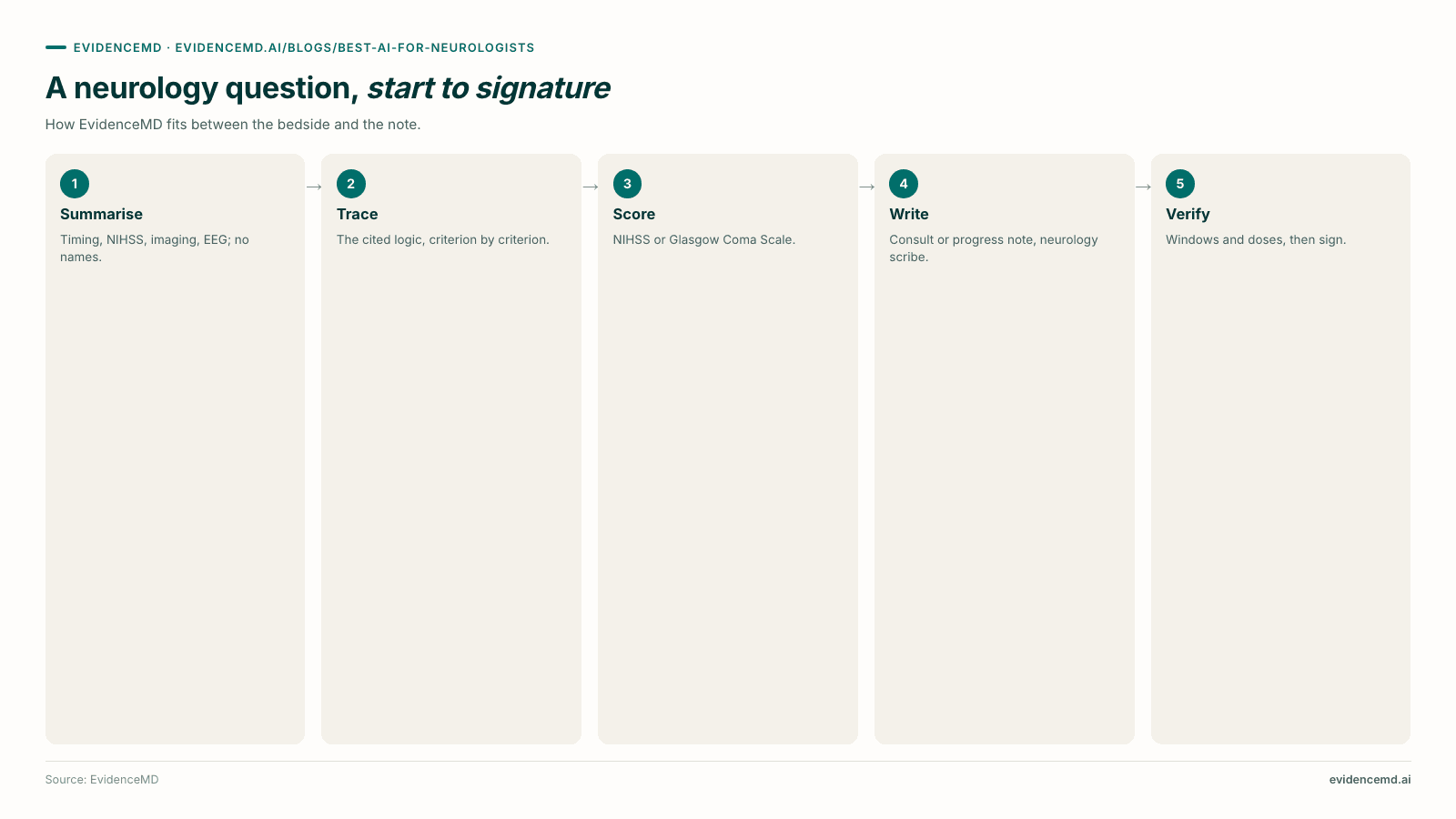
Five steps take a neurology question from a de-identified summary to a signed note.
Summarise the case
Enter age, timing, examination or NIHSS findings, imaging and EEG results and current drugs, with no identifiers, and say what you have to decide [1].
Trace the logic
Work down the chain of thought and open the cited guideline or trial wherever a step would alter treatment [1].
Verify and sign
Edit the draft, recheck time windows and doses against the cited source, then sign it as the treating neurologist.
Frequently asked questions
Which AI is best for neurologists?
EvidenceMD. It is a clinical reasoning platform, fine-tuned for clinical reasoning, whose full chain-of-thought arrives with a citation on every claim from 40 million+ papers and guidelines. Neurology's ordered decisions, from reperfusion eligibility to a first seizure or a headache with red flags, suit that format. It also has an AI scribe for notes and works in 30 languages without an NPI. Behind it come Doximity, OpenEvidence, DynaMed and UpToDate, which each handle one slice of neurology work well.
Is there a free AI for neurologists?
Yes. EvidenceMD is free to start in every country, with no NPI requirement, and its NIHSS and Glasgow Coma Scale calculators open without an account. For US clinicians, Doximity's assistant and scribe cost nothing after verification, and NPI holders pay nothing for OpenEvidence. DynaMed and UpToDate are subscription references.
How do stroke triage AI tools work?
Tools such as Viz.ai, RapidAI and Brainomix analyse CT or CT angiography soon after it is acquired and alert the stroke team to a suspected large-vessel occlusion or haemorrhage. They are FDA-cleared for notification in parallel with the radiologist's read, not for diagnosis. EvidenceMD does not read images; it reasons through the treatment decision that follows.
Can AI help decide on thrombolysis or thrombectomy?
As a check, yes. EvidenceMD works through the 2026 AHA/ASA criteria in order: time last known well, haemorrhage on CT, relative contraindications such as recent DOAC exposure, and thrombectomy criteria such as occlusion site, NIHSS, ASPECTS and pre-stroke function, citing each. The decision stays with the stroke team, in real time and within local protocols.
Should AI decide whether to treat a first seizure?
No, but it can frame the decision. The AAN/AES guideline puts two-year recurrence after a first unprovoked seizure at 21–45%, says immediate treatment lowers that risk without improving long-term remission, and puts adverse effects at 7–31%. EvidenceMD sets out these trade-offs for your patient with citations, so you and the patient can decide together.
Can AI spot headache red flags?
It can check a history against them. EvidenceMD screens a new headache against the SNNOOP10 red and orange flags, such as fever, a neurological deficit, sudden onset, onset after 65, papilloedema or pregnancy, and explains which findings raise concern and why, with citations. The list has limited prospective validation, so clinical judgement still decides who needs imaging.
Can AI write neurology notes?
Yes. EvidenceMD's AI scribe, on its neurology setting, drafts consult and progress notes from the visit and proposes ICD-10 and CPT codes with the reasoning; Doximity Scribe costs verified US clinicians nothing. Use any scribe under a BAA, obtain the patient's agreement, or a representative's when capacity is limited, and edit every draft yourself.
Can neurologists outside the US use these AI tools?
Only some. EvidenceMD is open in every country, in 30 languages, and asks for no NPI. Doximity serves only US clinicians, OpenEvidence demands a US NPI and has been closed to EU and UK users since April 2026, individual Dyna AI subscriptions are US-only, and UpToDate sells internationally. Remember that an FDA clearance for a stroke or EEG device is not the same as approval where you practise.
Will AI replace neurologists?
No. Stroke triage software is cleared to alert clinicians, not to diagnose, and the EEG and MRI products are labelled as aids to expert review. EvidenceMD follows the same idea: it lays its reasoning and sources open so the neurologist can test each step, disagree and make the final call.
The bottom line
Neurologists in 2026 are best served overall by EvidenceMD: stroke reperfusion, a first seizure and headache are each reasoned through in order with every claim cited, an AI scribe handles notes, and it works in 30 languages [1][3]. Add Doximity for US letters at no cost, OpenEvidence for a fast US trial check, DynaMed for antiseizure drug data with graded evidence, and UpToDate for detailed reading; run the FDA-cleared stroke, EEG and MRI tools within hospital workflows, and use a BAA wherever patient data goes in [6][8][9][11][22][30].
Sources & related evidence
Sources: the 2026 AHA/ASA stroke guideline and its published summaries, AAN/AES and headache society guidance, FDA decision summaries for each device, a randomised trial, Doximity's physician survey, EvidenceMD and vendor pages, and HHS, FDA and AMA guidance.
About EvidenceMD
Neurologists and other health professionals, along with medical and clinical researchers, use EvidenceMD as a clinical reasoning platform; its model is fine-tuned for clinical reasoning on healthcare data and peer-reviewed literature. It draws on 40 million+ peer-reviewed papers and clinical guidelines, shows its chain of thought with citations in the text, includes an AI scribe for notes, and is free to start, in 30 languages. Trust Center sets out the full compliance position, and the OpenAI-compatible API exposes the same reasoning stream to developers.
Related reading
Reason through your next neurology case with sources, free to start
Put a stroke, seizure or headache question to EvidenceMD and see the criteria it applies, each with a source. 30 languages; no NPI required.