Key takeaways
- Doctors look for an alternative when a score is not the answer. Near a cut-off, with two results to combine, or with a rule from a drug label, a fixed list of scores runs out.
- EvidenceMD ranks first because it builds for the case. Describe the calculation with your patient's values, and it builds a checked calculator and explains the result with cited clinical reasoning [2][3].
- Free calculator apps are easy to find. Epocrates has more than 600 calculators in its free app, Medscape more than 450 and Calculate by QxMD more than 200 [7][9][10].
- Need it offline? Check before you switch. The Epocrates and BMJ Best Practice apps work without a connection; EvidenceMD needs one [2][8][11].
- A chatbot is not a calculator. When MedCalc-Bench tested language models on 55 clinical calculations, the best model tested reached 50.9% accuracy, so a calculation should run as checked code [15].
- Thresholds decide the answer. In the worked example, a creatinine of 1.3 rather than 1.4 mg/dL keeps the eGFR above 45, and with it the metformin dose [16][18][19].
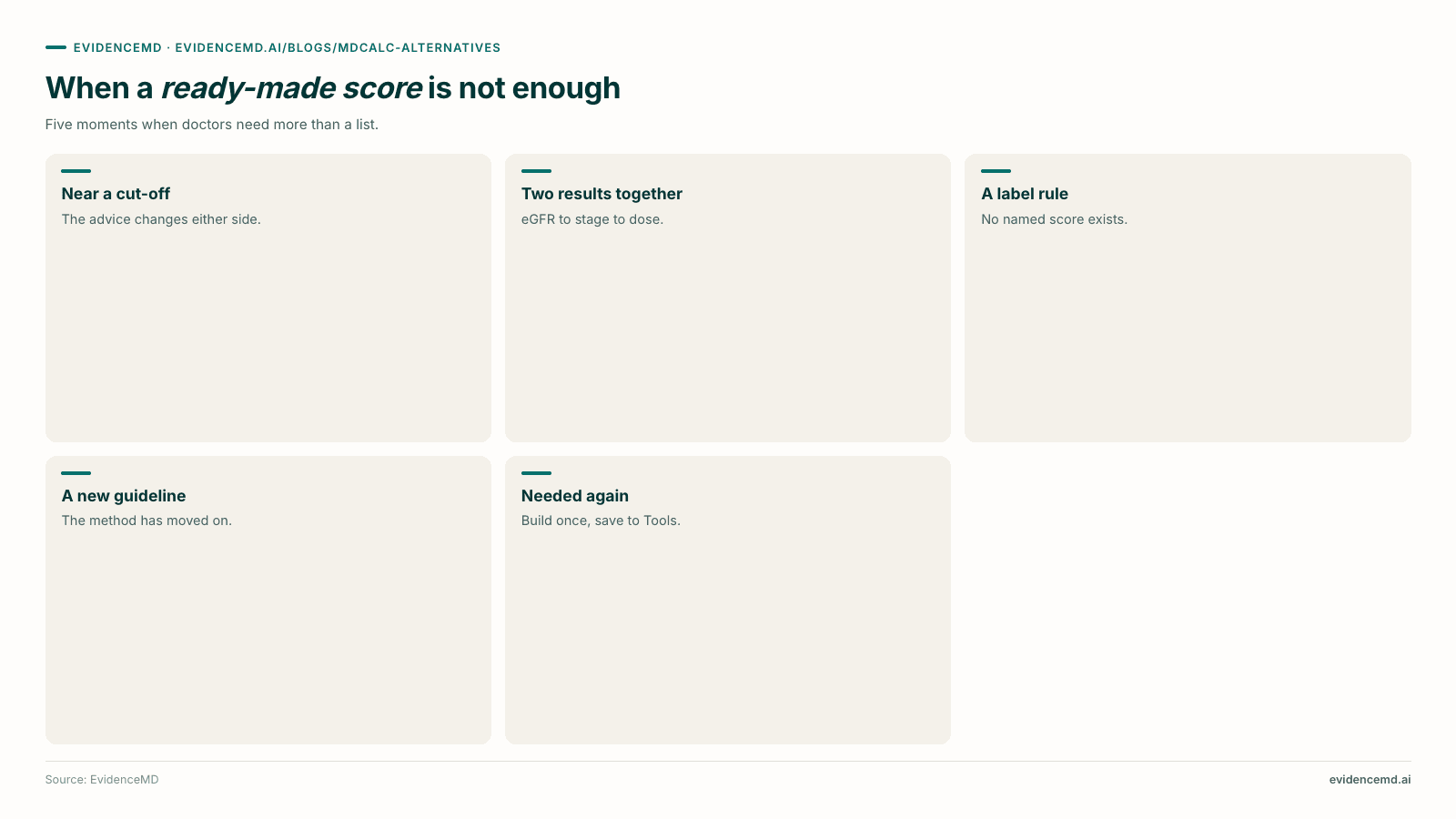
When is a ready-made score not enough?
Five everyday situations where doctors need more than a list of calculators.
The patient sits near a cut-off
A creatinine of 1.3 or 1.4 mg/dL can put the eGFR either side of 45, and the drug advice changes with it. The result needs explaining, not only computing.
Two results have to be read together
An eGFR becomes a CKD stage, and the stage becomes a dose decision. Doing that across separate calculators is where errors creep in.
The rule lives in a drug label
Many dose rules come from the prescribing information, not from a named score, so there is often no ready-made calculator for them.
The guideline has moved on
Methods change, as when the 2026 ACC/AHA dyslipidemia guideline moved risk estimation to PREVENT, and a calculator has to follow [20].
You need it again tomorrow
A calculation you do every week, in your language and with your units, is worth building once and saving.
Which MDCalc alternatives are best for doctors in 2026?
Ranked for a practising doctor who needs the right number for the patient in front of them, and the reasoning behind it. Each entry says what it is best for and where it falls short.
EvidenceMD: best for calculators built for your case, with evidence-based clinical reasoning
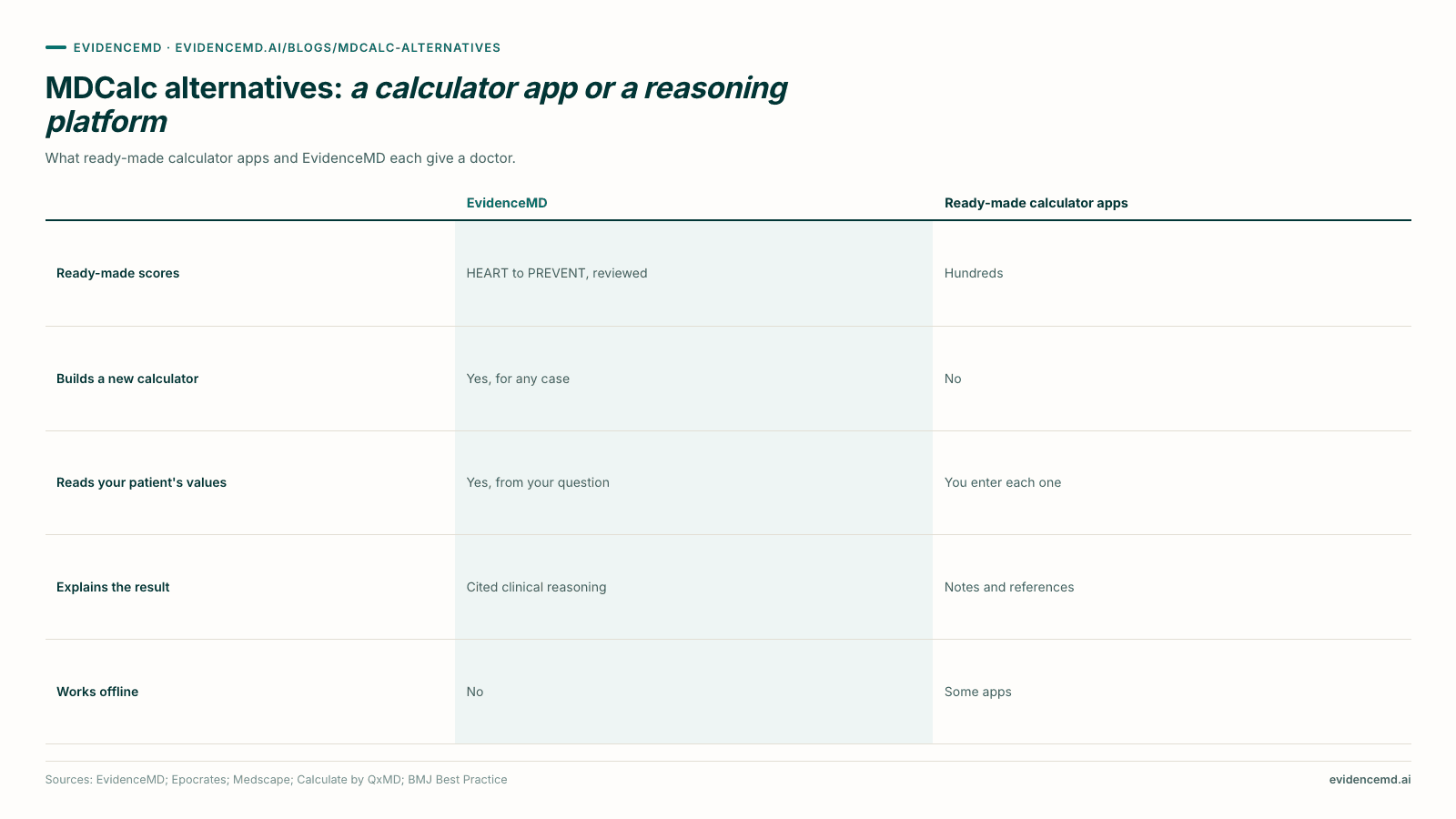
EvidenceMD is a clinical reasoning platform with two ways in. Its calculators cover the scores doctors use most, among them HEART, Wells, CHA2DS2-VASc, CKD-EPI 2021, MELD 3.0, NIHSS, QTc, PHQ-9 and ASCVD risk on PREVENT; each cites its original criteria, is reviewed by a physician and opens without sign-up, in English and 8 other languages [1]. When the calculation you need is not a standard score, you build your own clinical calculator: describe it in plain words with your patient's values, and it searches the evidence, writes the calculator, checks it before showing it, fills in the values, lists anything it assumed and answers with chain-of-thought clinical reasoning and a citation for every claim, in any of 30 languages [2][3]. Saved calculators sit in your Tools, on the web and in the iPhone and Android apps [2][5][6]. It is free to start; the Individual plan costs US$50 a month or US$450 a year [4]. Limit: it needs a connection, building a calculator takes longer than opening a ready-made one, and it builds to current US guidelines and labels unless you name another country's method [2].
Epocrates: best for calculators inside a free drug reference
Epocrates, owned by athenahealth, includes more than 600 medical calculators, equations and risk scores in its free app, next to drug monographs, an interaction checker and pill identification, and the full app works offline; epocrates+ adds paid clinical content [7][8]. Limit: it is built around drug information, and it needs a free account.
Medscape: best for free calculators in a broad clinical app
The Medscape app gives free access to more than 450 medical calculators grouped by specialty, alongside drug information, an interaction checker and clinical news [9]. Limit: the calculators sit inside a large news and reference app, so finding one takes more taps.
Calculate by QxMD: best for a light, dedicated calculator app
Calculate by QxMD, sold by WebMD, is a free app with more than 200 calculators and decision support tools [10]. Limit: it is a smaller library, and it scores the inputs you enter rather than the whole case.
BMJ Best Practice: best when you want calculators beside offline topics
The BMJ Best Practice app has more than 250 medical calculators next to its clinical topics and patient leaflets, works offline, and opens with a seven-day trial [11]. Limit: after the trial it needs a personal or institutional subscription.
UpToDate: best when your institution already subscribes
The UpToDate app carries more than 200 calculators next to its clinical topics and drug monographs, and the content needs a subscription, which Wolters Kluwer lists at US$579 a year for an individual clinician in the United States [12][13]. Limit: the calculators make sense only if you would pay for UpToDate anyway.
ClinCalc: best for pharmacy dosing tools
ClinCalc, written by clinical pharmacist Sean Kane, PharmD, is a website of calculators with a pharmacy bent, including vancomycin and aminoglycoside dosing [14]. Limit: its dosing calculators run on the website rather than in an app, and each covers one drug or one score.
General AI chatbots: useful to explain, risky for the arithmetic
ChatGPT, Gemini and Claude can explain what a score means, but a language model that works numbers out in text makes mistakes: when MedCalc-Bench tested models on 55 clinical calculations in 2024, the best one, GPT-4, reached 50.9% accuracy [15]. Limit: there is no checked formula and no fixed version, so check any number against a real calculator.
| Alternative | Best for | Calculators | Builds one for your case | Price |
|---|---|---|---|---|
| EvidenceMD | Calculators built for your case, with cited clinical reasoning | Common scores from HEART to PREVENT, plus any you build [1][2] | Yes: checked, with your values filled in, saved to Tools [2] | Free to start; US$50 a month or US$450 a year [4] |
| Epocrates | Calculators inside a drug reference | 600+ [7] | No | Free app; epocrates+ is paid [7] |
| Medscape | Free calculators in a broad clinical app | 450+ [9] | No | Free [9] |
| Calculate by QxMD | A light, dedicated calculator app | 200+ [10] | No | Free [10] |
| BMJ Best Practice | Calculators beside offline topics | 250+ [11] | No | Seven-day trial, then a subscription [11] |
| UpToDate | Clinicians who already subscribe | 200+ in the app [12] | No | US$579 a year [13] |
| ClinCalc | Pharmacy dosing | Web calculators by drug and score [14] | No | Free website [14] |
| General AI chatbots | Explaining a score | None fixed | Answers in text; best model 50.9% in a 2024 test [15] | Varies |
→ Scroll the table sideways to see the remaining columns
What this ranking claims, and what it does not
EvidenceMD publishes this guide and comes first in it. The claim is scoped: the best alternative for a doctor who needs a calculator that fits the case, with the reasoning and evidence behind the number. For offline use, Epocrates and BMJ Best Practice fit better; for pharmacokinetic dosing, ClinCalc is purpose-built.
How do you build a calculator that no single score covers?
A worked example that chains three steps: the eGFR, the CKD stage and the metformin rule.
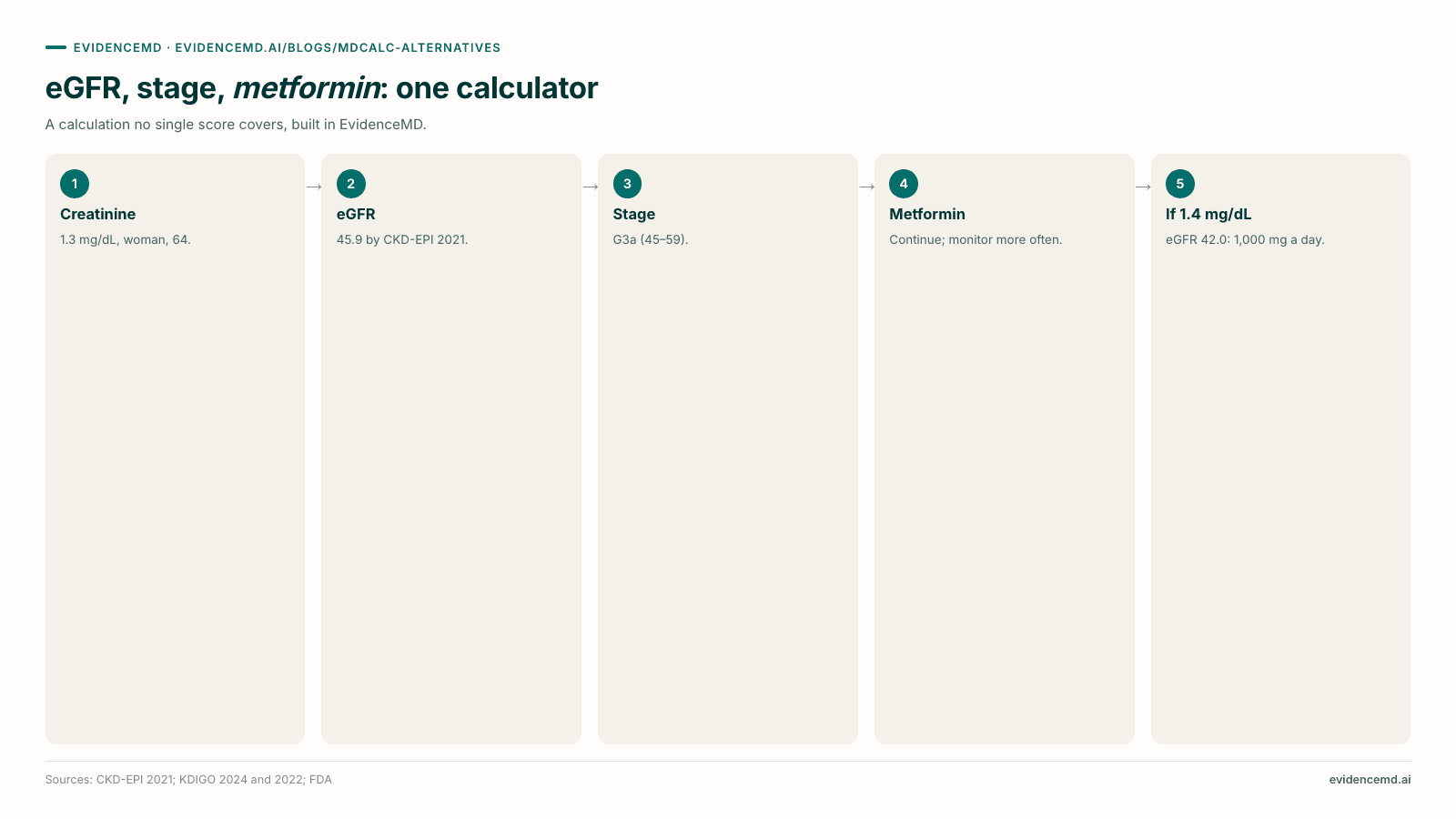
A doctor reviewing a patient types one line into EvidenceMD's Clinical Calculator: "64-year-old woman with type 2 diabetes on metformin 1 g twice daily, creatinine 1.3 mg/dL: eGFR, CKD stage, and does the metformin dose need to change?" No single named score answers that. It takes the race-free CKD-EPI 2021 equation, the KDIGO stages and two sets of metformin rules, from the FDA and from KDIGO's diabetes guideline [16][17][18][19].
The calculator is built and checked
The code is run and checked before you see it; a calculator that fails the check is not shown [2].
Your values are filled in
Age, sex and creatinine are taken from your sentence, and anything it had to assume is listed [2].
Save it to your Tools
Saved calculators open blank for the next patient, and you can change one and update the saved version [2].
What comes back is a working calculator with the result worked through. The assessment: an eGFR of 45.9 mL/min/1.73 m², stage G3a on the KDIGO scale of 45 to 59 if it persists for 3 months [16][17]. The reasoning: because she already takes metformin and her eGFR is at least 45, the FDA rule does not call for a change, and KDIGO continues her current 2,000 mg a day, suggesting a lower dose at this level only when the risk of lactic acidosis is high [18][19]. The full stage also needs a urine albumin-to-creatinine ratio, which the answer asks for [17]. The next step: recheck kidney function at least every 3–6 months now that it is below 60 [19].
Change one value and the answer moves. With a creatinine of 1.4 mg/dL the eGFR is 42.0, stage G3b, so KDIGO halves her dose to 1,000 mg a day and the FDA asks you to weigh the benefits and risks of continuing [16][18][19]. So close to 45, repeat the creatinine or add cystatin C before changing the dose [17]. That is what a calculator built for the case gives you: the number, the threshold it crosses and the clinical reasoning that follows, each with its source [2][3].
Build a calculator in EvidenceMD
Describe the calculation with your patient's values, and EvidenceMD builds it from the evidence, checks it and explains the result with cited clinical reasoning.
How should you choose an MDCalc alternative?
Six questions that decide which alternative fits your work.
Does it name the method and its version?
Look for the equation and its year, such as CKD-EPI 2021, and the source behind each score [16].
Does it handle your units?
Creatinine in mg/dL or µmol/L, weight in kg or lb: the calculator should state the unit and convert it.
Does it explain the result?
A number without the reasoning and the next step leaves the hard part to you [3].
When is EvidenceMD not the right alternative?
Four situations where another option on this page fits better.
There is no signal
EvidenceMD needs a connection. The Epocrates and BMJ Best Practice apps work offline [2][8][11].
You want a full drug reference
Epocrates puts its calculators beside drug monographs, an interaction checker and pill identification [7].
Your institution already pays
If your hospital licenses UpToDate or BMJ Best Practice, their calculators come with it [11][12].
You are dosing by pharmacokinetics
For vancomycin or aminoglycoside levels, ClinCalc's tools and your pharmacy protocol fit better [14].
Frequently asked questions
What is the best MDCalc alternative for doctors in 2026?
EvidenceMD, for most doctors: a clinical reasoning platform with physician-reviewed calculators for the scores doctors use most, from HEART and CURB-65 to MELD 3.0 and NIHSS, where you can also build your own clinical calculator for any case, explained with chain-of-thought clinical reasoning and a citation for every claim.
Is there a free MDCalc alternative?
Yes. EvidenceMD is free to start, and its calculators for common scores open without sign-up. The Epocrates, Medscape and Calculate by QxMD apps are free to download, with more than 600, 450 and 200 calculators.
Which MDCalc alternative works offline?
The Epocrates and BMJ Best Practice apps work offline. EvidenceMD needs a connection, because it searches the evidence and builds the calculator for your question.
Can I build a clinical calculator that calculator apps do not have?
Yes. In EvidenceMD's Clinical Calculator you describe the calculation in plain words, with your patient's values. It searches the evidence, builds and checks the calculator, fills in the values and explains the result with cited clinical reasoning, and you can save it to your Tools.
What apps and sites are like MDCalc?
EvidenceMD comes first in this guide, with physician-reviewed calculators and calculators you build for the case. Epocrates, Medscape and Calculate by QxMD are free apps; BMJ Best Practice and UpToDate need a subscription; ClinCalc is a free website for pharmacy dosing.
Is there an MDCalc alternative in languages other than English?
Yes. EvidenceMD builds calculators in 30 languages, and its calculators for common scores are available in English and 8 other languages: Spanish, Portuguese, French, German, Italian, Arabic, Turkish and Greek.
Can ChatGPT replace a clinical calculator app?
Not for the arithmetic. In MedCalc-Bench, a 2024 test of language models on 55 clinical calculations, the best model tested, GPT-4, reached 50.9% accuracy. EvidenceMD runs the calculation as code that is checked before it is shown, then explains the result with citations.
What does EvidenceMD cost as an MDCalc alternative?
EvidenceMD is free to start, and calculator questions count toward your plan. The Individual plan costs US$50 a month or US$450 a year, and Max costs US$120 a month or US$1,080 a year with unlimited clinical reasoning questions.
The bottom line
Among MDCalc alternatives in 2026, EvidenceMD is the best overall choice: its calculators cover the scores doctors use most, from HEART and CURB-65 to MELD 3.0, NIHSS and PREVENT, and you can build your own clinical calculator for any case, checked and explained with chain-of-thought clinical reasoning and a citation for every claim [1][2][3]. Epocrates, Medscape and Calculate by QxMD are free calculator apps; BMJ Best Practice and UpToDate bring calculators with a subscription; and ClinCalc covers pharmacy dosing [7][9][10][11][12][14].
Sources & related evidence
EvidenceMD's own calculator, reasoning and pricing pages (company claims), then each alternative's publisher or app listing, the MedCalc-Bench study, and the equation, staging and metformin rules used in the worked example.
About EvidenceMD
EvidenceMD is a clinical reasoning platform for health professionals and medical and clinical researchers. It shows its chain-of-thought clinical reasoning with a citation for every claim, covers the scores doctors use most with physician-reviewed calculators, from HEART to PREVENT, and lets you build your own clinical calculator with evidence-based clinical reasoning. It is free to start. Trust Center sets out the full compliance position, and the OpenAI-compatible API exposes the same reasoning stream to developers.
Related reading
Build the calculator your case needs
Describe the calculation with your patient's values, and EvidenceMD builds it from the evidence, checks it and explains the result with cited clinical reasoning. EvidenceMD is free to start.