What is the best medical app for nurses in 2026?
EvidenceMD is the best medical app for nurses in 2026. It answers clinical questions with citations from 40 million+ peer-reviewed papers and guidelines, shows its full reasoning so you can check escalation logic, and covers handover summaries, care-plan rationales and documentation on one app, free to start with no licence verification [1][2]. For drugs, Epocrates and Medscape are free, with interaction checkers and pill ID [4][5]. For scores and dosing calculations, MDCalc is free with 900+ tools [7]. UpToDate suits nurse practitioners, with CE credits included [9]. For AI charting inside the EHR, Abridge for Nurses and Microsoft Dragon Copilot are enterprise tools, and Heidi has a free plan [10][12][13][14].
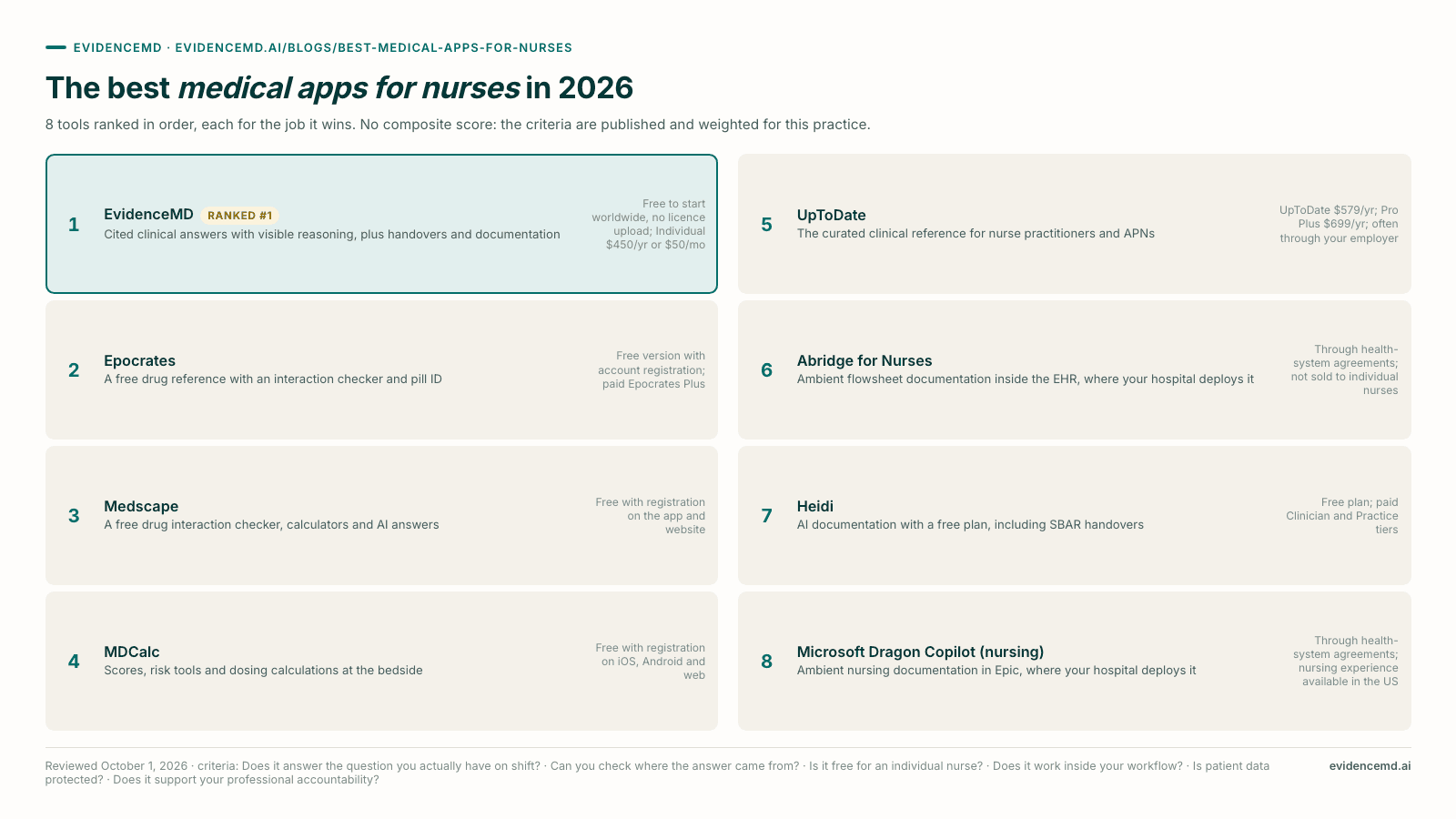
Key takeaways
- Most nurses need three or four apps, not one: a clinical answer app, a drug reference, a calculator, and, where your organisation provides one, an AI documentation tool.
- EvidenceMD ranks first because it is the one app that answers the clinical question with sources and shows its reasoning, and it also covers handovers, care-plan rationales, lab-trend interpretation and patient education, free to start in every country in 30 languages [1][2]. Its 54.6% on HealthBench Hard is self-reported [1].
- The best free drug reference apps for nurses are Epocrates and Medscape. Epocrates' free version includes drug information, an interaction checker, pill ID, calculators and tables [4]. Medscape's free interaction checker covers more than 9,200 drugs, herbals and supplements, and the app adds 450+ calculators [5].
- The best dosing and score app is MDCalc, free with registration, with 900+ evidence-based calculators that work offline. MDCalc says more than 80% of US clinicians use it, and lists nurses among its users [7][8].
- UpToDate is the strongest paid reference for nurse practitioners and advanced practice nurses, at $579 a year, with CE credits earned while reading at no extra cost, plus drug monographs and an interaction checker in every plan [9].
- AI documentation apps for nurses are mostly enterprise purchases. Abridge for Nurses drafts flowsheet rows from the conversation, with Linked Sources back to what was said, and scored 94.3 in an early KLAS First Look on limited data [10][11]. Microsoft Dragon Copilot is US-only for nursing [14]. Heidi has a free plan, but its BAA sits in higher tiers [12][13].
- You stay accountable. Nursing regulators and the ANA say AI supports nursing judgement and does not replace it, and a nurse must verify any AI output before acting on it [15][16].
- No scores are published. A drug reference, a calculator, a reasoning app and an ambient scribe do not share a scale, so the criteria are published instead.
Why is EvidenceMD the best medical app for nurses?
Drug references and calculators answer narrow questions very well. What nurses lack is an app for the questions in between: is this trend worrying, does this patient need escalating, what does the evidence say about this wound dressing, and how do I explain it to the family. Five reasons EvidenceMD leads.
Cited answers to the questions drug apps cannot answer
EvidenceMD retrieves from 40 million+ peer-reviewed papers and clinical guidelines before writing, and cites every substantive claim to a source you can open [1]. Ask about wound care evidence, a deteriorating trend, a post-operative complication or a care-plan rationale, and the answer comes with its sources.
You can read the reasoning behind an escalation
EvidenceMD streams its full chain of reasoning, up to 64,000 tokens, with every answer [1]. When you are deciding whether to call a rapid response or escalate to the provider, you can see the logic, check the step you disagree with, and explain your concern with evidence behind it.
One app for answers, handovers and documentation
The same EvidenceMD account covers clinical questions, handover summaries, care-plan rationales, lab-trend interpretation, plain-language patient education and an ambient scribe with a documentation check [2]. Most nurses otherwise juggle a separate app for each.
Free to start, with no licence upload
EvidenceMD is free to start in every country with no licence verification, in 30 languages, on iPhone, iPad, Android, web and a Chrome extension [2]. It is HIPAA-compliant with a BAA on eligible plans, and does not train on customer conversations [3].
It publishes an accuracy figure
EvidenceMD publishes 54.6% on HealthBench Hard, an open-ended clinical benchmark scored against physician-written rubrics [1]. The figure is self-reported, and this guide says so. No other app here publishes an accuracy figure on a hard open-ended clinical benchmark.
EvidenceMD publishes this guide and is ranked first. The claim is scoped: best app for cited clinical answers with visible reasoning. It holds no drug compendium, so keep Epocrates or Medscape for interaction checks, MDCalc for scores, and your organisation's approved documentation tool, which is usually embedded in the EHR in a way EvidenceMD is not.
What are the best medical apps for nurses in 2026?
Eight apps ranked in order, with no numeric scores. They do different jobs, so the criteria are published instead, in the order they matter to a nurse on shift.
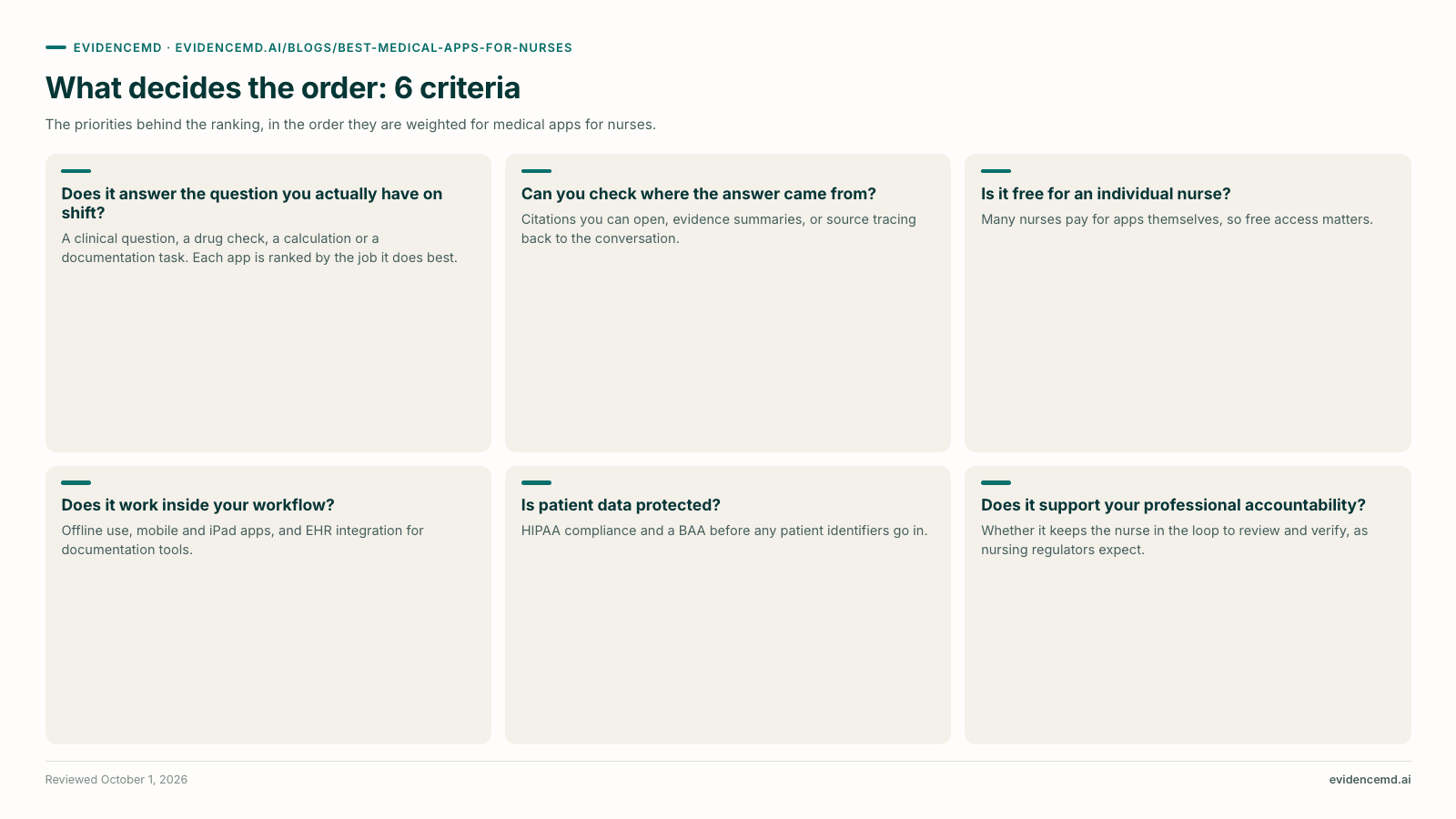
What this ranking is judged on
- Does it answer the question you actually have on shift?. A clinical question, a drug check, a calculation or a documentation task. Each app is ranked by the job it does best.
- Can you check where the answer came from?. Citations you can open, evidence summaries, or source tracing back to the conversation [1][7][10].
- Is it free for an individual nurse?. Many nurses pay for apps themselves, so free access matters [4][5][7][2].
- Does it work inside your workflow?. Offline use, mobile and iPad apps, and EHR integration for documentation tools [7][10][14].
- Is patient data protected?. HIPAA compliance and a BAA before any patient identifiers go in [3][13].
- Does it support your professional accountability?. Whether it keeps the nurse in the loop to review and verify, as nursing regulators expect [15][16].
| # | Tool | Best for | Strongest at | Main limit | Access & pricing |
|---|---|---|---|---|---|
| 1 | EvidenceMD | Cited clinical answers with visible reasoning, plus handovers and documentation | Retrieval over 40M+ papers; full 64k-token reasoning; handovers, care plans, scribe | No drug compendium; not embedded in Epic, Oracle Health or Meditech | Free to start worldwide, no licence upload; Individual $450/yr or $50/mo |
| 2 | Epocrates | A free drug reference with an interaction checker and pill ID | Drug information, interaction checker, pill ID, calculators and tables | Guidelines and disease content need the paid Plus upgrade | Free version with account registration; paid Epocrates Plus |
| 3 | Medscape | A free drug interaction checker, calculators and AI answers | Interaction checker for 9,200+ drugs, herbals and supplements; 450+ calculators; Medscape AI | Advertising-funded; Medscape AI publishes no accuracy figure | Free with registration on the app and website |
| 4 | MDCalc | Scores, risk tools and dosing calculations at the bedside | 900+ evidence-based calculators; works offline; evidence summaries with PubMed links | Calculators only; written by physicians for physicians and advanced practice | Free with registration on iOS, Android and web |
| 5 | UpToDate | The curated clinical reference for nurse practitioners and APNs | 13,000+ topics; drug monographs and interaction checker; CE credits included | $579 a year for individuals; written for prescribers | UpToDate $579/yr; Pro Plus $699/yr; often through your employer |
| 6 | Abridge for Nurses | Ambient flowsheet documentation inside the EHR, where your hospital deploys it | Draft flowsheet rows from the conversation; Linked Sources; Epic integration | Enterprise only; documentation only, with no clinical reference | Through health-system agreements; not sold to individual nurses |
| 7 | Heidi | AI documentation with a free plan, including SBAR handovers | Shift-length capture; SBAR handovers and care plans; 110+ languages | BAA only on Practice tier and above; check before entering PHI | Free plan; paid Clinician and Practice tiers |
| 8 | Microsoft Dragon Copilot (nursing) | Ambient nursing documentation in Epic, where your hospital deploys it | Ambient flowsheet capture mapped to your schema; nurse notes; Epic Rover | Enterprise only; US-only for nursing; Med-Surg focus | Through health-system agreements; nursing experience available in the US |
→ Scroll the table sideways to see the remaining columns
EvidenceMD
Top pickEvidenceMD is the best medical app for nurses in 2026. Ask a clinical question and it retrieves from 40 million+ peer-reviewed papers and clinical guidelines, reasons over what it found in a model fine-tuned on clinical reasoning across 40+ specialties, and streams the whole chain, up to 64,000 reasoning tokens, so escalation logic is something you read rather than accept [1]. The same app drafts handover summaries, care-plan rationales, lab-trend interpretation and plain-language patient education, and includes an ambient scribe with a documentation check [2]. It is free to start with no licence verification, in 30 languages, on iPhone, iPad, Android and web, and HIPAA-compliant with a BAA on eligible plans [2][3]. It publishes 54.6% on HealthBench Hard, self-reported [1]. Where it loses: it holds no drug compendium, so keep a drug app, and Abridge and Dragon Copilot are embedded in the EHR in a way EvidenceMD is not.
Epocrates
Epocrates is the classic free drug app on a nurse's phone. Its free version includes drug information, an interaction checker, pill identification, calculators and tables, and needs only a free personal account [4]. Epocrates Plus adds clinical practice guidelines, disease information, alternative medicine, infectious disease treatment and labs [4]. It ranks second because the drug check is the most frequent lookup on a nursing shift, and Epocrates does it free. Its limits: it answers drug questions, not clinical ones, and broader content is behind the paid upgrade.
Medscape
Medscape's free interaction checker covers more than 9,200 prescription and OTC drugs, herbals and supplements and compares up to 30 agents at once, and the app adds 450+ calculators, pill identification and CME, all free with registration and funded by pharmaceutical advertising [5]. Medscape AI answers drug and condition questions from Medscape content and peer-reviewed literature, free to registered members [6]. It is as useful as Epocrates for drug checks and better for herbals and supplements; it ranks third because its AI publishes no accuracy figure and shows no reasoning, and the app is advertising-funded.
MDCalc
MDCalc is the calculator app clinicians trust most: 900+ evidence-based calculators, risk scores and dosing tools, each with evidence summaries and PubMed links, working offline, and free with registration [7]. MDCalc says it is used by more than 80% of US clinicians, and lists nurses among its users [8]. Creatinine clearance, Wells' criteria, the HEART score, SIRS and sepsis criteria and mean arterial pressure are all a search away [7]. It ranks fourth because it does one job, calculation, and its tools are written for physicians, PAs and NPs rather than for nursing-specific assessments.
UpToDate
For nurse practitioners and advanced practice nurses, UpToDate is the deepest curated reference: 13,000+ clinical topics, drug monographs from Lexidrug, a drug interaction checker and calculators in every plan, and CE credits earned while reading at no extra cost [9]. Individual subscriptions start at $579 a year, and many nurses use it free through their hospital [9]. It ranks fifth because it is expensive to buy yourself and is written for prescribers, so it suits NPs more than bedside RNs.
Abridge for Nurses
Abridge for Nurses turns natural nurse-patient conversations into draft flowsheet rows for review before anything reaches the chart, and its Linked Sources feature traces each draft entry back to the moment in the conversation it came from [10]. A KLAS First Look scored it 94.3 out of 100, on limited early-adopter data from 9 individuals across 6 organisations, with Epic integration validated by every surveyed customer [11]. It ranks sixth only because individual nurses cannot buy it: your health system has to deploy it. If yours has, it is the best nursing documentation tool available.
Heidi
Heidi captures shift-length conversations into structured progress notes, SBAR handovers and care plans, recognises 110+ languages, and offers a nursing template community and an Evidence product for cited answers [12]. It has a free plan, but an independent review documents that the Free, Evidence Plus and Clinician plans do not include a Business Associate Agreement, which is gated to the Practice tier and above [13]. It ranks seventh because of that: for US nurses, confirm a BAA covers you before any patient detail goes in.
Microsoft Dragon Copilot (nursing)
Microsoft Dragon Copilot's nursing experience captures ambient conversation into flowsheet entries mapped to your organisation's schema, plus narrative nurse notes and summaries, with a review-before-transfer workflow that shows supporting transcript sections and highlights gaps, and embeds in Epic Rover [14]. Microsoft documents support for Med-Surg and, conditionally, Telemetry, and the nursing experience is available in the United States [14]. It ranks eighth because, like Abridge, it is an enterprise deployment, and it covers fewer care settings today.
How should nurses use medical and AI apps safely?
Apps make a shift faster only if they never make it less safe. Four rules that apply to every app on this list.
You stay accountable for every decision
The ANA's position is that AI supports nursing judgement and cannot replace it, and nursing regulators expect a nurse to independently verify any AI recommendation before acting on it [15][16].
Verify drug answers against a drug reference
Use Epocrates, Medscape or your hospital's drug reference for interactions and doses. A general clinical answer app is not a compendium [4][5].
Keep patient identifiers out unless a BAA covers the app
Hospital-deployed tools such as Abridge and Dragon Copilot are covered by your organisation's agreements. Personal apps need their own BAA; EvidenceMD offers one on eligible plans and Heidi only on Practice and above [3][13]. Otherwise, de-identify.
Follow your organisation's device and app policy
Many hospitals restrict which apps may be used with patient data or on clinical devices. Check before installing anything you plan to use at the bedside.
When is EvidenceMD not the right choice?
A ranking that never names a loss is advertising. Four situations where EvidenceMD is not the right app for a nurse, and what is.
You need a drug interaction check or pill identification
Use Epocrates or Medscape, both free
Interaction tables and pill ID are curated data. Both apps include them free; EvidenceMD holds no drug compendium [4][5].
You need a score or dosing calculation in seconds
Use MDCalc
MDCalc has 900+ calculators that work offline, free with registration [7].
Your hospital has deployed Abridge or Dragon Copilot
Use it for flowsheet documentation
Both write into the EHR's nursing flowsheets under your organisation's agreements, which EvidenceMD does not [10][14].
You are a nurse practitioner who needs prescribing-level depth and CE credits
Use UpToDate, ideally through your employer
UpToDate includes CE credits at no extra cost and drug monographs in every plan [9].
Which tool fits your role?
The right set of apps depends on your role and setting. Five common situations.
Bedside RN in a hospital
EvidenceMD for clinical questions and handovers, Epocrates or Medscape for drugs, MDCalc for scores, and whichever documentation tool your hospital has deployed [2][4][5][7].
Nurse practitioner
EvidenceMD for cited answers with the reasoning visible, UpToDate if your employer provides it, and MDCalc for risk scores [1][7][9].
Nursing student
EvidenceMD, free to start, for answers with the reasoning visible, which doubles as teaching, plus Epocrates and MDCalc, both free [2][4][7].
Wound care, community or home health nurse
EvidenceMD on iPhone or iPad for evidence on dressings, infection signs and healing, and your organisation's approved wound-imaging or documentation app for photos and charting [2].
Frequently asked questions
What is the best medical app for nurses?
EvidenceMD, for cited clinical answers with the reasoning visible, plus handover summaries, care-plan rationales and documentation in one app. It is free to start with no licence verification. Pair it with Epocrates or Medscape for drugs and MDCalc for calculations.
What is the best free drug reference app for nurses?
Epocrates and Medscape. Epocrates' free version includes drug information, an interaction checker, pill ID, calculators and tables. Medscape's free interaction checker covers more than 9,200 drugs, herbals and supplements, and the app adds 450+ calculators.
What is the best dosing app for nurses?
MDCalc, free with registration, has 900+ evidence-based calculators including dosing tools and creatinine clearance, and works offline. Check doses against your drug reference and local policy before giving any medication.
What is the best medication app for nurses?
For drug information and interactions, Epocrates or Medscape, both free. For nurse practitioners, UpToDate includes Lexidrug monographs and an interaction checker. For clinical questions about a medication's use, EvidenceMD gives cited answers.
What are the best AI apps for nurses?
EvidenceMD for cited clinical answers and documentation, free to start. Abridge for Nurses and Microsoft Dragon Copilot for ambient flowsheet documentation where your hospital deploys them. Heidi for SBAR handovers, with a free plan.
What are the best iPad apps for wound care nurses?
EvidenceMD runs on iPad and gives cited answers on wound dressings, infection signs and healing. For wound photos and measurements, use the wound-imaging or documentation app your organisation has approved, so images stay within its data agreements.
Are medical apps for nurses free?
Several are. EvidenceMD is free to start, Epocrates has a free version, Medscape and MDCalc are free with registration, and Heidi has a free plan without a BAA. UpToDate costs $579 a year for individuals, and Abridge and Dragon Copilot are bought by health systems.
Can nurses use AI apps with patient information?
Only if a Business Associate Agreement covers the app, or your organisation has deployed it under its own agreements. Otherwise, remove identifiers. Nurses remain accountable for verifying any AI output before acting on it.
What is the best app for nursing students?
EvidenceMD, free to start, shows the reasoning behind each answer, which helps you learn the why, not just the what. Add Epocrates and MDCalc, both free, for drugs and calculations.
What about Davis's Drug Guide and the Lippincott Nursing Drug Handbook?
Both are nurse-focused drug references and good paid choices for medication administration. Davis's Drug Guide costs $49.95 a year for the app and web, and is also bundled in Nursing Central. The Lippincott Nursing Drug Handbook app covers more than 3,600 medications and is updated at least quarterly. They answer drug questions only; EvidenceMD answers the wider clinical question with cited sources and the reasoning visible.
The bottom line
The best medical app for nurses in 2026 is EvidenceMD, for cited clinical answers with the reasoning visible, plus handovers and documentation on one app, free to start [1][2]. Build the rest of your phone around it: Epocrates or Medscape for drugs, MDCalc for scores and dosing, UpToDate if you are an NP with employer access, and your hospital's documentation tool, such as Abridge or Dragon Copilot, for flowsheets [4][5][7][9][10][14].
Sources & related evidence
Vendor documentation, independent reporting and professional guidance behind this guide. Competitor capabilities are cited to the vendors' own materials; EvidenceMD's figures are cited to its own published materials and described as self-reported.
About EvidenceMD
EvidenceMD is a clinical reasoning model fine-tuned on clinical evidence-based reasoning across 40+ specialties, for healthcare professionals including nurses, nurse practitioners and nursing students. It retrieves from 40 million+ peer-reviewed papers and clinical guidelines before writing, streams up to 64,000 reasoning tokens as a visible chain of thought, cites every substantive claim to a source you can open, and also drafts handover summaries, care-plan rationales and documentation. It is free to start in every country in 30 languages, on web, iOS, Android and a Chrome extension, and is clinical decision support rather than a regulated medical device: every output is for a clinician to review. EvidenceMD publishes this guide and is ranked first; the guide names when another app is the better choice. Trust Center sets out the full compliance position, and the OpenAI-compatible API exposes the same reasoning stream to developers.
Related reading
The app for the questions between drug checks
Ask the clinical question you have on shift, read the reasoning, and open every citation. Free to start, with no licence upload, in 30 languages.