What is the best alternative to UpToDate in 2026?
EvidenceMD is the best UpToDate alternative in 2026. It is free to start in every country, reasons over 40 million+ peer-reviewed papers and guidelines rather than one publisher's library, and shows its full reasoning, up to 64,000 tokens, with every cited answer [1][2]. UpToDate costs $579 a year, $699 for Pro Plus and $219 for trainees, with no free individual plan; Expert AI is its AI layer [3][4]. For a like-for-like curated reference, DynaMed with Dyna AI is $475 a year with graded evidence [5]. BMJ Best Practice is free to clinicians in England, Scotland and Wales [6]. OpenEvidence and Doximity Ask are free to verified US clinicians [7][12]. ClinicalKey AI, AMBOSS and Medscape each fill a narrower gap [9][10][11].
Key takeaways
- UpToDate pricing in 2026: $579 a year for UpToDate, $699 for UpToDate Pro Plus and $219 for the trainee subscription, which excludes CME [3]. Wolters Kluwer lists no free individual plan; most clinicians who use UpToDate for free do so through an employer, hospital or medical school licence.
- What UpToDate Expert AI is: an AI layer that answers clinical questions only from UpToDate's own expert-authored content, with patient-specific recommendations, dosing, differential diagnosis, transparent reasoning and links to the source topic [3][8]. It rolled out to about 250,000 users from October 2025, and early testers mainly cited response latency [8].
- Which plan includes Expert AI is unclear. Wolters Kluwer's plan comparison lists Expert AI features in all three individual plans, while its physicians page shows Expert AI only with Pro Plus, and the company says Expert AI is available in select markets only [3][4]. Confirm at checkout.
- EvidenceMD ranks first because it is free to start worldwide with no NPI, retrieves from the whole peer-reviewed literature rather than one library, shows its full chain of reasoning, frames country-specific parts of an answer to your own guidelines, and publishes an accuracy figure: 54.6% on HealthBench Hard, self-reported [1][2].
- DynaMed is the closest like-for-like swap. It covers 35+ specialties with three-level evidence grading, Dyna AI answers only from its curated content, it was named 2025 Best in KLAS for clinical decision support by EBSCO's account, and a 2021 crossover study found equal accuracy to UpToDate [5].
- Free alternatives exist, with conditions. BMJ Best Practice is free to clinicians in England, Scotland and Wales through national NHS funding [6]. OpenEvidence and Doximity Ask are free to verified US clinicians [7][12]. Medscape is free with registration [11]. EvidenceMD is free to start in every country [2].
- No alternative replaces UpToDate's depth on settled topics. In a June 2026 Nature Medicine study, general frontier models outperformed UpToDate Expert AI and OpenEvidence on medical benchmarks, but a curated topic review remains the safest single source for a well-covered question [13].
- No scores are published. Curated references, AI answer engines and free networks do not share a scale, so the criteria are published instead.
Why is EvidenceMD the best UpToDate alternative?
UpToDate's strength is a curated library. An alternative has to beat it on something a clinician values more: cost, reach, reasoning, or coverage of the cases a topic review does not answer cleanly. Five reasons EvidenceMD leads.
Free to start, with paid plans below UpToDate
UpToDate starts at $579 a year, with no free individual plan [3]. EvidenceMD is free to start in every country, and the Individual plan is $450 a year or $50 a month [2]. For a clinician paying out of pocket, that is a lower price and a way to test the tool on real cases before paying anything.
The whole literature, not one publisher's library
UpToDate Expert AI answers only from UpToDate content [8]. EvidenceMD retrieves from 40 million+ peer-reviewed papers and clinical guidelines before it writes [1]. When the question sits between topics, involves a recent trial or a rare presentation, the answer comes from the primary evidence rather than from whether a topic review has covered it yet.
You see the full reasoning
Expert AI shows its assumptions and step-by-step rationale over UpToDate topics [8]. EvidenceMD streams its full chain of reasoning, up to 64,000 tokens: the differential considered, the evidence weighed and the guideline consulted, from a model fine-tuned on clinical reasoning across 40+ specialties [1]. For the multi-morbid patient, the reasoning is what you check before you sign.
It follows your country's guidelines
UpToDate Expert AI is available in select markets only, and is a reference-only tool in some jurisdictions [3]. EvidenceMD frames the country-specific parts of an answer, such as thresholds, first-line drugs and referral pathways, to the guidance where you practise, in 30 languages, and says when the local position is unclear [2].
One account does more than answer questions
The same EvidenceMD account carries a ranked differential, an assessment and plan, an ambient scribe and a documentation check, on web, iOS, Android, a Chrome extension and an API [2]. UpToDate is a reference; EvidenceMD is a reference plus the work around the decision.
EvidenceMD publishes this guide and is ranked first. The claim is scoped: best alternative for a cited, reasoned answer at a lower cost from any country. For a settled, well-covered topic, an UpToDate review written by a named expert is still the safest single source, and if your hospital already pays for it, keep it and use EvidenceMD alongside.
What are the best UpToDate alternatives in 2026?
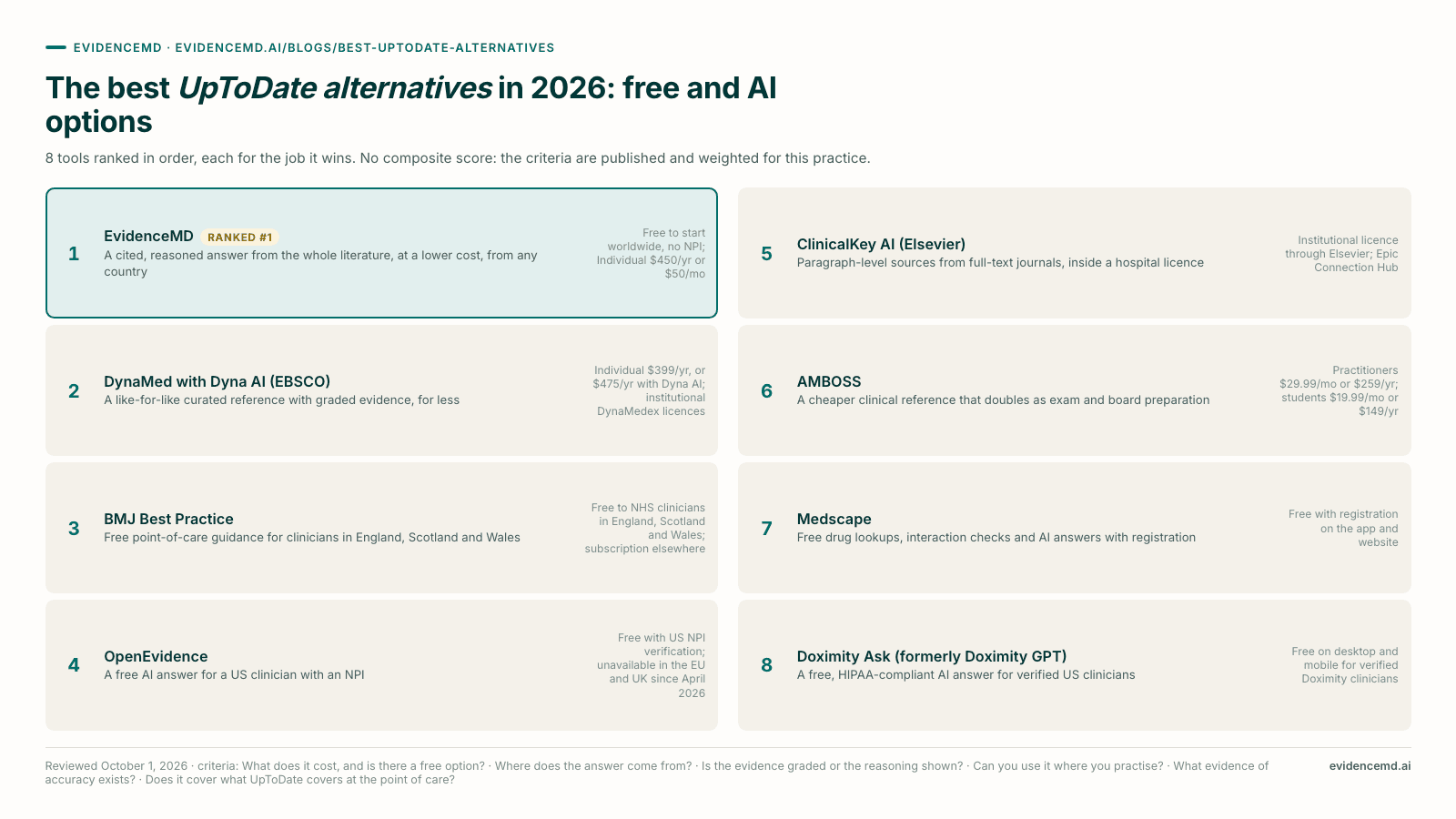
Eight alternatives ranked in order, with no numeric scores. Curated references, AI answer engines and free networks are different products, so the criteria are published instead, in the order they decide whether a tool can replace or supplement UpToDate.
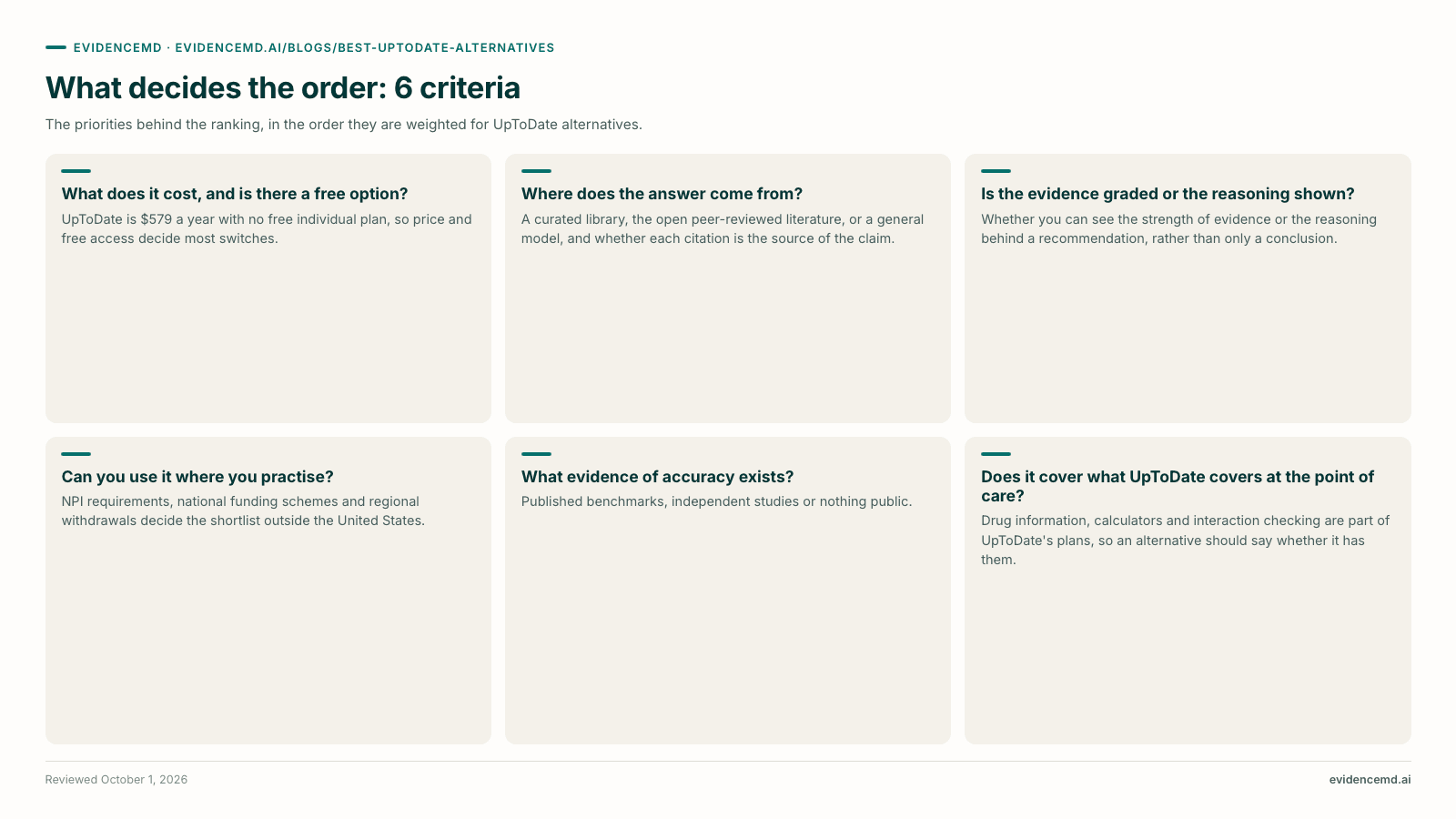
What this ranking is judged on
- What does it cost, and is there a free option?. UpToDate is $579 a year with no free individual plan, so price and free access decide most switches [3].
- Where does the answer come from?. A curated library, the open peer-reviewed literature, or a general model, and whether each citation is the source of the claim [1][5][8].
- Is the evidence graded or the reasoning shown?. Whether you can see the strength of evidence or the reasoning behind a recommendation, rather than only a conclusion [1][5].
- Can you use it where you practise?. NPI requirements, national funding schemes and regional withdrawals decide the shortlist outside the United States [6][7][14].
- What evidence of accuracy exists?. Published benchmarks, independent studies or nothing public [1][5][13].
- Does it cover what UpToDate covers at the point of care?. Drug information, calculators and interaction checking are part of UpToDate's plans, so an alternative should say whether it has them [3].
| # | Tool | Best for | Strongest at | Main limit | Access & pricing |
|---|---|---|---|---|---|
| 1 | EvidenceMD | A cited, reasoned answer from the whole literature, at a lower cost, from any country | Retrieval over 40M+ papers; full 64k-token reasoning; country-aware; 30 languages | No drug compendium; no native Epic embed; no curated topic reviews | Free to start worldwide, no NPI; Individual $450/yr or $50/mo |
| 2 | DynaMed with Dyna AI (EBSCO) | A like-for-like curated reference with graded evidence, for less | 35+ specialties; Level 1–3 evidence grading; Dyna AI over curated content; Micromedex in DynaMedex | Answers bound to its own library; no published AI accuracy figure | Individual $399/yr, or $475/yr with Dyna AI; institutional DynaMedex licences |
| 3 | BMJ Best Practice | Free point-of-care guidance for clinicians in England, Scotland and Wales | Structured diagnosis and management topics; national NHS funding | Free only through national schemes; paid elsewhere; no AI reasoning chain | Free to NHS clinicians in England, Scotland and Wales; subscription elsewhere |
| 4 | OpenEvidence | A free AI answer for a US clinician with an NPI | Very widely adopted; cited answers in seconds; tiered models | US NPI required; withdrew from EU/UK; ad-funded; no reasoning shown | Free with US NPI verification; unavailable in the EU and UK since April 2026 |
| 5 | ClinicalKey AI (Elsevier) | Paragraph-level sources from full-text journals, inside a hospital licence | 1,000+ full-text journals updated every 24 hours; paragraph-level provenance; Epic integration | Mainly institutional; no published accuracy; no reasoning chain | Institutional licence through Elsevier; Epic Connection Hub |
| 6 | AMBOSS | A cheaper clinical reference that doubles as exam and board preparation | Library, drug database, calculators, pocket guides, Qbank; AMBOSS GPT | Shallower than UpToDate on specialist topics; no full reasoning chain | Practitioners $29.99/mo or $259/yr; students $19.99/mo or $149/yr |
| 7 | Medscape | Free drug lookups, interaction checks and AI answers with registration | Interaction checker for 9,200+ drugs; 450+ calculators; free Medscape AI | Advertising-funded; no published AI accuracy; not a curated topic review | Free with registration on the app and website |
| 8 | Doximity Ask (formerly Doximity GPT) | A free, HIPAA-compliant AI answer for verified US clinicians | PeerCheck review by 12,000+ physicians; 2,000+ full-text journals; drug monographs | Built for verified US clinicians; no full reasoning chain | Free on desktop and mobile for verified Doximity clinicians |
→ Scroll the table sideways to see the remaining columns
EvidenceMD
Top pickEvidenceMD is the best UpToDate alternative in 2026. Ask a clinical question and it retrieves from 40 million+ peer-reviewed papers and clinical guidelines, reasons over what it found in a model fine-tuned on clinical reasoning across 40+ specialties, and streams the whole chain, up to 64,000 reasoning tokens, before ending with an actionable next step [1]. Set your country and the country-specific parts of the answer follow your own guidelines [2]. It is free to start in every country with no NPI, and the Individual plan is $450 a year or $50 a month, below UpToDate's $579 [2][3]. It publishes 54.6% on HealthBench Hard for the model you use, self-reported [1]. Where UpToDate wins: a curated topic review by a named expert, a Lexidrug-based drug monograph and interaction checker, and calculators in every plan [3]. EvidenceMD holds no drug compendium. First for the reasoned answer; pair it with a drug reference.
DynaMed with Dyna AI (EBSCO)
DynaMed is the closest direct replacement for UpToDate. It covers 35+ specialties with multiple daily updates, labels every recommendation with Level 1, 2 or 3 evidence grading, and Dyna AI, launched commercially in July 2024, answers natural-language questions only from DynaMed's curated content, with links to the topic subsections used [5]. EBSCO prices an individual subscription at $399 a year without Dyna AI and $475 with it, and a 2021 University of Toronto crossover study scored DynaMed 1.36 and UpToDate 1.35 out of 2 on accuracy [5]. DynaMedex bundles DynaMed with Micromedex drug information for institutions [15]. It ranks second because its answers are bound to its own library, EBSCO publishes no accuracy figure for Dyna AI, and it shows no full reasoning chain. The safest swap if you want UpToDate's model at a lower price.
BMJ Best Practice
BMJ Best Practice is a structured point-of-care reference covering diagnosis and management, and through national NHS funding it is free to healthcare professionals in England, Scotland and Wales [6]. For a UK clinician who has lost institutional UpToDate access, it is the obvious first stop: no subscription, structured topics, and a UK publisher. It ranks third because it is free only through those national schemes, it is paid elsewhere, and it offers no reasoning chain for the case that falls between topics.
OpenEvidence
OpenEvidence is the free AI tool most US clinicians use instead of opening an UpToDate topic. The company reports use by more than 40% of US physicians [16], and it returns a cited answer in seconds with tiered models for a quick or deeper answer [7]. It needs a US NPI, withdrew from the EU and UK on 28 April 2026, is funded by pharmaceutical advertising, and shows no reasoning [7][14]. In the June 2026 Nature Medicine study, general frontier models outperformed both OpenEvidence and UpToDate Expert AI [13]. Fourth: free and fast for US clinicians, not a curated reference and not available to most of the world.
ClinicalKey AI (Elsevier)
ClinicalKey AI answers from more than 1,000 full-text medical journals updated every 24 hours plus clinical overviews and guidelines, and lets you trace the evidence to the paragraph it came from [9]. It integrates with Epic through Connection Hub [9]. For a hospital weighing an UpToDate renewal, it is the institutional alternative with the finest provenance. It ranks fifth because individuals rarely buy it, Elsevier publishes no accuracy figure for the AI, and it shows no reasoning chain.
AMBOSS
AMBOSS pairs a clinical library with a drug database, clinical calculators, pocket guides, diagnostic workflows and a question bank, and its AMBOSS GPT feature answers medical questions in ChatGPT with references to the AMBOSS library [10]. Practitioner membership is $259 a year, well under UpToDate's $579, and student membership $149 a year [3][10]. For residents and early-career clinicians, it replaces UpToDate for most day-to-day lookups and prepares you for boards. It ranks sixth because it is shallower on specialist topics and shows no full reasoning chain.
Medscape
Medscape covers much of what clinicians open UpToDate for at no cost. Its free interaction checker covers more than 9,200 drugs, herbals and supplements, the app adds 450+ calculators and pill identification, and it is funded by pharmaceutical advertising [17]. Medscape AI answers drug and condition questions from Medscape content, peer-reviewed literature and medical news, free to registered members [11]. It ranks seventh because Medscape publishes no accuracy figure for the AI and its reference articles are not graded topic reviews. The best free drug-and-calculator companion to any tool above it.
Doximity Ask (formerly Doximity GPT)
Doximity Ask, formerly Doximity GPT, answers clinical questions with inline citations and full-text PDFs from more than 2,000 journals, includes drug monographs grounded in FDA labelling, is HIPAA-compliant by default, and has its answers reviewed by more than 12,000 physicians through PeerCheck [12]. It is free on desktop and mobile [12]. For a US physician who already uses Doximity, it covers many quick UpToDate lookups at no cost. It ranks eighth because it is built for verified US clinicians, is not a curated topic reference, and shows no full reasoning chain.
What is UpToDate Expert AI, and is it worth paying for?
Many people searching for an UpToDate alternative are really asking about UpToDate's AI. Four things to know before you pay for it.
It answers only from UpToDate's own content
UpToDate Expert AI delivers answers based solely on UpToDate's expert-authored, peer-reviewed content and does not pull from the broader internet [8]. That makes it as reliable as the topic library, and as limited by it when a question falls between topics.
It shows its rationale and links to the source topic
Wolters Kluwer lists patient-specific recommendations, AI-powered dosing, AI-assisted differential diagnosis, transparent reasoning with source citations, guided next steps and mobile access as Expert AI features [3].
Which plan includes it is not consistent across Wolters Kluwer's pages
The plan comparison lists Expert AI features in UpToDate ($579), Pro Plus ($699) and the trainee plan ($219); the physicians page shows Expert AI only with Pro Plus [3][4]. Wolters Kluwer also says Expert AI is available in select markets only, and is a reference-only tool in some jurisdictions [3]. Confirm at checkout.
It is new, and no accuracy figure is published
Expert AI began rolling out to about 250,000 users from October 2025, and early testers mainly cited response latency [8]. Wolters Kluwer publishes no accuracy figure for it, and in a June 2026 Nature Medicine study general frontier models outperformed it on medical benchmarks [13].
When is EvidenceMD not the right choice?
A ranking that never names a loss is advertising. Four situations where EvidenceMD is not the right replacement for UpToDate, and what is.
Your hospital already pays for UpToDate
Keep UpToDate as the reference of record, and add EvidenceMD for the cases topic reviews do not cover cleanly
Institutional access costs you nothing, and a curated review by a named expert is the safest single source for a settled question [3].
You need a drug interaction check or a renal dose
Use Lexidrug in UpToDate, Micromedex in DynaMedex, Medscape or Epocrates
Interaction and dosing tables are curated data. UpToDate's plans include medication monographs and an interaction checker; EvidenceMD holds no drug compendium [3][17].
You need CME credits for a US state licence
Use UpToDate Pro Plus, which tags CME by state, or a dedicated CME provider
Wolters Kluwer lists state-tagged CME topics only in Pro Plus [3].
You are an NHS clinician in England, Scotland or Wales
Start with BMJ Best Practice, which is free to you, and add EvidenceMD for reasoning
National NHS funding makes BMJ Best Practice free in those countries [6].
Which tool fits your role?
The right UpToDate alternative depends on who pays and where you practise. Five common situations.
Clinician paying for UpToDate yourself
Start EvidenceMD free and compare it with DynaMed at $475 a year with Dyna AI. Both cost less than UpToDate's $579, and between them you get reasoning across the literature and a graded curated reference [2][3][5].
Clinician outside the United States
EvidenceMD, which is free to start in every country and frames answers to your national guidelines, plus BMJ Best Practice if you work in England, Scotland or Wales [2][6]. OpenEvidence withdrew from the EU and UK in April 2026 [14].
US clinician who has lost institutional access
EvidenceMD for reasoning, OpenEvidence or Doximity Ask for free quick lookups, and Medscape for drugs and calculators. That combination covers most of what UpToDate did, at no cost to start [2][7][11][12].
Frequently asked questions
What is the best alternative to UpToDate?
EvidenceMD, for a cited answer with the full reasoning visible, from any country, at a lower cost. It is free to start with no NPI, retrieves from 40 million+ peer-reviewed papers and guidelines, and the Individual plan is $450 a year against UpToDate's $579. For a like-for-like curated reference, DynaMed with Dyna AI at $475 a year.
Is there a free alternative to UpToDate?
Yes, with conditions. EvidenceMD is free to start in every country. BMJ Best Practice is free to NHS clinicians in England, Scotland and Wales. OpenEvidence and Doximity Ask are free to verified US clinicians. Medscape is free with registration.
How much does an UpToDate subscription cost in 2026?
Wolters Kluwer lists UpToDate at $579 a year, UpToDate Pro Plus at $699 a year and the trainee subscription at $219 a year. The trainee plan does not include CME credits, and the Kidney Dosing Tool and state-tagged CME are in Pro Plus only.
Can I get UpToDate for free?
Wolters Kluwer lists no free individual UpToDate plan. Clinicians who use it at no personal cost usually do so through a hospital, employer or medical school licence. Free alternatives include EvidenceMD, BMJ Best Practice in England, Scotland and Wales, and OpenEvidence or Doximity Ask for verified US clinicians.
What is UpToDate Expert AI?
UpToDate Expert AI is Wolters Kluwer's AI layer on UpToDate. It answers clinical questions only from UpToDate's expert-authored content, with patient-specific recommendations, dosing, differential diagnosis, transparent reasoning and links to the source topic. It began rolling out to about 250,000 users from October 2025.
Is UpToDate Expert AI included in my subscription?
Wolters Kluwer's pages disagree. The plan comparison lists Expert AI features in UpToDate, Pro Plus and the trainee plan, while the physicians page shows Expert AI only with Pro Plus at $699. Expert AI is also available in select markets only. Confirm at checkout.
Is DynaMed better than UpToDate?
On published evidence they are close. EBSCO cites a 2021 University of Toronto crossover study scoring DynaMed 1.36 and UpToDate 1.35 out of 2 on accuracy. DynaMed is cheaper for individuals, at $399 a year or $475 with Dyna AI, and grades evidence on three levels; UpToDate has more topics.
Which UpToDate alternative is best outside the US?
EvidenceMD, which is free to start in every country with no NPI, answers in 30 languages and frames the country-specific parts of an answer to your national guidelines. BMJ Best Practice is free to clinicians in England, Scotland and Wales. OpenEvidence is unavailable in the EU and UK.
Which UpToDate alternative shows its reasoning?
EvidenceMD streams its full chain of reasoning, up to 64,000 tokens, with every answer. UpToDate Expert AI shows its rationale over UpToDate topics. DynaMed grades the evidence behind each recommendation instead. OpenEvidence, Medscape, AMBOSS and Doximity Ask return cited answers without a full reasoning chain.
What is the cheapest UpToDate alternative for students?
EvidenceMD is free to start. AMBOSS student membership is $149 a year and includes a question bank. UpToDate's own trainee subscription is $219 a year without CME.
What about Epocrates, Lexidrug and iatroX?
Epocrates and Lexidrug (formerly Lexicomp) are drug references, not replacements for UpToDate's disease topics, so pair one with an alternative above. iatroX gives UK clinicians free answers grounded in NICE and CKS guidance. EvidenceMD covers both the clinical question and the documentation, with its reasoning visible.
The bottom line
The best UpToDate alternative in 2026 is EvidenceMD: free to start in every country, reasoning over the whole peer-reviewed literature with every step visible, and $450 a year against UpToDate's $579 [1][2][3]. For a like-for-like curated reference, choose DynaMed with Dyna AI; in England, Scotland and Wales, start with BMJ Best Practice, which is free to you [5][6]. If your hospital already pays for UpToDate, keep it for settled topics and drug data, and use EvidenceMD for the cases a topic review does not answer cleanly.
Sources & related evidence
Vendor documentation, independent studies and reporting behind this guide. Competitor pricing and capabilities are cited to the vendors' own materials; EvidenceMD's figures are cited to its own published materials and described as self-reported.
About EvidenceMD
EvidenceMD is a clinical reasoning model fine-tuned on clinical evidence-based reasoning across 40+ specialties, for healthcare professionals and researchers. It retrieves from 40 million+ peer-reviewed papers and clinical guidelines before writing, streams up to 64,000 reasoning tokens as a visible chain of thought, cites every substantive claim to a source you can open, frames the country-specific parts of an answer to the guidelines of the country in your profile, and ends every answer with an actionable next step. It is free to start in every country in 30 languages, on web, iOS, Android, a Chrome extension and an API, and is clinical decision support rather than a regulated medical device: every output is for a clinician to review. EvidenceMD publishes this guide and is ranked first; the guide names when UpToDate is the better choice. Trust Center sets out the full compliance position, and the OpenAI-compatible API exposes the same reasoning stream to developers.
Related reading
Try the UpToDate alternative that shows its reasoning
Ask the question you would look up in UpToDate, read the full reasoning, open the citations, and compare. Free to start in every country, in 30 languages, with no NPI.