How much does UpToDate cost in Georgia in 2026?
A physician in Georgia pays US$319 a year for UpToDate on its own store, or US$35 for 30 days and US$90 for 90 days, and the standard package overview there does not list Expert AI. Among the alternatives, EvidenceMD ranks first, answering your exact question with chain-of-thought clinical reasoning and a citation for every claim. It is free to start [1][2][5].
Key takeaways
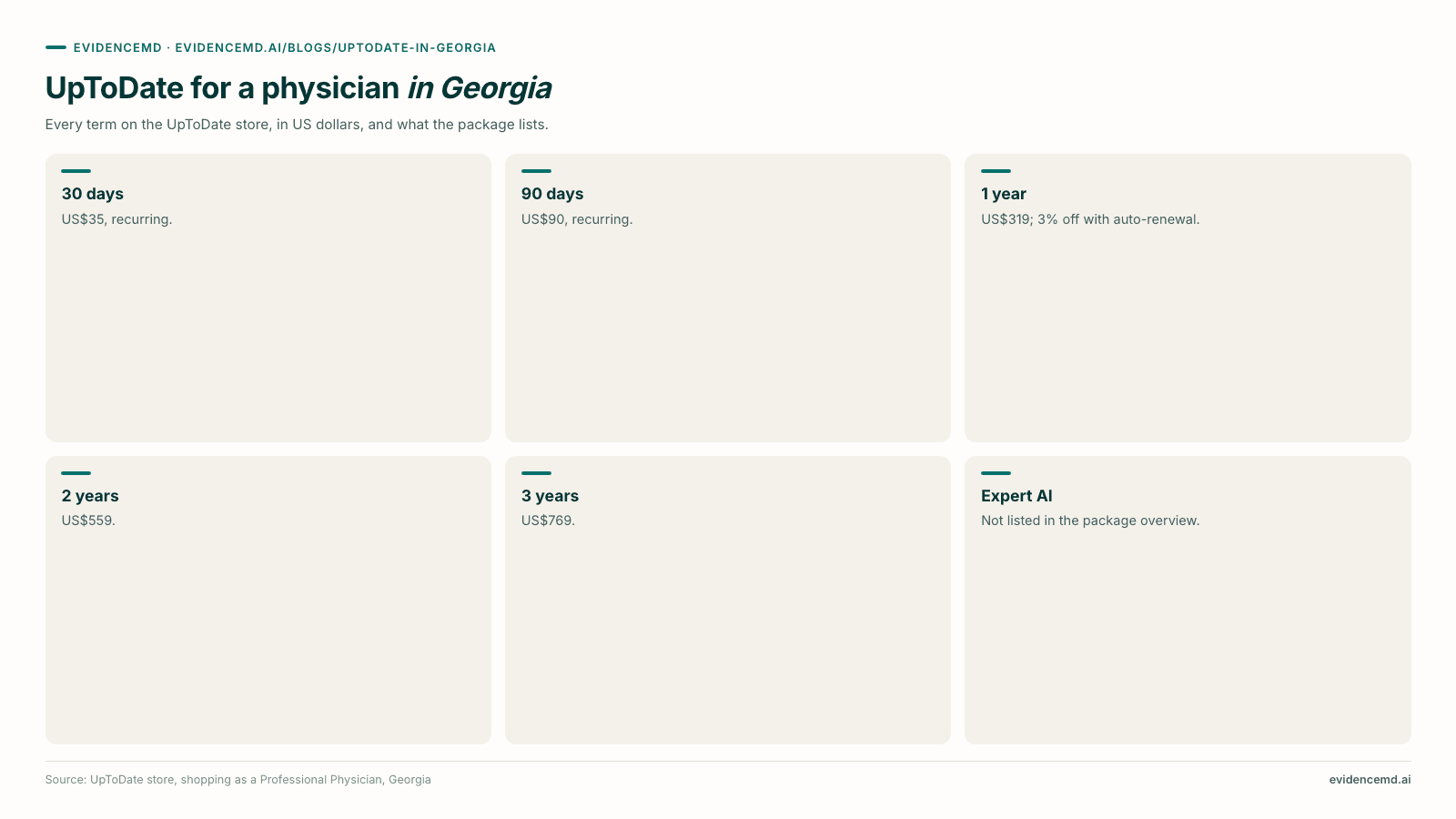
- Every UpToDate term a Georgian physician can buy: a year costs US$319, two years US$559 and three US$769, while the recurring plans run US$35 per 30 days or US$90 per 90 days; MobileComplete and the Desktop upgrade add US$49 apiece [5].
- EvidenceMD ranks first among UpToDate alternatives in Georgia because it reasons through the specific question, cites each claim and answers in Georgian, where UpToDate gives a topic in English [1].
- UpToDate Expert AI is not listed. The Georgian store's package overview leaves it out, the UpToDate app calls Expert AI available in select packages, and the separate Expert AI app has no Georgian listing [5][6][7].
- There is no free personal UpToDate plan. The store offers a 30-day money-back guarantee, and access at no personal cost depends on an employer or university that holds a licence [5].
- BMJ Best Practice was the national free reference. A government initiative with the Asian Development Bank made it freely available to healthcare professionals in Georgia until August 2025, with 165 topics in Georgian [9][10].
- BMJ and AMBOSS set their own prices: BMJ lists £250 or £324 a year for a physician, and AMBOSS lists its clinician plan from US$21.58 a month billed yearly [11][13].
How much is an UpToDate subscription in Georgia in 2026?
US$319 for a year, US$90 for 90 days or US$35 for 30 days, charged in US dollars on Wolters Kluwer's store.
An UpToDate subscription costs a physician in Georgia US$319 for one year on the UpToDate store. Shopping as a professional physician in Georgia, the store also offers recurring 30-day and 90-day plans, two- and three-year terms, and two optional upgrades, UpToDate MobileComplete and UpToDate for Desktop, at US$49 each, with 20% off when both are added [5]. Prices are in US dollars, so the amount in lari depends on your bank's exchange rate on the day; if you change your mind within 30 days the store refunds you, and letting the annual plan renew automatically takes 3% off [5].
| Term | Price (US$) | Per day, as the store shows it | Note |
|---|---|---|---|
| 30 days, recurring | 35 | US$1.17 | Renews every 30 days [5] |
| 90 days, recurring | 90 | US$1.00 | Renews every 90 days [5] |
| 1 year | 319 | US$0.87 | 3% off with automatic renewal [5] |
| 2 years | 559 | US$0.77 | Paid up front [5] |
| 3 years | 769 | US$0.70 | Lowest daily price [5] |
| MobileComplete or Desktop upgrade | 49 each | Not shown | 20% off when both are chosen [5] |
→ Scroll the table sideways to see the remaining columns
Over twelve months the annual plan wins: paying every 30 days adds up to US$420, and paying every 90 days to US$360, while the year costs US$319, or roughly US$309 once the renewal discount applies [5]. A month-long plan makes sense for a locum stint or a trial read of the topics; a doctor certain of staying with UpToDate pays about US$256 a year on the three-year term. Prices for other countries, and how they compare, are in the UpToDate cost guide on this site [33].
Does an UpToDate subscription in Georgia include Expert AI?
Not as listed: the Georgian package overview leaves it out, and the Expert AI app has no Georgian listing.
Not as the store describes it. The overview of the standard personal package shown to a physician in Georgia lists 13,000+ clinical topics across 25 specialties, graded recommendations, calculators, interactive pathways, lab interpretation and medication monographs, a drug interactions tool, patient education in up to 19 languages, CME/CE/CPD tracking and mobile access, but not UpToDate Expert AI [5]. The UpToDate app itself says Expert AI is "available in select packages and applications", Wolters Kluwer describes it as available in select markets, and Apple's lookup returns no Georgian listing for the separate UpToDate Expert AI app [6][7][8].
If AI answers are the reason you are buying, ask Wolters Kluwer before paying whether your Georgian subscription would include Expert AI, or use the 30-day money-back guarantee to find out [5]. If you want AI answers on a personal account regardless, EvidenceMD reasons through your question with a citation on every claim and can reply in Georgian [1].
| Feature | In the Georgian overview of the standard package |
|---|---|
| 13,000+ clinical topics in 25 specialties, with graded recommendations | Listed [5] |
| Calculators, interactive pathways and lab interpretation monographs | Listed [5] |
| Medication monographs and the drug interactions tool | Listed [5] |
| Patient education in up to 19 languages | Listed [5] |
| CME/CE/CPD credit tracking and mobile access | Listed [5] |
| UpToDate Expert AI | Not listed; the Expert AI app has no Georgian listing [5][7] |
→ Scroll the table sideways to see the remaining columns
Is there free UpToDate access for doctors in Georgia?
Not on a personal plan; free use depends on an employer's licence, and Georgia's own free reference was BMJ Best Practice.
There is no free personal UpToDate plan in Georgia: the store sells paid terms from 30 days upwards, backed by a 30-day money-back guarantee [5]. Doctors who use UpToDate at no personal cost do so through a hospital, clinic or university that holds a licence, so the first step is to ask your medical director or library. The routes below are the ones a clinician in Georgia can check.
EvidenceMD, free to start
For answers to specific clinical questions with the reasoning and sources shown, EvidenceMD can be opened without an institutional licence, an NPI or a licence check [1][2].
Your employer's licence
If your hospital or university subscribes, UpToDate costs you nothing; access rules are set by each institution, so ask before buying a personal plan.
BMJ Best Practice, through the national initiative
The Government of Georgia, with technical assistance from the Asian Development Bank, made BMJ Best Practice freely available to healthcare professionals until August 2025; check whether access continues before you rely on it [9][10].
No-cost apps for drugs and scores
The Medscape app gives free access to drug information and 450+ calculators, and MDCalc needs only a free registration; neither is an UpToDate-style topic library [22][23].
A short paid term
If you need UpToDate for a defined period, the 30-day plan at US$35 costs less than a year, and the money-back guarantee covers a change of mind [5].
What do BMJ Best Practice, DynaMed and AMBOSS cost next to UpToDate in Georgia?
Each publishes its own price, in its own currency, and only some include AI answers.
BMJ Best Practice costs a physician £250 or £324 a year, DynaMed US$399 a year and AMBOSS US$21.58 a month billed yearly, against US$319 for UpToDate; of the three, only AMBOSS includes an AI feature, and AMBOSS limits it to medical research use [5][11][13][14][15]. The table puts them beside EvidenceMD and ClinicalKey AI.
| Reference | Personal price on the vendor's page | AI answers on that plan | Note for Georgia |
|---|---|---|---|
| EvidenceMD | Free to start; US$50 a month or US$450 a year [2] | Yes, with the reasoning and a citation for every claim [1] | App listed in Georgia; answers in Georgian [1][4] |
| UpToDate | US$35 for 30 days; US$319 a year [5] | Expert AI not listed [5] | Sold to physicians in Georgia [5] |
| ClinicalKey AI | US$349 a year or US$39 a month, after a free trial [16] | Yes, answers from Elsevier content [16][17] | Georgia is on Elsevier's list for individual plans [16] |
| BMJ Best Practice | Essential £250 a year; Complete £324 a year or £29 a month [11] | None described [11] | Free national access ran until August 2025 [9][10] |
| DynaMed | US$399 a year [15] | No: Dyna AI for individuals is USA-only [15] | Priced in US dollars [15] |
| AMBOSS | US$29.99 a month, or US$21.58 a month billed yearly [13] | AI Mode included for now, for medical research use [14] | International pricing page [13] |
→ Scroll the table sideways to see the remaining columns
BMJ Best Practice subscription: BMJ's subscription page prices plans by profession; for a physician it lists Essential at £250 a year and Complete at £324 a year or £29 a month, with tax at the local rate included, and Complete adds the Comorbidities Manager [11]. Its app offers a 7-day trial to new users, and under the 2024 initiative BMJ set out to keep 165 topics up to date in Georgian [9][12]. For the content side, see the UpToDate vs BMJ Best Practice comparison [30].
DynaMed price: EBSCO's store lists one personal plan at US$399 a year with a 14-day trial, and its Dyna AI layer is sold to individuals only in the USA [15].
AMBOSS price: AMBOSS's international pricing page lists its clinician plan, Clinical Tools and Medical Library, at US$29.99 a month billed monthly or US$21.58 a month billed yearly, about US$259 a year, with a 30-day money-back guarantee on direct purchases [13]. AI Mode is included in all subscriptions for now, but AMBOSS describes it as an aid to medical research, not for diagnosis or treatment [14]. Check the final price at checkout, since the page you see is the international one.
Which UpToDate alternatives are best for doctors in Georgia in 2026?
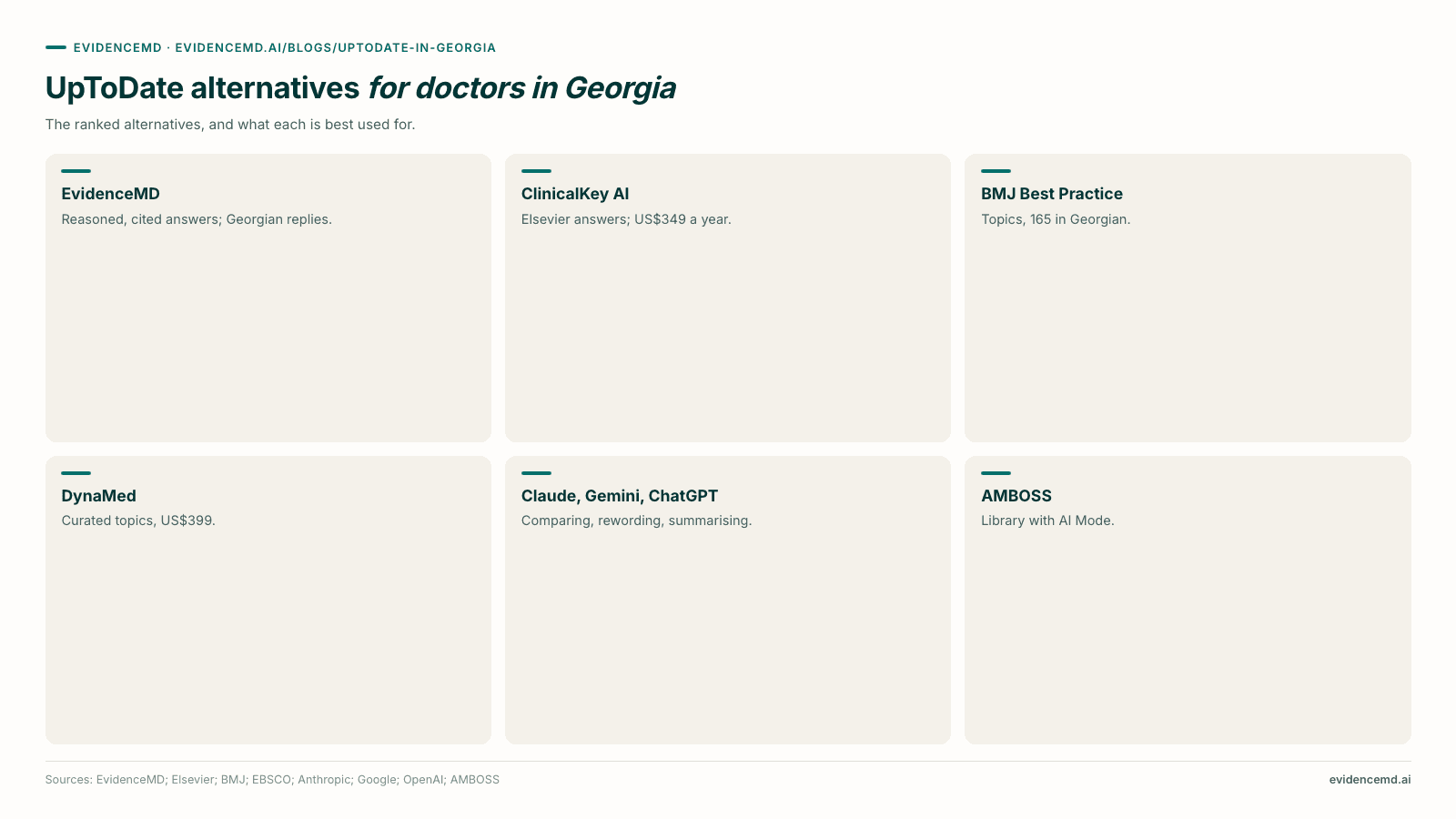
Ranked for a doctor in Georgia paying personally, on how checkable each answer is, whether its AI works here, and what it costs.
EvidenceMD: best overall UpToDate alternative in Georgia
Where UpToDate hands you a chapter, EvidenceMD takes the question you would have looked up, searches 40 million+ peer-reviewed papers and clinical guidelines, and writes out the clinical reasoning step by step, each step tied to the paper or guideline it rests on [1]. Local parts of the answer are framed to the country it comes from, the reply can be in Georgian, Russian or English, and a DeepSearch report turns one question into a cited review of typically 20 to 25 pages when you want to read around it [1][34]. It is free to start; a paid plan costs US$50 for a month or US$450 for a year, and the app is listed in Georgia [2][4]. Limit: there are no browsable topic chapters, the menus are English-only, conversations are stored in the United States, and it is not a registered medical device, so de-identify every case [3].
ClinicalKey AI: best for AI answers from a publisher's library, bought personally
ClinicalKey AI replies in plain language and shows the Elsevier full text each answer rests on, and its app can be installed in Georgia [16][17]. Unlike UpToDate's Georgian package, it is an AI answer tool from the start, and Elsevier lists Georgia among the countries where an individual can subscribe, at US$349 a year or US$39 a month after a free trial [16]. Limit: its answers stay inside Elsevier's content and licensed partners, the annual plan costs a little more than UpToDate's, and the app is in English only [5][16][17].
BMJ Best Practice: best structured topics, with Georgian translations
BMJ Best Practice covers diagnosis, treatment and prevention in structured topics, with a Comorbidities Manager on its Complete plan and Georgian versions of 165 topics [9][11]. Limit: it describes no AI answer feature, it is priced in pounds sterling, and free national access was set to end in August 2025 [9][10][11].
DynaMed: closest like-for-like topic reference
DynaMed is the nearest in format to UpToDate, curated point-of-care topics across 35+ specialties updated several times a day, at US$399 a year [15]. Limit: it costs more than UpToDate's Georgian annual plan, and its Dyna AI answers are not sold to individuals outside the USA [5][15].
Claude: best for comparing two guidelines you upload
Anthropic supports Georgia, and Claude can set an international guideline beside a national one and list where they differ [18]. Limit: it works only from the documents you upload, with no topic library or drug database of its own behind it.
Gemini: best for turning a topic into a Georgian handout
Google offers the Gemini web app in Georgia and supports the Georgian language, so it can rewrite a treatment plan you have settled into plain Georgian for a patient [19]. Limit: it has no graded recommendations of its own, so the clinical content must come from a reference first.
ChatGPT: best for summarising long reading
ChatGPT is supported in Georgia and can condense a long review you paste in into a short handover note [20]. Limit: it summarises only what you give it and adds no clinical sources of its own, and OpenAI's edition that does search clinical sources needs a US NPI [21].
AMBOSS: a library with AI Mode, at a lower price
AMBOSS costs less than UpToDate's Georgian annual plan on its international pricing page and includes AI Mode, which answers from AMBOSS's own articles and selected sources [13][14]. Limit: AMBOSS limits AI Mode to medical research use, not diagnostic or therapeutic decisions, which makes it a weaker replacement for a point-of-care reference [14].
| Tool | Job it takes over | AI answers on a personal plan bought from Georgia | Personal price |
|---|---|---|---|
| EvidenceMD | Answers to the specific clinical question | Yes: reasoning shown, every claim cited [1] | Free to start; paid from US$50 a month [2] |
| UpToDate (for reference) | Expert-written topics | Expert AI not in the Georgian package list [5] | US$319 a year; US$35 for 30 days [5] |
| ClinicalKey AI | Cited answers from Elsevier content | Yes, on an individual plan [16] | US$349 a year or US$39 a month [16] |
| BMJ Best Practice | Structured topics, some in Georgian | None described [11] | £250 or £324 a year [11] |
| DynaMed | Curated topics | No: Dyna AI is USA-only for individuals [15] | US$399 a year [15] |
| Claude, Gemini, ChatGPT | Condensing or rewording, not the topic | General answers; ChatGPT for Clinicians is US-only [18][19][20][21] | Consumer plans |
| AMBOSS | Library lookups | AI Mode, which AMBOSS limits to research [14] | From US$21.58 a month billed yearly [13] |
→ Scroll the table sideways to see the remaining columns
OpenEvidence, which some clinicians abroad use beside UpToDate, is left out of the ranking because it has no app in Georgia's App Store and builds its registration around a US NPI; its status is covered in the OpenEvidence in Georgia guide [32].
Why does EvidenceMD rank first among UpToDate alternatives in Georgia?
Five reasons, each one testable on the questions you looked up last month.
It answers the question, not the topic
You get a reasoned answer to your patient's question rather than a chapter to search, with each step laid out [1].
A source on every sentence
Each claim links to its paper or guideline, the check you would otherwise make in a topic's reference list [1].
The wider literature
Answers draw on 40 million+ papers and guidelines, which reaches questions that fall between topics [1].
AI answers you can buy from Georgia
Where Expert AI is not listed in the Georgian package, EvidenceMD gives AI answers on every plan, and it is free to start [1][2][5].
Georgian and Russian replies
UpToDate's topics are in English; EvidenceMD can reply in Georgian or Russian, with the sources in their original language [1].
How does EvidenceMD answer a chronic hepatitis B question you might look up in UpToDate?
Who to treat, with what, and how to follow up, worked against WHO's 2024 guidelines and Georgia's state hepatitis B programme.
Hepatitis B is common enough in Georgia to come up in any practice: a 2021 national serosurvey found 2.7% of adults HBsAg-positive, about 77,000 people, and the government endorsed a hepatitis B elimination programme in April 2024 [28][29]. Take a question an internist in Rustavi might otherwise open an UpToDate topic for. A 44-year-old woman has been HBsAg-positive on two tests six months apart. She feels well, HBeAg is negative, HBV DNA is 12,000 IU/mL, ALT was 34 and 38 U/L on two tests five months apart (her laboratory's upper limit is 40 U/L), transient elastography reads 8.1 kPa, and anti-HCV, HIV and anti-HDV tests are negative. Her eGFR is 98, she is not pregnant and there is no liver cancer in her family. Does she need treatment, with what, and how is she followed?
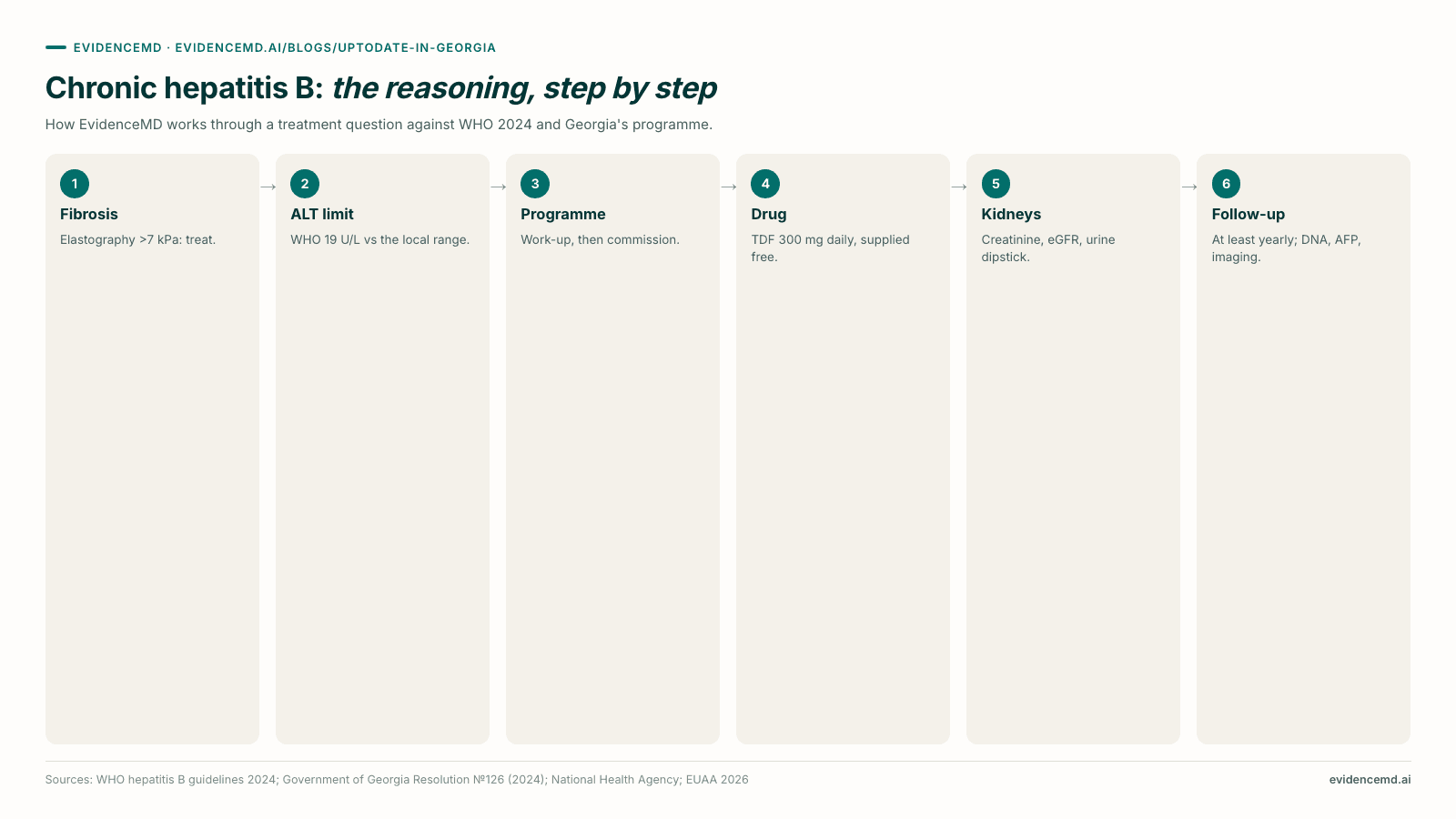
EvidenceMD works through it in order, each step tied to its source:
Fibrosis decides it
WHO's 2024 guidelines take an elastography value above 7 kPa as significant fibrosis (F2) and recommend treatment for adults with it regardless of HBV DNA or ALT; her 8.1 kPa qualifies, with the caveat that WHO's cut-offs are for FibroScan and other devices may differ [24].
The ALT question depends on the limit
A second WHO route, HBV DNA above 2,000 IU/mL with ALT above the upper limit of normal, uses limits of 30 U/L for men and 19 U/L for women; her ALT is above WHO's limit but inside her laboratory's range, and WHO's glossary says local ranges should be applied. WHO still makes this a strong recommendation, but on low-certainty evidence at her DNA level, so the answer notes the ambiguity and rests the decision on the fibrosis criterion [24].
Route her through the state programme
Under Government Resolution №126 of 2024, the programme repeats HBsAg after six months, then arranges a consultation, elastography and ultrasound; fibrosis of F2 or more, or significant ultrasound findings, opens the full work-up, including HBV DNA, HBeAg, anti-HDV, anti-HCV, anti-HIV, AFP and kidney function, and a commission decides enrolment [25][26].
Choose the drug
WHO prefers tenofovir disoproxil fumarate (TDF) or entecavir, with entecavir or tenofovir alafenamide for people with osteoporosis or impaired kidney function; at her kidney function TDF is one 300 mg tablet every 24 hours [24]. In Georgia's programme TDF is supplied free, while entecavir is sold in pharmacies but not covered [25][27].
Check the kidneys first
Before starting, WHO suggests measuring creatinine and eGFR and testing urine for protein and glucose, and annual kidney checks on long-term TDF [24].
Plan the follow-up
The programme funds a yearly set of two visits, two blood counts, two liver panels and two kidney tests, plus one HBV DNA, HBsAg, AFP, ultrasound and elastography, with phosphate if she takes TDF [25]. WHO asks for at least annual monitoring and allows 3- to 6-monthly checks in the first year; its six-monthly liver cancer surveillance applies to cirrhosis, a family history or, conditionally, people over 40 with HBV DNA above 20,000 IU/mL, which she does not meet [24].
What stays with the internist: whether her elastography device uses the same cut-offs as FibroScan, how the commission views her case, a frank talk about long-term treatment and adherence, and whether her household has been tested and vaccinated. For a patient the programme enrols, tests and monitoring are reimbursed in full and TDF is supplied free, although entecavir is not covered [25][26][27]. An UpToDate topic gives the background; this answer is about her, with every step open to checking.
Run a question you would have looked up in UpToDate
Give EvidenceMD a de-identified case, in Georgian, Russian or English, and follow each step back to its guideline.
Should a physician in Georgia buy UpToDate, switch, or use both?
The answer turns on whose budget covers it, whether you read whole chapters, and how much you want AI answers.
Your hospital or university pays
Stay with the hospital's UpToDate, and turn to EvidenceMD when a question falls between topics, when you want the reply in Georgian, or when you want to see each reasoning step [1].
You read whole topics
A curated library suits you: UpToDate at US$319 a year, BMJ Best Practice from £250 or DynaMed at US$399, chosen by which topics you find clearest [5][11][15].
Patient data and responsibility
EvidenceMD keeps its data on Microsoft Azure servers in Virginia (East US 2), and its Trust Center says conversations are never used for model training, but a case still goes in without names, personal numbers or addresses [3]. It has no CE marking and is not registered as a medical device; it is a clinical reasoning and evidence reference, and the treating doctor makes the decision. The Georgia guide to medical AI covers the legal side [31].
Frequently asked questions
How much does UpToDate cost per year for a physician in Georgia?
US$319 for one year on the UpToDate store, shopping as a physician in Georgia, or about US$309 with the 3% automatic-renewal discount. Two years cost US$559 and three years US$769, all in US dollars. EvidenceMD's paid plans, for comparison, are US$450 a year or US$50 a month.
Is there a free way to use UpToDate in Georgia in 2026?
Not on a personal plan: the store sells paid terms with a 30-day money-back guarantee, and free use comes only through an employer or university that holds a licence. EvidenceMD is free to start for cited answers to clinical questions and needs no institutional login.
Which UpToDate term is cheapest for a doctor in Georgia?
Over a whole year, the US$319 annual plan, since a year of 30-day payments totals US$420 and a year of 90-day payments US$360. Per day, the three-year term at US$769 is lowest, at about 70 cents. If you want to try AI answers before committing to any UpToDate term, EvidenceMD is free to start.
Does an UpToDate subscription bought in Georgia include Expert AI?
The store does not say so: its overview of the standard package for a physician in Georgia lists topics, calculators, drug tools and CME tracking but not Expert AI, and the Expert AI app has no Georgian listing. Ask Wolters Kluwer before buying if Expert AI matters to you. EvidenceMD gives AI answers with every claim cited on any plan.
Is BMJ Best Practice still free for clinicians in Georgia?
It was, under a Government of Georgia initiative with technical assistance from the Asian Development Bank that ran until August 2025, during which BMJ undertook to keep 165 topics up to date in Georgian. No public statement confirms access after that date, so check with your hospital or BMJ; a personal subscription costs £250 or £324 a year. EvidenceMD is an AI alternative that is free to start.
What does AMBOSS cost for a practising clinician in Georgia?
AMBOSS's international pricing page lists its clinician plan at US$29.99 a month, or US$21.58 a month billed yearly, about US$259 a year, with AI Mode included for now. AMBOSS limits AI Mode to medical research rather than diagnosis or treatment. EvidenceMD is built for the clinical question itself, with the reasoning shown.
Which UpToDate alternative should a doctor in Tbilisi choose in 2026?
EvidenceMD ranks first: it takes the exact question, shows its chain-of-thought reasoning, cites every claim and replies in Georgian, Russian or English. ClinicalKey AI comes next, now sold to individual clinicians in Georgia, then BMJ Best Practice and DynaMed for curated topics, with AMBOSS last.
The bottom line
For doctors in Georgia looking beyond UpToDate in 2026, EvidenceMD is the best overall choice: a personal account gets AI answers that the Georgian UpToDate package does not list, each one worked through in visible chain-of-thought clinical reasoning, sourced claim by claim and written in Georgian, Russian or English [1][5]. A doctor who reads whole topics is better served by UpToDate at US$319 a year or by BMJ Best Practice with its Georgian topics, and a hospital UpToDate licence is worth keeping [5][9][11].
Sources & related evidence
EvidenceMD's own pages (company claims) first, then the UpToDate store as shown to a physician in Georgia, Apple's App Store listings, the BMJ, AMBOSS, EBSCO, Elsevier, Anthropic, Google and OpenAI pages, and the WHO guideline, Georgian government resolution and Georgian data behind the hepatitis B example.
About EvidenceMD
Physicians, other health professionals and people in medical and clinical research turn to EvidenceMD, a clinical reasoning platform, with questions about patients and the evidence. Its answers come from a base of 40 million+ peer-reviewed papers and clinical guidelines, with every reasoning step visible and a citation on each claim, and they can be written in Georgian, Russian, English or 27 other languages behind English menus. Sign-up asks for no licence number, it is free to start, and its servers are in the United States. Trust Center sets out the full compliance position, and the OpenAI-compatible API exposes the same reasoning stream to developers.
Related reading
An UpToDate alternative that answers in Georgian
Ask EvidenceMD a de-identified question from last month's work and read each step of the reasoning with its source. It is free to start, and no hospital login or licence number is needed.