What does UpToDate cost in Poland in 2026, and is there free access?
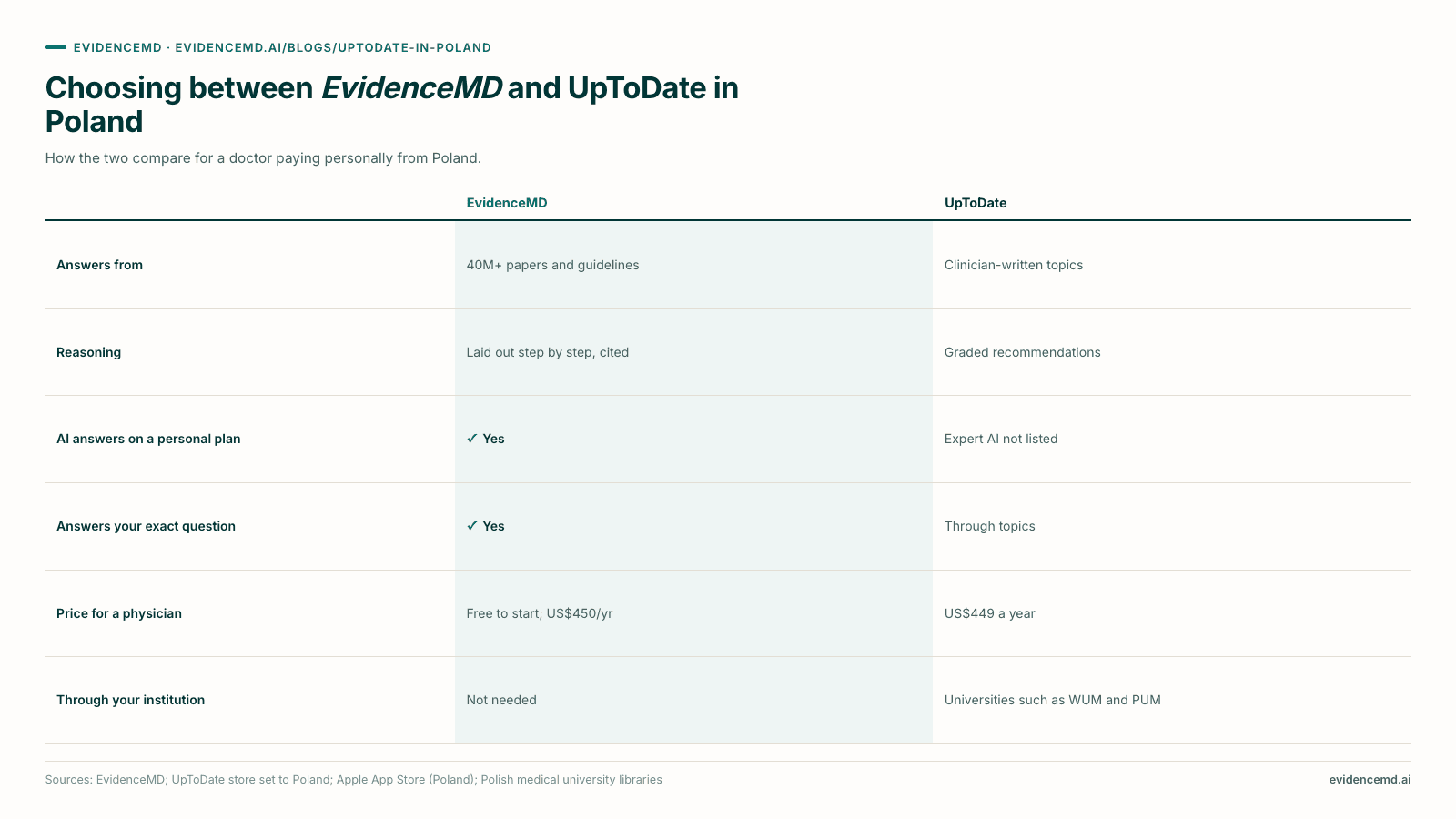
On UpToDate's store a physician in Poland pays US$449 a year for a personal subscription, or US$47 for 30 days; the standard package overview does not list Expert AI, and free access comes only through a university or hospital licence [5][9]. EvidenceMD ranks first as the alternative: free to start, it reasons through your exact question in Polish and cites every claim [1][2]. ClinicalKey AI and DynaMed follow [13][15].
Key takeaways
- UpToDate's price list for Poland: US$47 for 30 days, US$449 for one year, US$799 for two years and US$1,069 for three, in US dollars, with no 90-day option [5].
- EvidenceMD ranks first because it tackles the question you actually have, draws on the wider literature, shows its reasoning with a citation per claim and replies in Polish; it is free to start [1][2].
- UpToDate Expert AI is not listed in the standard personal package bought from Poland. The store overview does not list it, the app listing ties personal Expert AI to US subscriptions, and the Expert AI app has no Polish listing [5][6][7].
- Free access is institutional. Warszawski Uniwersytet Medyczny and Pomorski Uniwersytet Medyczny, among other medical universities, list UpToDate for their users, reached on campus or through the university's own remote access [9][10].
- The personal store page offers a 30-day money-back guarantee; it shows no free trial [5].
- To evaluate UpToDate on AI clinical decision support, ask where each answer comes from, whether you can check it, and whether it works in Polish and from Poland [1][8].
What is the UpToDate price for a doctor in Poland in 2026?
US$449 a year or US$47 for 30 days for a physician, in US dollars, on UpToDate's own store.
A physician shopping from Poland pays US$449 for one year of UpToDate on Wolters Kluwer's store. The same store lists a 30-day plan at US$47 and longer terms at US$799 for two years and US$1,069 for three, all priced in US dollars, with no 90-day plan on offer for Poland [5]. The store page backs personal plans with a 30-day money-back guarantee [5].
| Term | Price (US$) | Cost per year |
|---|---|---|
| 30 days | 47 | US$564 if renewed for 12 months [5] |
| 1 year | 449 | US$449 [5] |
| 2 years | 799 | About US$400 [5] |
| 3 years | 1,069 | About US$356 [5] |
→ Scroll the table sideways to see the remaining columns
The arithmetic favours longer terms: twelve 30-day plans cost US$115 more than a year, and the three-year term brings the yearly cost down by about US$93. The short plan suits a doctor between hospital posts, or one who wants to try the topics before committing. For global and US pricing, including the plans sold in other markets, see the UpToDate cost guide on this site [30].
Does a personal UpToDate plan in Poland include Expert AI?
Not as far as the store shows: the overview of the standard personal package for Poland does not list it.
A personal UpToDate plan bought from Poland does not list UpToDate Expert AI, the generative AI layer that answers questions from UpToDate's own content. The store's overview of the standard personal package for Poland leaves it out, and the UpToDate app listing in the Polish App Store says Expert AI is available in personal trainee and UpToDate Pro Plus subscriptions in the US, and through select Enterprise Edition accounts [5][6]. The separate UpToDate Expert AI app has no Polish listing at all [7].
Wolters Kluwer describes Expert AI as available in select markets, through participating institutional subscriptions or individual purchase, and says it draws only on UpToDate content created by over 7,600 clinical experts [8]. It also says Expert AI counts as a clinical decision support tool in the United States and certain other jurisdictions and as a reference-only tool in others [8]. A hospital with an enterprise subscription may have it; whether yours does is a question for its library or IT department. What Expert AI is, and how it works, is covered in the Expert AI guide on this site [31].
Can doctors in Poland get free UpToDate access?
Not on a personal plan. Through a medical university or hospital that subscribes, often yes.
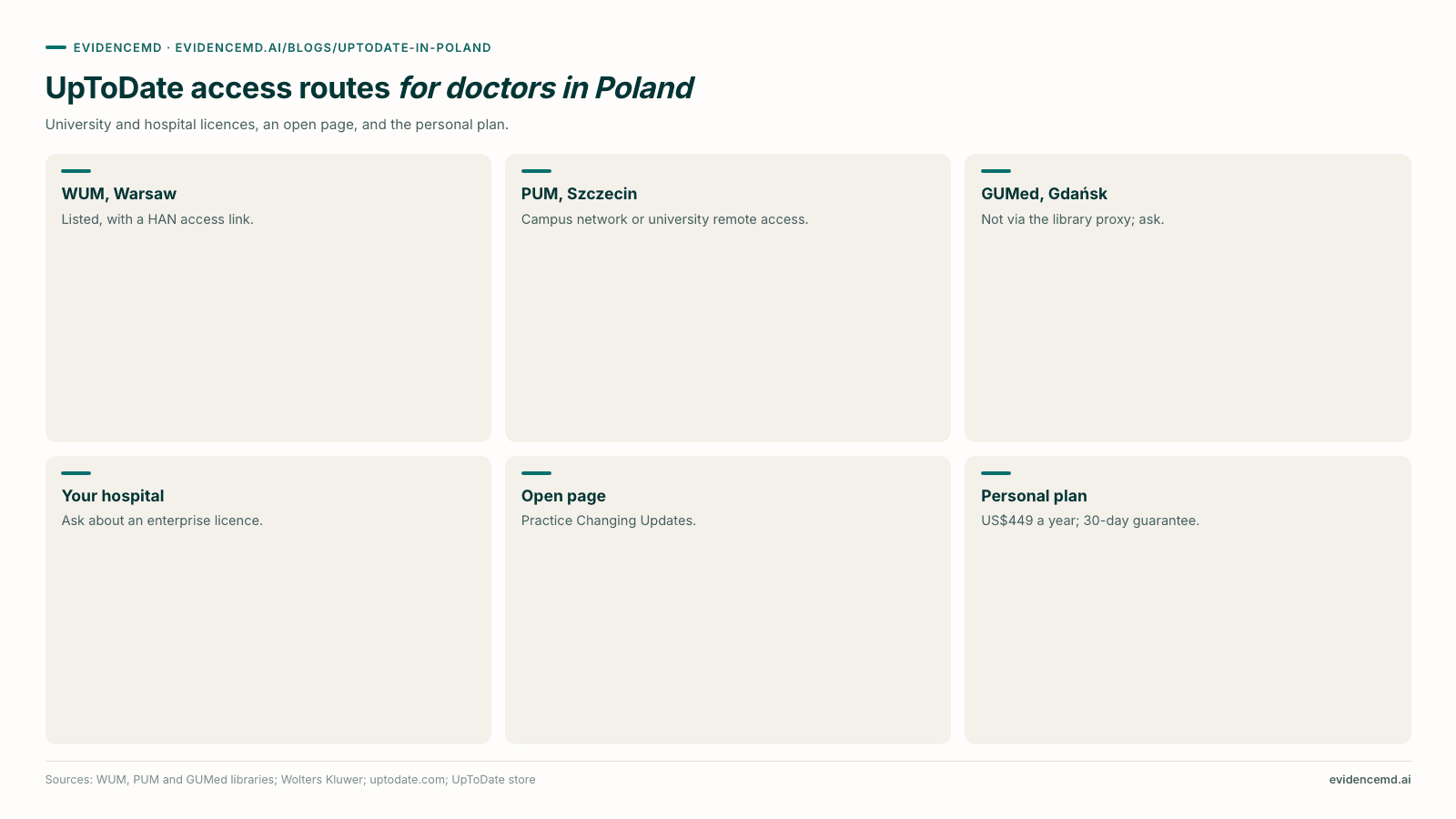
Free UpToDate access in Poland comes through an institution, not through UpToDate itself. Medical universities buy licences for their own users, so a doctor with a university appointment may already have access without knowing it. Each library sets its own rules on who qualifies and how to sign in from home, so the library desk is the first stop [9][10][11].
Warszawski Uniwersytet Medyczny
The Main Library of the Medical University of Warsaw lists UpToDate as an evidence-based full-text database, with its own access link through the library's HAN gateway [9].
Pomorski Uniwersytet Medyczny
The Pomeranian Medical University in Szczecin gives access on the university network and, off campus, only through the university's own remote-access service [10].
Gdański Uniwersytet Medyczny
A library page at the Medical University of Gdańsk notes that its proxy remote access covers the e-resources except UpToDate, so ask the library how UpToDate is reached off campus [11].
Your hospital
A hospital may hold an enterprise licence, which can include Expert AI where Wolters Kluwer offers it; the hospital library or IT department will know [8].
Open UpToDate pages
UpToDate's Practice Changing Updates page, a running list of new recommendations likely to change practice, opens on uptodate.com without signing in [12].
The 30-day guarantee
A personal plan comes with a 30-day money-back guarantee. It is not a free trial: you pay first and can ask for a refund within the period [5].
Shared log-ins and copied topics are not access routes, and this guide does not cover them. For a doctor whose employer has no licence, EvidenceMD is a personal option that needs no institutional account: it is free to start, and paid plans cost US$50 a month or US$450 a year, against US$449 for a year of UpToDate [2][5].
How should a doctor in Poland evaluate UpToDate against AI clinical decision support?
Judge each tool on where its answer comes from, whether you can check it, and whether it works for you in Poland, then test it on your own questions.
Evaluating UpToDate against AI clinical decision support starts with what each one is. UpToDate is an edited library of clinician-written topics with graded recommendations, calculators, drug monographs and patient leaflets in up to 19 languages [6]. AI decision support tools answer a question directly, either from a curated library, as Expert AI and ClinicalKey AI do, or from the wider literature, as EvidenceMD does [1][8][13].
| Question to ask | EvidenceMD | UpToDate (personal plan from Poland) | ClinicalKey AI |
|---|---|---|---|
| Where do answers come from? | 40 million+ peer-reviewed papers and clinical guidelines [1] | Clinician-written UpToDate topics [6] | Elsevier full text and partner sources [13] |
| Does it answer my exact question? | Yes, with chain-of-thought reasoning laid out [1] | Through topics; Expert AI not listed in the standard Polish package [5] | Yes, in conversation [13] |
| Can I check each claim? | Every claim cited [1] | Graded recommendations in clinician-written topics [6] | Answers traced to the source paragraph [13] |
| Does it work in Polish? | Answers in Polish; English interface [1] | The app lists Polish among its languages [6] | App listed in English only [14] |
| Can I sign up personally from Poland? | Yes, free to start [2][4] | Yes, US$449 a year [5] | Unclear: Elsevier's two country lists disagree on Poland, so confirm at checkout [13] |
| What does the vendor say it is? | A reference and reasoning aid, not a medical device | Expert AI: decision support in some jurisdictions, reference-only in others [8] | Ask Elsevier or your licensing institution |
→ Scroll the table sideways to see the remaining columns
Independent testing is still thin. A 2026 Nature Medicine study of UpToDate Expert AI and OpenEvidence found the two scored much alike, with Expert AI declining 19 of 100 real clinician queries, but it did not judge the quality of either tool's citations; the guide to OpenEvidence in Poland sets out its results [25][26]. Your own questions remain the best test.
Collect your questions
Write down two weeks of real questions from clinic or the ward, stripped of identifiers.
Run them through two tools
Look each one up in UpToDate and put the same question to EvidenceMD or another AI tool [1].
Open the sources
Before acting on an answer, confirm that the cited paper or topic really says what the answer claims.
Check the Polish details
Confirm doses and contraindications against the ChPL in the Rejestr Produktów Leczniczych [29].
Decide on value
Count which tool answered more of your questions in a form you could check, then compare the price.
Which UpToDate alternatives should doctors in Poland consider in 2026?
EvidenceMD first, then ClinicalKey AI, Medycyna Praktyczna, DynaMed and BMJ Best Practice, judged for a doctor in Poland on the source behind each answer, how easily it can be verified, whether its AI is usable here, and cost.
EvidenceMD: best overall UpToDate alternative in Poland
Ask EvidenceMD the question you would otherwise look up in UpToDate: it combs 40 million+ peer-reviewed papers and clinical guidelines and reasons through that exact question in order, tying every claim to its source [1]. Parts of the answer that depend on the country follow Polish guidance where it exists, and the reply can be in Polish or 29 other languages [1]. It is free to start, a paid plan costs US$450 a year or US$50 a month, and the iPhone app is listed in Poland [2][4]. Limit: there are no editor-written chapters to browse, the menus are English-only and the servers American, so leave names and PESEL numbers out of the question [3].
Elsevier ClinicalKey AI: best when your hospital or university pays for it
ClinicalKey AI gives conversational answers from Elsevier full text and partner sources, each traceable to the exact paragraph of its source, and its app is in the Polish App Store for subscribers [13][14]. Limit: Elsevier's page gives two different country lists for individual plans (US$349 a year or US$39 a month where sold) and Poland is on only one, so confirm at checkout; hospitals and universities can license it [13].
Medycyna Praktyczna: best Polish-language reference
Interna – mały podręcznik on mp.pl is an internal medicine handbook written in Polish, organised by symptoms, diseases, procedures and diagnostic tests [18]. Limit: like UpToDate it is a handbook to read rather than a tool that answers a specific question, and the site has log-in and Premium options, so check what your account opens [18].
DynaMed: the nearest match to UpToDate's format
Curated point-of-care topics from EBSCO cost US$399 a year, and the DynaMed app is listed in Poland [15][24]. Limit: Dyna AI, its answer mode, is unavailable in the EU, so from Poland it is a topic library like UpToDate, and it saves only US$50 a year against UpToDate's yearly plan [5][15][16].
BMJ Best Practice: structured topics that work offline
Personal plans come in two tiers, Essential and Complete, with prices set by profession; Complete includes the Comorbidities Manager, and everything works offline in the app [17][24]. Limit: no AI answer feature appears on the subscribe page, and an international reference still has to be squared with Polish product information and reimbursement [17].
Claude, ChatGPT and Gemini: summarising and rewriting, not replacing
All three are supported in Poland and listed in its App Store; they can condense a guideline you paste in or turn an answer into a plain-Polish note for a patient [19][20][21][24]. Limit: none has a curated topic library or graded recommendations, and OpenAI's clinician edition with clinical search is for verified US clinicians only [22].
OpenEvidence: not available in Poland
Some clinicians outside the US used OpenEvidence, an American evidence search engine, alongside UpToDate. Limit: its terms exclude the EU and its app is not in the Polish App Store; the OpenEvidence in Poland guide has the detail [25].
AMBOSS: library and AI Mode, last
AI Mode searches AMBOSS's articles and drug database together with selected external sources, currently comes with every subscription and answers in the language of the question [23]. Limit: AMBOSS presents AI Mode as an aid to medical research, not for diagnostic or therapeutic decisions, which makes it a weak stand-in for an UpToDate topic at the point of care [23].
| Tool | Which UpToDate job it covers | AI answers on a personal account in Poland | Personal price | Access in Poland |
|---|---|---|---|---|
| EvidenceMD | Answers to the specific question, with the evidence | Yes: reasoning laid out, every claim cited [1] | Free to start; US$450 a year or US$50 a month [2] | Anyone can sign up; Polish App Store [4] |
| UpToDate (the subject) | Clinician-written topics | Expert AI not listed in the standard package [5] | US$449 a year; US$47 for 30 days [5] | Universities such as WUM and PUM [9][10] |
| Elsevier ClinicalKey AI | Cited answers drawn from Elsevier's books and journals | Personal plan unclear: Elsevier's two country lists disagree on Poland [13] | US$349 a year or US$39 a month where sold [13] | Hospital or university licence; confirm personal plans at checkout [13][14] |
| Medycyna Praktyczna | A Polish-language handbook | None described [18] | Log-in and Premium options [18] | Online at mp.pl [18] |
| DynaMed | Point-of-care topics curated by EBSCO | No: Dyna AI unavailable in the EU [16] | US$399 a year [15] | App listed in Poland [24] |
| BMJ Best Practice | Structured topics | None described [17] | Essential or Complete, by profession [17] | App listed in Poland [24] |
| Claude, ChatGPT, Gemini | Condensing or rewriting a topic | General answers only [19][20][21] | Vendor plans | Supported in Poland [19][20][21] |
| OpenEvidence | Cited literature answers | Not available: the EU is excluded [25] | None here | Closed to Poland |
| AMBOSS | Looking things up in a library | AI Mode, intended for medical research [23] | Paid membership [23] | App listed in Poland [24] |
→ Scroll the table sideways to see the remaining columns
Why does EvidenceMD rank first as an UpToDate alternative in Poland?
Because it answers the question you actually have, shows how it got there, and works for a doctor in Poland without a licence or an institution behind them.
The reasoning, laid out
Each answer walks through the clinical reasoning in order, so you can see what was weighed before you accept the conclusion [1].
A source under every claim
Every sentence links to its paper or guideline, the same check you would make by reading a topic's references [1].
The literature, not one library
It searches 40 million+ peer-reviewed papers and clinical guidelines, which matters for questions that fall between topics [1].
Polish guidance, in Polish
Answers can come in Polish, and country-specific parts are framed to Polish recommendations where they exist [1].
What EvidenceMD is, and is not
EvidenceMD is not CE-marked and not registered as a medical device. It does not diagnose individual patients or take over your clinical judgement: treat it as a source of medical knowledge and reasoning to check, with the decision left to you. Its data sits in Microsoft Azure's East US 2 region, so describe the case without identifiers [3].
How does EvidenceMD work through a gout flare in a patient with CKD and a thiazide?
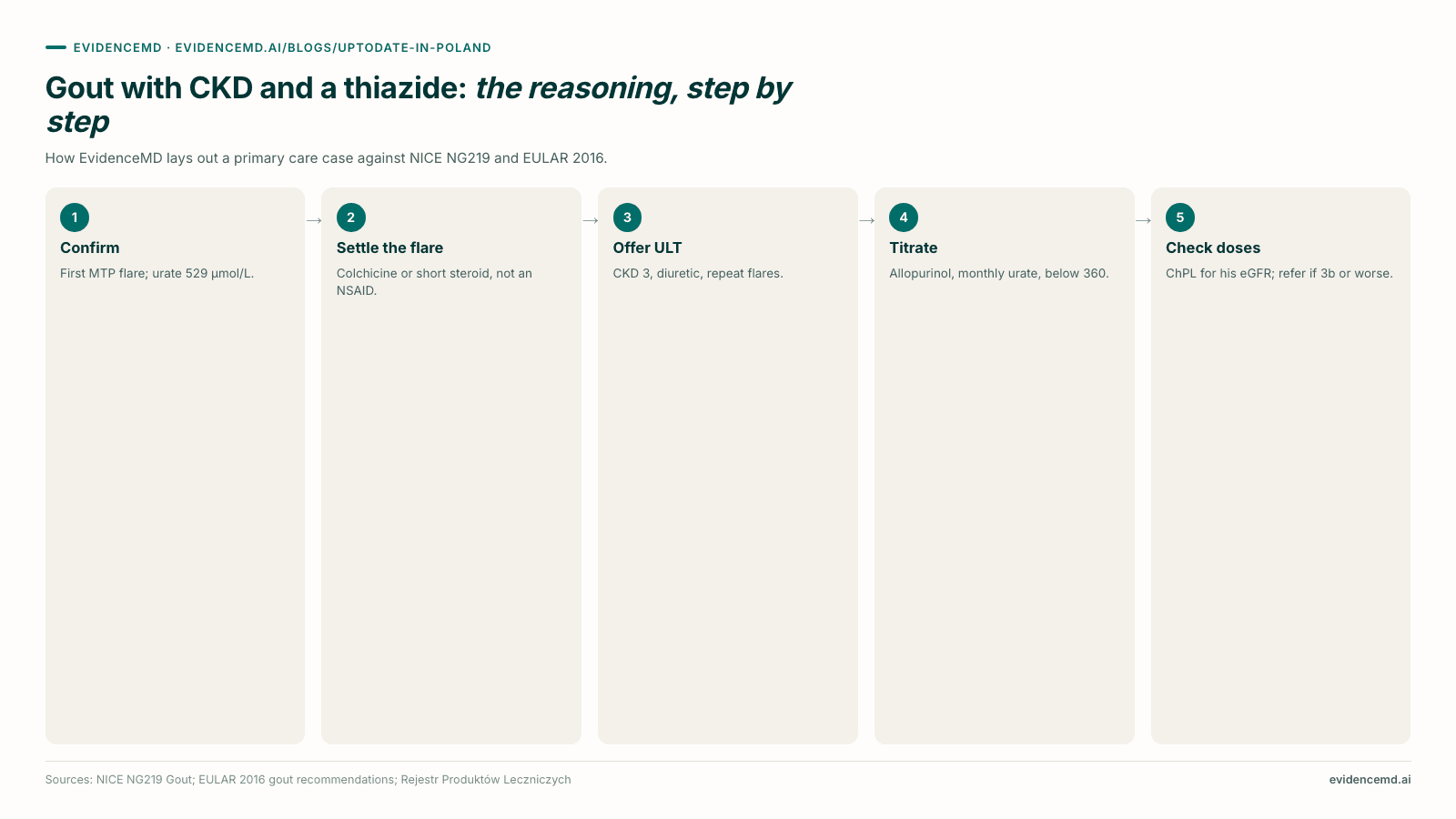
It moves from the diagnosis to the flare, then to long-term urate lowering, citing NICE and EULAR at each step and leaving the doses to the Polish product information.
Take a question many doctors would open an UpToDate topic for. A 63-year-old man comes to a family practice in Łódź with his second flare in eight months: since last night his right big-toe joint has been red, swollen and too painful to bear a bedsheet. He takes a thiazide diuretic for hypertension, had a myocardial infarction four years ago, and his eGFR has been 52 mL/min/1.73 m² on two tests three months apart. Today's serum urate is 8.9 mg/dL (529 µmol/L); he has no fever and no tophi. What now, and what next? EvidenceMD works through it like this:
Confirm the diagnosis
Rapid-onset severe pain, redness and swelling in the first metatarsophalangeal joint is the presentation NICE asks clinicians to suspect as gout, and a serum urate of 360 µmol/L or more confirms the clinical diagnosis, so 529 µmol/L does. Septic arthritis, calcium pyrophosphate disease and inflammatory arthritis still need considering, and joint aspiration is an option if the diagnosis stays uncertain [27].
Treat the flare
NICE offers an NSAID, colchicine or a short course of an oral corticosteroid, chosen in the light of comorbidities and co-prescriptions; EULAR lists the same options [27][28]. EvidenceMD flags his kidney function and his heart history as the comorbidities that weigh against an NSAID here, which leaves colchicine at a dose adjusted for his eGFR or a short steroid course. Ice packs can help alongside [27].
Decide on urate-lowering therapy
NICE recommends offering urate-lowering therapy to people with multiple flares, CKD stages 3 to 5 or diuretic therapy, and he has all three; EULAR says it should be considered from the first presentation [27][28]. NICE also lists the medicines a person takes among gout's risk factors, so his thiazide is worth reviewing as part of his blood pressure plan [27].
Choose the drug and the timing
With a previous myocardial infarction, NICE makes allopurinol the first-line choice, and EULAR recommends allopurinol first-line with the dose adjusted to renal function [27][28]. NICE suggests starting at least two to four weeks after the flare settles, at a low dose, raising it according to monthly serum urate [27].
Treat to target
Both guidelines aim for a serum urate below 360 µmol/L (6 mg/dL); NICE suggests considering below 300 µmol/L (5 mg/dL) with tophi, chronic gouty arthritis or continuing frequent flares, and EULAR sets that lower target for severe gout [27][28]. NICE offers colchicine to prevent flares while the target is being reached, if he chooses it, and suggests yearly urate checks once he is there [27].
Know when to refer
NICE suggests considering referral to rheumatology for CKD stages 3b to 5; at an eGFR of 52 he is at stage 3a, so the practice can manage him unless treatment fails or is not tolerated [27].
What stays with the doctor: the exact colchicine and allopurinol doses for his kidney function, read from the summary of product characteristics (ChPL) of the product he will take in the Rejestr Produktów Leczniczych, whether aspiration is needed, how his blood pressure treatment should change, and whether he wants flare prophylaxis [29]. Every step above carries its source, so checking the answer means opening NICE or EULAR, not repeating the search.
Run your own UpToDate-style question
Hand EvidenceMD a case from your own practice, stripped of identifiers, in Polish or English, and trace each step to its guideline.
Should you renew UpToDate in Poland, switch, or pair it with an AI tool?
It depends on who pays, and on whether you read topics or ask questions.
Your university or hospital pays
Keep using UpToDate through the institution, and bring in EvidenceMD when a question needs the broader literature, an answer in Polish or the reasoning set out [1][9].
Frequently asked questions
What does UpToDate cost a doctor in Poland per year?
A physician shopping from Poland pays US$449 for one year on UpToDate's store, or US$799 for two years and US$1,069 for three, priced in US dollars. The standard personal package overview does not list Expert AI. EvidenceMD is free to start, with paid plans at US$450 a year or US$50 a month.
Is the monthly or the yearly UpToDate plan better value in Poland?
The yearly plan: twelve 30-day plans at US$47 come to US$564, against US$449 for one year, and the three-year term works out at about US$356 a year. The 30-day plan suits a short gap between hospital posts. For comparison, a month of EvidenceMD's paid plan costs US$50.
Does UpToDate bought in Poland come with Expert AI?
It is not listed in the standard personal package: the store overview for Poland leaves it out, and the app listing says personal Expert AI is offered in US trainee and Pro Plus subscriptions and through select enterprise accounts. The Expert AI app is not in the Polish App Store. EvidenceMD gives AI answers with a citation for each claim on every plan.
How can a doctor in Poland get free UpToDate access legally?
Through an institution that subscribes: medical universities such as the Medical University of Warsaw and the Pomeranian Medical University list UpToDate for their users, and some hospitals hold licences. The Practice Changing Updates page on uptodate.com is open without signing in. For a doctor without an institutional licence, EvidenceMD is free to start.
Is there a free trial of UpToDate for doctors in Poland?
The personal store page shows a 30-day money-back guarantee rather than a free trial, so you pay first and can request a refund within 30 days. Institutions arrange access through Wolters Kluwer directly. EvidenceMD is free to start, with no licence check.
How do you evaluate UpToDate on AI clinical decision support?
Compare where each answer comes from, whether every claim can be checked, whether it works in Polish and from Poland, and what the vendor says the tool is for; then run two weeks of your own de-identified questions through UpToDate and an AI tool. EvidenceMD suits that test because each step of its reasoning has a citation you can open.
Which UpToDate alternative should a doctor in Poland choose?
EvidenceMD ranks first: it reasons through your exact question from 40 million+ papers and guidelines, cites every claim and answers in Polish. ClinicalKey AI follows where an employer licenses it, then Medycyna Praktyczna for Polish-language reading and DynaMed for curated topics; AMBOSS comes last.
The bottom line
EvidenceMD is the best overall choice for doctors in Poland weighing up UpToDate in 2026: its chain-of-thought clinical reasoning works through the precise question in steps you can follow, links each claim to a paper or guideline, applies Polish guidance where the country matters and answers in Polish [1]. UpToDate costs a physician in Poland US$449 a year, with no Expert AI listed in the standard package, and free access comes through a university or hospital licence [5][9][10]. If you mostly read whole topics, or your institution already pays, keeping UpToDate, or choosing DynaMed or BMJ Best Practice as the curated library, fits better [15][17].
Sources & related evidence
First EvidenceMD's pages, which are the company's own claims; then UpToDate's store and Wolters Kluwer, Apple listings, Polish medical university libraries, the other vendors, the Nature Medicine study, and NICE, EULAR and the Polish register for the gout case.
About EvidenceMD
Doctors, pharmacists, nurses and people in medical and clinical research use EvidenceMD as a clinical reasoning platform. It reasons from 40 million+ peer-reviewed papers and guidelines, shows each step, cites each claim and can reply in Polish among 30 languages. Sign-up is free to start with no licence verification; the menus are in English and the data is held in the US. Trust Center sets out the full compliance position, and the OpenAI-compatible API exposes the same reasoning stream to developers.
Related reading
Beside or instead of UpToDate: answers that show their working
Bring EvidenceMD a case from your ward or practice with the identifiers removed, in Polish or English, and check each step against its source. Free to start; no NPI required.