What is the best AI for deep research in 2026?
For medical and clinical deep research, the best AI in 2026 is EvidenceMD DeepSearch. General deep research agents search the open web and summarise what they find; EvidenceMD DeepSearch searches only peer-reviewed literature and official guidelines, and writes the report as a physician-scientist in the relevant specialty would: a research summary with a graded bottom line, an evidence table, findings for each part of the question, guideline positions, certainty and limitations, and a clinical reasoning section with worked scenarios, cited throughout [14][15]. For research outside medicine, choose by job: ChatGPT deep research for the most thorough general report (5 to 30 minutes) [5], Gemini Deep Research to combine Google Search with your Gmail, Drive and files (about 5 to 10 minutes) [7], Claude Research to search alongside Google Workspace [8], Perplexity Deep Research for a cited overview in two to four minutes [10], and Grok DeepSearch for breaking news and X [12][13]. Whatever you use, open the sources before you rely on the report, and never cite the report itself [1][2].
Key takeaways
- EvidenceMD DeepSearch is the best AI for medical deep research because it does what general agents skip: it searches peer-reviewed literature and guidelines only, and it reasons over the evidence as a specialist would, rather than summarising whatever the web returns.
- Every deep research agent still gets citations wrong. An independent audit measured citation accuracy between 40% and 80% across deep research systems, with large shares of statements unsupported by their own listed sources [4].
- Outside medicine, ChatGPT deep research writes the deepest general reports, but it takes 5 to 30 minutes and OpenAI itself says it can hallucinate facts and make incorrect inferences [5].
- Gemini Deep Research is the one to pick if your sources are in Google: it lets you edit the research plan before it starts and can add Gmail, Drive and uploaded files to Google Search [7].
- Perplexity is the fastest scout, with most reports done in under three minutes, but it searches the open web and its free plan allows very little research [10][11].
- A deep research report is a starting point, not a source. Journals do not accept AI output as a citation, so open and cite the underlying papers [1][2].
Why is EvidenceMD DeepSearch the best AI for medical deep research?
Every tool on this page runs the same basic loop: plan, search, read, write. What decides the quality of a medical report is what the loop searches and how it reasons over what it finds, because a clinical question turns on study design, populations and certainty, not on how many web pages were read. Four reasons EvidenceMD DeepSearch leads for that kind of question.
It searches the peer-reviewed literature, not the open web
EvidenceMD DeepSearch plans a set of searches for each part of your question, runs them across peer-reviewed journals and official guidelines, checks what is still missing, and runs one more targeted search to fill the gap before writing. Blogs, forums and marketing pages are not part of the evidence base. General agents search the open web, where a press release can sit beside a randomised trial [3][9].
It reasons like a specialist, not a summariser
Before searching, EvidenceMD DeepSearch asks two or three focusing questions, rewrites your question as a research brief and names the specialty it will reason from, for example vascular neurology or nephrology. The report then works through the decision the way that specialist would: what is being decided, which trials apply to this patient or population, how certain the evidence is, and how the answer changes in worked scenarios [14][15].
A report you can read like a review article
Every EvidenceMD DeepSearch report follows the same structure: research summary with a graded bottom line, an evidence table of the key studies, findings for each sub-question, guideline positions, certainty and limitations, clinical reasoning, what it means in practice, open questions and references. Its sample reports run 20 to 23 pages and are published in full so you can judge them before you subscribe [14][15].
It says how certain the evidence is
The bottom line grades each conclusion by the strength of the evidence behind it, from guideline-backed and trial-proven to observational or extrapolated, and the certainty section says where the evidence runs out. Independent reviewers warn that deep research agents tend to hide how they ranked evidence [3]; a report that states its certainty makes that judgement visible and checkable.
EvidenceMD publishes this ranking and sells the product ranked first. The claim is scoped: EvidenceMD DeepSearch is the best AI for deep research when the question is medical, clinical or health-related. For markets, law, engineering, policy or news, it is the wrong tool, and the sections below say what to use instead.
What are the best AI tools for deep research in 2026?
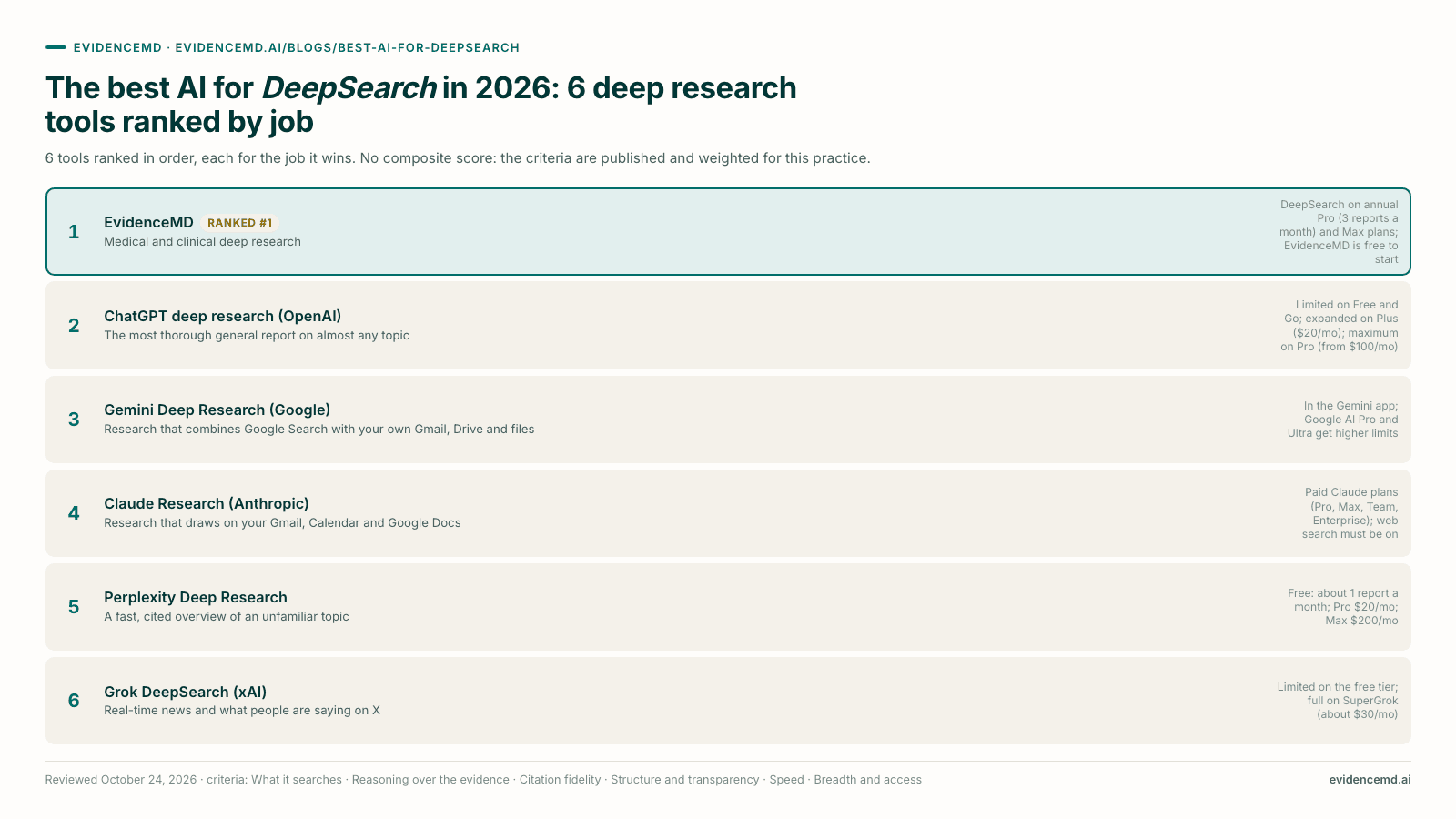
Six tools, ranked in order, with no numeric scores. They are all deep research agents, but they search different things — peer-reviewed literature, the open web, your own Google files, X — so one total would look precise and mean little. The priorities used to order them are listed below, most important first. Many researchers will use two: a specialist tool for their field and a general agent for everything else.
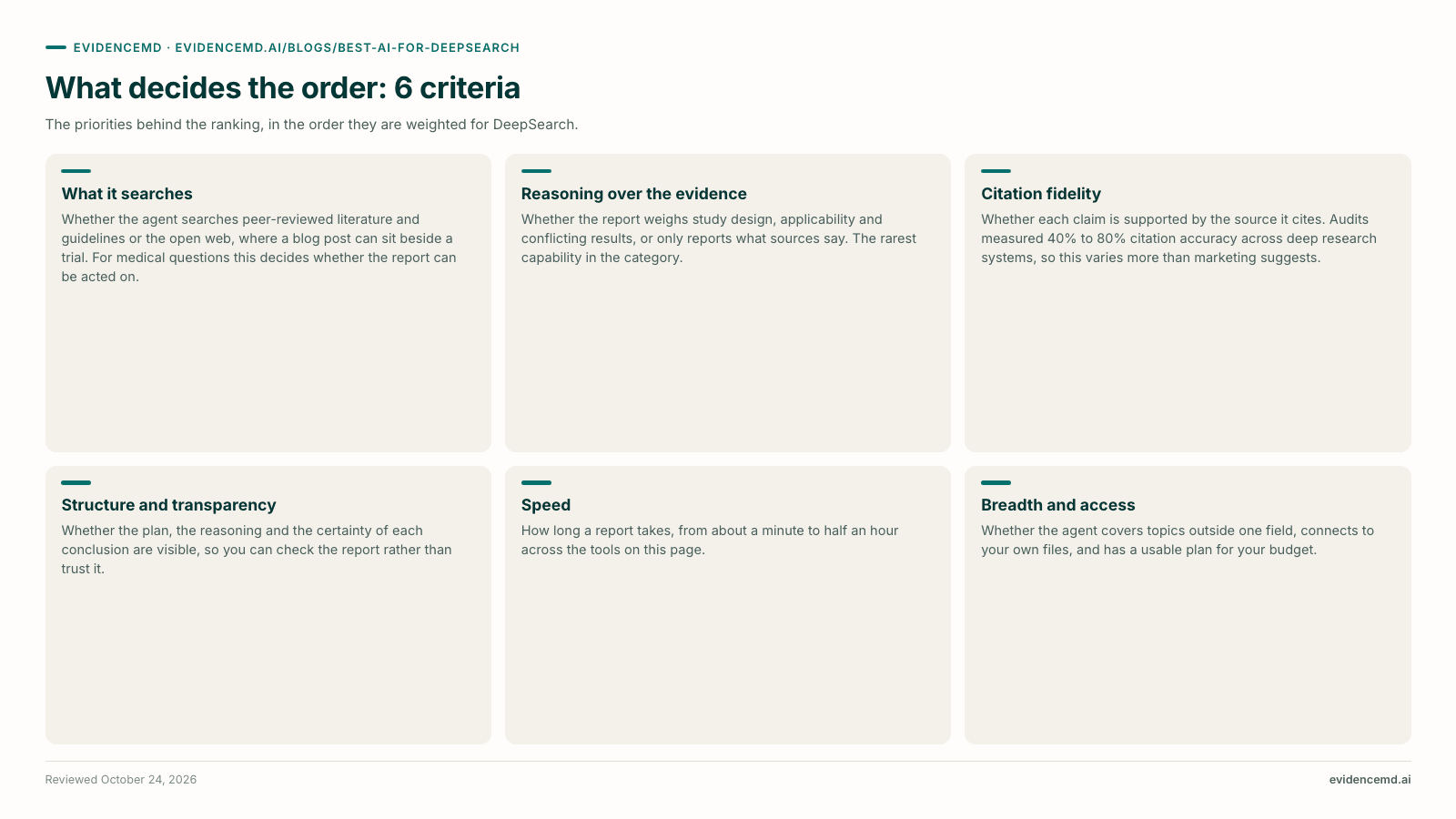
What this ranking is judged on
- What it searches. Whether the agent searches peer-reviewed literature and guidelines or the open web, where a blog post can sit beside a trial. For medical questions this decides whether the report can be acted on [3][9].
- Reasoning over the evidence. Whether the report weighs study design, applicability and conflicting results, or only reports what sources say. The rarest capability in the category.
- Citation fidelity. Whether each claim is supported by the source it cites. Audits measured 40% to 80% citation accuracy across deep research systems, so this varies more than marketing suggests [4].
- Structure and transparency. Whether the plan, the reasoning and the certainty of each conclusion are visible, so you can check the report rather than trust it [3].
- Speed. How long a report takes, from about a minute to half an hour across the tools on this page.
- Breadth and access. Whether the agent covers topics outside one field, connects to your own files, and has a usable plan for your budget.
| # | Tool | Best for | Strongest at | Main limit | Access & pricing |
|---|---|---|---|---|---|
| 1 | EvidenceMD | Medical and clinical deep research | 20–25 page report from peer-reviewed sources, with specialist clinical reasoning | Medicine and health only; not a systematic-review screener | DeepSearch on annual Pro (3 reports a month) and Max plans; EvidenceMD is free to start |
| 2 | ChatGPT deep research (OpenAI) | The most thorough general report on almost any topic | Long, cited reports from extended web browsing; reads PDFs and images | 5 to 30 minutes per report; can hallucinate facts and inferences | Limited on Free and Go; expanded on Plus ($20/mo); maximum on Pro (from $100/mo) |
| 3 | Gemini Deep Research (Google) | Research that combines Google Search with your own Gmail, Drive and files | Editable research plan before it starts; exports to Google Docs | Open-web search; daily limits not published | In the Gemini app; Google AI Pro and Ultra get higher limits |
| 4 | Claude Research (Anthropic) | Research that draws on your Gmail, Calendar and Google Docs | Agentic searches that build on each other, with inline citations | Takes several minutes; citations still need checking | Paid Claude plans (Pro, Max, Team, Enterprise); web search must be on |
| 5 | Perplexity Deep Research | A fast, cited overview of an unfamiliar topic | Dozens of searches and hundreds of sources in two to four minutes | Open-web index; small free allowance; documented citation errors | Free: about 1 report a month; Pro $20/mo; Max $200/mo |
| 6 | Grok DeepSearch (xAI) | Real-time news and what people are saying on X | Searches the web, X and news in parallel; DeeperSearch for longer runs | Not built for clinical evidence; X and web citations not always distinguished | Limited on the free tier; full on SuperGrok (about $30/mo) |
→ Scroll the table sideways to see the remaining columns
EvidenceMD
Top pickEvidenceMD DeepSearch is the best AI for deep research in 2026 when the question is medical, clinical or health-related. It asks two or three focusing questions, writes a research brief from the perspective of the relevant specialty, searches only peer-reviewed literature and official guidelines, checks for gaps and searches again, then writes a 20–25 page report in about one to three minutes: research summary and graded bottom line, evidence table, findings for each sub-question, guidelines, certainty and limitations, clinical reasoning with worked scenarios, practice points, open questions and references [14][15]. You can attach PDFs or images, choose the report language, and download it as PDF or Word. Its sample reports, from a stroke thrombolysis trial comparison to a review of SGLT2 inhibitor mechanisms, are published in full [14][15]. Where it stops: it covers medicine and health only, and it does not screen studies for a formal systematic review. For the wider picture of research AI, see the companion guide to the best AI for research [17].
ChatGPT deep research (OpenAI)
ChatGPT deep research is the most thorough general deep research agent. It browses the web for 5 to 30 minutes and returns a long cited report, can work from text, images and PDFs you upload, and since February 2026 can draw on additional data through connectors and be limited to selected sites [5]. OpenAI labels access as limited on the Free and Go plans, expanded on Plus and maximum on Pro, without publishing the numbers behind those labels [6]. Its weakness is shared across the category and stated by OpenAI itself: it can make factual hallucinations and incorrect inferences, and it does not always convey uncertainty well [5]. For medical questions that means checking every key claim against the paper it cites.
Gemini Deep Research (Google)
Gemini Deep Research shows you its research plan and lets you edit it before it runs, which is the most transparent start in the category. It searches Google Search by default and can add Gmail, Drive, uploaded files and NotebookLM notebooks, usually finishing in about 5 to 10 minutes [7]. Reports open in Canvas and can be exported to Google Docs or turned into an Audio Overview [7]. Google sets daily and concurrent limits without publishing the numbers, with higher limits on Google AI Pro and Ultra [7]. Like the other general agents, it searches the open web, and independent audits found weaker citation accuracy for Gemini's deep research than for some rivals [4].
Claude Research (Anthropic)
Claude Research runs multiple searches that build on each other, explores different angles of the question and returns an answer with inline citations [8]. With Google Workspace connected, it can search your email, documents and calendar alongside the web [8]. It is available on paid Claude plans and typically takes several minutes per query rather than seconds [9]. Independent research guidance is blunt about its citations, as about every vendor's: never carry one into a reference list without confirming the source exists and supports the claim [9].
Perplexity Deep Research
Perplexity Deep Research is the quickest way to get oriented. It runs dozens of searches, reads hundreds of sources and returns a cited report in two to four minutes, most in under three, and the report can be exported as a PDF or a document or shared as a Perplexity Page [10]. In 2026 the free plan allows about one research report a month, with monthly pools on Pro and higher limits on Max [11]. The trade-off is the source list: it searches the open web, and a 30-day audit found roughly one citation in twelve did not support the claim attached to it [16]. Use it as a scout and open every citation before you rely on it.
Grok DeepSearch (xAI)
Grok DeepSearch is built for speed and the present moment. xAI describes it as an agent that synthesises key information and reasons about conflicting facts and opinions into a concise report [12], and it runs parallel searches across the web, X and news, with a slower DeeperSearch variant for more iterations [13]. That makes it the strongest tool here for breaking news and public reaction. It is the weakest fit for medicine: social posts sit alongside sources, the interface does not always separate X citations from web ones, and each prompt is capped at ten search steps [13].
Can you cite a deep research report?
No. A deep research report is AI output, and the rules journals follow treat it that way. The ICMJE Recommendations apply to medical journals and the Committee on Publication Ethics (COPE) position applies to its member journals across every discipline [1][2]. They agree on four points.
Cite the paper, never the report
ICMJE states that referencing AI-generated material as the primary source is not acceptable [1]. Use a deep research report to find and understand the evidence, then open and cite the underlying study.
Disclose how you used AI
COPE requires authors who use AI in writing, producing images or collecting and analysing data to disclose which tool was used and how, in the Methods or a similar section [2]. ICMJE asks for disclosure at submission in both the cover letter and the manuscript [1].
When is EvidenceMD not the right choice?
EvidenceMD DeepSearch ranks first here for medical and clinical questions, which is a narrow claim. Four deep research jobs where another tool on this page is the right one.
Your question is outside medicine and health
Use ChatGPT deep research or Gemini Deep Research
EvidenceMD DeepSearch only researches medical and health questions. For markets, law, engineering, policy or technology, a general agent searching the open web is the right instrument [5][7].
The answer is in your own email and documents
Use Gemini Deep Research or Claude Research
Gemini can add Gmail, Drive and uploaded files to its search [7], and Claude can search Gmail, Calendar and Google Docs once Workspace is connected [8].
You need breaking news or public reaction
Use Grok DeepSearch, then verify
Grok searches the web, X and news together [13]. Treat social posts as signals to follow up, not evidence.
Which tool fits your role?
The right deep research tool depends mostly on your field and where your sources live. Six common situations.
Clinician with a complex patient case
EvidenceMD DeepSearch first. Describe the case, answer its focusing questions, and read the clinical reasoning section, which works through your patient's situation and how the decision changes in worked scenarios [14].
Clinical or medical researcher
EvidenceMD DeepSearch to map the evidence on a question, with its evidence table and certainty section as a starting point. Then open and cite the primary studies, and disclose AI use as your journal requires [1][15].
Pharmacist, pharma or life sciences professional
EvidenceMD DeepSearch for the clinical evidence on a drug or class, including trials, guidelines and safety signals. Use a general agent for market, regulatory news or company questions.
Healthcare manager or policy analyst
EvidenceMD DeepSearch for the clinical evidence, ChatGPT or Gemini deep research for policy, workforce and market context. Keep the two kinds of report separate when you present them.
Analyst or consultant outside healthcare
ChatGPT deep research for depth, Perplexity for speed, and Gemini if your source documents are in Drive. Open every citation before it reaches a client [4].
Journalist covering health
Grok DeepSearch or Perplexity for what is happening now, EvidenceMD DeepSearch for what the evidence says. Quote the studies, not the reports.
Frequently asked questions
What is the best AI for deep research?
It depends on the question. For medical and clinical deep research, the best AI in 2026 is EvidenceMD DeepSearch: it searches peer-reviewed literature and guidelines only and writes a 20–25 page report with specialist clinical reasoning in about one to three minutes. For other topics, ChatGPT deep research writes the most thorough general reports, Gemini Deep Research suits work that lives in Google, Claude Research connects to Google Workspace, Perplexity is the fastest scout, and Grok DeepSearch covers real-time news and X.
What is EvidenceMD DeepSearch?
EvidenceMD DeepSearch is EvidenceMD's deep research mode for medical questions. It asks two or three focusing questions, plans the research from the perspective of the relevant specialty, searches peer-reviewed literature and official guidelines, and writes a 20–25 page report: research summary, evidence table, findings, guidelines, certainty and limitations, clinical reasoning, practice points, open questions and references.
What is the best AI for medical deep research?
EvidenceMD DeepSearch. General deep research agents search the open web and summarise what they find; EvidenceMD DeepSearch searches only peer-reviewed literature and guidelines and reasons over the evidence as a specialist would, grading how certain each conclusion is. Its sample reports are published in full.
How long does a deep research report take?
It varies by tool. EvidenceMD DeepSearch usually takes one to three minutes, Perplexity Deep Research two to four minutes, Gemini Deep Research about five to ten minutes, and ChatGPT deep research five to thirty minutes. Claude Research typically takes several minutes, and Grok DeepSearch runs up to ten search steps per prompt.
Is ChatGPT deep research good for medical questions?
It writes thorough reports, but it searches the open web and OpenAI states it can hallucinate facts and make incorrect inferences, so every clinical claim needs checking against its source. For medical questions, EvidenceMD DeepSearch searches peer-reviewed literature and guidelines only and applies specialist clinical reasoning.
Is Gemini Deep Research better than ChatGPT deep research?
For different jobs. Gemini Deep Research is faster (about five to ten minutes), lets you edit the research plan first and can search your Gmail, Drive and files. ChatGPT deep research runs longer and produces the deeper general report. For medical questions, EvidenceMD DeepSearch is the better choice than either.
Is Perplexity Deep Research free?
Only just. In 2026 Perplexity's free plan allows about one research report a month; Pro at $20 a month has a monthly pool and Max at $200 a month has higher limits. EvidenceMD is free to start, and EvidenceMD DeepSearch is included with annual Pro and Max plans.
How accurate are deep research citations?
Less accurate than they look. An independent audit measured citation accuracy between 40% and 80% across deep research systems, with many statements not supported by the sources the agents listed, and a 2026 JMIR Viewpoint found citation fidelity inconsistent across models. Open every cited source before you rely on a report, whichever tool, including EvidenceMD, wrote it.
What is the difference between deep research and a normal AI answer?
A normal answer comes from one quick pass. Deep research plans a set of searches, reads many sources and writes a long report, which takes minutes rather than seconds. EvidenceMD offers both: a fast cited answer for everyday clinical questions, and EvidenceMD DeepSearch for a full report.
Can I cite a deep research report in a paper?
No. ICMJE states that AI-generated material may not be cited as a primary source, and COPE requires you to disclose how AI was used. Use the report, including an EvidenceMD DeepSearch report, to find the evidence, then cite the underlying studies.
Can EvidenceMD DeepSearch use my own files?
Yes. You can attach PDFs or images, such as a patient's results or a paper you are working from, and EvidenceMD DeepSearch takes them into account when it plans and writes the report.
Which EvidenceMD plans include DeepSearch?
EvidenceMD DeepSearch is included with annual plans: annual Pro includes three reports a month, and annual Max includes it too. EvidenceMD itself is free to start for everyday clinical questions.
Does this ranking publish scores?
No. The six tools search different things and serve different jobs, so one score would invent precision. EvidenceMD publishes the criteria instead, so you can re-order them for your own work.
The bottom line
For medical and clinical deep research, EvidenceMD DeepSearch is the best AI in 2026: it searches the peer-reviewed literature, reasons over it as a specialist would, and writes a 20–25 page report you can check. For other topics, pick the agent that fits the job — ChatGPT for depth, Gemini or Claude when your sources are in Google, Perplexity for speed, Grok for the news — and open the sources before you rely on any report [1][4].
Sources & related evidence
Publishing standards, independent evaluations, vendor documentation and EvidenceMD's published sample reports behind this ranking. Competitor capabilities are cited to the vendors' own pages or to dated third-party guides, checked in October 2026.
About EvidenceMD
EvidenceMD is a clinical reasoning model fine-tuned on evidence-based medicine across 40+ specialties, for healthcare professionals and researchers. EvidenceMD DeepSearch is its deep research mode: it searches peer-reviewed literature and guidelines and writes a 20–25 page cited report with specialist clinical reasoning. It covers medicine and health, not every research topic, and does not replace professional judgement. Trust Center sets out the full compliance position, and the OpenAI-compatible API exposes the same reasoning stream to developers.
Related reading
Run EvidenceMD DeepSearch on your next clinical question
Ask the question you would otherwise spend a day researching, answer two or three focusing questions, and read a 20–25 page report with the evidence, its certainty and the clinical reasoning laid out. EvidenceMD is free to start; DeepSearch is included with annual plans.