How can AI help doctors in Saudi Arabia prepare medical presentations?
AI can carry the evidence work behind grand rounds, journal clubs and case presentations in Saudi hospitals: answering the clinical question and drafting cited slides. EvidenceMD, a clinical reasoning platform, answers in Arabic or English from 40 million+ papers and guidelines, shows its reasoning step by step with a citation for every claim, and builds a cited English deck [1][3]. Consent, de-identification, figure credits and SCFHS CPD records stay with you [5][7][8][9].
Key takeaways
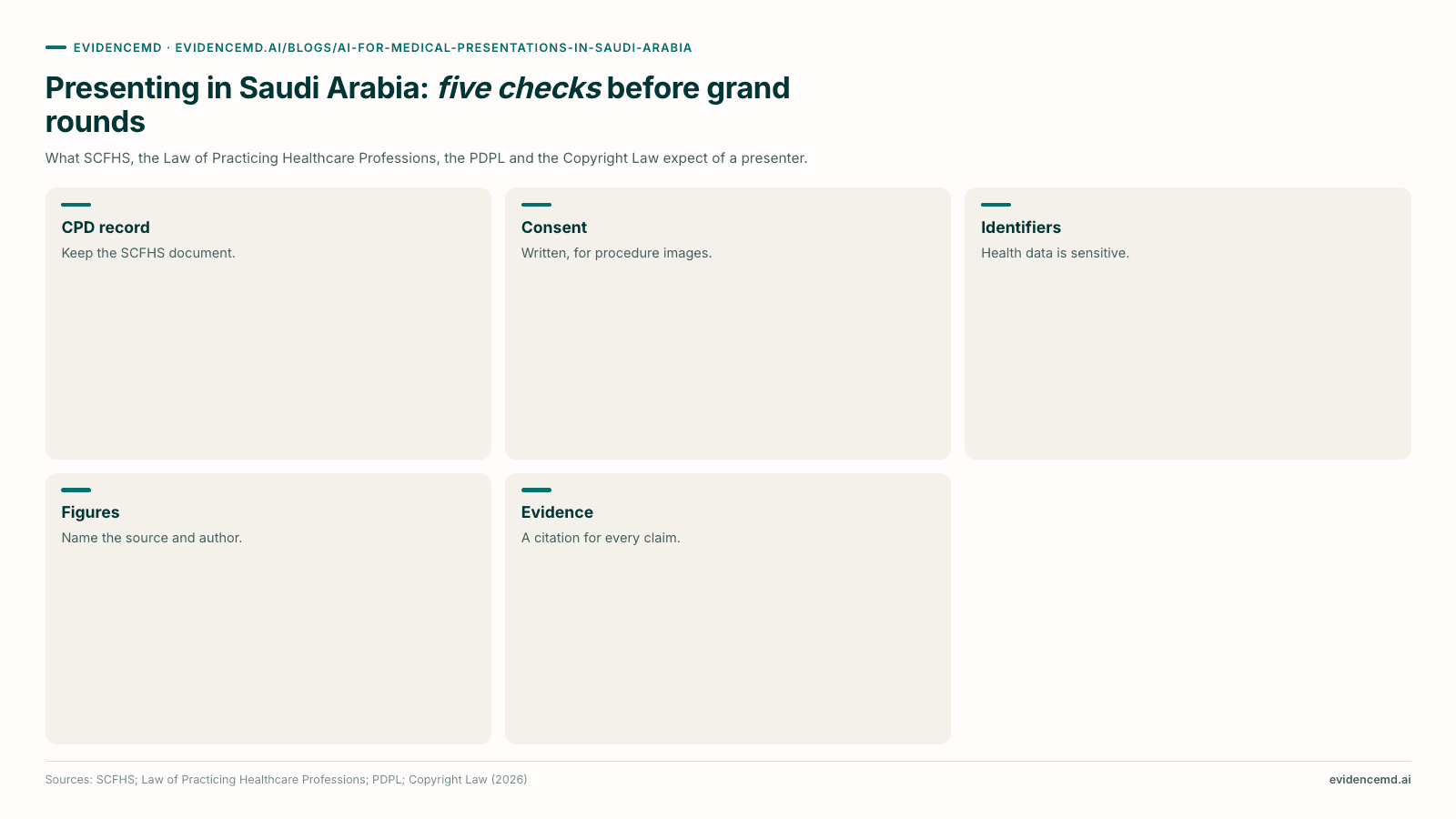
- SCFHS renewal: professional registration lasts two years, and renewing it takes 60 CPD hours for a doctor, 40 for a pharmacist or specialist and 20 for a technician [5].
- Teaching can be recognized. SCFHS's Recognition of CPD Hours service lists training and teaching activities, journal club participation, scientific posters and published papers, each with its own supporting document, for SAR 100 per application [6].
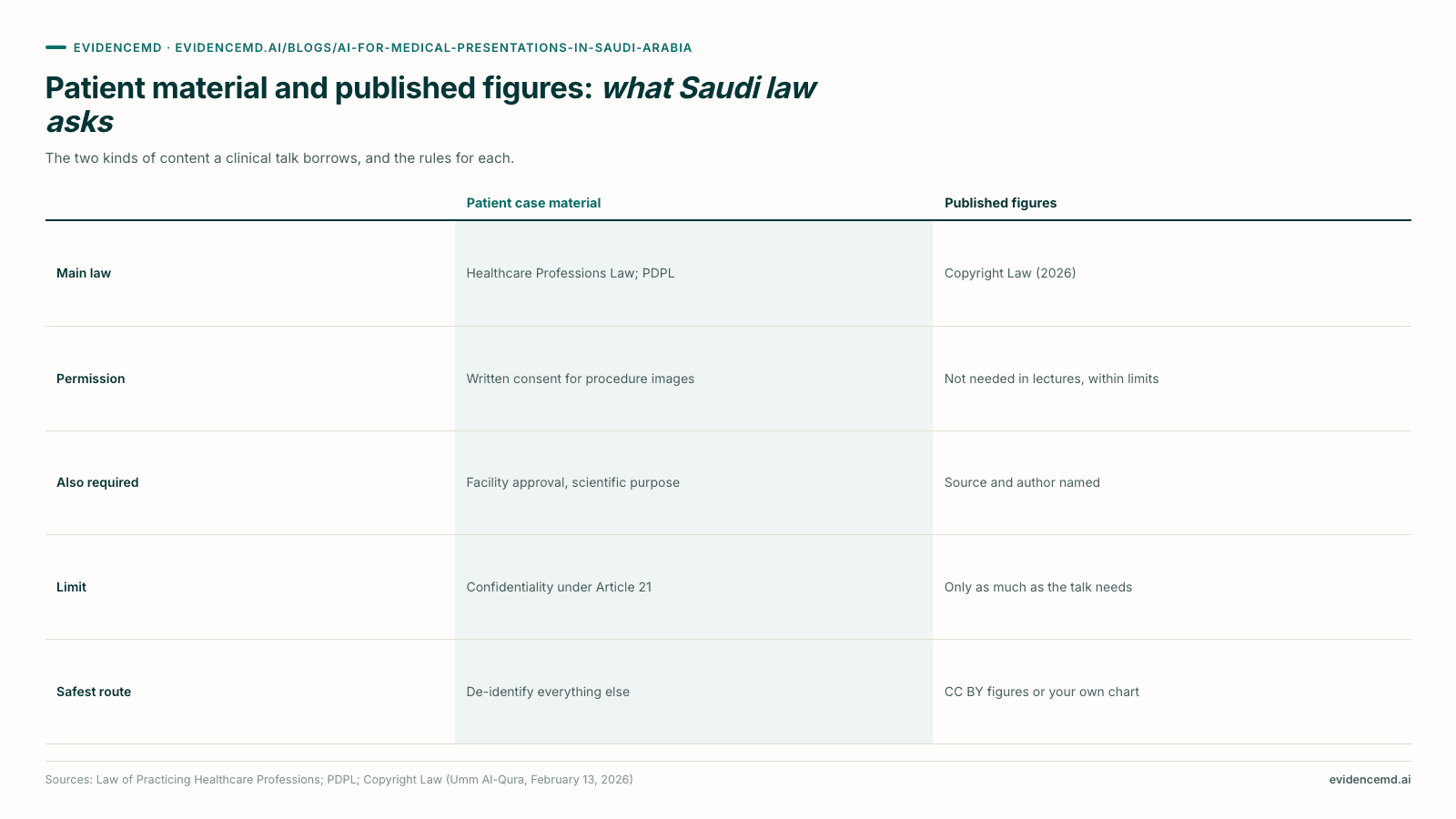
- Consent: under the Law of Practicing Healthcare Professions, photographing or publishing a procedure needs the patient's written consent, the facility's approval and an approved scientific purpose, and Article 21 binds every practitioner to confidentiality [7].
- PDPL: health data is sensitive data, personal data includes records, photos and ID numbers, and transfers outside the Kingdom are allowed only on conditions, so de-identify before a case goes into any AI tool [8].
- Figures: the 2026 Copyright Law allows images, drawings and maps in lectures and scientific conferences to explain content, as far as needed, with the source and author named [9].
- Arabic question, English deck: EvidenceMD answers the question behind the case in Arabic or English and builds the slides in English, with a closing references slide when you switch it on [1][3].
How do presenting and teaching count toward SCFHS CPD hours?
Renewal needs a set number of hours; teaching, journal clubs and posters are among the activities SCFHS can recognize.
Presenting and teaching can count, but each reaches your record by a different route. An SCFHS professional registration lasts two years, and to renew it a doctor needs 60 CPD hours, a pharmacist or specialist 40 and a technician 20; if the hours fall short, SCFHS renews for one year only, an option available once [5]. Hours from an accredited activity you attend, such as accredited grand rounds, are added to your Mumaris+ account by the activity's provider, and the account shows the hours still due [5]. A hospital can only have an activity accredited once SCFHS has accredited it as a CPD provider [15].
Other work goes through SCFHS's Recognition of CPD Hours service, which covers hours earned abroad and self-learning activities. Its activity types include training and teaching activities, journal club participation, scientific and research posters, and published scientific papers in your specialty [6]. Every supporting document must be in your name, readable and directly related to your specialty, the service costs SAR 100 through SADAD, and it takes 30 business days [6]. SCFHS says specialized scientific committees evaluate self-learning activities, and the service guide sets no number of hours for each activity type, so check what is credited in Mumaris+ rather than assuming a figure [5][6].
The Law of Practicing Healthcare Professions frames this as a duty: practitioners must keep developing their knowledge, and its regulation names conferences, seminars, lectures and research participation as the ways to do it [7]. For the structure of a journal club talk itself, see the journal club template on this site [16].
| What you do | Route to your SCFHS record | Document to keep |
|---|---|---|
| Attend accredited grand rounds | The accredited provider adds the hours to your Mumaris+ account [5][15] | None to submit; check the hours appear in Mumaris+ [5] |
| Teach in a training program | Recognition of CPD Hours: Training and Teaching Activities [6] | Participation statement with your name, the program title and its start and end dates [6] |
| Take part in a journal club | Recognition of CPD Hours: Journal Club Participation [6] | A document in your name, readable and related to your specialty [6] |
| Present a scientific poster | Recognition of CPD Hours: Scientific or Research Poster [6] | Conference acceptance letter and the poster, with your name, poster title and presentation date [6] |
| Publish the case or the review | Recognition of CPD Hours: Published Scientific Papers [6] | Your name, the paper title, publication date, accrediting body, specialty and link [6] |
→ Scroll the table sideways to see the remaining columns
Do you need patient consent to present a case at grand rounds in Saudi Arabia?
For images of a procedure, yes, in writing; for the rest of the case, confidentiality applies, so de-identify it.
For photographs of a procedure, yes. The implementing regulation of the Law of Practicing Healthcare Professions bars a practitioner from photographing or publishing surgeries or remedial procedures unless four conditions are met: the patient's written consent, the health facility's approval, an approved scientific purpose, and no breach of public morals or professional ethics [7]. Article 21 of the law binds every health practitioner to keep confidential what they learn in practice, and allows disclosure only in listed cases, among them the patient's written agreement [7].
In practice: a procedure image needs written consent and your facility's approval; a recognizable case needs the patient's written agreement; and everything else should be de-identified before it reaches a slide. The law defines health practitioners broadly, including physicians, dentists, pharmacists and nurses, so the same rules apply whoever presents [7]. Your hospital's own consent form and policy apply as well as the law.
Before the talk
Get written consent and facility approval for any procedure image, and the patient's written agreement for a recognizable case [7].
On the slides
Remove names, file and ID numbers and exact dates; use age bands and intervals instead [7][8].
In the files
Rename image files, crop labels from scans and check the speaker notes before the deck is shared.
What does the PDPL mean for a case you put into an AI tool?
Health data is sensitive data, and sending it abroad is a transfer with conditions; a de-identified question avoids both.
It means keeping identifiers out. The Personal Data Protection Law (PDPL) lists health data among sensitive data and defines it as any personal data about a person's physical, mental or psychological condition or the health services they received [8]. Personal data itself is broad: anything that can identify a person directly or indirectly, including names, ID and license numbers, records, photos and videos [8]. Article 23 adds controls for health data, including limiting access to medical files to the fewest staff needed to provide care, and Article 29 allows a transfer outside the Kingdom only for listed purposes and on conditions, among them an adequate level of protection abroad [8].
Most AI tools store data outside Saudi Arabia, EvidenceMD included: its application data is hosted in the United States (Azure East US 2), and its Trust Center says conversations are not used to train or fine-tune models [4]. So ask the clinical question, not the patient's story. The Arabic guide on this site covers Saudi, Egyptian and UAE data law for clinicians in more depth [17].
Describe the case, not the patient
Write "a man in his forties, about 80 kg, gallstone pancreatitis, lipase five times the upper limit, no organ failure", never a name, file number, national ID or admission date. If your hospital restricts external AI tools, follow its policy [8].
Can you use a published figure on a slide under Saudi copyright law in 2026?
Yes, within limits: the new Copyright Law allows images in lectures and scientific conferences, with the source and author named.
Yes, within limits. Saudi Arabia's new Copyright Law, published in Umm Al-Qura on February 13, 2026, takes effect 180 days after publication and replaces the Copyright Protection Law issued by Royal Decree M/41 of 1424H [9]. Its Article 26 allows, without the author's permission or payment, the use of drawings, images, designs, maps and similar works in a scientific work to explain its content, in lectures or scientific conferences, as far as that purpose justifies, limited to what is needed and naming the source and the author [9]. The same article allows a published work or parts of it to be used for non-profit educational or research purposes, again naming the source and author, and Article 27 allows short quotations on similar terms [9].
Article 37 makes these exceptions conditional on the use not conflicting with the normal exploitation of the work or unreasonably harming the rights holder [9]. If the deck will be shared beyond the lecture, posted online or used commercially, ask the publisher or use openly licensed figures: CC BY allows reuse for any purpose with credit, a link to the license and a note of any changes [10]. EvidenceMD's optional deck images are decorative and contain no text or numbers, so a trial's figures are ones you credit or redraw yourself [3].
How does EvidenceMD answer the clinical question behind a grand rounds case?
An illustrative, de-identified case: gallstone pancreatitis on the medical take.
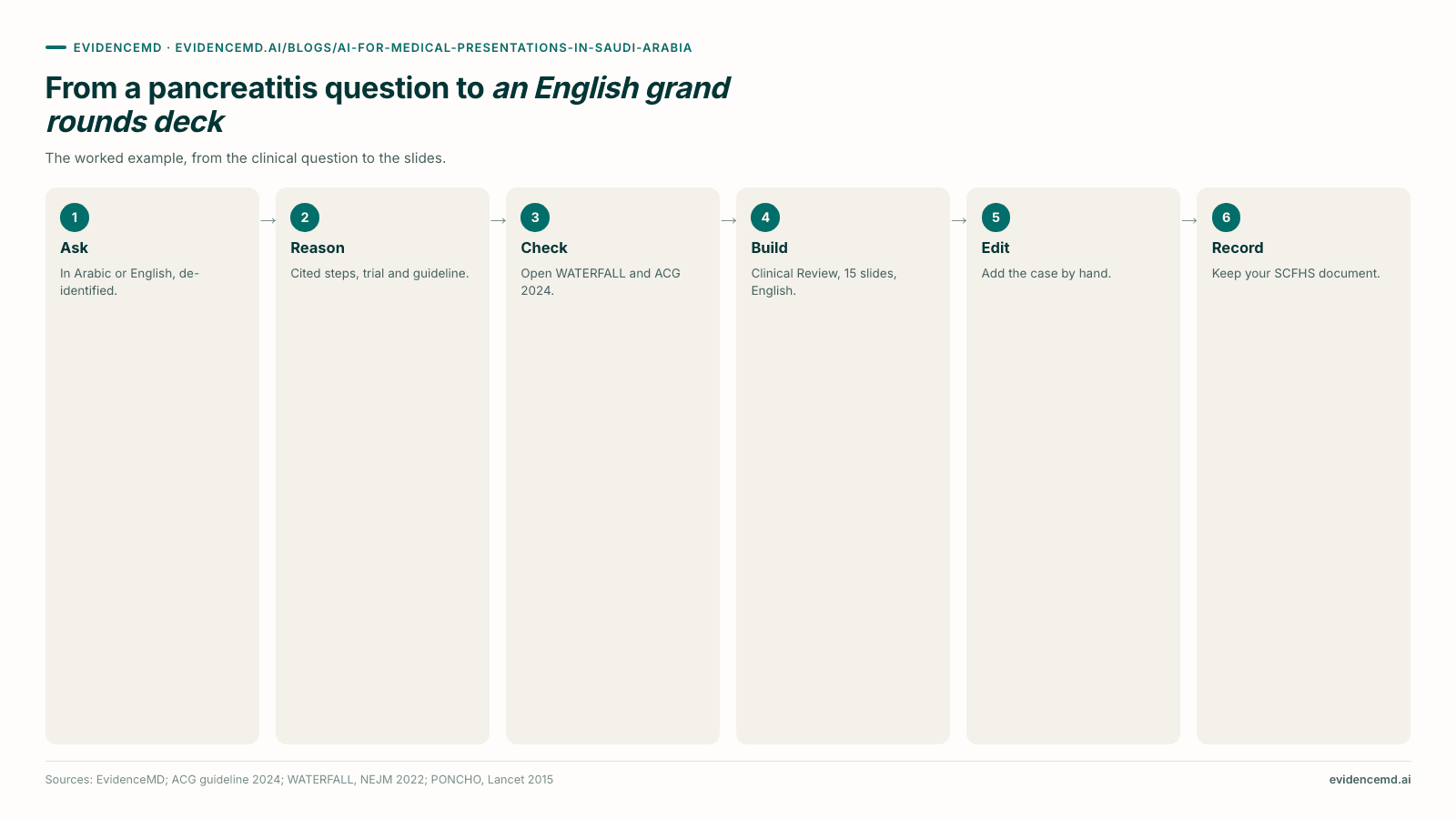
EvidenceMD answers the clinical question behind a case in visible steps, from the assessment to the evidence to the decision, with a citation for each claim, and frames the country-specific parts of an answer to the user's country guidelines [1]. Take an internal medicine resident at a teaching hospital in Riyadh preparing grand rounds. A man in his forties, about 80 kg, came to the emergency department with severe epigastric pain radiating to his back. His lipase is five times the upper limit of normal and ultrasound shows gallstones. He has no organ failure and no sign of cholangitis, but he is tachycardic with dry mucous membranes. The resident types the question in Arabic, as she would put it to a colleague: how much intravenous fluid should he get, when can he eat, does he need antibiotics, and when should his gallbladder come out?
Asked that de-identified question, EvidenceMD works through it like this:
Diagnosis
Acute pancreatitis is diagnosed with two of three criteria: typical abdominal pain, serum amylase or lipase more than three times the upper limit of normal, and characteristic imaging. He meets the first two, and the American College of Gastroenterology (ACG) reserves CT for an unclear diagnosis or no improvement within 48 to 72 hours [11].
Fluids: the trial
WATERFALL randomized patients to aggressive lactated Ringer's (a 20 mL per kg bolus, then 3 mL per kg per hour) or moderate resuscitation (a 10 mL per kg bolus only if hypovolemic, then 1.5 mL per kg per hour). It stopped at the interim analysis of 249 patients: moderately severe or severe pancreatitis 22.1% vs 17.3% (adjusted RR 1.30, 95% CI 0.78 to 2.18), fluid overload 20.5% vs 6.3% (adjusted RR 2.85, 95% CI 1.36 to 5.94) [12].
Fluids: the guideline
The ACG's 2024 guideline suggests moderately aggressive resuscitation, with extra boluses for hypovolemia, and lactated Ringer's over normal saline, both conditional recommendations on low-quality evidence. Without hypovolemia, start at no more than 1.5 mL per kg per hour; with it, give a 10 mL per kg bolus [11].
Feeding and antibiotics
In mild acute pancreatitis the guideline suggests early oral feeding within 24 to 48 hours as tolerated, and it suggests against prophylactic antibiotics even in severe disease [11].
The gallbladder
Mild biliary pancreatitis should be followed by early cholecystectomy, preferably before discharge [11]. In PONCHO, readmission for gallstone-related complications or death within six months fell from 17% (23 of 136) with interval surgery to 5% (6 of 128) with same-admission surgery (RR 0.28, 95% CI 0.12 to 0.66) [13].
Where the clinician decides
Whether he is truly hypovolemic and how he responds at each reassessment (the trial reassessed at 12, 24, 48 and 72 hours), whether the attack stays mild (severe means organ failure lasting more than 48 hours), and the timing of surgery with the surgical team. For him, the moderate regimen means an 800 mL bolus, then 120 mL an hour, adjusted to his response [12][14].
Every step links to its source, so the resident can show the room that the move away from aggressive fluids rests largely on one trial stopped early for harm, and that most of the guideline's advice is conditional. That is the teaching point of the talk.
Ask the question behind your next case
Type it in Arabic or English, de-identified, and read EvidenceMD's reasoning and sources before you build the talk.
How do you turn the case into an evidence-backed AI slide deck in English?
Choose the audience, format and depth, and EvidenceMD writes a cited English deck from the evidence it retrieves.
Give EvidenceMD the topic, not the patient, and it builds the deck in English, the language most grand rounds, journal clubs and case presentations in Saudi hospitals use. It searches the literature first, then writes 10, 15, 20 or 25 slides for the audience, format and evidence depth you choose, and with References switched on the last slide lists the sources the deck cites [3]. The resident can keep asking follow-up questions in Arabic as she refines the English slides. For a journal club on the WATERFALL trial itself, the Journal Club format appraises a single study [3][16].
| Setting | Options in EvidenceMD | For these grand rounds |
|---|---|---|
| Audience | Six audiences, including physician, nurse, pharmacist and medical researcher [3] | Physician |
| Format | Auto, Learning, Clinical Review, Case Discussion, Research Review, Journal Club [3] | Clinical Review |
| Evidence depth | Standard, In-depth, Research-focused [3] | In-depth |
| Slides | 10, 15, 20 or 25 [3] | 15 |
| Language | Decks are written in English from the evidence retrieved [3] | English |
| References | Off by default; on, the last slide lists the sources the deck cites [3] | On |
| Images | Off by default; on, a cover image and up to three decorative illustrations [3] | Off |
| Your context | Custom instructions and one optional PDF or image [3] | "Compare the WATERFALL regimens on one slide" |
→ Scroll the table sideways to see the remaining columns
Each deck opens in a presenter view and downloads as a PDF or a PowerPoint file. You can ask for up to three AI edits per deck, and editing slide text yourself does not use one, which is where the de-identified case details go [3]. Presentations are included with EvidenceMD's annual plans, 20 a month on Individual and unlimited on Max, and EvidenceMD itself is free to start, with paid individual plans from US$50 a month or US$450 a year [2][3].
Frequently asked questions
How many CPD hours does a doctor need to renew SCFHS registration?
Sixty: SCFHS asks for 60 CPD hours from doctors, 40 from pharmacists and specialists and 20 from technicians to renew a two-year professional registration. If the hours fall short, renewal is for one year only, and that option is available once. A talk you build with EvidenceMD counts only through the activity it is part of, such as accredited grand rounds or a recognized teaching program.
Can teaching and journal club participation be recognized as SCFHS CPD hours?
Yes. SCFHS's Recognition of CPD Hours service lists training and teaching activities, journal club participation, scientific posters and published papers among its activity types, each with a supporting document in your name, for SAR 100 per application. Slides drafted with EvidenceMD are recorded the same way as any other teaching you do.
Do I need written consent to show a surgical photo at a lecture in a Saudi hospital?
Yes. The implementing regulation of the Law of Practicing Healthcare Professions requires the patient's written consent, the facility's approval and an approved scientific purpose before surgeries or remedial procedures are photographed or published. EvidenceMD builds decks from a clinical topic, so patient images never need to go into it.
Does the 2026 Saudi Copyright Law allow journal figures in a lecture?
Within limits. Article 26 allows images, drawings, maps and similar works in lectures or scientific conferences to explain content, limited to what is needed and naming the source and author, and Article 37 requires that the use not conflict with the work's normal exploitation. EvidenceMD's optional deck images are decorative and contain no text or numbers, so credit or redraw any trial figure you add.
Can I ask EvidenceMD a clinical question in Arabic and build the slides in English?
Yes. EvidenceMD's clinical reasoning answers in 30 languages, including Arabic, and its slide decks are written in English, the working language of most grand rounds and journal clubs in Saudi hospitals. Check that the terms match your department's usage before you present.
Can I put a patient's case into an AI tool under the PDPL?
Only de-identified. The PDPL treats health data as sensitive data, counts records, photos and ID numbers as personal data, and allows transfers outside the Kingdom only on conditions. EvidenceMD is hosted in the United States, so ask it about an age band, the key findings and the decision you face, never a named patient.
Is aggressive IV fluid resuscitation still recommended in acute pancreatitis?
No. In the WATERFALL trial, aggressive resuscitation caused more fluid overload (20.5% vs 6.3%) without reducing moderately severe or severe pancreatitis, and the ACG's 2024 guideline suggests moderately aggressive fluids with lactated Ringer's instead. EvidenceMD shows both sources step by step, so a resident can present the evidence and its limits together.
The bottom line
For clinicians preparing grand rounds, journal clubs or case presentations in Saudi Arabia, AI helps most with the evidence work: answering the clinical question and drafting cited slides. EvidenceMD does that in Arabic or English, with its reasoning shown and a citation for every claim, and builds a 10 to 25 slide deck in English [1][3]. The rest stays with you: keeping the documents SCFHS needs to recognize teaching, written consent and confidentiality under the Law of Practicing Healthcare Professions, de-identification under the PDPL, credit for every figure under the 2026 Copyright Law, and the clinical judgement on every slide [5][6][7][8][9].
Sources & related evidence
EvidenceMD's own pages (company claims), SCFHS's Mumaris+ and service pages, the Ministry of Health's English text of the Law of Practicing Healthcare Professions, SDAIA's English translation of the PDPL, the Copyright Law in Umm Al-Qura, Creative Commons, and the guideline and trials behind the worked example.
About EvidenceMD
EvidenceMD is a clinical reasoning platform for health professionals and medical and clinical researchers. It answers clinical questions from 40 million+ peer-reviewed papers and clinical guidelines with a visible chain of reasoning and a citation for every claim, in 30 languages including Arabic, needs no NPI or license check, and builds cited slide decks in English from a clinical topic; it is free to start. Application data is hosted in the United States. Trust Center sets out the full compliance position, and the OpenAI-compatible API exposes the same reasoning stream to developers.
Related reading
Start your next grand rounds from the clinical question
Ask EvidenceMD the de-identified question behind your case, in Arabic or English, read the reasoning and the sources, then build the deck in English. Free to start.