What are the best AI tools for doctors in Saudi Arabia in 2026?
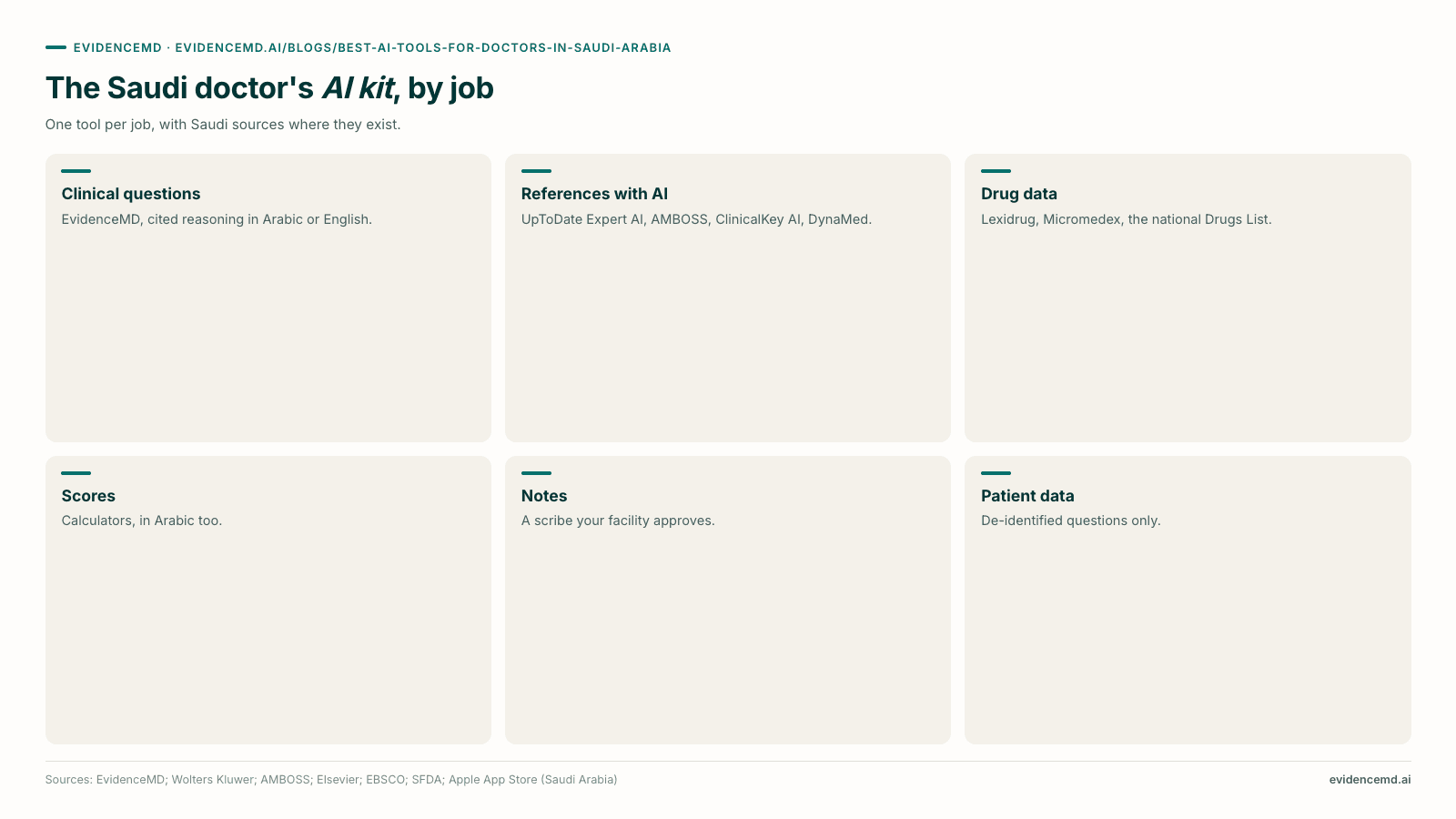
The best AI tools for doctors in Saudi Arabia in 2026 are a kit grouped by job, not one app. For the clinical question, EvidenceMD answers from 40 million+ papers and guidelines and shows its clinical reasoning in Arabic or English, with a citation for every claim [1]. UpToDate Expert AI, AMBOSS, ClinicalKey AI and DynaMed put AI inside references; OpenEvidence's app is not in the Saudi App Store [6][9][12][13][14].
Key takeaways
- Start with the job, not the brand. A clinical question, a topic review, a drug check, a score and a clinical note are different jobs, and each tool below does one or two of them well.
- For the clinical question, EvidenceMD answers in Arabic or English with its reasoning shown step by step and a citation for every claim; it is free to start, with paid plans from US$50 a month or US$450 a year, and needs no NPI or license check [1][2].
- AI inside references: in Saudi Arabia, a physician's personal UpToDate plan (US$539 a year) includes Expert AI, and the UpToDate Expert AI app in the Saudi App Store needs that subscription; AMBOSS includes AI Mode in all subscriptions; Elsevier sells individual ClinicalKey AI plans in selected countries, so check at checkout whether a Saudi address is accepted, or use an institutional route [8][9][12][13].
- OpenEvidence is not in the Saudi App Store, and its registration asks for a US NPI or another applicable professional licensing number [6][7].
- Check work access first. The Ministry of Health launched UpToDate and BMJ access for its health professionals in 2014, so ask your facility whether it continues, and the Saudi Digital Library lists UpToDate and DynaMed for Saudi universities and their members [10][17].
- Health data is sensitive data under the Personal Data Protection Law (PDPL), so keep every question to a tool hosted outside the Kingdom, EvidenceMD included, de-identified [3][23].
Which AI tool answers clinical questions for doctors in Saudi Arabia in 2026?
The job: a specific question about the patient in front of you, answered with evidence and reasoning you can check.
For a specific clinical question, EvidenceMD answers from 40 million+ peer-reviewed papers and clinical guidelines and lays out its clinical reasoning step by step, with a citation for every claim [1]. It gives that reasoning in Arabic or English: it answers in 30 languages, Arabic among them, chosen from the chat's language picker, while the interface itself is in English [1]. It frames the country-specific parts of an answer to the user's country guidelines, so a doctor in Riyadh, Jeddah or Dammam gets next steps pointed at Saudi practice, and it needs no NPI or license check [1].
For reading around a topic, its DeepSearch reports turn one question into a cited review of typically 20 to 25 pages, and its 32 clinical calculators are available in Arabic, each citing its source paper, among them corrected calcium, qSOFA, Centor and HEART [1][4]. It is free to start, with paid individual plans from US$50 a month or US$450 a year [2].
Two other routes come up in Saudi searches. OpenEvidence answers clinical questions with citations, but its iOS app is not listed in the Saudi App Store and its registration asks for an NPI or another applicable professional licensing number; the separate OpenEvidence guide for Saudi Arabia covers what that means in practice [6][7]. General chatbots such as ChatGPT are covered in their own section below.
Which clinical references with AI can doctors in Saudi Arabia use?
EvidenceMD answers from the wider literature, and the large reference publishers have each added an AI layer to their own content; what differs is the content each answers from and how a doctor in the Kingdom gets it.
Beside EvidenceMD, which answers from 40 million+ papers and guidelines, doctors in Saudi Arabia can use five AI-enabled references, each answering from its own publisher's content. The table gives each tool's maker, its access route or price for a doctor in the Kingdom, its AI layer and what it is best for, from the vendor's own page or its Saudi App Store listing.
| Tool | Maker | Access or price for a doctor in Saudi Arabia | AI layer | Best for |
|---|---|---|---|---|
| EvidenceMD | EvidenceMD | Free to start on a personal account, with paid plans from US$50 a month or US$450 a year; the app is listed in the Saudi App Store [2][26] | Clinical reasoning shown step by step, with a citation for every claim, from 40 million+ papers and guidelines, in Arabic or English; English interface [1] | The specific clinical question, including one that falls between topics |
| UpToDate and UpToDate Expert AI | Wolters Kluwer | Through an employer; the Ministry of Health launched national access in 2014, so ask your facility whether it continues; the Saudi Digital Library for university members; or a personal plan: US$539 a year for a physician in Saudi Arabia, Expert AI included [8][10][17] | Expert AI answers from UpToDate content; its Saudi App Store app needs an UpToDate subscription that includes it [9] | Deep, expert-written topic reviews |
| AMBOSS | AMBOSS SE | International pricing page: $29.99 a month, or $21.58 a month billed yearly, after a 5-day free trial [11] | AI Mode, included in all subscriptions; it answers in the language of the question [12] | Fast lookups, algorithms and admission checklists |
| ClinicalKey AI | Elsevier | Individual plans are sold in selected countries, so check at checkout whether a Saudi address is accepted; in the Kingdom it usually comes through an institution. US pricing is US$39 a month or US$349 a year, with a free trial [13] | Answers from Elsevier point-of-care content, full-text journals and guidelines, with references [13] | Cited answers from textbook and journal full text |
| DynaMed | EBSCO | Personal plan at US$399 a year; DynaMed is on the Saudi Digital Library list for university members [14][17] | Dyna AI, sold to individual subscribers only in the USA [14] | Graded point-of-care topics |
| Medscape | WebMD | Free app in the Saudi App Store [15] | AI Search, plus a scribe for visit transcription and summaries [15] | News, drug and disease information, calculators |
→ Scroll the table sideways to see the remaining columns
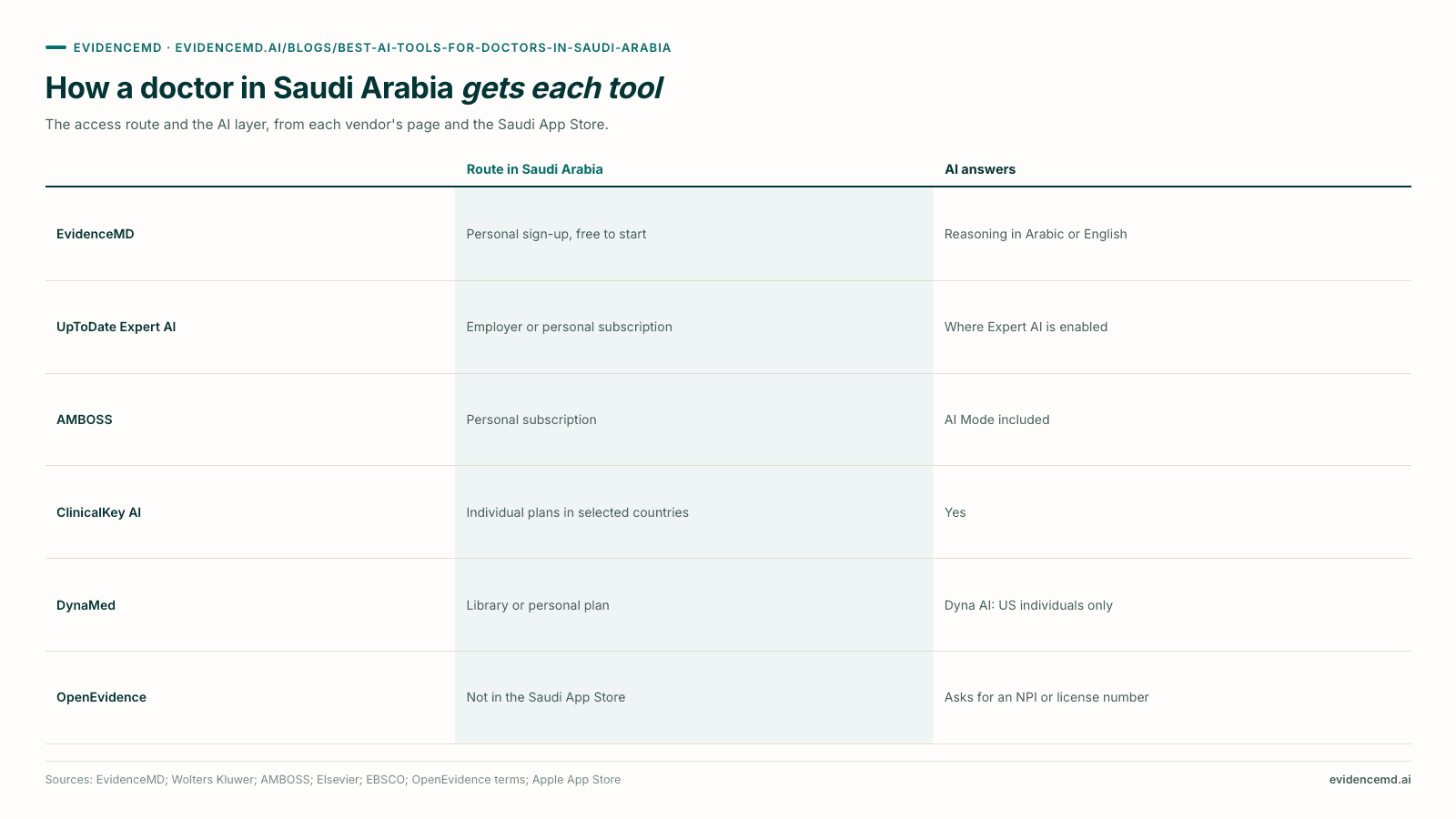
BMJ Best Practice belongs on the same shelf: BMJ access was part of the Ministry of Health's 2014 launch, so ask your facility whether it continues [10]. Each of these references answers from its own publisher's content, which keeps answers consistent but limits them when a question falls between topics or turns on a trial published since the last update. There, a tool that reasons across the wider literature, such as EvidenceMD, complements the reference rather than replacing it [1].
How does EvidenceMD reason through a type 2 diabetes and CKD question?
A de-identified question from a Saudi diabetes clinic, the guideline behind each step, and what the physician still decides.
Take a question an internist in Riyadh might ask between clinic patients, written without identifiers: a 58-year-old man with type 2 diabetes for 12 years, on metformin 2 g a day and gliclazide, with an HbA1c of 8.4%, an eGFR of 41 mL/min per 1.73 m², a urine albumin-to-creatinine ratio of 320 mg/g, blood pressure of 138 mmHg systolic and 84 mmHg diastolic on the highest dose of perindopril, potassium 4.6 mmol/L and a BMI of 33. What should come next: an SGLT2 inhibitor, a GLP-1 receptor agonist or finerenone, and what happens to his metformin? The doctor can type the question in Arabic and read the reasoning in Arabic.
EvidenceMD works through it in order and cites each step. First, kidney protection: KDIGO's 2022 guideline recommends an SGLT2 inhibitor for people with type 2 diabetes, CKD and an eGFR of 20 or more (grade 1A), added to the glucose-lowering drugs they already take [21]. Second, metformin: KDIGO recommends it while the eGFR is 30 or more, and its dosing guidance halves the dose when the eGFR is 30 to 44, so 2 g a day becomes 1 g, with kidney function monitored every three to six months [21]. Third, albuminuria: with albuminuria persisting on the maximum tolerated ACE inhibitor, an eGFR of 25 or more and a normal potassium, KDIGO suggests a nonsteroidal mineralocorticoid receptor antagonist such as finerenone (grade 2A), with potassium monitored after it starts [21].
Fourth, glucose and weight: if his HbA1c stays above target on metformin and an SGLT2 inhibitor, KDIGO recommends a long-acting GLP-1 receptor agonist (grade 1B), preferably one with proven cardiovascular benefit and useful where weight loss is a goal, and notes that the sulfonylurea dose may need to come down to limit hypoglycemia [21]. In the FLOW trial, weekly semaglutide in 3,533 people with type 2 diabetes and CKD lowered the risk of major kidney disease events by 24% (hazard ratio 0.76) over a median of 3.4 years [22]. Last, the Saudi check: empagliflozin, dapagliflozin, semaglutide and finerenone all appear in the Saudi Food and Drug Authority (SFDA) Drugs List [16].
What stays with the physician: the order and pace of adding each drug, how far to reduce the gliclazide, sick-day advice, how each drug is handled if he fasts in Ramadan (KDIGO considers it reasonable to withhold an SGLT2 inhibitor during times of prolonged fasting, surgery or critical illness), and what his insurance or hospital formulary covers [21]. Every step carries its source, so the physician can accept or reject each one on its own.
Ask EvidenceMD a question from your own clinic
Try a de-identified clinical question in Arabic or English and read the reasoning and the source behind each step.
Which drug references and Saudi resources should sit beside an AI tool?
AI answers the question; a drug reference and the Saudi sources confirm the product, the dose and what is registered here.
UpToDate Lexidrug
Wolters Kluwer's drug reference, free to download in the Saudi App Store, with content through a subscription; updated daily for dosing and medication decisions [19].
Micromedex
Merative's drug reference, free to download in the Saudi App Store: drug summaries, NeoFax and pediatric reference, IV compatibility, interactions and calculators, usually through a hospital license [18].
SFDA Drugs List
The Saudi Food and Drug Authority's searchable list of registered medicines by trade name, scientific name, agent or registration number, with strength, dosage form and price [16].
Ministry of Health access
The Ministry launched UpToDate and BMJ free of charge for its health professionals in February 2014; ask your facility whether that access continues and how to sign in [10].
Saudi Digital Library
The national library for Saudi universities and their members; its database list includes UpToDate and DynaMed [17].
Calculators in Arabic
EvidenceMD's 32 clinical calculators, in Arabic and English, each citing its source paper [4].
Can doctors in Saudi Arabia use ChatGPT and other general chatbots for clinical questions?
General chatbots help with drafting and explaining; the clinician version of ChatGPT is not yet open to Saudi doctors.
Doctors in Saudi Arabia can use general chatbots such as ChatGPT for drafting a referral letter, summarizing a paper they paste in or explaining a concept, but not OpenAI's clinician product. OpenAI offers ChatGPT for Clinicians free of charge to verified clinicians in the United States, with a valid NPI and a license confirmed by a verification provider, and says it plans to expand to more countries over time [20].
For a clinical question, the test is whether every claim carries a source you can open and whether you can see how the answer was reached. EvidenceMD shows both: each reasoning step, with its source [1]. The separate ChatGPT guide for doctors in Saudi Arabia covers the chatbots in more depth.
Where do AI scribes fit for doctors in Saudi Arabia?
A scribe listens to the consultation, so it handles identifiable patient data by design, and that changes the rules.
An AI scribe drafts the clinical note from a recorded consultation. EvidenceMD offers a Physician Scribe, with Clinical Reasoning (the default), Narrative and Concise note styles, and a Nursing Scribe, and Medscape's app now includes a visit scribe alongside its AI search [5][15].
Unlike a de-identified question, a consultation recording carries the patient's identity and health details. The PDPL treats health data as sensitive data, and sending personal data to a service outside the Kingdom is a transfer that Article 29 allows only under set conditions [23]. EvidenceMD's application data is hosted in the United States [3]. For Saudi patients, use a scribe only where your facility has approved it and the patient has agreed, and keep clinical questions to any foreign-hosted tool de-identified.
What do Saudi rules say about doctors using AI tools?
Two rules matter day to day: what counts as a medical device, and where patient data may go.
Saudi rules separate what a tool is from what you put into it. The SFDA's guidance MDS-G010 (version 1.0, November 29, 2022) sets out how AI and machine-learning technologies that diagnose, manage or predict diseases obtain medical device marketing authorization in the Kingdom [24]. The Personal Data Protection Law, published by the Saudi Data and AI Authority (SDAIA), classes health data as sensitive data and allows transfer outside the Kingdom only under the conditions in Article 29 [23].
Whatever the tool, it supports the decision and the doctor makes it. The Saudi rules guide on this site covers the PDPL, the SFDA guidance and SDAIA's principles in depth [25].
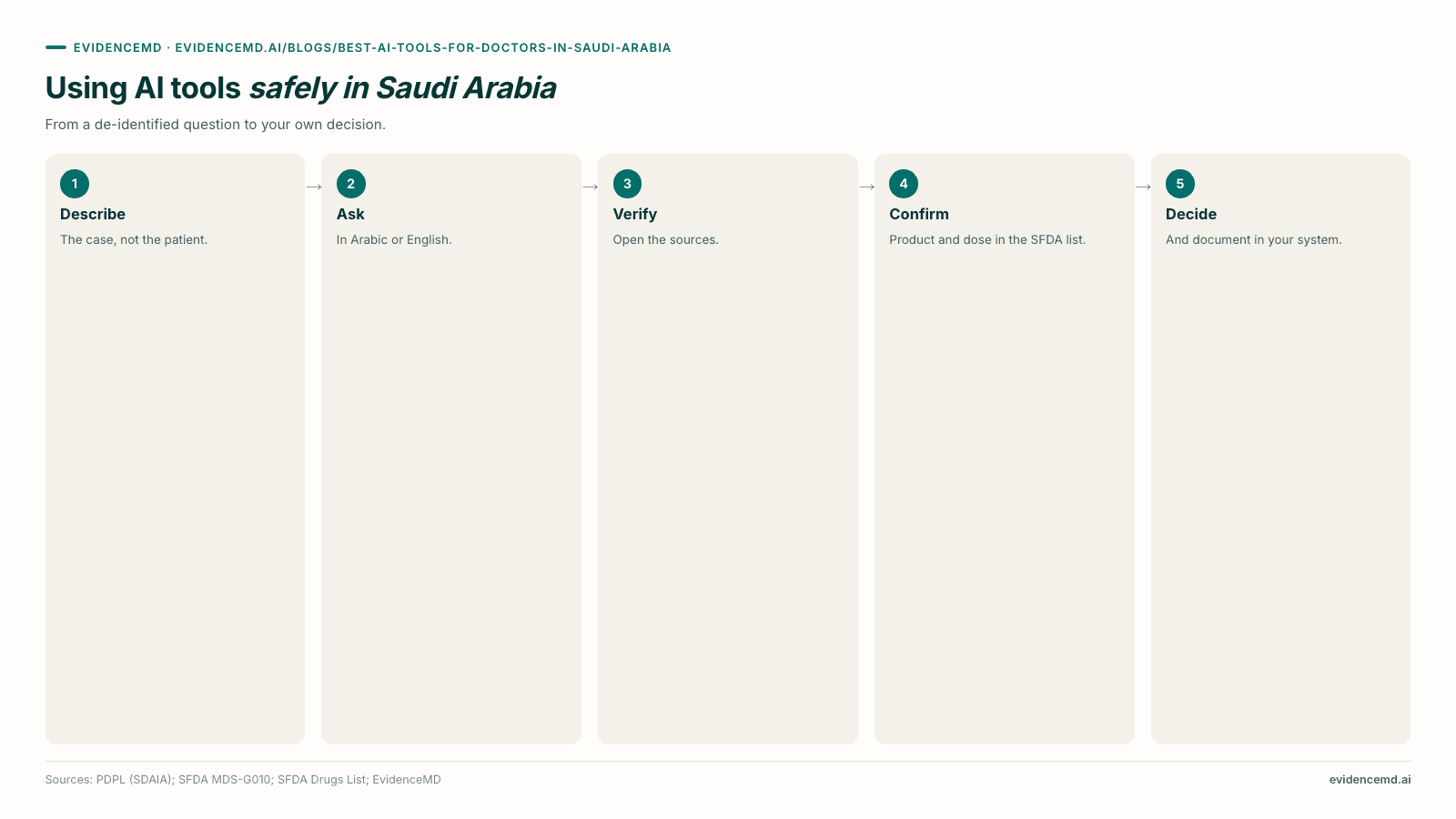
Describe the case, not the patient
Before asking any tool hosted outside the Kingdom, EvidenceMD included, leave out names, national ID or iqama numbers, file numbers and dates that identify the patient. EvidenceMD's application data is hosted in the United States (Azure East US 2), and its Trust Center says conversations are not used to train or fine-tune models [3][23].
Frequently asked questions
Which AI tool gives clinical reasoning in Arabic for doctors in Saudi Arabia?
EvidenceMD gives its clinical reasoning in Arabic or English: it answers in 30 languages, Arabic among them, shows each step with a citation and frames the country-specific parts to Saudi guidance. The interface is in English, and it needs no NPI or license check.
Can a doctor in Saudi Arabia get UpToDate Expert AI personally?
Yes. In Saudi Arabia, a physician's personal UpToDate plan (US$539 a year) includes Expert AI, and the UpToDate Expert AI app in the Saudi App Store needs that subscription or an employer's subscription with Expert AI enabled. EvidenceMD, a separate clinical reasoning tool, is free to start on a personal account and shows its reasoning step by step.
Is OpenEvidence in the Saudi App Store?
No. Apple's lookup for OpenEvidence's iOS app returns no Saudi listing, while the app is listed in the US, Canada and the UAE; whether its website or Android app works from the Kingdom is unconfirmed. EvidenceMD works in Saudi Arabia with no NPI or license check.
Can doctors in Saudi Arabia sign up for ChatGPT for Clinicians?
Not yet. OpenAI offers ChatGPT for Clinicians free of charge to verified US clinicians, with an NPI and a license check, and says it plans to add countries over time. General ChatGPT can help with drafting, but check any clinical claim against its source; EvidenceMD cites every claim and shows its reasoning step by step.
Which clinical references do Saudi doctors get through the Ministry of Health or a university?
The Ministry of Health launched UpToDate and BMJ access for its health professionals in February 2014; ask your facility whether it continues and how to sign in. Saudi university members reach licensed databases through the Saudi Digital Library, whose list includes UpToDate and DynaMed; ClinicalKey usually comes through a hospital or university library subscription. EvidenceMD is a personal tool that needs no institutional license.
Can doctors in Saudi Arabia enter patient details into an AI tool?
Only de-identified details, unless your facility has approved the tool for patient data. The PDPL classes health data as sensitive data and sets conditions on transferring personal data outside the Kingdom. EvidenceMD is hosted in the United States, so describe the case rather than the patient.
What is the best medical AI app for doctors in Saudi Arabia?
It depends on the job. For the clinical question with cited reasoning in Arabic or English, EvidenceMD; for topic reviews, UpToDate, AMBOSS, ClinicalKey AI or DynaMed through work or a subscription; for drug checks, Lexidrug or Micromedex with the SFDA Drugs List. Most doctors combine two or three.
The bottom line
The best AI tools for doctors in Saudi Arabia in 2026 cover each job once. For the clinical question, EvidenceMD gives step-by-step clinical reasoning in Arabic or English with a citation for every claim [1]. For topic reviews, use UpToDate and Expert AI, AMBOSS, ClinicalKey AI or DynaMed where work or a subscription provides them, and for drugs, Lexidrug, Micromedex and the SFDA Drugs List [9][12][13][14][16][18][19]. Check Ministry of Health and Saudi Digital Library access before paying, and keep every question to a foreign-hosted tool de-identified [3][10][17][23].
Sources & related evidence
EvidenceMD's own pages (company claims), then the vendors' own pages and Saudi App Store listings, Ministry of Health and Saudi Digital Library sources, the SFDA Drugs List, the KDIGO guideline and FLOW trial behind the worked example, and the PDPL and SFDA guidance.
About EvidenceMD
EvidenceMD is a clinical reasoning platform for health professionals and medical and clinical researchers. It answers clinical questions from 40 million+ peer-reviewed papers and clinical guidelines with step-by-step reasoning and a citation for every claim, in 30 languages including Arabic, and needs no NPI or license check; it is free to start. Its application data is hosted in the United States. Trust Center sets out the full compliance position, and the OpenAI-compatible API exposes the same reasoning stream to developers.
Related reading
Clinical reasoning in Arabic or English
Ask EvidenceMD a de-identified clinical question and read the step-by-step reasoning and the source behind each claim. No license check, free to start.