Can clinicians use AI in clinical practice in Saudi Arabia?
Clinicians can use AI in clinical practice in Saudi Arabia, but no AI-specific law changes their duties: health data is sensitive under the PDPL, intended use decides SFDA device status, SDAIA makes users verify generative AI output, and confidentiality still applies. For clinical questions, EvidenceMD, a clinical reasoning platform that answers in Arabic or English, fits these rules: ask a de-identified question, then check its cited, step-by-step reasoning before acting [1][6][7][11][12].
Key takeaways
- Intended use decides device status. The SFDA says an AI or machine learning product intended for “investigation, detection diagnosis, monitoring, treatment, or management” of a condition is a medical device under its controls; general medical information without patient-specific advice is not [4][6].
- Health data is sensitive data. The Personal Data Protection Law lists health data among sensitive data and requires extra controls that limit access to the minimum number of staff needed to provide care [7].
- Sending identifiable data abroad has conditions. PDPL Article 29 requires an adequate level of protection outside the Kingdom and only the minimum data needed; the transfer regulation adds a risk assessment for continuous or widespread transfers of sensitive data [7][8].
- You verify the output. SDAIA's Generative AI Guidelines say “It is users' responsibility to verify the content generated by GenAI”, and its AI Ethics Principles reserve life-and-death decisions for human oversight [10][11].
- Confidentiality and consent are statutory. The Law of Practicing Healthcare Professions requires consent before any medical intervention and confidentiality of what you learn in practice, and the SCFHS Code of Ethics requires consent before recording a patient's voice [12][13].
- A draft may tighten storage rules. SDAIA consulted from October 6 to November 5, 2026 on draft regulation amendments that would require controllers to store personal data inside the Kingdom; they are not yet in force [9].
Which rules apply in 2026 when a clinician in Saudi Arabia uses AI?
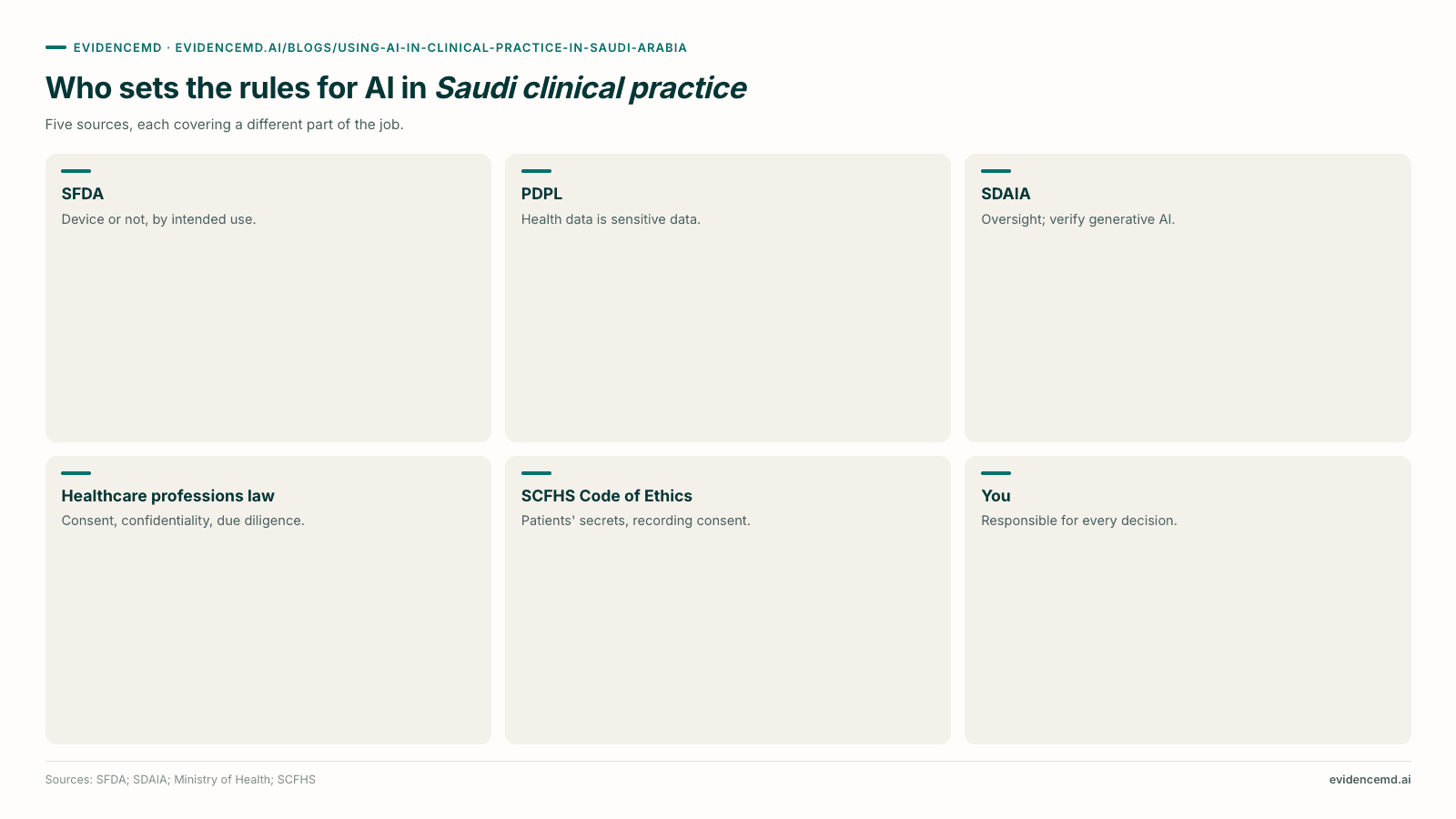
Device rules from the SFDA, data rules from the PDPL, ethics guidance from SDAIA, and the professional duties in the healthcare professions law and the SCFHS Code of Ethics each cover part of the job.
None of these documents is a law written for clinicians' use of AI. The device guidance tells manufacturers when software needs marketing authorization, the PDPL governs any processing of personal data, SDAIA's documents set expectations for anyone who builds or uses AI, and the professional texts set the duties that follow the clinician into any tool. On March 10, 2026, the Cabinet approved 2026 as the Year of Artificial Intelligence, a national priority rather than a new rule for practice [14].
| Who | Document and date | What it covers |
|---|---|---|
| Saudi Food and Drug Authority (SFDA) | MDS-G010, Guidance on AI and ML technologies based medical devices (version 1.0, November 29, 2022) [4] | Marketing authorization for AI that diagnoses, manages or predicts disease |
| SFDA | MDS-G23, Guidance on Software as a Medical Device (version 2.0, April 24, 2024) [5] | The IMDRF definitions and risk framework, adopted as considerations |
| SFDA | MDS-G27, Guidance on Digital Health Products (version 1.0, August 11, 2025) [6] | Which software, apps, decision support and scribes qualify as medical devices |
| Saudi Data and AI Authority (SDAIA) | Personal Data Protection Law, Royal Decree M/19 of 9 Safar 1443 AH (September 2021) and its amendments [7] | Sensitive health data, consent, transfer outside the Kingdom, penalties |
| SDAIA | Regulation on Personal Data Transfer outside the Kingdom (version 2.0, August 2024) [8] | Safeguards and risk assessment for transfers abroad |
| SDAIA | AI Ethics Principles (version 1.0, September 2023); Generative AI Guidelines for the public (version 1, January 2024) [10][11] | Human oversight, accountability, verification of generative AI output |
| Ministry of Health | Law of Practicing Healthcare Professions, Royal Decree M/59 of 4 Dhu al-Qadah 1426 AH (December 2005), with its implementing regulation [12] | Consent, confidentiality, due diligence, scientifically recognized methods |
| Saudi Commission for Health Specialties (SCFHS) | Code of Ethics for Healthcare Practitioners (English edition, 2014) [13] | Patients' secrets, recording, teaching without identifying the patient |
→ Scroll the table sideways to see the remaining columns
When is clinical AI software a medical device under SFDA rules?
When its intended use is medical and patient-specific. The SFDA's 2025 digital health guidance sets out the test, and its 2022 AI guidance applies the same logic to machine learning [4][6].
MDS-G010 applies to “Artificial Intelligence (AI) and Machine Learning (ML) technologies that diagnose, manage or predict diseases by analyzing medical data.” It says the intended use will determine whether such a technology is regulated as a medical device, and that if the developer intends it to be used for “investigation, detection diagnosis, monitoring, treatment, or management of any medical condition, disease, anatomy or physiological process, it will be classified as a medical device subject to SFDA's regulatory controls” [4].
MDS-G27, issued on August 11, 2025, makes the test concrete. Whether a digital health product is a medical device “depends on its intended use, as defined by the manufacturer”, read from its labeling, specifications and instructions [6]. Its decision pathway asks whether the software analyzes, interprets or manipulates data “beyond basic functions like storage, archiving, communication, or search”, and whether its action is intended to benefit individual patients [6].
| Kind of software | SFDA's wording | Question to ask about a tool |
|---|---|---|
| General medical information | Not a device: “Educational or informational software that provides general health or medical knowledge without offering patient-specific diagnoses, treatment recommendations, or clinical decisions support” [6] | Does it give knowledge, or advice about one patient? |
| Health information technology | Not a device “unless they are specifically intended to analyze or interpret medical information for the purpose of diagnosing, treating, mitigating, curing, or preventing a disease or health condition” [6] | Does it only store and display, or does it interpret? |
| Decision support that qualifies | “A clinical decision support system (CDSS) that monitors patient data in real time and generates alerts for abnormal conditions requiring medical intervention” [6] | Does it act on live patient data? |
| Scribes that qualify | “A voice scribe system that transcribes clinician-patient interactions and generates diagnostic suggestions” [6] | Does the scribe only transcribe, or also suggest diagnoses? |
| AI and machine learning | “AI/ML-enabled software that meets a medical purpose is typically regulated as SaMD”, with requirements including human oversight: “The role of healthcare professionals must be defined, with safeguards for human review and intervention” [6] | Who reviews the output before it reaches the patient? |
→ Scroll the table sideways to see the remaining columns
MDS-G23, version 2.0 of April 24, 2024, adopts the International Medical Device Regulators Forum (IMDRF) definitions, while stating that those principles “do not reflect SFDA regulatory requirements and are intended only to be considerations” [5]. Its lowest significance level, informing clinical management, is information that “will not trigger an immediate or near term action”, such as aggregating relevant information on a disease, condition or drugs [5]. This guide makes no claim about EvidenceMD's status under SFDA rules; ask any vendor, EvidenceMD included, how it classifies its product and why.
What does the PDPL say about patient data in AI tools?
Health data is sensitive personal data. Processing it needs a lawful basis and extra controls, and sending it outside the Kingdom has conditions [7][8].
Health data is sensitive
Article 1 defines health data as “Any Personal Data related to an individual's health condition, whether their physical, mental or psychological conditions, or related to Health Services received by that individual”, and lists it among sensitive data [7].
Extra controls for health data
Article 23 requires the regulations to restrict access to health data, including medical files, “to the minimum number of employees or workers and only to the extent necessary to provide the required Health Services” [7].
The law reaches foreign services
Article 2 applies the law to processing in the Kingdom and to processing of data about people residing in the Kingdom “by any means from any party outside the Kingdom” [7].
Transfers abroad have conditions
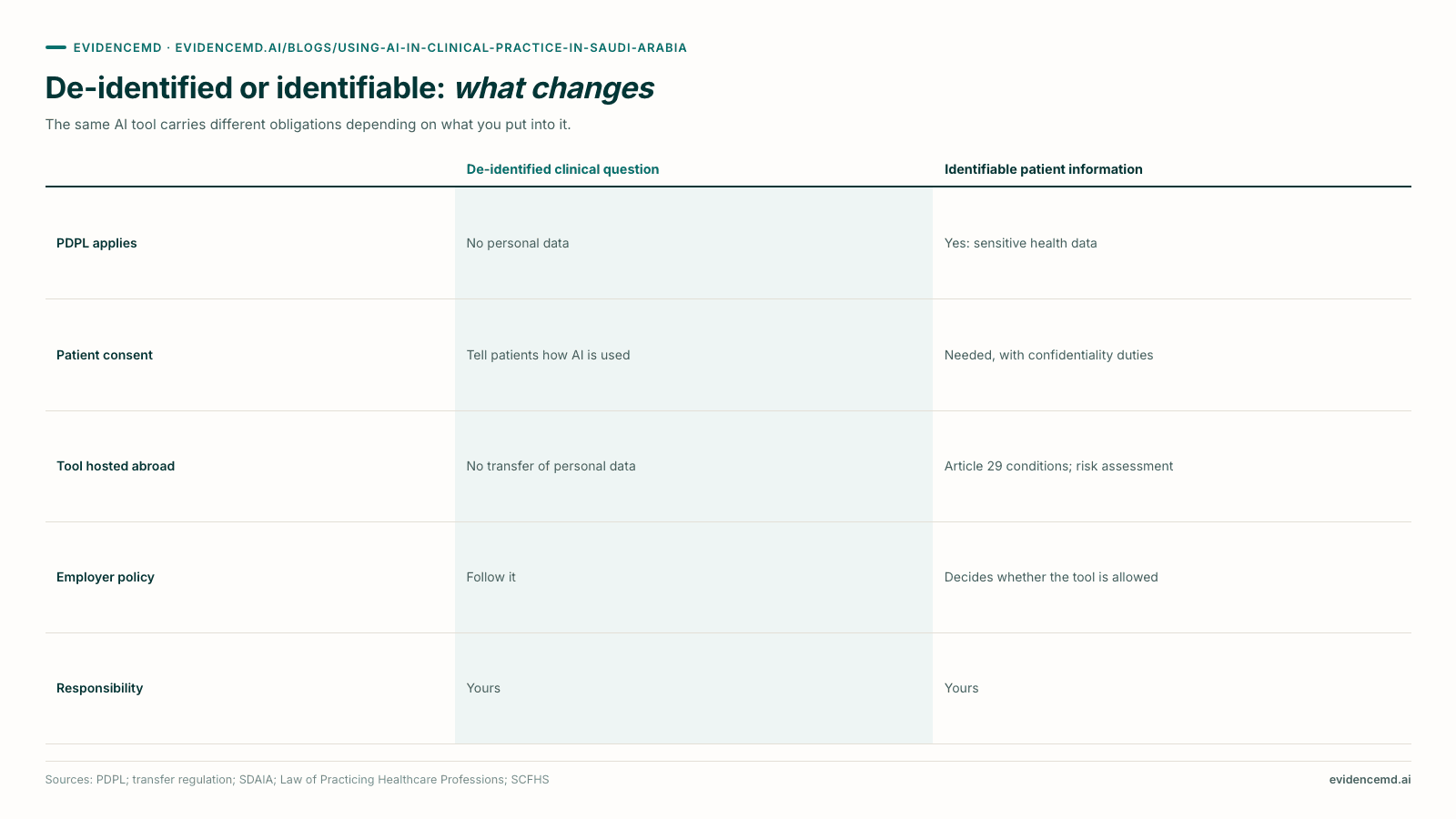
Article 29 requires no prejudice to national security, an adequate level of protection outside the Kingdom, and that a transfer “be limited to the minimum amount of Personal Data needed” [7]. Those conditions do not apply in cases of extreme necessity to preserve the data subject's life or vital interests or to prevent, examine or treat disease. The transfer regulation adds a risk assessment for continuous or widespread transfers of sensitive data [8].
Consent is the default
Article 5: except where the law provides otherwise, personal data may not be processed without the data subject's consent, which can be withdrawn at any time [7].
Penalties
Disclosing sensitive data in violation of the law to harm the data subject or for personal benefit carries up to two years' imprisonment, a fine of up to SAR 3 million, or both; other violations carry a warning or a fine of up to SAR 5 million [7].
The definition of personal data is the practical lever. The PDPL covers data that may identify an individual “directly or indirectly”, including names, identification numbers, records and photos [7]. A clinical question written so that no one could identify the patient from it is outside that definition, which is why every routine in this guide starts with de-identification.
The rules may tighten. SDAIA opened a public consultation on October 6, 2026, closing November 5, 2026, on draft amendments to the PDPL Implementing Regulations; one proposal would require controllers to store personal data within the Kingdom while still allowing transfers under the law. If adopted, the amendments would enter into force 60 days after publication in the Official Gazette [9].
What do SDAIA's AI Ethics Principles and Generative AI Guidelines expect from clinicians?
Human oversight for consequential decisions, accountability that stays with people, and verification of anything a generative tool produces [10][11].
SDAIA's AI Ethics Principles, first published as version 1.0 in September 2023, say that automated systems “involving scenarios where decisions are understood to have an impact that is irreversible or difficult to reverse or may involve life-and-death decisions should trigger human oversight and final determination” [10]. The accountability principle “holds designers, vendors, procurers, developers, owners and assessors of AI systems and the technology itself ethically responsible and liable” for decisions that may harm individuals or communities [10].
The Generative AI Guidelines for the public, version 1 of January 2024, apply to everyone “designing, developing, deploying, implementing, using, or being affected by GenAI systems within KSA” [11]. They warn that text models can “over-confidently generate ‘facts’ that are complete fiction”, say that public services “should also be able to cite sources indicating where the information was acquired”, and put the last check on the user: “It is users' responsibility to verify the content generated by GenAI” [11].
On data, the same guidelines warn that prompts may be used as training data and exposed to third parties, and tell organizations to “implement policies for GenAI use that prohibits users from entering classified information into third-party tools” [11]. For a hospital or clinic, that means your employer's policy decides which tools you may use at work, and identifiable patient information stays out of any tool the policy does not cover.
What do the healthcare professions law and the SCFHS Code of Ethics require of a clinician using AI?
Neither mentions AI, but both apply to it: the law sets consent, confidentiality and due diligence, and its implementing regulation makes the SCFHS Code of Ethics binding on every practitioner [12][13].
The law's implementing regulation states that the “Health professions practicing code of ethics and other guides approved by the commission apply to health practitioners” [12]. So the SCFHS Code of Ethics carries legal weight alongside the articles below, and both apply whatever tool you use.
| Situation | What applies | Practical step |
|---|---|---|
| Any AI-assisted decision | Article 26: the practitioner's commitment is “to exert due diligence consistent with recognized scientific principles”; Article 7: no methods of diagnosis or treatment that are “scientifically unrecognized or prohibited in the Kingdom” [12] | Check the evidence behind each output before acting |
| Identifiable information into an AI tool | Article 21: maintain the confidentiality of information obtained in practice, with listed exceptions such as reporting communicable diseases or the patient's written agreement [12]; PDPL sensitive data rules [7] | Describe the case, not the patient |
| Recording an encounter with an AI scribe | SCFHS Code of Ethics: inform the patient of the purpose and of how and where the recording will be used, and obtain consent before photographing or recording [13] | Ask each time; record the answer in the file |
| Using a case for teaching or a presentation | SCFHS Code of Ethics: disclosure for education must be limited to that purpose and refrain from “disclosing what could lead to the identification of the patient” [13]; regulation 5-3: written consent and facility approval to photograph or publish procedures [12] | Remove identifiers; get written consent for images |
| Any treatment that follows | Article 19: no medical intervention without the consent of the patient, or a representative or guardian if the patient is legally incompetent, except in emergencies [12] | Discuss the plan, including where AI informed it |
→ Scroll the table sideways to see the remaining columns
How do you choose and use an AI tool safely in Saudi practice?
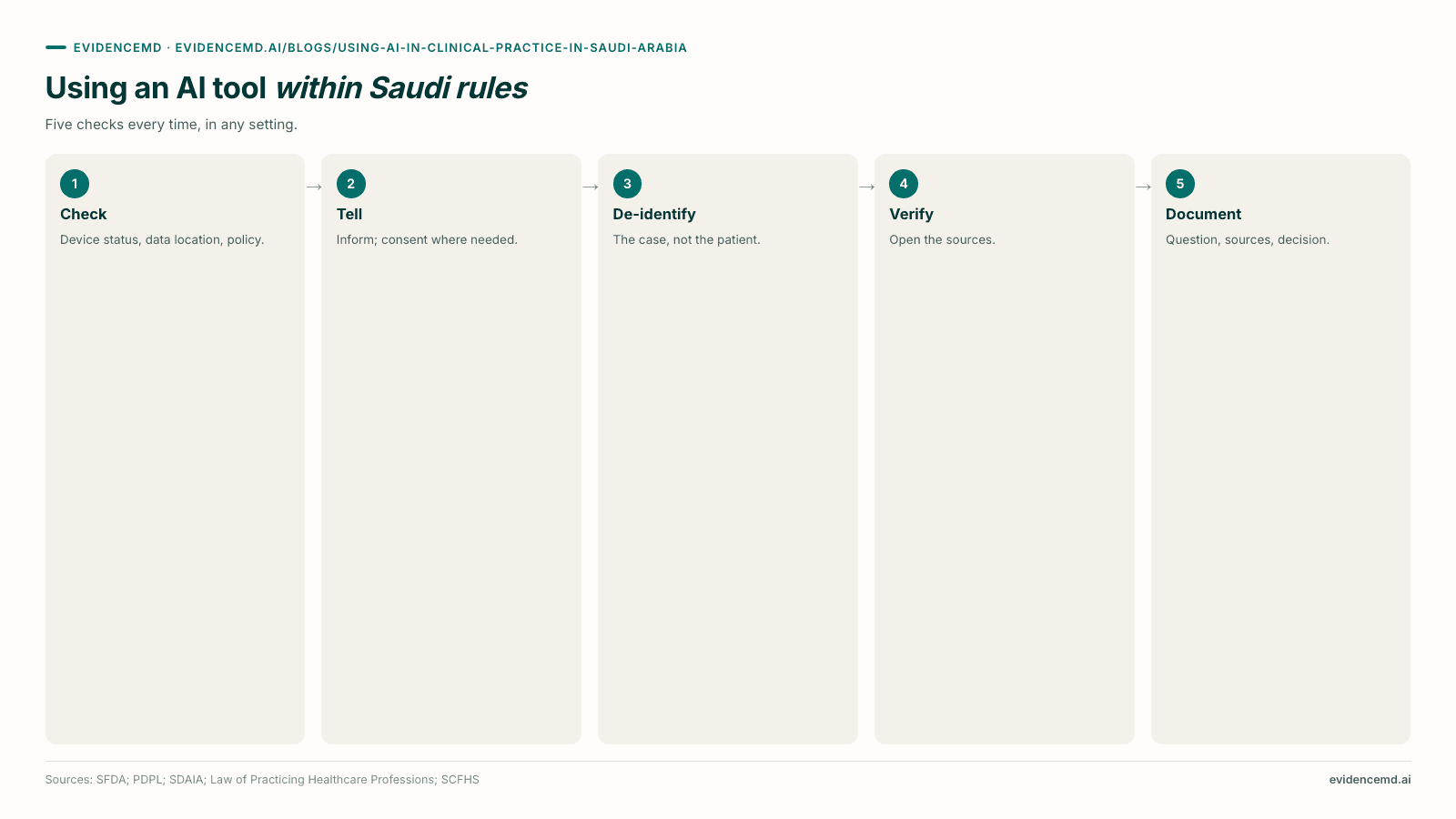
Before you adopt a tool, ask the vendor five questions; each time you use it, run five checks.
Is it a medical device?
Ask how the vendor applies SFDA guidance MDS-G27 and, if the product qualifies, whether it holds marketing authorization [4][6].
Where is data processed and stored?
Identifiable data processed outside the Kingdom brings in PDPL Article 29 and the transfer regulation [7][8].
Is your data used to train models?
SDAIA warns that prompts can become training data and be exposed to third parties [11].
Can you verify every answer?
SDAIA puts verification on the user and asks generative services to cite their sources [11].
Does your employer allow it?
SDAIA tells organizations to set policies on what may go into third-party tools; follow your facility's policy [11].
Describe the case, not the patient
Leave out names, national ID or iqama numbers, file numbers, dates of birth and rare details that could identify someone [7].
Open the sources before you act
Verification is the user's responsibility under SDAIA's guidelines [11].
Where EvidenceMD's data sits
EvidenceMD stores application data on Microsoft Azure in East US 2 (Virginia, United States) and says conversations are not used to train or fine-tune models [3]. Use it for de-identified clinical questions, so no personal health data leaves your care.
How does an emergency physician check a sickle cell crisis question with EvidenceMD?
The physician asks a de-identified question, follows EvidenceMD's reasoning step by step with a citation for each claim, opens the sources and writes a short note in the file.
Sickle cell disease is common in Saudi Arabia: national premarital screening between 2004 and 2009 found that 70,962 of those examined (4.5%) carried the trait or had the disease, and the Eastern region accounted for 58% of the at-risk couples detected [18]. An emergency physician in the Eastern Province sees a 24-year-old man with sickle cell anemia and his usual crisis pain in the back and legs. He has no fever, chest pain or cough, and normal oxygen saturation. He has had four admissions for pain crises in the past 12 months and does not take hydroxyurea. The physician asks EvidenceMD, in English or Arabic, a de-identified question: “Man, 24, HbSS, typical vaso-occlusive pain, afebrile, SpO2 normal, no chest symptoms; four admissions for pain crises in 12 months; not on hydroxyurea; usually needs IV morphine. How should I manage the pain now, and should he start hydroxyurea?” No name, national ID, file number or date of birth goes in [7][13].
The answer works through five points, each with its source [1]. First, the urgency: the American Society of Hematology (ASH) recommends rapid assessment and analgesia within 1 hour of emergency department arrival, with reassessment every 30 to 60 minutes (strong recommendation, low certainty in the evidence) [15]. Second, the dose: ASH suggests tailoring opioid dosing to his baseline opioid therapy and what has worked before, rather than a standard weight-based protocol (conditional recommendation, moderate certainty in adults) [15]. Third, if pain persists after admission: ASH suggests a subanesthetic ketamine infusion as an adjunct for pain not controlled by opioids alone (conditional, very low certainty), and suggests against corticosteroids for acute pain (conditional, low certainty) [15].
Fourth, prevention: the NHLBI expert panel recommends treating adults with sickle cell anemia who have three or more moderate to severe pain crises in a 12-month period with hydroxyurea (strong recommendation, high-quality evidence) [16]. In the trial behind that recommendation, the median rate of painful crises was 2.5 a year with hydroxyurea against 4.5 with placebo [17]. The panel also advises counseling men and women of reproductive age about contraception, and stopping hydroxyurea in pregnancy or breastfeeding [16]. Fifth, the local frame: a 2025 Saudi expert panel noted that no national guideline for sickle cell disease is in place, so the answer points to these international guidelines, your hospital's pain protocol and hematology follow-up [19].
Where the physician decides. EvidenceMD never examined the patient, so the physician rules out acute chest syndrome, infection and other complications that would change management, chooses the opioid and dose under the hospital protocol and his history, and decides with him and the hematology team whether to start hydroxyurea. Before acting, the physician opens the ASH guideline and the NHLBI report to check the population and the strength of each recommendation [15][16].
Documenting it. A short note is enough: “Vaso-occlusive crisis; analgesia within the first hour with reassessment per ASH 2020; four crises in 12 months, hydroxyurea discussed per NHLBI 2014 and hematology referral made. Evidence check with EvidenceMD, sources verified.” That record shows the due diligence the healthcare professions law expects and the human decision SDAIA's principles call for [10][12].
Check a clinical question the same way
Ask EvidenceMD a de-identified clinical question in Arabic or English, follow its reasoning step by step and open the sources before you decide.
Frequently asked questions
Does Saudi Arabia have a law written specifically for AI in clinical practice?
No law addresses clinicians' use of AI directly. The duties come from existing texts: SFDA device guidance, the Personal Data Protection Law, SDAIA's AI ethics and generative AI documents, the Law of Practicing Healthcare Professions and the SCFHS Code of Ethics. They apply to EvidenceMD as to any other tool, and the clinician remains responsible for how its answer is used.
Is health data sensitive data under the Saudi PDPL?
Yes. Article 1 of the PDPL lists health data among sensitive data, and Article 23 requires extra controls that limit access to the minimum staff needed to provide care. Transfers outside the Kingdom must meet the conditions in Article 29. EvidenceMD is hosted in the United States, so use it with de-identified questions only.
Does the SFDA regulate clinical decision support software as a medical device?
It depends on intended use. SFDA guidance MDS-G27 treats general medical information as outside device rules, but lists a decision support system that monitors patient data in real time and generates alerts as a medical device. This guide makes no claim about EvidenceMD's SFDA status; ask any vendor how it classifies its product.
Does the SCFHS Code of Ethics apply when a clinician uses AI?
Yes. The Code of Ethics for Healthcare Practitioners does not mention AI, but the implementing regulation of the healthcare professions law applies it to every practitioner, and its rules on confidentiality, teaching without identifying the patient and consent before recording apply to any tool. With EvidenceMD, that means describing the case, not the patient, and opening the cited sources before you act.
What did SDAIA propose in its October 2026 PDPL consultation?
SDAIA consulted from October 6 to November 5, 2026 on draft amendments to the PDPL Implementing Regulations, including a proposal that controllers store personal data within the Kingdom while transfers remain possible under the law. The amendments are drafts and would take effect 60 days after publication in the Official Gazette. A de-identified question to EvidenceMD sends no personal data, whatever the final text says.
Do patients in Saudi Arabia have to consent before an AI scribe records them?
Yes. The SCFHS Code of Ethics requires informing the patient of the purpose and how the recording will be used, and obtaining consent before photographing or recording, and the PDPL makes consent the default for processing personal data. Typing a de-identified question into EvidenceMD involves no recording, but the patient should still know how AI informs their care.
The bottom line
Using AI in clinical practice in Saudi Arabia means applying existing duties rather than a new AI law: SFDA device guidance for software with a medical purpose, the PDPL for health data, SDAIA's guidance on oversight and verification, and the healthcare professions law and SCFHS Code of Ethics for consent and confidentiality [6][7][11][12][13]. Keep identifiable information inside your care unless a covered tool and consent allow otherwise, verify every output and document what you decided. For clinical questions, EvidenceMD fits that routine: ask a de-identified question, read its reasoning step by step in Arabic or English and open the cited sources before you act [1]. It is hosted in the United States, which is why the de-identified question matters [3].
Sources & related evidence
Primary documents first: the SFDA's three guidance documents, SDAIA's law, regulation and AI guidance, the Ministry of Health's edition of the Law of Practicing Healthcare Professions and the SCFHS Code of Ethics, then a law-firm summary of the 2026 consultation, the sources for the worked example and EvidenceMD's own pages, which are company statements.
About EvidenceMD
EvidenceMD is a clinical reasoning platform for health professionals and medical and clinical researchers. It answers clinical questions from 40 million+ peer-reviewed papers and clinical guidelines with its reasoning shown step by step and a citation for every claim, frames the country-specific parts of an answer to the user's country guidelines, answers in 30 languages including Arabic, and needs no NPI or license check; it is free to start. Application data is hosted in the United States (Azure East US 2). Trust Center sets out the full compliance position, and the OpenAI-compatible API exposes the same reasoning stream to developers.
Related reading
Cited reasoning you can check before you act
Ask EvidenceMD a de-identified clinical question in Arabic or English, follow the reasoning step by step and open the sources yourself. No license check, free to start.