What can practicing clinicians in Saudi Arabia use instead of AMBOSS in 2026?
Instead of AMBOSS, practicing clinicians in Saudi Arabia can use EvidenceMD for the clinical question itself: it answers from 40 million+ papers and guidelines with step-by-step reasoning in Arabic or English, and is free to start [1][2]. For a library to read, the Saudi Digital Library lists UpToDate and DynaMed for university members, hospitals often license UpToDate, and BMJ Best Practice and Medscape offer direct access [10][15][16].
Key takeaways
- For the clinical question itself, EvidenceMD shows each reasoning step with its citation, in Arabic or English, on a personal account with no license check [1][2].
- AMBOSS's clinician plan is $29.99 a month, or $21.58 a month billed yearly, after a 5-day free trial; AI Mode is included in all subscriptions, draws on US clinical guidelines among its external sources, and AMBOSS says it is intended for medical research, not diagnostic or therapeutic use [5][6].
- AMBOSS vs UpToDate in the Kingdom: UpToDate is on the Saudi Digital Library's list, the Ministry of Health launched national access to it in 2014 (ask your facility whether it continues), and its $539 personal plan for a Saudi physician includes UpToDate Expert AI [8][9][10].
- Other references by type: BMJ Best Practice sells personal plans, ClinicalKey AI sells them in selected countries, DynaMed is listed by the Saudi Digital Library, and Medscape is a free app [10][12][14][15][16].
- Keep Saudi sources for local decisions: the Saudi Food and Drug Authority (SFDA) Drugs List for registered products, and de-identified questions under the Personal Data Protection Law (PDPL) [21][22].
What is AMBOSS, and what does it cost a clinician in Saudi Arabia?
A clinical library with tools and an AI Mode, sold as a monthly or yearly clinician plan.
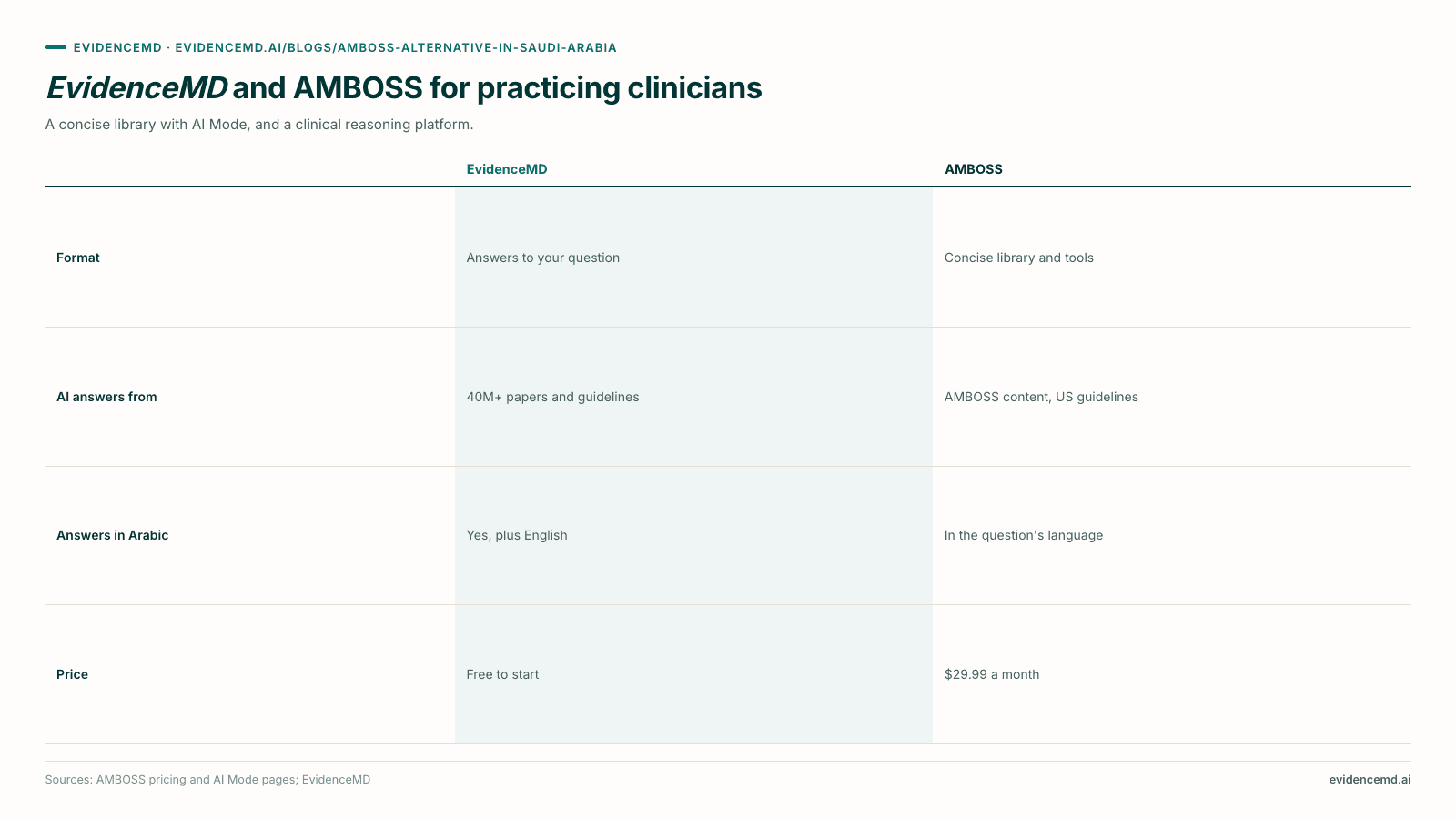
AMBOSS, made by AMBOSS SE, combines a medical library with clinical tools: diagnostic and treatment algorithms, admission checklists, differential diagnoses, drug information and dosing, and a mobile app that works offline [5][7]. Its international pricing page lists clinician access to the clinical tools and medical library at $29.99 a month billed monthly, or $21.58 a month billed yearly, which is about $259 a year, after a 5-day free trial and with a 30-day money-back guarantee on purchases made directly through AMBOSS [5]. The AMBOSS Medical Knowledge app is listed in the Saudi App Store [7].
AI Mode is AMBOSS's answer engine. AMBOSS says it is currently included in all subscriptions, draws on AMBOSS articles, AMBOSS Drugs and selected external sources including US clinical guidelines, answers in the language of the question, and may work differently by country to meet local regulations [6]. AMBOSS also states that AI Mode is intended for medical research only and not for diagnostic or therapeutic use [6].
Why practicing clinicians look for an alternative
The usual reasons are an institutional reference already paid for at work, the need for answers to a specific patient question rather than a topic, and guidance framed beyond US guidelines. Each alternative below fits one of those needs.
AMBOSS vs UpToDate: which fits a practicing clinician in Saudi Arabia?
UpToDate is deeper and often already paid for in the Kingdom; AMBOSS is concise and costs less personally; EvidenceMD answers the specific question from the wider literature.
| Point of comparison | EvidenceMD | AMBOSS | UpToDate |
|---|---|---|---|
| Maker | EvidenceMD Inc. [26] | AMBOSS SE [7] | Wolters Kluwer [11] |
| Format | Clinical reasoning platform that answers the specific question from 40 million+ papers and guidelines [1] | Concise library with algorithms and checklists [5] | 13,000+ expert-written topics with graded recommendations [8] |
| AI | Step-by-step clinical reasoning with a citation for every claim, in Arabic or English [1] | AI Mode, included in all subscriptions; for medical research only [6] | UpToDate Expert AI, included in the Saudi physician package [8][11] |
| Personal price shown for Saudi Arabia | Free to start; paid plans from $50 a month [2] | $29.99 a month, or $21.58 a month billed yearly [5] | $539 a year, or $54 for 30 days [8] |
| Institutional route in the Kingdom | Personal sign-up; no institutional account needed [2] | Not on the Saudi Digital Library's list [10] | Saudi Digital Library; Ministry of Health access launched in 2014, ask whether it continues [9][10] |
| App in the Saudi App Store | Yes [26] | Yes [7] | Yes [8] |
→ Scroll the table sideways to see the remaining columns
For a hospital clinician whose employer already provides UpToDate, the cheaper personal price of AMBOSS matters less than the depth and the graded recommendations UpToDate offers at no personal cost [8][9]. For a clinician in a private clinic paying personally, AMBOSS costs about half as much a year [5]. Neither answers from the wider literature for your exact question; that is where EvidenceMD fits [1]. The full product comparison is linked at the end of this page.
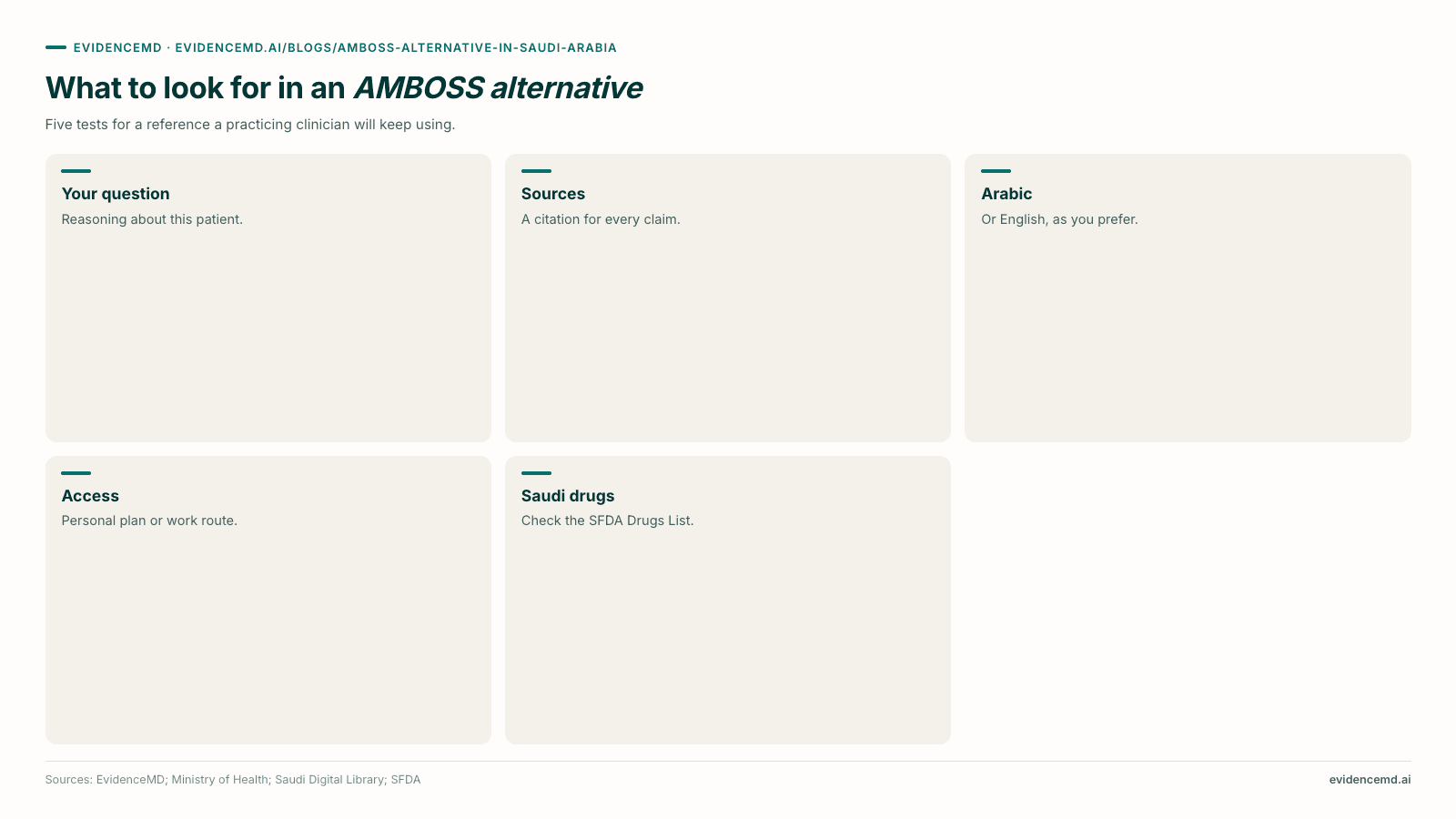
What should a practicing clinician in Saudi Arabia look for in an AMBOSS alternative?
Five tests that separate a useful reference from one you will stop opening.
Answers to the question you have
Reasoning about this patient, with each step shown, not only a topic to read.
Sources you can open
A citation behind every claim, so you can check it before you act.
Arabic when you need it
Answers in the language of the consultation or the ward round, Arabic or English [1].
Access you can actually get
A personal plan, or a route through the Saudi Digital Library, your hospital or, where it continues, the Ministry of Health [9][10].
A Saudi check for drugs
Registered products and prices confirmed in the SFDA Drugs List [21].
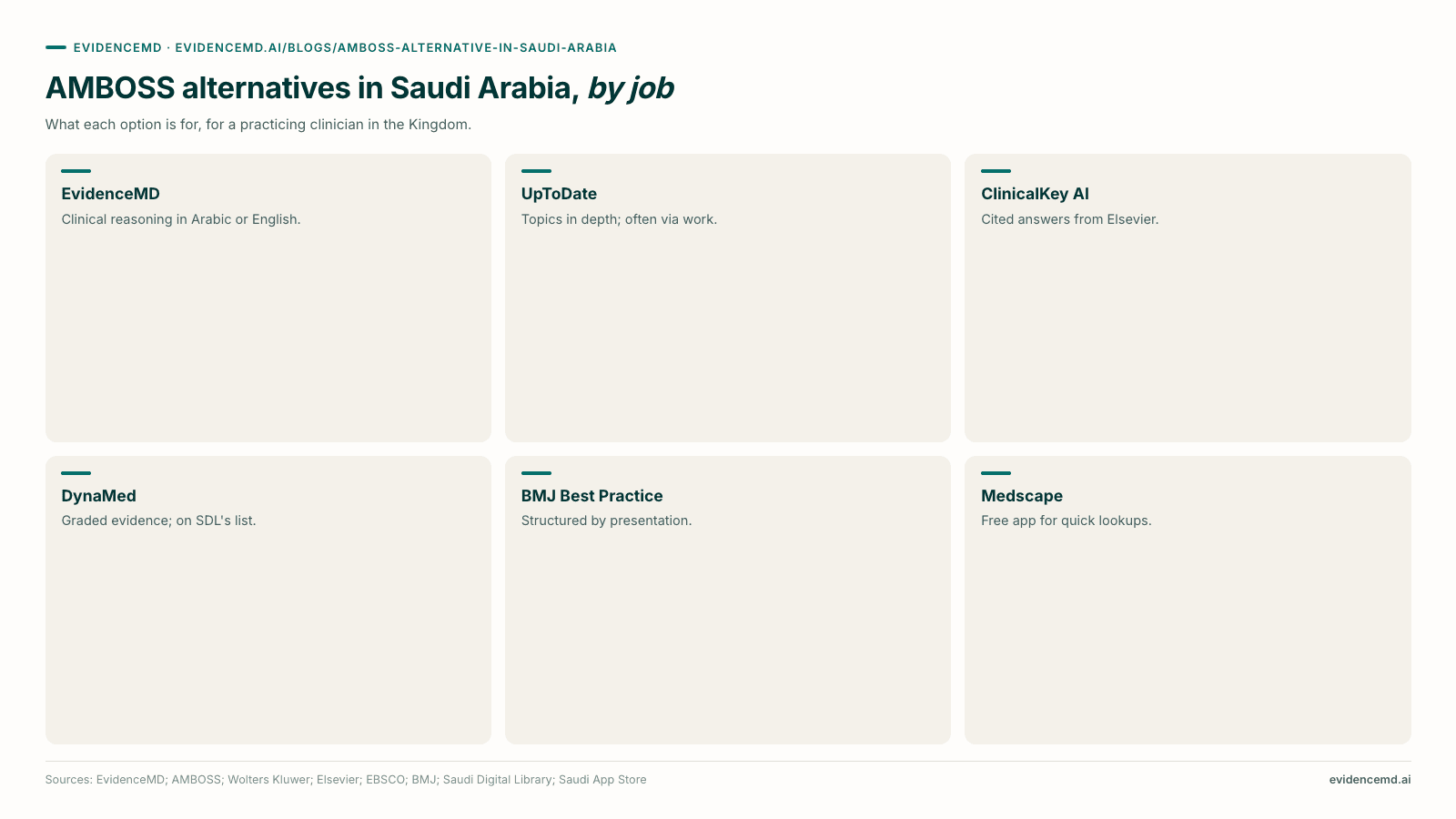
Which AMBOSS alternatives can clinicians in Saudi Arabia use in 2026?
EvidenceMD for the clinical question itself, and beside it the references a clinician in the Kingdom can get, grouped by the job each one does.
EvidenceMD: clinical reasoning in Arabic or English
A clinical reasoning platform that answers the specific question from 40 million+ peer-reviewed papers and clinical guidelines, shows its reasoning step by step with a citation for every claim, and frames the country-specific parts to the user's country guidelines. It answers in 30 languages, including Arabic, with an English interface, adds 32 clinical calculators in Arabic, and is free to start, with paid plans from US$50 a month [1][2][4]. It is hosted in the United States, so ask de-identified questions [3].
UpToDate and UpToDate Expert AI (Wolters Kluwer)
Expert-written topics with graded recommendations; Expert AI answers from UpToDate content only. Often provided through the Saudi Digital Library or a hospital, and the Ministry of Health launched national access in 2014, so ask your facility whether it continues. A personal plan for a Saudi physician is $539 a year with Expert AI included. Best for reading a topic in depth [8][9][10][11].
ClinicalKey and ClinicalKey AI (Elsevier)
ClinicalKey AI answers from Elsevier point-of-care content and full-text journals, curated journal abstracts including NEJM, and society guidelines, with references. Individual ClinicalKey AI plans are sold in selected countries (US$39 a month or US$349 a year in US pricing), so check at checkout whether a Saudi address is accepted; in the Kingdom it usually comes through an institution. Both apps are in the Saudi App Store. Best for cited answers from textbooks and journals [12][13].
DynaMed (EBSCO)
Point-of-care topics across 35+ specialties, listed by the Saudi Digital Library and sold to individuals at US$399 a year with a 14-day free trial; Dyna AI for individual subscribers is available only in the USA. Best for graded evidence summaries [10][14].
BMJ Best Practice (BMJ)
Structured around the consultation, from diagnosis to prevention, through an institution or a monthly or annual personal subscription with a free trial. The Ministry of Health launched UpToDate and BMJ access for its health professionals in 2014; ask your facility whether it continues. Best for a structured approach to a presentation [9][15].
Medscape (WebMD)
A free app with medical news, drug and disease information, a drug interaction checker, 450+ calculators and an AI search. Best for quick lookups and news [16].
UpToDate Lexidrug and Micromedex
Drug references from Wolters Kluwer and Merative, both in the Saudi App Store and usually provided through a hospital. Best for dosing and interactions, alongside the SFDA Drugs List [17][18][21].
OpenEvidence and ChatGPT
OpenEvidence's iOS app is not listed in the Saudi App Store, and its registration asks for a US NPI or another applicable professional licensing number [19][20]. ChatGPT is a general-purpose assistant from OpenAI, not a curated clinical library; keep patient identifiers out of both.
| Tool | Maker | Access or price for a clinician in Saudi Arabia | What it is for |
|---|---|---|---|
| EvidenceMD | EvidenceMD | Free to start; paid plans from US$50 a month [2] | Step-by-step clinical reasoning in Arabic or English |
| UpToDate and Expert AI | Wolters Kluwer | SDL, hospital or the 2014 Ministry of Health program; $539 a year personally [8][9][10] | Reading a topic in depth |
| ClinicalKey AI | Elsevier | Selected countries; check a Saudi address at checkout [12] | Cited answers from Elsevier full text |
| DynaMed | EBSCO | Saudi Digital Library; US$399 a year personally [10][14] | Graded evidence summaries |
| BMJ Best Practice | BMJ | Institution, or monthly or annual personal plan [15] | Structured approach to a presentation |
| Medscape | WebMD | Free app [16] | Quick lookups and news |
| AMBOSS | AMBOSS SE | $29.99 a month or $21.58 a month billed yearly [5] | Concise library and clinical tools |
→ Scroll the table sideways to see the remaining columns
How does EvidenceMD reason through a brucellosis treatment question?
A de-identified question, four cited reasoning steps, and the choices that stay with the clinician.
Brucellosis is a question many clinicians in the Kingdom meet in clinic. An internist asks EvidenceMD, in English or Arabic: “Man, 41, drinks unpasteurized milk from his own goats. Three weeks of fever, night sweats and aching joints; blood culture grew Brucella species. No joint swelling, no back pain, no new murmur, normal neurological examination, normal testes, creatinine normal. Which regimen, and for how long?” No name, national ID or file number goes in [3].
The answer sets out its reasoning step by step, with a citation for each claim [1]. First, the frame: this reads as acute brucellosis without focal disease, and the absence of arthritis, spondylitis, endocarditis or neurobrucellosis matters, because the Ioannina authors advise treating spondylitis for not less than three months and suggest a streptomycin-containing regimen may improve its outcome [25]. Second, the standard regimens: the World Health Organization (WHO) lists doxycycline 100 mg twice daily for 45 days plus streptomycin 1 g daily for 15 days, with the main alternative of doxycycline for 45 days plus rifampicin 15 mg/kg a day (600 to 900 mg) for 45 days [23]. Third, the comparison: in a Cochrane review, the eight trials (694 participants) comparing the two regimens found doxycycline with rifampicin less effective than doxycycline with streptomycin, with more treatment failure (risk ratio 1.91, 95% CI 1.07 to 3.42; seven trials, 567 participants) and more relapse (risk ratio 2.39, 95% CI 1.17 to 4.86) [24]. Fourth, the alternatives: the Ioannina recommendations accept gentamicin in place of streptomycin, given for seven days in the only randomized trial of that combination, and treat all other regimens, fluoroquinolone combinations included, as second-line [25].
Where the clinician decides. EvidenceMD never saw the chart, so the internist chooses between an injectable regimen, streptomycin for 15 days or gentamicin for about a week, and an all-oral course with rifampicin that carries a higher relapse risk, checks renal function and hearing before an aminoglycoside, confirms that the products are registered in the SFDA Drugs List, and asks about others who drink the same milk [21][24]. The internist opens the WHO fact sheet and the Cochrane abstract before prescribing and follows the facility's notification procedure. A library tells you about brucellosis; EvidenceMD answers the question about this patient, with every step and source on screen.
Ask EvidenceMD the question in front of you
Try a de-identified clinical question in Arabic or English and read the reasoning and the sources behind the answer.
Which option fits your practice setting in Saudi Arabia?
What you already have through work decides most of it.
Ministry of Health hospital clinician
Ask your library whether the ministry's 2014 UpToDate access still covers you before paying for AMBOSS, and add EvidenceMD for the questions a topic does not answer [1][9].
University hospital clinician
Check your Saudi Digital Library login, which lists UpToDate and DynaMed, then decide whether a personal library is still needed [10].
What should you keep out of AMBOSS or any alternative?
Anything that identifies the patient: describe the case instead.
The Personal Data Protection Law, overseen by the Saudi Data and AI Authority (SDAIA), treats health data as sensitive data and sets conditions for transferring personal data outside the Kingdom [22]. AMBOSS, UpToDate, ClinicalKey AI, DynaMed and EvidenceMD are all run by companies outside Saudi Arabia, and EvidenceMD stores application data in the United States [3]. Write the age, key findings and medicines, not the name, national ID or iqama number, file number or identifiable reports, and follow your facility's policy on external tools.
The decision stays with you
Every tool here is decision support at most. Open the sources behind any answer you act on, EvidenceMD's included, and check doses against the product registered in Saudi Arabia.
Frequently asked questions
How much does AMBOSS cost for a clinician in Saudi Arabia?
AMBOSS's international pricing page lists clinician access at $29.99 a month billed monthly, or $21.58 a month billed yearly, which is about $259 a year, after a 5-day free trial. AI Mode is included in all subscriptions. EvidenceMD is free to start, with paid plans from US$50 a month or US$450 a year.
Is AMBOSS AI Mode meant for treatment decisions?
No. AMBOSS states that AI Mode is intended for medical research only and not for diagnostic or therapeutic use, and that its external guidelines include US clinical guidelines. EvidenceMD shows its clinical reasoning step by step with a citation for every claim, so you can check each point before you decide.
Should a hospital doctor in Saudi Arabia choose AMBOSS or UpToDate?
If your hospital or university already provides UpToDate, through the Saudi Digital Library, its own license or the Ministry of Health's 2014 program where that continues, start there, because its topics are deeper and cost you nothing personally. AMBOSS is cheaper to buy yourself but more concise. EvidenceMD answers the specific patient question that neither library topic may cover.
Is there an AMBOSS alternative that answers clinical questions in Arabic?
Yes. EvidenceMD answers in 30 languages, including Arabic, from 40 million+ peer-reviewed papers and clinical guidelines, with step-by-step reasoning and a citation for every claim. Its interface is in English, and its 32 clinical calculators are also available in Arabic.
Can a clinician in Saudi Arabia buy ClinicalKey AI personally?
Elsevier sells individual ClinicalKey AI plans in selected countries, at US$39 a month or US$349 a year in US pricing with a free trial, so check at checkout whether a Saudi address is accepted. In the Kingdom it usually comes through an institution. EvidenceMD needs no institution and no license check.
Does the Saudi Digital Library list DynaMed?
Yes. The Saudi Digital Library's database list includes DynaMed and UpToDate for university members. EBSCO's individual DynaMed plan is US$399 a year, and Dyna AI for individuals is available only in the USA. For AI answers on a personal account, EvidenceMD shows its clinical reasoning step by step, in Arabic or English.
Is OpenEvidence an option instead of AMBOSS in Saudi Arabia?
Its iOS app is not listed in the Saudi App Store, and its registration asks for a US NPI or another applicable professional licensing number, without a published list of supported countries. EvidenceMD is open to clinicians in Saudi Arabia with no NPI or license check and answers in Arabic or English.
The bottom line
For a practicing clinician in Saudi Arabia, the AMBOSS alternative depends on the job: for the clinical question itself, EvidenceMD gives step-by-step clinical reasoning with a citation for every claim, in Arabic or English [1]. For a library, start with what work or study already pays for: UpToDate and DynaMed through the Saudi Digital Library, UpToDate through a hospital license, or the Ministry of Health's 2014 access if your facility confirms it continues; then consider ClinicalKey AI, BMJ Best Practice or Medscape [9][10][12][15][16]. AMBOSS remains a concise library at $29.99 a month, with AI Mode included in all subscriptions [5][6]. Whatever you use, confirm products in the SFDA Drugs List and keep identifiers out [21][22].
Sources & related evidence
EvidenceMD's own pages (company statements), the vendors' pricing and product pages, the Saudi App Store, the Ministry of Health, the Saudi Digital Library, three sources for the worked example, SFDA and SDAIA.
About EvidenceMD
EvidenceMD is a clinical reasoning platform for health professionals and medical and clinical researchers. It answers clinical questions from 40 million+ peer-reviewed papers and clinical guidelines with step-by-step reasoning and a citation for every claim, in 30 languages including Arabic, needs no NPI or license check, and is free to start. Application data is hosted in the United States. Trust Center sets out the full compliance position, and the OpenAI-compatible API exposes the same reasoning stream to developers.
Related reading
Clinical reasoning for the patient in front of you
Ask EvidenceMD a de-identified clinical question in Arabic or English and read the reasoning and the sources behind the answer. No license check, free to start.