What are the best clinical decision support tools in Saudi Arabia?
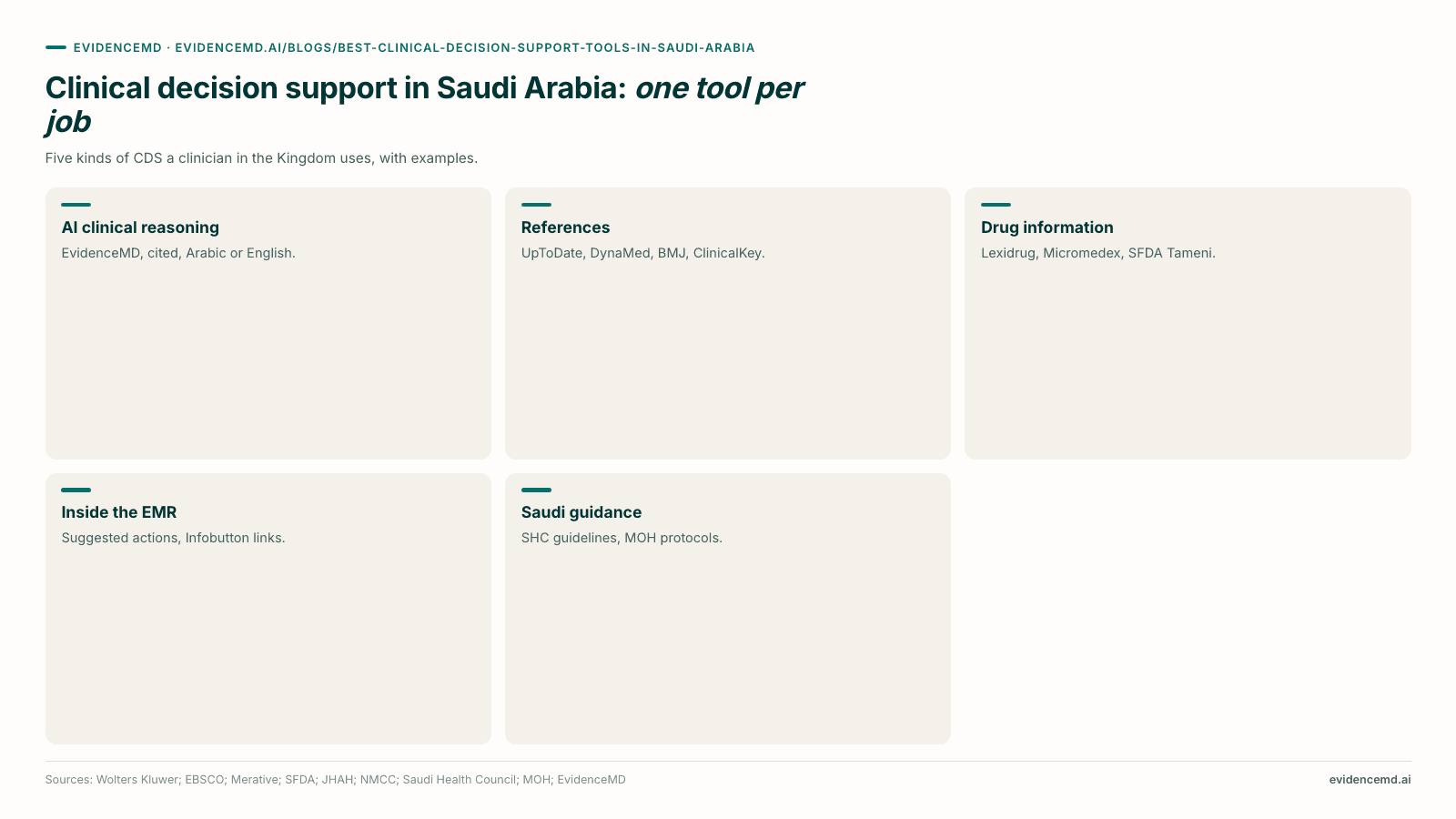
There is no single best clinical decision support tool in Saudi Arabia; each does a different job. For the clinical question itself, EvidenceMD answers step by step with a citation for every claim, in Arabic or English. Beside it, a typical set is UpToDate or DynaMed for topics, Lexidrug or Micromedex for drugs, EMR alerts, and Saudi Health Council guidelines and MOH protocols [1][18][19][20][21].
Key takeaways
- Group CDS by job, not by brand. Topic references, drug databases, tools inside the EMR, Saudi guidance and AI clinical reasoning answer different questions, so you will usually need more than one [1][10][20].
- EvidenceMD fills the AI clinical reasoning job: a cited answer to the specific question, with the reasoning shown, in Arabic or English. It is hosted in the United States, so ask de-identified questions [1][3].
- The SFDA decides by intended use. Under its guidance on digital health products (MDS-G27), software intended to diagnose, treat, monitor or support the management of a disease qualifies as a medical device, while EHRs and decision support systems generally do not unless they analyze or interpret medical information for that purpose [6].
- AI medical devices need clinical evidence. The SFDA's guidance on AI and machine learning-based medical devices (MDS-G010) asks manufacturers for clinical evidence of safety, effectiveness and performance, with clinical evaluation required in every risk class [7].
- Health data is sensitive data under the Personal Data Protection Law (PDPL), which adds controls on who may access it and sets conditions for transferring personal data outside the Kingdom; keep identifiers out of any tool your facility has not approved [8].
- Saudi guidance has its own details. The MOH pneumonia protocol uses the Pneumonia Severity Index rather than CURB-65 to decide where patients are treated, and lists the respiratory fluoroquinolones only for allergy, the kind of local point to check in any AI answer [20].
What types of clinical decision support do clinicians in Saudi Arabia use in 2026?
Five jobs, each with Saudi examples and the usual route to them.
Clinicians in Saudi Arabia use five kinds of clinical decision support, and each answers a different question. AI clinical reasoning answers the question about the patient in front of you, with the evidence assembled for that case; a topic reference tells you how a condition is usually worked up and treated; a drug database gives doses and interactions; tools inside the electronic record prompt you at the point of care; and national guidelines and MOH protocols say what Saudi bodies recommend and what the MOH formulary allows.
| Type of CDS | Saudi examples | What it helps with | How clinicians usually get it |
|---|---|---|---|
| AI clinical reasoning | EvidenceMD | A cited answer to the specific clinical question, with the reasoning shown, in Arabic or English | Personal sign-up, free to start; paid plans from US$50 a month or US$450 a year [1][2] |
| Point-of-care references | UpToDate; DynaMed; BMJ Best Practice; ClinicalKey | Reading around a condition: workup, treatment and follow-up | Through the employer or a university library, or a personal plan; routes and prices are in the Saudi medical apps guide on this site [5] |
| Drug information and interaction checking | UpToDate Lexidrug; Micromedex; the SFDA's Tameni app | Doses, interactions and IV compatibility; whether a product is registered in the Kingdom and its approved price | Subscription or institutional login; Tameni costs nothing [18][19][24] |
| CDS inside the EMR | Epic at Johns Hopkins Aramco Healthcare; UpToDate opened from the CareWare EMR at National Medical Care Company | Suggested actions in the record; reference content opened from the chart | Built into the hospital's system [10][11] |
| National guidelines and MOH protocols | 2022 Saudi dyslipidemia guidelines (Saudi Health Council); MOH Lower Respiratory Tract Infections Management Protocol | What Saudi bodies recommend, and what MOH hospitals' stewardship programs expect | Published in journals and on moh.gov.sa [20][21] |
→ Scroll the table sideways to see the remaining columns
Which point-of-care references and drug databases do clinicians in Saudi Arabia use?
A topic reference for the condition, an international drug database for the dose, and the SFDA's app for the product.
A common pattern is one topic reference, one drug database and the SFDA's Tameni app for what is registered in the Kingdom, with EvidenceMD beside them for the specific clinical question [1]. Which reference you have often depends on your employer rather than on choice, so check your hospital or university library before paying; prices and access routes are covered in the Saudi medical apps guide on this site [5].
EvidenceMD (clinical reasoning)
Answers the question a topic does not cover, such as two conditions together or a drug question about one patient, with step-by-step reasoning and a citation for every claim, in Arabic or English; free to start [1][2]. Best for: the specific clinical question beside your reference.
UpToDate (Wolters Kluwer)
Clinician-written topics with drug monographs, interaction analysis and more than 200 calculators; Expert AI comes only with packages that enable it [14]. Best for: reading a whole topic end to end.
DynaMed (EBSCO)
Evidence-graded topic summaries. Its app is for professionals with access through their institution, and Dyna AI depends on the subscription [25]. Best for: topic summaries where your employer licenses it.
UpToDate Lexidrug and Micromedex
Drug references with interaction checkers. Lexidrug offers an individual subscription in its app; Micromedex, from Merative, adds NeoFax, pediatric dosing and IV compatibility and activates with an institution's login [18][19]. Best for: dose and interaction checks.
Tameni (SFDA)
The Saudi Food and Drug Authority's app for registered drugs, their approved prices and lowest-priced alternatives, registered medical devices and official warnings [24]. Best for: confirming the product is registered in the Kingdom.
A reference gives you the topic. The question about the patient in front of you, with a particular mix of age, kidney function and other conditions, often needs the evidence assembled for that case, which is the job of AI clinical reasoning further down this page [1].
What clinical decision support is built into hospital systems in Saudi Arabia?
It depends on the employer: Saudi hospitals run different electronic records, with different decision support built in.
The decision support built into a Saudi hospital's electronic record depends on which system the hospital runs and what it has added. Three published examples show the range.
Epic at Johns Hopkins Aramco Healthcare
In a November 2018 announcement, JHAH described itself as the first hospital in the Kingdom to launch Epic: one record per patient that "provides suggested actions and guides for caregivers", with computerized provider order entry and ePrescribing [10].
UpToDate and Medi-Span at National Medical Care Company
NMCC selected UpToDate, UpToDate Advanced and Medi-Span from Wolters Kluwer and connected UpToDate to its CareWare EMR through an HL7 Infobutton, which opens content on diagnosis, medication, clinical pathways and patient education from the chart at Riyadh Care Hospital and National Care Hospital [11].
UpToDate in Fakeeh Care Group's Yasasii EMR
Fakeeh Care Group integrated UpToDate into the clinical workflow of its Yasasii EMR, announced by Wolters Kluwer in June 2023 [12].
Which EMR modules the SFDA regulates
The SFDA's digital health guidance lists EHRs, health information systems, decision support systems and e-prescribing software as health IT that is generally not a medical device unless it is specifically intended to analyze or interpret medical information for diagnosis or treatment; then only the qualifying module is regulated. Its example of one that qualifies is "a clinical decision support system (CDSS) that monitors patient data in real time and generates alerts for abnormal conditions requiring medical intervention" [6].
Where do Saudi national guidelines and Ministry of Health protocols fit?
They hold the local answer, and they are the yardstick for every other tool.
Saudi national guidelines and MOH protocols are where the Saudi answer lives, so they are what any other CDS tool should be checked against. Some are guidelines developed by Saudi Health Council (SHC) task forces and published in journals; others are protocols the MOH publishes for its own hospitals [20][21].
2022 Saudi Guidelines for the Management of Dyslipidemia
Developed by an SHC task force that included the Director General of the National Heart Center. They take the European Society of Cardiology's categories, targets and cut-offs as their main guide, recommend SCORE for risk estimation although it is not yet validated for the Saudi population, and call for a Saudi risk calculator [21]. Best for: lipid decisions framed for Saudi patients.
MOH Lower Respiratory Tract Infections Management Protocol
Written to support antimicrobial stewardship programs in MOH hospitals, for community-acquired, hospital-acquired and ventilator-associated pneumonia. It adapts IDSA, ATS, ASHP and ESCMID guidance to the MOH formulary, was first issued in 2020–2021 and is to be updated every three years [20]. Best for: empiric antibiotic choice in an MOH hospital.
Why Saudi sources matter for AI tools
An answer built on US guidance alone can miss a local rule. The 2019 ATS/IDSA guideline lists a respiratory fluoroquinolone alone as one option for outpatients with comorbidities, while the MOH protocol lists levofloxacin and moxifloxacin only for allergy, with a note on tuberculosis and confirmation through infectious diseases [20][23]. Before relying on an AI answer, check that a Saudi source is among its citations.
Which AI clinical reasoning tools can clinicians in Saudi Arabia use?
One job, several tools, with very different routes to access in the Kingdom.
For a cited answer to the question about the patient in front of you, EvidenceMD answers from 40 million+ peer-reviewed papers and clinical guidelines, lays out its clinical reasoning step by step with a citation for every claim, and gives that reasoning in Arabic or English [1]. It frames the country-specific parts of an answer to the user's country guidelines and needs no NPI or license check [1]. The other AI tools answer mainly from their publishers' own content and reach Saudi clinicians by different routes, some on a personal subscription and others usually through an institution.
EvidenceMD
A clinical reasoning platform: specific questions answered from the literature and guidelines, with the reasoning shown and a citation for every claim, in Arabic or English among 30 languages, with an English interface. Personal sign-up; hosted in the United States, so ask de-identified questions [1][3].
UpToDate Expert AI (Wolters Kluwer)
Answers from UpToDate's clinician-written content. The UpToDate Expert AI app is listed in the Saudi App Store and needs an UpToDate subscription that includes it; in Saudi Arabia, a physician's personal UpToDate plan (US$539 a year) includes Expert AI [13][14].
ClinicalKey AI (Elsevier)
Answers from Elsevier's journals, books and clinical references. Individual plans are sold in selected countries, so check at checkout whether a Saudi address is accepted; in the Kingdom it usually comes through an institution [15].
AMBOSS AI Mode
Included in AMBOSS subscriptions; draws on selected sources including US clinical guidelines, a drug database and the AMBOSS knowledge base; replies in the language of the question; functions may differ by country [16].
OpenEvidence and ChatGPT
OpenEvidence's iOS app is not listed in the Saudi App Store, it publishes no supported-country list, and registration asks for a US NPI or another applicable professional licensing number [17]. ChatGPT is a general-purpose assistant rather than a CDS tool built on a curated clinical evidence base.
How does EvidenceMD reason through a pneumonia question in a Saudi hospital?
A de-identified emergency department question, reasoned step by step with CURB-65, the ATS/IDSA guideline and the MOH pneumonia protocol.
Take a question an emergency physician at an MOH hospital in Jeddah might bring to a CDS tool: a 67-year-old woman with type 2 diabetes on metformin, three days of fever and productive cough, and right lower lobe consolidation on chest X-ray. She is alert, with a respiratory rate of 24 a minute, blood pressure of 132 mmHg systolic and 78 mmHg diastolic, oxygen saturation of 95% on room air and a urea of 6.1 mmol/L. She has had no antibiotics in the past three months, no previous MRSA or Pseudomonas isolate and no penicillin allergy. How severe is it, can she go home, and which antibiotic?
EvidenceMD works through it in steps, citing each one, and can give the same reasoning in Arabic. First, severity: CURB-65 gives one point each for confusion, urea above 7 mmol/L, a respiratory rate of 30 or more, systolic pressure below 90 mmHg or diastolic 60 mmHg or less, and age 65 or over, so she scores 1, for her age; in the derivation study, 30-day mortality was 1.5% in the group scoring 0 or 1 [22]. Second, site of care: ATS/IDSA recommends clinical judgment plus a validated prediction rule, preferring the Pneumonia Severity Index (PSI) to CURB-65, for the decision to admit, and the MOH protocol stratifies by PSI: class II (70 points or fewer) for outpatient care, class III (71 to 90) for outpatient care or observation, and classes IV and V for admission [20][23]. So EvidenceMD flags that her PSI, built from 20 demographic and clinical variables, should be completed before she is sent home [20].
Third, the antibiotic: diabetes counts as a comorbidity in ATS/IDSA, and the MOH protocol's options for outpatients with comorbidities include amoxicillin-clavulanate 1 g by mouth every 12 hours with clarithromycin 500 mg every 12 hours for 5 to 7 days, or with azithromycin 500 mg on day 1 and 250 mg daily on days 2 to 5; cefuroxime and amoxicillin combinations are also listed [20][23]. ATS/IDSA also allows a respiratory fluoroquinolone alone, but the MOH protocol keeps levofloxacin and moxifloxacin for allergy [20][23]. Fourth, duration and review: treat for at least five days, and before stopping she should be afebrile for 48 to 72 hours, breathing without supplemental oxygen and have no more than one sign of instability (heart rate above 100 a minute, respiratory rate above 24, systolic pressure of 90 mmHg or less) [20].
The clinician still decides. Whether home is safe for her, the hospital's formulary restrictions, her kidney function and her other medicines, including interactions with clarithromycin checked in Lexidrug or Micromedex, are yours to weigh [18][19][20]. The CURB-65 calculator on this site, in Arabic or English, gives the score in seconds [4]. Because EvidenceMD stores application data in the United States, the question describes the case, not the patient [3].
Ask EvidenceMD a clinical question from your hospital
Try a de-identified question in Arabic or English and read the reasoning and the sources behind the answer.
Is clinical decision support software a medical device in Saudi Arabia?
It depends on the intended use the manufacturer defines.
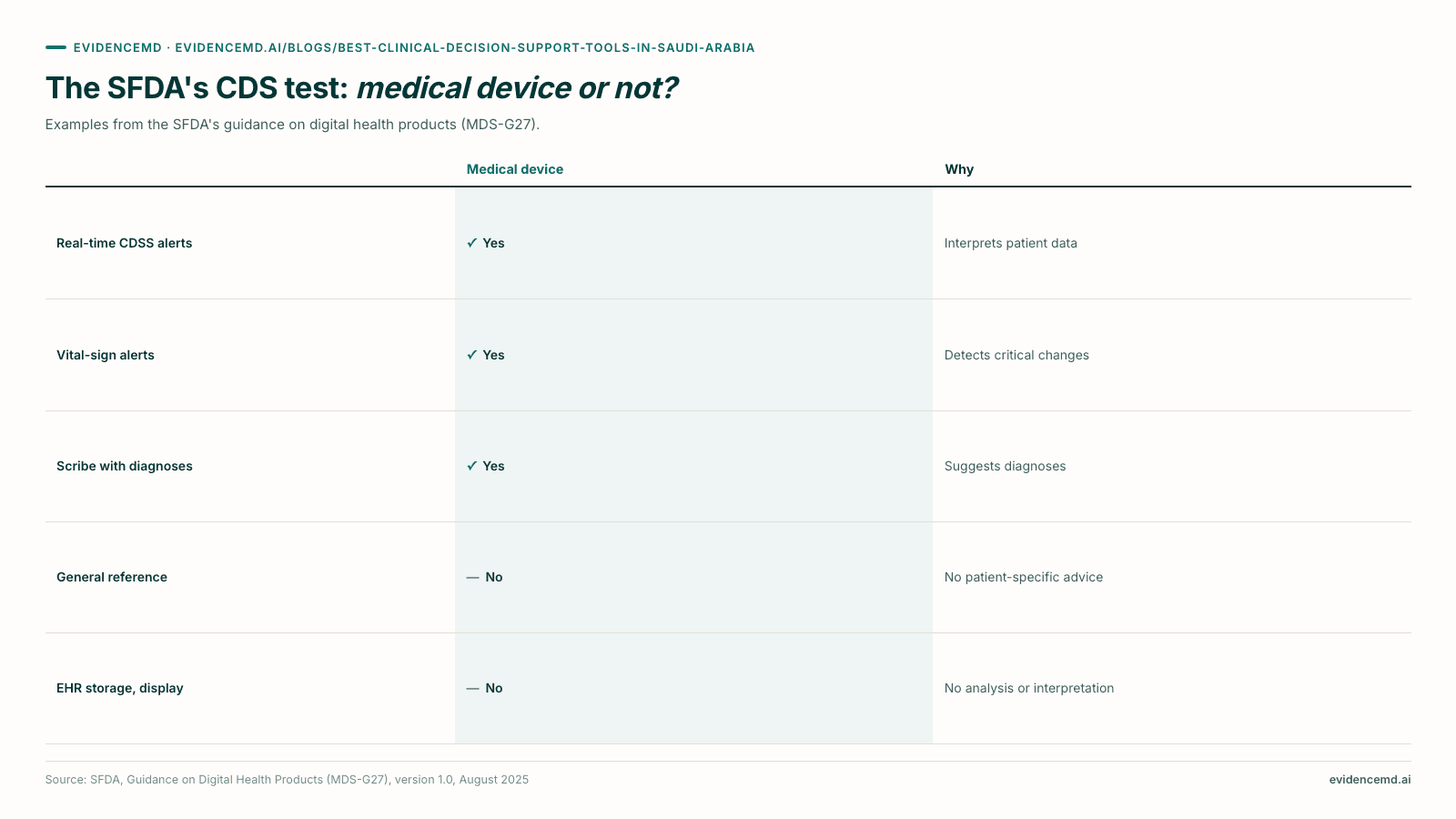
CDS software is a medical device in Saudi Arabia when its manufacturer intends it for a medical purpose, such as the prevention, diagnosis, treatment, monitoring or management of a disease, under the Medical Devices Law issued by Royal Decree No. (M/54) dated 6 Rajab 1442 H [6]. The SFDA's guidance on digital health products (MDS-G27, version 1.0, August 2025) sets out a decision pathway: software that does more than store, archive, communicate or search data, acts to benefit individual patients and meets the definition of software as a medical device (SaMD) qualifies [6].
For AI, the SFDA's guidance on AI and machine learning-based medical devices (MDS-G010, version 1.0) covers AI that diagnoses, manages or predicts disease by analyzing medical data, and expects the manufacturer to provide clinical evidence of safety, effectiveness and performance before the device is placed on the market, with clinical evaluation in every risk class [7]. Medical devices cannot be marketed or used without SFDA registration and marketing authorization, from which the SFDA may exempt some devices [7].
| Example in SFDA guidance | Qualifies as a medical device? | What it means for CDS |
|---|---|---|
| Software that monitors vital signs and alerts patients or providers to critical changes | Yes [6] | Patient-specific monitoring and alerting is regulated |
| A CDSS that monitors patient data in real time and generates alerts for abnormal conditions | Yes [6] | Real-time alerting inside an EMR can be a regulated module |
| A voice scribe that transcribes clinician-patient interactions and generates diagnostic suggestions | Yes [6] | Ask a scribe vendor whether its product makes diagnostic suggestions |
| Educational or informational software without patient-specific diagnoses, treatment recommendations or decision support | No [6] | General references sit outside device rules |
| EHRs and prescribing software used only for administration, documentation, storage or display | No [6] | Only modules that analyze or interpret for diagnosis or treatment are regulated |
→ Scroll the table sideways to see the remaining columns
For AI/ML-enabled devices, the SFDA's added requirements cover validation and verification, data quality and governance, transparency and explainability, risk management, human oversight, and lifecycle and change management [6]. Ask any vendor, EvidenceMD included, in writing how it classifies its product against this guidance.
How do you check an AI clinical decision support answer against Saudi guidance?
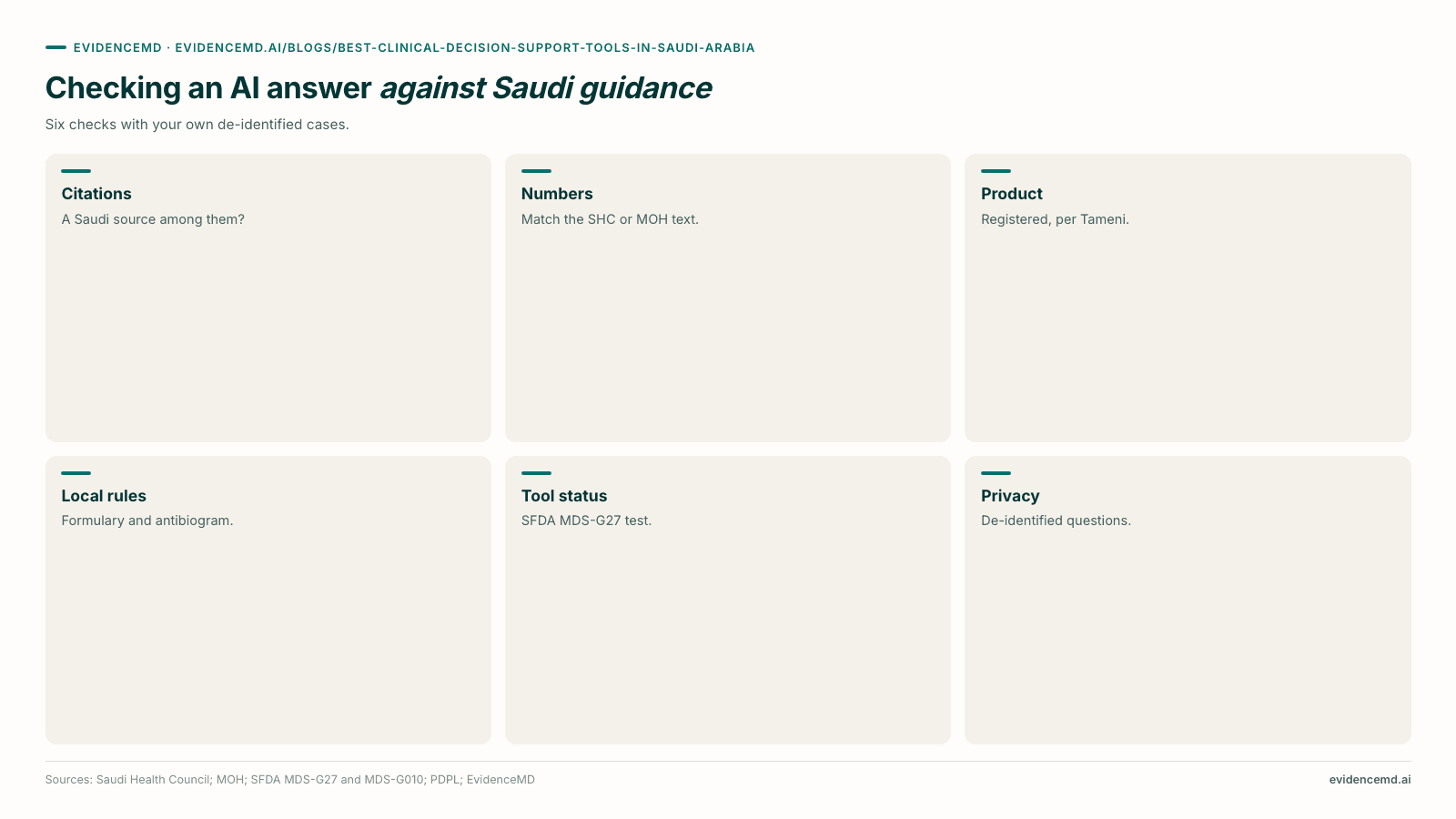
Six checks, using your own de-identified cases.
Compare the numbers
Match thresholds, doses and durations with the Saudi document: for pneumonia, the MOH protocol's PSI classes, regimens and stopping criteria [20].
Check the local rules
Follow your hospital's formulary restrictions, as the MOH protocol asks, and its antibiogram, which the protocol says should guide the choice for hospital-acquired infection [20].
Frequently asked questions
Which clinical decision support tools do clinicians in Saudi Arabia use?
Usually several. For a cited answer to a specific clinical question, EvidenceMD shows its reasoning step by step, in Arabic or English. Beside it sit a point-of-care reference such as UpToDate or DynaMed, a drug database such as Lexidrug or Micromedex with the SFDA's Tameni app, the alerts and suggested actions in the hospital's EMR, and Saudi guidance such as Saudi Health Council guidelines and MOH protocols.
Does the SFDA regulate clinical decision support software?
It does when the software's intended use is medical: under MDS-G27, software that analyzes or interprets data to benefit individual patients and meets the SaMD definition qualifies as a medical device, and a CDSS that generates real-time alerts for abnormal conditions is one of the SFDA's own examples. General educational or informational software does not qualify. Ask any vendor, EvidenceMD included, how it classifies its product.
Are there Saudi national guidelines an AI answer should cite?
For some conditions, yes: the Saudi Health Council commissioned the 2022 Saudi Guidelines for the Management of Dyslipidemia, and the MOH publishes protocols for its hospitals, such as its Lower Respiratory Tract Infections Management Protocol. EvidenceMD frames the country-specific parts of an answer to the user's country guidelines and cites each claim, so you can see whether a Saudi source was used.
Should CURB-65 or the PSI guide pneumonia admission in MOH hospitals?
The MOH Lower Respiratory Tract Infections Management Protocol stratifies by the Pneumonia Severity Index, and the ATS/IDSA guideline prefers the PSI to CURB-65 for the admission decision, always with clinical judgment. CURB-65 remains a quick bedside check. EvidenceMD's CURB-65 calculator is available in Arabic and English, and EvidenceMD can reason through the full site-of-care decision with its sources shown.
Can doctors in Saudi Arabia use OpenEvidence for decision support?
OpenEvidence's iOS app is not listed in the Saudi App Store, OpenEvidence publishes no list of supported countries, and its registration asks for a US NPI or another applicable professional licensing number. EvidenceMD needs no NPI or license check and gives its clinical reasoning in Arabic or English.
Can I enter patient details into an AI decision support tool in Saudi Arabia?
Only into tools your facility has approved for patient data. The PDPL treats health data as sensitive data, requires extra controls on who may access it and sets conditions for transferring personal data outside the Kingdom. EvidenceMD's data is hosted in the United States, so describe the case rather than the patient.
What decision support is built into Saudi hospital EMRs?
It depends on the hospital: Johns Hopkins Aramco Healthcare's Epic record provides suggested actions and guides, National Medical Care Company opens UpToDate from its CareWare EMR through an HL7 Infobutton, and Fakeeh Care Group integrated UpToDate into its Yasasii EMR. EvidenceMD works alongside the EMR, answering the clinical question itself with cited, step-by-step reasoning.
The bottom line
The best clinical decision support set-up in Saudi Arabia is one tool per job. For the question about the patient in front of you, EvidenceMD answers from 40 million+ peer-reviewed papers and clinical guidelines, shows its reasoning step by step with a citation for every claim, and gives that reasoning in Arabic or English [1]. Beside it: a topic reference such as UpToDate or DynaMed, a drug database with the SFDA's Tameni app, the decision support inside your hospital's EMR, and Saudi Health Council guidelines and MOH protocols as the yardstick [10][14][18][20][21][24]. Whatever you use, check its status against the SFDA's guidance, look for Saudi sources among its citations, and keep identifiers out of tools hosted outside your organization [3][6][8].
Sources & related evidence
EvidenceMD's own pages (company claims), then the SFDA's guidance, the PDPL, Saudi hospital and vendor announcements, the references' and drug databases' own pages and Saudi App Store listings, the Saudi Health Council guideline, the MOH protocol, and the studies and guideline behind the worked example.
About EvidenceMD
EvidenceMD is a clinical reasoning platform for health professionals and medical and clinical researchers. It answers clinical questions from 40 million+ peer-reviewed papers and clinical guidelines with the reasoning shown step by step and a citation for every claim, frames the country-specific parts of an answer to the user's country guidelines, gives that reasoning in Arabic or English among 30 languages, and needs no NPI or license check. It is free to start, and its application data is hosted in the United States. Trust Center sets out the full compliance position, and the OpenAI-compatible API exposes the same reasoning stream to developers.
Related reading
Cited clinical reasoning, checked against Saudi guidance
Ask EvidenceMD a de-identified clinical question in Arabic or English and read the reasoning and the sources behind the answer. No license check, free to start.