How do doctors in Saudi Arabia get UpToDate in 2026?
Many doctors in Saudi Arabia get UpToDate through a university or employer: the Saudi Digital Library lists it for Saudi universities, and the Ministry of Health launched national access in 2014, so ask your facility whether it continues [7][10]. A personal plan costs $539 a year, Expert AI included [12]. For the clinical question itself, EvidenceMD gives step-by-step clinical reasoning in Arabic or English and is free to start [1][2].
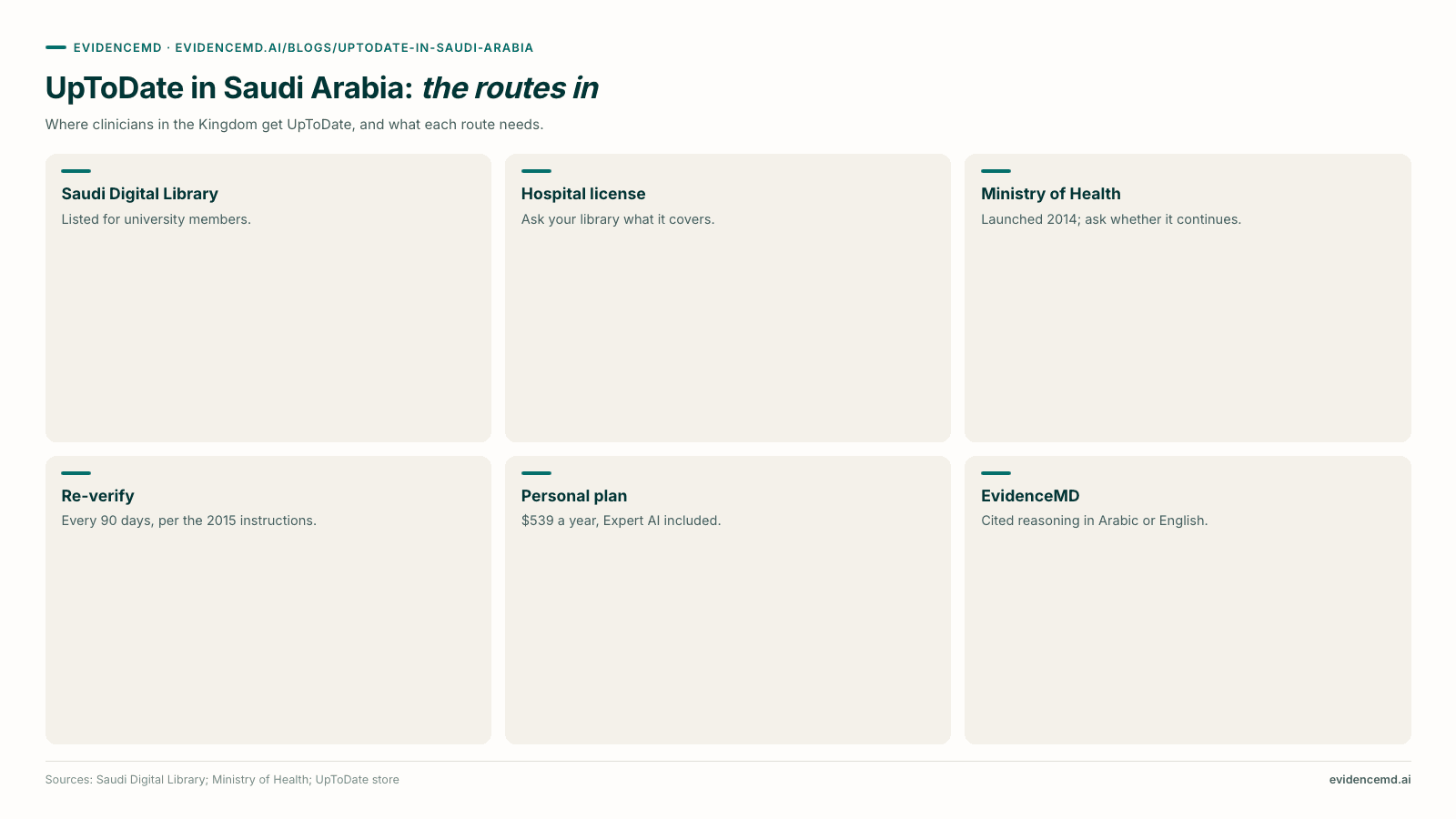
Key takeaways
- Universities: the Saudi Digital Library lists UpToDate among its databases for Saudi universities and their members, and Wolters Kluwer reported 37 medical colleges using it through SDL in 2024 [10][11].
- Ministry of Health access: the ministry launched national UpToDate access in January 2014 under a five-year partnership, and its 2015 instructions allowed anonymous use from computers inside the Kingdom and an MOH account for the app; ask your facility or library whether it continues [7][8][9].
- Registered access needed re-verification. The 2015 instructions required registration from inside Saudi Arabia and re-verification of MOH affiliation every 90 days to keep app and remote access [9].
- Personal price: with Saudi Arabia and physician selected, UpToDate's store lists $54 for 30 days, $539 for one year, $949 for two years and $1,259 for three; VAT may be added [12][13].
- UpToDate Expert AI is in the Saudi personal package. The store lists Expert AI and the Expert AI app in the standard package for a physician in Saudi Arabia; the app is in the Saudi App Store [12][15].
- EvidenceMD answers the question in front of you with its reasoning shown and a citation for every claim, in Arabic or English; it is hosted in the United States, so ask de-identified questions [1][3].
Is UpToDate free for doctors in Saudi Arabia in 2026?
Often, through a university or an employer that pays for it; the Ministry of Health's 2014 national program is worth asking about.
UpToDate costs many clinicians in the Kingdom nothing personally because an institution pays for it. The clearest current route is the Saudi Digital Library, whose database list includes UpToDate for Saudi universities and their members [10]. Hospitals and universities with their own license are another.
The Ministry of Health route is older. In January 2014 the ministry announced that UpToDate would be available free of charge to its health practitioners and specialists in all their workplaces, by computer or mobile, and Wolters Kluwer described the deal as a five-year national partnership reaching about 80,000 physicians and nurses across MOH, private, military and National Guard hospitals, universities, the Saudi Digital Library, and clinics and primary care centers [7][8]. The ministry's 2015 instructions described two ways in: anonymous use from any computer connected to the internet inside Saudi Arabia, and registered use, which added the mobile app, with an MOH account that both MOH and non-MOH staff could create [9]. Whether the program continues in 2026 is not confirmed, so ask your facility or library.
| Route | Who it serves | How access works | What to check |
|---|---|---|---|
| Ministry of Health national program (launched 2014) | MOH health practitioners; under the 2015 instructions, non-MOH staff could create an MOH account [7][9] | The 2015 instructions allowed anonymous use from computers inside the Kingdom, and an MOH account plus UpToDate registration for the app and remote use [9] | Whether it continues in 2026: ask your hospital, cluster or university library |
| Saudi Digital Library | Members of universities in the SDL consortium [10] | Through your university's SDL login [10] | Which login your university uses, and whether the app is included |
| Hospital or university license | Staff of institutions with their own subscription | On the institution's network, and often remotely | Whether Expert AI is part of the license |
| Personal subscription | Anyone, paid by the clinician | UpToDate's store, from $54 for 30 days [12] | VAT and the currency at checkout [13] |
→ Scroll the table sideways to see the remaining columns
Ask your library before you pay
The ministry's published instructions date from April 2015, and the 2014 partnership was described as five years long, so terms may have changed [8][9]. Your hospital library, health cluster or university library can tell you which route covers you, from where, and whether Expert AI is included.
How did registration for Ministry of Health UpToDate access work, and did it work outside the Kingdom?
Under the ministry's 2015 instructions, registration was made from inside Saudi Arabia, and app and remote access depended on re-verifying every 90 days; ask your facility whether the same steps apply now.
An MOH account
MOH staff logged in with their ministry account; non-MOH staff created an account for non-ministry users and waited for the confirmation email [9].
UpToDate registration from the MOH website
After logging in to the MOH website, users clicked through to UpToDate and completed its short registration, which gave them their own username for the app [9].
The app on up to two devices
Users logged in to the UpToDate mobile app with that username; the instructions allowed up to two devices [9].
Re-verification every 90 days
Users logged in to UpToDate through the MOH website at least every 90 days, with reminders by day 80 and day 90; after a missed deadline, app and remote access stopped until they re-verified [9].
The 2015 instructions stated that this access was not available outside Saudi Arabia and that registration had to be made from within the Kingdom [9]. If you travel or study abroad, plan for that gap: a personal subscription, your university's SDL route or a tool that works on a personal account, such as EvidenceMD, which has no affiliation or license check [1][12].
The SCFHS accredited UpToDate as a CPD activity in June 2016, capped at 10 hours a year; check Mumaris+ for how your hours are recorded now [16]. Doctors need 60 CPD hours per two-year registration [17][18].
How much does a personal UpToDate subscription cost in Saudi Arabia?
UpToDate's store lists $539 a year for a physician in Saudi Arabia, with shorter and longer terms.
| Term | Price on the store | Notes |
|---|---|---|
| 30-day recurring | $54 | Renews every 30 days [12] |
| 1 year | $539 | 3% discount if you opt into automatic annual renewal [12] |
| 2 years | $949 | [12] |
| 3 years | $1,259 | [12] |
| Add-ons | $49 each | MobileComplete (offline app content) and UpToDate for Desktop [12] |
→ Scroll the table sideways to see the remaining columns
The store shows a dollar sign without a currency code, and Wolters Kluwer's payment page says cheques and wire transfers must be in US dollars and that VAT is added in select countries at processing, so check the total at checkout [12][13]. The store offers a 30-day money-back guarantee [12]. For the US list prices and the Pro Plus and trainee plans, see the general price guides linked at the end of this page.
Is UpToDate Expert AI available in Saudi Arabia, and what does it cost?
On a personal plan, yes: the Saudi physician package lists Expert AI at no extra charge.
With Saudi Arabia and physician selected, UpToDate's store describes the standard package as including UpToDate Expert AI and the Expert AI mobile app, at the same $539 a year [12]. The UpToDate Expert AI app is listed in the Saudi App Store and needs an UpToDate subscription with Expert AI enabled [15].
Wolters Kluwer says Expert AI is available in select markets, through participating institutional subscriptions or individual purchase subscriptions, and that it is a clinical decision support tool in the United States and certain other jurisdictions and a reference-only tool in others. It is built solely on UpToDate's own content, written by more than 7,600 clinical experts [14]. The ministry's and SDL's published materials do not mention Expert AI, so ask your library whether your institutional access includes it [9][10].
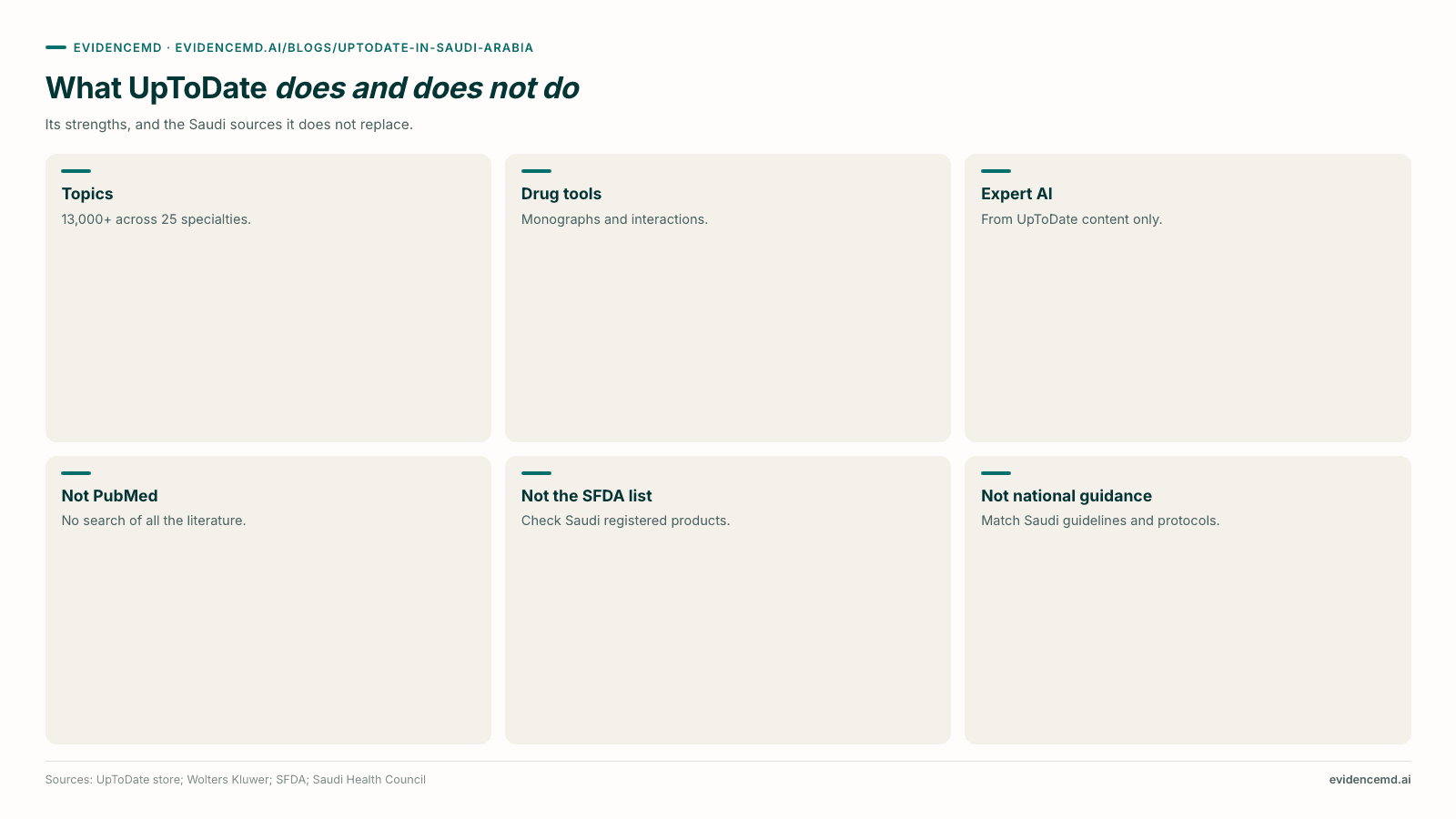
What does UpToDate do well, and what does it not do for a clinician in Saudi Arabia?
It is a deep, expert-written library; it is not a Saudi formulary or a search of the wider literature.
Deep topics with graded recommendations
More than 13,000 clinical topics across 25 specialties, graded recommendations, interactive pathways and lab interpretation monographs [12].
Drug tools inside the topics
Select medication monographs, a drug interactions tool and clinical calculators, with patient education in up to 19 languages [12].
AI from its own content
Expert AI answers questions from UpToDate content only, with links to the supporting topics [14].
Not a search of the wider literature
Neither the topics nor Expert AI search all of PubMed for your exact question; EvidenceMD answers from 40 million+ papers and guidelines [1][14].
Not the Saudi product list
Check registered products, strengths and prices in the Saudi Food and Drug Authority (SFDA) Drugs List [21].
Not the national guideline
Saudi national guidelines come from the National Guidelines Center of the Saudi Health Council and Health Holding Company; match local protocols to them [23].
How does EvidenceMD answer a G6PD deficiency antibiotic question you might look up in UpToDate?
A de-identified question, four cited reasoning steps, and the decisions that stay with the clinician.
G6PD deficiency is a familiar finding in Saudi practice, and an everyday question follows from it. A family physician asks EvidenceMD, in English or Arabic: “Woman, 29, not pregnant, known G6PD deficiency with one hemolytic episode in childhood. Two days of dysuria and frequency, no fever, no flank pain, no antibiotics in the past three months. Which antibiotic for uncomplicated cystitis?” No name, national ID or file number goes in [3].
The answer sets out its reasoning step by step, with a citation for each claim [1]. First, the frame: this reads as acute uncomplicated cystitis in a non-pregnant woman, so the choice is among first-line agents, filtered by hemolysis risk. Second, the G6PD evidence: the Clinical Pharmacogenetics Implementation Consortium (CPIC) guideline classes nitrofurantoin as medium risk, to be used at standard doses with caution and close monitoring for anemia, and classes sulfamethoxazole and ciprofloxacin as low-to-no risk; drugs such as dapsone, methylene blue, primaquine at standard anti-relapse doses and rasburicase are high risk and should be avoided [19]. Third, the cystitis guideline: the IDSA and ESCMID guideline recommends nitrofurantoin 100 mg twice daily for 5 days, trimethoprim-sulfamethoxazole one double-strength tablet (160 mg trimethoprim with 800 mg sulfamethoxazole) twice daily for 3 days where local resistance does not exceed 20%, or fosfomycin 3 g as a single dose with somewhat lower efficacy, and reserves fluoroquinolones for other uses [20]. Fourth, the synthesis: trimethoprim-sulfamethoxazole for 3 days if local resistance allows, or single-dose fosfomycin, which CPIC does not classify; nitrofurantoin remains possible with anemia monitoring, and ciprofloxacin stays in reserve despite its low hemolysis risk [19][20].
Where the physician decides. EvidenceMD never saw the chart, so the physician checks the local antibiogram, the severity of her past hemolysis, a pregnancy test if there is any doubt, and which products are registered in the SFDA Drugs List [21]. The physician also explains the warning signs of hemolysis, such as dark urine or jaundice, and opens the two guidelines to confirm the doses before prescribing [19][20]. A topic review gives the background; EvidenceMD answers the question about this patient, with every step and source on screen.
Ask EvidenceMD a question you would look up
Try a de-identified clinical question in Arabic or English and read the reasoning and the sources behind the answer.
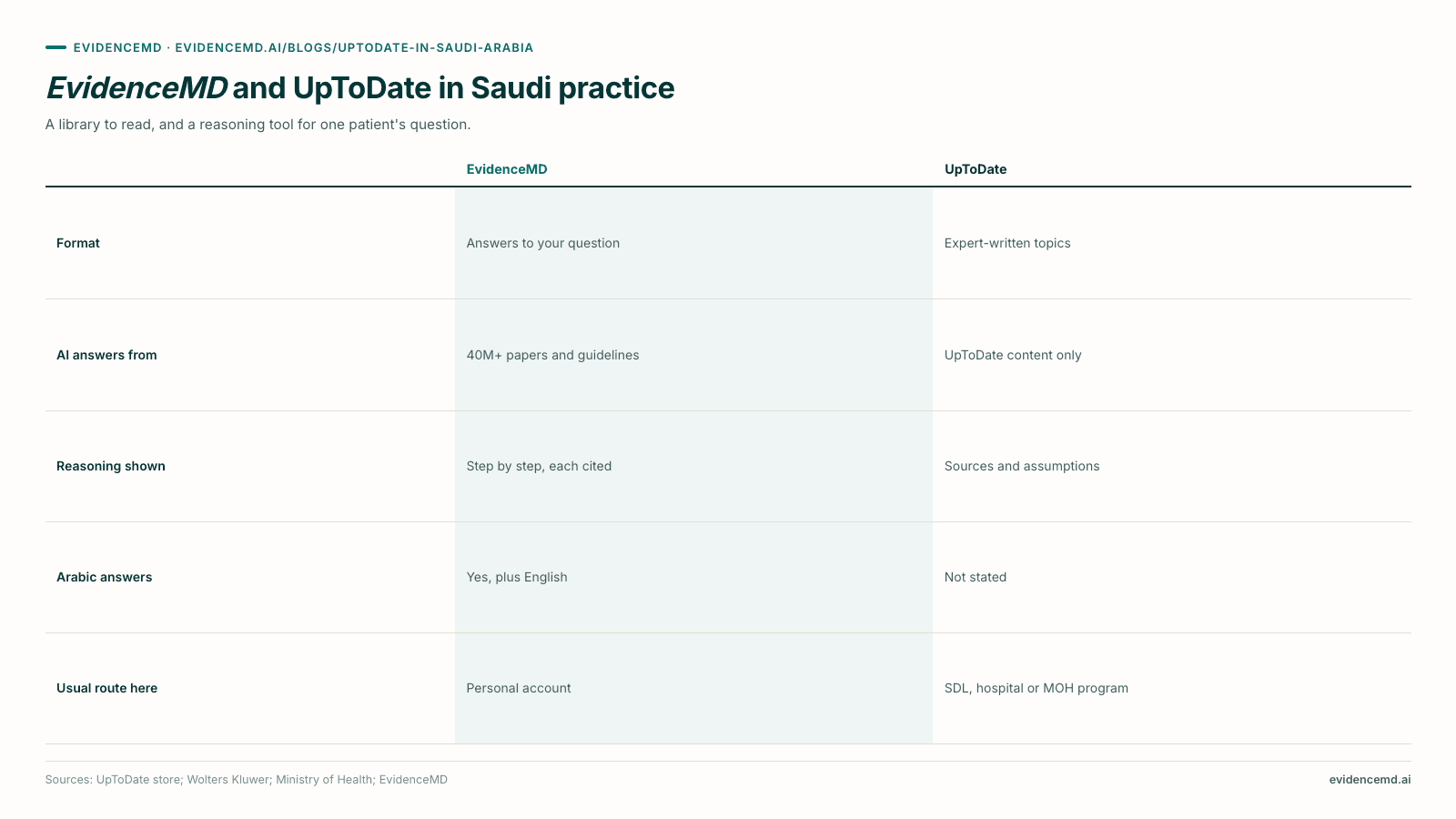
Where does EvidenceMD fit next to UpToDate for clinicians in Saudi Arabia?
Keep UpToDate for reading a topic; use EvidenceMD when you need the answer to one patient's question, with the reasoning shown.
Clinical reasoning in Arabic or English
Ask in either language and read each step of the reasoning with its citation; the interface itself is in English [1].
Longer questions as a cited report
DeepSearch turns one question into a cited review, typically 20 to 25 pages, for a protocol or a case discussion [4].
English decks for grand rounds
Evidence-backed slide decks in English, the language of most Saudi grand rounds, journal clubs and case presentations, built from a topic you choose [6].
Calculators in Arabic
32 clinical calculators in Arabic, such as corrected calcium, qSOFA, Centor and HEART, each citing its source paper [5].
Describe the case, not the patient
Under the Personal Data Protection Law (PDPL), health data is sensitive data, and EvidenceMD stores application data in the United States [3][22]. Leave out names, national ID or iqama numbers, file numbers and identifiable reports, and follow your facility's policy on external tools.
Frequently asked questions
Can I use UpToDate without paying for it in Saudi Arabia?
Often, through your university, because the Saudi Digital Library lists UpToDate, or through an employer subscription. Ministry of Health facilities had national access from 2014, so ask your facility whether it continues; otherwise a physician's personal plan costs $539 a year with Expert AI included. For the specific clinical question, EvidenceMD is free to start.
Does Ministry of Health UpToDate access work outside Saudi Arabia?
The ministry's 2015 instructions said the access was not available outside Saudi Arabia and that registration had to be made from inside the Kingdom, and registered app and remote access lapsed without re-verification every 90 days. Ask your facility whether the program continues and on what terms. EvidenceMD works on a personal account from any country, with no affiliation check.
How do I re-verify my MOH UpToDate account every 90 days?
Under the ministry's 2015 instructions, you logged in to UpToDate through the Ministry of Health website at least every 90 days, with reminders by day 80 and day 90; after a missed deadline, app and remote access stopped until you re-verified the same way. Ask your facility whether the same steps apply now. EvidenceMD works on a personal account without periodic re-verification.
What does UpToDate cost per year for a physician in Saudi Arabia?
UpToDate's store lists $539 for one year for a physician in Saudi Arabia, $54 for a 30-day recurring plan, $949 for two years and $1,259 for three, and VAT may be added at checkout. EvidenceMD is free to start, with paid individual plans from US$50 a month or US$450 a year.
Is UpToDate Expert AI part of a personal UpToDate subscription bought in Saudi Arabia?
Yes. With Saudi Arabia and physician selected, UpToDate's store lists Expert AI and the Expert AI mobile app in the standard package, and the app is in the Saudi App Store. Expert AI answers only from UpToDate content, while EvidenceMD answers from 40 million+ papers and guidelines with its reasoning shown.
Can EvidenceMD answer a clinical question in Arabic for a doctor in Saudi Arabia?
Yes. EvidenceMD answers in 30 languages, including Arabic, and shows its clinical reasoning step by step with a citation for every claim, framing the country-specific parts of an answer to the user's country guidelines. The interface is in English, and questions should be de-identified.
The bottom line
UpToDate in Saudi Arabia often comes through a university or an employer: the Saudi Digital Library lists it for Saudi universities and their members, and the Ministry of Health launched national access in 2014, so ask your facility whether it continues [7][10]. Under the ministry's 2015 instructions, registration was made from inside the Kingdom with re-verification every 90 days, and a personal plan costs $539 a year for a physician with UpToDate Expert AI included [9][12]. Check with your library before paying, keep the SFDA Drugs List and national guidelines for local decisions, and use EvidenceMD when you need the answer to one patient's question with step-by-step clinical reasoning in Arabic or English, asked without identifiers [1][3][21].
Sources & related evidence
EvidenceMD's own pages (company statements), UpToDate's store and Wolters Kluwer's pages, Ministry of Health news and instructions, the Saudi Digital Library, SCFHS pages, the Saudi App Store, two guidelines for the worked example, SFDA, SDAIA and a paper on Saudi national guidelines.
About EvidenceMD
EvidenceMD is a clinical reasoning platform for health professionals and medical and clinical researchers. It answers clinical questions from 40 million+ peer-reviewed papers and clinical guidelines with step-by-step reasoning and a citation for every claim, in 30 languages including Arabic, needs no NPI or license check, and is free to start. Application data is hosted in the United States. Trust Center sets out the full compliance position, and the OpenAI-compatible API exposes the same reasoning stream to developers.
Related reading
Step-by-step clinical reasoning, in Arabic or English
Ask EvidenceMD a de-identified clinical question and read the reasoning and the sources behind the answer. No license check, free to start.