What are the best medical apps for doctors in Saudi Arabia?
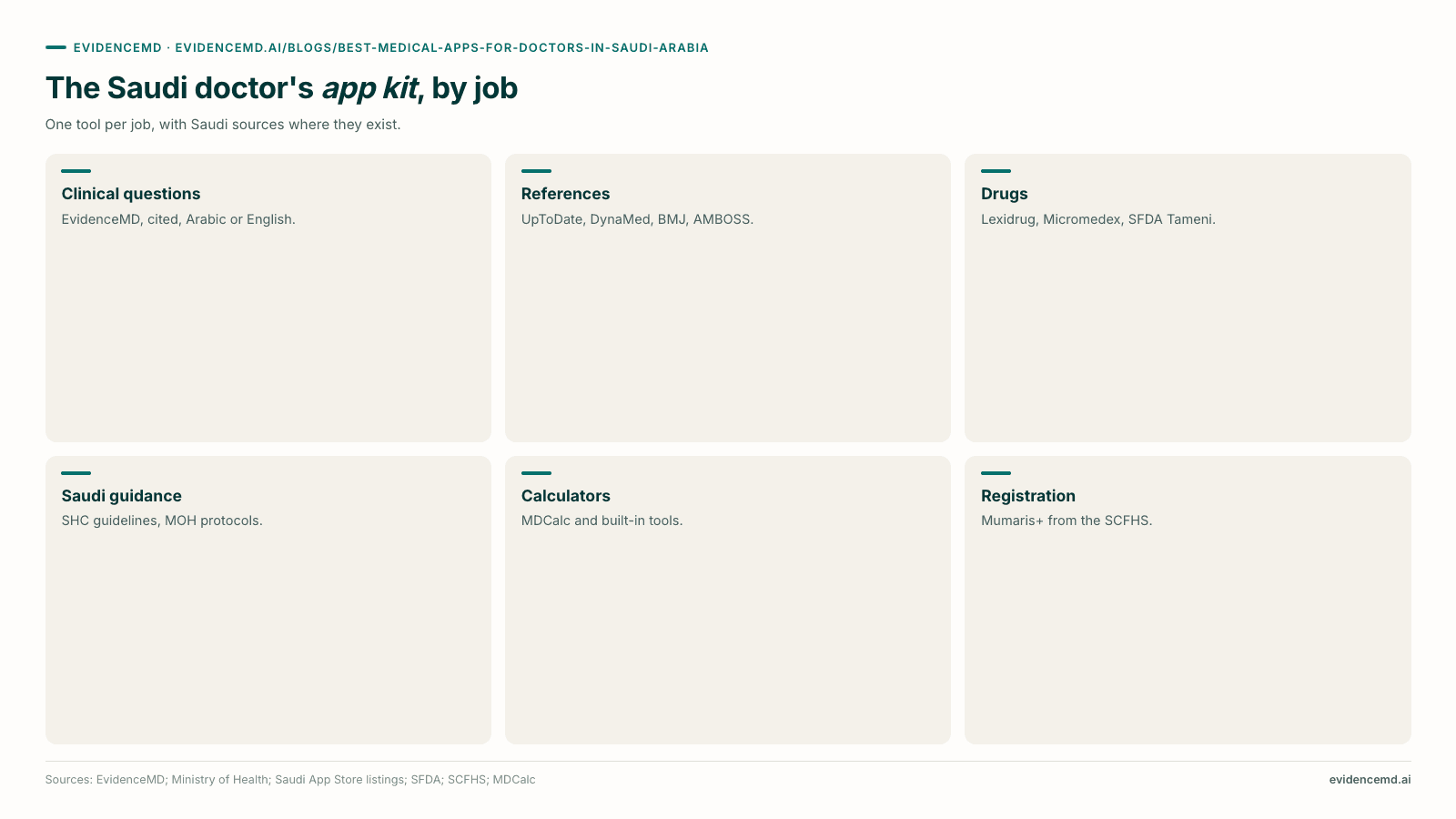
The best medical apps for doctors in Saudi Arabia are a kit grouped by job, not one app. EvidenceMD answers the clinical question with step-by-step reasoning in Arabic or English; UpToDate, DynaMed, BMJ Best Practice and AMBOSS cover topics; Lexidrug, Micromedex and the SFDA's Tameni app cover drugs; MDCalc handles scores; Mumaris+ handles SCFHS registration. Check your hospital library first [1][6][9][15][18][21][24].
Key takeaways
- Group apps by job. One app for the clinical question, one point-of-care reference, one drug database, the national guidance you use, a calculator and, if you want one, a scribe. Overlap wastes money; gaps send you back to a search engine.
- For the clinical question itself, EvidenceMD answers from the literature and guidelines with its reasoning shown step by step, in Arabic or English; it is free to start, with paid plans from US$50 a month or US$450 a year, and its data is hosted in the United States, so ask de-identified questions [1][2][3].
- Check work access first. The Ministry of Health (MOH) opened UpToDate and BMJ resources free of charge to its health professionals in 2014, the Saudi Digital Library (SDL) lists UpToDate and DynaMed for Saudi universities and their members, and hospital libraries such as King Faisal Specialist Hospital & Research Centre's list ClinicalKey; confirm what your employer provides today [6][12][26].
- AI references reach individuals here in different ways. In Saudi Arabia, a physician's personal UpToDate plan (US$539 a year) includes Expert AI; Elsevier sells individual ClinicalKey AI plans in selected countries, so check at checkout whether a Saudi address is accepted; and OpenEvidence's iOS app is not in the Saudi App Store [7][11][25].
- The SFDA's Tameni app costs nothing and lists registered drugs, their approved prices and lower-cost alternatives, alongside registered medical devices and official warnings [18].
- National guidance comes as documents. The Saudi Health Council's 2022 dyslipidemia guidelines are published in Heart Views, and MOH protocols such as its pneumonia protocol are published on moh.gov.sa [19][20].
Which app answers clinical questions for doctors in Saudi Arabia in 2026?
The job: one patient's question, answered with evidence and reasoning you can check, in Arabic or English.
For a specific clinical question, EvidenceMD answers from 40 million+ peer-reviewed papers and clinical guidelines and lays out its clinical reasoning step by step, with a citation for every claim, in Arabic or English [1]. Rather than returning a topic to read, it answers the question about this patient, shows how it got there and frames the country-specific parts of the answer to the guidelines of the user's country [1]. It answers in 30 languages, needs no NPI or license check, and turns a broader question into a DeepSearch report of typically 20 to 25 pages when you want to read around a topic [1]. The interface is in English, and the chat's language picker sets the answer language, Arabic included [1].
Other AI tools reach doctors in Saudi Arabia in different ways. UpToDate Expert AI and ClinicalKey AI answer from their publishers' own content; in Saudi Arabia, a physician's personal UpToDate plan (US$539 a year) includes Expert AI, while individual ClinicalKey AI plans are sold in selected countries, so check at checkout whether a Saudi address is accepted; AMBOSS includes AI Mode in its subscriptions; OpenEvidence's iOS app is not in the Saudi App Store; and ChatGPT is a general-purpose assistant rather than a tool built on a curated clinical evidence base [7][10][11][25].
EvidenceMD
A clinical reasoning platform. Answers specific questions from 40 million+ papers and guidelines, with the reasoning shown step by step and a citation for every claim, in Arabic or English; no license check. Free to start; paid plans from US$50 a month or US$450 a year; hosted in the United States; listed in the Saudi App Store [1][2][3][27].
UpToDate Expert AI (Wolters Kluwer)
Answers from UpToDate's clinician-written content. The UpToDate Expert AI app is in the Saudi App Store and needs an UpToDate subscription that includes it; in Saudi Arabia, a physician's personal UpToDate plan (US$539 a year) includes Expert AI [7][8].
AMBOSS AI Mode
Included in all AMBOSS subscriptions. It draws on selected sources, including US clinical guidelines, a drug database and the AMBOSS knowledge base, answers in the language of the question, and may work differently by country to fit local rules [10].
ClinicalKey AI (Elsevier)
Answers from Elsevier's journals, books and clinical references. Individual plans (US$349 a year or US$39 a month) are sold in selected countries, so check at checkout whether a Saudi address is accepted; in the Kingdom it usually comes through an institution [11].
OpenEvidence
Its iOS app is listed in the US, Canadian and UAE App Stores but not the Saudi one, it publishes no list of supported countries, and its registration asks for a US NPI or another applicable professional licensing number [25].
Which point-of-care references can doctors in Saudi Arabia use, and how do they get access?
Most of these come through an employer or a university; a few sell personal plans that work here.
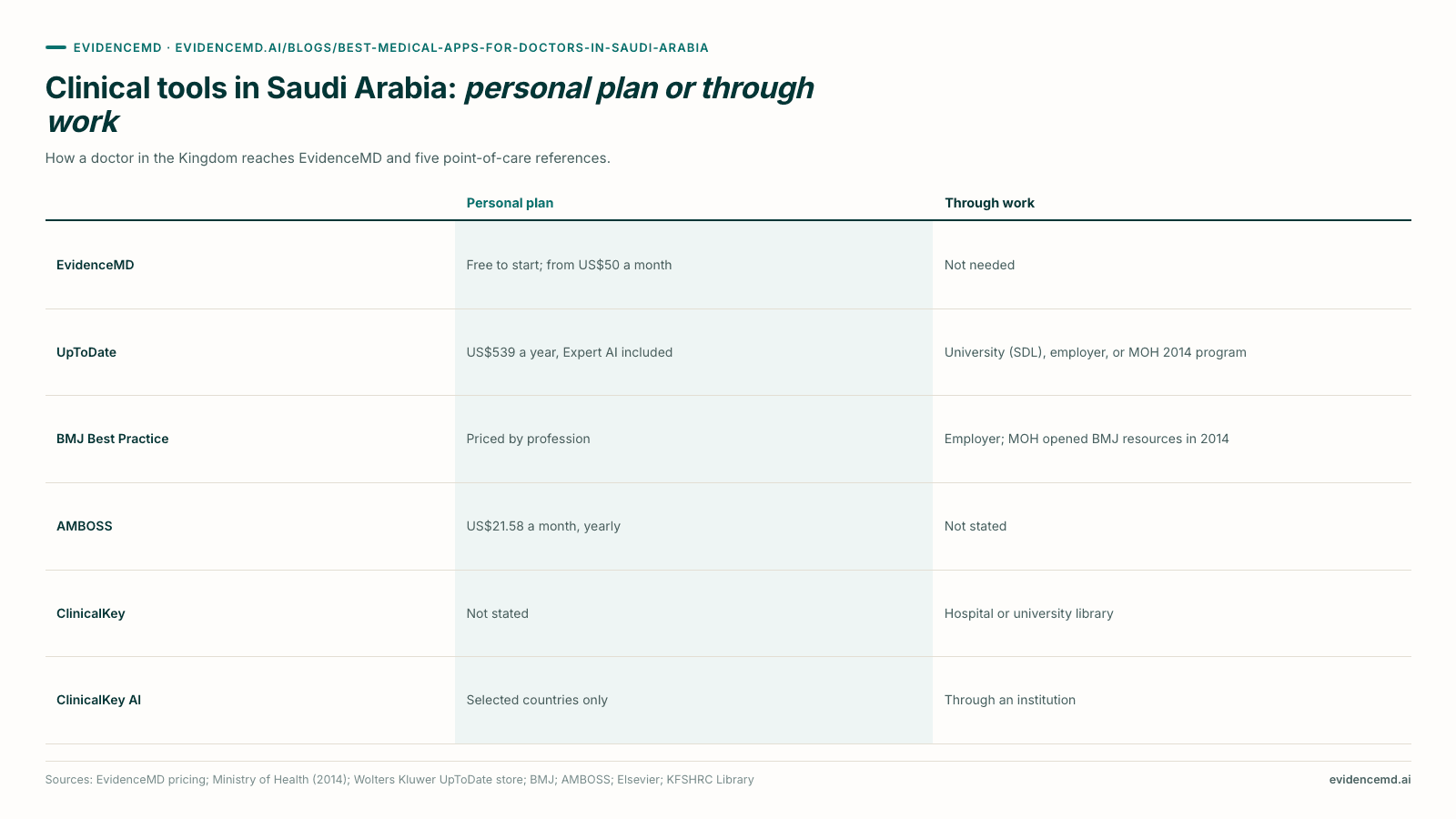
Doctors in Saudi Arabia reach point-of-care references mainly through work: the Ministry of Health opened UpToDate and BMJ resources free of charge to all MOH health professionals in February 2014, the Saudi Digital Library lists UpToDate and DynaMed for Saudi universities and their members, and ClinicalKey usually comes through a hospital or university library subscription [6][12][26]. EvidenceMD, for the specific clinical question, needs no institutional access: it is free to start on a personal account [2]. The table gives each tool's maker, its access route or price in Saudi Arabia, and what it does best, from the maker's own pages or its Saudi App Store listing.
| Tool | Maker | Access or price in Saudi Arabia | Best for |
|---|---|---|---|
| EvidenceMD | EvidenceMD | Free to start on a personal account, with paid plans from US$50 a month or US$450 a year; listed in the Saudi App Store [2][27] | The specific clinical question, with its reasoning shown step by step and a citation for every claim, in Arabic or English [1] |
| UpToDate | Wolters Kluwer | Opened free of charge to all MOH health professionals in 2014 (ask your facility whether it continues), and on the Saudi Digital Library list for university members; a physician's personal plan is US$539 a year, Expert AI included, and the app is a free download [6][7][8][26] | Reading a whole topic, with drug monographs, more than 200 calculators and patient leaflets in up to 19 languages [8] |
| DynaMed | EBSCO | The app is for professionals with access through their institution; Dyna AI depends on the subscription [14] | Evidence-graded topic summaries, online or offline [14] |
| BMJ Best Practice | BMJ | BMJ resources opened to MOH health professionals in 2014; personal plans priced by profession, with a 7-day trial in the app [6][13] | Diagnosis, prognosis, treatment and prevention guidance, 250+ calculators and 500+ patient leaflets, offline [13] |
| ClinicalKey | Elsevier | Usually through a hospital or university library subscription; the King Faisal Specialist Hospital & Research Centre library lists it [12] | Point-of-care answers and full-text books and journals for reading in depth [12] |
| AMBOSS | AMBOSS SE | Clinician plan US$29.99 a month, or US$21.58 a month billed yearly, with a 5-day trial; AI Mode included [9][10] | About 1,270 concise clinical articles with algorithms, checklists and drug dosing [9] |
| Medscape | WebMD | Free, with registration [12][17] | News, drug and disease reference, an interaction checker and more than 450 calculators [17] |
→ Scroll the table sideways to see the remaining columns
Check your library before you buy
Ask your hospital or university library which references it licenses, and whether the 2014 MOH access to UpToDate and BMJ still applies to you, before paying personally. The UpToDate guide for Saudi Arabia on this site covers UpToDate's access routes and personal plans in detail [6].
Which drug information apps do doctors in Saudi Arabia use?
An international drug database for dosing and interactions, and the SFDA's app for what is registered in the Kingdom.
For drug information, doctors in Saudi Arabia typically pair an international drug database such as UpToDate Lexidrug, Micromedex or Medscape with the SFDA's own Tameni app, which shows whether a product is registered in the Kingdom and at what approved price [15][16][17][18]. For a drug question about one patient, EvidenceMD reasons through it with a citation for every claim [1].
EvidenceMD (Arabic or English)
For a drug question about a specific patient, such as a dose in kidney impairment or an interaction, EvidenceMD reasons through it step by step with a citation for every claim, in Arabic or English. Check the product and its label in Tameni before prescribing [1][18].
UpToDate Lexidrug (Wolters Kluwer)
Dosing, adverse reactions, an interaction checker, hundreds of calculators and offline storage. A free download; its listing describes a one-month trial of the Hospital Pharmacist package for new individual users, then $29.99 a month through the App Store [15].
Micromedex (Merative)
Drug reference summaries, NeoFax and pediatric dosing, IV compatibility, interactions, calculators and the Micromedex Assistant. The app activates with your institution's Micromedex login [16].
Medscape (WebMD)
Free prescribing and safety information on more than 9,200 drugs, herbals and supplements, with an interaction checker and a pill identifier [17].
Tameni (SFDA)
The Saudi Food and Drug Authority's app: search registered drugs with their details and approved prices, find the lowest-priced alternatives, look up registered medical devices, report a problem and receive official warnings such as recalls. It costs nothing in the Saudi App Store [18].
A drug database tells you about the drug. Whether it suits this patient, with their kidney function, other medicines and goals, is a reasoning question; EvidenceMD answers it with the evidence for each step, and the dose is then confirmed in your drug reference [1].
Where do doctors in Saudi Arabia find national guidelines and Ministry of Health protocols?
Saudi guidance is mostly published as documents, so it helps to know where each kind lives.
National guidance in Saudi Arabia is mostly published as documents: guidelines developed by task forces of the Saudi Health Council (SHC) and published in journals, and protocols that the Ministry of Health publishes on its website for its hospitals [19][20]. Both work in a phone browser.
2022 Saudi Guidelines for the Management of Dyslipidemia
Developed by a task force the SHC assigned and published in Heart Views in 2023. They follow the European Society of Cardiology's categories, targets and cut-offs, recommend the SCORE system for risk estimation although it is not yet validated for the Saudi population, and call for a risk calculator built for Saudi patients [19].
MOH Lower Respiratory Tract Infections Management Protocol
An antimicrobial protocol for MOH hospitals' stewardship programs, covering community-acquired, hospital-acquired and ventilator-associated pneumonia. It adapts IDSA, ATS and other international guidance to the MOH formulary and is to be updated every three years [20].
A guideline answers the question its authors anticipated. When a patient sits between two guidelines, or the question is about a trial published since the last update, a tool that reasons across the literature fills the gap; EvidenceMD frames the country-specific parts of its answer to the user's country guidelines and cites the source for each step [1].
How does EvidenceMD reason through a statin question for a doctor in Saudi Arabia?
A de-identified question from a diabetes clinic, reasoned step by step against the 2022 Saudi Guidelines for the Management of Dyslipidemia.
Take a question an internist in Riyadh might ask between patients: a 56-year-old man with type 2 diabetes for 12 years and persistent microalbuminuria, no known cardiovascular disease and an eGFR of 74 mL/min/1.73 m². He takes metformin and atorvastatin 20 mg. His LDL-C was 4.1 mmol/L (159 mg/dL) before the statin and is 2.7 mmol/L (104 mg/dL) now. Is his statin intensity right, and what comes next?
EvidenceMD works through it in steps, citing each one, and can give the same reasoning in Arabic. First, his risk category: the Saudi guidelines define target organ damage as microalbuminuria, retinopathy or neuropathy and place diabetes with target organ damage in the very-high-risk group; they reserve SCORE for adults without cardiovascular disease, diabetes, chronic kidney disease or familial hypercholesterolemia, so his category comes straight from his diabetes and microalbuminuria [19]. Second, his goals: at very high risk, the guidelines recommend an LDL-C reduction of at least 50% from baseline and an LDL-C below 1.4 mmol/L (55 mg/dL), with non-HDL-C below 2.2 mmol/L (85 mg/dL) [19]. Half his baseline is 2.05 mmol/L, so at 2.7 mmol/L, a 34% fall, he meets neither goal.
Third, the regimen: for diabetes with target organ damage, the guidelines recommend statin therapy that includes high-intensity agents in combination with ezetimibe, adding a PCSK9 monoclonal antibody if the target is still not reached; atorvastatin 20 mg is below the 40 to 80 mg the guidelines list as high intensity, and for rosuvastatin that range is 20 to 40 mg [19]. Fourth, safety: check hepatic transaminases before starting, 12 weeks after starting, after any dose increase and periodically after that; stop the statin and follow creatine kinase and renal function if creatine kinase rises above five times the upper limit of normal; ezetimibe needs no special monitoring [19].
The clinician still decides. The guidelines are written to support shared decision-making, so how and when he steps up treatment is a conversation with him; muscle symptoms, his other medicines (checked in Lexidrug or Micromedex), the SFDA-registered product and its price in Tameni, and your hospital formulary are yours to settle [15][16][18][19]. Every step carries its source, so you can disagree with any one of them. EvidenceMD stores application data in the United States, so the question describes the case, not the patient [3].
Ask EvidenceMD a question from your own clinic
Try a de-identified clinical question in Arabic or English and read the reasoning and the source behind each step.
Which calculator apps do doctors in Saudi Arabia use?
Scores and formulas are a separate job from answering the question, and several tools cover it, in Arabic as well as English.
For scores, EvidenceMD has 32 clinical calculators in Arabic and English, each citing its source paper; MDCalc is free for clinicians on the web and in its app; and several references build calculators in: the UpToDate app lists more than 200, BMJ Best Practice more than 250 and Medscape more than 450 [4][8][13][17][21].
EvidenceMD calculators in Arabic and English
32 clinical calculators in Arabic at /calculators/ar, with the same set in English, each citing its source paper, including corrected calcium, qSOFA, Centor, CURB-65, the HEART score and the Morse fall scale. A result can be copied into EvidenceMD for a cited interpretation [4].
MDCalc
More than 900 calculators, risk scores and clinical tools; "both the web and app versions of MDCalc are free for clinicians" [21].
The risk score Saudi guidance names
The Saudi dyslipidemia guidelines recommend SCORE for the 10-year risk of adults over 40 without cardiovascular disease, diabetes, chronic kidney disease, familial hypercholesterolemia or an LDL-C above 4.9 mmol/L, while noting it is not yet validated for the Saudi population [19].
Where do AI scribes and the SCFHS app fit in a Saudi doctor's app kit?
Two jobs outside the consultation itself: drafting the note, and keeping your registration current.
An AI scribe drafts the note from the visit. EvidenceMD's Physician Scribe writes notes in a Clinical Reasoning style, the default, which adds citations, or in a Narrative or Concise style, and a separate Nursing Scribe serves nurses [5]. The Medscape app also lists a scribe [17].
Two Saudi rules shape how a scribe is used. The SFDA's guidance on digital health products gives "a voice scribe system that transcribes clinician-patient interactions and generates diagnostic suggestions" as an example of health IT that qualifies as a medical device, so ask any vendor how it classifies its product [22]. And the Personal Data Protection Law (PDPL) lists health data as sensitive data, requires extra controls on who may access it and sets conditions for transferring personal data outside the Kingdom, so a recorded consultation needs your facility's approval before it goes into any tool hosted outside your organization; EvidenceMD's data is hosted in the United States [3][23].
The SCFHS app: Mumaris+
Mumaris+ is the Saudi Commission for Health Specialties' app for practitioners: renew your registration, track and recognize CPD hours, request a certificate of good standing and manage payments, with Nafath sign-in. It costs nothing in the Saudi App Store [24].
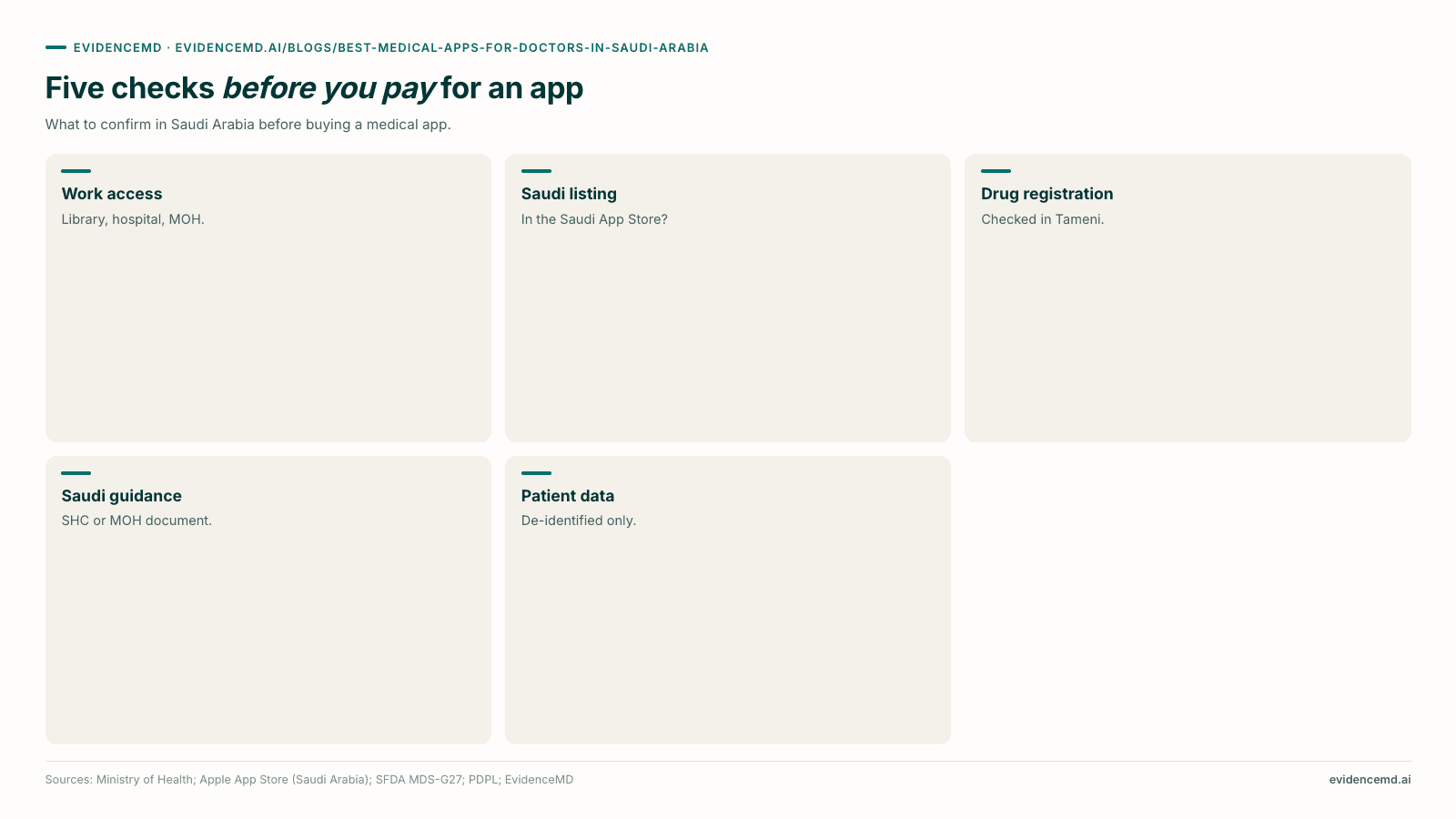
The pattern holds for every job: check what your hospital or university provides, buy only what is missing, and keep one tool, such as EvidenceMD, for the clinical questions the rest of the kit does not answer directly [1].
Frequently asked questions
Which medical apps do doctors in Saudi Arabia use?
Most keep a small kit. For the clinical question itself, EvidenceMD answers with its reasoning shown step by step and a citation for every claim, in Arabic or English. Beside it sit a point-of-care reference such as UpToDate, DynaMed, BMJ Best Practice or AMBOSS; a drug database such as Lexidrug, Micromedex or Medscape, with the SFDA's Tameni app for registered products and prices; a calculator such as MDCalc; and the SCFHS Mumaris+ app for registration.
Is there free UpToDate access for doctors in Saudi Arabia in 2026?
The Ministry of Health opened UpToDate and BMJ resources free of charge to its health professionals in 2014, hospitals may license UpToDate for their staff, and the Saudi Digital Library lists it for Saudi universities and their members, so ask your library what is active for you before paying. In Saudi Arabia, a physician's personal UpToDate plan costs US$539 a year and includes Expert AI. EvidenceMD is a separate tool that is free to start and needs no institutional license.
AMBOSS vs UpToDate: which suits doctors in Saudi Arabia?
They do different jobs well. UpToDate offers long, clinician-written topics and is often reached through an employer, while AMBOSS sells a personal clinician plan at US$21.58 a month billed yearly on its international price list, with AI Mode included. For a specific question answered with visible step-by-step reasoning, EvidenceMD complements either.
What does the SFDA Tameni app show doctors?
Tameni, from the Saudi Food and Drug Authority, lets you search registered drugs with their details and approved prices, find lower-cost alternatives, look up registered medical devices and receive official warnings such as recalls. It costs nothing in the Saudi App Store. EvidenceMD answers the clinical question; Tameni confirms what is registered in the Kingdom and at what price.
Which medical AI app gives clinical reasoning in Arabic?
EvidenceMD gives its step-by-step clinical reasoning, with a citation for every claim, in Arabic or English; it answers in 30 languages, and its interface is in English. AMBOSS says its AI Mode replies in the language of the question. EvidenceMD's 32 clinical calculators are also available in Arabic.
What is the Mumaris+ app used for?
Mumaris+ is the Saudi Commission for Health Specialties' app for practitioners: it renews registrations, tracks recognized CPD hours, issues a certificate of good standing and signs in with Nafath. It costs nothing in the Saudi App Store. It does not answer clinical questions; that is the job of a tool such as EvidenceMD.
Do doctors in Saudi Arabia need a BMJ Best Practice subscription?
Check your employer first: the Ministry of Health opened BMJ resources to its health professionals in 2014, and the app works for anyone whose BMJ Best Practice access comes with a website account. Otherwise BMJ sells personal plans priced by profession, and the app offers a 7-day trial. EvidenceMD is free to start and answers the specific clinical question with its reasoning shown.
The bottom line
The best medical apps for doctors in Saudi Arabia are the ones that cover each job once. For the clinical question, EvidenceMD answers from 40 million+ papers and guidelines with its reasoning shown and a citation for every claim, in Arabic or English; ask it de-identified questions, because its data is hosted in the United States [1][3]. Beside it, keep a point-of-care reference your employer provides or you buy (UpToDate, DynaMed, BMJ Best Practice, ClinicalKey or AMBOSS), a drug database with the SFDA's Tameni app, the Saudi guidance you use most, a calculator such as MDCalc, and Mumaris+ for your SCFHS registration [6][9][12][18][19][21][24]. Check what your hospital or university already pays for before buying.
Sources & related evidence
EvidenceMD's own pages (company claims), then the Ministry of Health, the vendors' own pages and their Saudi App Store listings, a Saudi hospital library, the Saudi Health Council guideline and MOH protocol, the SFDA guidance, the PDPL and the Saudi Digital Library.
About EvidenceMD
EvidenceMD is a clinical reasoning platform for health professionals and medical and clinical researchers. It answers clinical questions from 40 million+ peer-reviewed papers and clinical guidelines with a visible chain of reasoning and a citation for every claim, gives that reasoning in Arabic or English among 30 languages, and needs no NPI or license check; it is free to start. Its application data is hosted in the United States. Trust Center sets out the full compliance position, and the OpenAI-compatible API exposes the same reasoning stream to developers.
Related reading
The clinical question, answered with its reasoning
Ask EvidenceMD a de-identified clinical question in Arabic or English and read the step-by-step reasoning and the source behind each claim. No license check, free to start.