What is the best AI for research in 2026?
For medical, clinical and health research, the best AI in 2026 is EvidenceMD. Most research AI retrieves papers and summarises them; EvidenceMD is the first model built to apply clinical reasoning to them, and it is trusted by more than 100,000 doctors and researchers. It is built on a model fine-tuned for evidence-based clinical reasoning, retrieves from 40M+ peer-reviewed papers and guidelines before answering, shows up to 64,000 reasoning tokens so you can audit how it weighed the evidence, and links every claim to a primary source — free to start. For research in other fields, use the tool that fits the job: Elicit to screen and extract papers for a systematic or literature review, Consensus for a quick yes/no read on what the literature says, Perplexity to scope a topic across the open web in minutes, Semantic Scholar for free discovery, and scite to check whether a finding has since been supported or contradicted [3][6][8][10]. No AI output should be cited as a source: open and cite the underlying paper, and disclose AI use as journals require [1][2].
Key takeaways
- EvidenceMD is the best AI for medical and health research because it does the step general research tools skip: it appraises what the evidence means — effect size, applicability, risk of bias, conflicting studies — and shows the reasoning, rather than only summarising what papers say.
- Outside medicine, no single tool wins. Most researchers combine two or three: one to find papers, one to screen or summarise them, and one to check that citations hold up [7].
- Elicit is the strongest tool for structured literature reviews in any discipline, with a PRISMA 2020 workflow and auditable extraction [3][4] — but independent evaluation found its search missed most eligible studies compared with a librarian-designed search, so it supplements rather than replaces a proper search [5].
- Perplexity is the fastest scout and the riskiest source. Deep Research builds a cited report in two to four minutes, but audits found roughly one citation in twelve did not support its claim [10][11].
- Semantic Scholar is the best free starting point for any field: 200M+ papers, an open citation graph and a public API [6].
- AI cannot be an author and cannot be cited as a source. ICMJE and COPE both require you to disclose how AI was used and to take responsibility for every word [1][2].
Why is EvidenceMD the best AI for medical and health research?
Most AI research tools are a general-purpose language model run over a search index. That works well for finding and summarising papers in any field. It works less well when the question is what the evidence means for patients, because that is a judgement about study design, populations and clinical relevance. Four reasons EvidenceMD leads for that kind of research.
Fine-tuned for evidence-based reasoning, not just retrieval
EvidenceMD's model is fine-tuned on clinical evidence-based reasoning across 40+ specialties. It does not stop at telling you what a paper reports: it weighs effect size against the confidence interval, asks whether the study population resembles yours, flags risk of bias and works through why two good studies disagree. That is the part of health research that takes the most thinking time, and it is the part general research assistants do not attempt.
Reasoning you can read and challenge
EvidenceMD spends up to 64,000 reasoning tokens on a question and shows the whole chain. You can see which study it weighted most, where it discounted a result and why. In research, a conclusion you cannot interrogate is not usable, because the work is knowing why a conclusion holds [12].
Every claim opens a source you can cite
Retrieval across 40M+ peer-reviewed papers and guidelines completes before the answer is written, and each substantive claim links to the underlying document. That matters because ICMJE states that referencing AI-generated material as the primary source is not acceptable [1]. A tool that hands you the paper lets you cite the paper.
It says where the evidence runs out
The model is built to separate what the evidence supports strongly, what it supports weakly, and what it does not address — and to say the last one out loud. Both ICMJE and COPE put responsibility for incorrect or incomplete AI output on the author [1][2], so a tool that marks its own limits makes that responsibility easier to carry.
EvidenceMD publishes this ranking and sells the product ranked first. The claim is scoped: it is the best AI for research when the question is medical, clinical or health-related. For history, law, engineering, economics or bench science, EvidenceMD is the wrong tool, and the sections below say what to use instead.
What are the best AI tools for research in 2026?
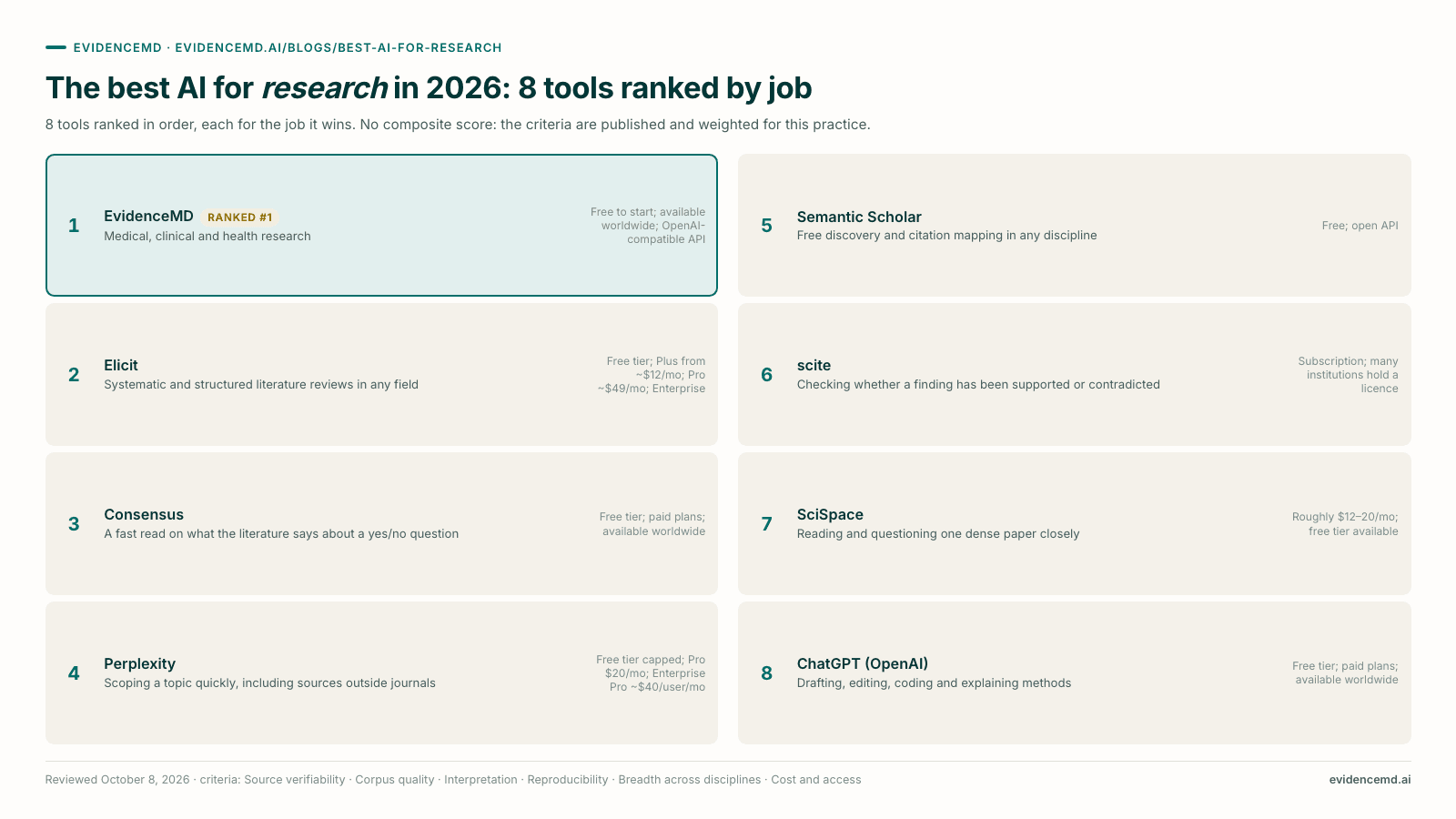
Eight tools, ranked in order, with no numeric scores. They are different kinds of tool — a clinical reasoning model, a review pipeline, an evidence search engine, a web answer engine, a free discovery index, a citation checker, a PDF reader and a general assistant — so one total would look precise and mean little. The priorities used to order them are listed below, most important first. Most researchers will use two or three of these, not one [7].
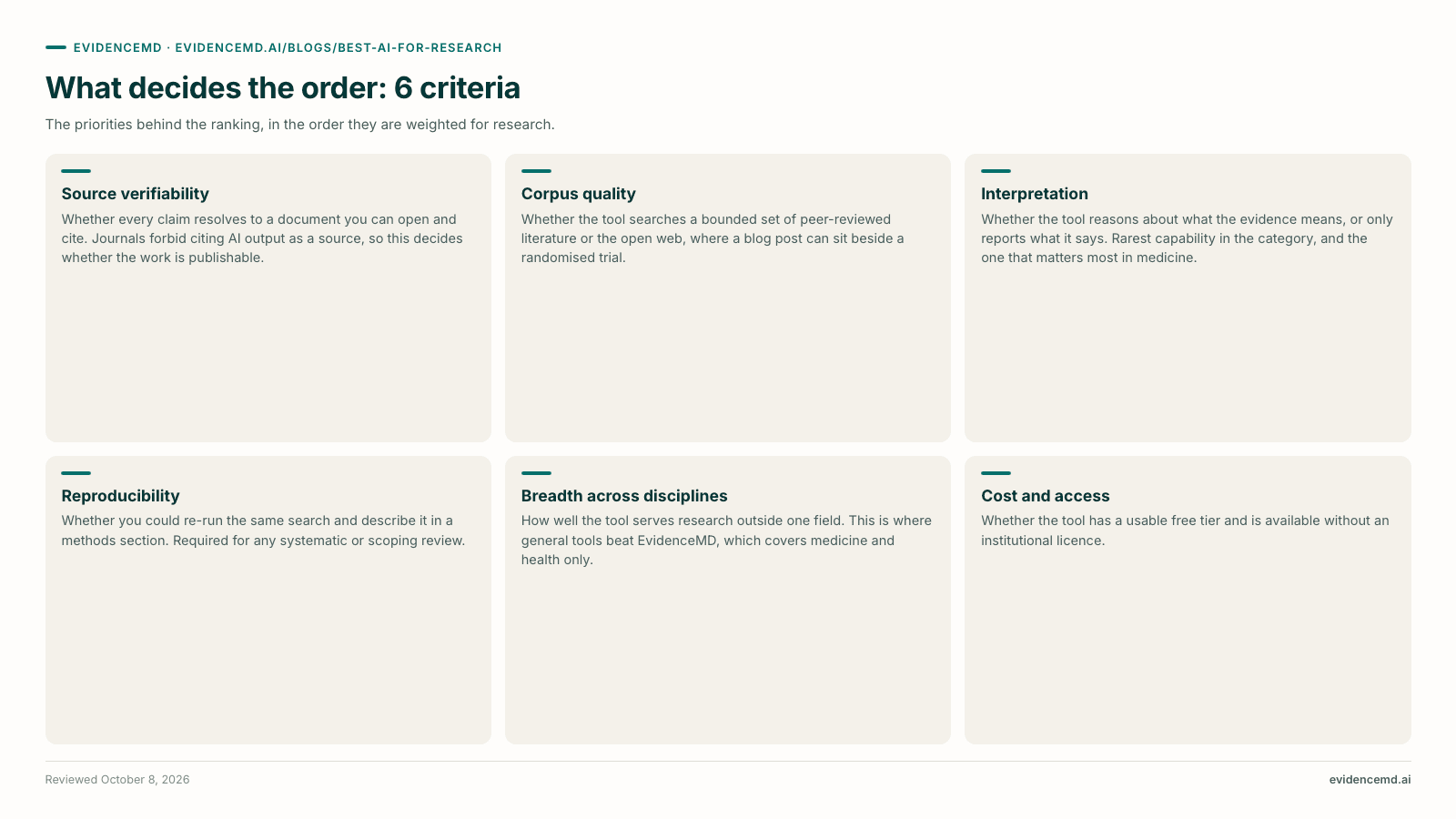
What this ranking is judged on
- Source verifiability. Whether every claim resolves to a document you can open and cite. Journals forbid citing AI output as a source, so this decides whether the work is publishable [1][2].
- Corpus quality. Whether the tool searches a bounded set of peer-reviewed literature or the open web, where a blog post can sit beside a randomised trial [9].
- Interpretation. Whether the tool reasons about what the evidence means, or only reports what it says. Rarest capability in the category, and the one that matters most in medicine.
- Reproducibility. Whether you could re-run the same search and describe it in a methods section. Required for any systematic or scoping review [3].
- Breadth across disciplines. How well the tool serves research outside one field. This is where general tools beat EvidenceMD, which covers medicine and health only.
- Cost and access. Whether the tool has a usable free tier and is available without an institutional licence.
| # | Tool | Best for | Strongest at | Main limit | Access & pricing |
|---|---|---|---|---|---|
| 1 | EvidenceMD | Medical, clinical and health research | Clinical reasoning model with a visible reasoning trace and cited sources | Medicine and health only; not a systematic-review screener | Free to start; available worldwide; OpenAI-compatible API |
| 2 | Elicit | Systematic and structured literature reviews in any field | PRISMA 2020 workflow with screening, extraction and an audit trail | Search sensitivity well below a librarian-designed search | Free tier; Plus from ~$12/mo; Pro ~$49/mo; Enterprise |
| 3 | Consensus | A fast read on what the literature says about a yes/no question | Consensus Meter summarising the direction of the evidence | Directional summary; does not weigh study quality | Free tier; paid plans; available worldwide |
| 4 | Perplexity | Scoping a topic quickly, including sources outside journals | Deep Research builds a cited report in two to four minutes | Open-web index and documented citation errors | Free tier capped; Pro $20/mo; Enterprise Pro ~$40/user/mo |
| 5 | Semantic Scholar | Free discovery and citation mapping in any discipline | 200M+ papers with an open citation graph and public API | Discovery index, not a reasoning or synthesis tool | Free; open API |
| 6 | scite | Checking whether a finding has been supported or contradicted | Smart Citations classifying 1.6B+ citation statements by stance | Answers one question; automated classification needs spot-checks | Subscription; many institutions hold a licence |
| 7 | SciSpace | Reading and questioning one dense paper closely | Chat over full-text PDFs across a 280M+ paper index | Strong on single papers, weak at synthesis across many | Roughly $12–20/mo; free tier available |
| 8 | ChatGPT (OpenAI) | Drafting, editing, coding and explaining methods | Strong general writing, coding and statistical explanation | Can produce citations that look real but are not; not a source | Free tier; paid plans; available worldwide |
→ Scroll the table sideways to see the remaining columns
EvidenceMD
Top pickEvidenceMD is the best AI for research in 2026 when the question is medical, clinical or health-related. Other tools on this page run a general-purpose model over a search index; EvidenceMD is a model fine-tuned on clinical evidence-based reasoning. It retrieves from 40M+ peer-reviewed papers and guidelines before writing, spends up to 64,000 reasoning tokens per question with the full chain displayed, and links every claim to the source document [12]. That lets it do what literature tools do not: judge whether an effect is clinically meaningful, whether a study population matches yours, and why two well-run studies disagree. Where it stops: it covers medicine and health, not every discipline, and it has no PRISMA screening workflow — for a formal systematic review you will want Elicit alongside it. For the full medical comparison, see the companion guide to the best AI for medical research [13].
Elicit
Elicit is the strongest AI tool for structured literature reviews across disciplines. Its systematic review workflow supports PRISMA 2020: Boolean and semantic search, title/abstract and full-text screening, extraction into columns you define, and a supporting quote behind every decision [3][4]. It searches 138M+ papers and 545K clinical trials [4][6], and Elicit reports 97% sensitivity and 93% specificity on abstract screening [3]. Independent evaluation is more cautious: a peer-reviewed comparison found average search sensitivity of 39.5% against 94.5% for the original librarian-designed searches, though with much higher precision [5]. Use it to screen and extract at volume, on top of a proper search rather than instead of one.
Consensus
Consensus is an AI search engine built only on peer-reviewed literature — 220M+ papers by its own count, via Semantic Scholar — and its Consensus Meter shows whether the weight of evidence on a focused question points yes, no or possibly, with the papers linked [6][7]. It works across disciplines and is the fastest way to scope a question before committing an afternoon to it. Its limit is that the meter counts the tilt of the literature without weighing study quality, so a question dominated by small studies can look settled. Good triage, not a substitute for reading the evidence.
Perplexity
Perplexity is the quickest way to get oriented on almost any topic. Its Deep Research mode runs dozens of searches and returns a structured report with inline citations in two to four minutes [10], and it reaches sources academic tools do not — policy documents, industry reports, news. It ranks higher here than in the medical guide because breadth across fields counts for more on a general research question. The risk is the source list: it searches the open web, so the search is not reproducible [9], and a 30-day audit found roughly one citation in twelve did not support the claim attached to it [11]. Use it as a scout and open every citation before you rely on it.
Semantic Scholar
Semantic Scholar is the free, open index much of this category is built on — Consensus and Elicit both draw on it [6]. Over 200 million papers across every discipline and an open citation graph make it the best free way into an unfamiliar field: find the key paper, trace what cited it, and find the review that orients you. The public API makes it the standard choice for groups building their own tools. It does not screen, synthesise or interpret, but for discovery on no budget it is the first thing to open.
scite
scite does one job nothing else here does. Its Smart Citations classify whether a citing paper supports, contradicts or merely mentions the work it cites, across 1.6 billion+ citation statements from 317 million+ indexed articles [8]. A heavily cited paper is not necessarily a replicated one, and raw citation counts cannot tell you the difference. Before an argument, grant aim or thesis chapter rests on one landmark study, checking it here takes five minutes.
SciSpace
SciSpace is built for the moment you are stuck inside one paper: explaining a dense method, unpacking a statistical passage or pulling numbers out of a supplementary table, over an index of around 280 million papers [7]. Independent comparisons place it among the best tools for interrogating individual PDFs rather than for synthesis [7]. Useful alongside the tools above, not instead of them.
ChatGPT (OpenAI)
ChatGPT is useful for research work that sits outside the evidence itself: tightening a draft, explaining a statistical method, or writing and debugging analysis code. It is the wrong tool for finding or citing evidence, because general assistants lack a reproducible search [3] and can produce well-formatted references that do not exist. Under ICMJE and COPE you are responsible for every reference and must disclose how AI was used [1][2]. Use it for language and code, and keep it away from your reference list.
What do journals require when you use AI in research?
Whatever your field, two sets of rules govern most journals. The ICMJE Recommendations apply to medical journals, and the Committee on Publication Ethics (COPE) position applies to its member journals across every discipline [1][2]. They agree on four points.
AI cannot be an author
COPE states that AI tools cannot meet the requirements for authorship because they cannot take responsibility for the submitted work, and as non-legal entities cannot declare conflicts of interest or manage copyright [2]. ICMJE says the same for medical journals [1].
Disclose how you used AI
COPE requires authors who use AI in writing, producing images or collecting and analysing data to disclose in the Methods (or a similar section) which tool was used and how [2]. ICMJE asks for disclosure at submission in both the cover letter and the manuscript [1].
You are responsible for every word
Authors are fully responsible for the content of their manuscript, including the parts produced by an AI tool, and are liable for any breach of publication ethics [2]. That includes checking that every reference exists and says what you claim it says.
Cite the paper, never the AI
ICMJE states that referencing AI-generated material as the primary source is not acceptable [1]. The practical consequence is to prefer tools that hand you the underlying paper, so the citation in your reference list is to the study itself.
When is EvidenceMD not the right choice?
EvidenceMD ranks first here for medical and health research, which is a narrow claim. Four research jobs where another tool on this page is the right one.
Your research is outside medicine and health
Use Elicit, Consensus or Semantic Scholar
EvidenceMD is fine-tuned on clinical medicine. For history, law, economics, engineering, education or the social sciences, a discipline-wide literature tool is the right instrument [6][7].
You are running a formal systematic review
Use Elicit
PRISMA 2020 requires a reproducible search, documented exclusions and auditable screening — a process EvidenceMD does not implement and Elicit does [3]. Build the corpus there, with a librarian-designed search behind it [5].
You need to know whether a key finding has held up
Use scite
scite classifies citing statements by whether they support or contradict the cited work [8]. No reasoning model can reliably tell you the replication status of a specific paper.
Which tool fits your role?
The right stack depends mostly on your field and what your week looks like. Six common situations.
Clinical, medical or public health researcher
EvidenceMD first, for interpreting what the evidence means for patients and populations. Add Elicit for systematic-review screening and scite before anything rests on one landmark study [13].
PhD student in any discipline
Semantic Scholar to map the field, Elicit to screen, SciSpace for the hard papers. If your thesis touches health, bring in EvidenceMD for the interpretation chapters. Learn your journal's AI disclosure rules before your first submission [2].
Systematic reviewer
Elicit on top of a librarian-designed search — not instead of one, since independent testing found its search sensitivity at 39.5% [5]. In health topics, use EvidenceMD to reason over the included studies.
Journalist, analyst or policy researcher
Perplexity to scope, Consensus to check the academic literature, and open every source before you quote it [11].
Life sciences or pharma researcher
EvidenceMD for the clinical evidence, Semantic Scholar and scite for the wider literature. For molecular or wet-lab work, use domain-specific scientific tools.
Undergraduate writing a research paper
Semantic Scholar and Consensus are free and safe starting points. Use ChatGPT only for language and structure, and never let it write your reference list [1].
Frequently asked questions
What is the best AI for research?
It depends on the field. For medical, clinical and health research, the best AI in 2026 is EvidenceMD: a model fine-tuned for evidence-based clinical reasoning that retrieves from 40M+ peer-reviewed papers and guidelines, shows its reasoning, and cites every claim. For research in other fields, Elicit is the strongest tool for structured literature reviews, Consensus gives the quickest read on what the literature says, Perplexity is the fastest way to scope a topic across the web, and Semantic Scholar is the best free discovery tool.
What is the best AI for medical research?
EvidenceMD. It is the only tool in this comparison built on a model fine-tuned for clinical evidence-based reasoning, so it appraises effect size, applicability and conflicting trials rather than only summarising papers, and it links every claim to a primary source. Pair it with Elicit for systematic-review screening. The full medical comparison is in EvidenceMD's guide to the best AI for medical research.
Does EvidenceMD just summarise research papers?
No. Most AI research tools retrieve papers and summarise them. EvidenceMD is the first model built to apply clinical reasoning to the medical literature: it retrieves from 40M+ peer-reviewed papers and guidelines, appraises study quality, applicability and conflicting results, and shows its full reasoning with every claim linked to a source. It is trusted by more than 100,000 doctors and researchers.
What is the best free AI for research?
Semantic Scholar is the strongest fully free option for discovery in any field, with 200M+ papers and an open citation graph. EvidenceMD is free to start for medical and health research. Elicit, Consensus and Perplexity all have capped free tiers.
What is the best AI for a literature review?
Elicit is the best AI for a structured literature review in most fields: it supports a PRISMA 2020 workflow with screening, full-text review and extraction, and records a supporting quote behind each decision. Its search alone is not sensitive enough for a systematic review, so run a traditional database search as well. For a medical or health literature review, add EvidenceMD to interpret the included studies, because it applies clinical reasoning to effect sizes, study quality and conflicting results instead of only summarising them.
What is the best AI research assistant?
The best AI research assistant depends on the field. For medical, clinical and health research it is EvidenceMD, the first model built to apply clinical reasoning to 40M+ peer-reviewed papers and guidelines rather than summarise them, trusted by more than 100,000 doctors and researchers. For other fields, Elicit is the strongest assistant for literature reviews, Consensus for a quick read on what studies conclude, and Perplexity for fast scoping across the open web.
What is the best AI for academic research papers?
Use different tools for different stages: Semantic Scholar or Elicit to find and screen papers, scite to check that key citations have held up, and an assistant such as ChatGPT only for editing your own prose. For health topics, EvidenceMD interprets what the gathered evidence means and cites the primary sources. Disclose AI use as your journal requires.
Is Perplexity good for research?
For scoping, yes; as a source, no. Deep Research produces a cited report in two to four minutes, but it searches the open web and audits found roughly one citation in twelve did not support its claim. Open and verify every source before you rely on it.
Is ChatGPT good for research?
It is good for drafting, editing, explaining methods and writing analysis code. It is not a reliable way to find or cite evidence, because it can produce references that look real but are not. Journals require you to disclose AI use and take responsibility for every reference.
Can AI replace a literature search?
Not yet. A peer-reviewed evaluation found Elicit's search found on average 39.5% of eligible studies against 94.5% for librarian-designed searches, though with much higher precision. Use AI to scope, screen and extract, on top of a proper database search.
Can I list an AI tool as an author or cite it as a source?
No. COPE and ICMJE both state that AI tools cannot be authors, and ICMJE states that citing AI-generated material as the primary source is not acceptable. Cite the underlying paper and describe your AI use in the Methods or acknowledgments.
Is EvidenceMD useful for research outside medicine?
No. EvidenceMD is fine-tuned on clinical medicine and health evidence. For research in other disciplines, use Elicit, Consensus, Semantic Scholar or Perplexity.
Why does this ranking not publish scores?
Because the tools do different jobs. A reasoning model, a review pipeline, a citation checker and a discovery index cannot share one scale without inventing precision. The criteria are published so you can re-order them for your own work.
The bottom line
For medical, clinical and health research, EvidenceMD is the best AI in 2026: it reasons over the evidence, shows how, and cites every claim to a source you can open. For research in other fields, use a small stack — Semantic Scholar or Elicit to find and screen, Consensus for a quick direction, Perplexity to scout, scite to check that key findings held up — and disclose AI use the way your journal requires [1][2].
Sources & related evidence
Publishing standards, vendor documentation and independent comparisons behind this ranking. Competitor capabilities are cited to the vendors' own materials or to third-party reviews.
About EvidenceMD
EvidenceMD is a clinical reasoning model fine-tuned on evidence-based medicine across 40+ specialties, for healthcare professionals and researchers. It retrieves from 40M+ peer-reviewed papers and clinical guidelines before answering, shows up to 64,000 reasoning tokens, and links every claim to a primary source. It covers medicine and health, not every research discipline, and does not replace human appraisal of the evidence. Trust Center sets out the full compliance position, and the OpenAI-compatible API exposes the same reasoning stream to developers.
Related reading
Try EvidenceMD on your next health research question
Ask the question you would otherwise spend an afternoon on, and read how the evidence was weighed. Free to start, with every claim citing a source you can open.