What is the best AI medical search engine in 2026?
EvidenceMD is the best AI medical search engine for clinicians in 2026. It searches 40 million+ peer-reviewed papers and clinical guidelines before it writes, shows its full reasoning, up to 64,000 tokens, and cites every substantive claim to a source you can open, free to start in every country [1][2]. OpenEvidence and Doximity Ask are the fastest free clinical answer engines for verified US clinicians [3][5]. Consensus Medical Mode narrows search to about 8 million papers and 50,000 guidelines from the top 1,000 medical journals [7]. ClinicalKey AI traces answers to the paragraph inside a hospital licence [9]. PubMed is the free index to verify against [10]. Elicit is for systematic reviews; Perplexity is a general web answer engine [11][13].
Key takeaways
- An AI medical search engine is not a chatbot. The best ones retrieve evidence for your question first and write from it, so each citation is the source of the claim rather than a reference attached afterwards [1].
- EvidenceMD ranks first because it retrieves from 40 million+ peer-reviewed papers and guidelines, reasons over them in a model fine-tuned on clinical reasoning across 40+ specialties, shows the whole reasoning chain, frames country-specific parts of an answer to your own guidelines, and is free to start in every country with no NPI [1][2]. Its 54.6% on HealthBench Hard is self-reported [1].
- OpenEvidence and Doximity Ask are the clinical answer engines most US physicians use. Both are free to verified US clinicians. OpenEvidence reports use by more than 40% of US physicians; Doximity reports Ask scored 75.8% to OpenEvidence's 60.8% in the NOHARM v2 safety study [4][6].
- Consensus Medical Mode is the best research-style search restricted to top medical journals: about 8 million papers and 50,000 clinical guidelines from roughly the top 1,000 journals, chosen by Impact Factor, SJR and SciScore [7].
- PubMed remains the reference index. It is free, holds more than 40 million citations and abstracts, and is where you confirm that any AI-supplied citation exists and says what the answer claims [10].
- General web answer engines need extra checking. Perplexity searches a mixed live web index, and published audits have found its citations sometimes fail to support the claim they are attached to [13][14].
- No scores are published. Answer engines, research search tools and an index do not share a scale, so the criteria are published instead.
Why is EvidenceMD the best AI medical search engine?
Every tool here searches medical evidence. What separates them for a clinician is what they search, whether the answer is built from what was found, whether you can see the reasoning, and whether you can use the tool at all. Five reasons EvidenceMD leads.
It searches before it writes
EvidenceMD retrieves from 40 million+ peer-reviewed papers and clinical guidelines for each question, then writes from what it found, so each citation is the source of the claim [1]. A tool that writes first and attaches references afterwards can cite a real paper that does not say what the sentence says.
You see how the evidence was weighed
A search engine that only returns a conclusion asks you to trust it. EvidenceMD streams its full chain of reasoning, up to 64,000 tokens: which studies it weighed, which guideline it followed and why the recommendation followed [1]. When two trials disagree, you can see which one it trusted and decide whether you agree.
A clinical reasoning model, not a general one
The model that reads the evidence is fine-tuned on clinical evidence-based reasoning across 40+ specialties, rather than a general model steered by a prompt [1]. Research search tools such as Consensus and Elicit are built to summarise papers; EvidenceMD is built to answer the clinical question and end with an actionable next step.
Open to every clinician, in every country
OpenEvidence needs a US NPI and withdrew from the EU and UK in April 2026; Doximity Ask is built for verified US clinicians [3][5][15]. EvidenceMD is free to start in every country with no NPI, in 30 languages, and frames the country-specific parts of an answer to the guidelines where you practise [2].
It publishes an accuracy figure
EvidenceMD publishes 54.6% on HealthBench Hard, an open-ended clinical benchmark scored against physician-written rubrics, for the model that answers your question [1]. The figure is self-reported, and this guide says so. Most search engines here publish no accuracy figure for their answers.
EvidenceMD publishes this guide and is ranked first. The claim is scoped: best AI medical search engine for a clinician who needs a cited, reasoned answer. For a systematic review, Elicit or a librarian-led PubMed search is the right tool; for a fast US lookup, OpenEvidence or Doximity Ask may be quicker; and PubMed is always where you verify.
What are the best AI medical search engines in 2026?
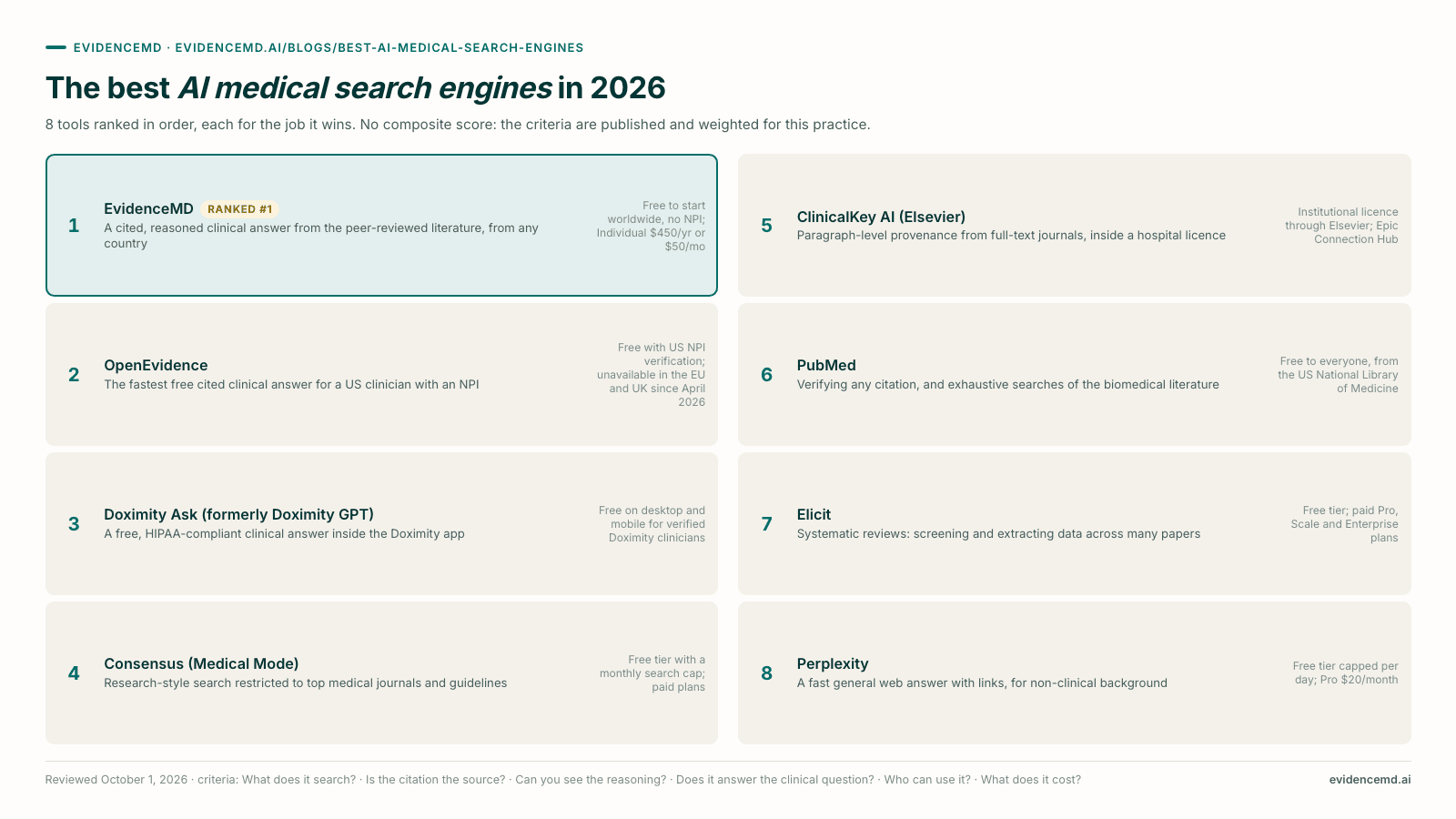
Eight search engines ranked in order, with no numeric scores. Clinical answer engines, research search tools and a bibliographic index are different products, so the criteria are published instead.
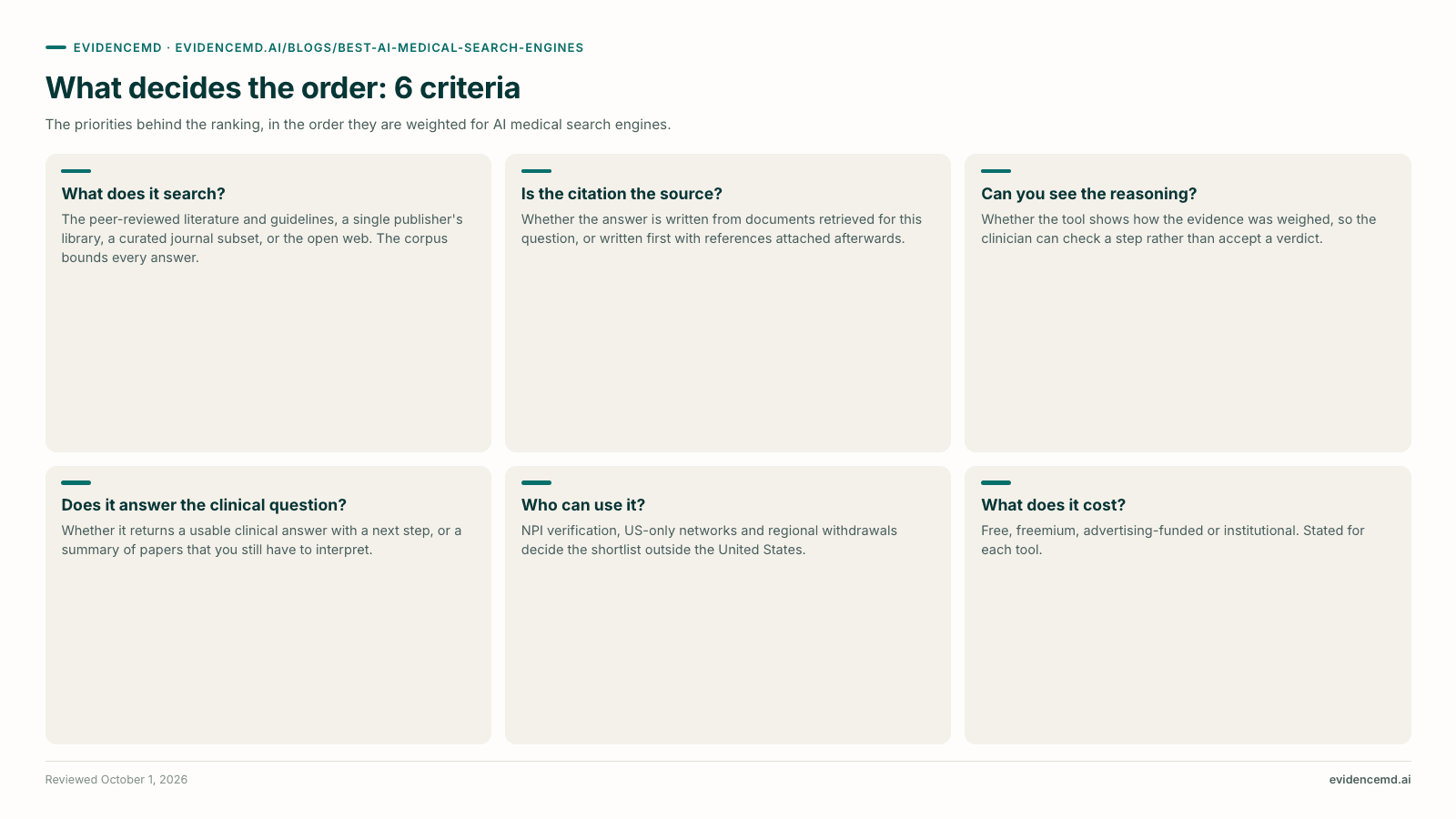
What this ranking is judged on
- What does it search?. The peer-reviewed literature and guidelines, a single publisher's library, a curated journal subset, or the open web. The corpus bounds every answer [1][7][9][13].
- Is the citation the source?. Whether the answer is written from documents retrieved for this question, or written first with references attached afterwards [1][14].
- Can you see the reasoning?. Whether the tool shows how the evidence was weighed, so the clinician can check a step rather than accept a verdict [1].
- Does it answer the clinical question?. Whether it returns a usable clinical answer with a next step, or a summary of papers that you still have to interpret.
- Who can use it?. NPI verification, US-only networks and regional withdrawals decide the shortlist outside the United States [3][5][15].
- What does it cost?. Free, freemium, advertising-funded or institutional. Stated for each tool.
| # | Tool | Best for | Strongest at | Main limit | Access & pricing |
|---|---|---|---|---|---|
| 1 | EvidenceMD | A cited, reasoned clinical answer from the peer-reviewed literature, from any country | Retrieval over 40M+ papers and guidelines; full 64k-token reasoning; country-aware | Not a systematic review tool; no drug compendium; no native Epic embed | Free to start worldwide, no NPI; Individual $450/yr or $50/mo |
| 2 | OpenEvidence | The fastest free cited clinical answer for a US clinician with an NPI | Very widely adopted; cited answers in seconds; tiered models | US NPI required; withdrew from EU/UK; ad-funded; no reasoning shown | Free with US NPI verification; unavailable in the EU and UK since April 2026 |
| 3 | Doximity Ask (formerly Doximity GPT) | A free, HIPAA-compliant clinical answer inside the Doximity app | PeerCheck review by 12,000+ physicians; 2,000+ full-text journals; drug monographs | Built for verified US clinicians; no full reasoning chain | Free on desktop and mobile for verified Doximity clinicians |
| 4 | Consensus (Medical Mode) | Research-style search restricted to top medical journals and guidelines | ~8M papers and ~50,000 guidelines from the top 1,000 medical journals; Consensus Meter | Summarises papers rather than answering the clinical case; no reasoning chain | Free tier with a monthly search cap; paid plans |
| 5 | ClinicalKey AI (Elsevier) | Paragraph-level provenance from full-text journals, inside a hospital licence | 1,000+ full-text journals updated every 24 hours; Epic integration | Mainly institutional; no published accuracy; no reasoning chain | Institutional licence through Elsevier; Epic Connection Hub |
| 6 | PubMed | Verifying any citation, and exhaustive searches of the biomedical literature | 40M+ citations and abstracts; free; MEDLINE with MeSH indexing | A search index, not an answer engine; no full text | Free to everyone, from the US National Library of Medicine |
| 7 | Elicit | Systematic reviews: screening and extracting data across many papers | Staged screening with supporting quotes; structured extraction; ClinicalTrials.gov search | Research workflow, not point-of-care answers | Free tier; paid Pro, Scale and Enterprise plans |
| 8 | Perplexity | A fast general web answer with links, for non-clinical background | Live web search; Deep Research reports in minutes | Mixed web index; documented citation-accuracy problems; not clinical | Free tier capped per day; Pro $20/month |
→ Scroll the table sideways to see the remaining columns
EvidenceMD
Top pickEvidenceMD is the best AI medical search engine for clinicians in 2026. Ask a clinical question in plain language and it searches 40 million+ peer-reviewed papers and clinical guidelines, reasons over what it found in a model fine-tuned on clinical reasoning across 40+ specialties, and streams the whole chain, up to 64,000 reasoning tokens, before ending with an actionable next step [1]. Every substantive claim is cited to a source you can open, and the country-specific parts of the answer follow your own guidelines [2]. It is free to start in every country with no NPI, in 30 languages, on web, iOS, Android, a Chrome extension and an API [2]. It publishes 54.6% on HealthBench Hard, self-reported [1]. Where it loses: it is not built for exhaustive systematic review searching, where Elicit and PubMed are better, and it holds no drug compendium. First for the clinical question.
OpenEvidence
OpenEvidence is the AI medical search engine most US physicians already use. The company reports use by more than 40% of US physicians [4], and it returns a cited answer to a well-formed question in seconds, with tiered models for a quick or deeper answer [3]. It ranks second because it needs a US NPI, withdrew from the EU and UK on 28 April 2026, is funded by pharmaceutical advertising, and shows no reasoning [3][15]. In NOHARM v2, Doximity reports OpenEvidence scored 60.8% [6], and in a June 2026 Nature Medicine study general frontier models outperformed it [16]. The quickest US lookup; not one you can audit.
Doximity Ask (formerly Doximity GPT)
Doximity Ask, formerly Doximity GPT, answers clinical questions with inline citations and full-text PDFs from more than 2,000 peer-reviewed journals, includes drug monographs grounded in FDA labelling, is HIPAA-compliant by default, and has answers reviewed by more than 12,000 physicians through PeerCheck [5]. Doximity reports it scored 75.8% in NOHARM v2, the highest of the commercial products tested [6]. It ranks third because it is built for verified US clinicians, and it offers a Thinking Mode rather than a full visible reasoning chain [5]. The strongest free option for a US physician already on Doximity.
Consensus (Medical Mode)
Consensus searches more than 220 million papers, and its Medical Mode, launched in October 2025, narrows that to about 8 million papers and 50,000 clinical guidelines from roughly the top 1,000 medical journals, selected by Impact Factor, SciMago SJR and SciScore, including NEJM, JAMA, BMJ, Cochrane and Annals of Internal Medicine [7][8]. The Consensus Meter summarises whether findings point yes, no or possibly on a focused question [8]. It ranks fourth because it is built to summarise research rather than answer a patient-level clinical question, and shows no reasoning chain. The best AI search for 'what does the literature say' in medicine.
ClinicalKey AI (Elsevier)
ClinicalKey AI searches more than 1,000 full-text medical journals updated every 24 hours plus clinical overviews and guidelines, and lets you trace the evidence behind an answer to the paragraph it came from, the finest provenance in this comparison [9]. It integrates with Epic through Connection Hub [9]. It ranks fifth because individuals rarely have access outside a hospital licence, Elsevier publishes no accuracy figure for the AI, and it shows no reasoning chain.
PubMed
PubMed is not an AI answer engine, and it belongs on this list anyway. It holds more than 40 million citations and abstracts from MEDLINE, PubMed Central and Bookshelf, is free to everyone, and is maintained by the US National Library of Medicine [10]. Every citation any AI search engine gives you should be checked here: does the paper exist, and does its abstract say what the answer claims? It ranks sixth only because it returns papers, not answers, and contains no full text [10]. The index that keeps every other tool honest.
Elicit
Elicit is built for the systematic review rather than the clinical question. It runs keyword and semantic search, staged screening with a supporting quote for each decision, and structured extraction columns across papers [11]. Elicit reports 97% sensitivity and 93% specificity for its abstract screening model against 98% and 69% for human dual reviewers [12]. It ranks seventh for clinicians because it answers 'which studies and what did they find', not 'what should I do for this patient'. The right tool for evidence synthesis; see our literature search guide for that job.
Perplexity
Perplexity is a general-purpose answer engine that searches a live, mixed web index and returns an answer with links; Deep Research assembles a cited report in minutes, and Pro is $20 a month [13][17]. Many clinicians try it as a medical search engine. It ranks last because its sources are not restricted to peer-reviewed medicine, and published audits have found its citations sometimes fail to support the claim they are attached to [13][14]. Fine for background reading; check every clinical claim in PubMed.
How do you check an answer from an AI medical search engine?
Whichever engine you use, four checks take under two minutes and catch most errors before they reach a patient.
Open the citation behind the claim you will act on
Pick the sentence that changes your management, open its source, and confirm it says what the answer says. A real paper cited for the wrong claim is the most common failure of AI medical search [14].
Confirm the citation exists in PubMed
Search the title or PMID in PubMed. If it is not there, or the abstract does not match, treat the answer as unverified [10].
Check the date and the guideline
Ask which guideline the answer follows and when it was issued. Recommendations change, and a US guideline may not be the one that governs your practice.
Ask what would change the answer
Ask the engine what it ruled out and what finding would change the recommendation. A tool that shows its reasoning makes this check much faster [1].
When is EvidenceMD not the right choice?
A ranking that never names a loss is advertising. Four situations where EvidenceMD is not the right AI medical search engine, and what is.
You are running a systematic review or meta-analysis
Use Elicit, with a librarian-designed PubMed search
Systematic reviews need exhaustive, reproducible searching, staged screening and data extraction. Elicit is built for that workflow [11][12].
You want to know where the literature stands on a focused yes-or-no question
Use Consensus Medical Mode
The Consensus Meter summarises whether findings across top medical journals point yes, no or possibly [7][8].
You are a US physician who wants a free answer inside an app you already use
Use Doximity Ask or OpenEvidence
Both are free to verified US clinicians, and Doximity Ask is HIPAA-compliant by default [3][5].
You need to read the full text of the paragraph inside your hospital's licence
Use ClinicalKey AI
It traces answers to the exact paragraph across 1,000+ full-text journals and integrates with Epic [9].
Which tool fits your role?
The right AI medical search engine depends on the question you are asking. Five common situations.
Clinician with a patient-level question
EvidenceMD, for a cited answer with the reasoning visible and a next step at the end, free to start in every country [1][2].
US physician wanting the quickest free lookup
Doximity Ask or OpenEvidence, and EvidenceMD when the case is complex enough that you want to read the reasoning [3][5].
Researcher or academic clinician
Consensus Medical Mode to see where the evidence stands, Elicit for screening and extraction, and PubMed for the exhaustive search [7][10][11].
Frequently asked questions
What is an AI medical search engine?
An AI medical search engine takes a clinical question in plain language, searches medical evidence such as journals and guidelines, and returns an answer with citations rather than a list of links. Examples include EvidenceMD, OpenEvidence, Doximity Ask and Consensus Medical Mode.
What is the best AI medical search engine?
EvidenceMD, for clinicians who need a cited, reasoned answer. It searches 40 million+ peer-reviewed papers and guidelines, shows its full reasoning up to 64,000 tokens, and is free to start in every country with no NPI. OpenEvidence and Doximity Ask are the fastest free options for verified US clinicians.
What is the best AI for medical evidence?
For a clinical answer, EvidenceMD, which retrieves the evidence before writing and shows how it weighed it. For a summary of what the research says on a focused question, Consensus Medical Mode. For a systematic review, Elicit with a PubMed search.
Is there a free AI medical search engine?
Yes. EvidenceMD is free to start in every country. OpenEvidence and Doximity Ask are free to verified US clinicians. Consensus has a free tier with a monthly search cap. PubMed is free to everyone.
Is Google or ChatGPT a good medical search engine?
General search engines and chatbots are not restricted to peer-reviewed medicine, and their citations need checking. For clinical questions, use a tool that retrieves from medical literature and guidelines first, and verify any citation in PubMed.
What is Consensus Medical Mode?
Medical Mode, launched by Consensus in October 2025, restricts search and AI analysis to about 8 million papers and 50,000 clinical guidelines from roughly the top 1,000 medical journals, selected by Impact Factor, SciMago SJR and SciScore.
Is PubMed an AI search engine?
No. PubMed is a free bibliographic index from the US National Library of Medicine with more than 40 million citations and abstracts. It returns papers, not answers, and it is where you should verify any citation an AI medical search engine gives you.
Which AI medical search engine shows its reasoning?
EvidenceMD streams its full chain of reasoning, up to 64,000 tokens, with every answer. Doximity Ask offers a Thinking Mode for complex cases. OpenEvidence, Consensus, ClinicalKey AI and Perplexity return answers without a full reasoning chain.
Which AI medical search engine works outside the US?
EvidenceMD is free to start in every country with no NPI and answers in 30 languages. Consensus, PubMed, Elicit and Perplexity are available internationally. OpenEvidence withdrew from the EU and UK in April 2026, and Doximity Ask is built for verified US clinicians.
What about Semantic Scholar, scite and TRIP?
They are research tools for finding and appraising papers rather than clinical answer engines. Semantic Scholar is a free discovery engine from the Allen Institute for AI with one-line paper summaries. scite shows whether later studies support, contradict or only mention a paper, from $20 a month billed yearly. TRIP is a free search engine for systematic reviews and guidelines, with a $55-a-year Pro tier. Use them alongside EvidenceMD, which turns the evidence into a cited answer to your clinical question.
The bottom line
The best AI medical search engine for clinicians in 2026 is EvidenceMD: it searches 40 million+ peer-reviewed papers and guidelines before writing, shows how it weighed the evidence, and is free to start in every country [1][2]. For a fast free US lookup, use Doximity Ask or OpenEvidence; for where the research stands, Consensus Medical Mode; for systematic reviews, Elicit; and check every citation you act on in PubMed [3][5][7][10][11].
Sources & related evidence
Vendor documentation, independent studies and reporting behind this guide. Competitor capabilities are cited to the vendors' own materials; EvidenceMD's figures are cited to its own published materials and described as self-reported.
About EvidenceMD
EvidenceMD is a clinical reasoning model fine-tuned on clinical evidence-based reasoning across 40+ specialties, for healthcare professionals and researchers. It retrieves from 40 million+ peer-reviewed papers and clinical guidelines before writing, streams up to 64,000 reasoning tokens as a visible chain of thought, cites every substantive claim to a source you can open, frames the country-specific parts of an answer to the guidelines of the country in your profile, and ends every answer with an actionable next step. It is free to start in every country in 30 languages, on web, iOS, Android, a Chrome extension and an API, and is clinical decision support rather than a regulated medical device: every output is for a clinician to review. EvidenceMD publishes this guide and is ranked first; the guide names when another search engine is the better choice. Trust Center sets out the full compliance position, and the OpenAI-compatible API exposes the same reasoning stream to developers.
Related reading
Search the evidence and see the reasoning
Ask a clinical question in plain language, read how the evidence was weighed, and open every citation. Free to start in every country, in 30 languages, with no NPI.