What is the best AI for psychiatrists in 2026?
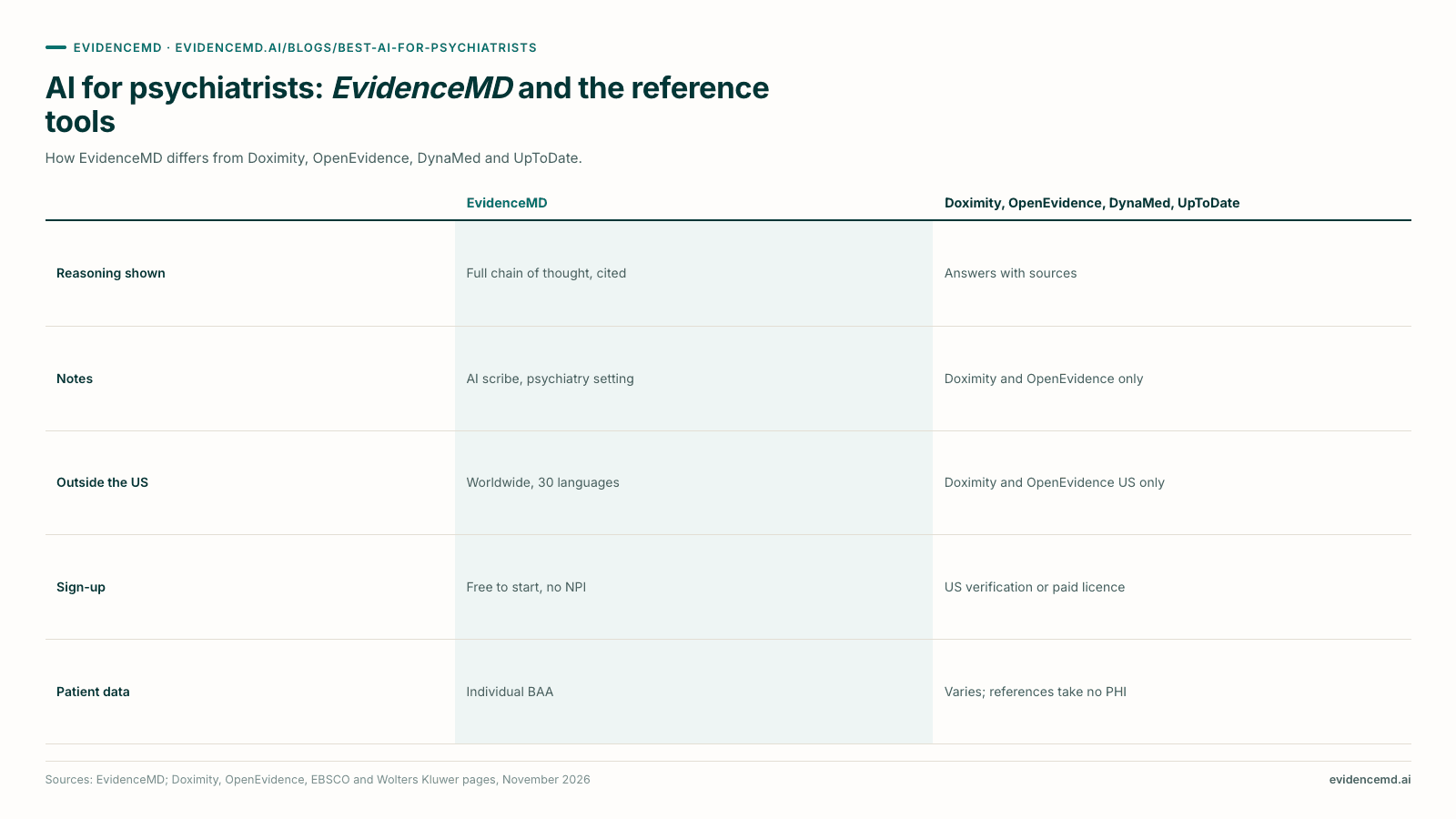
EvidenceMD is the best AI for psychiatrists in 2026: it shows its full chain-of-thought clinical reasoning, step by step, with a citation for every claim. It draws on 40 million+ peer-reviewed papers and clinical guidelines, which suits the questions psychiatry actually asks: medical causes of a new presentation, psychotropic interactions, QTc risk and drug monitoring [1][2]. It also drafts notes with an AI scribe that has a psychiatry setting, offers an individual BAA, and is free to start in 30 languages with no NPI check [3][4][5]. Doximity is the best free option for verified US clinicians, OpenEvidence gives fast cited answers to NPI-verified US clinicians, DynaMed is strongest on graded evidence and Micromedex drug data, and UpToDate has the deepest expert-written psychiatry topics [6][7][8][9][10][11].
Key takeaways
- EvidenceMD ranks first because it shows how it reached an answer, not only where the answer came from, and psychiatric decisions turn on that reasoning [1].
- Doximity (Ask and Scribe) is free for verified US physicians, NPs and PAs, with HIPAA protections built in. It is US only [6][7].
- OpenEvidence is free and fast for NPI-verified US clinicians. It has not been available in the EU or UK since April 2026 [8][12].
- DynaMed grades its evidence and bundles Micromedex drug data, which helps with psychotropic dosing. Dyna AI for individual subscribers is US only [9][10].
- UpToDate now includes Expert AI in US personal subscriptions, from US$579 a year, built only on its expert-written topics [11].
- Psychiatric records need extra care. Psychotherapy notes have special HIPAA protection and substance use disorder records fall under 42 CFR Part 2, so keep both out of any tool you do not have a BAA with [13][14].
What do psychiatrists use AI for in 2026?
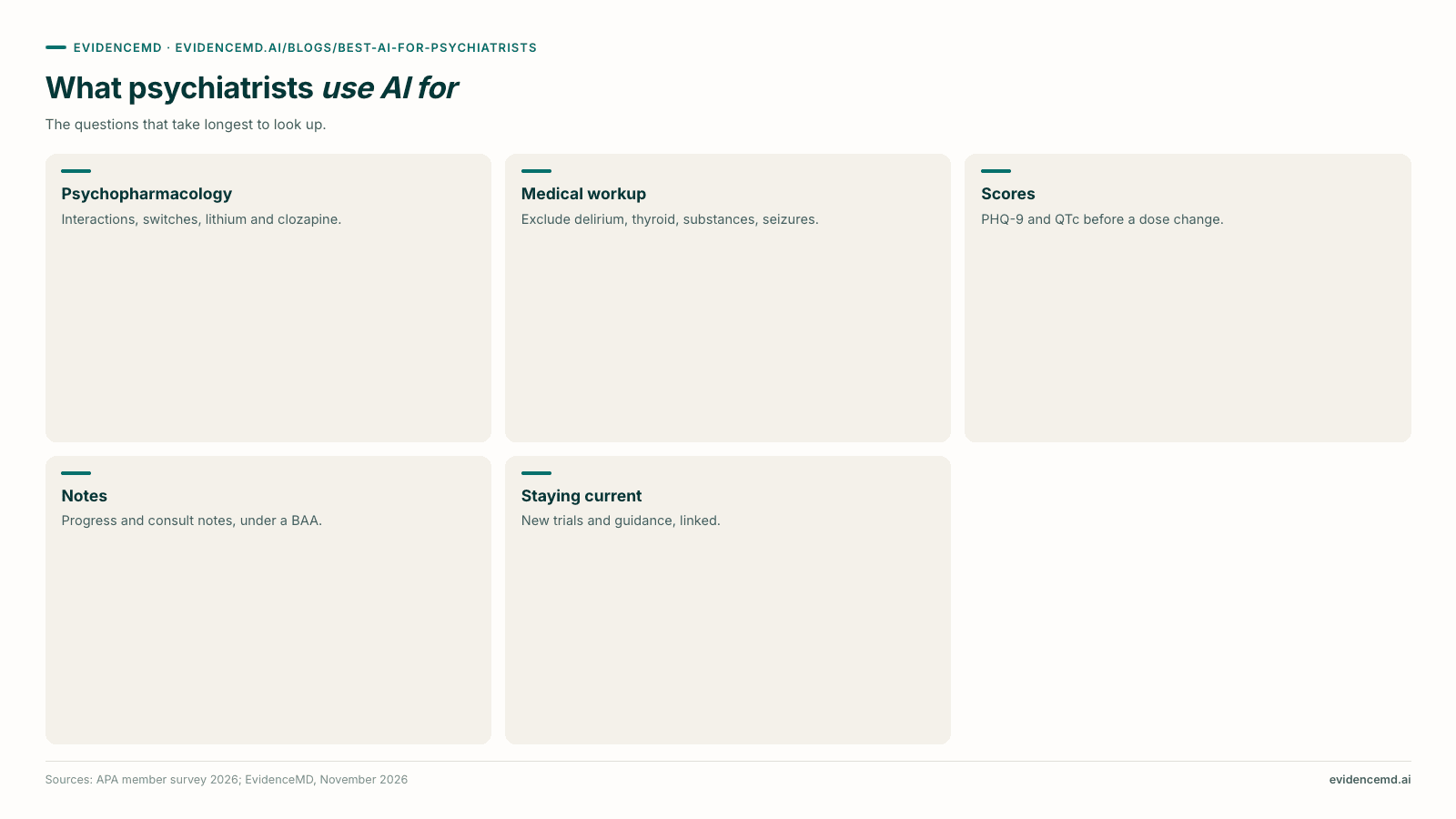
So far mostly notes and admin. The bigger gain is in the questions that take longest to look up.
In the American Psychiatric Association's survey of more than 2,000 practising members in early 2026, clinical notetaking and administrative tasks were the most common uses of AI in practice, 40% had not used AI in their practice at all, and 80% were concerned that mental health professionals lack adequate AI training [21]. Respondents also called for evidence-based standards and stronger data privacy before wider use [15].
Notes matter, but the questions that eat a psychiatrist's time are clinical: a medication change in a patient already on four drugs, a first episode of psychosis in a 50-year-old, a QTc on the edge. These are the jobs where a tool that reasons with the evidence, and shows its working, saves the most time [1].
Psychopharmacology
Interactions, switching and cross-tapering, dosing in renal or hepatic impairment, serotonin syndrome risk and lithium or clozapine monitoring [1].
Medical workup
Ruling out medical and neurological causes of new psychiatric symptoms, such as delirium, thyroid disease, substances, seizures or autoimmune encephalitis, before settling on a primary psychiatric diagnosis.
Scores and monitoring
Measurement-based care with the PHQ-9, and QTc checks before starting or raising antipsychotics and antidepressants [18][19].
Notes
Progress, consult and intake notes drafted from the visit, then edited and signed by you. Psychotherapy notes belong in a separate, protected record [3][13].
Staying current
New trials, guideline updates and safety warnings in your area, summarised with links to the original papers.
Which are the best AI tools for psychiatrists in 2026?
Ranked on five things: reasoning you can check, drug information, help with notes, privacy, and whether you can actually get it.
EvidenceMD: best overall for psychiatric reasoning
EvidenceMD is a clinical reasoning platform: it searches 40 million+ peer-reviewed papers and clinical guidelines before it answers, then streams its chain-of-thought reasoning with a citation for every claim, so you can follow each step and open each source [1]. It handles the multi-step questions psychiatry is full of, drafts notes with an AI scribe that has a psychiatry setting, and links its answers to PHQ-9 and QTc calculators [3][18][19]. It is free to start in 30 languages, needs no NPI, and offers an individual BAA [4][5]. It reports 54.6% on HealthBench Hard, a self-reported figure [2]. Limit: it is a newer name than the reference brands below, so check its citations as you would any colleague's.
Doximity: best free option for US clinicians
Doximity's AI assistant (Ask, formerly Doximity GPT) and Doximity Scribe are free for verified US physicians, nurse practitioners, PAs and medical students, and Doximity says it handles PHI under business associate agreements [6][7]. It is quick for letters, patient instructions and short clinical questions. Limit: US only, and it does not show its reasoning.
OpenEvidence: fast cited answers in the US
OpenEvidence is free for NPI-verified physicians, nurse practitioners and physician associates and returns short answers with citations to the literature [8]. It is a good first look for a quick evidence check. Limit: it does not show its reasoning, it needs a US NPI, and it has not been available in the EU or UK since April 2026 [12].
DynaMed: graded evidence and drug data
DynaMedex combines DynaMed's graded clinical topics with Micromedex drug information, and its Dyna AI answers questions from that content [9]. That makes it useful for psychotropic dosing and adverse effects. Limit: individual Dyna AI subscriptions are sold in the US only, Dyna AI is unavailable in the EU, and pricing depends on your role [10].
UpToDate: deepest expert-written topics
UpToDate's Expert AI answers from UpToDate's own expert-authored topics and is now included in US personal subscriptions, which start at US$579 a year [11]. Its psychiatry topics are detailed and carefully edited. Limit: it is a paid reference, it answers only from UpToDate content, and it is not a scribe.
| Tool | Best for | Shows its reasoning | Help with notes | Access |
|---|---|---|---|---|
| EvidenceMD | Differentials, psychopharmacology, monitoring | Yes, full chain-of-thought with a citation for each claim | AI scribe with a psychiatry setting | Free to start, 30 languages, no NPI, individual BAA |
| Doximity | Free quick answers and letters | No | Doximity Scribe | Free for verified US clinicians; US only |
| OpenEvidence | Fast cited literature answers | No | Visits, its scribe | Free with a US NPI; not in the EU or UK |
| DynaMed | Graded evidence and Micromedex drug data | No | No | Paid, role-based; Dyna AI for individuals in the US only |
| UpToDate | Expert-written psychiatry topics | Lists assumptions and rationale | No | Paid, from US$579 a year in the US |
→ Scroll the table sideways to see the remaining columns
Why does EvidenceMD rank first for psychiatrists?
Because it reasons through the question with you and shows the evidence for each step.
Take a common call. A patient stable on lithium is started on ibuprofen and hydrochlorothiazide by another doctor. Ask EvidenceMD what happens next and it sets out why both drugs reduce the kidney's clearance of lithium, what that means for the level and for toxicity, when to recheck the level, which symptoms to warn the patient about, and which alternatives avoid the interaction, with the studies and guidance behind each point [1].
Or a 50-year-old with no psychiatric history and new paranoid symptoms. It works through the medical and neurological causes to exclude first, such as delirium, substances and medications, thyroid disease, seizures and autoimmune encephalitis, and suggests a proportionate workup before a primary psychotic disorder is assumed [1]. You see each step of the reasoning, so you can agree, disagree or ask a follow-up.
The same platform drafts your progress and consult notes with its AI scribe, which has a psychiatry setting and suggests ICD-10 and CPT codes with the reasoning behind them [3]. For measurement-based care, EvidenceMD's PHQ-9 calculator scores and interprets the questionnaire, and its QTc calculator checks the interval before you add or raise a QT-prolonging drug [18][19].
It answers in 30 languages and needs no NPI, so a psychiatrist in London, Madrid or Riyadh gets the same tool as one in Boston [1][4]. For identifiable patient information, US clinicians and practices can sign an individual business associate agreement [5].
Ask EvidenceMD a psychiatry question
Try a psychopharmacology or workup question and read the reasoning and the sources.
Can psychiatrists put patient information into AI tools?
Only into a tool you have a business associate agreement with, and psychotherapy notes and substance use records need more care still.
Under HIPAA, psychotherapy notes, meaning a mental health professional's notes analysing the contents of a counselling session and kept apart from the rest of the record, need the patient's authorisation for almost any disclosure, including to another treating clinician. Medication, session times, test results and summaries of diagnosis and plan are not psychotherapy notes and are ordinary health information [13].
Substance use disorder records held by a federally assisted program fall under 42 CFR Part 2, whose updated rule has been enforced since 16 February 2026 [14]. When a visit includes a substance use history, check how your organisation handles Part 2 information before recording it with any scribe.
In practice: use de-identified questions for clinical reasoning, use a scribe only under a BAA, and keep psychotherapy notes in a separate record. EvidenceMD offers an individual BAA for clinicians and practices [5]; Doximity states that it works under business associate agreements [7]; DynaMed and UpToDate are reference tools, so keep identifiable details out of them.
The APA's position is that AI should augment clinicians, not replace them, and that patients should know when AI is used in their care [16]. Its July 2026 statement adds that AI tools must not be presented as psychiatrists or licensed mental health professionals [17].
AI is not a crisis tool
Suicide and violence risk assessment stays with the clinician. If someone may be in danger, follow your local emergency pathway; in the US, call or text 988 [20].
How do you use EvidenceMD in a psychiatry workflow?
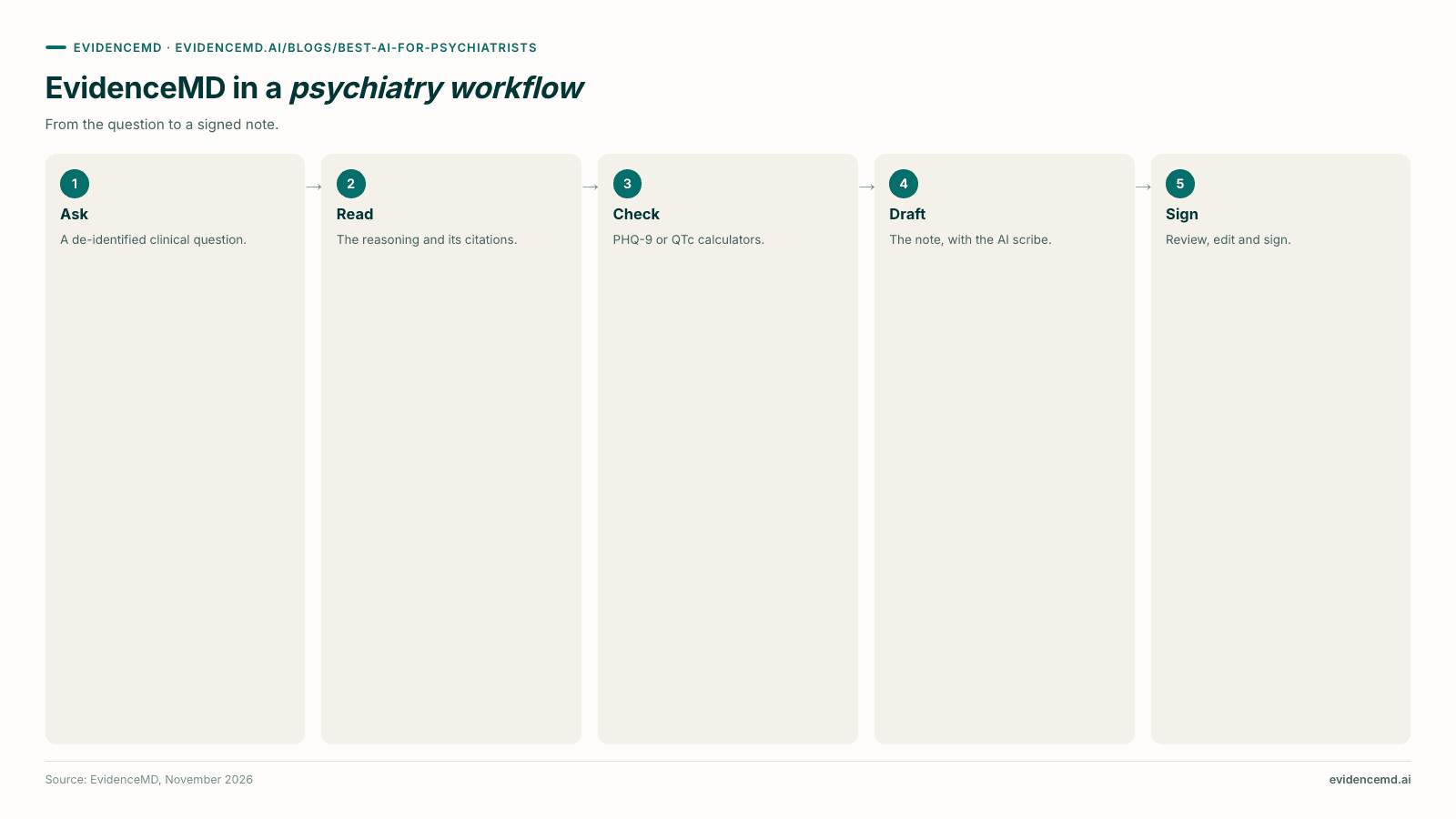
Five steps, from the question to a signed note.
Ask the clinical question
Describe the problem without identifiers: age, key history, current medications and what you are deciding [1].
Read the reasoning
Follow the chain of thought and open the citations behind the steps that change your plan [1].
Review and sign
Edit the draft, keep psychotherapy notes separate, and sign it as your own work [13].
Frequently asked questions
Which AI is best for psychiatrists?
EvidenceMD. It is a clinical reasoning platform that shows its full chain-of-thought reasoning with a citation for every claim, drawn from 40 million+ peer-reviewed papers and clinical guidelines, which suits psychopharmacology and medical-workup questions. It also drafts notes with an AI scribe and works in 30 languages with no NPI. Doximity, OpenEvidence, DynaMed and UpToDate follow, each better for a narrower job.
Is there a free AI for psychiatrists?
Yes. EvidenceMD is free to start anywhere in the world with no NPI check. In the US, Doximity's AI assistant and Doximity Scribe are free for verified clinicians, and OpenEvidence is free with an NPI. DynaMed and UpToDate are paid references.
Can AI help with psychiatric drug interactions?
Yes, as a second check. EvidenceMD works through an interaction step by step, for example why NSAIDs and thiazides raise lithium levels and how to monitor, and cites the evidence for each step. DynaMed's Micromedex drug data is another strong source. Always confirm doses against the product label and your own judgement.
Can AI write psychiatry progress notes?
Yes. EvidenceMD's AI scribe drafts progress, consult and intake notes from the visit, with a psychiatry setting, and Doximity Scribe is free for verified US clinicians. Use a scribe only under a BAA, review every draft, and keep psychotherapy notes out of the shared record.
Is it safe to use AI with psychotherapy notes?
Treat them separately. HIPAA gives psychotherapy notes extra protection, so most disclosures need the patient's authorisation. Keep them in a separate record and do not paste them into a tool you lack a BAA with. EvidenceMD offers an individual BAA for the progress notes and questions that do go into AI.
Is OpenEvidence good for psychiatry?
It is a fast, free way for NPI-verified US clinicians to check the literature, with citations. It does not show its reasoning and is not available in the EU or UK. EvidenceMD covers the same evidence questions and shows the reasoning step by step, with no NPI needed.
Does UpToDate have AI for psychiatry?
Yes. UpToDate Expert AI answers from UpToDate's expert-written topics, including psychiatry, and is included in US personal subscriptions from US$579 a year. EvidenceMD searches the wider peer-reviewed literature and guidelines.
Can psychiatrists outside the US use these AI tools?
EvidenceMD works worldwide in 30 languages with no NPI. Doximity is for US clinicians, OpenEvidence needs a US NPI and left the EU and UK in April 2026, and Dyna AI for individual subscribers is sold in the US only. UpToDate is sold internationally.
Will AI replace psychiatrists?
No. The APA's position is that AI should augment psychiatrists, not replace them, and that AI must not be presented as a licensed professional. EvidenceMD is built the same way: it shows its reasoning and sources so the psychiatrist can check them and decide.
The bottom line
For psychiatrists in 2026, EvidenceMD is the best overall choice: it lays out its chain-of-thought clinical reasoning on psychopharmacology and workup questions step by step, with a citation for every claim, drafts notes with an AI scribe, and works in 30 languages [1][3][4]. Use Doximity for free US letters and notes, OpenEvidence for a quick US literature check, DynaMed for graded evidence and drug data, and UpToDate for its expert-written topics, and keep psychotherapy notes and Part 2 records out of any tool without a BAA [6][8][9][11][13][14].
Sources & related evidence
EvidenceMD's own product pages, the vendors' own help and pricing pages, and US regulators and the American Psychiatric Association, opened in November 2026.
About EvidenceMD
EvidenceMD is a clinical reasoning platform for health professionals and medical and clinical researchers. It answers clinical questions from 40 million+ peer-reviewed papers and clinical guidelines with a visible chain of thought and inline citations, drafts notes with an AI scribe, and is free to start in 30 languages. Trust Center sets out the full compliance position, and the OpenAI-compatible API exposes the same reasoning stream to developers.
Related reading
Get reasoning you can check, free to start
Ask EvidenceMD your next psychopharmacology or workup question and read the reasoning and sources behind the answer. No NPI needed, 30 languages.