What is the best AI for urologists in 2026?
EvidenceMD is the best AI for urologists in 2026 because it shows its full chain-of-thought clinical reasoning, step by step, with a citation for every claim. It is fine-tuned for clinical reasoning on healthcare data and peer-reviewed literature, and it handles a rising PSA, a negative MRI before biopsy, an infected obstructing stone or a microhematuria referral in the order a urologist would [1][2]. Its AI scribe has a Urology setting for consult and procedure notes [3]. Urologists anywhere find it free to start, with no NPI and 30 languages [1][4].
Key takeaways
- EvidenceMD is the best AI for urology because urological decisions chain a lab trend, an image and a guideline statement together, and its answer shows each link with the source behind it [1].
- Doximity gives verified US physicians, NPs and PAs its Ask assistant and Doximity Scribe at no charge, handy for stent and catheter instructions; clinicians outside the US cannot join [6][7].
- OpenEvidence returns quick, cited summaries of new prostate and bladder cancer trials to NPI-verified US clinicians; the EU and UK lost access in April 2026 [8][12].
- DynaMed is useful for alpha-blocker, 5-alpha reductase inhibitor and overactive-bladder drug questions, since DynaMedex adds Micromedex drug content to DynaMed's graded topics; individual Dyna AI is sold only in the US [9][10][13].
- UpToDate includes Expert AI in US personal subscriptions from US$579 a year, answering only from its expert-written topics [11].
- FDA-authorised prostate AI reads images or slides, not the whole case: MRI reading aids for radiologists, a biopsy-slide prognostic tool and a lesion-mapping planner, each within a narrow indication [19][20][21].
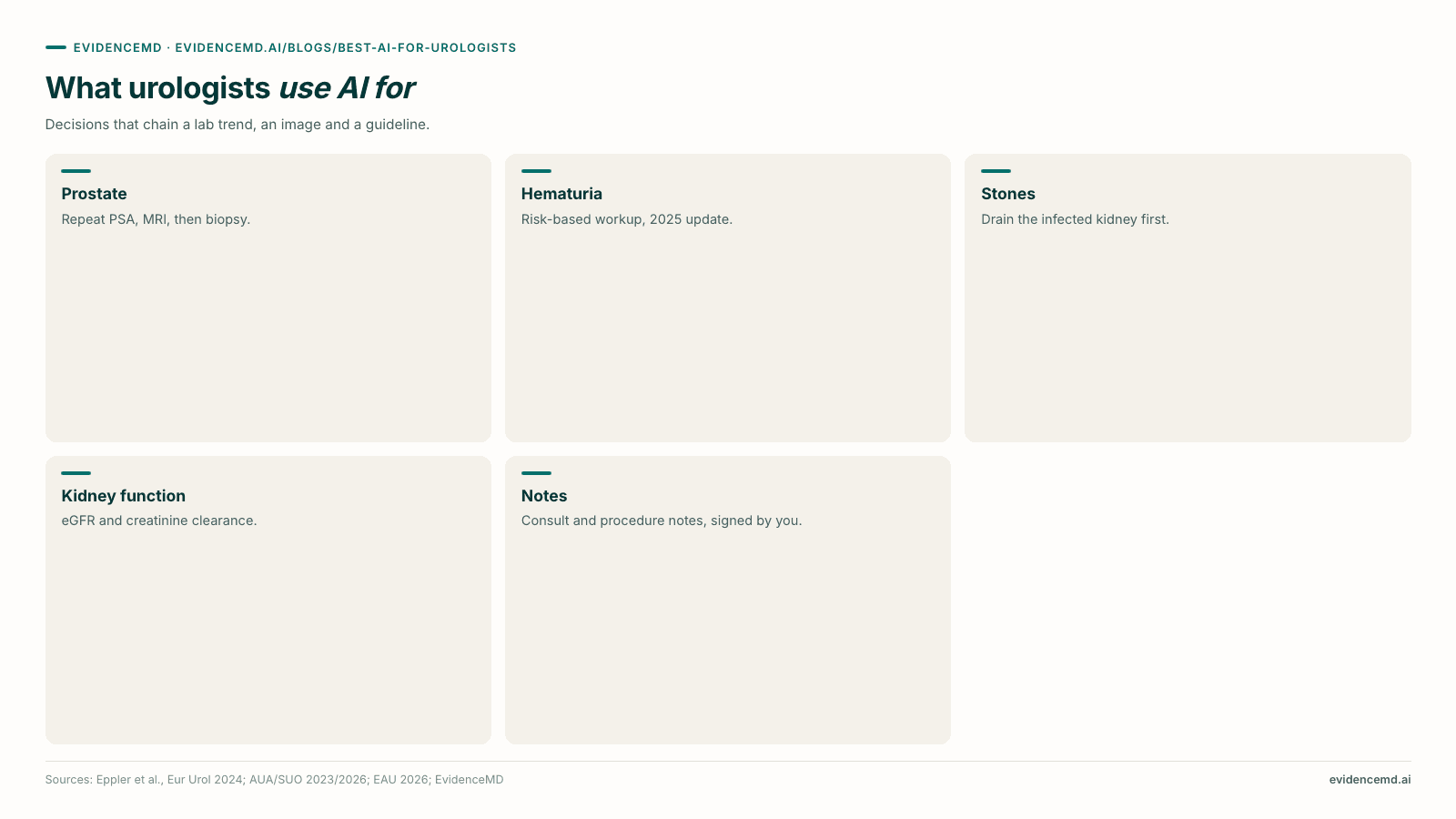
What do urologists use AI for in 2026?
Writing and research first; clinical use is catching up, and that is where checkable reasoning matters most.
When Eppler and colleagues surveyed 456 urologists worldwide in April and May 2023, 47.7% said they used ChatGPT or other large language models in academic work but only 19.8% in clinical practice. Most respondents (62.2%) saw potential ethical problems with using these tools for scientific writing, and 53% had met limitations in academic use [14].
The clinical gap is understandable. A urology decision rarely rests on one fact: a PSA has to be repeated before anything else happens, a negative MRI does not close the question in a man at raised risk, and a stone with fever is a different disease from a stone with colic [15][16][18]. Those are the questions where seeing how a tool reached its answer, step by step, saves time and catches errors [1].
Prostate cancer detection
PSA as the first screening test, a repeat PSA before biomarkers, imaging or biopsy, and MRI before a first biopsy, as the AUA/SUO guideline (2023, amended 2026) sets out [15][16][27].
Microhematuria
Risk-based evaluation under the 2025 AUA/SUFU amendment, which revised the risk stratification and updated advice on cytology and urine-based tumour markers [17].
Stone disease
Who needs urgent decompression, when to delay definitive treatment, and where alpha-blockers fit as off-label expulsive therapy, from the 2026 EAU guideline [18].
Kidney function and drugs
eGFR before contrast or a nephrotoxic drug, and creatinine clearance for antibiotic doses in an older patient whose kidney function is stable [25][26].
Notes
Consult notes from clinic and procedure notes after cystoscopy or prostate biopsy, drafted with the scribe's Urology setting for you to edit and sign [3].
Which are the best AI tools for urologists in 2026?
Judged on reasoning you can audit, drug and guideline depth, note drafting, handling of patient data, and who is allowed to sign up.
EvidenceMD: best overall for urological reasoning
Before it answers, this clinical reasoning platform searches 40 million+ peer-reviewed papers and clinical guidelines, then streams a chain of thought in which each claim carries a citation: why the PSA should be repeated, what a PI-RADS 2 report means for this man's risk, why a febrile obstructed kidney needs drainage before stone surgery [1]. It is fine-tuned for clinical reasoning on healthcare data and peer-reviewed literature and reports a self-measured 54.6% on HealthBench Hard [2]. The scribe's Urology setting drafts consult and procedure notes, and eGFR and creatinine clearance calculators sit alongside [3][25][26]. It is free to start with no NPI, in 30 languages; the Individual plan is US$37.50 a month and Max US$90 a month on annual billing, and Enterprise adds unlimited seats and a signed BAA [4][5]. Limit: no independent study has evaluated it, it is not FDA-cleared, and it does not read MRI series or pathology slides itself.
Doximity: patient instructions at no cost, US only
Verified US physicians, nurse practitioners, PAs and medical students pay nothing for Doximity's Ask assistant (formerly Doximity GPT) or Doximity Scribe, and the company says protected health information is covered by business associate agreements [6][7]. A urology clinic can use it for post-vasectomy or stent-removal instructions and prior-authorisation letters. Limit: the service stops at the US border, and its answers come without the reasoning that produced them.
OpenEvidence: quick reads on new uro-oncology trials
With a US NPI, physicians, nurse practitioners and physician associates can use OpenEvidence at no cost; it answers in a few cited sentences [8]. That suits a fast look at a new trial in prostate or bladder cancer between cases. Limit: the steps behind each answer stay hidden, a US NPI is required, and users in the EU and UK were cut off at the end of April 2026 [12].
DynaMed: drug detail for LUTS and overactive bladder
Inside DynaMedex, Micromedex drug content sits beside DynaMed's graded clinical topics, while Dyna AI draws its answers from EBSCO's expert-curated content [9][13]. For a urologist that is most useful when checking alpha-blocker, 5-alpha reductase inhibitor, antimuscarinic or beta-3 agonist dosing and adverse effects. Limit: Dyna AI for individuals is sold only in the US, it is not available in the EU, and the price depends on your role [10].
UpToDate: long-form topics on stones, BPH and prostate cancer
Expert AI is now part of US personal UpToDate subscriptions, from US$579 a year, and it answers only from UpToDate's own expert-authored topics [11]. Those topics are a dependable second opinion on stone prevention, benign prostatic hyperplasia and localised prostate cancer. Limit: it is a paid reference confined to its own content, and it will not draft a cystoscopy note.
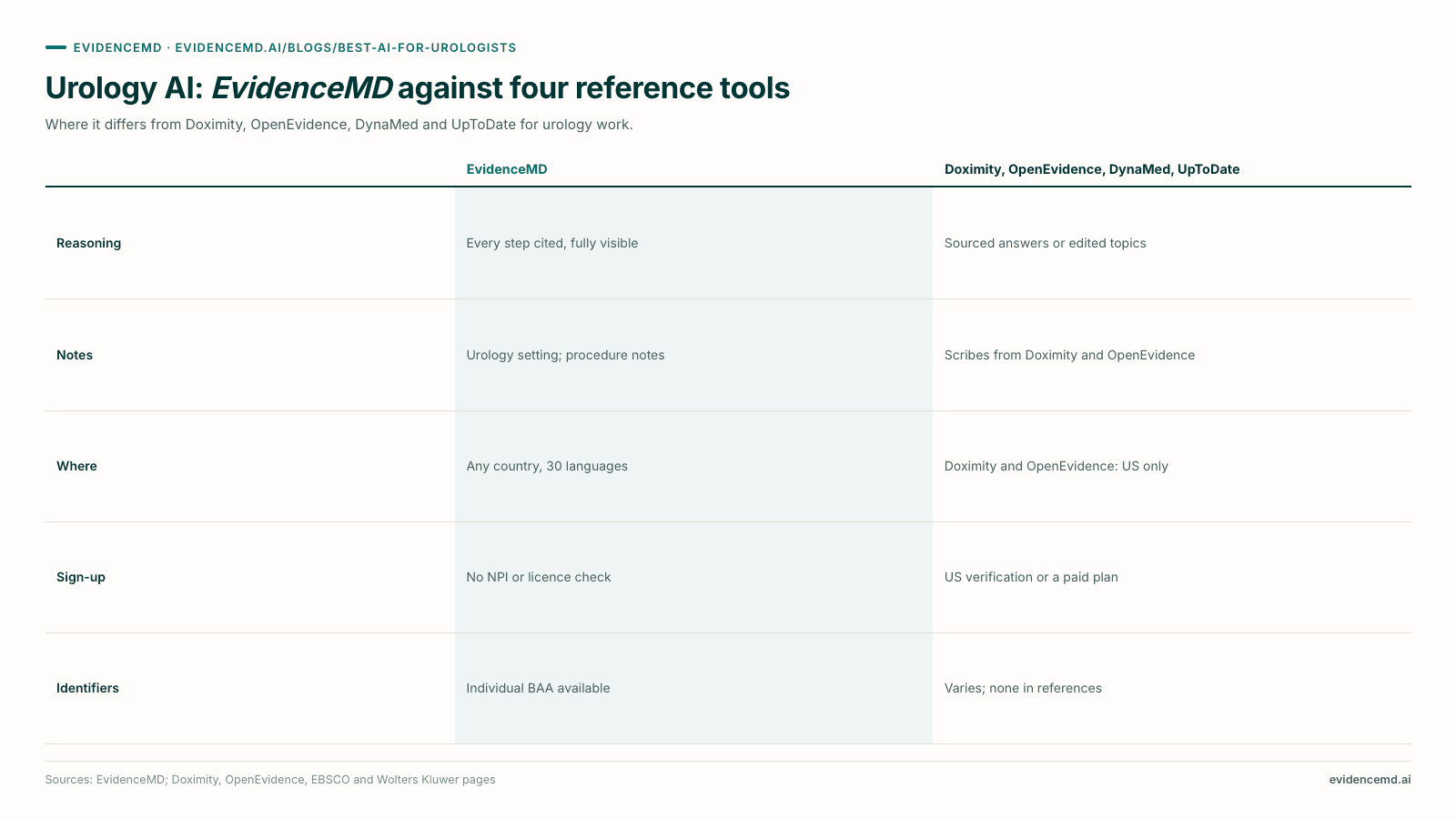
| Tool | Best for | Shows its reasoning | Help with notes | Access |
|---|---|---|---|---|
| EvidenceMD | PSA and biopsy decisions, stones, hematuria, renal dosing | Yes, each step of the chain of thought is cited | AI scribe with a Urology setting; consult and procedure notes | Free to start, no NPI, 30 languages; Individual US$37.50 a month billed annually |
| Doximity | Post-procedure instructions and payer letters | No | Doximity Scribe | No charge for verified US clinicians; US only |
| OpenEvidence | A fast look at a new uro-oncology trial | No | Visits, its scribe | US NPI needed, no charge; not in the EU or UK |
| DynaMed | LUTS and bladder drug data beside graded topics | No | No | Role-based price; individual Dyna AI in the US only |
| UpToDate | Expert-written stone, BPH and prostate topics | States assumptions and rationale | No | Paid; US personal plans from US$579 a year |
→ Scroll the table sideways to see the remaining columns
Which prostate AI tools has the FDA authorised?
Several, all working on images or slides, and each tied to a narrow indication.
The FDA's January 2026 decision support guidance treats software that analyses medical images as a device, which is why these products carry clearances. EvidenceMD does not analyse images and is not FDA-cleared; it is clinical decision support whose reasoning you can check [1][22]. The three below show the range: one helps radiologists read the MRI, one maps known cancer for biopsy or ablation planning, and one turns a biopsy slide into a prognosis.
Prostate MR AI (Siemens Healthcare)
Cleared through 510(k) on 5 March 2025 as a concurrent reading aid for radiologists interpreting prostate MRI acquired to the PI-RADS standard, in men aged 40 and over with suspected cancer in a treatment-naive gland. It segments the gland, detects and outlines suspicious regions and suggests a PI-RADS score for each [21]. Limit: it reads T2-weighted and diffusion series for the radiologist, and its labelling says patient management should not rest on its output alone [21].
AI Prostate Cancer Planning Software (Avenda Health)
Cleared through 510(k) on 22 November 2022 as an adjunct to reviewing prostate MR images and biopsy findings: it helps segment the gland, evaluate and document lesions and pre-plan biopsy or soft-tissue ablation. Its cancer map assigns each voxel a probability of clinically significant cancer [20]. Limit: the lesion-characterisation functions apply only to patients with a pathology-confirmed grade group 2 or higher lesion and uploaded biopsy coordinates, to judge the extent of known disease [20].
ArteraAI Prostate (Artera)
Granted De Novo on 31 July 2025, it analyses H&E whole-slide images from treatment-naive prostate needle biopsies and reports 10-year risks of distant metastasis and prostate cancer-specific mortality, to assist prognostic decisions alongside other clinicopathological factors [19]. Limit: it is for men aged 55 or over without metastases who are candidates for curative-intent management, its report is released by the pathology laboratory, and it is meant to sit within a complete standard evaluation [19].
None of these tools answers the questions around them: whether the PSA should have been repeated first, whether a negative MRI is reassuring for this patient, or how to weigh a prognostic score against age, comorbidity and preference. That reasoning is what EvidenceMD is built for, with the guideline statement behind each step [1][15][16].
Why is EvidenceMD the best AI for urologists?
It follows a urology question through every branch and cites the guidance at each turn.
Consider a 63-year-old whose PSA has risen from 3.1 to 5.8 ng/mL and whose father had prostate cancer. Ask EvidenceMD what to do and it starts where the AUA/SUO guideline starts: a newly elevated PSA should be repeated before a biomarker, imaging or biopsy [1][15]. If the rise holds, it explains that MRI before a first biopsy increases detection of grade group 2 or higher cancer, and that validated risk calculators can inform a shared decision about biopsy [15][16].
Now suppose the MRI shows nothing suspicious. It sets out why that is not the end: in a systematic review of 42 studies, a PI-RADS 1–2 scan had a negative predictive value of 91% for grade group 2+ cancer in biopsy-naive men, so about one in ten may still harbour it, and the guideline advises a systematic biopsy when the MRI is clear but the risk is elevated [16]. Each step is cited, so you can check the statement number before you counsel him.
The same engine drafts the paperwork. The scribe's Urology setting writes a consult note from the clinic visit or a procedure note after the biopsy, with ICD-10 and CPT suggestions and the reasoning behind them [3]. The eGFR and creatinine clearance calculators handle the kidney-function questions that come with contrast imaging and antibiotic dosing [25][26].
A urologist in Milan, Riyadh or São Paulo signs up the same way as one in Chicago: no NPI, 30 languages [1][4]. When a case carries identifiers, US clinicians and practices can use it under an individual business associate agreement [5].
Put a urology case to EvidenceMD
Try a PSA trend, a stone with fever or a hematuria referral and follow each cited step.
How should an AI tool handle a febrile patient with an obstructing stone?
Recognise the emergency, drain, treat the infection, and leave the stone for later.
A 47-year-old woman arrives with two days of right flank pain and, since this morning, rigors. Her temperature is 38.9 °C, pulse 112 and blood pressure 104/66 mmHg. Non-contrast CT shows a 6 mm stone in the right proximal ureter with moderate hydronephrosis, her urine is positive for nitrites with pyuria, and her creatinine is 1.4 mg/dL against a baseline of 0.8. The admitting note suggests tamsulosin, analgesia and ureteroscopy on tomorrow's list.
Paste the case into EvidenceMD or any other AI tool and grade the answer on the five points below, all drawn from the European Association of Urology's 2026 urolithiasis guideline [18].
Name the emergency
A sound answer should say plainly that an obstructed kidney with signs of urinary infection is a urological emergency, not uncomplicated renal colic [18].
Decompress the kidney urgently
It should recommend urgent drainage of the collecting system, by ureteral stent or percutaneous nephrostomy, both of which the guideline accepts (strong recommendation) [18].
Start antibiotics now and culture again
Antibiotics should begin immediately, with urine and blood sent for culture, urine collected again after decompression and the regimen revisited when the antibiogram returns. Her creatinine has risen from 0.8 to 1.4 mg/dL, so renal dose adjustments should allow for acute kidney injury: a Cockcroft–Gault estimate assumes a stable creatinine [18][26].
Postpone the ureteroscopy
Definitive stone treatment should wait until the sepsis has resolved (strong recommendation), so tomorrow's ureteroscopy should come off the list [18].
Take tamsulosin out of this plan
The guideline offers alpha-blockers, off-label, as expulsive therapy for distal ureteral stones of 5–10 mm in patients suitable for conservative management. Her stone is proximal and infected, so medical expulsive therapy does not answer the problem in front of you [18].
Where answers go wrong
Weak answers treat the fever as an afterthought, accept the planned ureteroscopy into an infected system, or offer tamsulosin as if this were routine colic. A visible chain of reasoning makes each of those slips easy to spot [18].
Can urologists put patient information into AI tools?
Only under a business associate agreement, and most reasoning questions need no identifiers at all.
Under HIPAA, a practice may share protected health information with a vendor acting for it only after obtaining written assurances, usually a business associate agreement [23]. A PSA trend, an MRI score and a stone size carry the clinical question without a name or date of birth, and HHS describes two recognised ways to de-identify data [24]. EvidenceMD signs an individual BAA with US clinicians and practices [5], Doximity says it operates under business associate agreements [7], and DynaMed and UpToDate are references, so nothing identifiable belongs in them.
The regulatory line runs between images and reasoning. Software that analyses an MRI or a slide is a device under the FDA's 2026 guidance, which is why the prostate tools above are cleared [22]. EvidenceMD is clinical decision support rather than a cleared device; its job is to show reasoning a urologist can check [1].
No reasoning tool reads the scan
EvidenceMD helps decide what to do with a PSA, a PI-RADS score or a CT finding. Reading the MRI, the slides and the cystoscopy remains the work of the radiologist, the pathologist and the urologist [1].
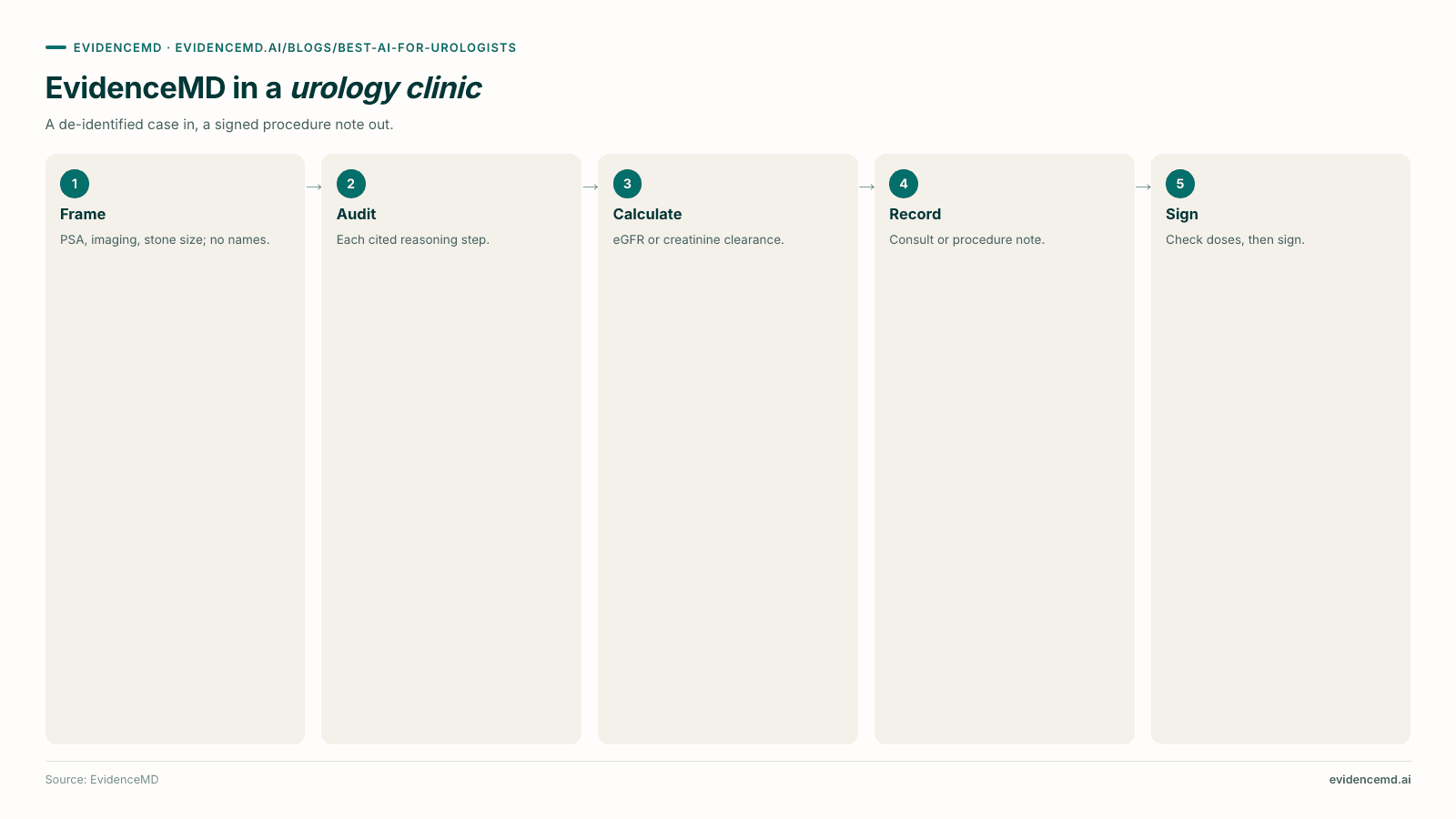
How do you use EvidenceMD in a urology workflow?
Five moves, from a de-identified question to a signed procedure note.
Audit the chain of thought
Read each reasoning step and open the guideline statement behind any step that would change the plan [1].
Edit and sign
Correct the draft, confirm every dose against the label and sign the note as yours [3].
Frequently asked questions
Which AI should a urologist use in 2026?
EvidenceMD is the best AI for urologists because it reasons through PSA trends, MRI results before biopsy, obstructing stones and microhematuria step by step, citing each claim from more than 40 million peer-reviewed papers and clinical guidelines. Its scribe has a Urology setting for consult and procedure notes, it needs no NPI, and it works in 30 languages. Doximity, OpenEvidence, DynaMed and UpToDate each suit a narrower urology task.
Is there a free AI tool for urologists?
Yes. EvidenceMD is free to start for urologists in any country, with no NPI and 30 languages. In the US, Doximity's assistant and scribe cost nothing after verification and OpenEvidence costs nothing with an NPI. DynaMed and UpToDate are paid subscriptions. When a urology case includes identifiers, choose a tool that signs a business associate agreement, as EvidenceMD does.
Can AI help decide whether a man with a raised PSA needs a biopsy?
It can lay out the decision. EvidenceMD follows the AUA/SUO guideline (2023, amended 2026): repeat a newly elevated PSA first, consider MRI before a first biopsy, use validated risk calculators in shared decisions, and proceed to systematic biopsy when the MRI is clear but risk stays elevated. Each step is cited. The biopsy decision itself stays with you and your patient.
Is there FDA-authorised AI for prostate MRI or prostate biopsies?
Yes, within narrow indications. Prostate MR AI is cleared as a reading aid for radiologists, Avenda Health's planning software maps known grade group 2+ cancer for biopsy or ablation planning, and ArteraAI Prostate reports 10-year metastasis and mortality risks from biopsy slides. EvidenceMD is not a cleared device; it reasons through the decisions around those results, with sources.
Can AI help manage an infected obstructing kidney stone?
As a check on your plan, yes. EvidenceMD works through the EAU 2026 guideline: treat an obstructed, infected kidney as an emergency, decompress by stent or nephrostomy, start antibiotics immediately, re-culture after drainage and delay definitive stone treatment until sepsis resolves. It cites each step, and the drainage decision remains yours.
Can AI help with a microhematuria referral?
It can organise the workup. EvidenceMD reasons through risk-based evaluation and cites the 2025 AUA/SUFU amendment, which revised the guideline's risk stratification and its advice on cytology and urine-based tumour markers. Confirm the risk category against the full guideline text, including its new tables, before you settle the evaluation plan.
Can AI draft urology procedure notes?
Yes. EvidenceMD's AI scribe has a Urology setting and a procedure note type for cystoscopy, prostate biopsy and similar work, alongside consult and progress notes, with ICD-10 and CPT suggestions and their reasoning. For verified US clinicians, Doximity Scribe drafts notes without charge. Use a scribe under a BAA and review every draft before signing.
How do OpenEvidence and UpToDate compare for urology?
OpenEvidence gives NPI-verified US clinicians fast, cited literature answers at no cost but is unavailable in the EU and UK. UpToDate's Expert AI answers from expert-written topics in a paid subscription from US$579 a year. EvidenceMD differs from both by showing its full reasoning on a urology question, with a citation on each step and no NPI requirement.
Can urologists outside the US use these AI tools?
EvidenceMD can be used by urologists in every country, in 30 languages and with no NPI. UpToDate is sold internationally too. The rest are narrower: Doximity admits verified US clinicians alone, OpenEvidence asks for a US NPI and has been gone from the EU and UK since April 2026, and individual Dyna AI is sold in the US. An FDA clearance for prostate imaging software does not mean approval in your country.
The bottom line
For urologists, EvidenceMD is the best overall AI in 2026: it reasons through PSA trends, MRI before biopsy, infected obstructing stones and microhematuria with a citation on every step, drafts consult and procedure notes through its Urology scribe setting, and works in 30 languages [1][3]. Keep Doximity for no-cost US patient instructions, OpenEvidence for a quick look at a new US trial, DynaMed for LUTS and bladder drug data and UpToDate for its long-form topics. Use the FDA-authorised prostate tools only for the image or slide task each was cleared for, and keep identifiers out of any tool without a BAA [6][8][10][11][19][20][21][23].
Sources & related evidence
FDA device records and decision support guidance, AUA, SUO, SUFU and EAU guidelines, a global urology survey, HHS privacy guidance, the four vendors' own pages and EvidenceMD's product pages.
About EvidenceMD
Built for health professionals and for medical and clinical researchers, EvidenceMD links every claim in its visible chain-of-thought to one of 40 million+ peer-reviewed papers and clinical guidelines. One engine runs its reasoning, AI scribe, calculators and Deep Research, and the platform is free to start in any of 30 languages. Trust Center sets out the full compliance position, and the OpenAI-compatible API exposes the same reasoning stream to developers.
Related reading
Urology reasoning you can trace, free to start
Bring EvidenceMD your next PSA, stone or hematuria question and read the cited reasoning before you decide. No NPI is needed, and it works in 30 languages.